


赵振斌 , 褚玉杰, 郝亭, 张铖
陕西师范大学旅游与环境学院,西安 710062
ZHAO Zhenbin, CHU Yujie, HAO Ting, ZHANG Cheng
收稿日期: 2015-02-3
修回日期: 2015-06-5
网络出版日期: 2015-10-20
版权声明: 2015 《地理学报》编辑部 本文是开放获取期刊文献,在以下情况下可以自由使用:学术研究、学术交流、科研教学等,但不允许用于商业目的.
基金资助:
作者简介:
作者简介:赵振斌(1965-), 男, 陕西洛南人, 教授, 博士生导师, 中国地理学会会员(S110007658M), 主要研究方向为人文地理和社区旅游。E-mail: zhaoxhe@163.com
展开
摘要
在中国快速城镇化的背景下,对乡村意义空间的认识能够帮助理解社区居民与居住环境之间复杂的心理联系,为缓解搬迁改造过程中非经济因素引起的社会矛盾提供思路。本研究利用半结构访谈、参与式制图方法,对汉长安城遗址申遗搬迁的9个村落社区的251位居民进行调查。通过对访谈结果的质性分析,获得地方特征类目12种,地方意义类目7大类,34小类。在此基础上,对地方特征和意义间的关联进行了交叉分析,并采用GIS可视化和空间分析工具,揭示了居民感知的空间格局。结果显示:村子、文化遗址、房屋和人构成了地方特征的主体,而地方适应、个人情感、历史文化联系和个人价值与成就成为地方的主要意义。地方特征作为意义的承载体,对意义的承载既有集合性特点,也表现出了明显的选择性。众多地方特征承载的意义共同形成意义体系,定义了当地的地方性,使此地区别于其他地方。另外,村民的地方感知具有空间结构,村落和遗址周围为感知热点区域,这些区域承载居民内心的重要的地方意义。情感联系、地方适应和个人认同可用于解释意义空间的对于居民的重要性。本研究延伸的措施建议是,以某种形式将典型的地方特征保留下来,有助于搬迁的社区居民故土情结的保留。
关键词:
Abstract
In the period of rapid urbanization of China at present, studies on the meaning space structure in rural villages will be helpful for understanding the complicated psychological bond between community members and residential settings, and conducive to mitigate social frictions and conflicts caused by non-economic factors in the village demolition and relocation process. In this research, data were collected by semi-structured interview and participatory mapping techniques, and 251 residents from 9 villages were investigated. Those villages would be removed and relocated for the registration of Han Chang'an City Historical Site as a UNESCO World Culture Heritage. Through qualitative analysis of the interviews, 12 place feature categories, 7 place meaning categories and 34 place meaning sub-categories were identified. Based on the above attribute analysis, cross-tabulation analysis was used to examine the association between place features and meanings, and GIS tool was used to reveal and visualize the residents' place perception spatial configuration. The findings show that village, culture relics, house and people are among the significant place features, and person-place fit, personal feelings, historical-cultural connection, values and accomplishments are the important meaning categories. As the carriers, place features symbolize place meanings in both collective and selective ways. Place features form a system together with associated meanings, by which the place is defined and distinguished from other places. In addition, there exists a spatial pattern of residents' perceptions, which is characterized by the perception hotspot areas around the villages and relics, carrying important place meanings of local people in the study area. Feeling connection, place fit and personal identity make sense for the explanation to the revealed meaning space structure. The extending suggestion of this study is that the preservation of typical place features for local people in some forms will be helpful for the removal communities preserving homeland attachment.
Keywords:
随着中国城镇化的加速发展,城市周边乡村聚落的拆迁成为凸显出来的社会现象,由此导致的利益冲突也成为了一个重大的社会问题。从乡村社区的角度来考虑,社区居民在拆迁过程中的诉求源自于其付出的成本。拆迁的成本可分为两个方面,一方面是经济成本,即社区居民迁移他处导致的物质层面的损失;另一方面为非经济成本,则主要指由于拆迁导致的居民与居住环境心理联系的隔断及其影响[1]。非经济成本往往难以显化和量化,但会强化居民的补偿心理,并构成冲突形成的重要因素[2-3]。传统上,学界对城镇化过程中拆迁现象的研究多集中于原因和制度层面,社区居民被简单当成物质利益的追求者,而对于乡村社区复杂环境心理因素的研究相对薄弱,这一定程度上制约了对拆迁社区及其现象的深入理解[4-5]。在中国政府提出的新型城镇化理念当中,“人”的城镇化成为区别于以往城镇化政策的特征和重点。人的城镇化既需要关注人的物质诉求,更应该关注人的心理活动,将人的幸福感放在首位。因此,对于乡村拆迁社区居民环境心理层面的研究是破解社会问题,实现新型城镇化面临的新课题。
地理学研究人的恋地情结(Topophilia)[6],并形成地方感(sense of place)理论[7],可以为认识社区居民与环境的复杂心理联系提供途径。按照地方感相关理论,人通过活动和体验对环境空间赋予一定的意义,使其变为地方,反过来又依附于这种意义空间(地方)[8]。对地方的感知影响到人的态度、行为、身份认同乃至生活质量[8-9]。地方意义是人针对环境的认知和评价,它反映环境对人的价值和重要性,经常被赋予具体或抽象的地方特征(place feature)之上[10]。地方意义是理解其他地方感概念,如地方依恋、地方认同的基础。
目前,学术界对地方感的研究主要包括地方依恋和地方意义两个方面,所涉及的研究方法和关注点有所不同:前者主要基于心理学量表进行,注重量化分析,揭示特定人群地方依恋的程度;后者采用质性分析手段,寻找地方意义构成和地方感产生的现象学基础。20世纪80年代以来,Williams等提出地方依恋(place attachment)的概念[11],并设计了普适性强的度量方法,相关研究不断出现。Bogac研究了塞浦路斯人难民对故土的地方依恋及人群差异,发现移民后代的地方依恋特征既有继承性,又有变化性[12]。Mazumdar等研究了不同类型宗教场所的地方依恋,认为宗教场所、建筑、符号、故事、人物是地方意义形成的要素,教育、朝觐和宗教活动是地方依恋传承的途径[13]。Gross、Kyle等认为游客由于关注游憩地并经历旅游活动而对游憩地产生依恋,这种依恋状态受到活动涉入程度(involvement)、活动类型的影响(划船、垂钓等)[14-15]。Brown等学者研究了地方依恋对于人的行为及犯罪、心理健康的影响,认为地方依恋是重要的优质社区及邻里建设因素[16]。地方依恋研究揭示了人与地理环境的某种心理联系(human-place bond)的程度,注重这种联系的整体评价,但没有能够揭示地方的具体意义构成,因此,不利于对地方依恋现象的深入理解。
地方意义(place meaning)的研究采用质性分析的方法了解地方构成,有利于对地方感细致结构的理解。Hull通过美国1989年Hugo飓风灾害后受灾城市Charleston的调查,揭示了城市社区的地方意义构成,归纳出6大类和40小类意义类目,涉及功能意义和情感意义等方面[10]。Smaldone则利用质性分析方法和Nvivo软件研究了Grand Teton国家公园游客的地方意义构成,归纳出了14种地方意义[17];Ryan等用照片引导方法发现自然环境、家庭朋友、社区事件、个人财产是农村社区主要的地方意义构成[18]。Manzo对美国纽约市40位居民进行深度访谈,采用扎根理论的方法归纳地方意义,区分出居民感知的正面意义如舒适、安全,负面意义如人身与财产损失。居民对地方的情感也分为正面,如爱,负面,如恐惧与憎恨。一种模糊的情感被认为是第三种情感类型(feeling ambivalent)[19]。上述研究都是基于人的主体性对地方意义进行的研究,归纳出的地方意义基本上可以归纳为两大类,即功能性意义和情感与心理意义。地方意义的研究可以弥补地方依恋研究的不足,但现有的地方意义研究主要集中于意义类型构成等属性特征的认识上,没有能够揭示意义空间结构特征,这是目前研究的不足之处。
近年来,中国学者开始关注地方感的研究,涉及不同人群地方感的形成、影响及其变化。研究内容包括旅游者地方感的构成与特征[20],城市外来务工人员的地方感形成[21],社区居民地方感对开发支持态度的影响[22],城市化对乡村社会居民地方感的影响[23],社区空间变化与居民地方感的变迁[24]等。国内学者结合典型案例,进行了地方性理论和方法的深入探索。周尚意教授分析了北京和上海两个艺术区的地方性特征,从人文主义和结构主义两方面寻找地方性营建的机制及其相互联系,对地方性形成从理论上进行了更为全面的认识[25];朱竑教授关于居民消费空间感知的研究倡导采用质性方法揭示居民日常空间感知,为地方感的研究开辟了新的方向[26]。但总体而言,关于地方意义及其空间结构的研究还没有引起重视,有待探索,地方感的研究还没有涉及到乡村拆迁社区居民的环境心理方面,其实践价值有待进一步提升。本研究利用人文主义地理学的地方感理论,采用质性分析与GIS分析方法,揭示城市周边拆迁社区的地方意义构成及其空间格局特征,以期丰富地方意义研究的内容,同时为认识社区居民环境心理和乡村社区拆迁冲突机制提供新的视角和方法。
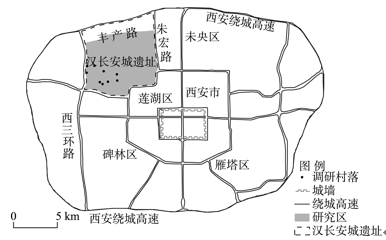
汉长安城遗址位于西安城区西北部,总面积65 km2,其中城垣内面积约34.39 km2(图1)。遗址包括城垣、城门、宫殿、园囿、市场等众多地面或地下遗迹,是中国迄今规模最大、保存最为完整、遗迹最为丰富的都城遗址,于1961年被国务院列为第一批重点文物保护单位。2012年3月,国家文物局将汉长安城未央宫遗址为首的7处陕西省历史遗迹纳入跨国联合申报“丝绸之路”世界文化遗产项目,并于2014年6月25日通过第38届世界遗产大会批准,顺利列入世界文化遗产名录。由于申遗的需要,遗址区域村落于2012年10月底开始拆迁,第一阶段拆迁范围为未央宫遗址公园周边的9个行政村。
汉长安城遗址区域历史悠久,自古就有人居住。拆迁工作开始前其城垣区域内分布着55个行政村,57600余人(2013年统计资料)。建国以来,由于保护需要而限制开发,遗址区基础设施落后,与外围西安城区快速发展形成鲜明对比。遗址区乡村特征明显,农家乐休闲、房屋租赁、土地出租、经营零售与餐饮业、农业种植成为当地主要经济来源。目前,区内已开辟未央宫遗址公园、汉城湖遗址公园供当地和周边居民休闲观光。当地居民多世代衍息于此,自称为“汉城人”,并将自己当做遗址的守护者。刘姓村民祭祀汉刘先祖,每过数年于未央宫遗址举行刘氏宗亲会,追根溯源。当地人对其长期生活的地方有着特殊的认识,对悠久的历史文化有认同感。本研究的调查范围是申遗工作先期拆迁的周河湾村、天禄村、卢家口村、西马寨村、东南马寨村、大刘寨村、东张村、东叶寨村、西叶寨村共9个行政村,分布于遗址城垣区的西南部(图1)。
由于上述9个村子于2012年10月底开始拆迁,所以本研究野外调研于2012年10月1日至11月15日进行。调研以入户访谈为基本方式,受访人为先期拆迁的9个村当地居民和外来常住居民。调查采用复合抽样设计选择访谈对象。首先按照村落规模的大小,分别分配给9个村庄30至40个抽样指标,然后采用立意抽样(purposive sampling)获取样本。样本的选取准则为:第一,以长期居住此地的当地居民为主要调查对象,注意人口学特征构成的均衡性;第二,调查样本相对均匀地分布于每个调查村落的不同位置。
调查工具包括半结构访谈与参与式制图(participatory mapping)两个部分。访谈工作包括调查对象的人口学特征和三个有关地方特征(place feature)和地方意义(place meaning)的开放式问题:
问题1:因为申遗工作,马上要搬离这里去其他地方居住,汉长安城遗址区域您最舍不得的东西(place feature)是什么(地方特征)?在哪里(参与式制图)?
问题2:为什么舍不得(地方意义)?
问题3:让您有什么样的感觉(地方意义)?
访谈开始,先用5分钟使访谈对象熟悉调查人员,尽量消除戒备,使访谈在一种相对自然的氛围中进行。本文第三作者为当地居民,为这种调查的进行提供了便利条件。为了使访谈过程更加顺利,设计了两个引入性话题:第一,从调查区域的历史和文物遗址引入;第二,从申遗搬迁引入。进入谈话状态后,逐渐将访谈问题渗透进来。每个访谈持续30~40分钟,每天完成5~10个访谈调查。填图工作要求调查对象在回答第一个问题的同时,在一张准备好的当地1:3500地图上用不干胶贴片标注相应的“舍不得的东西”的位置。填图开始前,先让调查对象熟悉地图,并帮助其辨认邓六路、石化大道、遗址公园等代表性地点,并找出自己所属村落的位置,以增强填图的准确性。每个受访者最多可以讨论5个地方特征(即东西),受访者可以指出地方特征对其没有特殊意义。调查过程中笔录访谈内容,并在访谈对象允许的情况下进行录音。
调查期间共有315人接受了访问,251人完成了调查内容,9个村庄的样本从最少24人到最多38人。从样本构成来看,男女性别构成基本均衡,分别占48%和52%;家庭月收入在3000元及其以下的调查对象占78.8%;年龄构成上,30岁以上的调查对象占85.6%,45岁以上的调查对象占56%;73%的调查对象描述自己的职业为务农;受访的当地居民占86%,外来居民仅占14%;受教育程度以初中及其以下为主,占76.4%;居住时间长达20年以上的居民占82.5%。
3.2.1 质性分析
质性分析方法是基于质性材料,通过归纳和概念化,最终形成理论和知识的一种研究方法。被用于从文字、图片、访谈、影像等多种资料中获得人的行为、体验背后的意义,从而帮助理解社会现象[27]。自然情景的调查,重复阅读和理解材料,归纳与比较形成主题是质性分析方法的基本程序[28-29]。
本研究中访谈结果分析包括部分访谈内容的编码(coding)、意义类目(categories)形成和访谈内容整体编码三个主要步骤:首先,录音和记录内容相互补充,形成访谈文本。在访谈文本中区分出表达单独意义的单位,即词、短语或短句(地方特征或舍不得原因);第二,将具有独立意义的访谈内容进行标记和归类,即开放编码。将开放编码的结果进行对比归纳,形成意义类目。在归纳过程中反复对比分析,并对模糊的地方进行修改。部分乡土词汇被用于类目命名中。大约二分之一的文本用于形成类目,此时达到所谓理论饱和状态(theoretical saturation)。最终形成的类目是研究小组公认的较好地涵盖和表征地方特征和意义的方案;第三,类目确定后,编写一个详细的编码指导文档,包括每一类目的代码、描述和举例(地方意义为二级类目),并对整个访谈文本进行编码。如果相同的词、短语或短句被一个访谈对象陈述多次,则仅编码1次。四个研究人员分成两组,独立对访谈文本进行编码,并对编码结果进行Holsti组间信度检验(Holsti inter-rater reliability)[29],信度公式为:
式中:M是编码过程中两组意见一致的编码数量;N1和N2是两组各自的编码数量。经过两组独立编码计算出本研究的编码信度如下:
本研究的信度为0.92,说明两组编码者对资料编码结果的一致性水平高,达到可接受水平[30],同时也说明类目构建具有合理性。编码中的偏差最终由两组成员通过协商进行统一。编码结果确定后,基于编码进行统计分析。
3.2.2 密度制图与Gi*热点分析
本研究采用核密度估计(Kernel density estimation, KDE)进行点密度制图,其结果用于感知空间可视化与热点分析。核密度估计依据核密度函数进行,该函数可以在样本点和给定搜索半径的邻域范围内拟合一个平滑的曲面。这种方法比一般的内插方法能够产生更为可靠的密度估计结果。在ArcGIS中,密度制图通过栅格数据来运算,本研究中核密度估计的输出栅格为50 m,搜索半径参照已有研究设定为500 m[31-32]。共计932个样本点(舍不得的地方)用于密度估计,样本点的权重选取默认值1。
本研究中,一种空间统计,即Getis-Ord Gi*(Gi*统计)被用于发现具有统计学意义的高密度感知空间集中区域,即热点[33-34]。热点是有一定范围的区域,这一区域的密度值高于随机分布的期望值。ArcGIS的Getis-Ord Gi*热点分析工具输出结果为Z值(Z score),Z值代表了被Gi*统计揭示的具有统计意义的聚集或热点。为了确定Z值是否统计显著,可将其与某置信水平的Z值进行比较。本研究中,栅格的Z值大于2.58被确定为密度值在0.01置信水平上的热点[33-34]。
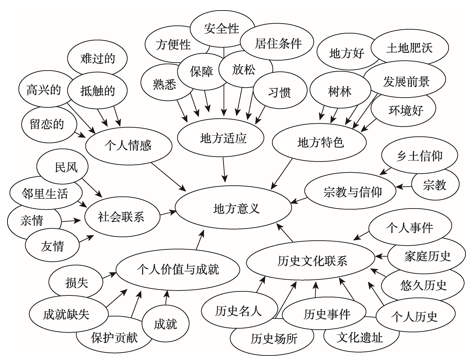
根据访谈内容进行质性分析,建构出12种地方特征(东西)类目,编码713个词汇、短语和短句;由访谈内容建构出附载于地方特征上的7大类地方意义类目,编码1781个词汇、短语和短句;最终共编码出2494个码号。地方意义类目形成过程如图2所示。
地方特征(place feature)是居民感知的对其自身重要的地方环境要素,源自于问题“最舍不得的东西是什么?”,是地方意义的承载体。此处的“东西”一词较为口头化,但能够有效地被调查对象理解,从而表达出对其重要的环境要素。本研究由访谈内容建构出12大类地方特征类目:文化遗址、房屋、土地、人、家当、祖坟、村子、树/树林、学校、工作、环境和其他。其频数构成见下表1所示。
表1 地方特征类目表
Tab. 1 The categories of place feature
| 序号 | 类目 | 举例 | 频次 | 百分比 | |||
|---|---|---|---|---|---|---|---|
| 1 | 文化遗址 | 未央宫、直城门、古迹、天禄阁、西安门 | 136 | 19.1 | |||
| 2 | 房屋 | 房、屋、家、院子、住的、老宅 | 125 | 17.5 | |||
| 3 | 土地 | 土地、地、地皮、粮食、口粮地、宅基地 | 47 | 6.6 | |||
| 4 | 人 | 邻里乡党、乡亲们、村民、亲戚、社员 | 118 | 16.5 | |||
| 5 | 家当 | 家当、家具、农具、屋里的东西、店里的衣服 | 20 | 2.8 | |||
| 6 | 祖坟 | 祖坟、先人、祖先、坟地、坟 | 13 | 1.8 | |||
| 7 | 村子 | 村子、村庄、地方、乡土、家乡、故土 | 169 | 23.7 | |||
| 8 | 树/树林 | 柿子树、树、大槐树、杨树林 | 4 | 0.6 | |||
| 9 | 学校 | 学校、小学、教育 | 22 | 3.1 | |||
| 10 | 工作 | 工作、店面、生意、超市、餐馆、生意网络 | 26 | 3.6 | |||
| 11 | 环境 | 环境、空气、气候 | 25 | 3.5 | |||
| 12 | 其他 | 医疗、回忆、一切 | 8 | 1.2 | |||
| 编码总数 713 | |||||||
| 6.2保护贡献 | 保护古迹这些年了、穷这么多年、守着、保护这里、不让开发 | 60 | 3.4 | ||||
| 6.3损失 | 搬不走、仍舍不得、借钱盖的、卖吧不值钱又带不走、贱卖 | 66 | 3.7 | ||||
| 6.4成就缺失 | 很穷、没自来水、结的帐还没还完、最穷的地方、穷了这些年 | 13 | 0.7 | ||||
| 小计 | 191 | 10.7 | |||||
| 宗教与信仰 7.1宗教 | 信仰基督教、有个集合点做礼拜 | 2 | 0.1 | ||||
| 7.2乡土信仰 | 祖先在这儿埋着呢、土葬、不能挖祖坟、离开先人心不安 | 24 | 1.4 | ||||
| 小计 | 26 | 1.5 | |||||
| 编码总数 | 1781 | ||||||
社区居民感知的地方特征(东西)较为丰富(表1),总体以人文类型为主,也包括树林、空气等自然环境要素类型;既有村民、地皮等具体的类型,又有诸如故土、生意、家乡等相对抽象的类型。虽然构成较复杂,但地方特征的频率分布有相对集中的特点,4种高频地方特征编码频次占到总频次的76.8%,依次是:“村子”(23.7%),“文化遗址”(19.1%),“房屋”(17.5%),“人”(16.5%)。其中频次最高的类目是“村子”,主要包括“村子”、“村庄”、“故土”、“家乡”这些具体和抽象的描述。村子既是生活空间,又具有象征意义,在当地居民心目中具有非常重要的地位。频次居于第二位的是“文化遗址”,高频词汇包括“未央宫”、“直城门”、“西安门”、“天禄阁”、“汉城湖”等,反映出当地地方构成的独特性。文化遗址既是村落环境的标志物,又见证着社区和居民的成长变化,是居民感知体验的重要成分,用当地人的话来说就是:“我们人老几辈都在这里,从小在上面耍大的”。居民对遗址的感知远远超出了一般地方构成要素的范畴。频次居于第三位的是“房屋”,相关的描述也包括具体与抽象两部分,“房”、“屋”、“院子”是具体的地方特征,而“家”除过有房屋的含义外,还包含了许多情感与精神因素,表现出以居所为核心的乡村聚落地方构成的特点。频次居于第四位的“人”这一地方特征类目中,“乡党”、“乡亲”、“社员”、“左邻右舍”这样的当地词汇频数高,透露出当地居民间相对传统的地缘社会关系。另外,“土地”、“祖坟”等类目频次相对较低,但依然是两个重要类型,反映了当地处于城市边缘,土地功能的变化和对传统习俗的固守的城中村地方构成特点。
地方意义来自于“为什么舍不得?”、“让您有什么样的感觉?”两个问题,由编码的1781个有关地方意义的词汇、短语和短句建构形成,最终得到地方意义共7大类目(包括34个二级类目),分别为:个人情感、地方适应、地方特色、社会联系、历史文化联系、个人价值与成就、宗教与信仰(表2)。
表2 地方意义类目构成
Tab. 2 The categories of place meaning
| 类目 | 举例 | 频次 | 百分比(%) |
|---|---|---|---|
| 个人情感 | |||
| 1.1高兴的 | 高兴、自豪、骄傲、兴奋地 | 21 | 1.2 |
| 1.2留恋的 | 舍不得、留恋、落叶归根、故土难离、难舍难分 | 170 | 9.6 |
| 1.3难过的 | 难过的、痛苦的、空落落的、流眼泪、麻烦、找新店面愁 | 138 | 7.7 |
| 1.4抵触的 | 不愿意走、坚决不走、不欢迎、可惜、遗憾、影响大 | 79 | 4.4 |
| 小计 | 408 | 22.9 | |
| 地方适应 2.1方便性 | 离城很近、就在跟前、串门方便、进货方便、孩子上学 | 200 | 11.3 |
| 2.2安全性 | 没有灾害、安全得很、相互照应、不出啥事 | 24 | 1.3 |
| 2.3习惯 | 在这习惯、到其他地方不习惯、搬走附近没人了 | 118 | 6.6 |
| 2.4保障 | 农民靠地生活、生活来源、谋生、生意还行、摊位固定 | 153 | 8.6 |
| 2.5熟悉 | 住的时间长、时间久了、熟地方、经常去 | 75 | 4.2 |
| 2.6放松 | 放松、夏凉、心情不好时去转转就很好、谝闲传、遛鸟、唱曲 | 44 | 2.5 |
| 2.7居住条件 | 居住条件好、宽敞、院子大、又宽敞又大 | 56 | 3.1 |
| 小计 | 670 | 37.6 | |
| 地方特色 3.1环境好 | 空气好、安静、风景好、避暑好地方 | 59 | 3.3 |
| 3.2地方好 | 地方好、风水宝地、龙脉、帝王之都、天子脚下 | 42 | 2.3 |
| 3.3土地肥沃 | 这儿地好、以前这地方很产粮食、良田 | 17 | 1.0 |
| 3.4树林 | 现在树林多、80年代植树造林、长寿树、桃树、果木 | 7 | 0.4 |
| 3.5发展前景 | 开发后会很好、未来发展前景、未来繁华、建公园、保护区 | 8 | 0.5 |
| 小计 | 133 | 7.5 | |
| 社会联系 4.1邻里生活 | 聊天、一起出行、一个村就是一个家、互相关照、打招呼 | 61 | 3.4 |
| 4.2亲情 | 感情很深、亲情、都在这里、一家人住一块儿、搬走见不着了 | 16 | 0.9 |
| 4.3友情 | 朋友、友情、朋友在这儿、在一起、朋友帮忙 | 14 | 0.8 |
| 4.4民风 | 这儿人好、朴实、亲切、实在、心好、人朴实厚道 | 25 | 1.4 |
| 小计 | 116 | 6.5 | |
| 历史文化联系 5.1历史名人 | 老祖先周西渠、怀远将军、刘邦、张骞、大学者刘向 | 4 | 0.2 |
| 5.2历史场所 | 皇上住的地方、刘邦坐都的地方 | 8 | 0.4 |
| 5.3文化遗址 | 未央宫土疙瘩、历史文化价值、文化遗产、武库、汉长安城 | 54 | 3.0 |
| 5.4悠久历史 | 有历史的村子、明朝就在这儿了、七百多年了、历史久远 | 31 | 1.7 |
| 5.5历史事件 | 韩信在这儿(未央宫)砍得头、张骞出使西域、国家考古发掘 | 9 | 0.5 |
| 5.6家庭历史 | 几辈子都在这儿、祖祖辈辈、好几代人、四辈人 | 50 | 2.8 |
| 5.7个人历史 | 住了五六十年了、二十多年了、自小到老、小的时候 | 32 | 1.8 |
| 5.8个人事件 | 放风筝、挑荠菜、钩槐花、在这里出生、恋爱、结婚 | 49 | 2.8 |
| 小计 | 237 | 13.2 | |
| 个人价值与成就 6.1成就 | 一砖一瓦盖的、自己的房子、家里的东西劳动的结晶、血汗 | 52 | 2.9 |
7大地方意义类目中(表2),“地方适应”频率最高,占37.6%,其次为“个人情感”,占22.9%,“历史文化联系”,占13.3%,“个人价值与成就”占10.7%,“地方特色”占7.5%,“社会联系”,占6.5%,最后是“宗教与信仰”,占1.5%。频率超过10%的4个类目总频率达84.5%,基本上构成了当地地方意义体系的主体。
归纳出的频率最高的意义类目是“地方适应”。在访谈当中,居民提到最多的内容是他们与当地环境间的一种需求与支持关系,如访谈中“进城方便”、“住的时间长了习惯了”、“住宅宽敞”、“有地有一切”、“去未央宫逛一逛”、“小孩上学近”、“人多生意好”等内容。地方适应表现为居民的需求与环境支持间的一致性以及居民对环境的可控性的感知,在这种情况下,居民所感知的环境压力小,满意度高。“方便性”、“保障”是该类目下频率最高的2个二级类目,其中“方便”频率为所有二级类目最高,反映出了一种对于村落就近生活、生产条件的肯定与依赖,与周围城市大尺度空间距离导致的“不方便”形成对比。“保障”反映了居民对以种植业和商业为主的生计来源的重视和认可。另外,“习惯”、“熟悉”共同反映了居民对环境的适应和生活的从容状态。地方适应源自居民与环境长期的互动与融合,虽然当地经济条件落后,但地方适应任然是意义当中比例最高的类目,说明适应与经济水平没有直接联系。
“个人情感”是归纳出的频率位列第二位的类目。这类描述是提到即将搬离居住地时访谈对象表达的心理感受。情感维度始终是环境认知的重要维度,同时也构成地方意义的重要部分。由于访谈调查时,居民正处于搬离故土的情景中,因此,情感的表达更为强烈并成为高频类目。本研究归纳出的4个二级类目可划分出积极(高兴),中性(留恋)和消极(难过的、抵触的)三种类型,可以看出,居民的情感表达以中性和消极为主。许多访谈对象提到了“落叶归根”、“故土难离”、“舍不得”等依恋性词汇,反映出居民与地方的深厚的情感联系。“痛苦”、“难过”、“不欢迎”,“坚决不走”等消极情感反映出居民的抵触心理。这些特点与村落拆迁带来的居民情感变化密切关联。
频率位列第三位的是“历史文化联系”。这类意义可分为两个部分,一部分反映当地的历史文化特征,另一部分是关于个人与家庭历史的描述。访谈中居民较多地提到了与长安城遗址、悠久历史、历史事件相关的内容,如“未央宫”、“文物”、“文化价值”、“刘邦坐都的地方”、“张骞出使西域”。文物遗址为当地打上了深深的烙印,成为当地居民对居住地的集体文化记忆。居民围绕文物遗址还构建了一些共享的概念,如“汉长安城城墙”称为“杨城”,“西安门”称为“皇门”,当地乡村环境概括为“二十四寨八疙瘩(遗址)”,当地人自称为“汉城人”等,使历史文化成为当地特有的符号。个人与家庭历史的描述是该类目下比例更大的意义类型。访谈对象多提到家族几辈人的长期固守和自己自小到大的成长经历。对个人事件的描述包括一些儿时或青年时期的生活细节的回忆,也包括人生关键节点的回顾。如“未央宫放风筝”、“城墙钩槐花”、“麦地里挖荠菜”以及“出生”、“结婚”、“生子”、“破四旧”、“植树造林”等。一个显著的特征是,居民的个人成长记忆多与文物遗址密切关联起来,使得遗址成为重要的人生经历的参照物。这些回忆表现出地方意义的个人化、具体化特点,并且对访谈对象亲切而又生动。
“个人价值与成就”是本案例中频率位列第四的意义类目。访谈中,居民提到过去辛苦劳作所得家当、财产,祖祖辈辈对文化遗产保护的功劳,以及由于政策限制所造成的贫穷,如“几辈子人守着土疙瘩”、“老先人留下的东西,我们守着这里”、“保护古迹这么些年了”、“不让开发”、“这里穷得很”、“辛辛苦苦盖得房子”、“结的帐还没有还完”等。这类意义中,“成就”和“保护贡献”属于积极层面的意义,是居民对自己长期努力所做出的家庭和社会贡献的肯定和积极评价;“损失”有消极的色彩,是居民对物质损失的考虑,与“成就”一起,反映了居民对于个人劳动成果的重视。“成就缺失”则属于消极类型,虽然频率低,但反映了居民对当地环境与发展状况的不满。
“地方特色”、“社会联系”与“宗教与信仰”是频率小于10%的三个意义类目。虽然居民谈论相对较少,但也揭示出重要的意义信息。“地方特色”实际上是居民通过比较获得的关于居住地方的独特之处。受访者较多地提到“环境好”和“地方好”意义,分别从自然环境和文化环境角度对当地进行了评价,并表现出一定的自豪心理。少数居民对未来的发展前景表示出了期许。与周围高楼林立的西安市差异显著的当地乡村环境,以及文化遗址是居民形成这种特色感知的主要因素。“社会联系”类目是居民重视当地社区关系和社会支持网络的反映。对日常邻里生活的描述,对民风、亲情、友情的褒扬显示出一个相对传统的村落社区的社会关系特点。访谈中“社会联系”的频率并不高,这一定程度上与集中搬迁安置,旧有社会网络基本保留有关。“宗教与信仰”所占比率很小,除了少数居民信仰基督教等宗教之外,访谈中多次提到“祖先”、“祖坟在这里”、“老一辈埋在这里”、“先人怎么办”、“祖先保佑着我们这些人”等这些乡土语句,表现了居民的担忧以及对祖先缅怀、敬仰的心情,这可看做是当地村落先祖崇拜这一传统仍然延续的表现。
分析地方特征和意义类目间的交叉对应关系能够帮助了解地方特征承载的意义类型及其组合状况,从而更好地理解地方构成。调查当中,问题“最舍不得的东西是什么?”与问题“为什么舍不得?”被逐条和连续询问,相互关联,因此,归纳出的地方特征类目和意义类目可一一对应起来,为交叉分析提供了可能。本研究将上述两个问题的访谈分析结果用于交叉分析,包含了地方特征编码713个,地方意义编码1497个(表3)。
表3 地方特征与地方意义交叉分析
Tab. 3 Cross-tabulation of meaning categories and place features
| 地方 特征 | 地方意义编码频次(编码比例%) | |||||||
|---|---|---|---|---|---|---|---|---|
| 个人 情感 | 地方 适应 | 地方 特色 | 社会 联系 | 历史文化 联系 | 个人价值与成就 | 宗教与 信仰 | 合计 | |
| 遗址 | 24(1.6) | 71(4.7) | 31(2.2) | 1(0.1) | 68(4.5) | 29(1.9) | 2(0.1) | 226(15.1) |
| 房屋 | 32(2.1) | 168(11.2) | 3(0.2) | 15(1.0) | 14(0.9) | 59(3.9) | 0(0) | 291(19.4) |
| 土地 | 6(0.4) | 62(4.1) | 14(0.9) | 1(0.1) | 7(0.5) | 5(0.3) | 2(0.1) | 97(6.5) |
| 人 | 13(0.9) | 34(2.3) | 1(0.1) | 45(3.0) | 5(0.3) | 3(0.2) | 0(0) | 101(6.7) |
| 家当 | 6(0.4) | 10(0.7) | 0(0) | 2(0.1) | 0(0) | 22(1.5) | 0(0) | 40(2.7) |
| 祖坟 | 1(0.1) | 2(0.1) | 0(0) | 0(0) | 1(0.1) | 1(0.1) | 15(1.0) | 20(1.3) |
| 村子 | 87(5.8) | 206(13.8) | 50(3.3) | 19(1.3) | 130(8.7) | 38(2.5) | 7(0.5) | 537(35.9) |
| 树/树林 | 0(0) | 0(0) | 4(0.3) | 0(0) | 1(0.1) | 0(0) | 0(0) | 5(0.3) |
| 学校 | 0(0) | 35(2.3) | 0(0) | 0(0) | 0(0) | 0(0) | 0(0) | 35(2.3) |
| 工作 | 6(0.4) | 36(2.4) | 2(0.1) | 1(0.1) | 0(0) | 29(1.9) | 0(0) | 74(4.9) |
| 环境 | 1(0.1) | 22(1.5) | 26(1.7) | 1(0.1) | 4(0.3) | 1(0.1) | 0(0) | 55(3.7) |
| 其他 | 0(0) | 4(0.3) | 0(0) | 5(0.3) | 4(0.3) | 3(0.2) | 0(0) | 16(1.2) |
| 合计 | 176(11.8) | 650(43.4) | 131(8.8) | 90(6.0) | 234(15.6) | 190(12.7) | 26(1.7) | 1497(100) |
从地方特征承载意义的角度来看,12种地方特征重要性有所区别。村子是承载意义最多的地方特征,比例占到意义总数的35.9%,其次是房屋、遗址、人和土地,以上5种地方特征承载了83.6%的意义频数,形成了地方特征的主体结构。从地方特征承载意义的类型构成上看,既有集合性特点,又表现出了明显的选择性,一些特征,如村子、遗址、土地都承载了全部的意义类型。而其他的地方特征则没有涵盖全部意义类型,如房屋、人和环境都缺失宗教与信仰意义类型,家当缺失地方特色、历史文化联系和宗教与信仰3种意义类型。一些特征仅仅承载了个别意义类型,如学校仅具有地方适应意义,树/树林仅具有地方特色和历史文化联系意义。从承载的高频意义类型来看,5种主要地方特征具有主导意义结构。村子主要承载了地方适应、历史文化联系和个人感情;房屋主要承载了地方适应、个人价值与成就和个人情感;遗址主要承载了地方适应、历史文化联系和地方特色;人主要包含了社会联系和地方适应;土地则主要包含了地方适应意义。
从意义与地方特征的关联来看,7种意义类目分别在某些地方特征上有缺失,并在地方特征上总体呈不均衡分布。地方适应意义除过在树/树林特征上缺失外,分布于其他11个特征上,但主要集中于村子、房屋、遗址和土地4类特征;个人价值与成就在5个特征上相对高频分布,分别是房屋、村子、遗址、工作和家当;个人情感意义主要分布于村子、房屋和遗址3种特征上,与人有一定的关联;地方特色集中分布于村子、遗址和环境三个类型上;其他3种意义更为集中地承载于一个或二个特征之上,社会联系主要与人相联系,历史文化联系主要承载在村子和遗址之上,而祖坟成为宗教与信仰集中分布的特征类型。
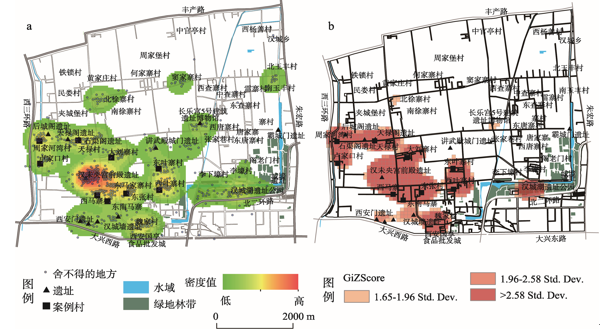
由于地方本身具有空间结构,因此,地方意义的空间特征的分析是地方研究的重要组成。本调查中要求社区居民标注舍不得的东西的位置(地方特征的位置),共得到932个位置点,这些位置点构成了一种感知空间结构。由于地方意义附载于地方特征之上,因此,这种空间结构也反映了意义空间的结构特征。利用核密度函数对932个位置点的密度分布进行拟合,得到点密度图。将点密度值作为输入数据,利用Gi*热点分析揭示居民感知热点和意义空间的构成特征。
从密度图(图3a)可知,研究区域感知位置点密度以未央宫前殿遗址为核心向外大致呈现层状结构。未央宫前殿遗址形成感知的高密度区域;在其外围,环绕9个调查村落位置以及南部的魏家寨、北二环路北部的汉城湖公园形成较高密度区域;在北部的徐家村、窦家寨村和玉丰村,中部的长乐宫遗址博物馆,南部的西安门遗址和汉城墙遗址也形成感知的集中区域,但密度较低。
图3 意义空间结构特征(a. 感知密度;b. 感知热点)
Fig. 3 The meaning space structure (a. perception density; b. perception hotspots)
通过Gi*热点分析生成感知热点分布图(图3b),图上Z-Score大于2.58的区域表示在0.01置信水平上具有统计意义的热点区域。对比密度图可知,热点区域包括两种类型,一种是高密度值聚集区域,如未央宫前殿遗址区域;另一种是密度值处于较高水平(不是高值区),但聚集程度高的区域,如周河湾村等9个调查村落区域。从分布位置看,热点区域形成以未央宫前殿遗址公园为核心,9个调查村落环绕的感知空间主体结构,该结构范围内,包括了上面提到的主要地方特征类型。在这一主体结构外围,还有两个热点形成,一个是汉城湖遗址公园,由于其树荫环绕、环境优美,加之有城墙遗址分布而受到关注;另一个是南部魏家寨商贸服务区域,这里的批发市场为当地居民生活提供方便,并提供了重要的就业机会而被重视。其他外围区域的感知密度较低,在给定置信水平上未形成热点。
英国社会学家Zygmunt Bauman在其著作《流动的现代性》(Liquid modernity)当中描绘了一幅现代社会的多变图景[35]:当下的社会正在全球化和信息技术的推动下变得快速流动,传统的稳定、固态的社会构成面临消解。在流动性的幕布前,中国正在上演快速城镇化的时代剧集,以传统乡村为代表的乡土世界频临失守。在这宏观和具体的背景下,重提乡土性和地方性,一方面可以从传统中找到用于应对流动性的手段和资源,另一方面,帮助我们理解乡土和地方的涵义,增强变化中的多群体相互理解和沟通,消除诸多潜在矛盾。
地方意义是了解乡土性和地方性的重要途径。本研究利用质性研究方法,对汉长安城遗址社区地方意义及其空间格局进行了分析。从研究的结果来看,研究区域的地方特征与地方意义构成都颇为丰富,并存在一定主体结构。村子、文化遗址、房屋和人构成了地方特征的主体,而地方适应、个人情感、历史文化联系和个人价值与成就成为主要的意义类型。意义类型基本可分为功能意义和情感与心理意义两种,这与前述文献研究结果一致[10]。然而,本研究揭示的研究区地方意义也有其特殊构成:地方适应意义比例高,反映出社区居民与居住环境联系的紧密性、稳固性和基础性,这是乡村聚落居民与地方联系的特征;个人情感意义表现突出,与长期居住形成的情感联系有关,也是搬迁社区居民感知锐化的心理反映;历史文化联系受到居民重视,与研究区独特的古都遗址分布相关联。地方特征作为意义的承载体,对意义的承载既有集合性特点,也表现出了明显的选择性。众多地方特征承载的意义共同构成意义体系,定义当地的地方性,使其区别于其他地方。另外,地方感知存在空间结构,表现为以遗址为核心,以村落为外围的感知热点格局。这一区域是当地居民的熟知区域和日常体验区域,承载居民主要的地方意义,既反映了居民的功能性和情感需要,也体现了居民的价值追求,被一些学者称作重要结构(Sacred structure)[36]。感知空间的制图可视化为我们更为直观地理解乡村地方性构成提供了帮助。
地方意义是空间和社会共同建构的结果。从本研究的结果看,不同的地方要素都在意义的产生中起到了作用。首先是地方的物质构成要素的作用,如遗址、乡村环境等。文物遗址在当地人的地方意义产生中起到了重要作用。虽然西安地区遗址分布较多,但本研究区域中村落社区与古代都城遗址重叠分布,还是显示了当地的特殊性,给当地居民的地方感打上了深深的烙印。其次,意义产生于居民的个人经历,调查对象关于个人经历的描述,生动具体,都与地方紧密联系,如“未央宫放风筝”,“城墙钩槐花”。第三,意义产生于社会互动。当地形成的集体记忆和概念,如“二十四寨八疙瘩(遗址)”、“杨城”等,充分说明意义具有互动和共享特征。居民感知的地方意义反映出了人文主义和结构主义双重机制的影响[25]。居民的地方意义是自下而上的基于个人和群体经历的建构,但同时又受到外部结构性力量的塑造。对于研究区域来说,长期的遗址保护区功能定位,导致了农业生产成为主要的产业形式,这些因素已经内化到居民的日常生活当中,成为地方意义形成的动力。另外,如前所述,地方适应和个人价值多反映的是功能(工具)意义,而居民对于历史遗留的文化遗址的珍视,对于个人美好经历的记忆,对于生于斯长于斯的故土的赞誉应该纳入价值理性的范畴。这种对于价值的追求是地方意义的深层次结构,是影响居民个人价值观的基础力量,是地方性形成的至真,至美的人性因素[25]。
地方意义是人关于环境的认知和评价,它反映环境对人的价值和重要性[37]。Twigger-Ross和Uzzell将Breakwell的认同概念用于地方感分析,认为地方意义与个人认同密切相关,可区分出4个维度,即区别(distinctiveness),延续性(continuity),自我肯定(self-esteem)和个人效能(self-efficacy)[38]。本研究揭示的地方意义基本上可以对应于这些维度:地方特色、社会联系使得当地居民与外部居民有显著区别,尤其是文物遗址使得当地居民获得了历史、文化、保护者等个人身份标记;历史文化联系、宗教与信仰反映连续性,个人和地方的历史记忆使得居民在时间的参照系中能够确定自身身份和状态;地方特色中的正面评价、个人价值与成就帮助居民形成关于自身的正面评价;地方适应反映地方与个人效能的关系,“方便”、“安全”、“习惯”、“熟悉”都反映了居民对环境的适应和正向个人效能感。由此可见,地方意义的重要性在于其参与到居民的个人认同过程当中。由于本研究中,地方适应意义所占比重显著高于其他意义类目,如果将该类目单独列出,则从意义重要性角度可以区分出三个主要的维度:情感联系、地方适应和个人认同。这样可以帮助我们理解乡村搬迁居民可能面临的困境,即情感割裂、再适应困难和认同危机,这些方面都会直接影响到搬迁居民的幸福感和主观态度。
现代社会的流动性使得时空的隔离被打破,并出现所谓时空压缩现象(time-space compression)[39],这些特点使得学者们思考地方性理论的发展问题,并试图寻找将流动性与地方性结合的途径,如Massey等提出了全球地方感概念(globle sense of place)[40],认为地方不是孤立的,而是与外部世界紧密联系。地方独特性不只与自身有关,也受地方与外部联系的特殊性所影响。Gustafson强调了地方意义中的变化维度[41],与连续性形成相对,地方意义的构建不是结果,而是一个持续的过程。一些学者还提出了全球地方化概念(glocalization)[42],强调新形势下全球化与地方化相融合,共同发展的重要性。虽然学界认识到了流动性带来的挑战,但实际上,在现代社会快速流动性面前,我们的社会,尤其是乡土社会尚未找到应对这种流动性的有效手段。如果地方意义有利于形成个人认同,那么在当下还未找到替代地方感的其他资源的状况下,保留一份乡土性和地方性,记住乡愁,应该是帮助现代人应对挑战,维持幸福感的重要手段。
本研究采用质性方法,较量表更加适合乡村社区居民的调查。所揭示的地方意义中包括一些负面意义,如“成就缺失”、“损失”、“难过的”情感,更为全面地反映了地方意义构成的状况。本研究揭示的“地方适应”意义类目,强调居民对环境的可控性(environment manageability)感知(“方便”、“熟悉”、“习惯”)[38],是居民与环境长期相互调适的结果,较量表的“地方依赖”维度更能真实地描述居民与环境的联系。由于地方感知(体验)经常处于一种不自觉(unconscious level)的状态[38],因此,研究这种感知的途径之一是关注地方的突变。本研究参照了Hull[10]等关于灾后居民地方意义的调查思路,选择了居民搬迁前夕做调查,这种居民面临失去地方的境况,实际上为调查提供了机会,因为“失去的才觉得珍贵”,居民的感知锐化为意义的表达和深层次探究创造了条件。研究人员中当地居民的加入(第三作者),使得研究者能够利用乡土语言与访谈对象沟通,理解与反思(reflective thinking)访谈内容,深入体会当地居民的认识和感受。
主要结论为:① 地方特征附载地方意义,且对地方意义的附载有集合性和选择性特点。本研究中“村子”、“房屋”、“遗址”是主要的意义附载体;② 地方特征和地方意义都存在主体结构,本研究中,“村子”和“地方适应”分别成为地方特征和地方意义的主要构成类型;③ 地方感知具有其空间特征,并形成地方特征—地方意义—空间分布一体的意义空间,共同定义地方;④ 情感联系、地方适应和个人认同可用于解释意义空间对于居民的重要性,可以帮助我们理解搬迁社区的故土情结。
意义空间的研究使以前未能表达的意义和声音表达出来,由于其揭示出了地方的细微结构,有利于了解传统社区,为决策提供更丰富的信息。从本研究的内容看,对于汉长安城遗址社区居民,文物遗址是居民个人认同的重要因素,因此,在更好地保护文物遗址这一点上,居民与政府的态度是一致的,这可以成为政府与居民沟通,开展社区参与的保护工作的切入点。另外,按照一般的理论,社会联系是乡村社区的重要构成内容,但是本研究中,这一意义比重不大,根据访谈内容,搬迁后集中安置使居民认为旧有社会关系仍然可以维持,因此,对这一意义的表述减少。这说明,合理的安置规划工作可以减少对已有地方意义的影响。长期以来,在强大的来自外部的文化遗产价值表征面前,社区的心理诉求显得微不足道。然而,反过来看,社区居民长期生活于遗址区域,他们为遗址保护所作出的贡献应该得到尊重。汉长安城遗址乡村社区的生活形态随着历史的进程一路发展而来,应该作为遗址区的一种人文景观组成受到重视。在遗址区保留当地乡村的某些地方特征(如居住建筑、农田),既可以体现先进的社区参与文化遗产保护的理念,又可以为搬迁居民保留一份精神寄托,维系一缕乡土情结,是当下保护和开发实践中应该努力尝试的内容。
由于地方意义可以影响态度,因此,后期的研究可以基于意义研究居民的态度倾向,不同人群间的意义差异和态度差别。另外,基于GIS技术的分析可以使得意义和态度的空间格局表现出来,更好地辅助社区发展规划。
The authors have declared that no competing interests exist.
| [1] |
Protection of rights and interests and government's responsibilities .生态移民权益保护与政府责任 . |
| [2] |
https://doi.org/10.3969/j.issn.1001-5558.2005.03.004 URL [本文引用: 1] 摘要
城市拆迁中的冲突现象成为一个不可回避的社会问题.在拆迁所形成的特定"场域"中,地方政府、开发商与被拆迁人等主要的三类利益主体是能动的"行动者", 已有的拆迁制度往往是他们为实现利益目标进行讨价还价的知识或策略,但制度并不完全限制他们的行动选择,拆迁制度的不断完善并没有从根本上改变拆迁中的矛 盾和冲突.诉求公平和正义原则,强化利益表达机制,可以减少拆迁冲突,并可降低其中潜在的社会代价.
https://doi.org/10.3969/j.issn.1001-5558.2005.03.004 URL [本文引用: 1] 摘要
城市拆迁中的冲突现象成为一个不可回避的社会问题.在拆迁所形成的特定"场域"中,地方政府、开发商与被拆迁人等主要的三类利益主体是能动的"行动者", 已有的拆迁制度往往是他们为实现利益目标进行讨价还价的知识或策略,但制度并不完全限制他们的行动选择,拆迁制度的不断完善并没有从根本上改变拆迁中的矛 盾和冲突.诉求公平和正义原则,强化利益表达机制,可以减少拆迁冲突,并可降低其中潜在的社会代价.
|
| [3] |
Place change and tourism development conflict: Evaluating public interest .https://doi.org/10.1016/j.tourman.2009.01.004 URL Magsci [本文引用: 1] 摘要
<h2 class="secHeading" id="section_abstract">Abstract</h2><p id="">As a set of economic activities, tourism trades on the character of special places. Conflict can emerge where local residents perceive that tourism development proposals challenge the special qualities of place, and where place meaning and attachments are compromised. A key function of government in mediating conflict is to protect public interests, yet explicit consideration of public interest in tourism development conflict is unusual. This paper argues for a reinvigoration of public interest in the mediation of tourism development conflicts. It explores the concept of public interest and how governments interpret and give meaning to it in development debates. In a case study of a cruise ship terminal proposal on the Gold Coast, Australia, the state adopted a neoliberal interpretation of public interest wherein increased global competitiveness of the destination was the overriding common good pursued. Local and diverse interests were marginalised in the debate. The paper concludes that in order to reinvigorate public interest, a public interest evaluation framework for tourism development is needed.</p>
|
| [4] |
The practice of involuntary resettlement policy in China: A historical retrospection, work examination an policy improvement .https://doi.org/10.3969/j.issn.1001-8409.2001.03.012 URL [本文引用: 1] 摘要
建国以来尤其是改革开放以来,随着我国基础设施建设的大规模展开,非自愿移民的数量与规模与 日俱增,但移民安置工作与绩效却很不平衡。20世纪90年代前后,我国开始尝试利用世界银行贷款进行基础设施建设,因此,在实践世行移民政策方面积累了一 些经验。本文拟在简要回顾我国移民安置工作的基础上,对我国移民安置工作方面取得的成效和存在的问题进行检讨和反思,并以此为基点,借鉴世行移民工作之经 验,对进一步作好我国的移民安置工作提出了改进意见。
我国非自愿移民政策实践: 历史回顾、工作检讨与政策改进 .https://doi.org/10.3969/j.issn.1001-8409.2001.03.012 URL [本文引用: 1] 摘要
建国以来尤其是改革开放以来,随着我国基础设施建设的大规模展开,非自愿移民的数量与规模与 日俱增,但移民安置工作与绩效却很不平衡。20世纪90年代前后,我国开始尝试利用世界银行贷款进行基础设施建设,因此,在实践世行移民政策方面积累了一 些经验。本文拟在简要回顾我国移民安置工作的基础上,对我国移民安置工作方面取得的成效和存在的问题进行检讨和反思,并以此为基点,借鉴世行移民工作之经 验,对进一步作好我国的移民安置工作提出了改进意见。
|
| [5] |
https://doi.org/10.3969/j.issn.1002-9753.2011.03.013 URL [本文引用: 1] 摘要
以往对于非自愿移民的研究多是 关注制度安排和安置环境对移民经济发展的影响,本文则是重点探讨移民自身的人力资本在其经济再发展过程中的作用。改革开放后中国劳动力市场发生着重大的社 会变迁,对于非自愿移民来说,这种变迁集中体现为移民的发展不仅受限于经济制度和政府政策,其自身所具有的人力资本将发挥着越来越重要的作用。基于丹江口 库区和巴东三峡库区的抽样调查,本文重点对影响移民经济恢复的人力资本因素作了实证分析。研究发现,人力资本因素对移民的经济恢复有着重要的影响,但是和 非移民相比,一些人力资本因素对移民的经济恢复失去了效用,并且不同搬迁时间的移民的人力资本失灵状况也有着明显的差异,在搬迁初期移民的人力资本失灵更 为严重。在劳动力市场较为完善的条件下,人力资本才能对移民经济发展发挥更好的效应。
https://doi.org/10.3969/j.issn.1002-9753.2011.03.013 URL [本文引用: 1] 摘要
以往对于非自愿移民的研究多是 关注制度安排和安置环境对移民经济发展的影响,本文则是重点探讨移民自身的人力资本在其经济再发展过程中的作用。改革开放后中国劳动力市场发生着重大的社 会变迁,对于非自愿移民来说,这种变迁集中体现为移民的发展不仅受限于经济制度和政府政策,其自身所具有的人力资本将发挥着越来越重要的作用。基于丹江口 库区和巴东三峡库区的抽样调查,本文重点对影响移民经济恢复的人力资本因素作了实证分析。研究发现,人力资本因素对移民的经济恢复有着重要的影响,但是和 非移民相比,一些人力资本因素对移民的经济恢复失去了效用,并且不同搬迁时间的移民的人力资本失灵状况也有着明显的差异,在搬迁初期移民的人力资本失灵更 为严重。在劳动力市场较为完善的条件下,人力资本才能对移民经济发展发挥更好的效应。
|
| [6] |
Topophilia: A Study of Environmental Perception, Attitudes and Values. Englewood Cliffs, NJ: |
| [7] |
Place and Placelessness .
Abstract. This paper examines the issue of place-making in 3D virtual world from the design point of view. It aims to find out what are the elements to create a sense of place. As Second Life currently has the largest users among 3D virtual worlds, it is selected as a study case.
|
| [8] |
Is it really just a social construction: The contribution of the physical environment to sense of place .https://doi.org/10.1080/08941920309189 URL [本文引用: 2] 摘要
Although sense of place definitions nominally include the physical environment, much research has emphasized the social construction of sense of place and neglect the potentially important contributions of the physical environment to place meanings and attachment. This article presents research that tests several models that integrate (1) characteristics of the environment, (2) human uses of the environment, (3) constructed meanings, and (4) place attachment and satisfaction. The research utilized a mail survey of 1,000 property owners in a lake-rich region (the Northern Highlands Lake District of Northern Wisconsin). Structural equation modeling revealed that the best fit model integrating environmental variables with sense of place was a meaning-mediated model that considered certain landscape attributes (i.e., level of shoreline development) as predictive of certain meanings related to attachment and satisfaction. This research demonstrates that landscape attributes matter a great deal to constructed meanings; these constructions are not exclusively social.
|
| [9] |
"Place" as an integrating concept in natural resource politics: Propositions for a social science research agenda .https://doi.org/10.1080/08941920309199 URL [本文引用: 1] 摘要
This article lays out six propositions centering on a relationship between people-place connections and strategic behavior in natural resource politics. The first two propositions suggest a strong and direct connection between self-identity, place, and how individuals perceive and value the environment. The third, fourth, and fifth propositions tie together social group identity and place, particularly emphasizing the influence of social group identity on strategic behavior in natural resource politics. The sixth proposition relates to the geographic scale of place as a strategic choice in natural resource decision making. Taken together, the propositions suggest that natural resource politics is as much a contest over place meanings as it is a competition among interest groups over scarce resources. The place perspective suggests an expanded role for natural resource social scientists as giving voice to meanings and values that may not otherwise be expressed in natural resource decision-making processes.
|
| [10] |
Place identity: Symbols of self in the urban fabric .https://doi.org/10.1016/0169-2046(94)90001-9 URL [本文引用: 4] 摘要
ABSTRACT The urban fabric contains symbols (icons) that tell us something about ourselves and something about those to whom the symbols belong. This aspect of the urban fabric has been called the glue that bonds people to place. The contention of this paper is that these icons deserve special attention in urban design decisions because they contribute to place identity and ultimately to self identify, health, sense of community and sense of place. To explore the nature of these place-based meanings, data were collected from residents of Charleston, SC following hurricane Hugo in 1989. Residents were asked to describe what they had lost to the storm, not just the physical features blown away by winds or damaged by rains, but the memories and meanings embodied by these features. Residents identified several types of features as icons of special significance: urban forest (30%), churches (27%), homes (19%), public buildings (6%), places associated with historic events (6%) and retail structures (5%). Residents' explanation for why these icons were special fell into six major categories. The icons: provided connections to residents' pasts; symbolize the social groups to which residents belonged or with which they identified; gave the community its distinctive character; satisfied important functional needs; evoked emotions or feelings; and served as reminders of personal accomplishments and concerns. We concluded that place identity, although subjective and subtle, can be assessed and managed through sensitive land development efforts.
|
| [11] |
Measuring place attachment: Some preliminary results. Proceeding of NRPA Symposium on Leisure Research, San Antonio, |
| [12] |
Place attachment in a foreign settlement .https://doi.org/10.1016/j.jenvp.2009.01.001 URL Magsci [本文引用: 1] 摘要
<h2 class="secHeading" id="section_abstract">Abstract</h2><p id="">This paper examines issues arising from the involuntary relocation of Turkish Cypriot refugees from the southern to the northern portion of the island of Cyprus. After the ceasefire in 1974, participants in this study were relocated into homes originally built and occupied by Greek Cypriots. Using data obtained from questionnaires, semi-structured interviews and drawings, the study analyses their place attachment under the unusual circumstances of their own forced relocation coupled with their occupation of homes abandoned by residents also displaced by war and interethnic hostility. The study compares the place attachment of refugees to their children, who were born and brought up in the new community. The results of this study suggest that participants' future expectations shaped their attachment to their new homes and community, whilst their degree of attachment to their previous environments also played an important role in the attachment process. Younger generations, on the other hand, were more attached to their current environment than older generations; however they did not wish to be identified with their current environment.</p>
|
| [13] |
Religion and place attachment: A study of sacred places .https://doi.org/10.1016/j.jenvp.2004.08.005 URL Magsci [本文引用: 1] 摘要
<h2 class="secHeading" id="section_abstract">Abstract</h2><p id="">In this paper we claim that religion can play an important role in place attachment and present a conceptualization of it. We provide an understanding of the role of place in the experience of religious place attachment, describing in detail place, design, aesthetics, and special characteristics that facilitate devotion. Next, we describe how attachment to place is learned through the process of socialization involving rituals, use of artifacts, story telling, and place visits. We argue that there is an active socializing component to religious place attachment in addition to the experiential one. We conclude with a brief discussion integrating the complex issues of religion, place, identity, and attachment.</p>
|
| [14] |
An empirical structural model of tourists and places: Progressing involvement and place attachment into tourism .https://doi.org/10.1016/j.tourman.2008.02.009 URL Magsci [本文引用: 1] 摘要
<h2 class="secHeading" id="section_abstract">Abstract</h2><p id="">Research which examines the relationship between involvement and place attachment has started to emerge in the leisure literature and this paper reports the findings of a study, which applied these constructs within a tourism context. A survey was conducted with tourists in five South Australian tourism regions that measured respondents’ attitudes towards tourism experiences in South Australia. Involvement was conceptualised as a multidimensional construct consisting of the dimensions of <em>attraction, centrality to lifestyle, self expression</em> and <em>food & wine</em>. Place attachment was also conceptualised as a multidimensional construct of <em>place dependence</em> and <em>place identity</em>. The study developed and tested a structural model that was found to reliably and validly measure predictive relationships between the constructs of involvement and place attachment. The findings indicated that the combined use of involvement and place attachment is applicable in tourism. The implications for destination management are discussed.</p>
|
| [15] |
An examination of recreationist's relationships with activities and settings . |
| [16] |
Incivilities, place attachment and crime: Block and individual effects .https://doi.org/10.1016/j.jenvp.2004.01.001 URL Magsci [本文引用: 1] 摘要
<h2 class="secHeading" id="section_abstract">Abstract</h2><p id="">The popular incivilities hypothesis suggests physical incivilities, such as unkempt lawns and litter, and weak social ties with neighbors encourage crime. Despite a strong impact on policing policies and public awareness, this hypothesis has seldom been tested. We extend this basic model to test whether place attachments protect from crime as well. In a suburban area facing decline, multilevel (hierarchical linear modeling) analyses reveal that renters, properties with more physical incivilities, and blocks with more physical incivilities experience more subsequent crimes. Although these actual physical incivilities were important predictors of crime, residents’ perceptions of incivilities were not, suggesting that environmental incivilities act directly upon offenders, not through non-offender resident perceptions. A cross-level interaction indicated incivilities predicted crime less well on socially cohesive blocks, suggesting that social cohesion can buffer the effects of the physical environment. Weaker block level place attachments also contributed independently to individuals’ risks of crime, demonstrating that place attachment merits greater attention in neighborhood revitalization and crime reduction interventions.</p>
|
| [17] |
Place attachment and management of critical park issues in Grand Teton National Park .
Theory and empirical evidence suggest that place attachment is multidimensional, hard to define, and comprised of a wide range of constructs embodying both setting variables and personal variables (Relph, 1976; Brown & Perkins, 1992; Low & Altman, 1992). This concept has not been fully recognized and employed by past public land managers, but todays more holistic planning involves assessing a multitude of values associated with special places. This paper seeks to contribute to this trend of using place attachment as a potential natural resource management tool.
|
| [18] |
Uncovering hidden meanings, values and insights through photos . |
| [19] |
For better or worse: Exploring multiple dimensions of place meaning .https://doi.org/10.1016/j.jenvp.2005.01.002 URL [本文引用: 1] 摘要
This paper explores the nature of people's emotional relationships to places in order to learn about the kinds of places that are meaningful for people, the role these places play in their lives and the processes by which they develop meaning. Because such relationships have been most commonly explored through positive experiences of the residence, this research was undertaken to explore other dimensions of our relationships to places. To accomplish this, in-depth interviews were conducted with 40 participants in the New York metropolitan area. Qualitative analysis reveals the diversity and richness of people's emotional relationships to places, indicating that place meaning develops from an array of emotions and experiences, both positive and negative. Moreover, findings demonstrate the socio-political underpinnings of our emotional relationships to places, particularly the impact of gender, race, class and sexuality, suggesting a need to further incorporate the full magnitude of the human experience into the current discourse on people–place relationships.
|
| [20] |
Roles of tests in the construction of tourists sense of place: Analysis on Qufu travel writings. Geography and https://doi.org/10.7702/dlydlxxkx20130220 URL [本文引用: 1] 摘要
许多研究分析了游客对旅游目的 地的感知水平及影响因素,但对文本在游客地方感建构中的作用研究相对较少。成功的旅游目的地营销往往借助了文艺作品、历史文献等文本,但文本在游客旅游动 机产生、旅游过程和旅游后的情感积累中如何起作用,这方面尚缺乏具体的研究。该文以44篇有关曲阜的游记作为分析对象,从中找出文本在旅游三阶段中对游客 地方感建构的作用。结论如下:1)旅游之前,文本是游客建立初步地方感的基础,而且著名文本能够激发游客的旅游动机;2)在旅游过程中,文本能够对游客初 步地方感进行强化与修正;3)旅游后的游记类文本,能够提升游客对旅游地的情感和认同,优秀的游记类文本又可成为他人建构地方感的基础材料。因此,旅游目 的地管理者应在网站上推介旅游目的地文本、增设游客观感展示区,并要加强景区解说文本的编写。
文本在游客地方感建构中的作用研究: 基于曲阜游记的分析 .https://doi.org/10.7702/dlydlxxkx20130220 URL [本文引用: 1] 摘要
许多研究分析了游客对旅游目的 地的感知水平及影响因素,但对文本在游客地方感建构中的作用研究相对较少。成功的旅游目的地营销往往借助了文艺作品、历史文献等文本,但文本在游客旅游动 机产生、旅游过程和旅游后的情感积累中如何起作用,这方面尚缺乏具体的研究。该文以44篇有关曲阜的游记作为分析对象,从中找出文本在旅游三阶段中对游客 地方感建构的作用。结论如下:1)旅游之前,文本是游客建立初步地方感的基础,而且著名文本能够激发游客的旅游动机;2)在旅游过程中,文本能够对游客初 步地方感进行强化与修正;3)旅游后的游记类文本,能够提升游客对旅游地的情感和认同,优秀的游记类文本又可成为他人建构地方感的基础材料。因此,旅游目 的地管理者应在网站上推介旅游目的地文本、增设游客观感展示区,并要加强景区解说文本的编写。
|
| [21] |
Characteristics and causes of situational theme restaurant staff's sense of place: A case study of the Taste-Yunnan Restaurant in Guangzhou .
地方感的研究为探讨人地关系提供了新的视角。情境主题餐厅作为能提供特殊体验的一种微观文化空间,为员工构造了一个“异位(heterotopias)”的超现实空间(hyperreality)。本文通过对广州味道云南食府这一典型情境主题餐厅员工的体验式观察和深度访谈,探讨了情境主题餐厅员工对不同尺度空间产生的不同地方感特征及其原因,得出以下结论:① 员工对情境主题餐厅及其所处城市的地方感存在差异。他们对餐厅具有强烈的地方认同和地方依赖,对餐厅所处城市具有地方依赖,但对餐厅以外的其他城市空间不存在地方认同;② 员工对情境主题餐厅地方感特征产生的原因是餐厅融洽的社交环境、良好的工作和生活环境以及较高认同的情境(文化);③ 员工对情境主题餐厅所处城市地方感特征产生的原因是城市所提供的良好工作条件、较差的自然环境、低熟悉的城市空间、对家乡的依恋和对“异乡人”的身份认同;④ 员工对情境主题餐厅及其所处城市的熟悉程度、环境和文化认同程度和归属/依恋程度的差异是员工对两者地方感存在差异的原因。结论对于丰富地方感在微观空间层面的理论与实证研究有重要的价值,能够为城市中其他微观文化空间的地方感研究提供借鉴。
情境主题餐厅员工地方感特征及其形成原因: 以广州味道云南食府为例 .
地方感的研究为探讨人地关系提供了新的视角。情境主题餐厅作为能提供特殊体验的一种微观文化空间,为员工构造了一个“异位(heterotopias)”的超现实空间(hyperreality)。本文通过对广州味道云南食府这一典型情境主题餐厅员工的体验式观察和深度访谈,探讨了情境主题餐厅员工对不同尺度空间产生的不同地方感特征及其原因,得出以下结论:① 员工对情境主题餐厅及其所处城市的地方感存在差异。他们对餐厅具有强烈的地方认同和地方依赖,对餐厅所处城市具有地方依赖,但对餐厅以外的其他城市空间不存在地方认同;② 员工对情境主题餐厅地方感特征产生的原因是餐厅融洽的社交环境、良好的工作和生活环境以及较高认同的情境(文化);③ 员工对情境主题餐厅所处城市地方感特征产生的原因是城市所提供的良好工作条件、较差的自然环境、低熟悉的城市空间、对家乡的依恋和对“异乡人”的身份认同;④ 员工对情境主题餐厅及其所处城市的熟悉程度、环境和文化认同程度和归属/依恋程度的差异是员工对两者地方感存在差异的原因。结论对于丰富地方感在微观空间层面的理论与实证研究有重要的价值,能够为城市中其他微观文化空间的地方感研究提供借鉴。
|
| [22] |
Research on influence of residents place attachment on positive attitude to tourism with a mediator of development expectation: A case of core tourism community in Jiuzhaigou .
<p>基于“地方感”、“期望理论”两个基本理论,从旅游核心社区居民地方感、旅游发展期望、旅游发展获益感知、旅游发展成本感知以及旅游发展支持度五个结构变量出发,通过引入旅游发展期望值作为中介变量,构建居民地方感对旅游发展支持度内部影响机制的理论模型。以世界遗产地九寨沟为实证研究对象,通过验证性因子分析和三阶段结构方程模型的定量分析,校验理论模型中各结构因子、结构因子与其所含维度之间影响路径及其系数,定量测度了居民的旅游发展期望在居民地方感与旅游发展正反影响感知关联中的中介效用和影响机制,及对旅游发展支持度的潜在影响模式。研究结果表明:① 居民地方感对居民旅游发展正反影响感知的作用存在差异,地方感对获益感知的作用远大于成本感知。② 居民从旅游发展中感知获益有助于他们对当地旅游发展持更积极态度,而成本感知则会产生消极影响。③ 居民旅游发展期望中介效用的存在性和有效性,居民地方感通过发展期望,强化了对旅游发展影响感知及旅游支持度作用。④ 发展期望在居民旅游发展正反影响感知两结构模型中的中介效用存在强弱,在感知获益子结构模型的中介作用强于感知成本子模型。</p>
居民地方感对区域旅游发展支持度影响: 以九寨沟旅游核心社区为例 .
<p>基于“地方感”、“期望理论”两个基本理论,从旅游核心社区居民地方感、旅游发展期望、旅游发展获益感知、旅游发展成本感知以及旅游发展支持度五个结构变量出发,通过引入旅游发展期望值作为中介变量,构建居民地方感对旅游发展支持度内部影响机制的理论模型。以世界遗产地九寨沟为实证研究对象,通过验证性因子分析和三阶段结构方程模型的定量分析,校验理论模型中各结构因子、结构因子与其所含维度之间影响路径及其系数,定量测度了居民的旅游发展期望在居民地方感与旅游发展正反影响感知关联中的中介效用和影响机制,及对旅游发展支持度的潜在影响模式。研究结果表明:① 居民地方感对居民旅游发展正反影响感知的作用存在差异,地方感对获益感知的作用远大于成本感知。② 居民从旅游发展中感知获益有助于他们对当地旅游发展持更积极态度,而成本感知则会产生消极影响。③ 居民旅游发展期望中介效用的存在性和有效性,居民地方感通过发展期望,强化了对旅游发展影响感知及旅游支持度作用。④ 发展期望在居民旅游发展正反影响感知两结构模型中的中介效用存在强弱,在感知获益子结构模型的中介作用强于感知成本子模型。</p>
|
| [23] |
https://doi.org/10.3969/j.issn.1002-3054.2009.02.005 URL [本文引用: 1] 摘要
本文通过选取受城市化影响程度不同的三个乡村社区,调查居民日常行为空间的变化过程以及对地方感的影响,发现地方感的差异不仅与空间重构导致的居民社区依 附程度差异有关,同时还与社区"公共领域"有关.本文在此基础上提出强化地方感的措施,以更好地发挥农民建设新农村的主体作用,促进乡村建设.
https://doi.org/10.3969/j.issn.1002-3054.2009.02.005 URL [本文引用: 1] 摘要
本文通过选取受城市化影响程度不同的三个乡村社区,调查居民日常行为空间的变化过程以及对地方感的影响,发现地方感的差异不仅与空间重构导致的居民社区依 附程度差异有关,同时还与社区"公共领域"有关.本文在此基础上提出强化地方感的措施,以更好地发挥农民建设新农村的主体作用,促进乡村建设.
|
| [24] |
Negotiating place and identity after change of administrative division .https://doi.org/10.1080/14649365.2011.545140 URL [本文引用: 1] 摘要
Place identity is a fluid construction that is in a constant dynamics of re-imagination. Changes in economic, social, cultural and political conditions lead individual and groups to re-imagine and rebuild their place-based identity. One major force that causes people's interruption in place identity is the rationalizing spatial process that reduces place into abstract space that is open to reorganization. In this paper, we investigate the interruption, reconfirmation and renegotiation of the place-based identity of local residents of the former municipal district of Dongshan, Guangzhou, China, after the official administrative establishment of Dongshan was cancelled by the Guangzhou municipal authority in 2005. Thirty-six in-depth interviews were conducted, and it is found that local Dongshan residents' place identity had generally been enhanced, rather than vitiated, after the 2005 change of administrative division, while discourses about interruptions in their place identity fill up their narratives. Although sensing obvious interruption in place-based identity, local Dongshan residents re-imagined the meanings of the place of Dongshan to build up culturally delimited borders that were conditioned by the name Dongshan, and this re-imagined place-based identity results from the local residents' renegotiation about what the place of Dongshan is and how their identities are connected to the place.
|
| [25] |
The structuralistic and humanistic mechanism of placeness: A case study of 798 and M50 art districts .
探讨地方性的形成机制对保护传统的地方性和发展新的地方性十分必要。本文选择北京和上海两个艺术类文化创意产业集聚区,分析人文主义机制和结构主义机制的相互作用。按照结构主义的分析思路,调查了艺术区与外界的社会关系;按照人文主义的分析思路,调查了艺术家、画廊经营人和消费者对地方性的认同程度。研究发现:(1)结构主义和人文主义机制共同促成艺术区以景观体现城市的地方性。(2)国外艺术品需求的结构机制虽促成了对中国题材作品的需求,但尚未形成对两个城市地方性题材作品的强大需求。(3)在外界结构动力不足的情况下,三类人群对城市地方性的深层情感认同比较少,因此他们在创作或营销艺术品时,缺少人文主义的内在机制。由此建议:两市的政府应组织一些活动,鼓励艺术家创作本城市题材的艺术作品,从而使该类题材作品逐渐具有市场竞争力,并能抵制经济全球化过程对地方文化的负面冲击。
地方性形成机制的结构主义与人文主义分析: 以798和M50两个艺术区在城市地方性塑造中的作用为例 .
探讨地方性的形成机制对保护传统的地方性和发展新的地方性十分必要。本文选择北京和上海两个艺术类文化创意产业集聚区,分析人文主义机制和结构主义机制的相互作用。按照结构主义的分析思路,调查了艺术区与外界的社会关系;按照人文主义的分析思路,调查了艺术家、画廊经营人和消费者对地方性的认同程度。研究发现:(1)结构主义和人文主义机制共同促成艺术区以景观体现城市的地方性。(2)国外艺术品需求的结构机制虽促成了对中国题材作品的需求,但尚未形成对两个城市地方性题材作品的强大需求。(3)在外界结构动力不足的情况下,三类人群对城市地方性的深层情感认同比较少,因此他们在创作或营销艺术品时,缺少人文主义的内在机制。由此建议:两市的政府应组织一些活动,鼓励艺术家创作本城市题材的艺术作品,从而使该类题材作品逐渐具有市场竞争力,并能抵制经济全球化过程对地方文化的负面冲击。
|
| [26] |
The perception and identity to the cultural micro-space: A case study of Fangsuo Commune in TaiKoo Hui, Guangzhou .https://doi.org/10.11821/dlxb201402004 URL Magsci [本文引用: 1] 摘要
自20 世纪70 年代以来,经济文化全球化成为微空间生产与重构的重要动力。而随着生产方式和生活方式的改变,以符号和审美消费为主的后现代消费社会范式的崛起,促使文化成为行就消费空间的主要手段之一。广州方所文化书店就是在这样的背景下催生的新生事物。贴上文化标签后的方所文化书店,一反实体书店在现代消费社会中逐步被边缘化的窘境,出现伊始就受到各界的广泛关注。研究剖析了方所文化书店这类实体书店文化身份的展演(performance),并对消费者的感知与认同进行了解读。结果显示,通过经营者对文化手段的操纵,方所文化书店被形塑成一个世界文化的微观缩影,同时也成为一个具有尊贵与典雅特质的文化新空间。而消费者通过对实体微空间的环境、商品文化及人群品质的感知,也认同了这种新的文化消费空间。实体书店在标签化的文化表征与文化变迁中完成自我救赎,同时也被消费者重新认同。
对文化微空间的感知与认同研究: 以广州太古汇方所文化书店为例 .https://doi.org/10.11821/dlxb201402004 URL Magsci [本文引用: 1] 摘要
自20 世纪70 年代以来,经济文化全球化成为微空间生产与重构的重要动力。而随着生产方式和生活方式的改变,以符号和审美消费为主的后现代消费社会范式的崛起,促使文化成为行就消费空间的主要手段之一。广州方所文化书店就是在这样的背景下催生的新生事物。贴上文化标签后的方所文化书店,一反实体书店在现代消费社会中逐步被边缘化的窘境,出现伊始就受到各界的广泛关注。研究剖析了方所文化书店这类实体书店文化身份的展演(performance),并对消费者的感知与认同进行了解读。结果显示,通过经营者对文化手段的操纵,方所文化书店被形塑成一个世界文化的微观缩影,同时也成为一个具有尊贵与典雅特质的文化新空间。而消费者通过对实体微空间的环境、商品文化及人群品质的感知,也认同了这种新的文化消费空间。实体书店在标签化的文化表征与文化变迁中完成自我救赎,同时也被消费者重新认同。
|
| [27] |
The state of qualitative tourism research .https://doi.org/10.1016/S0160-7383(99)00068-7 URL [本文引用: 1] 摘要
Previous reviews of tourism research methods have concentrated on studies underpinned by positivist science or assessments of quantitative methods and analyses. Conspicuous by their absence are reviews that focus on studies supported by the interpretive paradigm and assessments of qualitative analyses. This paper provides a descriptive review of the latter research using feature articles from four major journals in the field, employing “moments of qualitative research” as the framework of analysis. This paper makes no attempt to assess methodological sophistication but provides baseline data about previous and present uses of the interpretive paradigm and qualitative methods. It reviews each journal from its inception through 1996.L’état de la recherche qualitative en tourisme. Les examens antérieurs des méthodes de recherche en tourisme ont focalisé sur des études basées sur la science positiviste ou des évaluations d’analyses et de méthodes quantitatives. Il y a un manque notable de rapports qui se concentrent sur des études basées sur le paradigme explicatif ou des évaluations d’analyses qualitatives. Cet article présente un bilan descriptif de grands articles de recherches qualitatives de quatre revues importantes en tourisme, en employant des “moments de recherche qualitative” comme cadre d’analyse. L’objectif de l’article n’est pas d’évaluer la sophistication méthodologique sinon de présenter des données de base au sujet de l’utilisation actuelle et antérieure du paradigme interprétative et des méthodes qualitatives. On prend en considération chaque revue depuis ses débuts jusqu’en 1996.
|
| [28] |
A qualitative exploration of the wilderness experience as a source of spiritual inspiration .https://doi.org/10.1006/jevp.1998.0110 URL [本文引用: 1] 摘要
On-site observations, personal field journals, and in-depth interviews were used to examine qualitative aspects of the wilderness experience as a source of spiritual inspiration. Two groups of women kept personal journal accounts of their daily `lived-experience' during one of two outdoor recreation trips; five participants went to the Boundary Waters Canoe Area Wilderness in northern Minnesota, and seven went to the Grand Canyon of northern Arizona. Journal entries were content-analysed, exploring the commonalties and idiosyncrasies found between individual accounts. Results were used to develop a general interview guide. Follow-up in-depth personal interviews were conducted within 3 weeks of the conclusion of each trip. Interviews were tape-recorded and transcribed verbatim. Transcripts were content-analysed, looking for commonalties and distinctions between the data. Participants spoke of the expansiveness of the landscape and an awareness of the sheer powers of nature as contributing to a meaningful wilderness experience, which thereby acted as spiritual inspiration for most individuals. Moreover, positive interpersonal interactions combined with complete immersion in a wilderness setting seemed to influence one's proclivity to perceiving elements of the landscape as possible sources of spiritual inspiration.
|
| [29] |
Natural area visitors' place meaning and place attachment ascribed to a marine setting .https://doi.org/10.1016/j.jenvp.2012.05.001 URL [本文引用: 2] 摘要
Investigations of place have often focused on either place meaning (utilizing interpretive designs) or place attachment (using quantitative measures). Rarely have researchers explored the association between and . Hence, this investigation was designed to explore how individuals' attachment to a natural environment is reflected in their depictions of why the resource is meaningful.We began with 20 key informant interviews designed to identify the meanings visitors ascribed to places in the Great Barrier Reef Marine Park. The meanings identified were used to create a questionnaire, addressing the thoughts and feelings that visitors ascribed to the marine park, which was administered to a larger sample (= 324) of visitors to the marine park. Results suggest that, as a particular meaning becomes more salient to the individual, the individual has a distinctive cognitive, emotional, and behavioral response to the meaning鈥攅voking a greater degree of attachment.
|
| [30] |
Place meanings ascribed to marine settings: The case of the Great Barrier Reef Marine Park .https://doi.org/10.1080/01490401003712705 URL [本文引用: 1] 摘要
Using data collected from in-depth interviews of recreational visitors to Australia's Great Barrier Reef Marine Park, place-related meanings ascribed to a marine environment are described. The usefulness of using symbolic interactionism to understand the creation of these meanings is also assessed. Ten meaning-themes emerged (aesthetic beauty, lack of built infrastructure/pristine environment, ...
|
| [31] |
Mapping outdoor recreationists' perceived social values for ecosystem services at Hinchinbrook Island National Park, Australia .https://doi.org/10.1016/j.apgeog.2012.06.008 URL [本文引用: 1] 摘要
Coastal ecosystems are increasingly faced with human impacts. To better understand these changing conditions, biophysical and economic values of nature have been used to prioritize spatial planning efforts and ecosystem-based management of human activities. Less is known, however, about how to characterize and represent non-material values in decision-making. We collected on-site and mailback s...
|
| [32] |
Economic hotspots: Visualizing vulnerability to flooding .https://doi.org/10.1007/s11069-004-4542-y URL [本文引用: 1] 摘要
We simulate a large-scale flooding in the province of South-Holland in the economic centre of the Netherlands. In traditional research, damage due to flooding is computed with a unit loss method coupling land use information to depth-damage functions. Normally only direct costs are incorporated as an estimate of damage to infrastructure, property and business disruption. We extend this damage concept with the indirect economic effects on the rest of the regional and national economy on basis of a bi-regional input output table.We broaden this damage estimation to the concept of vulnerability. Vulnerability is defined as a function of dependence, redundancy and susceptibility. Susceptibility is the probability and extent of flooding. Dependency is the degree to which an activity relates to other economic activities in the rest of the country. Input聳output multipliers form representations of this dependency. Redundancy is the ability of an economic activity to respond to a disaster by deferring, using substitutes or relocating. We measure redundancy as the deg
|
| [33] |
Social-ecological hotspots mapping: A spatial approach for identifying coupled socialecological space .https://doi.org/10.1016/j.landurbplan.2007.09.007 URL Magsci [本文引用: 2] 摘要
<h2 class="secHeading" id="section_abstract">Abstract</h2><p id="">This paper advances the concept of a coupled social–ecological system (SES), where human and biophysical systems are closely linked, to examine and explain variations in landscape values perceived by people in their region. In this paper, we describe an approach that allows the mapping of SES by linking survey research with geographic information systems (GIS) to provide spatial representations of social and ecological system convergence. Using survey data that measured landscape values from multiple communities on the Kenai Peninsula, Alaska, we identify geographical areas where both human-perceived and physically measured ecological values overlap and are referred to as social–ecological “hotspots”. Community landscape values, collected as point data, were used to generate point density maps to produce hotspot surfaces for each value. These value surfaces were spatially cross-correlated with other communities’ value surfaces and with an ecological map layer (net primary productivity) to demonstrate social–ecological mapping. Moderate spatial cross-correlation coefficients were found between most landscape values by community with 18 hotspot surfaces pairings exhibiting strong positive spatial cross correlations. Moderately significant, positive linear relationships were found between perceived biological values and net primary productivity for three of six communities. The exploratory spatial analysis presented in this paper is a first step in identifying and describing the presence of SES in a regional context. We conclude the paper by discussing the potential managerial and ecological implications of coupled social–ecological systems including system resilience and vulnerability, and the limitations of the approach that need to be considered.</p>
|
| [34] |
Spatial differentiation of landscape values in the Murray River Region of Victoria, Australia .https://doi.org/10.1007/s00267-010-9462-x Magsci [本文引用: 2] 摘要
This research advances the understanding of the location of perceived landscape values through a statistically based approach to spatial analysis of value densities. Survey data were obtained from a sample of people living in and using the Murray River region, Australia, where declining environmental quality prompted a reevaluation of its conservation status. When densities of 12 perceived landscape values were mapped using geographic information systems (GIS), valued places clustered along the entire river bank and in associated National/State Parks and reserves. While simple density mapping revealed high value densities in various locations, it did not indicate what density of a landscape value could be regarded as a statistically significant hotspot or distinguish whether overlapping areas of high density for different values indicate identical or adjacent locations. A spatial statistic Getis–Ord Gi* was used to indicate statistically significant spatial clusters of high value densities or “hotspots”. Of 251 hotspots, 40% were for single non-use values, primarily spiritual, therapeutic or intrinsic. Four hotspots had 11 landscape values. Two, lacking economic value, were located in ecologically important river red gum forests and two, lacking wilderness value, were near the major towns of Echuca-Moama and Albury-Wodonga. Hotspots for eight values showed statistically significant associations with another value. There were high associations between learning and heritage values while economic and biological diversity values showed moderate associations with several other direct and indirect use values. This approach may improve confidence in the interpretation of spatial analysis of landscape values by enhancing understanding of value relationships.
|
| [35] |
|
| [36] |
Subconscious landscapes of the heart . |
| [37] |
Toward a social psychology of place: Predicting behavior from place-based cognitions, attitude, and identity .https://doi.org/10.1177/0013916502034005001 URL [本文引用: 1] 摘要
Sense-of-place writings have proliferated in recent years, yet research suffers from a relative lack of construct clarity and hypothesis testing. This research presents a model of sense of place based in conventional social psychology: cognitions, attitudes, identities, and behavioral intentions located in and fundamentally about place. A survey of property owners in Vilas County, Wisconsin, revealed the importance of symbolic meanings as underpinning both place satisfaction, conceptualized as an attitude toward a setting, and attachment, conceptualized as personal identification with a setting. In turn, attachment, satisfaction, and meanings all have independent effects on willingness to engage in behaviors that maintain or enhance valued attributes of the setting.
|
| [38] |
Place and identity processes .https://doi.org/10.1006/jevp.1996.0017 URL [本文引用: 3] 摘要
ABSTRACT This paper examines the role of place and identity processes using Breakwell's model as a framework. This model suggests that there are four principles of identity which guide action: continuity, self-esteem, self-efficacy and distinctiveness. These principles are examined here in relation to attachment to a residential environment. It focuses on residents living in an area of the London Docklands, chosen because of the social, environmental and economic change in that area. It was hypothesized that attached respondents would discuss their relationship with the local environment in ways which supported or developed the identity principles whereas nonattached residents would not consider the local environment in this way. Twenty in-depth semi-structured interviews were carried out on a sample of residents from Rotherhithe in the London Docklands. The interviews were transcribed and content analysed. Results showed that there were differences between the attached and nonattached respondents in their discussion of their local environment. In addition, there were differences within the nonattached group such that some residents were not attached and neutral with regards to their residential environment, whereas others were not attached but had a negative evaluation of their residential environment. These results are discussed within the identity process model framework.
|
| [39] |
The Condition of Postmodernity: An Enquiry into the Origins of Cultural Change .https://doi.org/10.2307/1425268 URL [本文引用: 1] 摘要
Publication » The condition of postmodernity: an enquiry into the origins of cultural change.
|
| [40] |
A place in the world? : places, cultures and globalization edited by Doreen Massey and Pat Jess (The shape of the world : explorations in human geography, v. 4) Open University , Oxford University Press, 1995 : cloth : paper
|
| [41] |
Meanings of place: Everyday experience and theoretical conceptualizations .https://doi.org/10.1006/jevp.2000.0185 URL [本文引用: 1] 摘要
This paper suggests an analytical framework for the understanding of what makes places meaningful. In an interview study, respondents were asked to list places they considered important and describe what these places meant to them. The analysis of the interviews indicates that meanings spontaneously attributed to places by the respondents can be mapped around and between the three poles of self, others and environment. In addition, a number of underlying dimensions of meaning emerge: distinction, valuation, continuity and change. The relationship between these results and earlier empirical research is discussed. The paper also points out that, to a great extent, the empirical findings converge with theoretical conceptualizations of place within social science. It therefore argues that the results of empirical studies need not be limited to 聭special places聮, but may also, using the suggested analytical framework, contribute to more general empirical and theoretical discussions regarding the roles and meanings of place in contemporary society. Copyright 2001 Academic Press.
|
| [42] |
Glocalization: Time-space and homogeneity-heterogeneity//Featherstone M, Lash S, Robertson R. Global Modernities .
Page 8. vi GLOBAL MODERNITIES 14 The Birth of Identity Politics in the 1960s:Psychoanalysis and the Public/Private Division Eli Zaretsky 244 15 The Modern Error: Or,the Unbearable Enlightenment of Being Eugene Halton 260 Index 278 Page 9.
|

/
| 〈 |
|
〉 |