


贺灿飞 , 任永欢
, 任永欢
He Canfei, Ren Yonghuan
中图分类号: K902
文献标识码: A
文章编号: 1000-0690(2016)11-1605-09
收稿日期: 2015-12-25
修回日期: 2016-03-25
网络出版日期: 2016-11-10
版权声明: 2016 《地理科学》编辑部 本文是开放获取期刊文献,在以下情况下可以自由使用:学术研究、学术交流、科研教学等,但不允许用于商业目的.
基金资助:
作者简介:
作者简介:贺灿飞(1972-),男,江西永新人,教授,博士生导师,主要从事区域经济和产业地理研究。E-mail:hecanfei@urban.pku.edu.cn
展开
摘要
使用2002~2013年中国(不包括港澳台地区)地级市出口的四位数产品数据,建立高维固定效应模型探究了新产品的出现与邻近地区之间的关系。回归结果显示产品的演化可以在邻近地区之间跨越行政边界发生,但发生的条件是本地要拥有良好的相关产业基础。同时省间分权作用会阻碍跨边界演化过程。除此之外,跨边界演化机制表现出明显的地区差异与行业差异。
关键词:
Abstract
New product promotes the sustainable growth of the local economy. Evolutionary economic geographers believe that the emergence of new products is based on local original products and related industries, saying that the development of new industries demands access to local capability. Local capability is the key source of technological and industrial diversification, which provides potentials for regions to diversify into new technologies and industries. Organizational routines are core concept in an evolutionary approach. Economic evolution can then be understood as the selective transmission of routines among organizational entities. However little attention has yet been paid to the role of spillovers from neighbor regions for industrial diversification. Regions are in an associative network but not absolutely isolated, especially for the neighbor regions. Knowledge spillovers may occur across regions and successful routines may be transferred to neighbor regions by the way of population mobility and spinoff. So this article discusses whether the evolutionary process can cross space and administrative boundaries based on the current evolutionary theories. To answer this question, we analyze the development of new products in Chinese prefecture-level cities during the period 2002-2013 using the HS 4-digit classification data on exports. The results show that the evolution of product can occur across administrative boundaries between neighbor cities, but only when the local has a good foundation of relevant industries. And the decentralization between provinces is a significant barrier for cross-boundary evolution. Besides, taking into account of the different knowledge attributes of products and the regional difference of economic development, there exist significant differences among regions and products in cross-boundary evolutionary mechanisms.
Keywords:
新产业与新产品为地区经济的发展提供持续的动力,对于地区产业升级、经济的可持续发展具有重要意义。有较多研究探讨了地区新产品出现的机制,主要关注地区产业结构对于其产品创新、地区发展机会的多样化的影响[1~4]。 Jacobs认为本地区的产业多样化会促进创新导致新产品的产生,较高的产业多样化程度会增加资源组合的可能性,从而促进区域的创新[5]。在此基础上演化经济地理学家认为地区产业与产品的发展是按照演化的路径进行的,一个新产业不是凭空产生的,而是以原有的产业为基础,将后者的知识、资源重新组合形成[6]。Frenken认为Jacobs的多样化概念还不足以促进创新,各产业间的认知距离会显著地影响知识的溢出与学习过程[7],距离较远的技术不能被有意义地组合,所以技术与资源的重组行为主要在相关的产业之间进行,关联性不高的产业之间很难完成重组。
按照这种演化的思路,大量的文献探究了新产业的兴起和本地原有相关产业间的关系[8]。一些实证研究结果说明新产业确实可以从原有产业中衍生出来,例如汽车产业往往从原有的马车与自行车产业中衍生出来,电视机产业往往诞生于原有的收音机生产企业[9]。原有产业基础较好的地区具有生产要素与技术的优势,要素、技术的重组促进新产品的发展,加之逐步形成的本地知识与制度体系,使地区逐渐演变为具有自我更新能力的生态系统。
演化经济地理已经具有一整套完善的理论体系,可以解释地区经济的发展与创新。但绝大多数演化的研究是基于本地的视角,其前提假设是区域的能力难以复制和跨区域流动,对跨边界演化问题少有讨论。然而区域并不是孤立与封闭的,而是会与其他地区特别是其邻近地区产生复杂的关联。更为重要的是区域间的联系有助于打破本地的区域锁定效应[10~12]。近年来学术界才逐渐开始研究生产能力是否可以在空间发生扩散的问题,较多数学者关注于国际之间的生产能力扩散,一些研究表明大多数生产技术呈现明显的本地化特征,辐射范围有限[13~15],也有部分文献验证了跨界演化的存在[16, 17]。现有文献大多仅关注于证实跨界演化作用,且研究尺度较大,研究对象为西方发达国家,对跨界演化的作用机制还没有进行深入探讨,对中国等发展中国家以及小尺度的跨界演化也没有进行很好的研究。本文将在现有研究的基础上对跨边界演化现象进行进一步探讨,重点关注两个核心问题:产品演化过程是否会在中国地级市之间发生?及跨边界演化面临怎样的动力与障碍?
中国经济发展水平存在较大的空间差异,全国尺度上,东部地区已处于较高的发展阶段,但广大中西部地区经济发展水平相对较低。区域尺度上,邻近地区之间的经济发展水平也存在较大差异,例如河北与北京、苏北与苏南。国家采取“区域经济一体化战略”来促进地区间经济的协调发展,区域一体化的本质是地区间产业的融合与联系,较多学者对其进行了深入的探讨[18~20]。演化经济地理学为区域经济一体化的实施提供了新的思路——落后地区需要吸收发达地区的先进生产路径,来为自身的发展提供新的增长动力,从而减小地区间发展水平的差距。本研究关注产品如何跨越边界演化,生产路径如何在邻近地区间传播扩散,并探讨阻碍跨边界演化的机制与壁垒,可以为区域经济一体化政策的实施提供理论支撑和政策建议。
演化经济地理中的核心概念是企业路径(routine)。路径是一个抽象的概念,指的是企业所特有的一套运作方式,包括与特定行业、地区相关的知识与技术,人员的组织形式,盈利模式等。市场竞争机制会对各种路径进行筛选,导致不同路径的公司的盈利能力不同,具有优势路径的企业会在竞争中存活下来[21]。而这种适宜的路径也会通过模仿行为扩散到其他企业中去,学术界对于企业路径的传播机制进行了较多的研究。Boschma等[8]认为这种传播的途径主要包括企业衍生(spinoff)和劳动力的流动两种形式。衍生(spinoff)指的是企业的员工离开原有企业创办新公司的行为,Boschma[22]的实证研究发现同行业内衍生公司的存活率比非衍生公司显著高,而成功企业的衍生公司的存活率将更高。劳动力的流动也是路径传播的主要机制,美国各州之间的人口流动将显著影响其出口产品的相似性[17]。衍生与劳动力流动两个过程都会直接将原有企业的生产路径(routine)复制到新企业、新产业当中去。
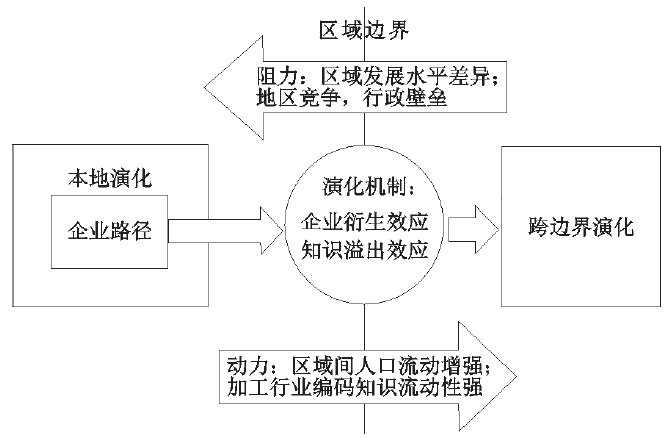
然而关于产业演化的讨论不应该仅仅局限于区域之内。本研究认为,企业生产路径的扩散不仅可以在本地区内发生,也可以在空间上扩散,演化过程可以跨越行政边界在邻近地区发生(图1)。主要有两方面的动力,首先知识的空间溢出效应可以通过区域贸易、核心科技人员、管理经验的流动等方式发生,导致成功的企业路径可以在区域间传播。然而知识按照其属性可以被划分为编码知识(codified knowledge)与缄默知识(tacit knowledge)[23],前者是已经被标准化、模式化的知识与技术,在空间的流动能力较强,而后者是在产品开发过程中关于战略设计步骤、设计策略和方法的知识[24],这类知识难以被编码,固化于地区的创新环境、人际网络与社会文化中[25],难以脱离其原有空间,流动能力较弱。不同产业的知识属性有所不同,知识密集型行业与创新产业会更加依赖于缄默知识[26],将导致其跨区域演化的能力较低。但现阶段的中国工业中,纯加工行业占据了较高的份额,这类行业的技术、生产工艺都已经较为成熟,其知识主要是固化在生产设备与生产流水线中的编码知识,企业自身的创新、创意往往较少,这显然会强化产业跨边界演化的趋势。另一方面,在过去的几十年来里人口的流动性大大增强,中国政府对交通设施进行了较高的投资,使得区域间的交通可达性有了显著的改善,并且逐渐放宽了户籍管理制度,减弱了人口流动的管制,这些因素导致劳动力在区域间的流动性显著增强[27],国有企业改革降低了人们对于原单位的依赖,使企业与行业间的劳动力流动也有所增强[28]。劳动力的流动将间接地把其原来所在企业的生产路径带到其邻近地区与相关产业,综上所述,在中国现阶段的产业发展背景下,跨边界演化具有较强的动力。
然而与本地演化过程相比,企业生产路径的区域间传播要跨越地理距离与行政边界的限制,面临一定的阻力。首先,邻近地区与本地的产业发展水平可能存在差别,适合在本地发展的产业不一定在邻近地区仍然具有利润空间。一种产业的跨边界过程也是其与一个新地区相融合的过程,如果该产业在邻近地区没有较好的发展基础和一定的配套产业则说明该产业跨越边界进行演化面临成本较高,跨界演化阻力较大,中国各地区之间产业发展水平相差较大[29],会给跨边界演化带来较高的壁垒。其次,2002年国家实行了企业所得税和个人所得税的分税改革,使得地方政府对于地区增值税的依赖程度明显增高,所以地方政府会出于保护税基的目的来实行区域保护主义。同时中国政府采用官员锦标赛的制度来决定官员的晋升,本地经济增长、地方财政增加、居民充分就业是官员面临的政治激励[30]。这种官员的晋升竞争直接导致了地方保护主义和重复建设[31]。所以在财政激励与政治激励两方面的动力之下,地区间竞争愈演愈烈。地区竞争主要体现在地方政府通过地区市场封锁、限制地区间贸易与企业间合作等手段控制生产要素在区域间的流动,这种限制行为在省级边界上体现得尤其突出,Young研究认为中国各个省份之间的劳动生产率与商品价格方面存在巨大差异,表明中国市场的一体化程度没有加强,反而有日益分割的趋势,庞塞特认为中国各省间的贸易壁垒使得商品在流动中被征收了46%的“关税”,几乎与欧盟的成员国之间的关税相当[32]。所以省间的分权作用一方面会限制生产要素的自由流动,另一方面各省具有不同的制度条件,适合于一个省的生产路径不一定适合于其他省份,所以跨行政边界的演化过程有可能受到分权化力量的阻力,尤其是省级边界有可能对演化过程产生明显的阻碍作用。
基于以上分析,提出以下研究假设:
假设一:企业生产路径可以在空间上发生扩散,演化行为可以跨越边界发生,邻近地区的产品优势度越高,本地区发展该产品的可能性越大,同时不同行业的跨边界演化能力有显著差别。
假设二:在中国各省间行政、财政的分权化作用下,相比于地级市边界,省级边界将对演化作用产生更强的壁垒。
假设三:本地区具有该产业相关性行业的区域将降低跨边界演化的成本,提高其发生概率。
本文采用2002~2013年中国(不包括港澳台)的出口数据,数据来源于中国海关数据库。研究中以地级市为地区单元,排除了属于海南省的、数据不能匹配的地区以及每年的出口额都低于5万元的地区。
关于产品,本文使用的是HS编码分类的4位数产品。在本文的研究时间内,HS编码于2002年、2007年和2012年进行过较大幅度修订,加入了部分新的产品编码,部分产品代码也进行了更改,很难与之前时期的数据进行匹配。所以基于数据的限制,本文在构建模型时仅使用2002~2011年的数据,并以HS编码统一为原则将数据分为两个时段,分别为2002~2006年、2007~2011年。
为了探究地理邻近与地区产品结构之间的关系,本文首先比较地区之间产品结构的相似性。为此,我们首先计算每个地区每种产品的区位熵(
式中,
为了衡量地区之间出口产品结构的相似性,本文按照Bahar等[33]的方法定义地区c与c′ 之间出口相似性指数(
式中,
为了研究地区产品演化是否能够跨边界以及跨边界演化的机制,本文按照HS编码调整的时间将2002~2011年分为两个时期进行了动态分析。在动态分析中,排除了浙江舟山市,因为其不存在相邻的地区。在Bahar[33]和Boschma[17]的研究基础上,估计以下回归方程:
式中,
本研究的核心问题是跨边界演化,所以关心的变量是
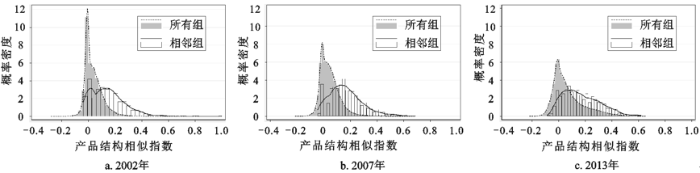
本文选取2002年、2007年和2013年的数据分析各地区之间产品结构相似性与地理邻近的关系,得出所有地区和邻近地区的两组核密度函数,见图2。
2002、2007、2013年3个代表年份中,除2002年的相邻组呈现双峰分布的态势外,所有组和相邻组的产品相似性分布函数都表显现出偏态分布的趋势,但在曲线形态与峰值方面具有显著的差别。3个年份中,所有组的峰值大致都位于0处,说明整体上各地级市之间的产品结构没有表现出明显的相关性,但相邻组的分布函数峰值都显著大于零,说明与所有组对比,相邻区域具有更高的产品结构相似性。对3个年份的邻近地区分布函数纵向比较发现,其分布状态发生了显著的变化,2007年与2002年相比,相邻地区的分布函数的左侧峰值消失,说明在2002年时仍然有大部分邻近地区之间产品结构完全不相似,但到了2007年这部分地区的产品结构开始出现了显著的相似趋势。2013年与2007年相比,邻近地区产品结构分布函数的右侧明显升高,相似指数高于0.2的邻近地区比例显著增多,这说明在2007~2013年间很多邻近区域之间的联系程度加强,表现出了更高的产品结构相似程度。
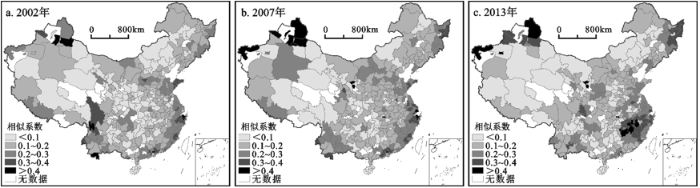
将产品结构的相似性分解到各个地级单元得到图3,发现产品结构相似指数存在显著的空间差异。总体上,相似指数在东南沿海地区最高,并从东南部向西北方向递减。纵向比较3个年份的相似指数空间分布可以发现明显的差异,首先相似地区比例明显增多,其次随时间发展,邻近地区产品结构相似度高的地区出现了明显的从沿海地区向内陆扩散的趋势,2002年时邻近地区相似度的高值区域主要集中在从山东半岛到珠三角的东部海岸线,2007年时开始出现了向华北以及南方内陆地区的扩散趋势,到了2013年产品结构相似度高值集聚区从沿海地区转移到了浙江西部、福建西部、以及江西等南方内陆地区。同时东北以及新疆西部等区域也逐渐出现了部分产品结构相似度的高值区域。
待估计方程中含有产品和地区的高维固定效应,通过两组高维固定效应的线性模型估计方法实现,利用Stata软件来进行线性概率模型的参数估计。因为线性概率模型存在异方差的问题,所以在模型估计中使用的是稳健性的标准误。通过观察解释变量的Pearson相关系数矩阵,发现变量之间相关系数的绝对值一般都在0.3以下,说明解释变量之间的多重共线性现象很弱,对模型估计影响较小。在社会科学中,回归方程中的R2过低是很正常的,对于截面模型来说更是如此,看似很低的R2值并不意味着回归方程没有用,把R2作为评价计量经济分析成功与否的主要准则可能会带来许多麻烦[35]。本文重点关注跨边界演化这个变量在决定地区产品结构中的地位如何。所以基于已有的文献,模型控制了影响地区产品发展的local ability相关变量,并探讨了本研究所关心的变量,该变量显著就说明本文的结论是有支撑的。
对于全国总体,分3个阶段将自变量纳入模型中(表1)。回归结果发现,本地区前一阶段的产品区位熵与相关产业的密度对本期该产品的区位熵的上升具有显著的正向影响,证明中国地级市尺度的产品发展也遵循演化的规律,新产品以现有产品结构为基础产生,原有相关产业提供技术、劳动力等生产要素,经过重新组合衍生出新产品。同时如果该种产品的原有区位熵较高,其区位熵在下一阶段发生跳跃的概率也会显著增加。说明新进入某地区的主导产品往往不是突然间出现的,从非主导产品变为主导产品需要一定的前期积累,进而开始产品发展的加速过程,使其在某一时段完成突变。
表1 全国模型估计结果
Table 1 The estimation results of national scale
| 模型 ① | 模型 ② | 模型 ③ | |
|---|---|---|---|
| 0.278*** | 0.278*** | 0.278*** | |
| (0.02) | (0.02) | (0.02) | |
| 0.796*** | 0.794*** | 0.804*** | |
| (0.0897) | (0.0896) | (0.0916) | |
| 0.00427*** | 0.00319*** | 0.000892 | |
| (0.000479) | (0.000658) | (0.00142) | |
| -0.000983 | -0.00132 | ||
| (0.00281) | (0.00282) | ||
| 0.00153* | 0.00176** | ||
| (0.000843) | (0.000853) | ||
| 0.00367** | |||
| (0.00187) | |||
| R2 | 0.071 | 0.071 | 0.071 |
如模型①所示,邻近地区变量
上述结论表明,在中国地级市尺度,跨边界演化现象确实存在,对于某种产品,邻近地区较高的区位熵会显著增加本地发展该产品的几率。但是跨边界演化面临一些壁垒,由于各省之间的财政、行政的分权化作用,省内地级市之间的演化作用明显强于跨越省界的演化。
分地区模型可以发现(表2),东、中、西3个地区中,东部地区与西部地区邻近区位熵
西部地区
表2 分地区分产品模型估计结果
Table 2 The estimation results of different areas and different products
| 模型 ④ | 模型 ⑤ | 模型 ⑥ | 模型 ⑦ | 模型 ⑧ | |
|---|---|---|---|---|---|
| 0.247*** | 0.313*** | 0.361*** | 0.419*** | 0.202*** | |
| (0.0226) | (0.0481) | (0.0635) | (0.126) | (0.038) | |
| 1.607*** | 0.513*** | 0.298*** | 0.909*** | 1.043*** | |
| (0.167) | (0.121) | (0.111) | (0.22) | (0.166) | |
| -0.00623** | 0.00225 | 0.0130*** | 0.00167 | -0.00046 | |
| (0.00305) | (0.00321) | (0.00418) | (0.00847) | (0.0033) | |
| -0.00368 | -0.00356 | 0.0107** | 0.0108 | 0.0136* | |
| (0.00372) | (0.00467) | (0.00489) | (0.0146) | (0.00742) | |
| -0.00097 | 0.00323** | 0.00262* | -0.00253 | -0.00121 | |
| (0.00134) | (0.00134) | (0.00142) | (0.00557) | (0.00238) | |
| 0.0188*** | 0.00277 | -0.0116*** | 0.00871 | 0.00805* | |
| (0.00576) | (0.00428) | (0.00439) | (0.0106) | (0.00411) | |
| 样本 | 58558 | 45981 | 23055 | 2791 | 18100 |
| R2 | 0.083 | 0.08 | 0.147 | 0.241 | 0.127 |
同时,由于不同的生产范式与要素投入,不同产业的跨边界演化过程可能存在明显的差别,按照傅钧文对于各二位数产业要素投入的分类,选取交通运输设备制造业代表技术密集型产业,纺织服装业代表劳动力密集型产业[36],对比具有不同知识属性的产品的演化过程。模型⑦、模型⑧结果显示,地区交通运输设备制造业产品主要受到本地区的该产品原有区位熵和相关产品密度的影响,而邻近地区的产品区位熵对其没有显著的影响,与此不同的是,纺织服装行业的产品却表现出明显的向相关产业基础较好的地区扩散的趋势。行业对比的结果说明跨边界演化过程存在明显的行业差异,技术密集型行业更依赖绑定知识、制度环境等绑定于本地的资源,产品演化只发生在本地尺度,难以跨越空间发生。而传统产业的技术工艺都已经较为成熟,跨越空间传播的成本较低,所以更容易发生跨边界演化过程。
本研究证实,中国地级市尺度下,产品跨边界演化情况确实存在,总体上邻近地区较高的产品区位熵会增加本地区该产品出现的概率。其过程会受到一些因素的影响,并且不同的地区影响机制存在差异。对于东部地区,只有具备这种产业发展的支持性条件,即存在一定的技术相关产业时,跨边界演化过程才可能发生。这是由于东部地区市场化程度较高、交通条件较好,导致区域间产业分工、竞争明显,本地产业基础较好的地区会利用邻近地区的溢出作用发展新产业。而西部地区区域间产业发展较为孤立,市场条件较差,相关的产业基础较好的地区会倾向于吸收东中部地区的产业转移。同时在分权化作用的影响下,省边界相比于地级市边界对于演化有更高的阻碍作用,东部地区的区域一体化程度较高,这种分权的阻力较低。另一方面,不同行业的跨边界演化过程有所不同,技术密集型行业对于知识、技术等有较高的要求,这些资源具有绑定于本地的倾向,在空间的传播的衰减速度较快,导致其跨边界演化趋势较弱。而劳动力密集型行业已经进入了范式化的生产模式,在空间传播阻力较小,表现出更明显的跨边界演化现象。
实现区域一体化的核心问题是促进区域间产业的协调发展,演化经济地理学为其提供了新的思路,欠发达地区需要学习发达地区的产业发展路径来突破自身的发展瓶颈。本研究发现这一过程存在较大的阻力,其中省间的分权是较大的壁垒,尤其在市场环境较差的中西部,地区行政边界显著地阻碍产品的跨边界演化。为保证区域一体化进程的稳步发展,需要降低产业空间演化的行政阻力。同时本地相关产业的密度对跨边界演化具有决定性的作用,说明地区如果想要引进某一产业,应该首先集中力量打造自身的产业基础,吸收与该产业相关的资本、专业化技术、人才,提高区域竞争能力,从而利用跨边界演化的力量吸引该产业的进入。
本研究仅仅关注于邻近地区的跨区域演化,实际上区际要素流动所导致的跨区域演化是一个更加复杂的过程,除空间距离的邻近以外,地区之间的政策邻近性、交通可达性、以及地区文化亲缘程度都会对产品结构的跨区域演化产生显著的影响,这些问题需要在后续研究中进一步探讨。
The authors have declared that no competing interests exist.
| [1] |
How do regions diversify over time? Industry relatedness and the development of new growth paths in regions [J].https://doi.org/10.1111/j.1944-8287.2011.01121.x URL Magsci [本文引用: 1] 摘要
abstract The question of how new regional growth paths emerge has been raised by many leading economic geographers. From an evolutionary perspective, there are strong reasons to believe that regions are most likely to branch into industries that are technologically related to the preexisting industries in the regions. Using a new indicator of technological relatedness between manufacturing industries, we analyzed the economic evolution of 70 Swedish regions from 1969 to 2002 with detailed plant-level data. Our analyses show that the long-term evolution of the economic landscape in Sweden is subject to strong path dependencies. Industries that were technologically related to the preexisting industries in a region had a higher probability of entering that region than did industries that were technologically unrelated to the region's preexisting industries. These industries had a higher probability of exiting that region. Moreover, the industrial profiles of Swedish regions showed a high degree of technological cohesion. Despite substantial structural change, this cohesion was persistent over time. Our methodology also proved useful when we focused on the economic evolution of one particular region. Our analysis indicates that the Link枚ping region increased its industrial cohesion over 30 years because of the entry of industries that were closely related to its regional portfolio and the exit of industries that were technologically peripheral. In summary, we found systematic evidence that the rise and fall of industries is strongly conditioned by industrial relatedness at the regional level.
|
| [2] |
The emergence of new industries at the regional level in Spain: a proximity approach based on product relatedness [J].https://doi.org/10.1111/j.1944-8287.2012.01170.x URL Magsci 摘要
How do regions diversify over time? Inspired by recent studies, we argue that regions diversify into industries that make use of capabilities in which regions are specialized. Since the spread of capabilities occurs through mechanisms that have a strong regional bias, we expect that capabilities that are available at the regional level play a larger role than do capabilities that are available at the country level for the development of new industries. To test this hypothesis, we analyze the emergence of new industries in 50 Spanish regions at the NUTS 3 level in the period 1988鈥2008. We calculate the capabilitydistance between new export products and existing export products in Spanish regions and provide econometric evidence that regions tend to diversify into new industries that use similar capabilities as existing industries in these regions. We show that proximity to the regional industrial structure plays a much larger role in the emergence of new industries in regions than does proximity to the national industrial structure. This finding suggests that capabilities at the regional level enable the development of new industries.
|
| [3] |
Relatedness, industrial branching and technological cohesion in US metropolitan areas [J].https://doi.org/10.1080/00343404.2013.806793 URL 摘要
This paper builds on and complements work by evolutionary economic geographers on the role of industry relatedness for regional economic development and extends this work into a number of methodological and empirical directions. First, while recent work defines relatedness through co-occurrence, this paper measures relatedness as intensity of input-output links between industry pairs. Second, this measure is employed to examine industry evolution in 360 U.S. metropolitan areas over the period 1977-1997. The paper confirms the findings of existing work: Industries are more likely to be members of and enter and less likely to exit a metropolitan industry portfolio if they are technologically related to those industries. Third, based on average industry relatedness in a metropolitan area, an employment weighted measure of metropolitan technological cohesion is developed. Changes in technological cohesion can then be decomposed into selection, entry and exit effects revealing that the change in technological cohesion is not only due to the entry and exit of related industries but employment growth in strongly related incumbent industries.
|
| [4] |
Shutters S T et al. Urban economies and occupation space: Can they get “there” from “here” [J].https://doi.org/10.1371/journal.pone.0073676 URL PMID: 24040021 [本文引用: 1] 摘要
Much of the socioeconomic life in the United States occurs in its urban areas. While an urban economy is defined to a large extent by its network of occupational specializations, an examination of this important network is absent from the considerable body of work on the determinants of urban economic performance. Here we develop a structure-based analysis addressing how the network of interdependencies among occupational specializations affects the ease with which urban economies can transform themselves. While most occupational specializations exhibit positive relationships between one another, many exhibit negative ones, and the balance between the two partially explains the productivity of an urban economy. The current set of occupational specializations of an urban economy and its location in the occupation space constrain its future development paths. Important tradeoffs exist between different alternatives for altering an occupational specialization pattern, both at a single occupation and an entire occupational portfolio levels.
|
| [5] |
The economy of cities [M]. |
| [6] |
A theoretical framework for evolutionary economic geography: industrial dynamics and urban growth as a branching process [J].https://doi.org/10.1093/jeg/lbm018 URL [本文引用: 1] 摘要
We propose a framework that specifies the process of economic development as an evolutionary branching process of product innovations. Each product innovation provides a growth opportunity for an existing firm or a new firm, and for an existing city or a new city. One can then obtain both firm size and city size distributions as two aggregates resulting from a single evolutionary process. Gains from variety at the firm level (economies of scope) and the urban level (Jacobs externalities) provide the central feedback mechanism in economic development generating strong path dependencies in the spatial concentration of industries and the specialisation of cities. Gains from size are also expected, yet these are ultimately bounded by increasing wages. The contribution of our framework lies in providing a micro-foundation of economic geography in terms of the interplay between industrial dynamics and urban growth. The framework is sufficiently general to investigate systematically a number of stylised facts in economic geography, while at the same time it is sufficiently flexible to be extended such as to become applicable in more specific micro-contexts. A number of extensions related to the concepts of knowledge spillover and lock-in, are also discussed.
|
| [7] |
|
| [8] |
Technological relatedness and regional branching [M] |
| [9] |
The spatial evolution of the British automobile industry: Does location matter? [J].https://doi.org/10.1093/icc/dtm004 URL [本文引用: 1] 摘要
This article aims to describe and explain the spatial evolution of the automobile sector in Great Britain from an evolutionary perspective. This analysis is based on a unique database of all entries and exits in this sector during the period 1895–1968, collected by the authors. Cox regressions show that spinoff dynamics, agglomeration economies and time of entry have had a significant effect on the survival rate of automobile firms during the period 1895–1968. Copyright 2007 , Oxford University Press.
|
| [10] |
Regional innovation systems: the integration of local ‘sticky’ and global ‘ubiquitous’ knowledge [J].https://doi.org/10.1023/A:1013100704794 URL [本文引用: 1] 摘要
The paper examines how firms in three regional clusters in Norway dominated by shipbuilding, mechanical engineering and electronics industry, respectively exploit both place-specific local resources as well as external, world-class knowledge to strengthen their competitiveness. From these case-studies we make four points: (1) Ideal-typical regional innovation systems, i.e., regional clusters ‘surrounded’ by supporting local organisations, is rather uncommon in Norway. (2) External contacts, outside of the local industrial milieu, are crucial in innovation processes also in many SMEs. (3) Innovation processes may nevertheless be regarded as regional phenomena in regional clusters, as regional resources and collaborative networks often have decisive significance for firms' innovation activity. (4) Regional resources include in particular place-specific, contextual knowledge of both tacit and codified nature, that, in combination, is rather geographically immobile.
|
| [11] |
Clusters and knowledge: local buzz, global pipelines and the process of knowledge creation [J]. |
| [12] |
Principles and practices of knowledge creation: On the organization of “buzz” and “pipelines” in life science communities [J].https://doi.org/10.1111/j.1944-8287.2008.00004.x URL [本文引用: 1] 摘要
This article links up with the debate in economic geography on “local buzz” and “global pipelines” as two distinct forms of interactive knowledge creation among firms and related actors and argues for a rethinking of the way social scientists should approach interactive knowledge creation. It highlights the importance of combining the insights from studies of clusters and innovation systems with an activity-oriented approach in which more attention is paid to the specific characteristics of the innovation processes and the conditions underpinning their organization. To illustrate the applicability and added value of such an alternative approach, the notion of embeddedness is linked with some basic ideas adopted from the literature on knowledge communities. The framework is then applied to a study of innovation activities conducted by firms and academic research groups working with biotechnology-related applications in the Swedish part of the Medicon Valley life science region. The findings reveal that local buzz is largely absent in these types of activities. Most interactive knowledge creation, which appears to be spontaneous and unregulated, is, on closer examination, found safely embedded in globally configured professional knowledge communities and attainable only by those who qualify.
|
| [13] |
Geographic localization of international technology diffusion [J].https://doi.org/10.1257/000282802760015630 URL [本文引用: 1] 摘要
Convergence in per capita income across countries turns on whether technological knowledge spillovers are global or local in a large class of models. This Paper estimates the amount of spillovers from R&D expenditures in major industrialized countries on a geographic basis. A new data set is used which encompasses most of the world's innovative activity at the industry-level between the years 1970 and 1995. First, I find that technological knowledge is to a substantial degree local, not global, as the benefits from foreign spillovers are declining with distance. I estimate that the distance at which the amount of technological knowledge is halved is about 1,200 kilometres. Second, while technological knowledge has become considerably more global over time, strong spatial patterns do persist. I also find that language skills are important for diffusion, which suggests that a substantial portion of international technology diffusion is unrelated to trade in high-technology goods.
|
| [14] |
International technology diffusion [J].https://doi.org/10.1257/0022051042177685 URL 摘要
ABSTRACT I discuss the concept and empirical importance of intemational technology diffusion from the point of view of recent work on endogenous technological change. In this literature, technologyis viewed as technological knowledge. I first review the maj or concepts, and how intemational technology diffusion relates to other factors affecting economic growth in open economies. The following main section of the paper provides a review of recent empirical results on (i) basic results in intemational technology diffusion; (ii) the importance of specific channels of diffusion, in particular trade and foreign direct investment; (iii) the spatial distribution of technological knowledge, and (iv) other issues.
|
| [15] |
Innovation and spillovers in regions: Evidence from European patent data [J].https://doi.org/10.1016/S0014-2921(02)00307-0 URL [本文引用: 1] 摘要
This paper estimates the effect of research externalities in generating innovation. We use R&D and patent data for European Regions in the 1977–1995 period. We find that spillovers are very localized and exist only within a distance of ja:math . The estimates are robust to simultaneity, omitted variable bias, different specifications of distance functions, country and border effects. However the size of these spillovers is small. Doubling R&D spending in a region would increase the output of new ideas in other regions within ja:math only by 2–3%, while it would increase the innovation of the region itself by 80–90%.
|
| [16] |
Neighbors and the Evolution of the Comparative Advantage of Nations: Evidence of International Knowledge Diffusion? [J].https://doi.org/10.1016/j.jinteco.2013.11.001 URL Magsci [本文引用: 1] 摘要
The literature on knowledge diffusion shows that knowledge decays strongly with distance. In this paper we document that the probability a product is added to a country?s export basket is, on average, 65% larger if a neighboring country is a successful exporter of that same product. For existing products, growth of exports in a country is 1.5 percent higher per annum if it has a neighbor with comparative advantage in these products. While these results could be driven by a common third factor that escapes our controls, they align with our expectations of the localized character of knowledge diffusion.
|
| [17] |
|
| [18] |
区域一体化的理论概念及其发展 [J].https://doi.org/10.11820/dlkxjz.1997.02.007 URL [本文引用: 1] 摘要
为了明确国际性区域经济合作的理论和实践对中国开展区域经济合作的参照性,本文对国际性区域合作的基本理论概念及其演变进行较为系统的总结和分析。首先阐述了用来描述在国家之间建立区域化、集团化合作关系的基本概念——“区域一体化”的理论内涵,然后概括分析了60年代以来,特别是冷战结束后,世界经济的区域化、集团化发展实践对“区域一体化”概念的传统理论界定的挑战,并对近年来有关世界范围内区域经济合作现象的理论概念的新发展进行了概括总结,在此基础上,提出澄清有关认识的必要性。
The conception of regional integration and related development. https://doi.org/10.11820/dlkxjz.1997.02.007 URL [本文引用: 1] 摘要
为了明确国际性区域经济合作的理论和实践对中国开展区域经济合作的参照性,本文对国际性区域合作的基本理论概念及其演变进行较为系统的总结和分析。首先阐述了用来描述在国家之间建立区域化、集团化合作关系的基本概念——“区域一体化”的理论内涵,然后概括分析了60年代以来,特别是冷战结束后,世界经济的区域化、集团化发展实践对“区域一体化”概念的传统理论界定的挑战,并对近年来有关世界范围内区域经济合作现象的理论概念的新发展进行了概括总结,在此基础上,提出澄清有关认识的必要性。
|
| [19] |
关于京津冀区域一体化发展的思考 [J].URL 摘要
从区域一体化的角度,分析了京津冀区域发展的现状,指出京津冀区域发展的核心问题在于制定恰当的公共政策,实现产业与人口发展的有机衔接。一方面,深化区域产业结构调整,切实提高产业创新和升级能力 另一方面,抓好区域产业结构优化升级与人才和劳动力市场衔接,实现产业与人口发展的无缝对接。从处理好人口、经济和生态关系的角度,提出要改变人口向首都过度聚集现象,就必须完善京津冀区域合作机制,提高周边城市的人口吸纳能力。最后,围绕提升区域产业创新与升级能力、促进人口迁移与区域协同发展、有效疏导首都人口压力等问题讨论了相应的公共政策。
Thoughts on the development of Beijing-Tianjin-Hebei regional integration. URL 摘要
从区域一体化的角度,分析了京津冀区域发展的现状,指出京津冀区域发展的核心问题在于制定恰当的公共政策,实现产业与人口发展的有机衔接。一方面,深化区域产业结构调整,切实提高产业创新和升级能力 另一方面,抓好区域产业结构优化升级与人才和劳动力市场衔接,实现产业与人口发展的无缝对接。从处理好人口、经济和生态关系的角度,提出要改变人口向首都过度聚集现象,就必须完善京津冀区域合作机制,提高周边城市的人口吸纳能力。最后,围绕提升区域产业创新与升级能力、促进人口迁移与区域协同发展、有效疏导首都人口压力等问题讨论了相应的公共政策。
|
| [20] |
长三角区域物流一体化与区域经济一体化互动机理及规划探讨 [J].https://doi.org/10.3969/j.issn.1006-3102.2005.32.209 URL [本文引用: 1] 摘要
长三角区域经济一体化正倍受关注,区域物流在区域经济中占有非常重要的地位.本文综合区域经济与区域物流的理论,在此基础上对区域经济与区域物流的发展关系进行了分析,结合长三角区域经济发展现状,分析了区域物流促进区域经济发展的重要性以及应着重解决定问题.
Dicussion on the interaction and planning of regional logistics integration and regional economic integration in the Yangtze River Delta. https://doi.org/10.3969/j.issn.1006-3102.2005.32.209 URL [本文引用: 1] 摘要
长三角区域经济一体化正倍受关注,区域物流在区域经济中占有非常重要的地位.本文综合区域经济与区域物流的理论,在此基础上对区域经济与区域物流的发展关系进行了分析,结合长三角区域经济发展现状,分析了区域物流促进区域经济发展的重要性以及应着重解决定问题.
|
| [21] |
|
| [22] |
The spatial evolution of the British automobile industry: Does location matter? [J].https://doi.org/10.1093/icc/dtm004 URL [本文引用: 1] 摘要
This article aims to describe and explain the spatial evolution of the automobile sector in Great Britain from an evolutionary perspective. This analysis is based on a unique database of all entries and exits in this sector during the period 1895–1968, collected by the authors. Cox regressions show that spinoff dynamics, agglomeration economies and time of entry have had a significant effect on the survival rate of automobile firms during the period 1895–1968. Copyright 2007 , Oxford University Press.
|
| [23] |
Why all this fuss about codified and tacit knowledge? [J].https://doi.org/10.1093/icc/11.2.245 URL [本文引用: 1] 摘要
This paper starts with a critical assessment of the recent paper by Cowan, Foray and David. It also provides the authors' own assessment of why the tacit-codified distinction is important in relation to economic analysis and knowledge management practice. The criticism of Cowan, Foray and David centres on three points. Firstly, it is argued that the discussion on codification must make the fundamental distinction between knowledge about the world (know-what) and knowledge in the form of skills and competence (know-how). Secondly, it is argued that the dichotomy between codifiable and non-codifiable knowledge is problematic since it is rare that a body of knowledge can be completely transformed into codified form without losing some of its original characteristics and that most forms of relevant knowledge are mixed in these respects. Thirdly, we contest their implicit assumption that codification always represents progress. We conclude that for these reasons their intellectual exercise of extending definitions of what is codified and possible to codify, while in principle addressing very important issues related to innovation policy and knowledge management, ends up having limited practical implications for these areas. Copyright 2002, Oxford University Press.
|
| [24] |
知识密集产业企业间缄默知识传递方式及影响因素研究[D] .The research on tacit knowledge transfer among enterprises in knowledge-intensive industry and its influence factors. |
| [25] |
Knowledge spillovers and local innovation systems: a critical survey [J].https://doi.org/10.1093/icc/10.4.975 URL [本文引用: 1] 摘要
This paper re-examines critically the growing literature on localized knowledge spillovers (LKSs), and finds the econometric evidence on the subject still lacking a firm theoretical background, especially in relation to the more recent developments in the economics of knowledge. LKSs as externalities are too narrow a concept to embrace the wide variety of knowledge transmission mechanisms that may, or may not, spread ideas and expertise while keeping the diffusion process bounded in space.
|
| [26] |
Innovation in cities: Science-based diversity, specialization and localized competition [J].https://doi.org/10.1016/S0014-2921(98)00047-6 URL [本文引用: 1] 摘要
Whether diversity or specialization of economic activity better promotes technological change and subsequent economic growth has been the subject of a heated debate in the economics literature. The purpose of this paper is to consider the effect of the composition of economic activity on innovation. We test whether the specialization of economic activity within a narrow concentrated set of economic activities is more conducive to knowledge spillovers or if diversity, by bringing together complementary activities, better promotes innovation. The evidence provides considerable support for the diversity thesis but little support for the specialization thesis.
|
| [27] |
中国省际劳动力流动的特征演变及经济合理性研究: 1995~2010 [J].https://doi.org/10.3969/j.issn.1003-3890.2013.08.003 URL [本文引用: 1] 摘要
通过比较1995—2010年三次人口调查数据,考察我国省际劳动力流动的特征演变及经济合理性。结果表明,1995—2010年我国省际劳动力流动数量上呈现出规模趋大,流入流出分布均呈空间极化和时间惯性,典型流入省区的流出增幅趋大,流动重心北移等特征。结构演变则表现为省际流动劳动力年龄分布趋于集中,纵比中年化与横比年轻化并存、受教育水平趋高但增幅趋小、经济型流动为主且日趋明显、中西部短期化流动倾向增强,东部和东北部则渐趋长期化、就业集中于二三次产业,且东部更趋向集中等。计量结果显示,1995—2010年的省际劳动力流动有助于促进地区经济发展和缩小省区间经济增长差距,具备经济合理性。
Study on the Feature and Economic Rationality of Inter-Provincial Labor Flows in China: 1995-2010. https://doi.org/10.3969/j.issn.1003-3890.2013.08.003 URL [本文引用: 1] 摘要
通过比较1995—2010年三次人口调查数据,考察我国省际劳动力流动的特征演变及经济合理性。结果表明,1995—2010年我国省际劳动力流动数量上呈现出规模趋大,流入流出分布均呈空间极化和时间惯性,典型流入省区的流出增幅趋大,流动重心北移等特征。结构演变则表现为省际流动劳动力年龄分布趋于集中,纵比中年化与横比年轻化并存、受教育水平趋高但增幅趋小、经济型流动为主且日趋明显、中西部短期化流动倾向增强,东部和东北部则渐趋长期化、就业集中于二三次产业,且东部更趋向集中等。计量结果显示,1995—2010年的省际劳动力流动有助于促进地区经济发展和缩小省区间经济增长差距,具备经济合理性。
|
| [28] |
人力资本与劳动力产业间流动 [J].
人力资本作为一种生产要素决定着产业的边际效率,在三次产业的劳动力间形成了收入差距,而收入差距又影响着劳动力在产业间的流动.同时,人力资本也影响着劳动力的流动性,人力资本含量越高,劳动力的流动性就越强.人力资本的城乡结构及其不同的积累方式决定了增加农村公共人力资本投资,能促进第一产业劳动力向二、三产业流动;城市人力资本能促进第二产业劳动力向第三产业流动,间接促进第一产业劳动力向二、三产业流动.
Human Capital and Inter-Industry Labor Mobility.
人力资本作为一种生产要素决定着产业的边际效率,在三次产业的劳动力间形成了收入差距,而收入差距又影响着劳动力在产业间的流动.同时,人力资本也影响着劳动力的流动性,人力资本含量越高,劳动力的流动性就越强.人力资本的城乡结构及其不同的积累方式决定了增加农村公共人力资本投资,能促进第一产业劳动力向二、三产业流动;城市人力资本能促进第二产业劳动力向第三产业流动,间接促进第一产业劳动力向二、三产业流动.
|
| [29] |
|
| [30] |
地方保护主义与中国省际贸易 [J].https://doi.org/10.3969/j.issn.1000-6249.2012.01.006 URL [本文引用: 1] 摘要
根据地方政府的财政收支、各地区的企业所有制结构以及地区间劳动力市场分割等三类指标,本文分析了地方保护主义如何影响中国的省际贸易。基于边界效应模型,本文的大多数实证结果表明:省际贸易的边界效应较低,地方财政收支和劳动力市场分割并没有显著的影响省际贸易,但是地方政府仍然出于保护本地国有企业的目的阻碍地区间贸易。地方保护主义作为一种贸易壁垒确实阻碍了全国市场的一体化。
Local Protectionism and Inter-provincial Trade in China. https://doi.org/10.3969/j.issn.1000-6249.2012.01.006 URL [本文引用: 1] 摘要
根据地方政府的财政收支、各地区的企业所有制结构以及地区间劳动力市场分割等三类指标,本文分析了地方保护主义如何影响中国的省际贸易。基于边界效应模型,本文的大多数实证结果表明:省际贸易的边界效应较低,地方财政收支和劳动力市场分割并没有显著的影响省际贸易,但是地方政府仍然出于保护本地国有企业的目的阻碍地区间贸易。地方保护主义作为一种贸易壁垒确实阻碍了全国市场的一体化。
|
| [31] |
晋升博弈中政府官员的激励与合作——兼论我国地方保护主义和重复建设问题长期存在的原因 [J].
过去大量的研究强调行政性分权和财政包干下地方官员的财政激励对区域经济发展及其互动的影响。本文建立了一个地方官员政治晋升博弈的简单模型,旨在强调地方官员的晋升激励对地区间经济竞争和合作的影响。由于政治晋升博弈的基本特征是一个官员的晋升直接降低另一个官员的晋升机会,即一人所得为另一人所失,这使得同时处于政治和经济双重竞争的地方官员之间的合作空间非常狭小,而竞争空间非常巨大。该模型理解我国区域经济竞争与合作问题提供了一个系统的视角和框架,它尤其有助于解释我国长期存在的地方保护主义、“大而全”的地区发展战略和地区间形形色色的产业“大战”和恶性竞争。
The Incentive and Cooperation of Government Officials in the Political Tournaments: An Interpretation of the Prolonged Local Protectionism and Duplicative Investments in China.
过去大量的研究强调行政性分权和财政包干下地方官员的财政激励对区域经济发展及其互动的影响。本文建立了一个地方官员政治晋升博弈的简单模型,旨在强调地方官员的晋升激励对地区间经济竞争和合作的影响。由于政治晋升博弈的基本特征是一个官员的晋升直接降低另一个官员的晋升机会,即一人所得为另一人所失,这使得同时处于政治和经济双重竞争的地方官员之间的合作空间非常狭小,而竞争空间非常巨大。该模型理解我国区域经济竞争与合作问题提供了一个系统的视角和框架,它尤其有助于解释我国长期存在的地方保护主义、“大而全”的地区发展战略和地区间形形色色的产业“大战”和恶性竞争。
|
| [32] |
中国入世:地方保护主义与省际贸易壁垒 [J].China’s Entry into WTO: Local Protectionism and Inter-Provincial Trade Barriers. |
| [33] |
Neighbors and the evolution of the comparative advantage of nations: Evidence of international knowledge diffusion? [J].https://doi.org/10.1016/j.jinteco.2013.11.001 URL Magsci [本文引用: 2] 摘要
The literature on knowledge diffusion shows that knowledge decays strongly with distance. In this paper we document that the probability a product is added to a country?s export basket is, on average, 65% larger if a neighboring country is a successful exporter of that same product. For existing products, growth of exports in a country is 1.5 percent higher per annum if it has a neighbor with comparative advantage in these products. While these results could be driven by a common third factor that escapes our controls, they align with our expectations of the localized character of knowledge diffusion.
|
| [34] |
Barabási A L et al. The product space conditions the development of nations [J].https://doi.org/10.1126/science.1144581 URL PMID: 17656717 [本文引用: 1] 摘要
Economies grow by upgrading the products they produce and export. The technology, capital, institutions, and skills needed to make newer products are more easily adapted from some products than from others. Here, we study this network of relatedness between products, or "product space," finding that more-sophisticated products are located in a densely connected core whereas less-sophisticated products occupy a less-connected periphery. Empirically, countries move through the product space by developing goods close to those they currently produce. Most countries can reach the core only by traversing empirically infrequent distances, which may help explain why poor countries have trouble developing more competitive exports and fail to converge to the income levels of rich countries.
|
| [35] |
|
| [36] |
上海工业行业要素密集度测算与产业分类 [J].
测算工业行业的要素密集度并依据此进行产业分类,有助于了解各行业所含生产要素的比例,有助于分析各行业在国民经济中的地位和作用,从而为制定经济发展战略提供依据。本文测算了上海“六·五”期间工业行业的技术密集度、劳动与资本密集度。在这基础上,本文应用作者过去的研究成果,将产业划分成四种类型,即技术资本密集型、非技术资本密集型、非技术劳动密集型和技术劳动密集型,并就推广应用该分类方法提出了初步设想。
Measurement of industrial factor density and classification of industry in Shanghai.
测算工业行业的要素密集度并依据此进行产业分类,有助于了解各行业所含生产要素的比例,有助于分析各行业在国民经济中的地位和作用,从而为制定经济发展战略提供依据。本文测算了上海“六·五”期间工业行业的技术密集度、劳动与资本密集度。在这基础上,本文应用作者过去的研究成果,将产业划分成四种类型,即技术资本密集型、非技术资本密集型、非技术劳动密集型和技术劳动密集型,并就推广应用该分类方法提出了初步设想。
|

/
| 〈 |
|
〉 |