Quantitative inversion of soil salinity and analysis of its spatial pattern in agricultural area in Shihezi of Xinjiang
Received date: 2014-03-03
Request revised date: 2014-09-08
Online published: 2014-11-10
Copyright
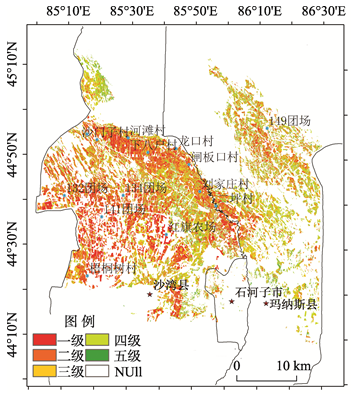
Salinization has been a serious threat to continuous farming and grain production security, therefore, the rapid inversion of soil salinity is particularly important. The monitoring and prevention of soil salinization are of great significance to agricultural sustainable development in Shihezi, Xinjiang. In this study, we took the remote sensing image of Landsat-8 OLI and the soil salinity of 72 samples measured in the field as a data base. Then we introduced the soil brightness index, soil moisture index, soil cover degree index and soil radiation level index. Finally we built feature remote sensing index to invert quantitatively the soil salinity of Land Reclamation District of Shihezi in Xinjiang, and analyzed the spatial pattern of it. The results showed that: ① The accuracy of characteristic remote sensing index value of image pixel to invert soil salinity which corresponded to the ground was better. The inversion method was feasible. REE and RMSM, the precision validation index of inversion model were 3.07 and 0.34 respectively, and retrieval accuracy was 66%; ② The distribution map of soil salinity with obvious grades and clear levels presented the pattern of 'one stripe and one region'. One stripe referred to the stripe with high salinization formed by Manas basin, mostly located in the alluvial plains, low-lying area, and reservoir areas. And one region referred to the region with serious salinization caused by soil texture. ③ In the farming areas, the non-salinization cotton area accounted for 14.02%, the mild salinization cotton area accounted for 21.38%, the moderate salinization cotton area accounted for 21.27%, severe salinization cotton area accounted for 29.99%, and saline accounted for 13.30% in cotton area. Some 35.40% of the cotton field was suitable for cultivation and 64.60% of the cotton field which needed to be improved. It is urgent to control soil salinization of farming areas.
CHEN Shi , GAO Chao , XU Bin , JIN Yunxiang , LI Jinya , MA Hailong , ZHAO Fen , GUO Jian , YANG Xiuchun . Quantitative inversion of soil salinity and analysis of its spatial pattern in agricultural area in Shihezi of Xinjiang[J]. GEOGRAPHICAL RESEARCH, 2014 , 33(11) : 2135 -2144 . DOI: 10.11821/dlyj201411013
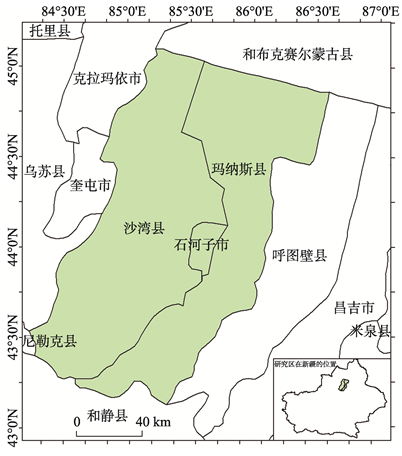
Fig. 1 The geographical situation of the study area图1 研究区位置图 |
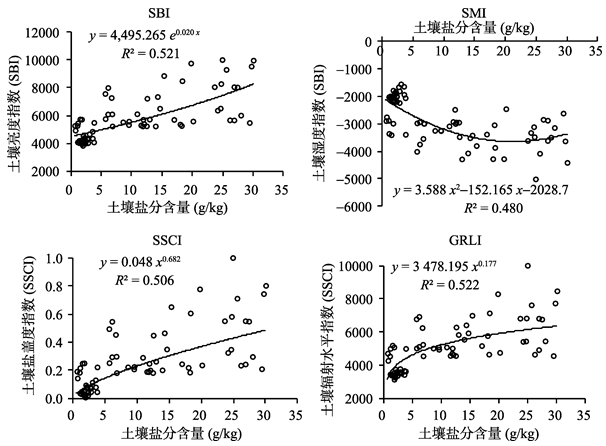
Fig. 2 The fitting scatter plot diagram of the feature remote sensing index value and the soil salinity图2 各种特征遥感指数值与土壤盐分含量拟合散点图 |
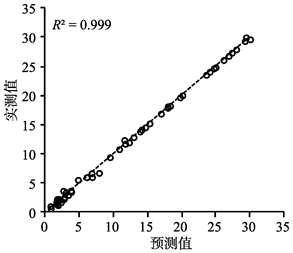
Fig. 3 The precision results of inversion model training of neural network图3 神经网络反演模型训练精度结果 |
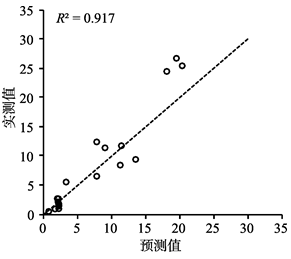
Fig. 4 The validation scatter plot of BP neural network inversion of soil salinity图4 BP神经网络反演土壤含盐量验证散点图 |
Tab. 1 The hierarchy standard table of soil salinization degree表1 土壤盐渍化程度等级划分标准表 |
| 等级 | 土壤含盐量S(g/kg) | 土壤盐渍化程度 |
|---|---|---|
| 五级 | 0≤S<3 | 非盐渍化土 |
| 四级 | 3≤S<6 | 轻度盐渍化土 |
| 三级 | 6≤S<10 | 中度盐渍化土 |
| 二级 | 10≤S<20 | 重度盐渍化土 |
| 一级 | S≥20 | 盐土 |
Fig. 5 The spatial pattern of inversion of soil salinity in cotton field图5 研究区棉田土壤盐分含量反演空间格局图 |
The authors have declared that no competing interests exist.
| [1] |
|
| [2] |
[
|
| [3] |
|
| [4] |
[
|
| [5] |
[
|
| [6] |
[
|
| [7] |
[
|
| [8] |
[
|
| [9] |
[
|
| [10] |
|
| [11] |
|
| [12] |
|
| [13] |
[
|
| [14] |
[
|
| [15] |
[
|
| [16] |
[
|
| [17] |
[
|
| [18] |
[
|
| [19] |
[
|
| [20] |
[
|
| [21] |
[
|
| [22] |
[
|
| [23] |
[
|
| [24] |
[
|
| [25] |
[
|
| [26] |
[
|
| [27] |
[
|
| [28] |
[
|
| [29] |
[
|
| [30] |
[
|
| [31] |
[
|
/
| 〈 |
|
〉 |