Changes of dry-hot wind hazard for winter wheat in the typical agricultural areas of Huang-Huai-Hai Plain: A case of Shangqiu
Received date: 2014-07-29
Request revised date: 2014-11-20
Online published: 2015-03-10
Copyright
Climate change is producing significant impacts on global agricultural production. Climatic variations affect crop production, and tend to be a key constraint of agricultural production, primarily on continuous increase of winter wheat yields worldwide. The great uncertainties in predicting the effects of climate change on wheat production are most likely due to less understanding of the responses of wheat production to extreme climatic factors, e.g. high temperatures, low humidity as well as high wind speed. Dry-hot wind hazard represents one of the main natural disasters for Chinese winter wheat production, especially in the Huang-Huai-Hai Plain. However, there still exist great uncertainties of the effects of dry-hot wind hazard on winter wheat production, mainly due to the gaps of long-term observations. Therefore, we selected Shangqiu as the case study area to determine the occurrence regularity of dry-hot wind hazard on winter wheat production in the Huang-Huai-Hai Plain. We analyzed regional meteorological data with daily resolution in the later growth stage of winter wheat during the period 1963-2012. In accordance with the meteorological industry standards of "Disaster Grade of Dry-hot Wind for Wheat" by the China Meteorological Administration, we synthetically analyzed the distribution of annual average days of dry-hot wind in winter wheat growing seasons and the associated responses to the climate change. Hence, the relationship between dry-hot wind times and winter wheat yields was examined. The results showed that the annual average days of light and severe dry-hot wind tended to decline in recent 50 years. Great inter-annual variations of light and severe dry-hot wind were observed. The significant inter-annual variations were related with the corresponding meteorological conditions of temperature, moisture and wind speed. The most serious damages of both light and severe dry-hot wind occurred in the 1960s, while less damages appeared in the 1980s and the last decade, which could be also explained by the corresponding temperature, moisture and wind speed conditions. From 1963 to 2012, a climatic mutation point of daily maximum temperature was found in 1972 (p>0.05). The wind speed at 14:00 and the relative humidity at 14:00 were closely related to the hazard. A climatic mutation point of the wind speed at 14:00 was found around 1984, and climatic mutation of the relative humidity at 14:00 was found in 1981 (p<0.05). Daily maximum temperature and wind speed at 14:00 and the relative humidity at 14:00 played a major role in the decreasing trend of dry-hot wind disaster, and the significant decrease of wind speed at 14:00 was a main factor in Shangqiu. Dry-hot wind hazard had a strong response to climate change. Yields of winter wheat were negatively correlated with annual average days of dry-hot wind in Shangqiu (p<0.05). In actual practices, great attention should be paid to the defense of dry-hot wind for winter wheat production. Thus, the most effective measures have to be taken to enhance the resistance of winter wheat to dry-hot wind hazard through improving field microclimate condition.
Key words: climate change; winter wheat; grain filling stage; dry-hot wind; Shangqiu
LI Hongzhong , ZHU Xinyu , SHI Benlin , HU Yunchuan , ZHANG Yi , ZHAO Shuang . Changes of dry-hot wind hazard for winter wheat in the typical agricultural areas of Huang-Huai-Hai Plain: A case of Shangqiu[J]. GEOGRAPHICAL RESEARCH, 2015 , 34(3) : 466 -474 . DOI: 10.11821/dlyj201503006
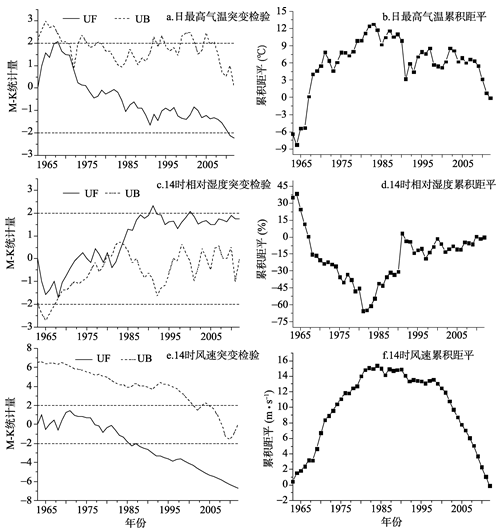
Fig.1 Mutation test and cumulative departure of daily maximum temperature, relative humidity at 14:00 and wind speed at 14:00图1 日最高气温、14时相对湿度、14时风速的突变检验及累积距平曲线 |
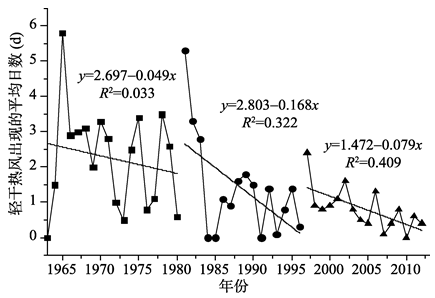
Fig. 2 Changes of annual average days of light dry-hot wind图2 轻度干热风发生平均日数变化曲线 |
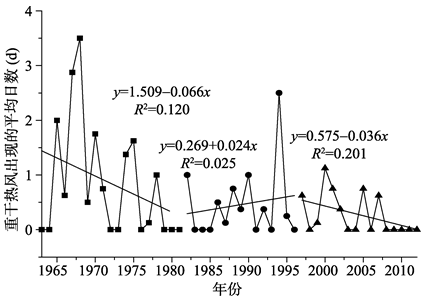
Fig. 3 Changes of annual average days of severe dry-hot wind图3 重度干热风发生平均日数变化曲线 |
Tab. 2 Correlation between the number of dry-hot wind days and climatic factors表2 干热风发生日数与气象要素之间的相关关系 |
| 平均温度 | 平均最高气温 | 平均最低气温 | 最高气温≥30 ℃日数 | 最高气温≥32℃日数 | |
|---|---|---|---|---|---|
| 相关系数 | 0.612 | 0.498 | 0.414 | 0.701 | 0.753 |
| 显著性水平 | 0.01 | 0.01 | 0.04 | 0.01 | 0.01 |
| 最高气温≥35℃日数 | 平均相对湿度 | 平均降水量 | 平均蒸发量 | 平均降水日数 | |
| 相关系数 | 0.594 | -0.604 | -0.497 | 0.408 | -0.639 |
| 显著性水平 | 0.01 | 0.01 | 0.03 | 0.05 | 0.01 |
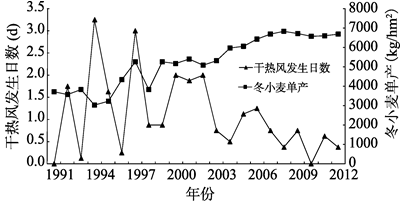
Fig. 4 The relationship of the number of dry-hot wind days and yield of winter wheat图4 干热风发生日数与冬小麦单产的相关关系 |
The authors have declared that no competing interests exist.
| [1] |
|
| [2] |
[
|
| [3] |
[
|
| [4] |
|
| [5] |
|
| [6] |
[
|
| [7] |
|
| [8] |
[
|
| [9] |
[
|
| [10] |
[
|
| [11] |
[
|
| [12] |
|
| [13] |
[
|
| [14] |
[
|
| [15] |
|
| [16] |
[
|
| [17] |
[
|
| [18] |
[
|
| [19] |
[
|
| [20] |
[
|
| [21] |
|
| [22] |
[
|
| [23] |
[
|
| [24] |
[
|
| [25] |
[
|
| [26] |
[
|
| [27] |
|
| [28] |
|
| [29] |
[
|
| [30] |
|
/
| 〈 |
|
〉 |