Paradigm and spatial pattern analysis of island settlements based on mixed-use development: A case study of Zhoushan work-live community
Received date: 2017-03-25
Request revised date: 2017-07-06
Online published: 2017-08-10
Copyright
Based on the empirical study of island mixed-use settlements and the theory of work-live community, this paper interprets the evolutionary perspective and motivation of island mixed-use settlements under the background of marine economy. It builds an evaluation model of mixed-use cells including three major aspects (time-space-population) based on analysis of the mixed-use elements of small work-live units. And then it makes a differential analysis of work-live cells by using STING method (statistical information grid) in each settlement homestead. On this basis, the paper deduces evolution mechanism of island settlements which is composed by diversified mixed-use factors, and estimates the settlement spatial form with the aid of GIS kernel density function method. Empirical result of Zhoushan mixed-use settlements manifests that different types of work-live elements have significant differences on space and time organization and social structure. From the perspective of the distribution of settlements space, mixed-use factors accord to the law of homogeneity-diffused, networked-interacted and centralized-aggregated. We divide settlement patterns into three types of spatial distribution including dissipation broken, cluster permeated and gradient expanded. Finally, the paper comes out several measures that are meaningful for the sustainable improvement of the plan and development of island mixed-use settlements, such as the work-live compatibility of mixed-use systems, organic integration of flexible institutions and smart growth of diverse communities.
Key words: mixed-use; island settlements; work-live community; spatial pattern; Zhoushan; Zhejiang
ZHU Xiaoqing , WU Yiqun , WENG Jiantao , WANG Zhu , GAO Weijun . Paradigm and spatial pattern analysis of island settlements based on mixed-use development: A case study of Zhoushan work-live community[J]. GEOGRAPHICAL RESEARCH, 2017 , 36(8) : 1543 -1556 . DOI: 10.11821/dlyj201708012
Tab. 1 Paradigm evolution and development dynamics of Zhoushan mixed-use settlements表1 舟山混合功能聚落演化范式与增长动因 |
| 演化范式 | I:就地转产 | II:厂坊内生 | III:商住一体 | |
|---|---|---|---|---|
| 典型样本 | 庙根村、南洞村 | 金山村、凤田村 | 路下徐村、蒲湾村 | |
| 聚居类型 | 旅居渔家集落 | 家庭工业组群 | 专业市场社区 | |
| 社群关系 | 血缘、地缘 | 地缘、业缘 | 血缘、地缘、业缘 | |
| 主导业态 | 渔家乐、艺术观光、文化旅居 | 海产加工、船舶配件制造 | 海产批发、工艺品零售 | |
| 生 成 动 因 | 社会 | 海岛新兴产业发展 | 海岛工业化进程加快 | 海岛城镇化建设推进 |
| 自然 | 海岛旅游资源 | 港口岸线资源 | 海洋水产资源 | |
| 开发 | 强内部作用、弱外部作用 | 弱内部作用、强外部作用 | 强内部作用、强外部作用 | |
| 政策 | 鼓励渔民“转产转业” | 坚持实施“以港兴市” | 积极推动“商住合建” | |

Tab. 2 Empirical analysis of work-live elements coupling of Zhoushan mixed-use settlements表2 舟山混合功能聚落的产住要素耦合实证分析 |
 |
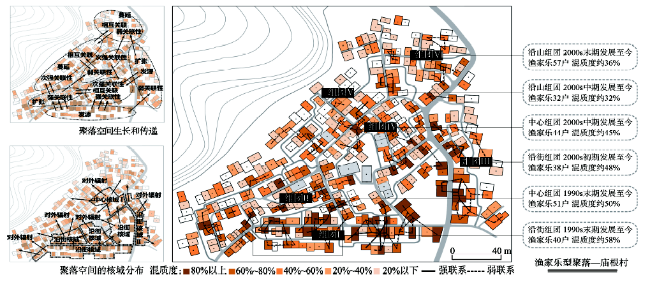
Fig. 1 Empirical analysis of mixed-use cells evolution in Miaogen recreational fishery settlement图1 庙根旅居渔家集落混质元胞演进的实态分析 |
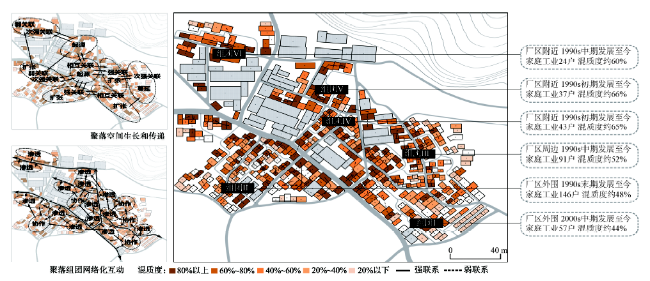
Fig. 2 Empirical analysis of mixed-use cells evolution in Jinshan cottage industry cluster图2 金山村家庭工业组群混质元胞演进的实态分析 |
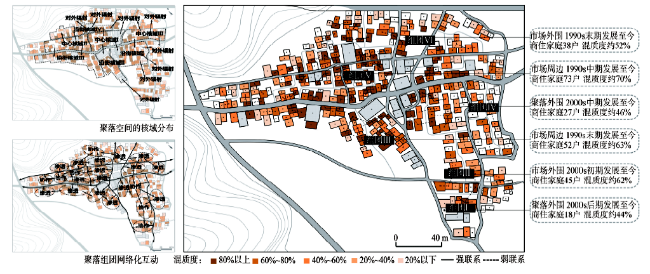
Fig. 3 Empirical analysis of mixed-use cells evolution in Luxiaxu specialized market community图3 路下徐专业市场社区混质元胞演进的实态分析 |
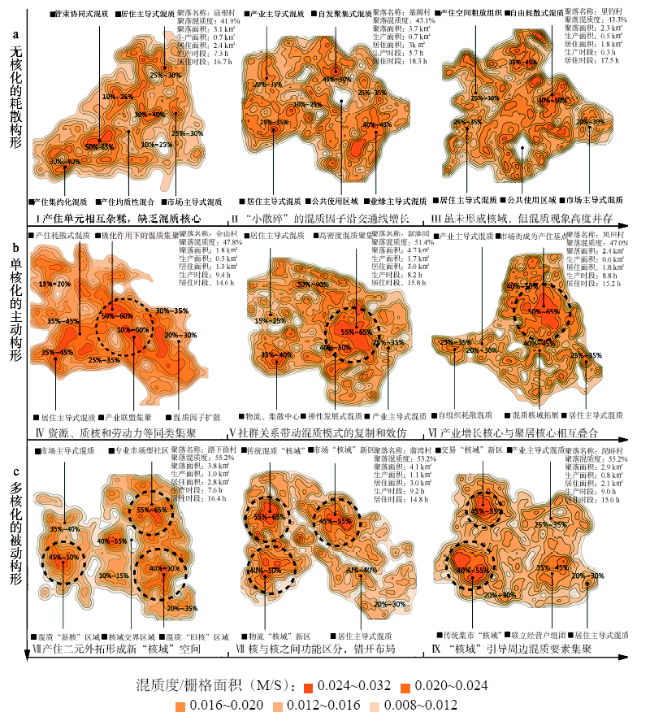
Fig. 4 Empirical analysis of work-live spatial patterns of Zhoushan mixed-use settlements图4 舟山混合功能聚落的产住混质空间形态实证分析 |
The authors have declared that no competing interests exist.
| [1] |
|
| [2] |
|
| [3] |
The United Nations Global Conference on the Sustainable Development of Small Island Developing States (Ungcsids). Barbados Programme of Action. , 2016-12-08.
|
| [4] |
Marine Fisheries Department of Republic of Korea. The Law of Island Development and Promotion. Soul: Marine Fisheries Department of Republic of Korea, 1992.
|
| [5] |
State of New South Wales, Department of Environment, Climate Change and Water, 2016-12-08.
|
| [6] |
|
| [7] |
|
| [8] |
|
| [9] |
|
| [10] |
|
| [11] |
|
| [12] |
[
|
| [13] |
[
|
| [14] |
[
|
| [15] |
[
|
| [16] |
[
|
| [17] |
[
|
| [18] |
[
|
| [19] |
[
|
| [20] |
[
|
| [21] |
[
|
| [22] |
[
|
| [23] |
[
|
| [24] |
|
| [25] |
|
| [26] |
[
|
| [27] |
[
|
| [28] |
[
|
| [29] |
[
|
| [30] |
[
|
| [31] |
[
|
| [32] |
[
|
| [33] |
[
|
| [34] |
[
|
| [35] |
[
|
/
| 〈 |
|
〉 |