The participation characteristics and coupling relationship of China, Japan and South Korea in the ASEAN manufacturing value chain: Empirical research based on TiVA database
Received date: 2019-02-27
Request revised date: 2019-07-11
Online published: 2020-05-20
Copyright
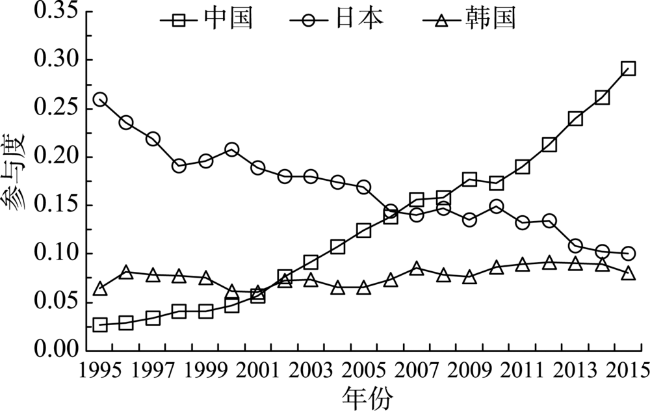
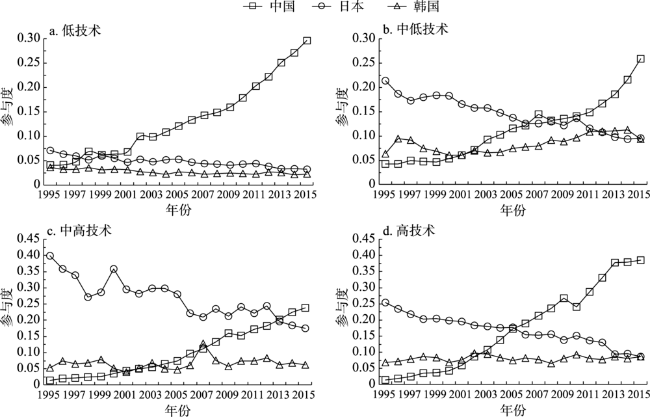
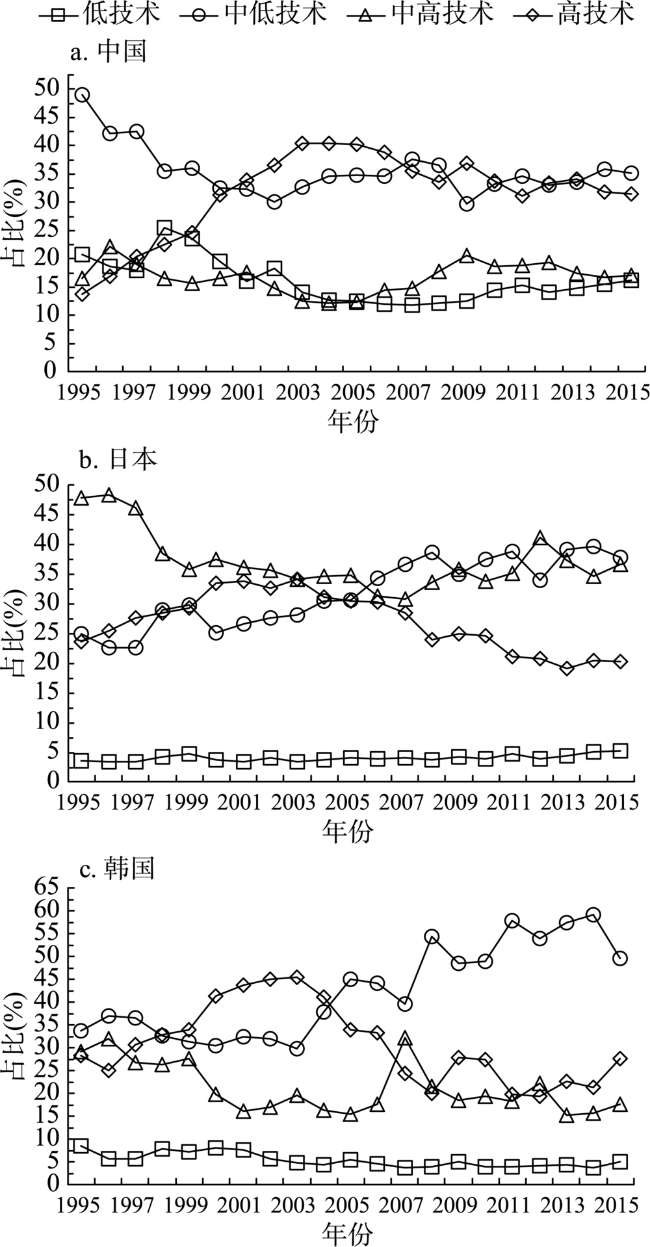
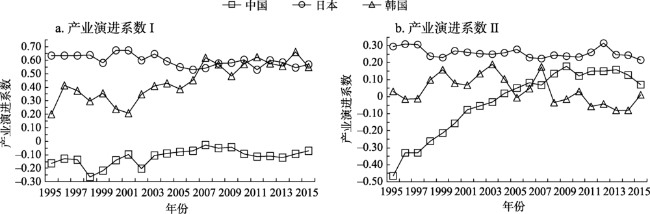
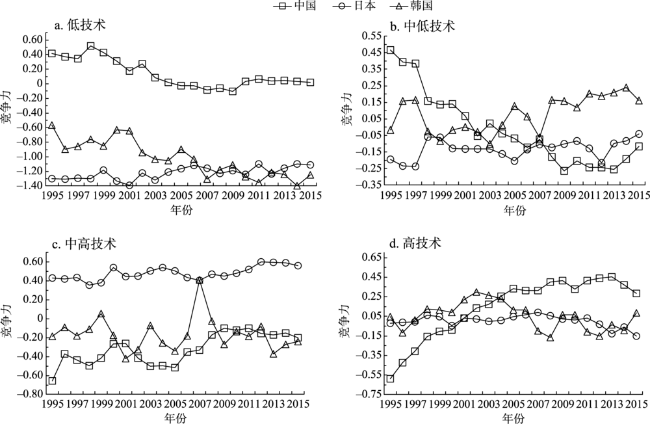
It is a new field of international trade and industrial specialization research with the perspective of value added creation and flow, to observe manufacturing regional network and value chain. The effect of each country in the manufacturing regional value chain participation is a black box that needs to be explored, especially the regulation of the value chain participation on the optimal allocation of various economies and their production factors. The paper constructs quantitative indicators such as regional value chain participation index, industrial evolution index, industrial competitiveness index, and regional value chain participation degree order. Based on the latest statistical data of TiVA database jointly released by OECD and WTO, the paper analyzes the participation characteristics and coupling relationship of China, Japan and South Korea in the ASEAN manufacturing value chain, using an analysis framework of participation-adaptation-competitiveness, with the method of time series statistics and horizontal comparison. The research shows that: (1)The contribution of China, Japan and South Korea to the ASEAN manufacturing value chain has increased to 47%, which is the main player and actual leader of the regional value chain. Among them, China experienced three development periods of 1995-2001, 2002-2007, and 2008-2015, and has surpassed South Korea and Japan to become the first participating countries. (2) The industrial structure of the three countries participating in the regional value chain has been adjusted during the same period. China conforms to the general law of the gradient of industrial evolution and deconstructs the so-called East Asian “goose line model”, but it still needs to be optimized in terms of structural rationality. Japan and South Korea have reversed the trend toward medium-low-tech industries, which is more in line with market demand. (3) The industrial competitiveness of the three countries and their spatial pattern have resulted in a phased succession. At present, China, Japan and South Korea each have advantages in high-tech industries, medium-high-tech industries and medium-low-tech industries, and have developed three types of industrial interaction, such as spatial intersection, partial overlap and monopoly in the ASEAN region. This is closely related to the manufacturing capacity of each country and its development stage, and is also affected by the growth of regional value chain demand and participating countries’ competitive relationship.
Key words: manufacturing value added; RVC; coupling relationship; ASEAN
LI Zheng , WU Youde , LIAO Yahui , HU Pingping . The participation characteristics and coupling relationship of China, Japan and South Korea in the ASEAN manufacturing value chain: Empirical research based on TiVA database[J]. GEOGRAPHICAL RESEARCH, 2020 , 39(3) : 539 -553 . DOI: 10.11821/dlyj020190148
表1 OECD标准下的制造业细分产业Tab. 1 Manufacturing sector under the OECD standard |
| 产业划分 | 产业编码(2015年) | 产业编码(2018年) | 产业描述 |
|---|---|---|---|
| 低技术产业 | C15T22 、C36T37 | D10T18、D31T33 | 食品制造和烟草加工业;纺织及服装制造业;木材加工及木材和软木制品业;造纸及纸制品,印刷和出版业;其他制造业及资源和废旧产品回收加工业 |
| 中低技术产业 | C23T28 | D19T25 | 煤炭,石油产品和核燃料加工业;化学原料和化学产品制造业;橡胶和塑料制品业;非金属矿物制造业;贱金属制造业;基本金属制造业 |
| 中高技术产业 | C29、C34T35 | D28T30 | 机械设备制造业;基本交通运输设备制造业;其他运输设备制造业 |
| 高技术产业 | C30T33X、C31 | D26T27 | 计算机,电子和光学设备制造业;未另分类的电气机械和设备制造业 |
注:根据2015年、2018年TiVA数据库对其产业进行划分。 |
图1 1995—2015年中日韩制造业参与度演变趋势Fig. 1 Evolution trend of manufacturing RVC ̠̠ participation in China, Japan and South Korea 1995-2015 |
表2 不同发展期中日韩制造业细分产业的参与模式Tab. 2 RVC participation model in China, Japan and South Korea’s manufacturing sector in different periods |
| 1995—2001年 | 2002—2007年 | 2008—2015年 | |
|---|---|---|---|
| 中国 | 较高-高-较低-较低 | 低-高-低-高 | 较低-高-较低-高 |
| 日本 | 低-较高-高-较高 | 低-高-高-高 | 低-高-高-较高 |
| 韩国 | 低-高-较高-高 | 低-较高-较低-高 | 低-高-较低-较高 |
表3 中日韩出口东盟各国的制造业产业的竞争位序Tab. 3 The RVC-Rank of manufacturing sector in China, Japan and South Korea’s exports to ASEAN countries |
| 越南 | 泰国 | 柬埔寨 | 马来西亚 | 新加坡 | 印度尼西亚 | 菲律宾 | 文莱 | ||
|---|---|---|---|---|---|---|---|---|---|
| 低技术产业 | 中国 | Top1 | Top1 | Top1 | Top1 | Top2 | Top1 | Top1 | Top2 |
| 日本 | |||||||||
| 韩国 | Top2 | Top3 | |||||||
| 中低技术产业 | 中国 | Top1 | Top1 | Top1 | Top1 | Top2 | Top1 | Top3 | |
| 日本 | Top2 | Top3 | |||||||
| 韩国 | Top2 | Top3 | Top3 | Top3 | |||||
| 中高技术产业 | 中国 | Top1 | Top2 | Top1 | Top1 | Top1 | Top2 | ||
| 日本 | Top2 | Top1 | Top3 | Top2 | Top2 | Top1 | Top3 | ||
| 韩国 | Top3 | Top2 | Top1 | ||||||
| 高技术产业 | 中国 | Top1 | Top1 | Top1 | Top1 | Top1 | Top1 | Top1 | Top1 |
| 日本 | Top2 | Top2 | |||||||
| 韩国 | Top3 |
| [1] |
|
| [2] |
|
| [3] |
|
| [4] |
|
| [5] |
|
| [6] |
|
| [7] |
王直, 魏尚进, 祝坤福 . 总贸易核算法: 官方贸易统计与全球价值链的度量. 中国社会科学, 2015, (9):108-127.
[
|
| [8] |
王厚双, 李艳秀, 朱奕绮 . 我国服务业在全球价值链分工中的地位研究. 世界经济研究, 2015, (8):11-18.
[
|
| [9] |
乔小勇, 王耕, 郑晨曦 . 我国服务业及其细分行业在全球价值链中的地位研究——基于“地位-参与度-显性比较优势”视角. 世界经济研究, 2017, (2):99-113.
[
|
| [10] |
李正, 武友德, 胡平平 . 1995—2011年中国制造业全球价值链动态演进过程分析——基于TiVA数据库的新兴市场国家比较. 国际贸易问题, 2019, (5):69-83.
[
|
| [11] |
聂聆, 李三妹 . 制造业全球价值链利益分配与中国的竞争力研究. 国际贸易问题, 2014, (12):102-113.
[
|
| [12] |
吕越, 黄艳希, 陈勇兵 . 全球价值链嵌入的生产率效应: 影响与机制分析. 世界经济, 2017, (7):28-51.
[
|
| [13] |
刘遵义, 陈锡康, 杨翠红 , 等. 非竞争型投入占用产出模型及其应用——中美贸易顺差透视. 中国社会科学, 2007, (5):91-103.
[
|
| [14] |
李昕, 徐滇庆 . 中国外贸依存度和失衡度的重新估算——全球生产链中的增加值贸易. 中国社会科学, 2013, (1):29-55.
[
|
| [15] |
罗长远, 张军 . 附加值贸易: 基于中国的实证分析. 经济研究, 2014, (6):4-11.
[
|
| [16] |
张杰, 陈志远, 刘元春 . 中国出口国内附加值的测算与变化机制. 经济研究, 2013, (10):124-137.
[
|
| [17] |
李艳秀, 毛艳华 . 区域贸易协定深度与价值链贸易关系研究. 世界经济研究, 2018,298(12):25-36.
[
|
| [18] |
程大中 . 中国参与全球价值链分工的程度及演变趋势——基于跨国投人-产出分析. 经济研究, 2015, (9):4-16.
[
|
| [19] |
|
| [20] |
傅元海, 叶祥松, 王展祥 . 制造业结构优化的技术进步路径选择. 中国工业经济, 2014,318(9):78-90.
[
|
| [21] |
李方一, 刘思佳, 程莹 , 等. 出口增加值对中国区域产业结构高度化的影响. 地理科学, 2017,37(1):37-45.
[
|
| [22] |
贺灿飞, 金璐璐, 刘颖 . 多维邻近性对中国出口产品空间演化的影响. 地理研究, 2017,36(9):1613-1626.
[
|
| [23] |
胡国良, 王继源, 龙少波 . 中国与东盟产业合作的效益测算及评价研究. 世界经济研究, 2017, (4):95-105.
[
|
| [24] |
岑丽君 . 中国在全球生产网络中的分工与贸易地位——基于TiVA数据与GVC指数的研究. 国际贸易问题, 2015, (1):3-13.
[
|
| [25] |
傅元海, 叶祥松, 王展祥 . 制造业结构变迁与经济增长效率提高. 经济研究, 2016, (8):86-99.
[
|
| [26] |
李建新, 杨永春, 蒋小荣 , 等. 中国制造业产业结构高级度的时空格局与影响因素. 地理研究, 2018,37(8):1558-1774.
[
|
| [27] |
王岚, 李宏艳 . 中国制造业融人全球价值链路径研究——嵌入位置和增值能力的视角. 中国工业经济, 2015,323(2):76-87.
[
|
| [28] |
侯丹丹 . 后“雁行模式”时期东亚产品空间结构演化研究. 国际经贸探索, 2018,34(6):50-65.
[
|
| [29] |
戴金平, 刘东坡 . 实际运行、镜鉴方式与雁行发展模式的关联度. 改革, 2015,261(11):43-53.
[
|
| [30] |
周昕 . 产品内分工的区域化与全球化: 基于东亚生产网络的研究. 天津: 南开大学出版社, 2015: 98-120.
[
|
| [31] |
苏宏伟 . 日本制造业产业结构合理化与高级化研究. 长春: 吉林大学博士学位论文, 2017.
[
|
/
| 〈 |
|
〉 |