Migrants' subjective social integration and its determinants as a result of the two-way process of assimilation and segregation: A case study of Fuzhou-Xiamen-Quanzhou Urban Cluster
Received date: 2020-04-13
Request revised date: 2020-07-20
Online published: 2021-02-20
Copyright
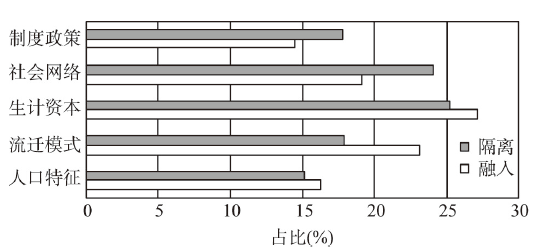
Migrants' social integration into destination cities has been an important and long-standing topic in the field of migration research in China. So far most research has treated such social integration of migrants as a combined process of both subjective and objective social integration, with little efforts to single out the former and conduct multi-dimensional and in-depth investigation into it. Using data from a migrant survey of Fujian Province in 2017 and taking Fuzhou-Xiamen-Quanzhou Urban Cluster as a case study, this paper aims to fill this gap of research and examine the subjective social integration of migrants and its determinants by comparing their two-way process of assimilation and segregation in the destination cities. The results show that: (1) The overall level of migrants' subjective social integration is high, with the process of assimilation stronger than that of segregation. (2) Subjective social integration of migrants is jointly influenced by migrants' demographic characteristics, mobility patterns, social networks, and livelihood capitals, and related to the institutional arrangements and relevant policies. Equalization of basic public services plays a more important role in the subjective social integration of migrants than the Hukou system, contributing to the increase of their assimilation and the decrease of their segregation in the destination cities. Those migrants who have higher income and better housing conditions, more frequently contacts with local people and participation in local organizations and their activities do have higher degree of subjective social integration in destination cities. The effects of land, family difficulties and local attachments in the places of origin are more complicated than expected, demonstrating both negative effects on the assimilation process and positive effects on the segregation process at the same time. Short-distance migration and long-term settlement with more family members promote assimilation as well as reduce segregation. Based on the above findings, we suggest that more attention should be paid to promoting the objective social integration of migrants and coordinating its development with that of subjective social integration. Efforts should be made to change the one-way approach of promoting migrants' full citizenship in the destination cities, taking factors from both the origin and destination into account, and to shift the focus of promoting migrants' full citizenship from facilitating their urban settlement to the equalization of basic public services, so that migrants are not only willing but also able to integrate into the cities.
XIAO Baoyu , ZHU Yu , LIN Liyue . Migrants' subjective social integration and its determinants as a result of the two-way process of assimilation and segregation: A case study of Fuzhou-Xiamen-Quanzhou Urban Cluster[J]. GEOGRAPHICAL RESEARCH, 2020 , 39(12) : 2796 -2807 . DOI: 10.11821/dlyj020200301
表1 流动人口主观社会融合影响因素变量的描述性分析Tab. 1 Description of determinants of migrants' subjective social integration |
| 变量分类 | 具体变量 | 变量类型及赋值 | 均值 | 标准差 |
|---|---|---|---|---|
| 人口特征 | 性别 | 男=1,女=2 | 1.46 | 0.498 |
| 年龄 | 30岁以下=1,30~49岁=2,50岁及以上=3 | 1.69 | 0.590 | |
| 受教育程度 | 未上过小学=1,小学=2,初中=3,高中=4,大学专科=5,大学本科=6,研究生=7 | 3.29 | 1.025 | |
| 婚姻状况 | 单身=1,在婚=2 | 1.81 | 0.393 | |
| 流迁模式 | 流动范围 | 省际流动=1,省内跨市流动=2,市内跨县流动=3 | 1.50 | 0.654 |
| 滞留年数 | 数值变量 | 5.20 | 5.422 | |
| 流动原因 | 经济原因=1,社会原因=2 | 1.10 | 0.298 | |
| 流入地家庭规模 | 数值变量 | 2.54 | 1.234 | |
| 生计资本 | 流入地月收入对数 | 数值变量 | 8.30 | 0.515 |
| 流入地住房类型 | 非正规场所=1,免费宿舍或廉租房=2,租住私房=3,自购自建房=4 | 2.77 | 0.576 | |
| 在流入地困难 | 无=1,不清楚*=2,有=3 | 1.52 | 0.500 | |
| 家乡承包地 | 无=1,不清楚=2,有=3 | 2.05 | 0.934 | |
| 家乡宅基地 | 无=1,不清楚=2,有=3 | 2.70 | 0.673 | |
| 在家乡困难 | 无=1,不清楚=2,有=3 | 1.40 | 0.490 | |
| 社会网络 | 业余主要交往对象 | 很少与人来往=1,同乡=2,其他外地人=3,本地人=4 | 2.24 | 0.912 |
| 参加流入地社会组织数量 | 数值变量 | 0.98 | 1.104 | |
| 参加流入地社会活动频率 | 没有=1,偶尔=2,有时=3,经常=4 | 1.02 | 0.149 | |
| 未回老家年数 | 数值变量 | 0.38 | 1.289 | |
| 制度政策 | 户口性质 | 农业=1,非农业=2 | 1.22 | 0.412 |
| 个人社会保障卡 | 未办理=1,不清楚=2,已办理=3 | 2.53 | 0.827 | |
| 暂住证/居住证 | 未办理=1,不清楚=2,已办理=3 | 2.68 | 0.728 | |
| 居民健康档案 | 未办理=1,不清楚=2,已办理=3 | 2.08 | 0.947 |
注:“不清楚”选项取中间值2作为近似值,因该类型所占比例不大,对统计结果或有微小影响,但不影响总体可信度。 |
表2 福厦泉城市群流动人口主观社会融合程度Tab. 2 Subjective social integration of migrants in Fuzhou-Xiamen-Quanzhou Urban Cluster |
| 指标 | 融入作用 | 隔离作用 | ||||||
|---|---|---|---|---|---|---|---|---|
| 主体评价 | 客体感知 | 平均 得分 | 主体评价 | 客体感知 | 平均 得分 | |||
| 对流入地 评价 | 身份 认同 | 流入地 接纳 | 对流出地风俗 文化的遵守 | 对流出地行为 习惯的保持 | 流入地 歧视 | |||
| 得分 | 82.09 | 66.98 | 78.33 | 75.80 | 64.67 | 48.17 | 48.06 | 53.63 |
表3 福厦泉城市群流动人口主观社会融合的影响因素Tab. 3 Determinants of migrants' subjective social integration in Fuzhou-Xiamen-Quanzhou Urban Cluster |
| 变量分类 | 具体变量 | 融入作用 | 隔离作用 |
|---|---|---|---|
| 人口特征 | 性别 | 0.014 | -0.001 |
| 年龄 | 0.075** | 0.016 | |
| 受教育程度 | 0.064** | -0.090*** | |
| 婚姻状况 | -0.054 | 0.006 | |
| 流迁模式 | 流动范围 | 0.098*** | -0.046* |
| 滞留年数 | 0.102*** | -0.054* | |
| 流动原因 | -0.024 | -0.025 | |
| 流入地家庭规模 | 0.070** | -0.009 | |
| 生计资本 | 流入地月收入对数 | 0.047* | -0.014 |
| 住房类型 | 0.093*** | -0.059** | |
| 在流入地困难 | 0.045* | -0.032 | |
| 家乡承包地 | 0.053* | -0.045* | |
| 家乡宅基地 | -0.038* | 0.015 | |
| 在家乡困难 | -0.070** | 0.024 | |
| 社会网络 | 业余主要交往对象 | 0.034 | -0.062** |
| 参加流入地社会组织数量 | 0.130*** | -0.079*** | |
| 参加流入地社会活动频率 | 0.039* | 0.003 | |
| 未回老家年数 | -0.040* | 0.036 | |
| 制度政策 | 户口性质 | 0.011 | 0.018 |
| 个人社会保障卡 | 0.046* | -0.056** | |
| 暂住证/居住证 | 0.057** | -0.029 | |
| 居民健康档案 | 0.070*** | -0.030 | |
| 常量 | 4.877 | 5.354 | |
| F检验值 | 17.523*** | 7.296*** | |
| 调整R2 | 0.129 | 0.062 |
注:双尾检验统计显著度:*表示P<0.1,**表示P<0.05,***表示P<0.01。 |
真诚感谢匿名评审专家在论文评审中所付出的时间和精力,评审专家对本文基于主观社会融合范畴的融入-隔离概念说明、结论梳理方面的修改意见,使本文获益匪浅。
| [1] |
陈宏胜, 王兴平, 刘晔, 等. 家庭视角的流动人口城市定居意愿及其影响机制: 基于中国 8 个城市的实证分析. 热带地理, 2019,39(1):58-68.
[
|
| [2] |
朱宇, 林李月, 柯文前. 国内人口迁移流动的演变趋势: 国际经验及其对中国的启示. 人口研究, 2016,40(5):50-60.
[
|
| [3] |
国家发展改革委员会. 国家发展改革委办公厅关于印发第一批国家新型城镇化综合试点经验的通知. http://www.ndrc.gov.cn/gzdt/201805/t20180503_884929.html, 2020-04-12.
[ National Development and Reform Commission. Notice of the General Office of the National Development and Reform Commission on the issuance of the first national comprehensive pilot experience of new-type urbanization, http://www.ndrc.gov.cn/gzdt/201805/t20180503_884929.html, 2020-04-12.]
|
| [4] |
宁越敏, 杨传开. 新型城镇化背景下城市外来人口的社会融合. 地理研究, 2019,38(1):23-32.
[
|
| [5] |
杨菊华. 从隔离、选择融入到融合: 流动人口社会融入问题的理论思考. 人口研究, 2009,33(1):17-29.
[
|
| [6] |
|
| [7] |
|
| [8] |
|
| [9] |
|
| [10] |
|
| [11] |
周皓. 流动人口社会融合的测量及理论思考. 人口研究, 2012,36(3):27-37.
[
|
| [12] |
悦中山, 杜海峰, 李树茁, 等. 当代西方社会融合研究的概念、理论及应用. 公共管理学报, 2009,6(2):114-121, 128.
[
|
| [13] |
吴玉锋, 雷晓康, 聂建亮. 从“结构”到“认知”: 社会资本与流动人口社会融合: 基于2014年中国劳动力动态调查数据. 人口与发展, 2019,25(5):111-122.
[
|
| [14] |
任远, 乔楠. 城市流动人口社会融合的过程、测量及影响因素. 人口研究, 2010,34(2):11-20.
[
|
| [15] |
|
| [16] |
|
| [17] |
田凯. 关于农民工的城市适应性的调查分析与思考. 社会科学研究, 1995, (5):90-95.
[
|
| [18] |
|
| [19] |
童星, 马西恒. “敦睦他者”与“化整为零”: 城市新移民的社区融合. 社会科学研究, 2008, (1):77-83.
[
|
| [20] |
朱力. 论农民工阶层的城市适应. 江海学刊, 2002, (6):82-88.
[
|
| [21] |
|
| [22] |
朱宇, 林李月. 流动人口的流迁模式与社会保护: 从”城市融入”到”社会融入”. 地理科学, 2011,31(3):264-271.
[
|
| [23] |
|
| [24] |
李志刚, 梁奇, 林赛南. 转型期中国大城市流动人口的身份认同、特征与机制. 地理科学, 2020,40(1):40-49.
[
|
| [25] |
方创琳, 毛其智, 倪鹏飞. 中国城市群科学选择与分级发展的争鸣及探索. 地理学报, 2015,70(4):515-527.
[
|
| [26] |
肖子华, 徐水源, 刘金伟. 中国城市流动人口社会融合评估报告No.1. 北京: 社会科学文献出版社, 2019: 9.
[
|
| [27] |
|
| [28] |
杨高, 周春山. 深圳不同类型农民工聚居区的社会融合及影响因素. 地理研究, 2019,38(2):297-312.
[
|
| [29] |
李荣彬. 生计资本视角下农民工社会融合的现状及其影响因素: 基于2014年流动人口动态监测数据的实证研究. 人口与发展, 2016,22(6):47-54, 64.
[
|
| [30] |
|
| [31] |
汪明峰, 程红, 宁越敏. 上海城中村外来人口的社会融合及其影响因素. 地理学报, 2015,70(8):1243-1255.
[
|
| [32] |
|
| [33] |
|
| [34] |
陈春, 于立, 吴娇. “人的城镇化”需解决农民工融入城市的制约因素: 重庆农民工调研分析的启示. 城市发展研究, 2016,23(7):8-14.
[
|
| [35] |
刘涛, 陈思创, 曹广忠. 流动人口的居留和落户意愿及其影响因素. 中国人口科学, 2019, 33(3): 80-91, 127-128.
[
|
| [36] |
杨高, 周春山. 中国农民工“同乡村”研究:空间生产与社会融合: 以深圳“四川村”为例. 地理科学, 2019,39(10):1570-1580.
[
|
| [37] |
梁波, 王海英 . 城市融入: 外来农民工的市民化: 对已有研究的综述. 人口与发展, 2010,16(4):73-85, 91.
[
|
/
| 〈 |
|
〉 |