The influence of commercial gentrification on surrounding old neighborhoods based on field theory: A case study of Daci Temple Community of Chengdu
Received date: 2021-12-07
Accepted date: 2022-06-06
Online published: 2022-12-10
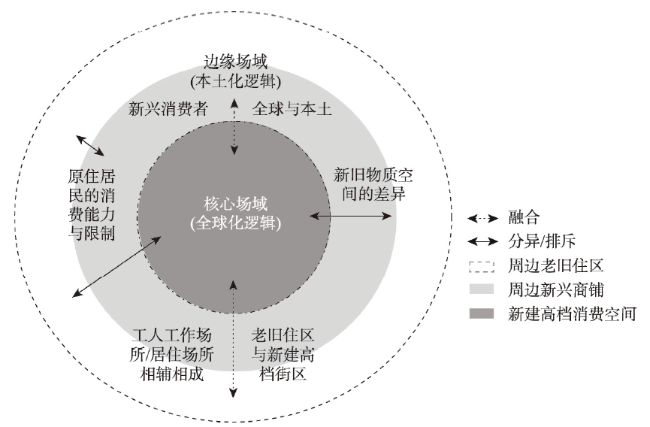
This paper uses the commercial gentrification space of Daci Temple Community in Chengdu as the case. Based on Pierre Bourdieu's ‘field’ theory, it analyses the interest demand and capital acquisitions from the different actors of local government, developers, gentrifiers, residents, surrounding merchants and tenants. Then, it explores the influence mechanism between commercial gentrification and surrounding old neighborhoods. Using two qualitative research methods of participant observation and semi-structured interview, the empirical research findings show that commercial gentrification and surrounding old residential areas constitute a gentrification field, where different actors acquire and accumulate their own capital to establish social practice status. The gentrification core field composed of high-end consumption space where the local government and private developers unite. Specifically, the former pursuits the symbolic capital brought by beautification image driven by the development of the global city and national central city, while the latter accumulates maximum economic capital. Gentrifiers promote the development and consolidation of commercial gentrification in the process of pursuing a lifestyle consistent with their own social attributes. However, the residents are in a weak position in the process of gentrification, which becomes the subject of capital outflow. In the marginal field, the surrounding merchants begin to reconstruct businesses to cater to gentrifiers. Besides, with the new consumption space in the core field, the surrounding tenants have acquired economic and social capital in the whole gentrification field. Therefore, this paper reveals two important capital logics in the field. The core field of gentrification is promoted by the interest alliance formed by the local government, developers and gentrifiers, which reflects a top-down global capital logic. The marginal field is constructed by residents, surrounding merchants and tenants, which is presenting a bottom-up local capital logic. This is because the marginal field is influenced by the core field, forming a dynamic mutual relationship with the core field. Finally, this research fills the theoretical gap for the impact of China's commercial gentrification on surrounding residential areas, and in light of the practice value for the renovation of commercial space in urban centers.
Key words: commercial gentrification; field; capital; surrounding old neighborhoods; actors
HUANG Xing , GU Hao , SHI Meishi . The influence of commercial gentrification on surrounding old neighborhoods based on field theory: A case study of Daci Temple Community of Chengdu[J]. GEOGRAPHICAL RESEARCH, 2022 , 41(10) : 2726 -2741 . DOI: 10.11821/dlyj020211164
表1 重点访谈对象基本资料Tab. 1 The background information of key interviewees |
| 编号 | 性别 | 称呼 | 年龄 | 身份 | 访谈时间 |
|---|---|---|---|---|---|
| 12-Y-07 | 女 | 陈HY | 50 | 大慈寺社区原住居民 | 2012.11.02 2012.11.21 |
| 12-Y-13 | 男 | 张SA | 44 | 大慈寺社区原住居民, 废品收购站管理员 | 2012.11.12 2017.08.11 |
| 12-S-04 | 男 | 文哥 | 43 | 冷淡杯小吃摊老板 | 2012.11.13 2017.05.11 |
| 17-G-09 | 女 | Cathy | 31 | 太古里消费者 自主创业设计公司 | 2017.05.23 2019.11.03 |
| 17-G-21 | 女 | 何小姐 | 39 | 太古里消费者 外资企业管理人员 | 2017.07.15 2019.11.10 |
| 17-G-25 | 男 | 莫LF | 36 | 太古里消费者 保险公司管理人员 | 2017.08.17 2019.11.01 |
| 17-G-30 | 男 | David | 39 | IFS消费者(新加坡人) 外资企业管理人员 | 2017.07.21 2019.11.14 |
| 17-Z-05 | 男 | 陈主任 | 46 | 大慈寺社区居委会主任 | 2017.08.12 2019.11.15 |
| 17-Z-11 | 女 | 杨XR | 49 | 锦官驿街道办工作人员 | 2017.08.13 2019.11.19 |
| 17-S-23 | 男 | 黄总 | 38 | 太古里周边咖啡馆老板 | 2017.05.31 2021.07.15 |
| 19-T-15 | 男 | Chris | 37 | 太古里CY餐馆店长 | 2019.11.03 2019.11.25 |
| 19-T-26 | 男 | 梁总 | 42 | 太古里D茶楼老板 | 2019.11.14 2021.07.16 |
| 19-Z-17 | 男 | 熊警官 | 46 | 合江亭派出所警官 | 2019.06.29 2021.07.04 |
| 19-Y-38 | 女 | 王TL | 56 | 周边住区原住居民 | 2017.07.14 2019.11.19 2021.07.12 |
| 19-R-31 | 男 | 小刘 | 24 | 周边老旧住区租户、 太古里内部清洁工 | 2019.06.06 2019.08.03 |
| 19-R-40 | 男 | 小胡 | 22 | 周边老旧住区租户 太古里内部餐饮店杂工 | 2019.06.08 2019.08.23 |
| 19-Y-32 | 女 | 王姐 | 50 | 周边住区原住居民 | 2019.11.08 2021.07.15 |
| 21-Z-44 | 男 | 李警官 | 42 | 合江亭派出所社区民警 | 2021.12.17 |
| 21-Z-46 | 女 | 王科长 | 46 | 锦官驿街道办工作人员 | 2021.12.18 |
| 21-K-48 | 女 | 聂经理 | 41 | 地产开发商工作人员 | 2021.12.19 |
| 21-K-50 | 男 | 张经理 | 43 | 地产开发商工作人员 | 2021.12.21 |
注:访谈者编号由“年份-身份-顺序号码”组成,身份代码:Y表示原住居民;S表示周边商户;G表示绅士化群体;Z表示政府及相关机构人员;T表示新消费空间的高档商户;R表示周边租户;K表示开发商。 |
真诚感谢匿名评审专家在论文评审中付出的时间和精力,专家对本文的理论分析、结论梳理等方面提出的宝贵意见,使本文受益匪浅。
| [1] |
|
| [2] |
|
| [3] |
|
| [4] |
|
| [5] |
|
| [6] |
|
| [7] |
宋伟轩, 孙洁, 陈艳如, 等. 南京内城商业绅士化发育特征研究. 地理学报, 2020, 75(2): 426-442.
[
|
| [8] |
胡小武, 何平. 从“绅士化”到“超级绅士化”: 大城市中心城区空间更新“奢侈化”趋势研究. 河北学刊, 2021, 41(2): 190-197.
[
|
| [9] |
|
| [10] |
宫留记. 布迪厄的社会实践理论. 开封: 河南大学出版社, 2009: 47-59.
[
|
| [11] |
|
| [12] |
|
| [13] |
|
| [14] |
谢小芹. “场域-行动分析”视角: 贵州西村农民的旅游抗争. 人文地理, 2019, 34(4): 135-142.
[
|
| [15] |
郭文, 黄震方. 基于场域理论的文化遗产旅游地多维空间生产研究: 以江南水乡周庄古镇为例. 人文地理, 2013, 28(2): 117-124.
[
|
| [16] |
赵巧艳. 布迪厄实践理论视角下民族旅游与社会性别的互动: 以龙胜金坑红瑶为例. 人文地理, 2011, 26(6): 67-71.
[
|
| [17] |
郭岩, 杨昌鸣, 张雨洋. 场域视角下清代北京宣南雅文化核心区范围及空间关联特征. 地理研究, 2020, 39(4): 836-852.
[
|
| [18] |
纪小美. 基于资本与场域理论的徽州地名变迁的社会响应与内在机理研究. 人文地理, 2020, 35(6): 44-49, 105.
[
|
| [19] |
李巍, 漆建武, 张凯. 甘肃省文化记忆空间识别与格局演化. 经济地理, 2021, 41(1): 74-86.
[
|
| [20] |
陈晓亮, 蔡晓梅, 朱竑. 基于“地方场域”视角的中国旅游研究反思. 地理研究, 2019, 38(11): 2578-2594.
[
|
| [21] |
孙洁, 宋伟轩. 国外商业绅士化研究进展及其对本土研究的启示. 世界地理研究, 2021, 30(5): 1096-1105.
[
|
| [22] |
黄幸, 刘玉亭. 中国绅士化研究的本土实践: 特征、议题与展望. 人文地理, 2021, 36(3): 5-14, 36.
[
|
| [23] |
|
| [24] |
孙洁, 朱喜钢, 宋伟轩, 等. 文化消费驱动的高校周边地区商业绅士化研究: 以南京大学与南京师范大学老校区为例. 城市规划, 2018, 42(7): 25-32.
[
|
| [25] |
|
| [26] |
罗伯特·K 殷. 案例研究: 设计与方法, 周海涛, 史少杰译 重庆: 重庆大学出版社, 2017: 151-163.
[
|
| [27] |
|
| [28] |
何深静, 刘玉亭. 市场转轨时期中国城市绅士化现象的机制与效应研究. 地理科学, 2010, 30(4): 496-502.
[
|
| [29] |
石美施. 成都大慈寺周边地区商业绅士化研究. 广州: 华南理工大学硕士学位论文, 2019.
[
|
| [30] |
|
| [31] |
|
| [32] |
|
| [33] |
|
| [34] |
|
| [35] |
|
| [36] |
|
| [37] |
|
| [38] |
|
/
| 〈 |
|
〉 |