Evolutionary mechanism of rural settlement patterns: A perspective of residential form differentiation
Received date: 2022-04-06
Accepted date: 2022-10-25
Online published: 2023-01-31
A systematic exploration on the evolution mechanism of rural settlement patterns in different regions is the foundation of guiding rural settlement reconstruction and constructing rural settlement transformation theory. Residential form is a comprehensive concept of residential space form, life form and cultural form. Based on the perspective of residential form, it would be helpful to reveal the underlying logic of the evolution mechanism of rural settlement patterns and their regional differences. Following the logic of 'phenomenon description - mechanism analysis - typical area comparison', this study takes the regional differences of rural settlement patterns as the breakthrough point, and attempts to explore the temporal and spatial differentiation of rural settlement patterns in different development stages from the perspectives of 'human-land' and 'human-human' relationships. The formation of residential form and its action mechanism on the evolution of traditional rural settlement patterns were constructed, and an empirical study was carried out based on the typical areas in Sichuan Basin and Jitai Basin of China. The research shows that, residential form is a multi-level and multi-dimensional factor derived from the macro evolution of rural settlement pattern, both of which can be interpreted from the dual perspectives of 'human-land' and 'human-human' relationship. The residential from has relatively strong continuity and stability compared to the rural settlement pattern. Particularly, the residential culture form provides fundamental path and endogenous mechanism for the evolution of rural settlement pattern. Rural settlement pattern can be deemed as the result of spatial interpretation and diffusion of residential culture forms in rural territory. Productivity improvements and accidental events could lead to substantial changes in residential forms, further inducing significant changes of the evolution mechanism of rural settlement pattern. Facing the rural revitalization strategy, it is recommended to pay more attention to the research perspective of residential form, to explore the operation mechanism of traditional rural settlements in different regions, their declining mechanisms and evolution paths induced by rapid urbanization, as well as the essential differences of rural settlement governance strategies under the background of rural revitalization. These researches would provide theoretical references for formulating the differentiated schemes of rural settlement revitalization.
LIU Weiping , WEI Chaofu . Evolutionary mechanism of rural settlement patterns: A perspective of residential form differentiation[J]. GEOGRAPHICAL RESEARCH, 2023 , 42(1) : 228 -244 . DOI: 10.11821/dlyj020220337
表1 居住形态的主要内涵Tab. 1 The main connotations of the residential form |
| 空间-社会单元 | 空间形态 | 生活形态 | 文化形态 |
|---|---|---|---|
| 住屋单体-家庭 | 建筑风格、建筑朝向、建筑结构 | 生活方式、亲密关系、生产模式 | 个体、家庭或社群的价值观、生活态度、行为准则 |
| 住屋群体-邻里 | 住屋秩序、邻里空间、邻接程度 | 日常社会互动、交换行为、合作关系 | |
| 聚落整体-社区 | 居住边界、聚落形状、聚落规模 | 组织形式、权力结构、非正式制度、公共秩序 |
表2 乡村聚落格局的涵义、指标与关联因素Tab. 2 The meaning, indicators and influencing factors of rural settlement pattern |
| 空间格局维度 | 涵义 | 常用度量指标 | 直接关联变量 |
|---|---|---|---|
| 分布 | 聚落单元的质心在地域空间的散布程度 | 平均最近邻指数、斑块密度等 | 生态格局、地形地貌、土地开发难度、开发程度 |
| 规模 | 聚落单元的人口规模以及聚落间规模差异 | 规模均值、变异系数、相对香农熵 | 耕地连片度、土壤沃度、社会结构 |
| 形状 | 聚落单元的几何形状 | 分形维数、形状指数 | 生态环境、耕作制度、文化风俗 |
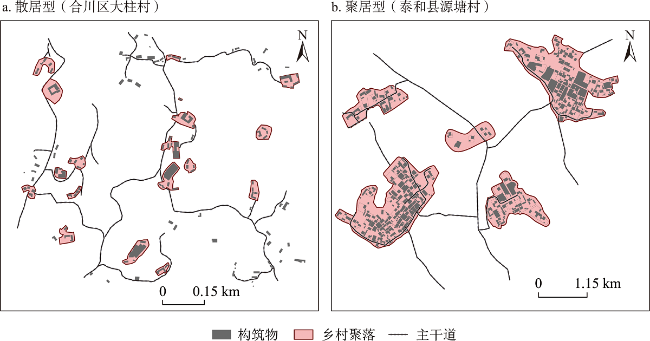
图3 两种居形态与乡村聚落格局局部示意注:数据来源于两个样本村2010年的土地利用测绘资料(比例尺1:2000)。 Fig. 3 Local schematic diagram of two traditional residential forms and rural settlement patterns |
表3 传统散居与聚居形态的空间特征及涵义Tab. 3 The spatial characteristics and connotations of dispersed and concentrated residential forms |
| 居住 形态 | 空间形态 | 主要内涵 | |||
|---|---|---|---|---|---|
| 房屋层面 | 聚落层面 | 土地利用策略 | 社会文化形态 | ||
| 散居 | 布局松散,排列无序,结构均一 | 规模较小,边界模糊,斑块密度大 | 劳动高度密集化,追求土地产出最大 | 地缘关系主导,社会原子化,商品意识强 | |
| 聚居 | 布局紧凑,排列有序,结构分异 | 规模较大,边界清晰,斑块密度小 | 追求土地产出和社会利益的平衡 | 以血缘关系为纽带,组织化程度高,宗法意识强 | |
真诚感谢两位匿名评审专家在论文评审中所付出的时间和精力,评审专家对本文框架优化、逻辑梳理、理论构建及核心概念界定等方面的修改意见,使本文获益匪浅。
| [1] |
|
| [2] |
|
| [3] |
|
| [4] |
|
| [5] |
|
| [6] |
|
| [7] |
李红波, 张小林. 国外乡村聚落地理研究进展及近今趋势. 人文地理, 2012, 27(4): 103-108.
[
|
| [8] |
|
| [9] |
|
| [10] |
|
| [11] |
周国华, 戴柳燕, 贺艳华, 等. 论乡村多功能演化与乡村聚落转型. 农业工程学报, 2020, 36(19): 242-251.
[
|
| [12] |
|
| [13] |
张佰林, 蔡为民, 张凤荣, 等. 隋朝至1949年山东省沂水县农村居民点的时空格局及驱动力. 地理研究, 2016, 35(6): 1141-1150.
[
|
| [14] |
肖飞, 杜耘, 凌峰, 等. 江汉平原村落空间分布与微地形结构关系探讨. 地理研究, 2012, 31(10): 1785-1792.
[
|
| [15] |
|
| [16] |
|
| [17] |
|
| [18] |
郭晓东, 张启媛, 马利邦. 山地-丘陵过渡区乡村聚落空间分布特征及其影响因素分析. 经济地理, 2012, 32(10): 116-122.
[
|
| [19] |
贺艳华, 曾山山, 唐承丽, 等. 中国中部地区农村聚居分异特征及形成机制. 地理学报, 2013, 68(12): 1643-1656.
[
|
| [20] |
|
| [21] |
李红波, 胡晓亮, 张小林, 等. 乡村空间辨析. 地理科学进展, 2018, 37(5): 591-600.
[
|
| [22] |
孙峰华. 基于易学与堪舆学的人地关系和谐论思辨. 地理学报, 2012, 67(2): 266-282.
[
|
| [23] |
周晓芳. 基于易经阴阳的人地关系地域系统模型. 地理研究, 2015, 34(2): 225-233.
[
|
| [24] |
李玉恒, 阎佳玉, 刘彦随. 基于乡村弹性的乡村振兴理论认知与路径研究. 地理学报, 2019, 74(10): 2001-2010.
[
|
| [25] |
李红波. 韧性理论视角下乡村聚落研究启示. 地理科学, 2020, 40(4): 556-562.
[
|
| [26] |
吕忠正, 唐建, 吴晓东, 等. 闾阎营造:英格兰风土建筑学术确立进程考. 建筑师, 2019, (6): 64-76.
[
|
| [27] |
娄永琪. 对居住形态形成过程中规划介入的反思: 基于"生活世界"概念. 规划师, 2002, 18(11): 52-54.
[
|
| [28] |
祁飞飞. 陇东黄土高原沟壑区乡村聚落居住形态研究. 西安: 长安大学硕士学位论文, 2019.
|
| [29] |
王轶, 耿虹, 欧阳国辉, 等. 转型期长沙市近郊乡村居住形态演变及机理. 经济地理, 2021, 41(5): 176-185.
[
|
| [30] |
鲁西奇, 韩轲轲. 散村的形成及其演变: 以江汉平原腹地的乡村聚落形态及其演变为中心. 中国历史地理论丛, 2011, 26(4): 77-91+104.
[
|
| [31] |
熊万胜. 聚落的三重性:解释乡村聚落形态的一个分析框架. 社会学研究, 2021, 36(6): 23-44+226-227.
[
|
| [32] |
杨庆媛, 田永中, 王朝科, 等. 西南丘陵山地区农村居民点土地整理模式: 以重庆渝北区为例. 地理研究, 2004, 23(4): 469-478.
[
|
| [33] |
|
| [34] |
|
| [35] |
|
| [36] |
|
| [37] |
大卫·克里斯蒂安. 极简人类史:从宇宙大爆炸到21世纪(中译本). 北京: 中信出版集团, 2015.
[
|
| [38] |
鲁西奇. 散村与集村: 传统中国的乡村聚落形态及其演变. 华中师范大学学报(人文社会科学版), 2013, 52(4): 113-130.
[
|
| [39] |
王询. 中国南北方汉族聚居区宗族聚居差异的原因. 财经问题研究, 2007, (11): 20-30.
[
|
| [40] |
|
| [41] |
|
| [42] |
|
| [43] |
费孝通. 江村经济:中国农民的生活. 上海: 上海人民出版社, 2007: 24-29.
|
| [44] |
|
| [45] |
Huang, P C C。 The Peasant Economy and Social Change in North China. California: Stanford University Press, 1985: 31-40.
|
| [46] |
杜赞奇. 文化、权力与国家: 1900-1942年的华北农村. 南京: 江苏人民出版社, 2004: 1-17.
[
|
| [47] |
贺雪峰. 论中国农村的区域差异: 村庄社会结构的视角. 开放时代, 2012, 12 (10): 108-129.
[
|
| [48] |
周成斌, 邹广天. 居住形态创新的扩散机制研究. 华中建筑, 2007, 25(5): 106-107.
[
|
| [49] |
吴雪梅. 适应性选择:明清两湖乡村社会秩序的形成机制: 乡村社会秩序建构的另外一种解释. 华中师范大学学报(人文社会科学版), 2017, 56(6): 124-131.
[
|
| [50] |
|
| [51] |
张小路. “湖广填四川”与美国 “西进运动”比较. 江汉论坛, 2002,(5): 58-62.
[
|
| [52] |
|
| [53] |
李仲明, 唐时嘉, 张先婉, 等. 中国紫色土. 北京: 科学出版社, 1991: 63-79.
|
| [54] |
杨纫章. 重庆西郊小区域地理研究. 地理学报, 1941, 8(0): 19-28.
[
|
| [55] |
杨利普, 黄秉成, 施雅风, 等. 成都平原之土地利用. 地理学报, 1947, 14(1): 4-22.
[
|
/
| 〈 |
|
〉 |