Theoretical exploration, model construction and application of ecological policy effect evaluation from the “Potential-Realization” perspective of vegetation restoration
Received date: 2023-04-03
Accepted date: 2023-08-04
Online published: 2023-12-12
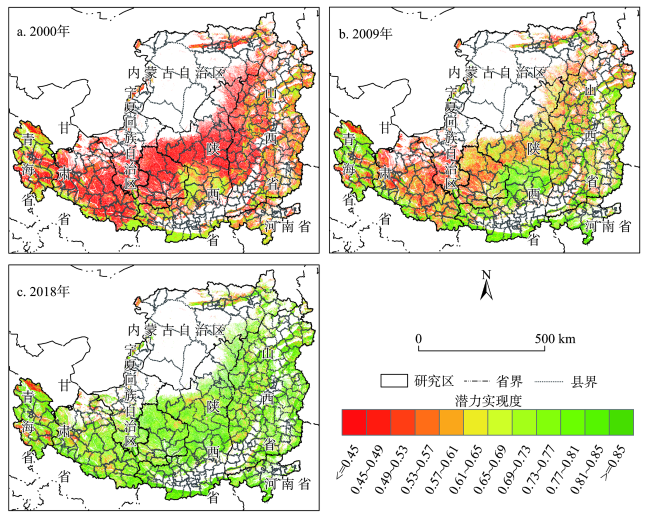
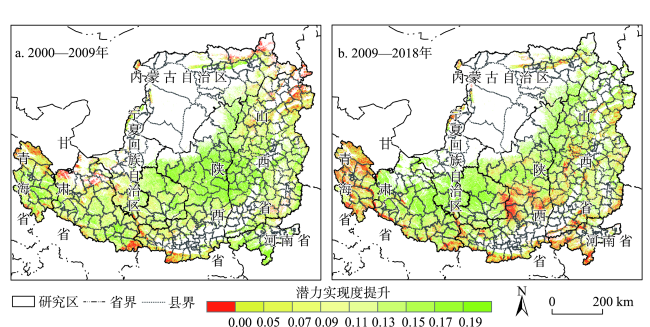
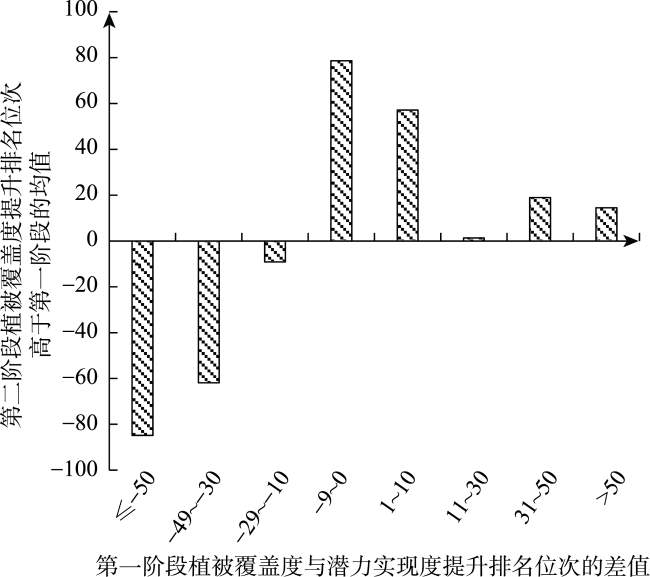
Vegetation restoration is a global issue and research hotspot. Ecological policy plays an important role in achieving vegetation restoration. It is of great significance to assess the contribution of ecological policies to vegetation restoration, as it helps in optimizing policy design and improving policy efficiency. However, vegetation restoration is the result of the joint interaction of resource endowment, human activities, and global changes, and thus restorative effect of vegetation cannot be simply equated with the effectiveness of ecological policies. In this study, a research framework called “Potential-Realization of Vegetation Restoration” is proposed to improve the evaluation work. Firstly, it is theoretically demonstrated that the maximum potential of vegetation restoration depends on resource endowment conditions, while the changes in potential realization reflect the effects of external factors such as ecological policies on vegetation restoration. Following the theoretical derivation, as well as spatial statistical theory and methods, a novel approach called the “Local Window Similar Habitat Modeling” was developed by integrating two important characteristics, i.e., the “proximity of spatial location” and the “similarity of environmental characteristics”, and the concept of “proximity” here also takes into account the time window. The new model is expected to improve the measurement accuracy for vegetation restoration potential and realization. Then, by taking the Loess Plateau as an example, combined with the interpretation of the parameters of the model, the application demonstration of the analysis framework and the new model is carried out. The main findings are as follows: (1) Through theoretical deduction, it is demonstrated that the vegetation restoration potential realization index can effectively shield the influence of resource endowment conditions and better reflect the vegetation restoration effect of ecological policy; (2) the case study further verifies the theoretical derivation; and (3) the joint analysis of traditional vegetation coverage index and potential realization index can provide more useful information for the sustainable restoration of vegetation. In conclusion, this study is expected to provide new theoretical and methodological support for ecological policy evaluation and vegetation restoration planning.
ZHANG Daojun . Theoretical exploration, model construction and application of ecological policy effect evaluation from the “Potential-Realization” perspective of vegetation restoration[J]. GEOGRAPHICAL RESEARCH, 2023 , 42(12) : 3099 -3114 . DOI: 10.11821/dlyj020230215
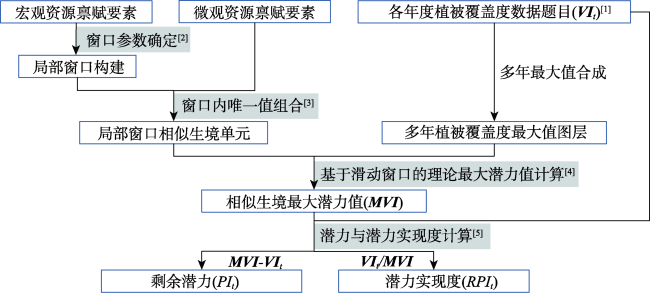
图1 植被恢复“潜力-实现”模型的构建流程注:[1] t表示年份;[2]~[5] 详见3.2.1-3.2.4。 Fig. 1 Modeling process of vegetation restoration “potential-realization” |
表1 植被恢复“潜力-实现”分析框架下相关变量的名称、相互关系及解释Tab. 1 Name, relationship and interpretation of relevant variables under the analysis framework of vegetation restoration “potential-realization” |
| 变量名称 | 变量简写 | 变量表达式 | 变量含义 |
|---|---|---|---|
| 现实植被覆盖度 | 某空间位置在年份t的实际植被覆盖度,等于该位置t年份EVI生长季均值的最小-最大值标准化,其中MIN和MAX为研究区在研究期内的最小、最大EVI值 | ||
| 最大潜力 | 见公式(6) | 通过植被恢复,某位置可达到的理论最大植被覆盖度 | |
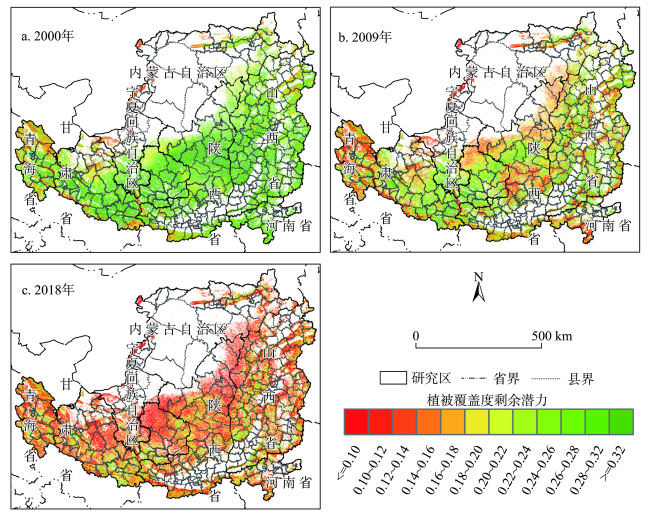
| 剩余潜力 | 见公式(7) | 于t年份在某空间位置进行植被恢复的理论剩余潜力,等于最大潜力 减去该位置在t年份的现实植被覆盖度 | |
| 潜力实现度 | 见公式(8) | 某空间位置在年份t的植被恢复潜力实现度,等于该位置t年份的现实覆盖度 除以该位置最大潜力 | |
| 植被覆盖度提升 | 由年份t1到年份t2的植被覆盖度提升,等于年份t2的现实覆盖度 减去年份t1的现实覆盖度 | ||
| 潜力实现度提升 | 由年份t1到年份t2的植被覆盖潜力实现度提升,等于年份t2的潜力实现度 ,减去年份t1的潜力实现度 |
表2 植被覆盖度提升和潜力实现度提升与资源禀赋变量和政策变量之间的相关性Tab. 2 Correlation coefficients between resource endowment, policy variables and vegetation coverage improvement, potential realization improvement |
| 变量 | 植被覆盖度提升 | 潜力实现度提升 |
|---|---|---|
| 年均气温 | 0.384* | 0.204* |
| 平均降水量 | 0.457* | 0.119 |
| 退耕还林强度** | 0.036 | 0.187* |
注:*表示在1%水平下显著;**退耕还林强度表示退耕还林面积除以原耕地总面积。 |
感谢徐鑫、宁嘉晨、杨婉静和张玉等同学在研究过程中的付出。感谢匿名评审专家在论文评审中所付出的时间和精力,使本文在模型表达上更加规范,避免歧义产生。
| [1] |
|
| [2] |
|
| [3] |
|
| [4] |
|
| [5] |
|
| [6] |
|
| [7] |
|
| [8] |
|
| [9] |
李婷, 吕一河, 任艳姣, 等. 黄土高原植被恢复成效及影响因素. 生态学报, 2020, 40(23): 8593-8605.
[
|
| [10] |
|
| [11] |
|
| [12] |
|
| [13] |
|
| [14] |
郑度, 杨勤业, 赵名茶, 等. 自然地域系统研究. 北京: 中国环境科学出版社, 1997.
[
|
| [15] |
|
| [16] |
彭建, 赵会娟, 刘焱序, 等. 区域生态安全格局构建研究进展与展望. 地理研究, 2017, 36(3): 407-419.
[
|
| [17] |
傅伯杰. 新时代自然地理学发展的思考. 地理科学进展, 2018, 37(1): 1-7.
[
|
| [18] |
赵鹏大. “三联式”资源定量预测与评价: 数字找矿理论与实践探讨. 地球科学, 2002, 27(5): 482-489.
[
|
| [19] |
成秋明. 非线性成矿预测理论: 多重分形奇异性-广义自相似性-分形谱系模型与方法. 地球科学, 2006, 31(3): 337-348.
[
|
| [20] |
|
| [21] |
|
| [22] |
朱阿兴, 闾国年, 周成虎, 等. 地理相似性: 地理学的第三定律?. 地球信息科学学报, 2020, 22(4): 673-679.
[
|
| [23] |
张玉, 张道军. 地形位指数模型改进及其在植被覆盖评价中的应用. 地理学报, 2022, 77(11): 2752-2772.
[
|
| [24] |
|
| [25] |
刘焱序, 王仰麟, 彭建, 等. 耦合恢复力的林区土地生态适宜性评价: 以吉林省汪清县为例. 地理学报, 2015, 70(3): 476-487.
[
|
| [26] |
|
| [27] |
|
| [28] |
高海东, 庞国伟, 李占斌, 等. 黄土高原植被恢复潜力研究. 地理学报, 2017, 72(5): 863-874.
[
|
| [29] |
|
| [30] |
|
| [31] |
|
| [32] |
|
| [33] |
|
| [34] |
|
| [35] |
|
| [36] |
|
| [37] |
|
| [38] |
|
| [39] |
|
| [40] |
|
| [41] |
|
| [42] |
刘若莎, 王冬梅, 杨海龙, 等. 青海黄土高寒区植被生态功能评价及优化措施. 中国水土保持科学, 2021, 19(1): 97-105.
[
|
| [43] |
桑广书. 黄土高原历史时期植被变化. 干旱区资源与环境, 2005, (4): 54-58.
[
|
| [44] |
|
/
| 〈 |
|
〉 |