The political ecology framework for conflict-governance research of protected area tourism
Received date: 2024-07-22
Accepted date: 2024-12-03
Online published: 2025-07-17
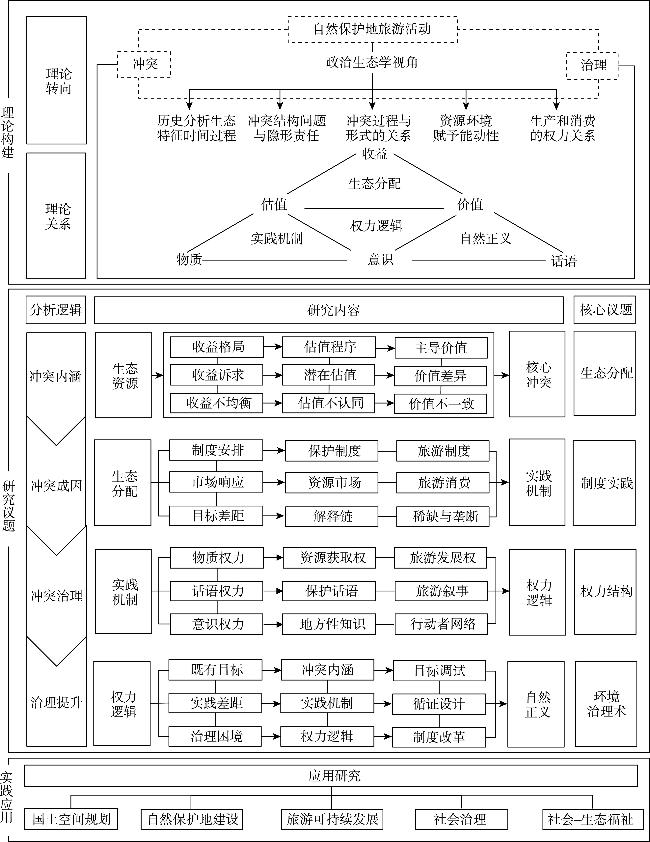
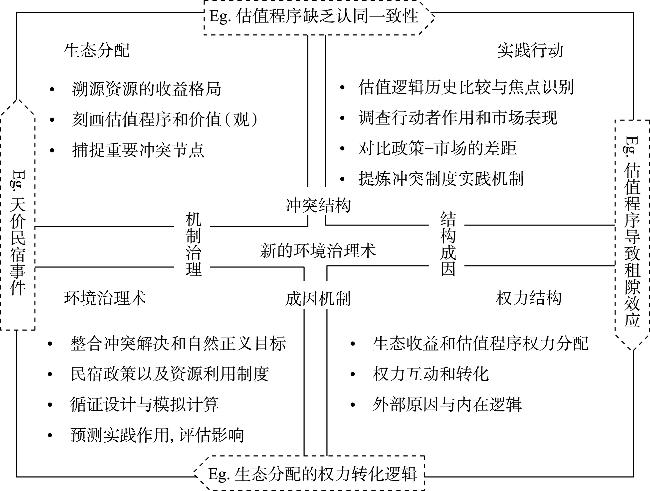
The resource use, costs and benefits of tourism activities in protected areas present unique characteristics. Revealing the distribution logic and the power mechanism is the key to breaking the conflict spiral to achieve the effective governance. Political ecology interprets ecological contradictions through political and economic linkages, providing a theory mean to integrate discrete and fluxes research works of nature conservation and tourism. The paper first compiles works related to tourism activities in protected areas from different disciplines, and then discusses the nature of political-ecology relation and internal unity of conflict-governance research in the governance process. Secondly, based on the epistemology of political ecology, the paper constructs a research framework for the conflict and governance of protected area tourism based on the practical logic of “conflict→governance”, which is based on the structure of the conflict, the causality of the structure, the mechanism of the causality, and the governance for the mechanisms. The framework starts with the social conflict events, and extends to the historical practice of nature and society interactions based on the dialectical and unified relationship of conflict and governance. Integrating the corresponding classical theories of political ecology, four main research topics emerge, i.e. ecological distribution, practical action, power structure and environmental governance. These topics are interconnected and causal with each other forming the paradigm of ecological distribution and in-depth power structure as a holistic theoretical manner to conduct research on the governance of conflicts over protected area tourism. Finally, the paper simulates the application of the research framework to analyze the causes of conflict by taking the example of the conflict over “sky-high priced homestay” in a protected area. The paper synthesizes, compares and evaluates interdisciplinary research on protected area tourism, bridging fragmented findings to reveal its political ecology dimensions. The proposed research framework bridges a conceptual gap in political ecology, focusing on the intrinsic links between conservation and tourism in protected areas. Last but not least, the study offers practical contributions to China's tecological civilization construction through technical support, theoretical guidance and discourse dissemination.
Key words: protected areas; tourism; political ecology; conflict; governance; sky-high priced homestay
ZHANG Haizhou , LU Lin . The political ecology framework for conflict-governance research of protected area tourism[J]. GEOGRAPHICAL RESEARCH, 2025 , 44(7) : 1941 -1954 . DOI: 10.11821/dlyj020240716
| [1] |
中共中央、国务院关于全面推进美丽中国建设的意见. 人民日报, 2024-01-12 (1).
[ Opinions of the CPC Central Committee and State Council on Comprehensively Promoting the Construction of a Beautiful China. People's Daily, 2024-01-12 (1).]
|
| [2] |
中华人民共和国国务院新闻办公室. 新时代的中国绿色发展. (2023-01-19). https://www.gov.cn/zhen gce/2023-01/19/content_5737923.htm.
[ The State Council Information Office the People's Republic of China. China's Green Development in the New Era. (2023-1-19). https://www.gov.cn/zhen gce/2023-01/19/content_5737923.htm.]
|
| [3] |
刘旭, 郝吉明, 王金南. 中国生态文明理论与实践. 北京: 科学出版社, 2022: 201-203.
[
|
| [4] |
张海洲. 自然区域保护与旅游的关系研究: 思想渊源与理论演进. 自然资源学报, 2024, 39 (10): 2383-2398.
[
|
| [5] |
吴次芳, 吴宇哲, 彭毅, 等. 空间治理. 北京: 地质出版社, 2022: 534-536.
[
|
| [6] |
|
| [7] |
中共中央办公厅国务院办公厅关于建立以国家公园为主体的自然保护地体系的指导意见. (2019-06-26). https://www.gov.cn/zhengce/2019-06/26/content_5403497.htm.
[ General Office of the CPC Central Committee & General Office of the State Council. Guiding Opinions on Establishing a System of Protected Natural Areas with National Parks as the Main Body. (2019-06-26). https://www.gov.cn/zhengce/2019-06/26/content_5403497.htm.]
|
| [8] |
吴必虎. 保护地转型与可持续旅游发展:理论与实践. 北京: 中国旅游出版社, 2023: 11-46.
[
|
| [9] |
|
| [10] |
保继刚, 杨兵. 旅游开发中旅游吸引物权的制度化路径与实践效应: 以“阿者科计划”减贫试验为例. 旅游学刊, 2022, 37 (1): 18-31.
[
|
| [11] |
左冰. 从景观到景像: 数字时代吸引资产权再探讨. 旅游学刊, 2024, 39(2): 31-48.
[
|
| [12] |
张海洲, 翁时秀, 保继刚, 等. 旅游政治生态学与本土研究议题. 旅游学刊, 2023, 38(9): 16-31.
[
|
| [13] |
张海洲, 吴志才. 国家公园的正义过渡与生态分配. 旅游学刊, 2024, 39(7): 3-5.
[
|
| [14] |
|
| [15] |
National Academies of Sciences, Engineering, and Medicine. Fostering Transformative Research in the Geographical Sciences. Washington, DC: The National Academies Press, 2019: 21-22.
|
| [16] |
|
| [17] |
|
| [18] |
|
| [19] |
|
| [20] |
|
| [21] |
|
| [22] |
|
| [23] |
|
| [24] |
保继刚, 左冰. 旅游招商引资中的制度性机会主义行为解析: 西部A地旅游招商引资个案研究. 人文地理, 2008(3): 1-6, 91.
[
|
| [25] |
|
| [26] |
|
| [27] |
|
| [28] |
|
| [29] |
|
| [30] |
|
| [31] |
|
| [32] |
|
| [33] |
|
| [34] |
|
| [35] |
蔡晓梅, 苏杨. 从冲突到共生: 生态文明建设中国家公园的制度逻辑. 管理世界, 2022, 38(11): 131-154.
[
|
| [36] |
李群绩, 王灵恩. 中国自然保护地旅游资源利用的冲突和协调路径分析. 地理科学进展, 2020, 39 (12): 2105-2117.
[
|
| [37] |
|
| [38] |
|
| [39] |
|
| [40] |
|
| [41] |
|
| [42] |
|
| [43] |
|
| [44] |
|
| [45] |
刘佳, 侯佳佳. 中外旅游环境承载力研究热点演变与比较. 中国生态旅游, 2022, 12(1): 32-48.
[
|
| [46] |
|
| [47] |
|
| [48] |
|
| [49] |
刘相军, 张士琴, 孙九霞. 地方性知识对民族旅游村寨自然环境的治理实践. 旅游学刊, 2021, 36(7): 27-42.
[
|
| [50] |
|
| [51] |
|
| [52] |
|
| [53] |
|
| [54] |
|
| [55] |
|
| [56] |
|
| [57] |
|
| [58] |
|
| [59] |
|
| [60] |
|
| [61] |
|
| [62] |
|
| [63] |
|
| [64] |
|
| [65] |
|
| [66] |
|
| [67] |
|
| [68] |
|
| [69] |
|
| [70] |
|
| [71] |
|
/
| 〈 |
|
〉 |