Differentiating characteristics and comprehensive effects of household energy transition in agro-pastoral areas of the Qingzang Plateau
Received date: 2024-11-05
Accepted date: 2024-12-03
Online published: 2025-07-31
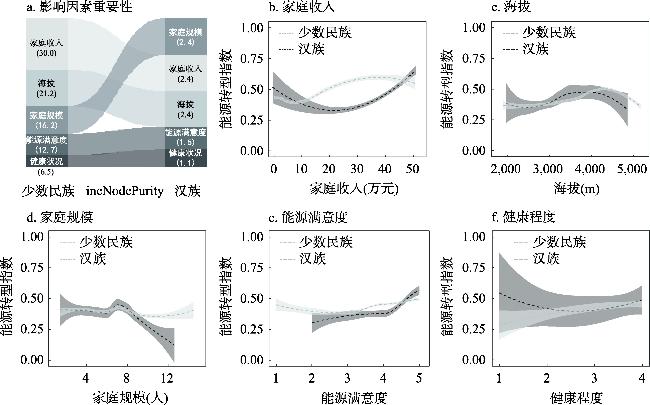
The energy transition within households of agro-pastoral regions has emerged as a pivotal pathway for re-establishing the human-land dynamic on the Qingzang Plateau. This study conducts an in-depth analysis of the current status and comprehensive impacts of household energy transitions across various regions, ethnicities, and livelihoods within the plateau, based on a dataset of 1,591 survey questionnaires collected during the Second Scientific Expedition to the Qingzang Plateau. Utilizing a Random Forest model, we have identified the key drivers of household energy transitions. Our findings indicate the following: (1) The energy consumption structure among agro-pastoral households on the Qingzang Plateau remains relatively primitive, with a significant dependence on coal and traditional biomass energy sources. Notably, households in Xizang and Han Chinese households exhibit higher levels of energy transition compared to other regions and ethnic groups, respectively. (2) The heavy reliance on primary biomass energy alleviates the energy transition burden for Xizang households but also leads to substantial pollutant emissions. Households with higher energy transition levels, particularly Han Chinese and agricultural households, demonstrate greater energy satisfaction, with significant social and environmental benefits. (3) Household income, altitude, and family size are identified as key determinants of energy transition on the Qingzang Plateau, with the impact of these drivers showing distinct nonlinear characteristics. Theoretical frameworks such as the energy ladder theory and tipping point theory are applicable in the study of household energy transitions in this region. This research provides a theoretical foundation for devising context-specific transition policies, promoting balanced development, and achieving inclusive and mutually beneficial outcomes, thereby fostering the green and sustainable development of the energy system on the Qingzang Plateau.
DANG Niu , WANG Qiang , HUANG Xueting , XU Ruling , YANG Yinuo , ZHANG Xin . Differentiating characteristics and comprehensive effects of household energy transition in agro-pastoral areas of the Qingzang Plateau[J]. GEOGRAPHICAL RESEARCH, 2025 , 44(8) : 2237 -2250 . DOI: 10.11821/dlyj020241196
表1 不同类型能源排放因子Tab. 1 Emission factors for different types of energy |
| 能源类型 | CO2 | CH4 | NOX | SO2 | PM2.5 |
|---|---|---|---|---|---|
| 电力(g/kWh) | 147.61 | 0.36 | 0.89 | 1.37 | 0.16 |
| 沼气(g/kg) | 140.00 | - | 0.48 | 1.68 | 0.24 |
| 液化气(g/kg) | 3,127.81 | 0.05 | 2.20 | 0.18 | 0.35 |
| 汽油(g/kg) | 3,448.94 | 1.11 | 7.94 | 0.20 | 0.24 |
| 煤炭(g/kg) | 1,963.35 | 1.47 | 1.83 | 9.59 | 8.31 |
| 牛粪(g/kg) | 903.59 | 3.76 | 2.45 | 2.64 | 10.17 |
| 柴薪(g/kg) | 1,522.99 | 2.36 | 1.44 | 0.46 | 4.67 |
表3 青藏高原农牧区家庭能源消费的环境效应Tab. 3 Environmental effects of household energy consumption in agro-pastoral areas of the Qingzang Plateau |
| 家庭类型 | CO2(kg) | CH4(g) | NOX(g) | SO2(g) | PM2.5(g) | |||
|---|---|---|---|---|---|---|---|---|
| 区域 | 青海 | 7,964 | 10,888 | 15,548 | 26,316 | 32,556 | ||
| 西藏 | 7,696 | 23,036 | 20,148 | 21,788 | 58,762 | |||
| 生计类型 | 农业 | 6,253 | 8,044 | 12,220 | 19,517 | 11,416 | ||
| 农牧兼业 | 8,332 | 13,148 | 17,577 | 26,167 | 18,459 | |||
| 牧业 | 8,209 | 22,467 | 19,910 | 25,403 | 29,967 | |||
| 民族 | 汉族 | 4,008 | 4,534 | 6,586 | 19,814 | 16,292 | ||
| 藏族 | 8,143 | 17,044 | 18,766 | 23,840 | 45,286 | |||
| 蒙古族 | 7,094 | 16,324 | 12,410 | 25,394 | 49,742 | |||
| 其他民族 | 8,050 | 9,324 | 11,346 | 37,648 | 37,118 | |||
表4 青藏高原农牧区家庭能源转型的社会-经济效益Tab. 4 Socio-economic benefits of household energy transition in agro-pastoral areas of the Qingzang Plateau |
| 家庭类型 | 家庭收入(元) | 能源支出(元) | 能源负担(%) | 能源满意度 | ||||||||
|---|---|---|---|---|---|---|---|---|---|---|---|---|
| 平均值 | 中位数 | 平均值 | 中位数 | 平均值 | 中位数 | 平均值 | 中位数 | |||||
| 青海 | 56,164.12 | 55,000 | 5,807.37 | 3,200 | 10.34 | 5.82 | 3.72 | 4 | ||||
| 西藏 | 33,445.94 | 64,000 | 2,140.54 | 2,400 | 6.40 | 3.75 | 3.64 | 4 | ||||
| 农业 | 49,276.12 | 75,000 | 4,272.24 | 3,150 | 8.67 | 4.20 | 3.79 | 4 | ||||
| 农牧兼业 | 58,151.82 | 56,800 | 6,565.34 | 3,550 | 11.29 | 6.25 | 3.78 | 4 | ||||
| 牧业 | 20,315.44 | 34,500 | 2,092.49 | 2,200 | 10.30 | 6.37 | 3.70 | 4 | ||||
| 汉族 | 38,917.81 | 40,000 | 2,949.97 | 1,200 | 7.58 | 3.00 | 3.60 | 4 | ||||
| 藏族 | 42,549.02 | 62,000 | 4,557.00 | 2,400 | 10.71 | 3.87 | 3.80 | 4 | ||||
| 蒙古族 | 63,697.41 | 75,000 | 738.89 | 450 | 1.16 | 0.60 | 3.14 | 3 | ||||
| 其他民族 | 34,038.97 | 43,000 | 4,026.81 | 2,500 | 11.83 | 5.83 | 3.48 | 4 | ||||
感谢两位匿名审稿人对本文研究思路、结果分析与行文细节的深刻意见,使本文获益匪浅;本文涉及的问卷调查由第二次青藏科考“生态安全保障的地域功能类型与区划”分队师生组织实施,并得到青海师范大学地理科学学院师生的大力协助,特此致以诚挚感谢!
| [1] |
傅伯杰, 欧阳志云, 施鹏, 等. 青藏高原生态安全屏障状况与保护对策. 中国科学院院刊, 2021, 36(11): 1298-1306.
[
|
| [2] |
陈发虎, 汪亚峰, 甄晓林, 等. 全球变化下的青藏高原环境影响及应对策略研究. 中国藏学, 2021(4): 21-28.
[
|
| [3] |
樊杰, 钟林生, 黄宝荣, 等. 地球第三极国家公园群的地域功能与可行性. 科学通报, 2019, 64(27): 2938-2948.
[
|
| [4] |
周侃, 樊杰, 周道静, 等. “十五五”时期我国生态地区的战略格局与优化. 中国科学院院刊, 2024, 39(4): 676-688.
[
|
| [5] |
杨华, 徐勇, 王丽佳, 等. 青藏高原人类活动强度时空变化与影响因素. 生态学报, 2023, 43(10): 3995-4009.
[
|
| [6] |
张健, 周侃. 农牧交错带村镇生活垃圾逆向物流模式的分异机制及空间优化. 地理学报, 2024, 79(2): 299-320.
[
|
| [7] |
党牛, 林景曜, 王强, 等. 青藏高原地区能源碳排放时空格局及驱动因素. 生态学报, 2024, 44(18): 8033-8046.
[
|
| [8] |
胡晓辉, 董柯. 可持续性转型研究动态与经济地理学展望. 地理研究, 2022, 41(1): 18-33.
[
|
| [9] |
姜璐, 余露, 薛冰, 等. 青海省家庭能源消费结构地域特征. 经济地理, 2019, 39(8): 146-152, 176.
[
|
| [10] |
温泽坤, 邱国玉. 中国家庭式光伏发电的环境与经济效益研究: 以江西5kW光伏系统为例. 北京大学学报(自然科学版), 2018, 54(2): 443-450.
[
|
| [11] |
|
| [12] |
王强, 周侃, 林键. 中国城乡家庭能源平等变化特征分析. 地理学报, 2022, 77(2): 457-473.
[
|
| [13] |
姜璐. 青藏高原农村家庭能源消费与能源贫困研究. 兰州: 兰州大学博士学位论文, 2019: 106-107.
[
|
| [14] |
沈国锋, 熊瑞, 程和发, 等. 青藏农村生活能源结构及一次PM2.5排放估算. 科学通报, 2021, 66(15): 1900-1911.
[
|
| [15] |
黄亚锡. 不同生产生活方式的牧区家庭能源消费及影响因素分析:以若尔盖为例. 成都: 西南财经大学硕士学位论文,2022: 22-35.
[
|
| [16] |
姜璐, 刘艳娟, 史晓楠, 等. 基于物质流的青海高原城镇社区家庭能源消费研究: 以西宁市为例. 干旱区地理, 2023, 46(2): 294-304.
[
|
| [17] |
|
| [18] |
何威风, 阎建忠, 花晓波. 不同类型农户家庭能源消费差异及其影响因素: 以重庆市“两翼” 地区为例. 地理研究, 2014, 33(11): 2043-2055.
[
|
| [19] |
|
| [20] |
|
| [21] |
殷悦, 周侃, 湛东升, 等. 基于自然与人文耦合视域的高寒生态功能区宜居性评价及阻滞因子诊断: 以青海省为例. 生态学报, 2024, 44(3): 992-1008.
[
|
| [22] |
高阳, 王晓锋, 熊巨华, 等. 地理科学视角下的气候变化研究实践与思考. 地理研究, 2023, 42(10): 2817-2826.
[
|
| [23] |
王正, 樊杰. 能源消费碳排放的影响因素特征及研究展望. 地理研究, 2022, 41(10): 2587-2599.
[
|
| [24] |
王强, 党牛, 蒋子龙, 等. 碳中和背景下能源转型研究综述与展望. 地理学报, 2025, 80(03): 586-604.
[
|
| [25] |
|
| [26] |
|
| [27] |
徐晓鹏, 刘影. 消费者感知视角下绿色农产品购买意愿的形成机理: 基于理性行为理论拓展模型. 中国农业大学学报, 2024, 29(1): 214-227.
[
|
| [28] |
|
| [29] |
|
| [30] |
刘逸, 陈海龙, 陈了凡. 饮酒休闲消费偏好的地域特征研究: 李白指数. 地理研究, 2024, 43(11): 2935-2951.
[
|
| [31] |
|
| [32] |
马小宾, 章锦河, 周乐莹, 等. 长三角区域经济与旅游规模异速关系的时空识别及成因分析. 地理研究, 2023, 42(11): 2984-3002.
[
|
| [33] |
|
| [34] |
高卿, 苗毅, 宋金平. 青藏高原可持续发展研究进展. 地理研究, 2021, 40(1): 1-17.
[
|
| [35] |
樊杰. “十五五”时期中国区域协调发展的理论探索、 战略创新与路径选择. 中国科学院院刊, 2024, 39(4): 605-619.
[
|
| [36] |
党牛, 陈达荃, 王强, 等. 能源转型对城乡能源公平的影响机制. 资源科学, 2024, 46(9): 1768-1779.
[
|
| [37] |
|
/
| 〈 |
|
〉 |