Spatial effects and spatial heterogeneity of rural industrial transformation on rural modernization
Received date: 2025-03-28
Accepted date: 2025-06-17
Online published: 2026-02-03
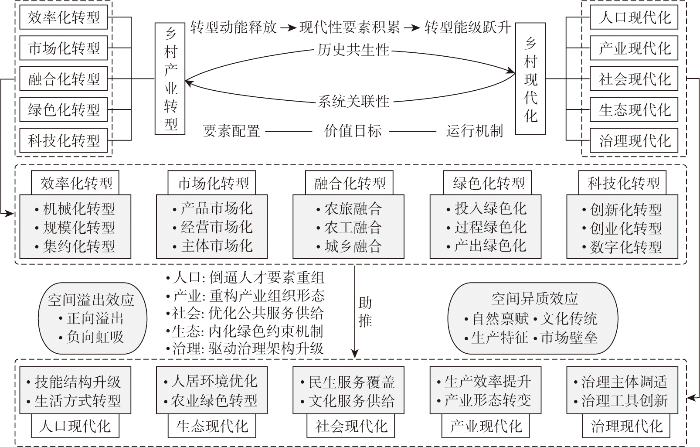
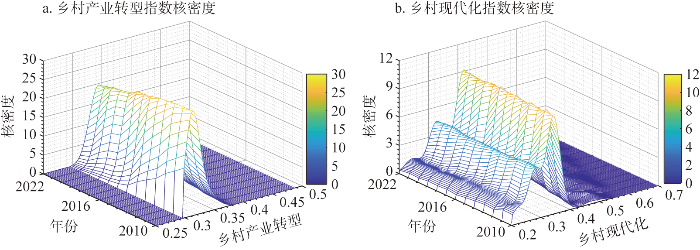
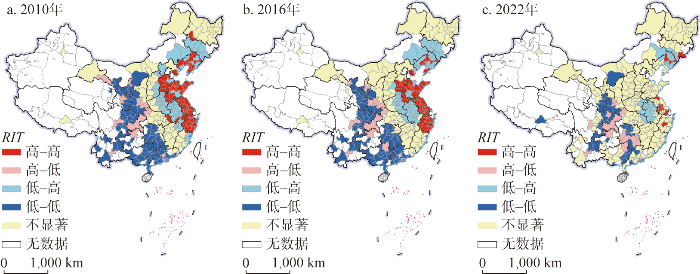
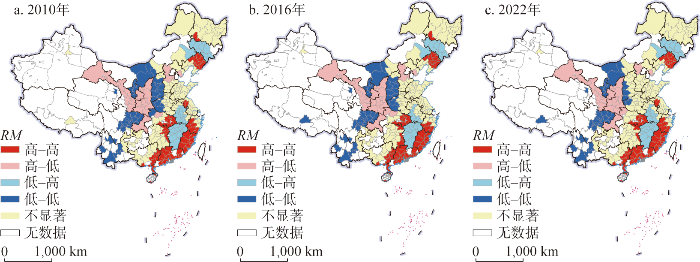
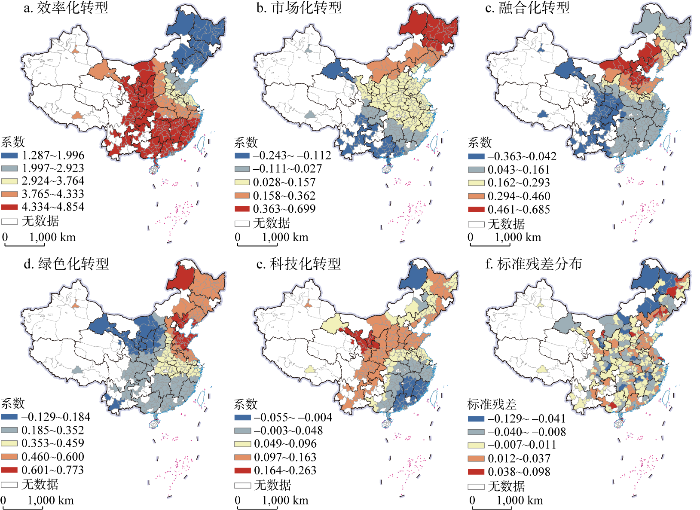
Rural industrial transformation plays a pivotal role in rural modernization. However, leveraging rural industrial transformation to drive modernization involves numerous uncertainties. Grounded in the theoretical framework of “factor restructuring-structural upgrading-functional leap”, this study meticulously constructs a five-dimensional evaluation system for rural industrial transformation, encompassing efficiency, marketization, integration, greening, and technology dimensions. The spatial panel Durbin model and the spatio-temporal geographically weighted regression model are applied to analyze the spatial interaction effects among 273 prefecture-level cities in China from 2010 to 2022. The following findings are obtainedas follows: (1) Spatially, the high-value areas of rural industrial transformation have shifted from Jiangsu, Shandong, Hebei, and southern Liaoning to the Yangtze River Delta, forming a “unipolar agglomeration” pattern centered on southern Jiangsu, while the high-high agglomeration areas of rural modernization have remained stably locked in Guangdong, Fujian, Zhejiang, southern Liaoning, and eastern Hubei. (2) There are dimensional differences in the transmission mechanism. Efficiency and market-oriented transformation generate positive spillover effects through industrial chain diffusion. However, integration exhibits negative spatial spillover owing to the siphoning effect, and technologization is locally locked by the dual constraints of geography and the system. (3) Concerning the spatial heterogeneity of the mechanism, the coefficients of efficiency and marketization increase from the northeast to the southwest in accordance with topographic fragmentation and traffic accessibility. The coefficients of integration and greening decrease from the Beijing-Tianjin-Hebei region to the periphery due to policy gradients and market attraction. Technology forms a high-value zone in the northeast and the west as a result of environmental coercion.
MA Zhifei , ZHANG Wei , GAO Junbo , LV Xinxin , LI Muyang . Spatial effects and spatial heterogeneity of rural industrial transformation on rural modernization[J]. GEOGRAPHICAL RESEARCH, 2026 , 45(2) : 309 -323 . DOI: 10.11821/dlyj020250363
表1 乡村现代化指标体系Tab. 1 Rural modernization indicator system |
| 准则层 | 指标层 | 指标解释 | 属性 |
|---|---|---|---|
| 人口现代化 | 技能结构升级 | 农村居民平均受教育年限 | + |
| 生活方式转型 | 农村居民教育文化娱乐支出/农村居民支出总额 | + | |
| 生态现代化 | 人居环境优化 | 农村绿化率 | + |
| 生活垃圾处理占比 | + | ||
| 农业绿色转型 | 农林业碳排放变化率 | - | |
| 社会现代化 | 民生服务覆盖 | 农村每千人拥有卫生技术人员数 | + |
| 农村居民人均住房面积 | + | ||
| 文化服务供给 | 每万人文化站数量 | + | |
| 产业现代化 | 生产效率提升 | 农业全要素生产率 | + |
| 产业形态转变 | 涉农企业数量/乡村人口数 | + | |
| 治理现代化 | 治理主体结构 | 村主任书记一肩挑比例 | + |
| 治理工具创新 | 已编制村庄规划的行政村比例 | + | |
| 已开展村庄整治的行政村比例 | + |
表2 乡村产业转型指标体系Tab. 2 Rural industrial transformation indicator system |
| 准则层 | 指标层 | 指标解释 | 属性 |
|---|---|---|---|
| 效率化转型 | 农业机械化 | 人均机械化总动力 | + |
| 农业规模化 | 人均农作物播种面积 | + | |
| 农业集约化 | 农业劳动生产率 | + | |
| 市场化转型 | 产品市场化 | 地理标志农产品数量/行政区划面积 | + |
| 经营市场化 | 设施农业占比 | + | |
| 主体市场化 | 电子商务进农村综合示范县政策占比 | + | |
| 融合化转型 | 农旅融合 | 乡村地区A级景区数量/乡村人口数 | + |
| 农工融合 | 规模以上农产品加工企业主营业务收入/乡村人口数 | + | |
| 城乡融合 | 乡村居民人均可支配收入/城镇居民人均可支配收入 | + | |
| 绿色化转型 | 投入绿色化 | 农药化肥使用量/耕地面积 | + |
| 过程绿色化 | 畜禽粪污综合利用率 | + | |
| 产出绿色化 | 绿色食品企业数量/乡村人口数 | + | |
| 科技化转型 | 乡村创新化 | 乡村创新指数 | + |
| 乡村创业化 | 乡村创业指数 | + | |
| 乡村数字化 | 乡村数字化指数 | + |
表3 乡村产业转型和乡村现代化全局自相关分析Tab. 3 The global autocorrelation analysis of rural industrial transformation and rural modernization |
| 年份 | 乡村产业转型 | 乡村现代化 | 年份 | 乡村产业转型 | 乡村现代化 | ||||
|---|---|---|---|---|---|---|---|---|---|
| 莫兰指数 | Z值 | 莫兰指数 | Z值 | 莫兰指数 | Z值 | 莫兰指数 | Z值 | ||
| 2010 | 0.150*** | 13.566 | 0.126** | 14.908 | 2017 | 0.099* | 9.092 | 0.116*** | 13.817 |
| 2011 | 0.144** | 13.025 | 0.113*** | 13.423 | 2018 | 0.101** | 9.214 | 0.125** | 14.818 |
| 2012 | 0.144** | 13.027 | 0.133** | 15.686 | 2019 | 0.088*** | 8.130 | 0.120** | 14.301 |
| 2013 | 0.126** | 11.489 | 0.111*** | 13.160 | 2020 | 0.073*** | 6.805 | 0.112** | 13.282 |
| 2014 | 0.136** | 12.316 | 0.116*** | 13.736 | 2021 | 0.056** | 5.326 | 0.116*** | 13.776 |
| 2015 | 0.125** | 11.410 | 0.116** | 13.786 | 2022 | 0.051** | 4.830 | 0.109** | 13.020 |
| 2016 | 0.113* | 10.349 | 0.119*** | 14.085 | |||||
注:*、**、***分别表示在0.1、0.05、0.01的置信水平上显著。下同。 |
图3 乡村产业转型局部自相关分析注:此图基于自然资源部地图技术审查中心的标准地图(GS(2020)4619号)绘制,底图边界无修改。 Fig. 3 Local autocorrelation analysis of rural industrial transformation |
表4 空间计量模型选择检验Tab. 4 Spatial econometric model selection test |
| 适配性检验 | 统计值 | 适配性检验 | 统计值 | 适配性检验 | 统计值 |
|---|---|---|---|---|---|
| LM_Spatialerror | 95.66*** | RobustLM_Spatiallag | 92.67** | Wald_Spatiallag | 31.75*** |
| RobustLM_Spatialerror | 57.29** | Wald_Spatialerror | 31.75*** | LR_Spatiallag | 650.31** |
| LM_Spatiallag | 31.23** | LR_Spatialerror | 85.15** | Hausman | 45.13** |
表5 乡村现代化空间面板杜宾模型结果Tab. 5 Results from the spatial panel Durbin model for rural modernization |
| 指标 | 时间固定效应模型 | 空间固定效应模型 | 时空双固定效应模型 |
|---|---|---|---|
| EFF | 2.488* | 2.423** | 2.412** |
| MAR | 0.059*** | -0.017 | -0.015 |
| INT | 0.143** | 0.021* | 0.020* |
| GRE | 0.676*** | 0.227* | 0.226*** |
| TEC | 0.087** | 0.052*** | 0.053** |
| W×EFF | -3.445* | 0.651* | 0.997** |
| W×MAR | 0.199* | -0.030 | 0.112 |
| W×INT | -0.278*** | -0.292** | -0.334** |
| W×GRE | -0.618** | 0.030 | -0.063 |
| W×TEC | -0.210* | 0.052* | 0.048 |
| rho | 1.277** | 0.311* | 0.137** |
| sigma2_e | 0.001** | 0.001*** | 0.001* |
| R2 | 0.548 | 0.583 | 0.573 |
表6 直接效应、间接效应和总效应结果Tab. 6 Direct effects, indirect effects, and total effect results |
| EFF | MAR | INT | GRE | TEC | |
|---|---|---|---|---|---|
| 直接效应 | 2.434* | 0.066*** | 0.142* | 0.682** | 0.084** |
| 间接效应 | 2.025** | 1.014** | -0.418** | -0.150 | 0.098 |
| 总效应 | 4.459*** | 1.080* | -0.276** | 0.532* | 0.182 |
真挚感谢两位匿名评审专家所付出的时间和精力,评审专家对本文理论分析、指标选取、语言表达等方面提出富有建设性的修改建议,使本文获益匪浅。
| [1] |
|
| [2] |
张千禧, 曹智. 基于机会窗口视角的乡村转型研究. 地理研究, 2025, 44(3): 785-808.
[
|
| [3] |
谭林, 赵蜀蓉, 陈岚. 空间治理赋能乡村转型的内在机理及路径选择. 地理研究, 2024, 43(6): 1572-1590.
[
|
| [4] |
刘彦随. 新时代乡村振兴地理学研究. 地理研究, 2019, 38(3): 461-466.
[
|
| [5] |
杨丽花, 雷欣, 白翠玲, 等. 河北省乡村旅游促进乡村产业振兴路径分析. 地理科学, 2024, 44(8): 1396-1405.
[
|
| [6] |
张静, 余灏哲, 谯伟, 等. 国内村域尺度乡村转型发展与重构的现状述评及展望. 地理科学进展, 2022, 41(5): 896-904.
[
|
| [7] |
姜长云. 农业新质生产力: 内涵特征、 发展重点、 面临制约和政策建议. 南京农业大学学报(社会科学版), 2024, 24(3): 1-17.
[
|
| [8] |
韩旭东, 刘闯, 刘合光. 农业全链条数字化助推乡村产业转型的理论逻辑与实践路径. 改革, 2023(3): 121-132.
[
|
| [9] |
何硕研, 方相, 杨钢桥. 土地综合整治能促进乡村产业转型吗? 来自湖北省部分乡村的证据. 中国土地科学, 2022, 36(4): 107-117.
[
|
| [10] |
戈大专, 龙花楼. 论乡村空间治理与城乡融合发展. 地理学报, 2020, 75(6): 1272-1286.
[
|
| [11] |
刘玲, 叶晓娟. 基于复杂因果模型的乡村旅游地农户旅游支持度研究. 信阳师范学院学报(自然科学版), 2023, 36(4): 594-598.
[
|
| [12] |
崔超, 郜亮亮, 来晓东. 新型农村集体经济赋能乡村特色产业绿色转型: 逻辑、 模式与进路. 中国人口·资源与环境, 2024, 34(9): 162-170.
[
|
| [13] |
|
| [14] |
程明洋, 尹珍珍, 张东, 等. 生态优越型城郊乡村转型过程及其振兴路径研究: 以河南省登封市杨家门村为例. 地理科学进展, 2024, 43(3): 474-487.
[
|
| [15] |
卫嫚, 黄泰. 县域城乡融合发展对乡村旅游地实现共同富裕的影响机制: 以长三角地区60个典型县为例. 自然资源学报, 2024, 39(7): 1591-1612.
[
|
| [16] |
方学军. 现代化产业体系与中国式农业农村现代化: 影响机理与实证检验. 统计与决策, 2024, 40(20): 107-112.
[
|
| [17] |
蒋辉, 刘兆阳. 乡村产业振兴的理论逻辑与现实困境: 以湖南千村调研为例. 求索, 2020(2): 128-134.
[
|
| [18] |
李玉恒, 阎佳玉, 武文豪, 等. 世界乡村转型历程与可持续发展展望. 地理科学进展, 2018, 37(5): 627-635.
[
|
| [19] |
张戬, 吴孔森, 王子侨, 等. 产业发展背景下黄土高原乡村转型与农户生计演化: 以陕西省长武县为例. 地理研究, 2023, 42(5): 1285-1306.
[
|
| [20] |
王坤, 贺清云, 朱翔. 新时代特色小镇与城乡融合发展的空间关系研究: 以浙江省为例. 经济地理, 2022, 42(8): 72-80.
[
|
| [21] |
戈大专, 孙攀, 周贵鹏, 等. 传统农区粮食生产转型机制及其安全效应: 基于乡村空间治理视角. 自然资源学报, 2021, 36(6): 1588-1601.
[
|
| [22] |
张蕴萍, 栾菁. 数字经济赋能乡村振兴: 理论机制、 制约因素与推进路径. 改革, 2022(5): 79-89.
[
|
| [23] |
李思梦, 杨忍, 龙花楼. 全球乡村发展理论演化及其对中国乡村现代化的启示. 地理学报, 2024, 79(4): 854-872.
[
|
| [24] |
戈大专, 王如敏, 卢小雪. 土地利用转型与乡村转型发展耦合关系研究: 以江苏省县域为例. 资源科学, 2025, 47(1): 196-210.
[
|
| [25] |
罗静, 韩婷婷, 裴利利, 等. 乡村公共服务布局与统筹政策研究进展及展望. 人文地理, 2024, 39(6): 23-32.
[
|
| [26] |
朱媛媛, 张瑞, 陈慧媛, 等. 乡村产业绿色转型发展的空间优化及调控路径研究: 以湖北省大冶市为例. 地理科学进展, 2023, 42(12): 2362-2376.
[
|
| [27] |
冉鹏程, 魏姝. “经济-政治”互动中的社会重塑: 乡村产业振兴如何推动社会共治. 中国农村观察, 2025(3): 85-106.
[
|
| [28] |
李明, 肖海峰. 农业生产性服务业发展对乡村产业振兴的影响效应与作用机制. 经济体制改革, 2025(2): 146-154.
[
|
| [29] |
文琦, 施琳娜, 马彩虹, 等. 黄土高原村域多维贫困空间异质性研究: 以宁夏彭阳县为例. 地理学报, 2018, 73(10): 1850-1864.
[
|
| [30] |
丛建辉, 刘学敏, 赵雪如. 城市碳排放核算的边界界定及其测度方法. 中国人口·资源与环境, 2014, 24(4): 19-26.
[
|
| [31] |
李文启, 牛健敏. 气候变化、气候适应性措施与农业全要素生产率: 基于投入要素视角. 世界农业, 2025(5): 29-41.
[
|
| [32] |
刘少芳, 戴文远, 包雪艳, 等. 沿海发达区乡村转型发展时空格局演变特征: 以闽东南地区为例. 人文地理, 2023, 38(4): 139-147.
[
|
| [33] |
梁盛凯, 陈池波, 田云, 等. 中国乡村产业振兴: 时空分异、 动态演进及共富效应. 农业技术经济, 2024(1): 75-95.
[
|
| [34] |
张子珍. 城乡产业互动视角下企业区位选址影响因素演变研究. 经济问题, 2016(3): 72-79.
[
|
/
| 〈 |
|
〉 |