


刘建国 , 张妍, 黄杏灵
北京联合大学旅游学院,北京 100101
Liu Jianguo, Zhang Yan, Huang Xingling
中图分类号: F59
文献标识码: A
文章编号: 1000-0690(2018)04-0564-11
收稿日期: 2017-04-20
修回日期: 2017-09-12
网络出版日期: 2018-04-20
版权声明: 2018 《地理科学》编辑部 本文是开放获取期刊文献,在以下情况下可以自由使用:学术研究、学术交流、科研教学等,但不允许用于商业目的.
基金资助:
作者简介:
作者简介:刘建国(1980-),男,内蒙古赤峰人,博士,副教授,硕士生导师,主要从事经济地理研究。E-mail: liujianguo009@163.com
展开
摘要
基于对北京16个景点游客的问卷调查,利用结构方程模型,分析了北京市不同类型旅游景区游客满意度的影响因素。研究结果表明:一方面,不同类型旅游景区游客满意度评价各影响因素影响程度不同。其中,影响自然风光类景区和现代文化类景区游客满意度的最主要因子为服务水平;便利性对历史古迹类景区游客满意度评价影响最大,景区主体特征对博物馆类景区游客满意度评价影响最为显著,而安全水平对各类旅游景区游客满意度评价影响相对显著,反映出北京市旅游景点整体安全水平较高。另一方面,不同类型景区之间游客满意度和出游决策路径系数存在显著差异,游客满意度对出游决策有正向影响。研究的政策涵义在于:北京市在旅游规划和管理中,需强化景区主体特征,完善景区的旅游功能,加强景区类型的划分,提高社会服务水平,增强游客体验性,从而提升北京旅游的整体形象。
关键词:
Abstract
This article analyzes the influence factors of tourist satisfaction in different types of scenic spots of Beijing by using the structural equation model, which is based on the random samples of the 16 scenic spots in Beijing. This article, through the factor analysis, gets the influenced factors of tourists in different types of scenic spots of Beijing, including 4 aspects: scenic spot main characteristics, service degree, security level and convenience, and builds a model, which has 2 exogenous latent variables, including the satisfaction and travel decision-making. This article, through structural equation confirmatory analysis, found that: different influencing factors on the degree of tourist satisfaction evaluation are different in kinds of scenic spots. 1) The service level is the most important factor of visitors’ satisfaction in the Natural scenery scenic spot and the modern cultural scenic spot, meanwhile, the traffic is the critical factor of tourist satisfaction in natural scenery scenic spot, and the diet has become the most important factor of tourist satisfaction in modern culture scenic spot. 2) The convenience to the historic scenic area has the greatest effects in the visitors' satisfaction evaluation; emergency exit and signs are the highest factor loading. 3) The main characteristics of scenic area are the most significant effect in museum visitors' satisfaction, also, tourists pay more attention to cultural educational significance of scenic spot, and visitors' satisfaction is not only affected by factors such as age, income, education level, but staff efficiency and traffic factors greatly affect the tourists’ behavior. 4) The path coefficient between the security level and tourist satisfaction is small, and security level is relatively significant influence on four types of the scenic area tourist satisfaction, reflecting that the overall safety condition of Beijing tourism is laudable. 5) The tourists' satisfaction has a positive correlation relationship on travailing decision-making. Between different types of scenic spots on tourist satisfaction and travailing decision-making path coefficient significantly different, tourist satisfaction of natural scenery and travailing decision-making path coefficient, followed by modern cultural attractions, museums scenic, path coefficient between tourist satisfaction of historic areas and travailing decision-making is lowest. Policy implications of the research are: Beijing, in the process of tourism planning and management, needs to plan the scenic spot layout scientifically, to strengthen the main characteristics of scenic spots, to perfect the function of the scenic spot tourism, to improve the classification of scenic areas, to promote the level of social services, and to enhance the visitor experience in order to make better the overall image of Beijing.
Keywords:
随着居民收入的不断增长,越来越多的人开始外出旅游休闲。旅游是指“人们到他们通常生活的环境之外的地方进行休闲、商务等,在时间上不超过1 a的活动” [1]。伴随旅游业的迅猛发展,游客的满意度、游客的感知问题逐渐成为政府和学术界关注的热点,而且相关研究日趋成熟。一些学者从游客满意度定义的视角进行研究,认为游客感知是旅游者在外界刺激物的影响下对目的地旅游过程的感知,即游客通过感官获得的对旅游地的游览对象、环境条件、服务质量等信息的心理过程,是对旅游地产品和服务认知程度的综合反映[2];将游客感知理解为是对旅游产品的综合评价,且会随着景区的主题独特性和感官体验的增强而提高[3]。由此可见,游客的感知行为不仅取决于旅游者对旅游目的地的满意度,而且对其评价需要从旅游者的情感、文化背景与信仰等多维视角来进行判断。
游客满意度指游客对于旅游目的地的期望与游客在旅游目的地游览后的体验结果进行比较,产生的一种心理状态[4]。国外的相关研究主要集中在满意度的内涵、行为结果、满意度的测评以及满意度模型等方面[5,6,7,8];国内学者的研究主要集中在游客满意度指标评价模型建立以及实证方面。游客满意度测评模型方面,有学者在对消费者满意度模型(American consumer satisfaction index, ACSI)改进的基础上,构建了旅游景区顾客满意度指数(TACSI)模型[9];另有学者将传统的重要性-绩效性分析法(Importance-performance analysis, IPA)与修正后的IPA分析法进行比较,对景区的旅游服务进行游客满意度分析[10]。研究方法采用多元回归法[11]、结构方程模型[12]、依据三角模糊评价理论[13]等对游客满意度影响因素进行模糊综合评价。
由于旅游目的地种类的多样性、旅游研究对象的复杂性,游客满意度测评指标研究是游客满意度的1个探讨热点。有学者从海滩、成本、游憩机会、好客度、餐饮设施、住宿设施、环境、商业化程度合计8个维度进行考量,对海滨旅游地游客满意度进行测评[14];Baker等认为在其他条件一定的情况下,供给高质量服务水平,很有可能带来高水平的游客满意度[15]。国内学者通常围绕旅游活动的六要素,即“食、住、行、游、购、娱”确定游客满意度测评指标体系[16,17,18],并认为景观环境质量、免票服务等对游客满意度产生影响 [19,20]。另有研究表明安全服务是影响游客服务质量满意度的主要因素,如有学者从医疗设施、应急安全设备等层面对旅游安全性进行评价[21]。此外,有学者从旅游目的地的管理、旅游交通系统、节事活动等方面来研究游客满意度[22,23]。研究进一步发现游客重游意愿受到公共交通“便捷性”因素的影响较强[24]。由此来看,在研究游客满意度的过程中,需要将其放置到不同类型的旅游地及其所处的特定地域环境来考虑[25]。
综上不难发现,学者们对于游客感知和游客满意度方面的研究已经十分丰富,而且角度各异。本文立足已有研究,在调查数据的基础上,研究北京不同类型景区游客行为的空间差异,并系统研究游客行为的规律性特征。这里,根据景区属性特征,将北京市旅游景区分为4个类型,并选取典型的景区作为研究对象,包括自然风光类(香山、植物园、雁栖湖、神堂峪)、现代文化类(国家大剧院、798、鸟巢与水立方、中央电视塔)、历史古迹类(故宫、颐和园、长城、圆明园)、博物馆类(国家博物馆、首都博物馆、保利博物馆、中国现代文学馆)。研究将对北京4个类型景区游客的满意度进行深入分析,以期为北京市旅游景区的发展提供对策建议。
景区游客行为感知的评价重点是构建游客的体验满意度的因素,通过对前人的研究进行梳理,可以看出满意度的评价因子总体来说主要围绕旅游六要素设定。借鉴前人的相关研究,并结合初步的调研,获得了16个北京不同类型旅游景区游客满意度的感知因素,相对应设定了16个题项,包括“文化教育意义、景区休闲娱乐、门票价格、导向标识、景区环境与卫生、工作人员态度、工作人员效率、讲解服务、残障服务、景区的防灾宣传、景区的紧急避难场所、景区的紧急出口、景区的医疗设施、景区的交通便利、餐饮便捷度、休息方便性”,每个题项采用Likert 5级量表形式,以“非常不满意、比较不满意、一般、比较满意、非常满意”分别由低到高赋1~5分。
调研所用问卷包括3部分,第1部分主要是针对旅游者的出游动机、旅游消费、对被调查景区的各项建设服务等方面的满意度。第2部分为游客旅游感知调查,主要针对游客来景区的主要目的、了解景区的途径、在景区停留时间、选择到景区的时间段,花费情况等方面的游客认知以及游客的行为调查。第3部分为游客人口统计学特征,包括旅游者的年龄、性别、家庭状况、学历、就业状况、从业类型及收入信息,从而确定旅游者的社会属性。
在问卷正式调研前进行了试调研,并通过反馈对问卷中的问题进行了修改,然后进行正式调研,调研时间为2015年10月1~7日和2016年3~7月,调研地点合计16个景点。本文采取结构访谈和问卷调查相结合的方法,对4种类型景区进行调研,共发放问卷2 000份,回收有效问卷1 855份,有效率为92.75%。
表1的数据表明,此次调查涵盖了各年龄段的人群,但以最具有消费能力和出游欲望的中青年女性为主,4类型不同景区的女性人数占比均超过50%,其中参观博物馆类的女性人数占比高达56.92%,其次为历史古迹类的女性占比为54.32%;从学历上看,游客多为大专及以上的高学历人群;在职业方面,以专业人员、白领和公务员人群为主;在收入方面,大多数被访人群的个人月收入低于万元。
表1 模型变量选择及样本统计描述
Table 1 Model variable selection and sample statistical description
| 变量 | 自然风光类 | 现代文化类 | 历史古迹类 | 博物馆类 | |||||
|---|---|---|---|---|---|---|---|---|---|
| 样本数(个) | 比重(%) | 样本数(个) | 比重(%) | 样本数(个) | 比重(%) | 样本数(个) | 比重(%) | ||
| 性别 | 女性 | 248 | 52.43 | 239 | 52.88 | 258 | 54.32 | 259 | 56.92 |
| 男性 | 225 | 47.57 | 213 | 47.12 | 217 | 45.68 | 196 | 43.08 | |
| 年龄 | <18岁 | 35 | 7.40 | 28 | 6.19 | 65 | 13.68 | 50 | 10.99 |
| 18~29岁 | 112 | 23.68 | 22.79 | 20.00 | 23.08 | ||||
| 30~39岁 | 91 | 19.24 | 19.03 | 23.58 | 17.8 | ||||
| 40~49岁 | 95 | 20.08 | 19.91 | 22.32 | 19.34 | ||||
| 50~59岁 | 75 | 15.86 | 15.27 | 13.68 | 17.58 | ||||
| >60岁 | 65 | 13.74 | 16.81 | 6.74 | 11.21 | ||||
| 职业类型 | 公务员 | 78 | 16.49 | 45 | 9.96 | 49 | 10.32 | 75 | 16.48 |
| 专业人员 | 119 | 25.16 | 28.32 | 38.95 | 25.05 | ||||
| 白领 | 92 | 19.45 | 18.81 | 16.63 | 21.32 | ||||
| 工人 | 76 | 16.07 | 14.38 | 14.74 | 14.95 | ||||
| 服务人员 | 61 | 12.90 | 10.40 | 8.00 | 12.31 | ||||
| 自由职业 | 47 | 9.94 | 18.14 | 11.37 | 9.89 | ||||
| 就业状态 | 全职 | 329 | 69.56 | 356 | 78.76 | 343 | 72.21 | 296 | 65.05 |
| 兼职 | 72 | 15.22 | 6.19 | 7.37 | 17.58 | ||||
| 退休 | 43 | 9.09 | 12.39 | 11.79 | 12.09 | ||||
| 待业 | 29 | 6.13 | 2.65 | 8.63 | 5.27 | ||||
| 个人月收入 | 3000以下 | 48 | 10.15 | 42 | 9.29 | 35 | 7.37 | 60 | 13.19 |
| 3000~4999元 | 61 | 12.90 | 12.39 | 17.89 | 16.48 | ||||
| 5000~1万元 | 286 | 60.47 | 67.70 | 61.05 | 43.96 | ||||
| 1万元以上 | 78 | 16.49 | 10.62 | 13.68 | 26.37 | ||||
| 学历 | 初中及以下 | 43 | 9.09 | 68 | 15.04 | 68 | 14.32 | 39 | 8.57 |
| 高中 | 56 | 11.84 | 16.59 | 17.89 | 14.95 | ||||
| 大专 | 146 | 30.87 | 37.17 | 32.21 | 27.47 | ||||
| 本科 | 153 | 32.35 | 23.45 | 22.74 | 29.01 | ||||
| 研究生及以上 | 75 | 15.86 | 7.74 | 12.84 | 20 | ||||
调查结果表明,博物馆类的游客出游目的以子女教育和充实自我为主,其余3个类型景区游客的旅游目的主要以度假休闲为主,说明游客更多地注重个人修养的提升,把旅游当作个人增值的休闲活动。而游客了解景区的途径多以互联网或报纸、杂志、书籍等方式为主。游客出游方式多为自由行,主要集中在周末或小长假期间;景区停留时间多为1~5 h。综合整体调研样本数据,游客特征和出游特征较相似,与游客行为感知特征及出游特征相一致,随机性较强,数据具有较好的可靠性。
影响游客对景区的满意度及出游决策的感知变量包含16个题项。首先对是否可以应用探索性因子分析(EFA)进行检验。整体样本的KMO值为0.936,Bartlett球形检验值为28 645.324,对应的P值为0.000,说明适合做因子分析。
这里,使用主成分分析和最大方差旋转法提取影响满意度的公因子,发现累计方差贡献率大于70%,每个题项在其单一维度的因子上负荷率均大于0.5;且第1公因子在“文化教育意义” “适合休闲娱乐” “门票价格”“环境卫生”和“导向标志”等感知因子上载荷较高,反映景区的功能、价格、环境、导向等方面,因此第1公因子可命名为“景区主体特征”;第2公因子在“工作人员态度”“工作人员效率”“讲解服务”和“残障服务”等感知因子上载荷较高,反映景区服务人员的服务质量,因此第2公因子可命名为“服务水平”;第3公因子在“防灾宣传管理”“游乐设施的安全”“紧急出口及标识”和“医疗设施”等感知因子上载荷较高,反映了景区的安全性,因此第3公因子可命名为“安全水平”;第4公因子在“饮食”“交通”和“休息”等感知因子上载荷较高,反映了景区的便利性,因此第4公因子可命名为“便利性”。分别以X1~X16命名以上感知变量(表2)。
表2 游客满意度探索性因子分析结果
Table 2 The results of exploratory factor analysis
| 因子 | 自然风光类 | 现代文化类 | 历史古迹类 | 博物馆类 | ||||||||
|---|---|---|---|---|---|---|---|---|---|---|---|---|
| 特征值 | 累积贡献率(%) | 标准 载荷 | 特征值 | 累积贡献率(%) | 标准 载荷 | 特征值 | 累积贡献率(%) | 标准 载荷 | 特征值 | 累积贡献率(%) | 标准载荷 | |
| 景区主体特征 | 7.85 | 49.86 | 7.94 | 63.39 | 6.76 | 56.85 | 7.62 | 67.57 | ||||
| X1文化教育意义 | 0.68 | 0.65 | 0.71 | 0.73 | ||||||||
| X2适合休闲娱乐 | 0.67 | 0.53 | 0.68 | 0.69 | ||||||||
| X3门票价格 | 0.71 | 0.61 | 0.73 | 0.71 | ||||||||
| X4环境卫生 | 0.72 | 0.55 | 0.76 | 0.73 | ||||||||
| X5导向标志 | 0.75 | 0.53 | 0.71 | 0.71 | ||||||||
| 服务水平 | 1.29 | 56.94 | 1.53 | 73.36 | 1.31 | 66.28 | 1.46 | 72.27 | ||||
| X6工作人员态度 | 0.78 | 0.73 | 0.72 | 0.71 | ||||||||
| X7工作人员效率 | 0.72 | 0.56 | 0.72 | 0.76 | ||||||||
| X8讲解服务 | 0.71 | 0.65 | 0.71 | 0.72 | ||||||||
| X9残障服务 | 0.35 | 0.55 | 0.65 | 0.69 | ||||||||
| 安全水平 | 0.98 | 63.89 | 0.87 | 78.67 | 0.92 | 70.36 | 0.87 | 78.31 | ||||
| X10防灾宣传管理 | 0.54 | 0.53 | 0.56 | 0.57 | ||||||||
| X11紧急避难场所 | 0.62 | 0.58 | 0.59 | 0.65 | ||||||||
| X12紧急出口及标识 | 0.58 | 0.73 | 0.77 | 0.68 | ||||||||
| X13医疗设施 | 0.53 | 0.57 | 0.69 | 0.69 | ||||||||
| 便利性 | 0.79 | 70.16 | 0.76 | 80.35 | 0.68 | 75.24 | 0.69 | 82.49 | ||||
| X14饮食 | 0.65 | 0.74 | 0.74 | 0.53 | ||||||||
| X15交通 | 0.79 | 0.72 | 0.72 | 0.76 | ||||||||
| X16休息 | 0.62 | 0.68 | 0.69 | 0.63 | ||||||||
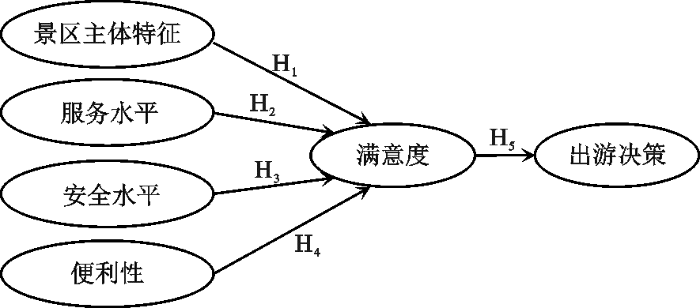
通过探索性因子分析提取出了影响游客满意度的4个公因子:“景区主体特征” “服务水平” “安全水平”和“便利性”。在此基础上,构建了游客感知与满意度及其出游决策关系的结构方程模型(图1)。该模型包含6个感知潜变量,其中,“景区主体优势”“服务水平”“安全水平”和“便利性”为外生潜变量,“总体满意度”和“出游决策”为内生潜变量。
进一步地在探索性因子分析的基础上,需要构建游客行为感知的概念模型(图1)。该模型是一个具有因果关系的结构方程模型,共包含6个感知潜变量,其中“景区主体特征”“服务水平”“安全水平”以及“便利性”为外生潜变量,“满意度”和“出游决策”为内生潜变量。
根据上述模型,本研究提出如下假设:
H1:景区总体特征对满意度有正向影响;H2:服务水平对满意度有正向影响;H3:安全水平对满意度有正向影响;H4:便利性对满意度有正向影响;H5:满意度对出游决策有正向影响。
借助于SPSS21.0和AMOS22.0软件,对数据进行分析及验证。分析方法包括:① Cronbach α值信度检验;② 验证性因子分析(CFA);③ 最大似然估计法(ML)。
2.3.1 正态性检验
首先通过计算偏度值与峰度值来检验数据的正态性。表3的计算结果显示,所有观测变量的偏度值绝对值小于3,峰度值绝对值小于10;各观测变量的样本数据符合正态分布,可用结构方程模型进行进一步分析。
表3 正态性检验
Table 3 Normality test
| 变量 | 自然风光类 | 现代文化类 | 历史古迹类 | 博物馆类 | |||||||||
|---|---|---|---|---|---|---|---|---|---|---|---|---|---|
| 偏度值 | 峰度值 | 标准化系数 | 偏度值 | 峰度值 | 标准化系数 | 偏度值 | 峰度值 | 标准化系数 | 偏度值 | 峰度值 | 标准化系数 | ||
| 景区主 体特征 | X1 | 0.04 | -0.69 | 0.72 | 0.25 | -0.28 | 0.82 | 0.19 | -0.58 | 0.68 | 0.16 | -0.37 | 0.56 |
| X2 | -0.35 | 0.36 | 0.76 | -0.46 | 0.59 | 0.86 | -0.28 | 0.56 | 0.71 | -0.45 | 0.67 | 0.67 | |
| X3 | -0.64 | 1.48 | 0.73 | -0.73 | 1.69 | 0.83 | -0.37 | 1.37 | 0.65 | -0.59 | 0.86 | 0.69 | |
| X4 | -0.19 | -0.02 | 0.75 | -0.36 | -0.15 | 0.85 | -0.26 | -0.44 | 0.63 | -0.67 | -0.27 | 0.73 | |
| X5 | -0.58 | 0.71 | 0.71 | -0.49 | 0.59 | 0.82 | -0.43 | 0.86 | 0.66 | -0.72 | 0.68 | 0.68 | |
| 服务水平 | X6 | -0.28 | -0.27 | 0.65 | -0.35 | -0.38 | 0.76 | -0.34 | -0.39 | 0.59 | -0.36 | -0.69 | 0.76 |
| X7 | -0.71 | 1.52 | 0.68 | -0.69 | 0.57 | 0.74 | -0.52 | 0.89 | 0.72 | -0.68 | 0.98 | 0.81 | |
| X8 | -0.31 | 0.47 | 0.69 | -0.58 | 0.57 | 0.64 | -0.43 | 0.52 | 0.76 | -0.56 | 0.78 | 0.56 | |
| X9 | -0.46 | 0.32 | 0.72 | -0.69 | 0.46 | 0.78 | -038 | 0.48 | 0.81 | -0.67 | 0.56 | 0.64 | |
| 安全水平 | X10 | -0.09 | -0.46 | 0.63 | -0.18 | -0.69 | 0.78 | -0.27 | -0.54 | 0.75 | -0.17 | -0.57 | 0.78 |
| X11 | 0.02 | -0.22 | 0.65 | 0.09 | -0.35 | 0.73 | 0.16 | -0.36 | 0.74 | 0.29 | -0.48 | 0.71 | |
| X12 | -0.39 | 0.51 | 0.75 | -0.53 | 0.78 | 0.86 | -0.41 | 0.67 | 0.81 | -0.42 | 0.69 | 0.77 | |
| X13 | -0.27 | 0.69 | 0.64 | -0.46 | 0.81 | 0.82 | -0.34 | 0.73 | 0.75 | -0.38 | 0.71 | 0.73 | |
| 便利性 | X14 | -0.24 | 0.16 | 0.62 | -0.35 | 0.37 | 0.68 | -0.36 | 0.42 | 0.67 | -0.59 | 0.37 | 0.74 |
| X15 | -0.68 | 0.62 | 0.71 | -0.47 | 0.67 | 0.74 | -0.75 | 0.59 | 0.61 | -0.62 | 0.71 | 0.76 | |
| X16 | -0.67 | 0.44 | 0.73 | -0.52 | 0.59 | 0.81 | -0.69 | 0.69 | 0.86 | -0.73 | 0.56 | 0.82 | |
| 再出游 决策 | Y1 | -0.25 | -0.57 | 0.65 | -0.28 | -0.58 | 0.68 | -0.25 | -0.56 | 0.56 | -0.26 | -0.46 | 0.75 |
| Y2 | 0.34 | -0.28 | 0.58 | 0.35 | -0.43 | 0.71 | 0.34 | -0.39 | 0.71 | 0.31 | -0.48 | 0.69 | |
| Y3 | -0.46 | 0.27 | 0.67 | -0.49 | 0.74 | 0.82 | -0.46 | 0.69 | 0.76 | -0.39 | 0.59 | 0.72 | |
| Y4 | -0.35 | 0.56 | 0.59 | -0.57 | 0.76 | 0.79 | -0.35 | 0.67 | 0.69 | -0.43 | 0.74 | 0.64 | |
2.3.2 信度检验
采用格朗巴哈(Cronbach α)信度系数,Cronbach α值越大表示问卷项目内部一致性可信度越高。α>0.7,表明数据的可靠性较高;量表级数少于6时,α>0.6,表明数据也是可靠的[26]。由表4可以看出,各公因子的Cronbach α>0.6,说明测量模型具有较好的内部协调性,充分表明了问卷调查具有较好的可靠性和稳定性,可以进行接下来的检验分析。
表4 Cronbach α信效度检验
Table 4 The test of validity and reliability of Cronbach α
| 变量 | 自然风光类 | 现代文化类 | 历史古迹类 | 博物馆类 | ||||||||
|---|---|---|---|---|---|---|---|---|---|---|---|---|
| Cronbach α | CR | AVE | Cronbach α | CR | AVE | Cronbach α | CR | AVE | Cronbach α | CR | AVE | |
| 景区主体特征 | 0.773 | 0.812 | 0.523 | 0.685 | 0.853 | 0.546 | 0.896 | 0.753 | 0.489 | 0.913 | 0.761 | 0.753 |
| 服务水平 | 0.845 | 0.834 | 0.534 | 0.736 | 0.769 | 0.498 | 0.765 | 0.757 | 0.476 | 0.846 | 0.814 | 0.689 |
| 安全水平 | 0.753 | 0.816 | 0.549 | 0.729 | 0.867 | 0.476 | 0.691 | 0.793 | 0.638 | 0.752 | 0.805 | 0.626 |
| 便利性 | 0.759 | 0.856 | 0.627 | 0.698 | 0.784 | 0.524 | 0.658 | 0.852 | 0.575 | 0.716 | 0.763 | 0.498 |
2.3.3 模型拟合度检验
计算结果显示了不同类型景区的整体拟合度,拟合效果较好。从表5可以看到,4类景区的χ2/df分别为1.46、1.39、1.87、1.96,均处于理想值之间;GFI、AGFI、NFI、CFI和IFI均达到大于0.9的标准,这表明模型拟合度很好。
表5 结构方程模型拟合度检验
Table 5 Fitting test of structural equation model
| 绝对拟合指数 | 增值拟合指数 | 精简拟合指数 | |||||||
|---|---|---|---|---|---|---|---|---|---|
| χ2/df | GFI | RMSEA | AGFI | NFI | CFI | IFI | AIC | CAIC | |
| 理想值 | 1~3 | >0.9 | <0.1 | >0.9 | >0.9 | >0.9 | >0.9 | 越小越好 | 越小越好 |
| 自然风光类 | 1.46 | 0.96 | 0.09 | 0.93 | 0.93 | 0.92 | 0.95 | 456.27 | 570.26 |
| 现代文化类 | 1.39 | 0.92 | 0.08 | 0.92 | 0.94 | 0.91 | 0.97 | 469.37 | 569.24 |
| 历史古迹类 | 1.87 | 0.98 | 0.09 | 0.93 | 0.96 | 0.94 | 0.93 | 459.32 | 597.26 |
| 博物馆类 | 1.96 | 0.97 | 0.07 | 0.91 | 0.91 | 0.93 | 0.98 | 497.64 | 589.37 |
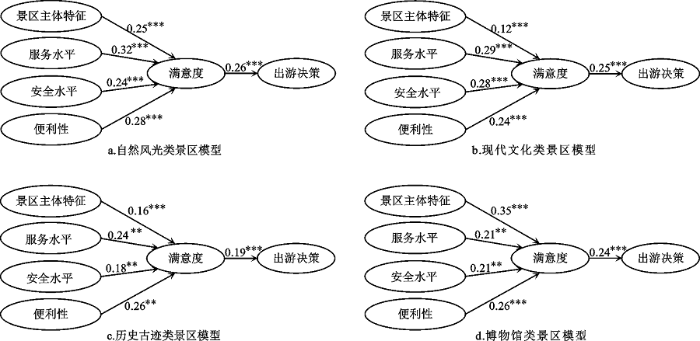
从以上几个检验可以看出,结构方程模型是有效的,可以进一步对北京市不同类型景区的游客行为进行分析估计。数据结果显示:自然风光类景区主体特征、安全水平、服务水平、便利性与满意度的标准化路径系数分别为0.25、0.24、0.32和0.28;现代文化类景区主体特征、安全水平、服务水平、便利性与满意度的标准化路径系数分别为0.12、0.28、0.29和0.24;历史古迹类景区主体特征、安全水平、服务水平、便利性与满意度的标准化路径系数分别为0.16、0.18、0.24和0.26;博物馆类景区主体特征、安全水平、服务水平、便利性与满意度的标准化路径系数分别为0.35、0.21、0.21和0.26(图2)。因此,4类旅游景区的景区主体特征、服务水平、安全水平、便利性都对满意度都显著影响,故而假设H1~H4成立。自然风光类、现代文化类、历史古迹类和博物馆类景区满意度与出游决策的标准化路径系数分别为0.26、0.25、0.19及0.24,因此假设H5成立,即满意度对出游决策的影响显著。
图2 结构方程模型参数值***表示在0.01 水平下显著,**表示在0.05 水平下显著
Fig.2 Structural model parameter values
2.4.1 服务水平是影响自然风光类景区和现代文化类景区游客满意度的最主要因素
在对4种不同类型旅游景区分析中,自然风光类景区、现代文化类景区的服务水平与游客满意度相关性最强,路径系数分别为0.32和0.29,说明自然风光类景区和现代文化类景区服务水平对游客满意度及其出游决策具有显著影响。因此,提高自然风光类景区和现代文化类景区服务能力运作效率,是提升游客满意度的有效途径。其次,规范的服务标准、训练有素的服务团队、不同语种的导游服务,对于提升整体的服务水平及提高游客自身感知和对景区建设至关重要。在对自然风光类景区16项感知因子分析中,工作人员态度对旅游目的地游客满意度的影响较大,表现为工作人员态度载荷值为0.78。而工作人员效率、讲解服务和残障服务的载荷值分别为0.72、0.71和0.35,这反映了游客在旅游过程中,更加注重人文情怀和旅游体验质量。结合游客出行多以自由行为主,以及景区游玩时间多为1~5 h,均凸显了服务水平在景区的重要性。标准化的服务、高效率的服务效率、景区导游讲解、导览图、游客服务中心等会直接影响游客在游玩过程的满意度,特别是在时下旅游个性化、时尚化、高消费化的市场趋势下,节约时间成本、消费成本、获得较高的旅游价值体验,景区服务水平的影响更不容小觑。
现代文化类景区的游客感知研究一般从感知价值、感知形象和感知服务质量这3个角度来解析[27,28,29]。在对北京市现代文化类景区16项感知因子分析中,影响最大的感知因子为饮食,载荷达到0.74,由于游客出游目的以度假休闲为主,研究显示出游客在现代文化类景区旅游过程中不仅注重景点观赏,也更关注特色美食享受与体验。因此,景区应挖掘与景点文化有联系的特色餐饮,引导游客主动而有意识地参与到有别于自己日常习惯的饮食文化系统之中,从事品尝、观摩、欣赏、制作、探索或娱乐休闲等活动。现代文化类景区中,其他感知因子为工作人员态度、紧急出口和标示以及交通,各载荷值分别为0.73、0.73和0.72。研究还发现大部分游客对景区内的布局,尤其是在紧急出口、文字标识、旅游购物区、餐饮服务店等的设置不满意,因此,景区应合理规划各个景点、导览标示等点与点的位置,引进体验式和创新式的目的地营销和管理理念,能给游客提供更优质的旅游体验,控制游客人数以降低对景区的损坏,以更有效地吸引游客[23],进而提高旅游目的地的竞争力。从现代文化类景区游客职业类型可以看出,专业人员占比为28.32%,受其专业性影响,游客能更好的掌握并了解景区文物,从而对景点有很好的感知,充分表明了游客在参观该类景区的过程中,对工作人员服务的专业要求也越来越高。由于游客的职业特征存起差异,不同游客逗留在景区的时间也会存在差异,对景区餐饮的需求也就存在较大差异。
2.4.2 便利性对历史古迹类景区游客满意度评价影响最大
从结构模型的参数可以看到,历史古迹类景区便利性与游客满意度相关性较强,路径系数为0.26,便利性程度对历史古迹类景区游客满意度评价影响显著。自然风光类景区、现代文化类景区和博物馆类景区的便利性与游客满意度相关性相对显著,路径系数分别为0.28、0.24及0.26。由调研结果发现:便利性对4类景区游客满意度影响路径系数较为均衡,说明便利性是影响各类景区游客满意度的稳定性因子。调查中我们也了解到一些景点由于处在交通便利的位置,长期人满为患,大大超过了景区的环境承载力;相反,一些高禀赋和高旅游价值的景点,却因为交通不便,导致游人稀少。究其原因在于,由于景区的可进入性不强,连接景区的道路和景区内部的交通状况在一定时期内不能得到很好的改善。再者,参观历史古迹类景区游客停留时间多为1~3 h,游客的时间观念较强,游客对旅游便利性要求较高。但由于历史古迹类景区分布较广、数量较多且景区之间相似性较大,有些景区的文化优势没有突显,由此便利性较好的景区就会成为首选。此外,如果出行游玩的团队中有老人小孩,那么交通不便的景区游玩的机率就会大大降低,所以基础设施便利性,很大程度上限制了游客对旅游目的地的选择。可见,通达性差异是造成历史古迹类景区发展参差不齐的主要原因之一。针对便利性不高的历史古迹类景区,应增加旅游车辆的数量,完善连接景区的交通通道。与此同时,要注重生态环境的保护,引入城市低碳公共交通在古城保护、城市环境、旅游效用、景区保护等诸多方面有着重要的意义[30]。
2.4.3 旅游景区的安全性是影响游客满意度的主要因素
旅游安全是历史古迹类景区游客首要考虑的一大因素,旅游目的地的安全风险是影响旅游感知的因素之一[31],它在某种意义上也影响了游客对旅游目的地的满意度[32]。在对历史古迹类景区16项感知因子分析中,紧急出口及标识因素影响最大,载荷达到0.77,紧急出口及标识成为游客出游行为的重要影响因素。由于游客出游一般集中在小长假、周末等时间段,游客出游时间段较集中,这加大了不确定因素发生的几率。调查过程中,有游客就认为一些景区的安全提示性标识缺少拼音或其他语言标示,且设置偏高。尤其是医疗设施、紧急出口及标识的数量相对较少,会降低游客的满意度及出游的质量。由此可见,景区对突发事件的处理方式也会影响游客对目的地感知,良好的应急处理方式可以为旅游目的地树立更加良好的形象。合理增设紧急避难所、紧急出口、医疗设施等安全性建设点,完善旅游购物体系,让游客充分感受到“吃、住、行、游、购、娱”为一体的旅游服务,以提高景区游客满意度及重游率。与历史文化类景区相比,自然风光类景区、现代文化类景区和博物馆类景区安全水平与游客满意度路径系数较高、相关性更强。因此,北京市在旅游景区管理中应重视旅游景区安全管理,建立旅游预报制度和旅游警示制度,加强网络监测和服务,注重旅游环节的安全责任等保障,坚决杜绝各类旅游安全事故的发生。
2.4.4 景区主体特征对博物馆类景区游客满意度评价影响显著
研究结果表明,景区主体特征对博物馆类景区游客满意度评价影响较大,其路径系数为0.35,说明景区主体特征对游客满意度评价影响显著。博物馆类景区不仅要向游客展示景区基本的游览展览功能,更要挖掘其深层次的文化元素,应不断注重与文化产业的融合,以满足游客的需求。事实上,参观博物馆类景区游客出游目的多为子女教育,这使得游客更关注景区的文化教育意义。与自然风光类景区、现代文化类景区及历史古迹类景区相比,参观博物馆类景区的游客受教育程度更高,本科及以上学历水平约占50%,高学历水平游客更加关注景区主体特征。在对博物馆类景区16项感知因子分析中,工作人员效率与交通感知因子载荷达到最高,均为0.76,说明工作人员效率与交通因素对游客满意度产生较大影响。由于参观博物馆游客停留时间多为1~3 h,停留时间较短,特别是高铁服务带来了时空压缩效应,而且扩大了景点短期中远途旅游市场范围,大幅削减交通时间成本支出。因此大多数博物馆都会不定期地举办展会活动来吸引游客量并且延长游客的停留时间。这不仅对旅游经济有着明显的带动作用,而且还会给旅游业带来更多发展和开拓的机会,并对游客的旅游行为和游客感知产生积极的影响[33,34]。但由于北京城区功能混合程度高,交通压力大,导致集聚于交通主干线附近的博物馆在举办大型活动时不利于游客的集散,对城市交通产生负面影响,从而影响游客满意度及行为决策,因此博物馆所在区位交通是否便利,同样是影响游客满意度的主要因素之一。
通过因子分析得到北京市不同类型旅游景区游客感知的影响因素,并构建了包含“满意度”与“出游决策”两个外生潜变量的模型。通过结构方程验证性分析发现:北京市不同类型景区游客满意度各影响因素影响程度不同。①服务水平是影响自然风光类景区和现代文化类景区游客满意度的最主要因素,而交通是影响自然风光类景区游客满意度的关键因子,饮食成为影响现代文化类景区游客满意度的最大因子。②便利性对历史古迹类景区游客满意度评价影响最大,其中紧急出口及标识因子载荷最高。③景区主体特征对博物馆类景区游客满意度评价影响最为显著,游客更关注景区的文化教育意义,游客满意度不仅受年龄、收入水平、教育程度等因素影响,工作人员效率及交通因子极大影响了游客行为。④安全水平与游客满意度路径系数较小,安全水平对四类景区游客满意度影响相对显著,反映出北京市旅游景点整体安全水平较高。⑤ 游客满意度对出游决策有正向影响。不同类型景区之间游客满意度和出游决策路径系数存在显著差异,自然风光类景区游客满意度和出游决策路径系数最大,其次为现代文化类景区、博物馆类景区,历史古迹类景区游客满意度和出游决策路径系数最小。
研究的政策涵义在于:① 自然风光类景区应注重服务水平的提升。由于自然风光类景区主要以自然资源为主要吸引物,其管理服务工作容易存在疏漏,服务水平方面更易引起游客的不满。景区的综合管理、投诉处理、秩序管理、员工形象及素质的培训、服务技能及服务态度的改善等方面都是自然景区提升服务质量的重要途径。② 现代文化类景区,如798艺术街区等通过文化、建筑、艺术风格吸引游客,景区通常在文化、艺术等方面投入较多,而景区的管理水平受到忽视。现代文化类景区,应关注公共服务的提供,如路牌标识的醒目指示、公共卫生间的合理设置以及关于现代艺术、文化的自助讲解等。③ 历史古迹类景区在便利性方面有待提高。历史古迹类景区蕴含深厚的文化底蕴,其内涵展现形式相对枯燥,游客获取知识和信息也需要一定文化储备。因此,历史古迹类景区应增加景区的趣味性,可提供与景区反映的历史相符的特色美食、古朴的交通工具以及具有特定历史风格的休息场所设置等。④ 博物馆类景区,游客满意度很大程度上受主体性特征的影响。因此,博物馆应结合各自鲜明特点,以各自独特主题特征为核心,运用音响、灯光、荧幕电影效果等现代化方式进行展示,在主体特征性方面加快创新,提升产品吸引力。综合各类型景区影响游客满意度因素来看,目前北京市各类型景区建设应结合景区类型、特点,关注景区管理容易忽视的方面,补齐短板是景区得到提升的重中之重。在旅游规划和管理的过程中,北京市需科学塑造并强化景区的主体特征,完善景区的旅游功能,加强景区类型的划分,提高社会服务水平,增强游客体验性,从而提升北京旅游的整体形象,提高游客满意度,进而影响游客行为决策,提高重游机率。
The authors have declared that no competing interests exist.
| [1] |
Tourism life cycle and sustainability analysis: Profit-focused strategies for mature destinations [J].https://doi.org/10.1016/j.tourman.2011.03.001 URL Magsci [本文引用: 1] 摘要
Tourist destinations tend to follow similar development patterns. Eventually, all destinations enter the market maturity stage leading to a decline in visitors. To prevent visitor decline, tourism managers and policy makers try to reposition their destinations appealing to more tourist segments. A multi-segment strategy is expensive and may create a fuzzy destination image, further accelerating the decline. An alternative strategy extends Zeithaml, Rust, and Lemon’s (2001) customer pyramid theory. This paper applies customer pyramid theory to Turkey’s tourism industry. Precise targeting of the most loyal visitors (Platinum tourists) creates a less costly and more focused marketing strategy leading to a sustainable tourism industry. Loyal Platinum tourists tend to be less price sensitive than other visitors. The discussion includes strategies to convert Gold and Iron category tourists to Platinum providing additional growth opportunities.
|
| [2] |
旅游目的地游客感知形象形成机理与实证——以江苏省南通市为例 [J].https://doi.org/10.11821/yj2011090002 URL [本文引用: 1] 摘要
Perceptive image of tourists is the focus of research of tourism destination image in recent years. Perceptive image formation is a complex process which is influenced by various factors and interweaves the aspects of the behavior, psychology, sociology and tourism. Firstly, this study presents a definition of perceptive image of tourism based on the domestic and international literatures. In addition, we study the influence of factors on perceptive image formation systematically and make the stage characters of formation clearly. And then we construct a conceptual model of perceptive image formation based on research hypotheses. The model is empirically tested by factor analysis and correlation analysis. The results are obtained as follows. (1) The main factors influencing the perceptive image formation are the individuals, situation of tourism destination and inducement. (2) Perceptive image of destination tourism contains cognitive image and emotional image; components of cognitive image include tourism resources, tourism accessibility, entertainment and tourism atmosphere. (3) Generally, factors of perceptive image formation of Nantong are positively related to the components of perceptive image and the results can verify the feasibility of the conceptual model.
Empirical study on perceptive image formation of tourists on tourism destination: A case study of Nantong, Jiangsu Province .https://doi.org/10.11821/yj2011090002 URL [本文引用: 1] 摘要
Perceptive image of tourists is the focus of research of tourism destination image in recent years. Perceptive image formation is a complex process which is influenced by various factors and interweaves the aspects of the behavior, psychology, sociology and tourism. Firstly, this study presents a definition of perceptive image of tourism based on the domestic and international literatures. In addition, we study the influence of factors on perceptive image formation systematically and make the stage characters of formation clearly. And then we construct a conceptual model of perceptive image formation based on research hypotheses. The model is empirically tested by factor analysis and correlation analysis. The results are obtained as follows. (1) The main factors influencing the perceptive image formation are the individuals, situation of tourism destination and inducement. (2) Perceptive image of destination tourism contains cognitive image and emotional image; components of cognitive image include tourism resources, tourism accessibility, entertainment and tourism atmosphere. (3) Generally, factors of perceptive image formation of Nantong are positively related to the components of perceptive image and the results can verify the feasibility of the conceptual model.
|
| [3] |
The sensory dimension of tourist experiences: Capturing meaningful sensory-informed themes in southwest Portugal [J].https://doi.org/10.1016/j.tourman.2013.11.011 URL [本文引用: 1] 摘要
61Analyzes sensory-informed experiences to facilitate positive tourist experiences.61Multiple correspondence analysis captures meaningful sensory-informed themes.61Uses sensory impressions to segment and profile tourists in Southwest Portugal.61Analyzes the connection between sensory-informed segments and external variables.
|
| [4] |
A cognitive model of the antecedents and consequences of satisfaction decisions [J].https://doi.org/10.2307/3150499 URL [本文引用: 1] 摘要
A model is proposed which expresses consumer satisfaction as a function of expectation and expectancy disconfirmation. Satisfaction, in turn, is believed to influence attitude change and purchase intention. Results from a two-stage field study support the scheme for consumers and nonconsumers of a flu inoculation.
|
| [5] |
Tourist satisfaction: A guided “cultural” tourist in North Queens land [J].https://doi.org/10.1080/00050069108257243 URL [本文引用: 1] 摘要
The principal aim of this research was to determine factors responsible for tourists' satisfaction with 1-day guided tours of an aboriginal and islander community in North Queensland. Requirements of the tour guide and expectations of cultural interaction were compared with overall satisfaction. The degree to which these expectations were met determined tourists' satisfaction with the tour as a whole. of particular importance were the ability of the tour guide to (a) provide an interesting commentary, (b) interact with the tour group, and (c) ensure the smooth running of the tour. Visitor evaluations of cultural enrichment and interaction with the local people were also important These results were interpreted within the tourist-environmental “fit” theory.
|
| [6] |
Quality satisfaction and behavioral intentions [J].https://doi.org/10.1016/S0160-7383(99)00108-5 URL [本文引用: 1] 摘要
Qualité, satisfaction et intentions de comportement. La qualité de performance est conceptualisée comme les attributs d’un service qui sont dirigés par des fournisseurs du tourisme, tandis que la satisfaction fait référence à l’état affectif du touriste après l’exposition à l’occasion. Un modèle d’équation structurelle part de l’hypothèse que la qualité de performance per04ue aurait un effet global plus fort sur les intentions de comportement que sur la satisfaction. Cette hypothèse a été confirmée. L’analyse indique aussi que le mesurage subjectif des perceptions de qualité correspond mieux à l’hypothèse que les données du mesurage sugjectif de non-confirmation. Les résultats suggèrent que les efforts d’évaluation devraient mesurer la qualité de performance et la satisfaction, mais que le mesurage de la qualité de performance sera plus utile, puisque celle-ci est ma0308trisable par la direction.
|
| [7] |
Conceptualization of a meaning-based research approach for tourism service experiences [J].https://doi.org/10.1016/j.tourman.2004.07.008 URL [本文引用: 1] 摘要
The purpose of this article is to explain the meaning-based research approach to improve quality of tourism services. The article includes a discussion on tourism quality, information-processing approach (IPA), meaning-based approach (MBA) as an alternative to the IPA, and a case study to illustrate the MBA and strategies to improve service quality design. The MBA is based on an alternative set of assumptions about the tourist that enables managers and researchers to gather in-depth customers perceptions of the service environment and improve service quality design. According to the evidence gathered in the case study, the three narrative themes for the backpackers were social interaction with other backpackers including differences between solitary and travel partners, independence, and the symbols of a distinctive backpacker's accommodation. Various management strategies are suggested based on the three themes. Three limitations are noted for the MBA to improve service quality for tourism service experiences.
|
| [8] |
Measuring tourist satisfaction with Kenya’s wildlife safari: A case study of Tsavo West National Park [J].https://doi.org/10.1016/S0261-5177(02)00044-4 URL [本文引用: 1] 摘要
Kenya's national parks form the pillar of the country's tourism industry. Over one million international tourists visit Kenya annually to partake in wildlife safari and other forms of nature-based tourism. However in recent years, the country's tourism industry has shown increasing signs of poor performance, especially in the volume of international tourists visiting the national parks. A number of reasons have been postulated as possible causes of this poor performance. They include the presumed degradation and reduction of the quality of the wildlife parks’ tourist product, a deteriorating security situation in the country and poor infrastructure. However, most of these suggestions are not based on empirical research. This study investigates one of these arguments (i.e. the reduction of the quality of the parks’ tourist product as it relates to visitor satisfaction) using the case study of Tsavo West National Park. The SERVQUAL service quality attributes were used to measure the quality of services, and the overall visitor satisfaction with tourist product and services of the park. A total of 200 international tourists were interviewed and interestingly, an overwhelming majority of the tourists (over 70%) indicated that they had a satisfactory experience. Thus, based on the tourists’ responses, one may argue that at least for the case of Tsavo West, the park offers a quality tourist product. In this regard, the study contends that probably there exist exogenous factors that are responsible for the current decline and poor performance of Kenya tourism industry a reduction of the quality of the parks’ tourist product is not a determinant of such decline.
|
| [9] |
旅游景区顾客的满意度指数模型 [J].Tourist attraction customer satisfaction index model . |
| [10] |
IPA分析法的修正及其在游客满意度研究的应用 [J].https://doi.org/10.3969/j.issn.1002-5006.2013.011.007 URL Magsci [本文引用: 1] 摘要
传统的重要性绩效(IPA)分析法以受访者自述满意度和重要性评价来衡量各评价要素对提升客户满意度的意义。多数学者指出,这种分析方法存在两个弊端:一是重要性评价受满意程度的影响,二是单个评价要素的满意与否不一定能带来整体满意度相对称的变化。因此,单个评价要素的重要性也应当有所不同。所以,采用自述重要性的分析方式并不能反映客户的真实感受,分析方法需要改进。该研究以一山地景区的游客满意度为例,使用对数转化和偏相关系数法从满意度评价计算出引申重要性评价,去除满意度的影响,从而能较为客观地反映出游客对评价指标重要性感知。该研究对两种IPA分析方法进行了实证比较研究,并指出了结果存在差异性的原因,为完善使用IPA方法提供了有价值的理论阐述和实践检验。
The modified importance-performance analysis method and its application in tourist satisfaction research .https://doi.org/10.3969/j.issn.1002-5006.2013.011.007 URL Magsci [本文引用: 1] 摘要
传统的重要性绩效(IPA)分析法以受访者自述满意度和重要性评价来衡量各评价要素对提升客户满意度的意义。多数学者指出,这种分析方法存在两个弊端:一是重要性评价受满意程度的影响,二是单个评价要素的满意与否不一定能带来整体满意度相对称的变化。因此,单个评价要素的重要性也应当有所不同。所以,采用自述重要性的分析方式并不能反映客户的真实感受,分析方法需要改进。该研究以一山地景区的游客满意度为例,使用对数转化和偏相关系数法从满意度评价计算出引申重要性评价,去除满意度的影响,从而能较为客观地反映出游客对评价指标重要性感知。该研究对两种IPA分析方法进行了实证比较研究,并指出了结果存在差异性的原因,为完善使用IPA方法提供了有价值的理论阐述和实践检验。
|
| [11] |
旅游目的地游客满意度及影响因子分析——以西安地区国内市场为例 [J].
游客满意度是游客对目的地的期望和到目的地后的实际感知相比较后,所形成的愉悦或失望的感觉状态,在目的地管理及营销中具有重要作用。本文以西安国内市场为例,在构建目的地游客满意度评价指标体系的基础上,通过对抽样调查数据的Co-plot分析和多元回归分析,得出以下结论:
An analysis of tourists' satisfaction and influencing factors in tourist destinations—Taking Xi' an domestic tourism market as an example .
游客满意度是游客对目的地的期望和到目的地后的实际感知相比较后,所形成的愉悦或失望的感觉状态,在目的地管理及营销中具有重要作用。本文以西安国内市场为例,在构建目的地游客满意度评价指标体系的基础上,通过对抽样调查数据的Co-plot分析和多元回归分析,得出以下结论:
|
| [12] |
主客交往偏好对目的地形象和游客满意度的影响——以广西阳朔为例 [J].https://doi.org/10.11821/yj2010060017 URL [本文引用: 1] 摘要
旅游者和东道主之间交往的性质等因素决定了旅游活动中的主客交往很难取得较好的效果,学术界对主客交往效应的经验研究也没能得到统一的结论。本研究根据目的地国内旅游主客交往效应研究的不足,以阳朔国内旅游者为例,使用结构方程模型技术探讨主客交往偏好对目的地形象感知和游客满意度的影响。研究发现:主客交往显著影响目的地形象、目的地形象显著影响满意度,但主客交往对满意度无直接影响,主要通过目的地形象对满意度产生间接影响。具体地说,主客交往偏好包括密切交往和适度交往两个维度,密切交往对认知形象有显著正向直接影响;密切交往通过认知形象和情感形象对满意度产生间接影响;认知形象和情感形象显著正向直接影响满意度;认知形象通过情感形象对满意度产生间接影响。文章最后还分析了研究的理论和管理意义。
The effect of tourists' host-guest contact preference on perceived destination image and tourist satisfaction: A case of domestic tourists in Yangshuo, Guilin .https://doi.org/10.11821/yj2010060017 URL [本文引用: 1] 摘要
旅游者和东道主之间交往的性质等因素决定了旅游活动中的主客交往很难取得较好的效果,学术界对主客交往效应的经验研究也没能得到统一的结论。本研究根据目的地国内旅游主客交往效应研究的不足,以阳朔国内旅游者为例,使用结构方程模型技术探讨主客交往偏好对目的地形象感知和游客满意度的影响。研究发现:主客交往显著影响目的地形象、目的地形象显著影响满意度,但主客交往对满意度无直接影响,主要通过目的地形象对满意度产生间接影响。具体地说,主客交往偏好包括密切交往和适度交往两个维度,密切交往对认知形象有显著正向直接影响;密切交往通过认知形象和情感形象对满意度产生间接影响;认知形象和情感形象显著正向直接影响满意度;认知形象通过情感形象对满意度产生间接影响。文章最后还分析了研究的理论和管理意义。
|
| [13] |
基于Fuzzy-IPA的景区游客满意度影响因素的实证研究 [J].
景区产品或服务感知不仅具有主观性和不确定性,且感知差异也不是呈离散态,而是具有连续性.传统的感知表现测量方法是采用离散的数值表示状态的转变,如"满意→非常满意",表示为"4→5",呈现跳跃式的转变,忽略了感知的缓冲区域.因此,本文首先依据三角模糊评价理论,采用三角模糊值表示游客的感知表现,用连续性的变化更为客观地描述游客感知表现,如"满意→非常满意"表示为"(50,75,100)→(75,100,100)";其次运用去模糊化法则,把产品或服务感知表现的三角模糊值转化为逻辑数值,结合传统的IPA,设计满意度影响因素的Fuzzy-IPA分析方法,探索景区游客满意度影响因素的关键性因素.
An empirical study of factors that affect tourist satisfaction in scenic areas based on Fuzzy-IPA .
景区产品或服务感知不仅具有主观性和不确定性,且感知差异也不是呈离散态,而是具有连续性.传统的感知表现测量方法是采用离散的数值表示状态的转变,如"满意→非常满意",表示为"4→5",呈现跳跃式的转变,忽略了感知的缓冲区域.因此,本文首先依据三角模糊评价理论,采用三角模糊值表示游客的感知表现,用连续性的变化更为客观地描述游客感知表现,如"满意→非常满意"表示为"(50,75,100)→(75,100,100)";其次运用去模糊化法则,把产品或服务感知表现的三角模糊值转化为逻辑数值,结合传统的IPA,设计满意度影响因素的Fuzzy-IPA分析方法,探索景区游客满意度影响因素的关键性因素.
|
| [14] |
Tourism’s impacts: The social costs to the destination community as perceived by its residents [J].https://doi.org/10.1177/004728757801600402 URL [本文引用: 1] 摘要
A study was conducted during the summer of 1976 in an attempt to examine empirically the existence of negative impacts of tourism. A total of 1,636 residents and 212 entrepreneurs of Cape Cod, Massachusetts, were interviewed to measure their perception of how tourism impacts on different domains. An Altitude-Index was created by averaging the scores of each respondent. Comparisons were made bet...
|
| [15] |
Quality, satisfaction and behavioral intentions [J].https://doi.org/10.1016/S0160-7383(99)00108-5 URL [本文引用: 1] 摘要
Qualité, satisfaction et intentions de comportement. La qualité de performance est conceptualisée comme les attributs d’un service qui sont dirigés par des fournisseurs du tourisme, tandis que la satisfaction fait référence à l’état affectif du touriste après l’exposition à l’occasion. Un modèle d’équation structurelle part de l’hypothèse que la qualité de performance per04ue aurait un effet global plus fort sur les intentions de comportement que sur la satisfaction. Cette hypothèse a été confirmée. L’analyse indique aussi que le mesurage subjectif des perceptions de qualité correspond mieux à l’hypothèse que les données du mesurage sugjectif de non-confirmation. Les résultats suggèrent que les efforts d’évaluation devraient mesurer la qualité de performance et la satisfaction, mais que le mesurage de la qualité de performance sera plus utile, puisque celle-ci est ma0308trisable par la direction.
|
| [16] |
文化创意型旅游地游客满意度测评及影响因子分析——以上海市田子坊、M50和红坊为例 [J].https://doi.org/10.18402/resci.2016.02.17 Magsci [本文引用: 1] 摘要
文化创意型旅游地是基于文化创意产业发展而来的一种新型旅游地,对其游客满意度的研究可以为该类型旅游地的可持续发展提供参考。文章基于美国顾客满意度指数模型,综合考虑文化创意型旅游地自身特性和旅游行为特征,构建文化创意型旅游地游客满意度指标体系和测评模型,采用偏最小二乘法确定其中的权重,并对田子坊、M50和红坊3个上海典型的文化创意型旅游地进行满意度测评,识别其主要影响因素。研究表明:文化创意型旅游地游客满意度的主要影响因子为主题特色、创意、文化内涵、文化创意交流环境等反映旅游地文化创意资源的变量,其次,购物环境和卫生状况也是重要影响因子;游客对3个旅游地均较为满意,其中以田子坊游客满意度指数(3.649)最高,M50(3.609)紧随其后,红坊(3.447)最低;由满意度-重要程度综合分析法(IPA)指数可知,田子坊发展态势良好,M50应完善旅游地购物环境和文化交流环境,红坊则应加强购物环境建设。
Tourists' satisfaction and influencing factors in cultural and creative tourism destination for Tianzifang, M50 and Hongfang in Shanghai .https://doi.org/10.18402/resci.2016.02.17 Magsci [本文引用: 1] 摘要
文化创意型旅游地是基于文化创意产业发展而来的一种新型旅游地,对其游客满意度的研究可以为该类型旅游地的可持续发展提供参考。文章基于美国顾客满意度指数模型,综合考虑文化创意型旅游地自身特性和旅游行为特征,构建文化创意型旅游地游客满意度指标体系和测评模型,采用偏最小二乘法确定其中的权重,并对田子坊、M50和红坊3个上海典型的文化创意型旅游地进行满意度测评,识别其主要影响因素。研究表明:文化创意型旅游地游客满意度的主要影响因子为主题特色、创意、文化内涵、文化创意交流环境等反映旅游地文化创意资源的变量,其次,购物环境和卫生状况也是重要影响因子;游客对3个旅游地均较为满意,其中以田子坊游客满意度指数(3.649)最高,M50(3.609)紧随其后,红坊(3.447)最低;由满意度-重要程度综合分析法(IPA)指数可知,田子坊发展态势良好,M50应完善旅游地购物环境和文化交流环境,红坊则应加强购物环境建设。
|
| [17] |
张家界与韶山景区游客满意度的影响因素比较研究 [J].A comparative study on the influence factors of tourist satisfaction between the scenic spots in Zhangjiajie and Shaoshan . |
| [18] |
基于游客满意度的客家文化旅游开发研究 [J].
以客家文化旅游为研究对象,运用游客满意理论,测评客家文化旅游的游客满意度,发现客家文化旅游游客满意度的显著影响因子,探讨基于游客满意度的客家文化旅游开发策略。结果表明,客家文化旅游游客总体满意度没有达到满意水平,不同游客群体满意度存在一定的差异,存在满意度显著影响因子。提出客家文化旅游开发的形象策略、市场策略、产品策略、环境策略、管理策略以提升客家文化旅游的形象价值、产品价值、环境价值和服务价值。
Hakka culture tourism development based on tourist satisfaction .
以客家文化旅游为研究对象,运用游客满意理论,测评客家文化旅游的游客满意度,发现客家文化旅游游客满意度的显著影响因子,探讨基于游客满意度的客家文化旅游开发策略。结果表明,客家文化旅游游客总体满意度没有达到满意水平,不同游客群体满意度存在一定的差异,存在满意度显著影响因子。提出客家文化旅游开发的形象策略、市场策略、产品策略、环境策略、管理策略以提升客家文化旅游的形象价值、产品价值、环境价值和服务价值。
|
| [19] |
主题景区属性绩效对游客满意度的非对称影响——以4家历史文化型主题景区为例 [J].https://doi.org/10.3969/j.issn.1002-5006.2014.09.005 URL Magsci [本文引用: 1] 摘要
属性绩效与满意度间为非对称关系的理论假设为已经相对停滞的游客满意度研究指明了细化及延伸发展的方向。文章在指出满意度评价中传统回归分析线.}生假设不足的基础上,选取较为典型的历史文化型主题景区,以虚拟变量回归检验属性绩效对游客总体满意度影响的非对称效应。实证结果显示,就历史文化型主题景区而言,仅有景观环境和景区体验与游客总体满意间为线性的对称关系,而其余5个属性对满意度的影响均存在非对称效应(娱乐活动、服务设施和主题展现发挥负向非对称影响,服务质量和消费价格则具有正向非对称效应)。故提升游客总体满意度策略的重点在于属性绩效的合理优化,而非一律简单最大化。文章最后提出了历史文化型主题景区游客满意度三因素结构模型,并讨论了促进满意度提升所应采取的属性绩效管理优先顺序。
The asymmetric effect of the attribute-level performance of themed scenic spots on tourist satisfaction: An empirical analysis of four historical and cultural themed scenic spots .https://doi.org/10.3969/j.issn.1002-5006.2014.09.005 URL Magsci [本文引用: 1] 摘要
属性绩效与满意度间为非对称关系的理论假设为已经相对停滞的游客满意度研究指明了细化及延伸发展的方向。文章在指出满意度评价中传统回归分析线.}生假设不足的基础上,选取较为典型的历史文化型主题景区,以虚拟变量回归检验属性绩效对游客总体满意度影响的非对称效应。实证结果显示,就历史文化型主题景区而言,仅有景观环境和景区体验与游客总体满意间为线性的对称关系,而其余5个属性对满意度的影响均存在非对称效应(娱乐活动、服务设施和主题展现发挥负向非对称影响,服务质量和消费价格则具有正向非对称效应)。故提升游客总体满意度策略的重点在于属性绩效的合理优化,而非一律简单最大化。文章最后提出了历史文化型主题景区游客满意度三因素结构模型,并讨论了促进满意度提升所应采取的属性绩效管理优先顺序。
|
| [20] |
基于扎根理论的文化遗产景区游客满意度影响因素研究——以大众点评网北京5A景区的游客评论为例 [J].A grounded theory approach to influence factors of tourist satisfaction in scenic area of cultural heritage—Taking tourist comments on Beijing 5A scenic area from the website of www. dianping. com . |
| [21] |
生态文明视角下旅游厕所建设影响因素与创新机制——基于游客满意度感知分析 [J].https://doi.org/10.18306/dlkxjz.2016.06.004 URL [本文引用: 1] 摘要
旅游厕所作为旅游活动中不可缺少的基本要素,既是一个民族的文明窗口,更是一个国家和地区综合实力的体现,已成为当前生态文明建设背景下中国旅游发展过程中亟待解决的重要课题。本文以苏州市为例,构建了旅游厕所满意度影响因素结构方程模型,基于游客满意度,深入分析旅游厕所建设影响因素,并提出旅游厕所创新发展机制。主要结论为:(1)规划布局、基本功能、细节设计、厕所文化、环保特征和管理工作与满意度之间存在正向关系,如厕教育与满意度之间存在负向关系;(2)影响旅游厕所建设主要表现在7个维度,其中规划布局对旅游厕所建设影响最大,其次是管理工作和基本功能,而环保特征对旅游厕所建设影响最小;(3)构建了集供需层、理念层、规划层和目标层于一体的旅游厕所创新发展机制,以期促进旅游厕所科学合理发展,为建设生态文明社会提供有益参考。
Influencing factors and innovation of tourism toilet development from the perspective of ecological civilization: Based on tourist satisfaction analysis .https://doi.org/10.18306/dlkxjz.2016.06.004 URL [本文引用: 1] 摘要
旅游厕所作为旅游活动中不可缺少的基本要素,既是一个民族的文明窗口,更是一个国家和地区综合实力的体现,已成为当前生态文明建设背景下中国旅游发展过程中亟待解决的重要课题。本文以苏州市为例,构建了旅游厕所满意度影响因素结构方程模型,基于游客满意度,深入分析旅游厕所建设影响因素,并提出旅游厕所创新发展机制。主要结论为:(1)规划布局、基本功能、细节设计、厕所文化、环保特征和管理工作与满意度之间存在正向关系,如厕教育与满意度之间存在负向关系;(2)影响旅游厕所建设主要表现在7个维度,其中规划布局对旅游厕所建设影响最大,其次是管理工作和基本功能,而环保特征对旅游厕所建设影响最小;(3)构建了集供需层、理念层、规划层和目标层于一体的旅游厕所创新发展机制,以期促进旅游厕所科学合理发展,为建设生态文明社会提供有益参考。
|
| [22] |
Transport infrastructure and tourism development [J].https://doi.org/10.1016/j.annals.2007.05.010 URL [本文引用: 1] 摘要
Infrastructure des transports et développement du tourisme. Cet article étudie l’importance de l’infrastructure des transports comme facteur dans le développement d’une destination en montrant qu’elle fait partie de la demande classique pour les fonctions du tourisme international. Une application est présentée dans le cadre de l’0303le Maurice par moyen d’un modèle de toutes les arrivées touristiques. Les résultats montrent que les touristes d’Europe, d’Amérique et d’Asie sont particulièrement sensibles à l’infrastructure des transports de l’06le. Les Américains et les Européens sont sensibles aussi à l’infrastructure non liée aux transports. Les deux sortes d’infrastructures, aussi bien que les revenus des touristes, la distance et les prix relatifs sont des ingrédients importants en soi dans l’équation de la demande du tourisme. L’0303le Maurice est une destination en expansion dont les marchés européen et américain sont les plus porteurs.
|
| [23] |
Tourist perception of recreational environment and management in a marine protected area [J].https://doi.org/10.1016/j.landurbplan.2006.02.017 URL [本文引用: 2] 摘要
A person's socio-economic status, cultural ties, and past experiences influence how people perceive environmental quality. In the case of tourism, people using protected areas can differ in many ways, including their personal characteristics and perception about the recreation environment. This research addresses the general problem of tourist perception in a marine protected area (MPA), focusing on tourists’ awareness of being in a MPA, tourists’ opinion on management activities, the importance of natural attractiveness components, tourists’ satisfaction with recreational experience and willingness to come back, and on tourists’ awareness of their environmental impacts. Data were collected by means of questionnaires, and statistical analyses were performed according to four main variables: awareness to be in a MPA, gender, education level, and place of residence. Answers, and consequently, perceptions were highly dependent on education level and the place of residence, and surprisingly the unaware tourists came from neighbouring municipalities, in particular from the province of Brindisi where the MPA is located. This research put in evidence that a different perception can be due to environmental and park related attitudes, but also to the profile of visitors who frequent protected areas. In this respect, we stress the importance of a better identification of visitors’ profile, for a better management of tourism development in a MPA.
|
| [24] |
张家界旅游城市游客公共交通感知、满意度与行为 [J].Tourists’ perception of urban public transport, satisfaction and behavioral intention in Zhangjiajie city, China . |
| [25] |
江南水乡游客满意度的多维度影响因素测量模型 [J].https://doi.org/10.13249/j.cnki.sgs.2016.11.014 Magsci [本文引用: 1] 摘要
<p>以江南水乡实证为例,从资源价值维度、旅游功能维度、心理满足维度、场所环境维度、负面评价维度等5个维度,探讨江南水乡游客满意度的多维度影响因素。偏最小二乘法回归显示,就江南水乡这种特定类型的旅游地而言,各个维度的影响重要性依次是:资源价值维度(0.203)>场所环境维度(0.183)>旅游功能维度(0.179)>心理满足维度(0.173)>负面评价维度(0.072)。重要的实践指示意义在于,对不同类型的旅游地应该进行针对性的游客满意度测评,包括其多维度的影响因素设计,及其影响因素可能存在的不同影响重要性的组合顺序。</p>
Multi-dimension influential factors of tourist satisfaction in the ancient waterfront towns in the south of the Changjiang river .https://doi.org/10.13249/j.cnki.sgs.2016.11.014 Magsci [本文引用: 1] 摘要
<p>以江南水乡实证为例,从资源价值维度、旅游功能维度、心理满足维度、场所环境维度、负面评价维度等5个维度,探讨江南水乡游客满意度的多维度影响因素。偏最小二乘法回归显示,就江南水乡这种特定类型的旅游地而言,各个维度的影响重要性依次是:资源价值维度(0.203)>场所环境维度(0.183)>旅游功能维度(0.179)>心理满足维度(0.173)>负面评价维度(0.072)。重要的实践指示意义在于,对不同类型的旅游地应该进行针对性的游客满意度测评,包括其多维度的影响因素设计,及其影响因素可能存在的不同影响重要性的组合顺序。</p>
|
| [26] |
Structural equation models with unobservable variables and measurement error: Algebra and statistics [J]. |
| [27] |
Tourist shopping habitat: Effects on emotions, shopping value and behaviors [J].https://doi.org/10.1016/j.tourman.2005.07.017 URL [本文引用: 1] 摘要
Research and anecdotal evidence suggests that satisfaction from shopping is not necessarily derived from acquiring goods. In this context, the shopping environment itself may become part of the tourist's experience influencing subsequent shopping behaviours and evaluations. Exterior environment in shopping districts at destinations deserves attention in that macroclimate is the first set of cues normally seen by the tourist. If macroenvironment is not attractive and inviting, the rest of the in-store atmosphere may not matter. The environment of shopping locations at destination must be pleasing and induce approach behaviours for the retail sector to be successful. This research explored the relationships between the shopping environment and tourists emotions, shopping values and approach behaviours. The emotional state and shopping value created by the shopping environment were found to influence enjoyment of shopping, willingness to talk to salespeople, revisit intentions, and tendency to spend more money and time than originally planned. Management implications are discussed.
|
| [28] |
A taxonomy of creative tourists in creative tourism [J].https://doi.org/10.1016/j.tourman.2013.11.008 URL [本文引用: 1] 摘要
This study aims to characterize creative tourists and their perceptions of creative experiences at tourism sites. Creative tourists are active co-creators of their experiences; hence, they should be treated as a heterogeneous group of co-producers who have subjective opinions and feelings toward their creative experiences. The existing literature suggests that a creative experience is constructed by ‘inner reflections’, which include not only ‘consciousness/awareness’, ‘needs/motivations’ and ‘creativity’, but also ‘outer interactions’ which refer to ‘environment’, ‘people’ and ‘activity’ (Tan, Kung, & Luh, 2013). However, how a particular mix of factors interact and define an individual's perceptions of a creative experience may vary among different types of creative tourists. Q methodology was used to reveal the tourists' inherent subjectivity of creative experiences with regard to the constructions of personal meaning. Five distinct groups of creative tourists were identified: novelty-seekers, knowledge and skills learners, those who are aware of their travel partners' growth, those who are aware of green issues, and the relax and leisure type. Each consists of a different composition of factors which can provide new insights into how different creative tourists construct their personal creative experiences at these sites.
|
| [29] |
Perceiving tourist destination landscapes through Chinese eyes: The case of south island, New Zealand [J].https://doi.org/10.1016/j.tourman.2014.08.010 URL [本文引用: 1] 摘要
This paper reports findings derived from a study of 235 Chinese tourists interviewed in Queenstown, New Zealand. The data were elicited by responses made to a process of showing photographs of South Island, New Zealand to informants, and then secondly by posing a series of options drawn at random and asking which were preferred and why. Among the images that drew strong favourable responses were those that showed snow covered mountains reflected in lake waters – an appeal partly explained by classical Chinese cultural associations of ying and yang through shan (mountain) and shu09 (water) and notions of harmonious balance in nature. However, the paper suggests that while perceptions of place are filtered through cultural understandings, of equal importance is the nature of comparison between the realities of dwelling in congested and polluted urban centres and the appearance of fresh, green open spaces. The paper confirms the usefulness of the research technique, the significance of culture in understanding tourist evaluations of holiday experiences and the importance of ‘difference’ in vacation destination choice.
|
| [30] |
城市低碳公共交通对旅游景点通达性影响研究——以苏州市为例 [J].
以苏州19个代表性旅游景点为样本,引入通达性的概念,使用空间距离通达性和时间距离通达性为测量指标,构建空间—时间通达性矩阵,分别得到不同条件下等空间距离示意图、等时间距离示意图和低碳公共交通对景点通达性改善示意图,通过测算比较,分析城市低碳公共交通对旅游景点通达性的影响程度和机理,结果表明:①景点的通达性与其空间距离通达值有一定的相关度;②城市公共自行车能在不同程度上改善景点的通达性;③城市公共自行车的科学布局非常关键;④要构建城市立体低碳公共交通系统实现整个城市内部交通通达性的提高;⑤引入城市低碳公共交通在古城保护、城市环境、旅游效用、景区保护等诸多方面有着重要的意义。
The impact of urban low-carbon public transport to tourist attractions’ accessibility—Suzhou city area as the example .
以苏州19个代表性旅游景点为样本,引入通达性的概念,使用空间距离通达性和时间距离通达性为测量指标,构建空间—时间通达性矩阵,分别得到不同条件下等空间距离示意图、等时间距离示意图和低碳公共交通对景点通达性改善示意图,通过测算比较,分析城市低碳公共交通对旅游景点通达性的影响程度和机理,结果表明:①景点的通达性与其空间距离通达值有一定的相关度;②城市公共自行车能在不同程度上改善景点的通达性;③城市公共自行车的科学布局非常关键;④要构建城市立体低碳公共交通系统实现整个城市内部交通通达性的提高;⑤引入城市低碳公共交通在古城保护、城市环境、旅游效用、景区保护等诸多方面有着重要的意义。
|
| [31] |
突发危机事件对游客感知可进入性的影响特征——以汶川“5. 12”大地震前后九寨沟景区游客为例 [J].https://doi.org/10.3724/SP.J.1033.2013.00251 URL [本文引用: 1] 摘要
基于汶川"5.12"大地震前后(2008和2011年)分别进行的2次九寨沟景区实地问卷调研,将这2年的游客群作为2个样本组,运用独立样本t检验,结合感知可进入性测量模型,从组内、组间2个角度研究突发危机事件对游客感知可进入性的影响。结果表明:①2008年"5.12"大地震前的感知可进入性要好于2011年地震后;②游客出游后对于感知可进入性的评分都出现下降,说明当地实际感知可进入性较好,与游客出游前的感知可进入性存在较大偏差;③突发危机事件前,游客对于"人身安全"最为担心;突发危机事件后,游客对于"交通通畅"最为担心;④"5.12"大地震造成游客的感知可进入性明显下降,对于当地旅游业游客人数和门票收入造成了消极影响。
Characteristics of the influence of unexpected event on the accessibility perceived by tourists: Taking the tourists to Jiuzhaigou scenic spot after “5. 12” earthquake as an example .https://doi.org/10.3724/SP.J.1033.2013.00251 URL [本文引用: 1] 摘要
基于汶川"5.12"大地震前后(2008和2011年)分别进行的2次九寨沟景区实地问卷调研,将这2年的游客群作为2个样本组,运用独立样本t检验,结合感知可进入性测量模型,从组内、组间2个角度研究突发危机事件对游客感知可进入性的影响。结果表明:①2008年"5.12"大地震前的感知可进入性要好于2011年地震后;②游客出游后对于感知可进入性的评分都出现下降,说明当地实际感知可进入性较好,与游客出游前的感知可进入性存在较大偏差;③突发危机事件前,游客对于"人身安全"最为担心;突发危机事件后,游客对于"交通通畅"最为担心;④"5.12"大地震造成游客的感知可进入性明显下降,对于当地旅游业游客人数和门票收入造成了消极影响。
|
| [32] |
Tourist attitudes towards an accommodation tax earmarked for environmental protection: A survey in the Algarve [J].https://doi.org/10.1016/j.tourman.2012.01.003 URL Magsci [本文引用: 1] 摘要
Tourist taxes have become increasingly popular worldwide in addressing environmental problems associated with tourism. This paper studies tourist attitudes towards an accommodation tax earmarked for environmental protection in the Algarve, the most important Portuguese tourism destination. A Chi-squared Automatic Interaction Detecting Algorithm (CHAID) is used to segment tourists according to their willingness to pay. This method allowed us to divide respondents into six segments. The dominant one, labelled “typical sun and beach tourists”, shows a low willingness to pay the earmarked accommodation tax. In contrast, the receptivity to this measure is above average in three segments, termed according to their main characteristics as “environmental steward tourists”, “nature oriented tourists” and “frugal tourists”.
|
| [33] |
An empirical evaluation of the determinants of tourist's hurricane evacuation decision making [J].https://doi.org/10.1016/j.jdmm.2013.10.003 URL [本文引用: 1] 摘要
Tourists are vulnerable in the event of a crisis. This article is focused on examining aspects of tourists that potentially influence whether or not they evacuate in the event of a hurricane. In general the results of this study suggest that individual characteristics (risk belief, connectedness, knowledge, and past experience with hurricanes), travel related variables and the socio-demographic characteristics of tourists influence their decision regarding whether or not to evacuate in the event of a hurricane, with tourists who are not local showing higher risk beliefs regarding hurricanes, with low connectedness and knowledge about hurricanes, without past experience with hurricane impacts, traveling with a larger party, traveling with children, traveling for the first time to the destination, traveling by plane and personal vehicle, older age groups, female, with an annual income more than $125,000 are more likely to evacuate. Managerial implications of the findings are discussed.
|
| [34] |
Practical application of importance-performance analysis in determining critical job satisfaction factors of a tourist hotel [J].https://doi.org/10.1016/j.tourman.2014.06.004 URL [本文引用: 1] 摘要
The service profit chain theory suggests that the satisfied employee delivered customer satisfaction and profit for service businesses. Competition between tourist hotels in Taiwan remains strong, as trips by foreign visitors are increasing year after year. One of the critical factors that differentiate whether or not a hotel can be profitable is the revenue per employee. Satisfied employees whose organizational citizenship behavior (OCB) is high will generate a higher ratio of revenue per employee. This study explores the key factors that effectively drive job satisfaction of the employees in an international tourist hotel. The study collected 474 valid employee responses. It applied an importance-performance analysis (IPA), using the self-explained matrix, which indicated that compensation was the top issue to be addressed, followed by work environment, interpersonal relationship, and supervision. Based on the research results, the author discusses some useful implications.
|

/
| 〈 |
|
〉 |