人类时空间行为数据观测体系架构及其关键问题
作者简介:柯文前(1988- ),男,福建晋江人,博士生,主要研究方向为空间结构与行为地理学。E-mail:wqke2005@163.com
收稿日期: 2014-08-15
要求修回日期: 2014-12-23
网络出版日期: 2015-02-10
基金资助
国家科技支撑计划项目(2012BAH35B02)
国家自然科学基金项目(41071084, 41201377)
江苏省自然科学基金项目(BK2012454)
江苏省优势学科资助项目
Architecture and key issues for human space-time behavior data observation
Received date: 2014-08-15
Request revised date: 2014-12-23
Online published: 2015-02-10
Copyright
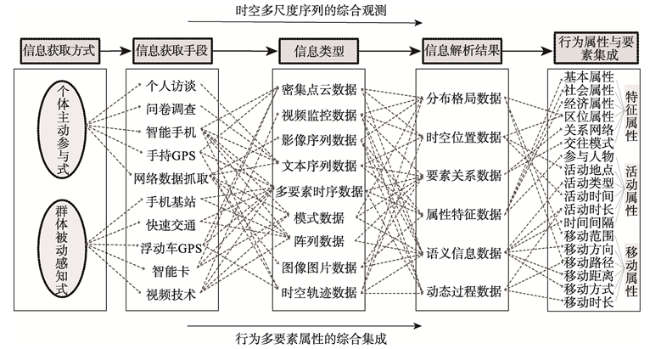
大数据的行为研究具有丰富的数据源,但在数据的尺度、信度、精度、粒度和研究边界等方面仍存在诸多问题,且涉及隐私、可预测性等广泛争议。依据“信息获取方式确定—信息获取手段整合—信息类型划分—信息解析与要素提取—行为属性与要素集成”的思路,构建了整合高精度、全要素和多视角的行为数据观测体系架构。梳理与论述了行为研究中行为变化的尺度依赖特征,个体行为与群体行为数据的区分与综合,行为数据需求与个体隐私边界界定及行为数据的解析、匹配与整合等关键问题。尝试从科学问题的边界界定与数据需求、多源数据采集与整合方法、多要素行为数据解析与集成方法及应用驱动的行为数据应用模式与途径等方面,对行为数据的综合采集与集成处理进行界定。
柯文前 , 俞肇元 , 陈伟 , 王晗 , 赵珍珍 . 人类时空间行为数据观测体系架构及其关键问题[J]. 地理研究, 2015 , 34(2) : 373 -383 . DOI: 10.11821/dlyj201502016
Human space-time behavior is the core element of behavioral geography and time geography, as well as one of the key issues that influence the society and economy. The advent of the "Big Data Era" provides abundant data for the study of space-time behavior. However, it also brings many problems in the scale, reliability, precision, granularity and research boundary of the provided data, which initiates controversy about individual privacy, and behavioral predictability. With the basic idea of "information collection mode construction-information collection methods consolidation-information type division-information parsing and elements extract-behavior properties and elements integration", this paper aims to build architecture for space-time behavior data observation, which consolidates high precision, total elements and multi-perspective behavior data. On the basis, four important issues are hackled and discussed, which include: scale dependency of system behavior and random behavior; differentiation and synthesis of individual behavior characteristics and group behavior regularity; strictly demarcation of behavior data demand and individual privacy boundaries; parsing, matching and integrating of behavior data. Based on the targeted issues, we attempt to achieve comprehensive collection and integrated processing for behavior data in several ways. Firstly, define data collection boundary and data demand on the basis of the scientific issues of behavioral research. Secondly, propose an acquisition mode of consolidating multi-source data collection means. Thirdly, provide the methods and ideas of multi-elements behavior data parsing and integration. Lastly, identify the application modes and ways of behavior data based on the perspective of application drive. What have been discussed above can not only lay a solid foundation for highly accurate and quantitative space-time behavior research, but also offer theoretical and methodological references for comprehensive integration research of sensing regional/urban society and spatial system from the view of microcosmic individual behavior.
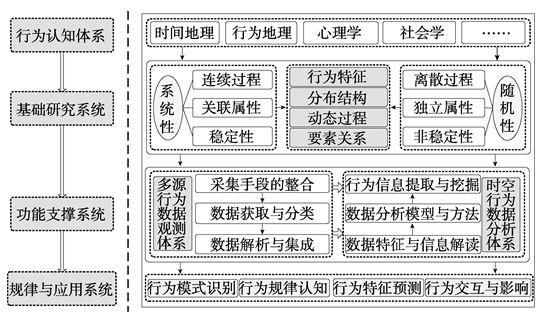
Fig. 1 The overall framework of space-time behavior research图1 人类时空行为研究的总体框架 |
Fig. 2 The architecture for human space-time behavior data observation图2 人类时空行为数据观测体系架构 |
The authors have declared that no competing interests exist.
| [1] |
|
| [2] |
[
|
| [3] |
|
| [4] |
[
|
| [5] |
[
|
| [6] |
|
| [7] |
|
| [8] |
|
| [9] |
|
| [10] |
|
| [11] |
|
| [12] |
|
| [13] |
|
| [14] |
|
| [15] |
|
| [16] |
|
| [17] |
[
|
| [18] |
[
|
| [19] |
[
|
| [20] |
[
|
| [21] |
[
|
| [22] |
[
|
| [23] |
[
|
| [24] |
[
|
| [25] |
[
|
| [26] |
[
|
| [27] |
|
| [28] |
[
|
| [29] |
[
|
| [30] |
[
|
| [31] |
[
|
| [32] |
[
|
| [33] |
|
| [34] |
[
|
| [35] |
[
|
| [36] |
|
| [37] |
[
|
| [38] |
[
|
| [39] |
[
|
| [40] |
[
|
| [41] |
[
|
| [42] |
|
| [43] |
|
| [44] |
|
| [45] |
[
|
| [46] |
[
|
| [47] |
[
|
| [48] |
[
|
| [49] |
|
| [50] |
|
| [51] |
[
|
| [52] |
[
|
| [53] |
[
|
| [54] |
[
|
| [55] |
|
| [56] |
|
/
| 〈 |
|
〉 |