基于GIS场模型的城市餐饮服务热点探测及空间格局分析
|
张海平(1989- ),男,甘肃榆中人,博士研究生,研究方向为GIS时空建模、城市地理与行为地理。E-mail: gissuifeng@163.com |
收稿日期: 2018-10-16
要求修回日期: 2019-02-21
网络出版日期: 2020-05-20
基金资助
国家自然科学基金重点项目(41930102)
江苏省自然科学青年基金项目(BK20160893)
版权
Hotspot discovery and its spatial pattern analysis for catering service in cities based on field model in GIS
Received date: 2018-10-16
Request revised date: 2019-02-21
Online published: 2020-05-20
Copyright
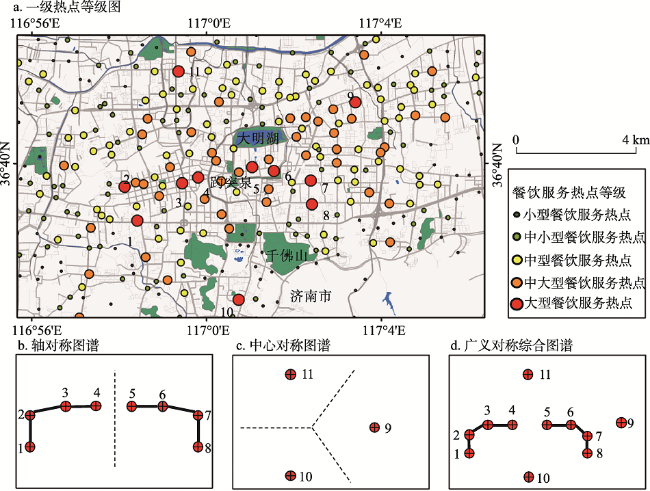
餐饮服务是城市生活的重要组成部分,提取城市餐饮服务热点并识别其空间分布模式,对于理解城市形态结构具有重要意义。针对过去基于POI进行城市形态特征定量分析的不足,利用GIS场模型对城市特征要素的空间分布模式进行识别,并采用地学信息图谱对其模式进行可视化和分析。以济南市主城区4.71万个餐饮服务POI作为主要数据源,首先基于密度场热点探测模型提取餐饮服务热点并按照密度值进行等级划分;然后采用广义对称结构图谱和数字场层次结构图谱表达餐饮服务热点的空间分布结构特征和规模等级结构特征,并构建其分布模式图谱;最后对结果展开讨论。研究表明:① 数字场热点探测模型能够有效地从POI中识别出不同等级的热点。② 广义对称结构图谱和基于GIS场模型的层级结构图谱能够分别从纵横两个方面分析和表达餐饮热点的空间分布结构和层次等级结构特征。综上所述,本研究为基于POI的城市特征要素提取和城市形态研究提供了一种有效的定量分析思路,其方法也可以推广至其他城市特征要素的提取、分析和表达当中。
张海平 , 周星星 , 汤国安 , 周蕾 , 叶信岳 . 基于GIS场模型的城市餐饮服务热点探测及空间格局分析[J]. 地理研究, 2020 , 39(2) : 354 -369 . DOI: 10.11821/dlyj020181104
Catering service is an important part of urban life. Extracting urban hotspots for catering services and identifying their spatial distribution patterns is important for our understanding urban space and urban structures. In view of the shortcomings of quantitative analysis of urban morphological features based on POI in the past, the GIS field model was used to identify the spatial distribution patterns of urban feature elements, and the Geo-information Tupu was used to visualize the patterns. Taking the 47100-catering service POIs in the main urban area of Jinan city as the main data source, the catering service hotspots were first extracted based on the density field hotspot detection model and classified according to the density value; then the catering service was expressed by Geo-information-Tupu of generalized symmetric structure and digital field based hierarchical Geo-information Tupu. The spatial distribution structure characteristics and scale structure features of the hotspots are presented, and their Geo-information Tupu of distribution pattern is constructed. Finally, the results are discussed. Research shows that: (1) The digital field hotspot detection model can effectively identify hotspots in different levels from POI. (2) The Geo-information-Tupu of generalized symmetric structure and digital field based hierarchical Geo-information Tupu can analyze and express the spatial distribution structure and hierarchical structure characteristics of the food hotspot from the aspect of vertical and horizontal of space. In summary, this study provides an effective quantitative analysis method for POI-based urban feature extraction and urban morphology research. The method can also be extended to the extraction, analysis and expression of other urban feature elements.
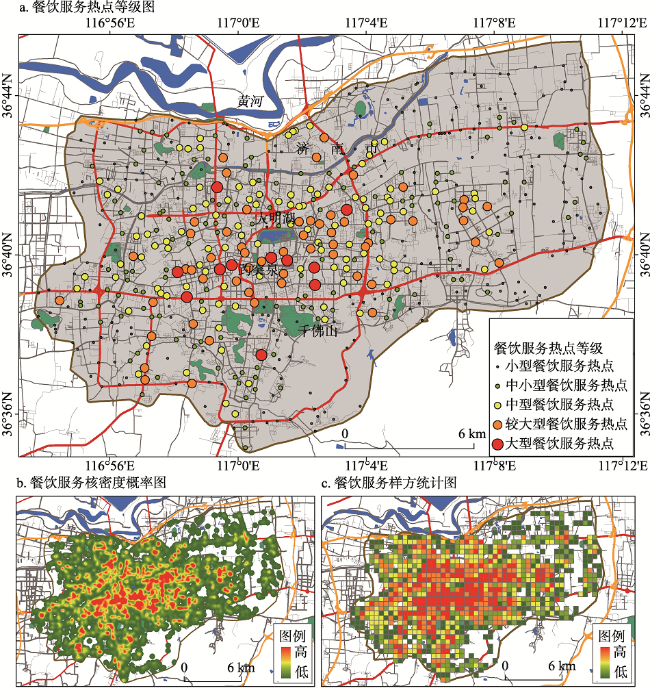
表2 不同等级餐饮服务热点基本信息Tab. 2 Basic attributions of catering service in different hierarchical scales |
| 餐饮服务热点等级 | 热点数量 | 占比(%) | 平均密度值 |
|---|---|---|---|
| 大型 | 11 | 1.95 | 2 368.29 |
| 中大型 | 57 | 10.12 | 1 048.87 |
| 中型 | 106 | 18.83 | 589.68 |
| 中小型 | 134 | 23.80 | 292.33 |
| 小型 | 255 | 45.29 | 49.45 |
Tab. 1 Categories explanation of POI data about catering service |
| 类别编号 | 一级分类 | 二级类别数量 | 二级类别举例或说明 | 占比(%) |
|---|---|---|---|---|
| 1 | 中餐厅 | 24 | 综合酒楼、四川菜、火锅店、清真菜等 | 55.50 |
| 2 | 外餐厅 | 18 | 日韩料理、美国风味、印度风味等 | 2.21 |
| 3 | 快餐厅 | 12 | 肯德基、麦当劳、必胜客、永和豆浆等 | 11.39 |
| 4 | 休闲餐饮场所 | 1 | 休闲餐饮场所 | 0.16 |
| 5 | 咖啡厅 | 5 | 星巴克咖啡、上岛咖啡、其他咖啡等 | 1.00 |
| 6 | 茶艺馆 | 1 | 以茶艺为特色的茶馆 | 0.86 |
| 7 | 冷饮店 | 1 | 以冷饮为主的饮品店 | 1.46 |
| 8 | 糕饼店 | 1 | 以国内南北方、国外的糕饼为特色的店 | 4.27 |
| 9 | 甜品店 | 1 | 以甜点为特色的店铺 | 1.00 |
| 10 | 其他餐饮场所 | 1 | 其他注册至高德地图上的实体餐饮店铺 | 22.15 |
感谢山东师范大学博士研究生史佳璐、济南市规划设计研究院张飞规划师、南京审计大学彭冲博士在本文数据分析和结果讨论部分给予的指导和建议。
| [1] |
周春山, 叶昌东 . 中国城市空间结构研究评述. 地理科学进展, 2013,32(7):1030-1038.
[
|
| [2] |
|
| [3] |
王海军, 夏畅, 张安琪 , 等. 基于空间句法的扩张强度指数及其在城镇扩展分析中的应用. 地理学报, 2016,71(8):1302-1314.
[
|
| [4] |
|
| [5] |
|
| [6] |
潘竟虎, 李俊峰 . 中国A级旅游景点空间分布特征与可达性. 自然资源学报, 2014,29(1):55-66.
[
|
| [7] |
甄峰, 王波 . “大数据”热潮下人文地理学研究的再思考. 地理研究, 2015,34(5):803-811.
[
|
| [8] |
张小英, 巫细波 . 广州购物中心时空演变及对城市商业空间结构的影响研究. 地理科学, 2016,36(2):231-238.
[
|
| [9] |
吴康敏, 张虹鸥, 王洋 , 等. 广州市多类型商业中心识别与空间模式. 地理科学进展, 2016,35(8):963-974.
[
|
| [10] |
|
| [11] |
|
| [12] |
|
| [13] |
李玏, 刘家明, 王润 , 等. 北京市高尔夫旅游资源空间分布特征及影响因素. 地理研究, 2013,32(10):1937-1947.
[
|
| [14] |
杨友宝, 王荣成, 李秋雨 , 等. 东北地区旅游资源赋存演化特征与旅游业空间重构. 经济地理, 2015,35(10):194-201.
[
|
| [15] |
|
| [16] |
许泽宁, 高晓路 . 基于电子地图兴趣点的城市建成区边界识别方法. 地理学报, 2016,71(6):928-939.
[
|
| [17] |
焦利民, 李泽慧, 许刚 , 等. 武汉市城市空间集聚要素的分布特征与模式. 地理学报, 2017,72(8):1432-1443.
[
|
| [18] |
陈蔚珊, 柳林, 梁育填 . 基于POI数据的广州零售商业中心热点识别与业态集聚特征分析. 地理研究, 2016,35(4):703-716.
[
|
| [19] |
李江苏, 梁燕, 王晓蕊 . 基于POI数据的郑东新区服务业空间聚类研究. 地理研究, 2018,37(1):145-157.
[
|
| [20] |
黄莹, 甄峰, 汪侠 , 等. 南京经济型连锁酒店空间集聚特征与过程研究. 规划师, 2012,28(12):97-100.
[
|
| [21] |
禹文豪, 艾廷华, 刘鹏程 , 等. 设施POI分布热点分析的网络核密度估计方法. 测绘学报, 2015,44(12):1378-1383.
[
|
| [22] |
禹文豪, 艾廷华, 杨敏 , 等. 利用核密度与空间自相关进行城市设施兴趣点分布热点探测. 武汉大学学报: 信息科学版, 2016,41(2):221-227.
[
|
| [23] |
秦萧, 甄峰, 朱寿佳 , 等. 基于网络口碑度的南京城区餐饮业空间分布格局研究: 以大众点评网为例. 地理科学, 2014,34(7):810-817.
[
|
| [24] |
张子坤 . 在线点评平台如何影响人们的消费行为? 一个信息性社会影响的观点. 中国科学技术大学, 2010.
[
|
| [25] |
谭欣, 黄大全, 赵星烁 . 北京市主城区餐馆空间分布格局研究. 旅游学刊, 2016,31(2):75-85.
[
|
| [26] |
舒舍玉, 王润, 孙艳伟 , 等. 城市餐饮业的空间格局及影响因素分析: 以厦门市为例. 热带地理, 2012,32(2):134-140.
[
|
| [27] |
曾国军, 陆汝瑞 . 星巴克在中国大陆的空间扩散特征与影响因素研究. 地理研究, 2017,36(1):188-202.
[
|
| [28] |
顾秋实, 张海平, 周星星 , 等. 中国传统八大菜系的地理分布及其扩散效应: 基于大数据视角的实证分析. 浙江学刊, 2019, (5): 47-53, 241-244.
[
|
| [29] |
薛冰, 肖骁, 李京忠 , 等. 基于POI大数据的城市零售业空间热点分析: 以辽宁省沈阳市为例. 经济地理, 2018,38(5):36-43.
[
|
| [30] |
秦之湄, 唐文雅, 尹元畅 , 等. 基于互联网大数据的成都餐饮源细颗粒物排放空间分配研究. 环境科学学报, 2017,37(12):4511-4518.
[
|
| [31] |
|
| [32] |
|
| [33] |
|
| [34] |
林梅花, 甄峰 . 基于核密度分析的南京市居民活动空间研究. 见: 中国城市规划学会, 贵阳市人民政府. 新常态: 传承与变革: 2015中国城市规划年会论文集(09城市总体规划). 贵阳, 2015: 486-498.
[
|
| [35] |
郭瑛琦, 齐清文, 姜莉莉 , 等. 城市形态信息图谱的理论框架与案例分析. 地球信息科学学报, 2011,13(6):781-787.
[
|
| [36] |
龚泽仪, 齐清文, 夏小琳 . 基于中国近代地图的城镇体系演变信息图谱. 测绘科学, 2014,39(8):103-110.
[
|
| [37] |
|
| [38] |
齐清文 . 地理信息科学方法论. 北京: 科学出版社, 2016.
[
|
| [39] |
陈述彭, 岳天祥, 励惠国 . 地学信息图谱研究及其应用. 地理研究, 2000,19(4):337-343.
[
|
| [40] |
陈述彭 . 地学信息图谱探索研究. 北京: 商务印书馆, 2001.
[
|
/
| 〈 |
|
〉 |