粤港澳大湾区住房租金的空间差异与影响因素
|
王洋(1984-),男,黑龙江黑河人,博士,副研究员,硕士生导师,研究领域为城市地理、城市与区域规划。E-mail: wyxkwy@163.com |
收稿日期: 2020-04-03
要求修回日期: 2020-06-08
网络出版日期: 2020-11-20
基金资助
国家自然科学基金项目(41871150)
国家自然科学基金项目(41671128)
广东省科学院发展专项资金项目(2020GDASYL-20200104001)
广东省科学院发展专项资金项目(2020GDASYL-20200102002)
粤港澳大湾区战略研究院建设专项(2019GDASYL-0202001)
国家重点研发计划(2019YFB2103101)
版权
Spatial differentiation and influencing factors of housing rents in the Guangdong-Hong Kong-Macao Greater Bay Area
Received date: 2020-04-03
Request revised date: 2020-06-08
Online published: 2020-11-20
Copyright
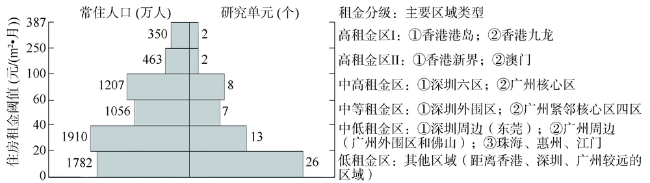
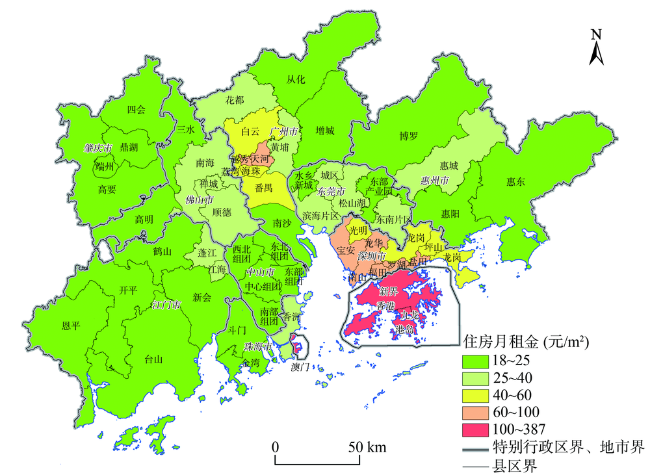
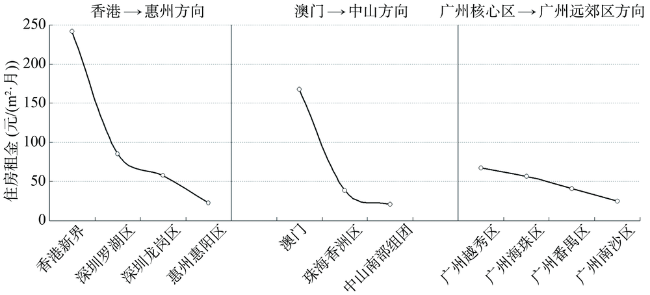
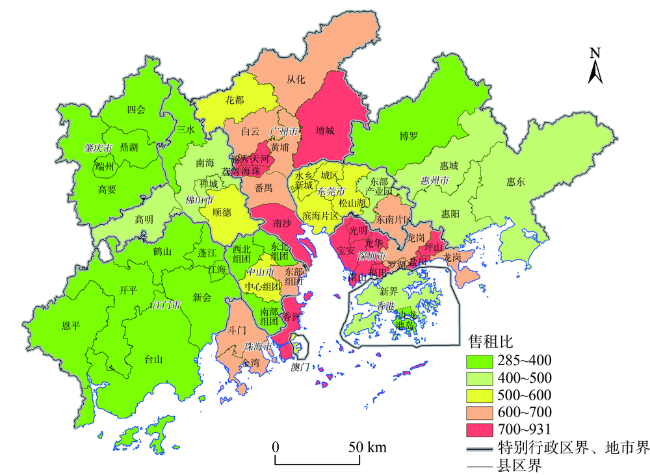
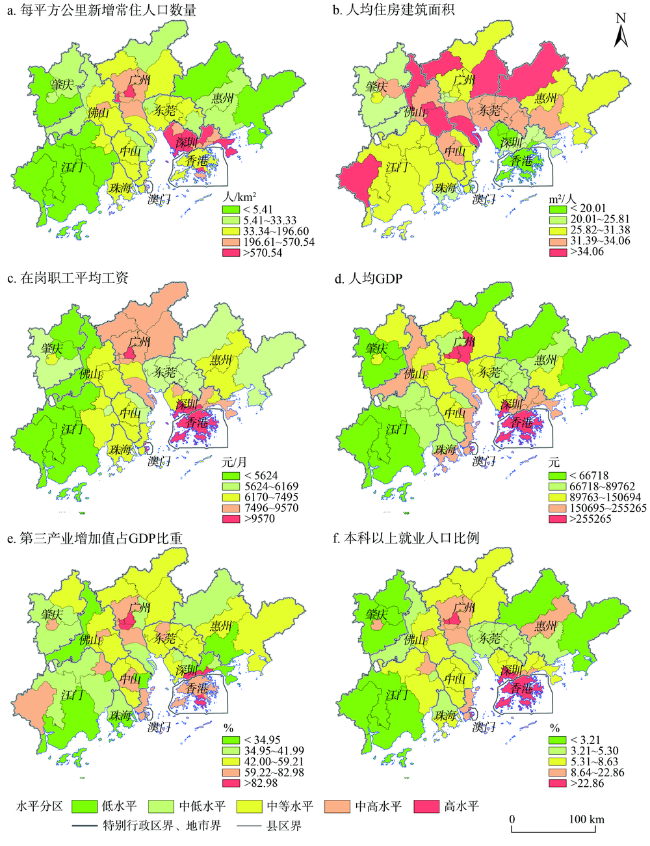
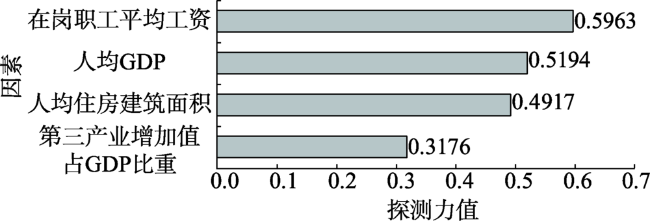
以粤港澳大湾区58个县区单元的住房平均租金为基本数据,通过“住房租金等级金字塔”构建、租金空间格局展示、空间自相关分析、跨境租金差距对比、售租比研究等方法总结粤港澳大湾区住房租金的空间差异格局与特征。从“租赁需求+城市基本面”的理论视角构建由新增人口、人均住房面积、收入水平、经济水平、产业结构、学历结构组成的租金差异影响因素模型。通过模型对比,采用空间滞后模型测度粤港澳大湾区住房租金的主要影响因素,并基于地理探测器分析其因素的影响强度差异。结果表明,粤港澳大湾区住房租金总体呈现以港澳与珠三角九市之间的境内外差异为主、以广深核心区与其他区域差异为辅的双层次差异格局。跨境租金差异程度最高,广州、深圳、珠海的“售租比”较高;收入水平、经济水平、人均住房面积和产业结构对粤港澳大湾区的住房租金差异有显著影响,其中,收入水平的影响强度最高。
王洋 , 张虹鸥 , 吴康敏 . 粤港澳大湾区住房租金的空间差异与影响因素[J]. 地理研究, 2020 , 39(9) : 2081 -2094 . DOI: 10.11821/dlyj020200272
"Livability" is at the core of building a high-quality living circle in the Guangdong-Hong Kong-Macao Greater Bay Area (GHMGBA), and the excessive housing burden costs have become an important obstacle to livability. The differentiation of the rental market is an indispensable and important part of the housing market in the GHMGBA and is inseparable from the creation of a livable life circle. Based on the average housing rent of 58 counties in the GHMGBA, this study summarizes the patterns and characteristics of the spatial differences in housing rents through the construction of a “grading pyramid of housing rents”, and displays the spatial pattern of housing rents through spatial autocorrelation analysis, cross-border rent gap comparison, and price-to-rent ratio analysis. From the theoretical perspective of leasing demand and urban fundamentals, this study constructs a model of factors influencing rent differences, consisting of population growth, per capita housing area, income level, economic level, industrial structure, and education structure. Through model comparison, a spatial lag model was used to measure the main factors influencing the housing rents in the GHMGBA. Based on the geographical detector, the study further analyzed the differences in the intensity of the factors' influence. The results showed that the housing rents in the GHMGBA generally presented a two-level difference pattern. The pattern was dominated by domestic and foreign differences between Hong Kong, Macao, and nine cities in the Pearl River Delta, as well as the differences between the core areas of Guangzhou, Shenzhen, and other regions. The cross-border rent difference was the highest. Higher price-to-rent ratios were observed in Guangzhou, Shenzhen, and Zhuhai. Income level, economic level, per capita housing area, and industrial structure had a significant impact on housing rent differences in the GHMGBA. Among them, income level had the highest impact intensity. This study responds to cross-border regional differences within the country from the perspective of housing rent. Cross-border differences are not only reflected in the population′s economic, income, and institutional levels, but also in the housing rent. The key issue for the regional linkage development of the housing market in the GHMGBA and the construction of a livable and quality living area is the coordinated development across borders.
表1 粤港澳大湾区住房租金差异的影响因素指标体系Tab. 1 The index system of impact factors of housing rents in the Guangdong-Hong Kong-Macao Greater Bay Area |
| 影响因素 | 评价指标 (单位) | 预期 符号 | 数据 主要时间 | 数据来源与数据处理方式 |
|---|---|---|---|---|
| F1新增人口 | 2016—2018年每平方公里新增常住人口数量(人/km2) | 正向 | 2016— 2018年 | 2019广东统计年鉴、2019东莞统计年鉴、2019中山统计年鉴、2019中国统计年鉴、香港统计年刊(2019年版);通过2016—2018年新增常住人口数量除以行政区面积得出 |
| F2人均住房 面积 | 人均住房建筑面积(m2/人) | 负向 | 2015年 11月 | 广东省2015年1%人口抽样调查、世界各国(地区)人均住房面积一览表(http://blog.sina.com.cn/s/blog_50321d940102y5rb.html) |
| F3收入水平 | 在岗职工平均工资(元/月) | 正向 | 2018年 | 2019广东统计年鉴、2019东莞统计年鉴、2019中山统计年鉴、2019中国统计年鉴;珠三角9市通过年度工资除以12个月计算得出月工资;香港、澳门为全部就业行业月收入的中位数 |
| F4经济水平 | 人均GDP(元) | 正向 | 2018年 | 2019广东统计年鉴、2019东莞统计年鉴、2019中山统计年鉴、2019中国统计年鉴 |
| F5产业结构 | 第三产业增加值占GDP比例(%) | 正向 | 2018年 | 2019广东统计年鉴、2019东莞统计年鉴、2019中山统计年鉴、2019中国统计年鉴 |
| F6学历结构 | 本科以上就业人口比例(%) | 正向 | 2015年 11月 | 广东省2015年1%人口抽样调查、香港统计年刊(2016年版)、澳门2016统计年鉴;香港为15周岁以上人口、澳门为14周岁以上人口 |
注:香港、澳门的经济、产业、价格类数据换算为人民币,住房面积转换为平方米;“本科以上”包含本科学历。 |
表2 粤港澳大湾区3种住房租金模型的主要参数对比Tab. 2 The main parameters of 3 housing rents model in the Guangdong-Hong Kong-Macao Greater Bay Area |
| 模型 | Adjusted R-squared | AIC | Log likelihood | Lagrange Multiplier | P of Lagrange Multiplier |
|---|---|---|---|---|---|
| 普通最小二乘法回归模型(OLS) | 0.8793 | 9.6052 | 2.1974 | — | — |
| 空间滞后模型(SLM) | 0.8913 | 4.9930 | 5.5035 | 6.2836 | 0.0122 |
| 空间误差模型(SEM) | 0.8807 | 9.2522 | 2.3739 | 0.1543 | 0.6944 |
表3 基于空间滞后模型的粤港澳大湾区住房租金影响因素回归系数Tab. 3 The regression coefficient of housing rents model based on SLM in the Guangdong-Hong Kong-Macao Greater Bay Area |
| 指标类别(单位) | 系数 | 标准差 | z统计值 | p |
|---|---|---|---|---|
| 新增常住人口(人/km2) | 0.0071 | 0.0250 | 0.2833 | 0.7769 |
| 人均住房建筑面积(m2/人) | -0.9065*** | 0.1586 | -5.7155 | 0.0000 |
| 在岗职工平均工资(元/月) | 1.0391*** | 0.2367 | 4.3895 | 0.0000 |
| 人均GDP(元) | 0.2085** | 0.1023 | 2.0378 | 0.0416 |
| 第三产业增加值占GDP比例(%) | 0.4815*** | 0.1197 | 4.0224 | 0.0001 |
| 本科以上就业人口比例(%) | -0.1050 | 0.0823 | -1.2768 | 0.2017 |
| 常数项 | -7.7974*** | 2.0417 | -3.8191 | 0.0001 |
| 空间权重项 | 0.2740*** | 0.0958 | 2.8592 | 0.0043 |
| Adjusted R-squared:0.8913;AIC:4.9930;Log likelihood:5.5035 | ||||
注:***、** 分别表示在0.01、0.05水平上显著。 |
真诚感谢二位匿名评审专家在论文评审中所付出的时间和精力,评审专家对本文的数据计算、租售比分析、空间回归模型选择、结果解释、结论完善方面的修改意见,使本文获益匪浅。
| [1] |
|
| [2] |
|
| [3] |
卢俊文, 袁奇峰, 黄哲, 等. 广州租赁住房的空间分布格局及其成因. 热带地理, 2018, 38(3): 384-393.
[
|
| [4] |
张虹鸥, 王洋, 叶玉瑶, 等. 粤港澳区域联动发展的关键科学问题与重点议题. 地理科学进展, 2018, 37(12): 1587-1596.
[
|
| [5] |
刘毅, 王云, 杨宇, 等. 粤港澳大湾区区域一体化及其互动关系. 地理学报, 2019, 74(12): 2455-2466.
[
|
| [6] |
周春山, 罗利佳, 史晨怡, 等. 粤港澳大湾区经济发展时空演变特征及其影响因素. 热带地理, 2017, 37(6): 802-813.
[
|
| [7] |
陈品宇, 李鲁奇, 孔翔. 尺度重组理论视角下的粤港澳大湾区建设研究. 人文地理, 2019, 34(1): 54-62.
[
|
| [8] |
许志桦, 刘云刚, 胡国华. 从珠三角到大珠三角再到粤港澳大湾区: 改革开放以来中国的国家尺度重组. 热带地理, 2019, 39(5): 635-646.
[
|
| [9] |
邱坚坚, 刘毅华, 陈浩然, 等. 流空间视角下的粤港澳大湾区空间网络格局: 基于信息流与交通流的对比分析. 经济地理, 2019, 39(6): 7-15.
[
|
| [10] |
熊瑶, 黄丽. 粤港澳大湾区城市网络的时空演化: 基于企业组织关系视角. 世界地理研究, 2019, 28(5): 83-94.
[
|
| [11] |
彭芳梅. 粤港澳大湾区及周边城市经济空间联系与空间结构: 基于改进引力模型与社会网络分析的实证分析. 经济地理, 2017, 37(12): 57-64.
[
|
| [12] |
叶玉瑶, 王景诗, 吴康敏, 等. 粤港澳大湾区建设国际科技创新中心的战略思考. 热带地理, 2020, 40(1): 27-39.
[
|
| [13] |
方远平, 彭婷, 陆莲芯, 等. 粤港澳大湾区城市职能演变特征与影响因素. 热带地理, 2019, 39(5): 647-660.
[
|
| [14] |
|
| [15] |
|
| [16] |
|
| [17] |
陈云凡, 陈成文, 倪家栖. 基于反向距离加权法的公租住房的租金定价模型及实证. 经济地理, 2015, 35(7): 87-92.
[
|
| [18] |
崔娜娜, 古恒宇, 沈体雁. 北京市住房价格和租金的空间分异与相互关系. 地理研究, 2019, 38(6): 1420-1434.
[
|
| [19] |
|
| [20] |
|
| [21] |
|
| [22] |
宋伟轩, 马雨竹, 陈艳如. 南京城区住宅售租价格时空分异与影响因素. 地理科学进展, 2018, 37(9): 1268-1276.
[
|
| [23] |
|
| [24] |
况伟大, 丁言豪. 中国城市居民住房支付能力时空分布研究: 35个大中城市租金负担能力分析. 价格理论与实践, 2018, (10): 16-19.
[
|
| [25] |
|
| [26] |
唐琳, 冯长春, 肖亮, 等. 北京市居民租赁住房可支付能力及空间分异研究. 人文地理, 2019, 34(3): 91-98.
[
|
| [27] |
|
| [28] |
|
| [29] |
|
| [30] |
|
| [31] |
刘轶伦, 陈逸敏, 刘颖, 等. 基于互联网数据的城市社区租金评估及空间格局制图: 以深圳市为例. 热带地理, 2019, 39(2): 36-43.
[
|
| [32] |
禤文昊. 面向农民工的村镇非正规住房租赁市场研究: 以东莞为例. 城市与区域规划研究, 2011, 4(2): 180-194.
[
|
| [33] |
|
| [34] |
|
| [35] |
|
| [36] |
|
| [37] |
兰峰, 张春苗. 空间经济学视角下的商品住房价格溢出效应研究. 统计与信息论坛, 2015, 30(6): 40-45.
[
|
| [38] |
|
| [39] |
|
| [40] |
|
| [41] |
|
| [42] |
|
| [43] |
|
| [44] |
|
| [45] |
|
| [46] |
|
| [47] |
|
| [48] |
|
| [49] |
|
/
| 〈 |
|
〉 |