全球城市知识流动网络的结构特征与影响因素
|
桂钦昌(1991-),男,四川宣汉县人,博士研究生,研究方向为科技创新与城市发展。E-mail:plmok753951@163.com |
收稿日期: 2020-05-20
录用日期: 2020-09-28
网络出版日期: 2021-07-10
基金资助
中国科学院战略性先导科技专项A类(XDA20100311)
国家社会科学基金重大项目(19ZDA087)
国家社会科学基金重大项目(21ZDA011)
华东师范大学未来科学家培育计划(WLKXJ2019-002)
华东师范大学研究生出国(境)访学项目(20190620013)
版权
Structural characteristics and influencing factors of the global inter-city knowledge flows network
Received date: 2020-05-20
Accepted date: 2020-09-28
Online published: 2021-07-10
Copyright
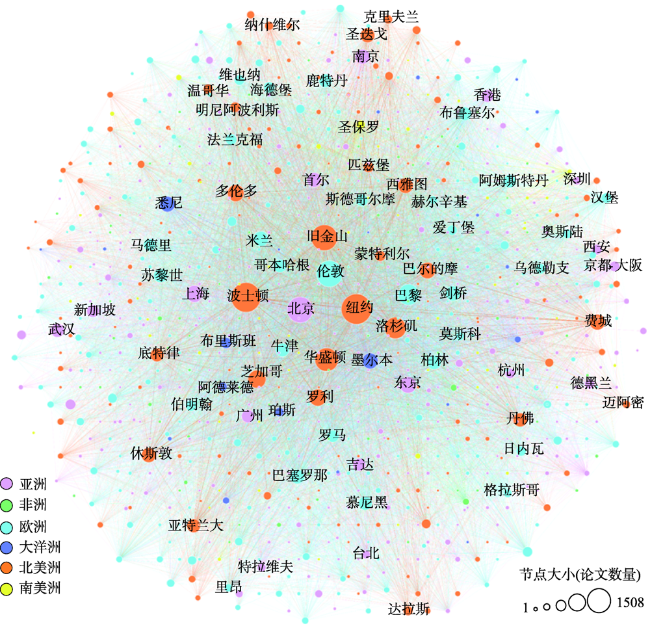
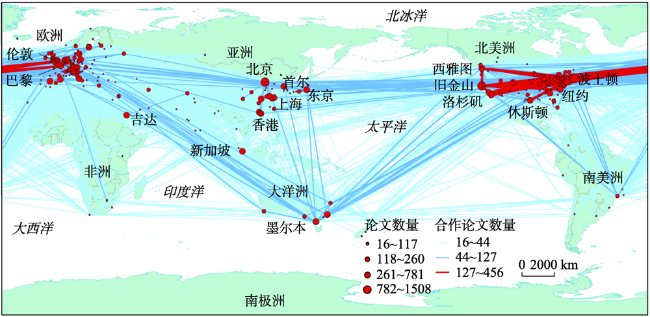
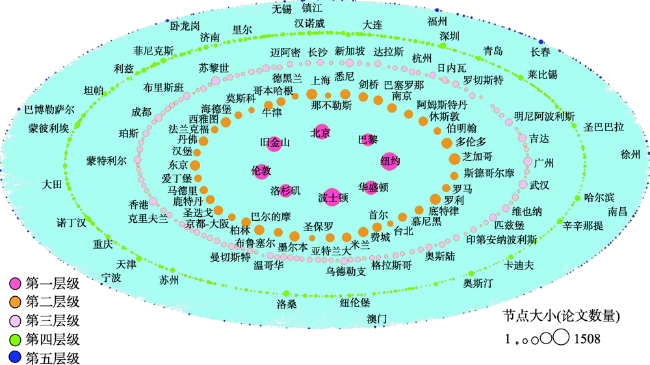
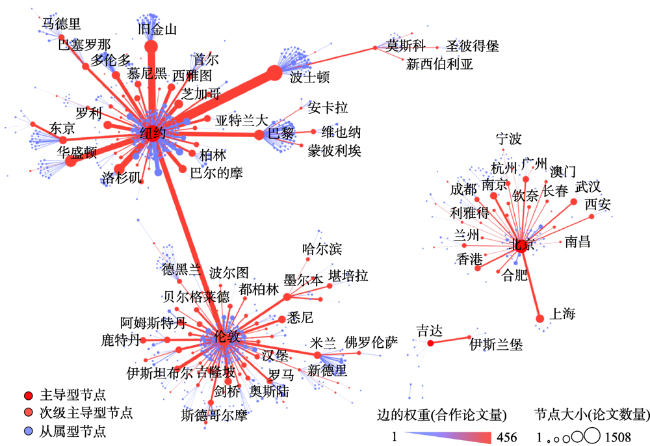
在科技全球化时代,城市之间的知识流动日益频繁,成为当代知识生产的重要特征。然而,鲜有从知识流动的视角开展全球城市体系的研究。基于2017年的高被引论文合作数据,采用社会网络分析方法和空间计量模型系统地刻画了全球城际科研合作网络的拓扑结构和空间格局及其影响因素。研究发现:① 拓扑结构呈现出以北美、欧洲和亚太城市的三极格局,轴辐式和分布式结构特征并存。② 世界城市科研合作网络形成以北美、西欧、东亚和澳大利亚为顶点的四边形格局。③ 多核心-边缘结构显现,纽约、伦敦和北京等8个城市为全球核心,芝加哥等41个城市为区域核心。④ 全球城市科研合作网络的等级层次特征显著,纽约、北京和吉达分别是三大子网的主导型城市。⑤ 空间相互作用模型表明地理距离阻碍了城市间的科研合作,城市的科研规模、人口规模、世界一流大学数量、制度邻近性和社会邻近性促进了城际联系。
桂钦昌 , 杜德斌 , 刘承良 , 徐伟 , 侯纯光 , 焦美琪 , 翟晨阳 , 卢函 . 全球城市知识流动网络的结构特征与影响因素[J]. 地理研究, 2021 , 40(5) : 1320 -1337 . DOI: 10.11821/dlyj020200443
In the age of globalizing science and technology, urban economic development increasingly rests on knowledge production and knowledge flows. Inter-city scientific collaborations, as the most potent aspect of modern knowledge production, are more and more frequent, which produces some of the highest quality science. However, there is a paucity of analysis of the world city system from the knowledge flows perspective. Using highly cited papers data from the Web of Science database in 2017, this study applies social network analysis, a Bayesian-inference weighted stochastic block model (WSBM), the dominant flow analysis and spatial interaction model to explore the topological structure, spatial pattern and influencing factors of global inter-city scientific collaboration. Results show that the science hotspots are highly concentrated in three regions: North America, East Asia and Western Europe, and the whole network is dominated by a tri-polar world. The two seemingly paradoxical trends, star-shaped and triangulated structure, coexist in the global inter-city knowledge flows network. The spatial pattern of inter-city collaboration network forms a quadrilateral graph with four vertexes in Western Europe, North America, East Asia and Australia, particularly on the trans-Atlantic axis between North America and Western Europe. The network has a distinctive multicore-periphery structure, which can be divided into five categories: global core, macro-region core, strong semi-periphery, semi-periphery, and periphery, and identifies New York, London, Boston, San Francisco-San Jose, Washington, Los Angeles, Paris and Beijing as eight global core cities and forty-one macro-region cores. The network is characterized as hierarchical “hub-and-spoke” structures, and the hierarchy of the network is obvious, New York, Beijing and Jeddah are dominant nodes in the three subnetworks. In addition, the gravity model indicates the spatial distance impedes inter-city scientific collaboration, while the amount of science output and the number of urban residents, the number of world-class universities, institutional proximity and social proximity have positive and significant effect on inter-city scientific collaboration. In order to further our understanding of world city network, this paper calls for more attention to inter-city knowledge flows.
表1 全球城际科研合作网络的统计特征Tab. 1 Statistical characteristics of global inter-city scientific collaboration network |
| 网络规模 | 稠密程度 | 集聚程度 | 小世界性 | ||||||||
|---|---|---|---|---|---|---|---|---|---|---|---|
| 节点数量 | 边数 | 密度 | 平均度 | 度中心势 | 接近度中心势 | 介数中心势 | 平均集聚系数 | 平均路径长度 | |||
| 923 | 109937 | 0.26 | 238.22 | 0.52 | 0.51 | 0.03 | 0.67 | 1.84 | |||
表2 负二项式的重力模型回归结果Tab. 2 Regression results of the negative binomial gravity models |
| 模型1 | 模型2 | 模型3 | 模型4 | |
|---|---|---|---|---|
| 城市i发文量 | 0.32750*** | 0.31521*** | 0.32182*** | 0.23175*** |
| (0.01140) | (0.01043) | (0.01017) | (0.00830) | |
| 城市j发文量 | 0.33523*** | 0.32794*** | 0.33285*** | 0.20712*** |
| (0.01205) | (0.01091) | (0.01088) | (0.00907) | |
| 城市i人口数 | 0.01690*** | 0.02252*** | 0.04210*** | 0.02666*** |
| (0.00451) | (0.00425) | (0.00435) | (0.00365) | |
| 城市j人口数 | 0.00740* | 0.01069*** | 0.02956*** | 0.01398*** |
| (0.00437) | (0.00413) | (0.00422) | (0.00345) | |
| 城市i一流大学 | 0.00005 | 0.00006 | 0.00005 | 0.00046*** |
| (0.00006) | (0.00006) | (0.00005) | (0.00004) | |
| 城市j一流大学 | 0.00004 | 0.00004 | 0.00003 | 0.00057*** |
| (0.00006) | (0.00006) | (0.00005) | (0.00004) | |
| 制度邻近性 | 0.30082*** | 0.16768*** | 0.30144*** | |
| (0.01472) | (0.01620) | (0.01330) | ||
| 地理邻近性 | -0.08666*** | -0.06924*** | ||
| (0.00484) | (0.00394) | |||
| 社会邻近性 | 1.14789*** | |||
| (0.02571) | ||||
| 常数 | -0.72820*** | -0.81986*** | -0.72664*** | 0.11746 |
| (0.13271) | (0.12082) | (0.12156) | (0.09622) | |
| 样本量 | 5312 | 5312 | 5312 | 5312 |
| Alpha | 0.09514 | 0.08036 | 0.07227 | 0.03873 |
| Log likelihood | -19390.632 | -19072.32 | -18886.488 | -17881.985 |
注:括号内为稳健标准误;*p<0.10,**p<0.05,***p<0.01。 |
真诚感谢二位匿名评审专家在论文评审中所付出的时间和精力,评审专家对本文的结果分析、结论梳理、行文规范方面的修改意见,使本文获益匪浅。
| [1] |
马海涛. 知识流动空间的城市关系建构与创新网络模拟. 地理学报, 2020,75(4):708-721.
[
|
| [2] |
|
| [3] |
李丹丹, 汪涛, 魏也华, 等. 中国城市尺度科学知识网络与技术知识网络结构的时空复杂性. 地理研究, 2015,34(3):525-540.
[
|
| [4] |
刘承良, 管明明, 段德忠. 中国城际技术转移网络的空间格局及影响因素. 地理学报, 2018,73(8):1462-1477.
[
|
| [5] |
|
| [6] |
|
| [7] |
OECD. The Knowledge-based Economy. Paris: OECD, 1996: 9-18.
|
| [8] |
|
| [9] |
吕拉昌, 廖倩, 黄茹. 基于期刊论文的中国地级以上城市知识专业化研究. 地理科学, 2018,38(8):1245-1255.
[
|
| [10] |
王保平, 徐伟. 城市网络:价值生产的空间组织. 北京: 科学出版社, 2017: 1-15.
[
|
| [11] |
薛德升, 邹小华. 基于中资商业银行全球空间扩展的世界城市网络及其影响因素. 地理学报, 2018,73(6):989-1001.
[
|
| [12] |
|
| [13] |
|
| [14] |
唐子来, 李粲, 李涛. 全球资本体系视角下的中国城市层级体系. 城市规划学刊, 2016,(3):11-20.
[
|
| [15] |
|
| [16] |
|
| [17] |
|
| [18] |
李恩康, 陆玉麒, 杨星, 等. 全球城市网络联系强度的时空演化研究: 基于 2014-2018 年航空客运数据. 地理科学, 2020,40(1):32-39.
[
|
| [19] |
|
| [20] |
|
| [21] |
|
| [22] |
|
| [23] |
|
| [24] |
|
| [25] |
|
| [26] |
|
| [27] |
张凡, 宁越敏. 中国城市网络研究的自主性建构. 区域经济评论, 2020,(2):84-92.
[
|
| [28] |
潘峰华, 方成, 李仙德. 中国城市网络研究评述与展望. 地理科学, 2019,39(7):1093-1101.
[
|
| [29] |
|
| [30] |
|
| [31] |
|
| [32] |
侯纯光, 杜德斌, 刘承良, 等. 全球留学生留学网络时空演化及其影响因素. 地理学报, 2020,75(4):681-694.
[
|
| [33] |
|
| [34] |
|
| [35] |
杜德斌. 全球科技创新中心动力与模式. 上海: 上海人民出版社, 2015: 18-59.
[
|
| [36] |
|
| [37] |
WIPO. The Geography of Innovation: Local Hotspots, Global Networks World Intellectual Property Report. Geneva: World Intellectual Property Organization, 2019: 1-13.
|
| [38] |
|
| [39] |
|
| [40] |
|
| [41] |
|
| [42] |
|
| [43] |
|
| [44] |
杜德斌. 跨国公司R&D全球化: 地理学的视角. 世界地理研究, 2007,(4):106-114.
[
|
| [45] |
司月芳, 陈思雨,
[
|
| [46] |
|
| [47] |
焦美琪, 杜德斌, 桂钦昌, 等. 全球城市技术合作网络的拓扑结构特征与空间格局. 地理科学, 2019,39(10):1546-1552.
[
|
| [48] |
马海涛, 黄晓东, 李迎成. 粤港澳大湾区城市群知识多中心的演化过程与机理. 地理学报, 2018,73(12):2297-2314.
[
|
| [49] |
|
| [50] |
段德忠, 杜德斌, 谌颖, 等. 中国城市创新网络的时空复杂性及生长机制研究. 地理科学, 2018,38(11):1759-1768.
[
|
| [51] |
|
| [52] |
胡杨, 李郇. 地理邻近对产学研合作创新的影响途径与作用机制. 经济地理, 2016,36(6):109-115.
[
|
| [53] |
|
| [54] |
|
| [55] |
|
| [56] |
|
| [57] |
|
| [58] |
|
| [59] |
|
| [60] |
|
| [61] |
|
| [62] |
|
| [63] |
|
| [64] |
宋伟, 李秀伟, 修春亮. 基于航空客流的中国城市层级结构分析. 地理研究, 2008,27(4) : 917-926.
[
|
| [65] |
|
| [66] |
刘承良, 桂钦昌, 段德忠, 等. 全球科研论文合作网络的结构异质性及其邻近性机理. 地理学报, 2017,72(4):737-752.
[
|
| [67] |
|
| [68] |
|
| [69] |
|
| [70] |
|
| [71] |
|
| [72] |
|
| [73] |
贺灿飞, 金璐璐, 刘颖. 多维邻近性对中国出口产品空间演化的影响. 地理研究, 2017,36(9):1613-1626.
[
|
| [74] |
|
| [75] |
|
| [76] |
|
| [77] |
|
| [78] |
|
| [79] |
|
/
| 〈 |
|
〉 |