家庭经济理论视角下山区耕地撂荒影响机理及效应——基于重庆奉节县1970份农户调查
|
何田(1987-),男,四川仪陇人,博士,讲师,研究生导师,主要研究方向为土地利用管理与乡村发展、城乡人口流迁。E-mail: 578299157@qq.com |
收稿日期: 2024-09-03
录用日期: 2024-10-26
网络出版日期: 2025-03-04
基金资助
教育部人文社会科学研究一般项目(23YJCZH072)
2023年成都市哲学社会科学规划项目(2023BS086)
The influencing mechanism and effects of abandoned cultivated land in mountainous areas from the perspective of household economic theory: A case study of 1970 households in Fengjie county, Chongqing
Received date: 2024-09-03
Accepted date: 2024-10-26
Online published: 2025-03-04
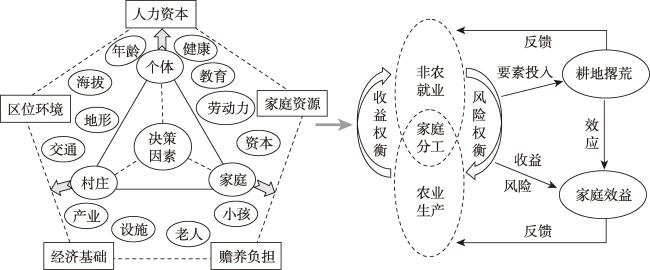
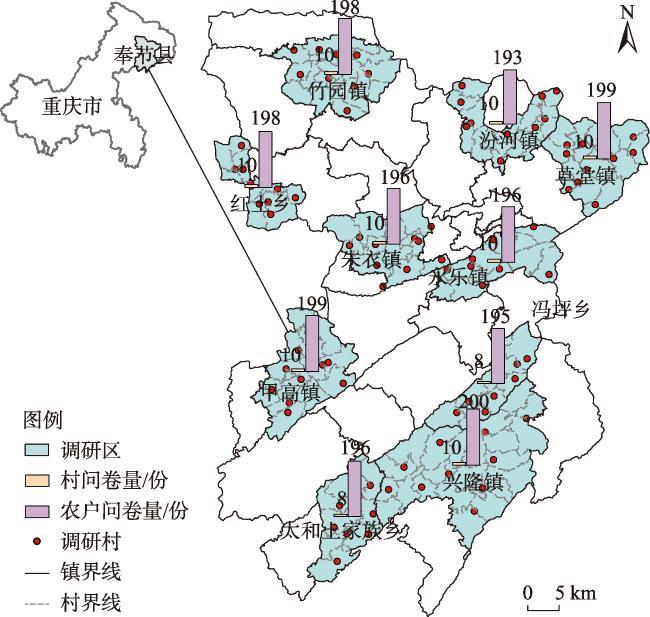
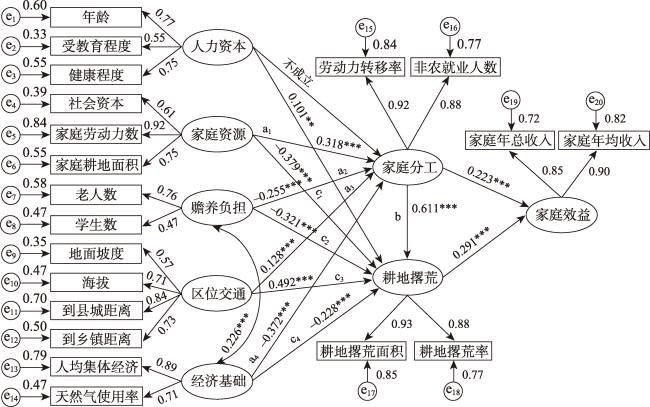
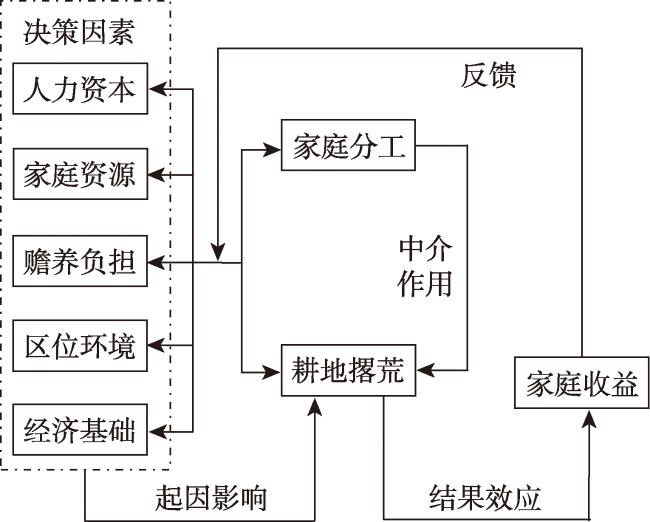
耕地撂荒现象作为山区经济发展中亟待解决的关键议题,不仅深刻关联着农户家庭生计模式的转型与资源优化配置,还直接牵动着粮食安全保障的稳固、农业现代化进程的加速以及乡村全面振兴的实现。基于此,本文以重庆市奉节县为研究区域,利用1970份农户实地调研数据,运用结构方程模型,分析农户耕地撂荒的影响机理及影响效应。结果表明:① 山区农户耕地撂荒是涉及家庭人力资源优化配置、经济收益综合考量、土地资源高效利用及风险规避等多方面因素综合作用的复杂现象,不仅是农户家庭内部经济结构对外界社会经济环境变化的适应性反应,也是农户为实现家庭效益最大化而作出的理性决策。② 家庭人力资本增强与村庄区位环境劣势的叠加影响,会显著促进耕地撂荒,而家庭资源丰富、赡养负担重以及村庄经济基础坚实则对农户撂荒决策具有显著的抑制作用。③ 家庭分工促进山区耕地撂荒,且其作为中介变量在影响耕地撂荒的多因素中扮演关键角色。为缓解山区耕地撂荒现象,要着重强化人力资本培养、改善区位环境势能、优化家庭分工结构、健全土地流转制度等策略,形成合力共同促进农村社会经济可持续发展。
何田 , 潘欣玥 , 郎雨 , 邓睿 , 刘愿理 , 廖和平 . 家庭经济理论视角下山区耕地撂荒影响机理及效应——基于重庆奉节县1970份农户调查[J]. 地理研究, 2025 , 44(3) : 676 -690 . DOI: 10.11821/dlyj020240856
The issue of cultivated land abandonment is a critical topic that urgently needs addressing in the economic development of mountainous areas. It is not only deeply tied to the transformation of farmers' household livelihood patterns and the optimal allocation of resources, but also directly affects the stabilization of food security, the acceleration of agricultural modernization, and the realization of comprehensive rural revitalization. Based on this, our study takes on Fengjie county in Chongqing city as the research area, utilizes field survey data from 1970 farmers, and applies a structural equation model to examine the impact mechanisms and effects of cultivated land abandonment. This approach provides a comprehensive understanding of the drivers behind land abandonment and their implications for rural development. The results show that: (1) The abandonment of cultivated land by farmers in mountainous areas is a complex phenomenon influenced by a combination of factors, including the optimal allocation of family human resources, comprehensive consideration of economic benefits, efficient land resource management, and risk aversion. It is both an adaptive response of the internal economic structure of farmers' families to changes in the external socio-economic environment and a rational decision made by farmers to maximize family interests. (2) The combined effects of enhanced family human capital and disadvantages in village location and environment significantly promote cultivated land abandonment. Conversely, abundant family resources, heavy caregiving responsibilities, and a solid village economic foundation significantly inhibit abandonment decisions. (3) The division of household labor significantly promotes cultivated land abandonment in mountainous areas and acts as a key mediator among the various factors influencing this process. To address the issue effectively, it is essential to enhance human capital through education and training programs, improve locational and environmental advantages by investing in infrastructure, public services, and ecological protection, optimize household labor division structures to balance work and caregiving responsibilities, and strengthen land transfer systems to increase land use efficiency and productivity. These strategies, when implemented collectively and tailored to the unique conditions of mountainous regions, can significantly mitigate land abandonment and contribute to sustainable socio-economic development in rural areas, ultimately supporting broader rural revitalization objectives and improving farmers' livelihoods.
表1 变量、指标及具体阐释Tab. 1 Variables, indicators and specific interpretation |
| 潜变量 | 观测变量 | 指标阐释 | 平均值 | 标准差 |
|---|---|---|---|---|
| 人力资本(CH) | 年龄(CH1) | 受访者报告值(岁) | 39.20 | 10.43 |
| 受教育程度(CH2) | 小学及以下=1,初中=2,高中或职高=3,大专及以上=4 | 2.76 | 0.97 | |
| 健康程度(CH3) | 不满意=1,一般=2,满意=3,非常满意=4 | 3.38 | 0.77 | |
| 家庭资源(FR) | 社会资本(FR1) | 亲朋中大学生或政府工作人员数量(个) | 2.53 | 1.41 |
| 家庭劳动力总数(FR2) | 家庭劳动力数量(个) | 2.95 | 0.93 | |
| 家庭耕地面积(FR3) | 家庭耕地总面积(hm2) | 0.32 | 0.26 | |
| 赡养负担(BSP) | 老人数(BSP1) | 60岁及以上老人数量(个) | 0.84 | 0.89 |
| 学生数(BSP2) | 6~16岁学生数量(个) | 0.72 | 0.82 | |
| 区位交通(NEL) | 地面坡度(NEL1) | 村域地面平均坡度(°) | 13.59 | 6.75 |
| 海拔(NEL2) | 村域平均海拔高程(m) | 836.70 | 337.84 | |
| 到县城中心距离(NEL3) | 村委会到县政府所在地的最短距离(km) | 55.36 | 19.06 | |
| 到乡镇中心距离(NEL4) | 村委会到乡镇政府所在地的最短距离(km) | 9.49 | 5.44 | |
| 经济基础(EF) | 人均集体经济收入(EF1) | 村庄集体经济收入/总人口(元/人) | 16.98 | 23.78 |
| 天然气使用率(EF2) | 村内农户天然气使用率(%) | 13.73 | 24.08 | |
| 家庭分工(DL) | 劳动力转移率(DL1) | 家庭外出转移就业劳动力占总人口比例(%) | 38.08 | 14.16 |
| 非农就业人数(DL2) | 家庭中在当地或外地从事非农产业就业活动的劳动力数量(个) | 1.38 | 0.65 | |
| 耕地撂荒(CLA) | 耕地撂荒面积(CLA1) | 家庭耕地撂荒面积(hm2) | 0.13 | 0.08 |
| 耕地撂荒率(CLA2) | 家庭耕地撂荒面积占耕地总面积的比例(%) | 39.56 | 23.43 | |
| 家庭效益(FB) | 家庭年总收入(FB1) | 家庭年总收入(万元) | 5.94 | 3.17 |
| 家庭年人均收入(FB2) | 家庭年收入/总人口(元/人) | 13140.32 | 8066.71 |
表2 假设模型信度检验结果Tab. 2 Reliability test of hypothesis model |
| 分维度 | 人力资本 | 家庭资源 | 赡养负担 | 自然区位 | 经济基础 | 家庭分工 | 耕地撂荒 | 家庭效益 |
|---|---|---|---|---|---|---|---|---|
| Cronbach'S α系数 | 0.744 | 0.722 | 0.761 | 0.798 | 0.743 | 0.727 | 0.843 | 0.886 |
| 组合信度(CR) | 0.740 | 0.820 | 0.700 | 0.810 | 0.780 | 0.890 | 0.910 | 0.870 |
| 平均变异提取量AVE | 0.490 | 0.600 | 0.540 | 0.520 | 0.640 | 0.820 | 0.830 | 0.770 |
真诚感谢二位匿名评审专家在论文评审中所付出的时间和精力,评审专家对本文指标选取、模型解释、对比讨论、政策启示等方面非常专业且细致的修改意见,使本文获益匪浅。
| [1] |
牛善栋, 方斌. 中国耕地保护制度70年: 历史嬗变、现实探源及路径优化. 中国土地科学, 2019, 33(10): 1-12.
[
|
| [2] |
张永江, 袁俊丽, 黄惠春. 中国特色农业强国的历史演进、理论逻辑与推进路径. 农业经济问题, 2023, (12): 4-16.
[
|
| [3] |
何田, 郎雨, 青丽波, 等. 乡村振兴视角下脱贫地区农村劳动力回流多维特征及形成机理: 以重庆市奉节县为例. 人文地理, 2024, 39(3): 132-141.
[
|
| [4] |
王刚, 廖和平, 温涛. 重庆南川村域耕地撂荒成因及分异机制与调控. 地理学报, 2024, 79(7): 1824-1841.
[
|
| [5] |
李赞红, 阎建忠, 花晓波, 等. 不同类型农户撂荒及其影响因素研究: 以重庆市12个典型村为例. 地理研究, 2014, 33(4): 721-734.
[
|
| [6] |
何田, 邓睿, 朗雨, 等. 乡村振兴背景下农村脱贫家庭转出劳动力返乡意愿及影响因素. 四川师范大学学报(自然科学版), 2024, 47(3): 338-345.
[
|
| [7] |
|
| [8] |
|
| [9] |
李升发, 李秀彬. 耕地撂荒研究进展与展望. 地理学报, 2016, 71(3): 370-389.
[
|
| [10] |
谢花林, 吴箐, 李秀彬. 湘闽赣山区劳动力转移差异对梯田撂荒决策和规模的影响. 地理学报, 2023, 78(1): 16-34.
[
|
| [11] |
|
| [12] |
|
| [13] |
李升发, 李秀彬, 辛良杰, 等. 中国山区耕地撂荒程度及空间分布: 基于全国山区抽样调查结果. 资源科学, 2017, 39(10): 1801-1811.
[
|
| [14] |
曹志宏, 郝晋珉, 梁流涛. 农户耕地撂荒行为经济分析与策略研究. 农业技术经济, 2008, (3): 43-46.
[
|
| [15] |
|
| [16] |
|
| [17] |
徐莉. 我国农地抛荒的经济学分析. 经济问题探索, 2010, (8): 60-64.
[
|
| [18] |
|
| [19] |
|
| [20] |
|
| [21] |
|
| [22] |
|
| [23] |
|
| [24] |
王刚, 廖和平, 洪惠坤, 等. 西南山区农业产业扶贫效率时空演化分析. 农业工程学报, 2019, 35(13): 243-252.
[
|
| [25] |
彭婷, 阎建忠, 陈方. 重庆山区农村家庭迁移特征及影响因素. 农业工程学报, 2019, 35(14): 270-279.
[
|
| [26] |
|
| [27] |
陈藜藜, 邹朝晖, 刘晔. 基于条件过程分析的农村劳动力外流对耕地撂荒影响机制研究. 中国土地科学, 2023, 37(11): 73-83.
[
|
| [28] |
|
| [29] |
|
| [30] |
李秀彬, 赵宇鸾. 森林转型、农地边际化与生态恢复. 中国人口·资源与环境, 2011, 21(10): 91-95.
[
|
| [31] |
安祥生, 陈园园, 凌日平. 基于结构方程模型的城镇化农民可持续非农生计分析: 以晋西北朔州市为例. 地理研究, 2014, 33(11): 2021-2033.
[
|
| [32] |
程培堽, 卢凌霄, 殷志扬, 等. 消费者对转基因食品态度的形成: 理论与量表设计. 华中农业大学学报(社会科学版), 2011, (3): 6-11.
[
|
| [33] |
宋子千, 蒋艳. 城市居民休闲生活满意度及其影响机制: 以杭州为例. 人文地理, 2014, 29(2): 53-60.
[
|
| [34] |
牛玉, 汪德根. 基于游客视角的历史街区旅游发展模式影响机理及创新: 以苏州平江路为例. 地理研究, 2015, 34(1): 181-196.
[
|
| [35] |
温忠麟, 叶宝娟. 中介效应分析: 方法和模型发展. 心理科学进展, 2014, 22(5): 731-745.
[
|
| [36] |
周旭海, 胡霞, 罗崇佳. 非农就业对耕地撂荒的影响: 基于CHFS数据的实证分析. 调研世界, 2022, (2): 12-20.
[
|
| [37] |
葛霖, 高明, 胡正峰, 等. 基于农户视角的山区耕地撂荒原因分析. 中国农业资源与区划, 2012, 33(4): 42-46.
[
|
/
| 〈 |
|
〉 |