杨少华 , 汪永进
, 汪永进
YANG Shaohua, WANG Yongjin
通讯作者:
收稿日期: 2017-01-17
修回日期: 2017-06-6
网络出版日期: 2017-08-10
版权声明: 2017 《地理研究》编辑部 《地理研究》编辑部
基金资助:
展开
摘要
采用集合经验模态分解方法(EEMD),对贵州省董哥洞全新世石笋δ18O、δ13C记录进行多尺度分解,分别获得8、9个本征模分量。在254 a以下尺度上,石笋δ13C和δ18O的本征模分量基本一致,其中254 a和116 a两个周期都类似于大气
关键词:
Abstract
The connection between Asian summer monsoon and northern high-latitude climate and solar forcing during the Holocene has been reported by the oxygen isotope records from Dongge cave, Guizhou province, China. In this paper, time series of carbon isotope from this stalagmite were reanalyzed via the ensemble empirical mode decomposition (EEMD). The decomposed results, intrinsic mode function, indicated three main time scale changes, e.g. inter-decadal (imfc1-imfc3), centennial scale (imfc4-imfc6) and millennial scale (imfc7-imfc9). The δ13C values reflect the types and density of vegetation and the production of soil CO2 above the cave. Discrepancies and similarities both occur between δ13C and δ18O time series. At centennial to decadal scales, both isotopic records are closely coupled, among which the periodicities of 254 a and 116 a agree well with the atmospheric
Keywords:
全新世是人类文明起源、演化和发展的重要阶段[1],海洋、冰芯、树轮、数值模拟 等[2-6]都对该时段气候演变规律和成因机制做了深入的研究。随着U系年代学的快速发展,石笋作为古气候重建的重要载体之一,在认识全新世气候方面取得了丰硕的成果[7-12],特别是石笋δ18O记录揭示了全新世低纬季风与北半球高纬气候的关系及其与太阳驱动力的本质联系受到学术界高度关注[9]。已有的研究表明,石笋δ18O反映与降水量相关的大气降水δ18O的变化,石笋δ18O值偏负,指示亚洲季风增强,反之则亚洲季风减弱[7,9]。然而,石笋δ13C由于气候指示意义不明确等原因,研究成果相对较少,甚至有人认为石笋δ13C不适合重建古气候[13-15]。近年来,在一些气候、环境变化敏感地区,石笋δ13C记录逐步用于示踪气候变化[16-23]。Genty等报道的法国南部的石笋δ13C显示了一系列气候突变事件,对应于格陵兰冰芯的DO6∼20,表明植被更替对气候突变的快速响应[16]。Frappier等研究发现伯利兹高分辨率石笋δ13C记录了明显的厄尔尼诺事件,并且在季节尺度上反映了洞穴地点土壤生产率的变化[18]。Zhang等根据中国江西神农洞的两支晚全新世石笋δ13C及微量元素序列,发现石笋δ13C主要反映了洞穴上覆植被的变化过程,且植被的改变受人类活动影响较为明显[23]。这些研究表明δ13C可能指示区域C3/C4型植被比例或洞穴地点土壤生产率的变化,理论上也可以作为大气降水变化的指标。但是在实践中发现不同地区δ13C记录的重现性差,难以进行区域对比。考虑到δ13C影响因素的复杂性等原因,有必要用新的方法对石笋δ13C进行进一步的研究。
为了揭示气候系统内部变化的精细过程和影响因素,功率谱分析、小波分析、交叉谱分析等方法被引入古气候研究中[24-29]。经验模态分解(Empirical Mode Decomposition, EMD)方法[30]具有数据处理客观、自适性强、数据冗余度小等优点,能够很好地处理非线性、非平稳态数据,明确表达内在尺度下信号波动振幅和周期的物理意义,在古气候变化研究方面的用途广泛。Coughlin等利用EMD方法处理平流层高势位数据,获得5个本征模函数和一个趋势分量,其中第4层分量表示11 a的旋回,与太阳黑子活动周期一致[31]。Liu等基于EMD的方法对全新世石笋氧同位素进行分解,分析了全新世亚洲季风的多尺度特征,通过与太阳活动指标大气
本文研究贵州省董哥洞生长在全新世的一支石笋(DA)碳同位素记录,并用EEMD的方法对其进行分解,探讨全新世石笋碳同位素时间序列多尺度变化特征。同时,对石笋氧、碳同位素的EEMD分析结果进行对比研究,以期获得二者在气候过程、成因机制等方面的区别与联系。
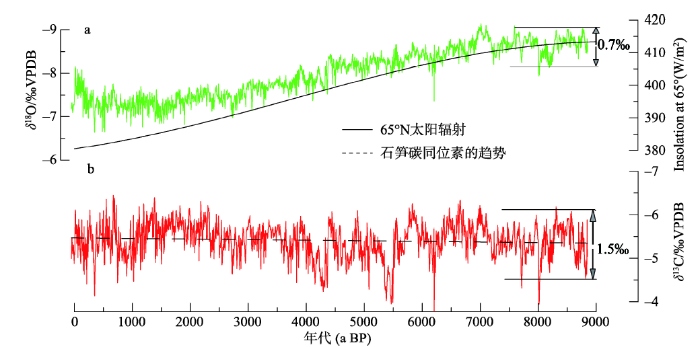
贵州省荔波县董哥洞DA石笋定年精确,平均分辨率达5 a[9],氧、碳同位素时间序列见图1。仔细对比氧碳同位素记录,至少有以下3点认识:① 石笋δ13C序列(图1a)在平均值-5.4‰上下波动,振荡幅度为~1.5‰,大约是δ18O(图1b)的2倍,由此推测石笋δ13C信号对响应区域环境变化可能比δ18O更敏感[16,36,37]。② δ18O序列在轨道尺度上呈现出和65°N太阳辐射一致的变化趋势[9,38],δ13C值相对稳定。③ 石笋δ18O记录的弱季风事件与北大西洋Bond事件一致[3],表明亚洲季风演化与北半球高纬度环境变化遥相关,这些弱季风事件在石笋δ13C序列中也有很好的体现。此外,石笋δ13C序列还存在以1000 a BP、4600 a BP和5400 a BP为中心的持续数百年的偏正,而在石笋δ18O中这些时段却没有明显的变化,说明石笋碳同位素比氧同位素受控因素更为复杂。
图1 董哥洞石笋氧碳同位素序列
Fig. 1 Stalagmite oxygen-carbon isotopes records of Dongge cave
经验模态分解(EMD)方法是Huang等于1998年提出的一种新型自适应信号时频处理方法[30]。它可以将不同尺度的波动信号分离出来,产生一系列不同尺度的数据序列,每个序列称为本征模(Intrinsic mode function,IMF)。对数据分解时,先使用原始时间序列最大值和最小值定义的包络线,识别所有极值,然后通过三次样条法将所有的极大值联系起来构成上部包络线,所有的极小值联系起来构成下部包络线。指定均值为m1,X(t)和m1之间的不同视为第一组分h1,如:
然而h1并非平稳的,因此,需要重复上述过程[32]。
式中:m2是h1的平均包络线。
反复进行这种筛选过程直到出现标准偏差(SD)。SD的临界值通常界定于0.2∼0.3(或略小)。
当符合SD的标准时,第一个IMF分量C1便通过r1=X(t)-c1从剩余的数据中分离出来。由于r1仍然包含着较长周期分量的信息,仍被视为新的数据,同样进行上述筛选过程。反复重复上述过程,ri描述如下:
因此,
如:
因此,X(t)分解成ci=IMFi(t)i=1,2,3,
每个IMF分量表现了原始数据在该尺度上的特征,为详细和直观的描述数据特征提供了更为精细的信息。将高频信号IMF分离出来的同时,剩下的就是较低频率的信号,依次分解,最后剩余的就是趋势分量。
集合经验模态分解(EEMD)方法[34]与上述过程基本一致,主要的区别是将具有一定信噪比的白噪声引入原始时间序列进行EMD分解,每次分解得到的IMFs再进行集合平均作为最终结果。该方法大大改进了EMD的模态混叠缺陷,且避免了原始数据可能携带的瞬时噪声,是一种噪声辅助数据分析方法(Noise Assisted Data Analysis)。
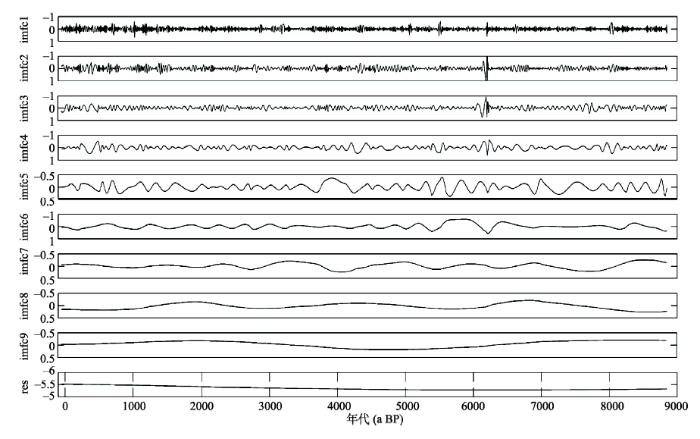
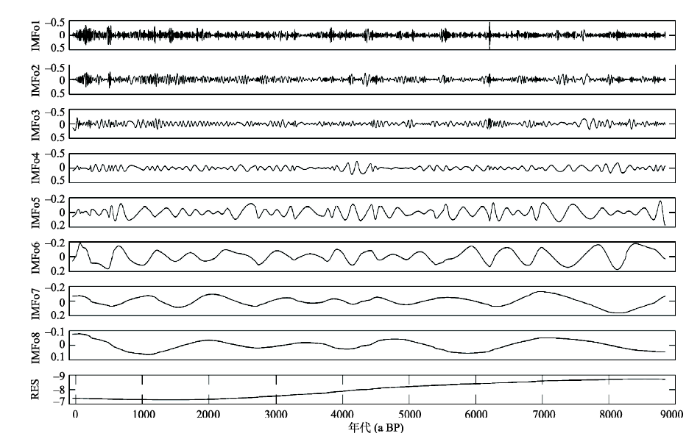
以Matlab软件为平台,对董哥洞石笋δ13C时间序列进行EEMD分解,得到9个本征模分量(imfc)及其趋势分量res(图2)。为了便于区分,将δ13C分解本征模分量标注为imfc,将δ18O的分解结果标注为IMFo。从这些本征模分量(imfc)中,识别出三个时间尺度的波动:年代际尺度(13 a、29 a和55 a)、百年尺度(116 a、254 a和526 a)和千年尺度(1156 a、2487 a和5950 a)。同样,分解δ18O时间序列获得8个本征模分量(IMFo)和趋势分量RES(图3),也识别出三个时间尺度的波动:年代际尺度(12 a、27 a和54 a)、百年尺度(118 a、217 a和568 a)和千年尺度(1133 a和1868 a)。每个imfc/IMFo分量代表不同的石笋δ13C及δ18O特征信号,反映不同的波动周期和振幅,且随着波动频率的减小,周期大小依次增加。
图2 董哥洞DA石笋δ13C时间序列EEMD分析结果
Fig. 2 Variations of imfc components and their res of δ13C from Dongge cave
图3 董哥洞DA石笋δ18O时间序列EEMD分析结果
Fig. 3 Variations of IMFo components and their RES of δ18O from Dongge cave
每个分量信号具有高还原性特征,变化规律符合自然信号非线性变化过程,其波动具有相对平稳的准周期性,可以得到平均周期,并可将每种尺度信号对原数据总体特征影响程度用方差贡献率表示出来。表1和表2给出了石笋δ13C及δ18O每个周期组分的方差贡献率及其排名,从中可以看出9个δ13C的imfc分量中,有6个贡献率大于10%,其中贡献率最大的是分量imfc6对应的526 a周期(19.08%),最小的是imfc7对应的1156 a周期(6.65%);8个δ18O的IMFo分量也有6个贡献率大于10%,贡献率最大的是分量IMFo1对应的12 a周期(22.55%),最小的是分量IMFo8对应的1868 a周期(3.23%)。方差贡献率可以帮助准确判断不同尺度信号的影响程度,更有效地理解气候变化的成因机制。
表1 石笋δ13C序列imfc分量的方差贡献率
Tab. 1 Contribution rate of the imfc components
| δ13C | infc1 | imfc2 | imfc3 | imfc4 | imfc5 | imfc6 | imfc7 | imfc8 | imfc9 |
|---|---|---|---|---|---|---|---|---|---|
| 周期(a) | 13 | 29 | 55 | 116 | 254 | 526 | 1156 | 2487 | 5950 |
| 贡献率(%) | 10.91 | 11.87 | 10.11 | 13.12 | 11.09 | 19.08 | 6.65 | 8.83 | 8.34 |
| 贡献率排名 | 5 | 3 | 6 | 2 | 4 | 1 | 9 | 7 | 8 |
表2 石笋δ18O序列IMFo分量的方差贡献率
Tab. 2 Contribution rate of the IMFo components
| δ18O | IMFo1 | IMFo2 | IMFo3 | IMFo4 | IMFo5 | IMFo6 | IMFo7 | IMFo8 |
|---|---|---|---|---|---|---|---|---|
| 周期(a) | 12 | 27 | 54 | 118 | 217 | 568 | 1133 | 1868 |
| 贡献率(%) | 22.55 | 13.92 | 10.6 | 10.87 | 9.07 | 18.32 | 11.41 | 3.23 |
| 贡献率排名 | 1 | 3 | 6 | 5 | 7 | 2 | 4 | 8 |
Liu等基于EMD分解董哥洞石笋δ18O序列和太阳活动指标序列,发现在高频变化上亚洲季风与太阳活动显著的相关[33],进一步证实了亚洲季风在高频变化上与太阳活动之间存在联系[9]。然而石笋δ13C与亚洲季风演化及太阳活动之间在高频变化上的联系尚不明确。从董哥洞石笋氧、碳同位素EEMD分解结果来看,254 a以下高频振荡尺度(imfc1~5/IMFo1~5)上,石笋δ18O和δ13C的周期组分有相同的特征。石笋δ18O、δ13C分解后均有明显的11 a太阳黑子活动周期[39,40]。IMFo2和IMFo3对应的27 a和54 a周期及imfc2和imfc3对应的29 a和55 a周期与太阳活动的30 a与60 a周期相似[33]。研究结果得到印度季风区降水器测记录的证实,该记录也显示存在明显的太阳活动周期,表明印度季风在年代际尺度上受控于太阳活动变化[41]。IMFo4分量表示的118 a周期和分量imfc4表示的116 a周期与太阳活动的120 a周期具有很好的一致性[42]。IMFo5分量表示的217 a周期和imfc5分量表示的254 a周期与太阳活动的de Vries周期(205 a)相近[43-45]。
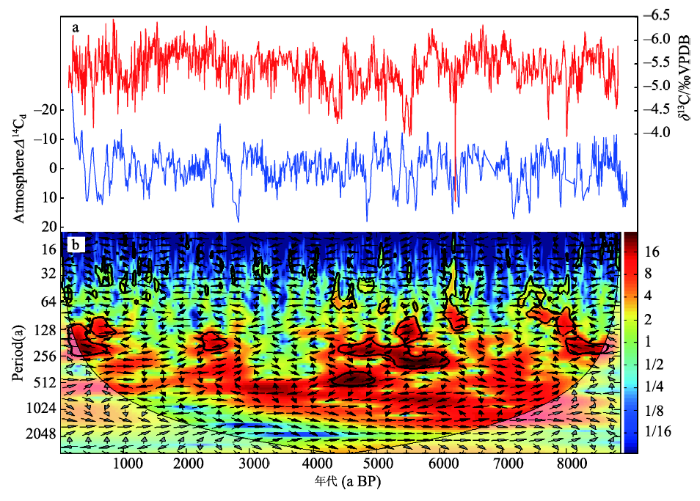
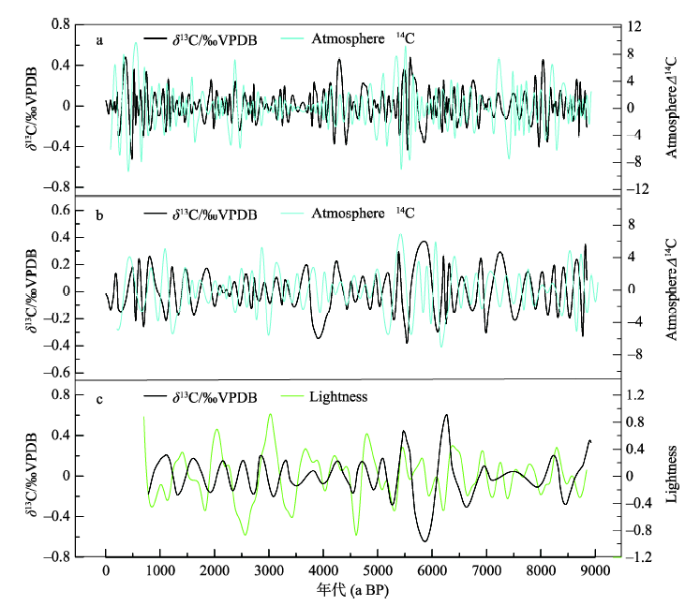
为了进一步判断董哥洞石笋δ13C周期特征与太阳活动的关系,将其与去除趋势的大气
图4 董哥洞石笋δ13C序列与大气
Fig. 4 Comparison between the stalagmite δ13C values of DA and the detrended atmosphere △14C, and cross-wavelet spectrum between them
图5 石笋δ13C分量与大气
Fig. 5 Comparison between components of the stalagmite δ13C values, atmosphere
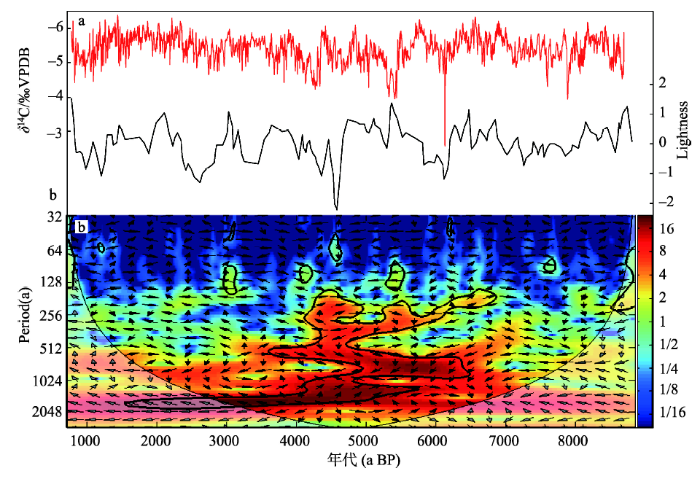
石笋δ13C分解的百年尺度周期的总贡献率为43.29%,其中imfc6的贡献率最大,其对应的526 a周期是δ13C序列变化的主周期。北大西洋NEAP15k岩芯亮度(Lightness)作为北大西洋深层水循环的指标存在显著的550 a周期[46]。董哥洞石笋δ13C记录与NEAP15k记录交叉谱分析显示(图6b),尽管两者从千年到数十年尺度都有一定的相关性,但是很显然最大的相关性出现在550 a周期左右。用同样的方法对北大西洋NEAP15k岩芯亮度进行EEMD分解,并将其准550 a振荡与石笋δ13C序列526 a振荡的进行对比(图5c),对比结果显示两个序列具有一定的相似性。说明在该时间尺度上,北大西洋区域环境演化与低纬植被生产率之间可能存在内在联系。可能的机制是北半球高纬气候通过西风带影响了东亚大陆的温度和干湿度变化,继而影响土壤生产率的变化[47]。
图6 董哥洞石笋δ13C与北大西洋NEAP15k岩芯亮度(Lightness)序列对比及交叉谱分析
Fig. 6 Comparison between the stalagmite δ13C values of DA and the lightness values of NEAP15k, and cross-wavelet spectrum between them
EEMD分解石笋δ18O与δ13C在年代际—百年尺度上得到的周期基本一致。相关性分析显示,IMFO与imfC在年代际上分量的相关系数r分别为0.474(IMFo1/imfc1)、0.412(IMFo2/imfc2)和0.358(IMFo3/imfc3)。在百年尺度上,二者对应的EEMD分解后的分量的相关系数分别为0.455(IMFo4/imfc4)、0.501(IMFo5/imfc5)和0.444(IMFo6/imfc6)。表明在年代际—百年尺度上,石笋δ18O与δ13C具有很强的相关性。云南中晚全新世石笋研究结果显示,百年尺度的季风环流所带来的降水及温度变化促使石笋δ18O和δ13C信号同向变化[48]。欧洲石笋δ18O与δ13C记录在反映全新世百年尺度事件上表现出趋同性[49],北美洲石笋研究也获得相同的结果[50]。这些证据表明石笋δ18O与δ13C在百年尺度的气候/环境事件方面具有共同的响应机制。
石笋氧同位素变化主要取决于季风降水,而降雨量的变化控制着土壤温、湿度水 平[51]。这些限制性因子影响植被生产率、土壤有机质分解、微生物活动和植物根部呼 吸[52-55],因此影响土壤CO2的产率。较高的土壤CO2分压(pCO2)导致较低的δ13C值[56],并在洞穴沉积物中反映出来。因此,与季风降水相关的土壤演化过程对石笋δ13C信号有显著的影响。石笋氧、碳同位素数据对比显示,石笋δ18C振幅比δ18O大得多。EEMD分析也显示,在同一准周期内,分量imfc的振幅几乎是IMFo的2倍。贵州省董哥洞全新世石笋δ18O记录[9]及其EMD解析结果[33]已揭示了低纬季风受到太阳活动的驱动,那么EEMD分析结果说明洞穴地点的土壤生产率和低纬水汽都响应于上述驱动,但土壤生产率放大了初始输入信号。如果董哥洞全新世石笋分析结果在更大区域上得以证实,石笋δ18C可能更适合于研究太阳活动与气候/生态变化之间的关系,至少在百年尺度上δ13C信号对区域环境变化响应似乎更敏感[16,36]。
石笋δ18O时间序列分解后的趋势分量代表了亚洲季风轨道尺度的气候变化,和全新世北半球太阳辐射变化一致,表明在轨道尺度上全新世气候依然受控于太阳辐射的岁差周期变化[57-59]。而石笋δ13C分解后得到的趋势分量变化平稳,明显不同于对应的δ18O的趋势分量,说明在轨道尺度上,董哥洞洞穴地点的土壤生产率并不直接响应于太阳辐射变化。在千年尺度上,虽然石笋δ18O分解得到了两个分量IMFo7和IMFo8,但IMFo8方差贡献率仅为3.23%。因此,认为石笋δ18O控制因素比较单一,即IMFo7(1133 a)分量指示北高纬气候变化是δ18O千年尺度的变化主控因子。相对而言,DA石笋δ13C在千年尺度上的影响因素要复杂得多,3个分量imfc7、imfc8和imfc9贡献率均在6%~9%之间。imfc7和imfc8对应的周期组分可能代表北高纬气候变化[9]。而imfc9对应的周期(5960 a)或许受控于岁差的四分之一谐振[39],这和赤道东非Challa湖泊沉积研究结果比较相似[60]。来自中国南方多支石笋研究表明[51],虽然δ13C和δ18O在轨道—千年尺度上差异明显,但在百年尺度—年代际上却显示出强烈的耦合性。更重要的是,这种关系不仅发生在全新世,也出现在末次冰期[51]。结合EEMD的分析结果,推测δ13C和δ18O的差异可能主要是由于δ13C在千年尺度复杂的控制因素造成的。
EEMD分解结果显示董哥洞全新世石笋δ13C在亚轨道尺度上有5950 a、2487 a、1156 a、526 a、254 a、116 a、55 a、29 a和13 a等9个周期组分,通过与大气
(1)石笋δ13C在254 a以下尺度上的高频变化与大气
(2)石笋δ13C分解的imfc6分量方差贡献率最大,对应526 a周期与北大西洋深层水550 a周期一致,相关性和交叉谱分析均显示两者有很好的内在联系,可能是北半球高纬度大西洋环境变化通过西风带影响东亚大陆的温度和干湿度变化,进而引起洞穴地表植被的变化。
(3)在亚千年尺度上,石笋δ13C与δ18O分量具有很好的相关性,且δ13C震荡幅度几乎是δ18O的2倍,说明洞穴地点的土壤生产率响应并放大了气候的初始输入信号,石笋δ13C在研究气候/生态变化之间的关系上可能更有优势。
The authors have declared that no competing interests exist.
| [1] |
中国全新世气候变化研究进展 .https://doi.org/10.3969/j.issn.1672-9250.2001.02.002 URL [本文引用: 1] 摘要
全新世气候变化研究是古气候研究的一个重点。中国全新世气候变化的研究也是全球变化研究中重要的一部分。大量的研究工作为恢复中国全新世气候做了重大贡献。中国地形地貌复杂,又处在具有复杂时空变率的东亚季风控制范围内,这使得不同的研究工作者在一些问题上存在意见分歧。比较统一的意见是:中国全新世始于约10.5ka BP;在约9~8 ka BP左右为一段降温期;7~4 ka BP为一段温暖期,通常称之为全新世大暖期;大约3 kaBP左右开始降温,至近代才又升温;约1300 a A.D.左右进入小冰期,到1850 a A.D.左右结束,其间又有几次比较明显的温度振荡。1850 a A.D.至今为温度的上升期。对于气候变动的驱动因素,不同的学者看法不一;从长时间尺度看,太阳辐射变化是气候变化的主要驱动力。
Advance in research on the Holocene climate fluctuations .https://doi.org/10.3969/j.issn.1672-9250.2001.02.002 URL [本文引用: 1] 摘要
全新世气候变化研究是古气候研究的一个重点。中国全新世气候变化的研究也是全球变化研究中重要的一部分。大量的研究工作为恢复中国全新世气候做了重大贡献。中国地形地貌复杂,又处在具有复杂时空变率的东亚季风控制范围内,这使得不同的研究工作者在一些问题上存在意见分歧。比较统一的意见是:中国全新世始于约10.5ka BP;在约9~8 ka BP左右为一段降温期;7~4 ka BP为一段温暖期,通常称之为全新世大暖期;大约3 kaBP左右开始降温,至近代才又升温;约1300 a A.D.左右进入小冰期,到1850 a A.D.左右结束,其间又有几次比较明显的温度振荡。1850 a A.D.至今为温度的上升期。对于气候变动的驱动因素,不同的学者看法不一;从长时间尺度看,太阳辐射变化是气候变化的主要驱动力。
|
| [2] |
Persistent solar influence on North Atlantic climate during the Holocene . |
| [3] |
Synchronizing ice cores from the Renland and Agassiz ice caps to the Greenland Ice Core Chronology .https://doi.org/10.1029/2007JD009143 URL [本文引用: 1] 摘要
N2 - Four ice cores from the Agassiz ice cap in the Canadian high arctic and one ice corefrom the Renland ice cap in eastern Greenland have been synchronized to theGreenland Ice Core Chronology 2005 (GICC05) which is based on annual layer countsin the DYE-3, GRIP and NGRIP ice cores. Volcanic reference horizons, seen in electricalconductivity measurements (ECM) have been used to carry out the synchronizationthroughout the Holocene. The Agassiz ice cores have been matched to the NGRIP ice coreECM signal, while the Renland core has been matched to the GRIP ice core ECM signal,thus tying the cores to GICC05. Furthermore, it has been possible to synchronize theRenland ice core to NGRIP-GICC05 in the glacial period back to 60,000 years b2k(years before A.D. 2000), on the basis of a matching of transitions between stadials andinterstadials. This work brings the total number of ice core records that have beenrigorously tied to the GICC05 timescale up to nine. Renland annual layer thicknessesare increasing with depth during the period from 7 to 8.5 ka b2k, a highly unusualobservation only matched by a similar thickness increase in the glacial section of theRenland core some 60 ka ago. Annual layer thicknesses in the Agassiz ice cores point toa well-developed Raymond bump in the Agassiz ice cap.
|
| [4] |
A 3585-year ring-width dating chronology of Qilian Juniper from the northeastern Qinghai-Tibetan Plateau .https://doi.org/10.1163/22941932-90000226 URL 摘要
This article documents the development of a precisely dated and well-replicated long regional tree-ring width dating chronology for Qilian juniper (Juniperus przewalskii Kom.) from the northeastern Qinghai-Tibetan Plateau. It involves specimens from 22 archeological sites, 24 living tree sites, and 5 standing snags sites in the eastern and northeastern Qaidam Basin, northwestern China. The specimens were cross-dated successfully among different groups of samples and among different sites. Based on a total of 1438 series from 713 trees, the chronology covers 3585 years and is the longest chronology by far in China. Comparisons with chronologies of the same tree species about 200 kin apart suggest that this chronology can serve for dating purposes in a region larger than the study area. This study demonstrates the great potential of Qilian juniper for dendrochronological research.
|
| [5] |
A 3500-year tree-ring record of annual precipitation on the northeastern Tibetan Plateau .https://doi.org/10.1073/pnas.1319238111 URL PMID: 24516152 摘要
An annually resolved and absolutely dated ring-width chronology spanning 4,500 y has been constructed using subfossil, archaeological, and living-tree juniper samples from the northeastern Tibetan Plateau. The chronology represents changing mean annual precipitation and is most reliable after 1500 B.C. Reconstructed precipitation for this period displays a trend toward more...
|
| [6] |
中世纪暖期南北半球气候变化特征与成因的模拟对比 .https://doi.org/10.11821/dlyj201609006 URL Magsci [本文引用: 1] 摘要
<p>利用通用地球系统模式CESM过去1500年气候模拟试验结果,对比分析中世纪暖期南、北半球气候变化特征及成因,对认识南、北半球暖期气候变化规律及其与外强迫变化的关系有重要科学意义。结果表明:中世纪暖期全球及南、北半球总体是变暖的,但仍存在峰谷变化,高纬地区增温幅度大于低纬地区,北半球中世纪暖期比南半球更为明显,其距平变幅也大于南半球。全球降水距平基本为正,南、北半球降水变幅基本相当,降水变化显著区域集中于低纬地区。太阳辐射是影响中世纪暖期全球及半球气温变化最显著的因素,火山活动对北半球气温变化也有较显著的影响。从全球尺度来看,降水由太阳辐射和火山活动共同影响,其中太阳辐射影响最为显著,但从半球尺度来看,火山活动是影响半球降水的重要因素。</p>
Inter-hemispheric comparison of characteristics and causes of climate change during the Medieval Warm Period based on CESM simulation .https://doi.org/10.11821/dlyj201609006 URL Magsci [本文引用: 1] 摘要
<p>利用通用地球系统模式CESM过去1500年气候模拟试验结果,对比分析中世纪暖期南、北半球气候变化特征及成因,对认识南、北半球暖期气候变化规律及其与外强迫变化的关系有重要科学意义。结果表明:中世纪暖期全球及南、北半球总体是变暖的,但仍存在峰谷变化,高纬地区增温幅度大于低纬地区,北半球中世纪暖期比南半球更为明显,其距平变幅也大于南半球。全球降水距平基本为正,南、北半球降水变幅基本相当,降水变化显著区域集中于低纬地区。太阳辐射是影响中世纪暖期全球及半球气温变化最显著的因素,火山活动对北半球气温变化也有较显著的影响。从全球尺度来看,降水由太阳辐射和火山活动共同影响,其中太阳辐射影响最为显著,但从半球尺度来看,火山活动是影响半球降水的重要因素。</p>
|
| [7] |
神农架石笋记录的近200年东亚季风变化及其ENSO响应 .https://doi.org/10.11821/dlyj201501007 URL Magsci [本文引用: 2] 摘要
<p>通过湖北省神农架永兴洞石笋(编号:YX92)<sup>230</sup>Th年龄和纹层计数年代学研究,建立了1788AD-1956AD时段年际分辨率石笋氧同位素序列。该序列δ<sup>18</sup>O值变化范围为-9.70‰~-7.87‰,最大振幅约达1.83‰,呈现显著的年代际尺度振荡旋回特征。功率谱分析结果揭示存在显著的60~70年准周期信号。该记录与同区域和尚洞石笋δ<sup>18</sup>O曲线具有很好的重现性,说明其可能受控于共同的气候因子,指示了东亚夏季风大尺度环流特征。将石笋重建的东亚夏季风指标与全印度夏季降水量指示的印度夏季风指数对比,结果显示两者在年代际旋回特征上具有很好的相似性,但是呈反相位关系。进一步与ENSO指数对比,发现东亚夏季风年代际尺度变化与ENSO存在密切联系,表现为东亚夏季风增强,对应于ENSO暖期,反之亦然。因此,东亚季风与印度季风在年代际尺度上的反相位关系可能源于两者对ENSO机制的不同响应。</p>
East Asian monsoon changes and its ENSO response revealed by a 200-year stalagmite record from Yongxing Cave on the Mountain Shengnonjia .https://doi.org/10.11821/dlyj201501007 URL Magsci [本文引用: 2] 摘要
<p>通过湖北省神农架永兴洞石笋(编号:YX92)<sup>230</sup>Th年龄和纹层计数年代学研究,建立了1788AD-1956AD时段年际分辨率石笋氧同位素序列。该序列δ<sup>18</sup>O值变化范围为-9.70‰~-7.87‰,最大振幅约达1.83‰,呈现显著的年代际尺度振荡旋回特征。功率谱分析结果揭示存在显著的60~70年准周期信号。该记录与同区域和尚洞石笋δ<sup>18</sup>O曲线具有很好的重现性,说明其可能受控于共同的气候因子,指示了东亚夏季风大尺度环流特征。将石笋重建的东亚夏季风指标与全印度夏季降水量指示的印度夏季风指数对比,结果显示两者在年代际旋回特征上具有很好的相似性,但是呈反相位关系。进一步与ENSO指数对比,发现东亚夏季风年代际尺度变化与ENSO存在密切联系,表现为东亚夏季风增强,对应于ENSO暖期,反之亦然。因此,东亚季风与印度季风在年代际尺度上的反相位关系可能源于两者对ENSO机制的不同响应。</p>
|
| [8] |
Paleo-climate reconstruction from stable isotope variations in speleothems: A review .https://doi.org/10.1016/j.quascirev.2003.06.021 URL 摘要
Speleothems are now regarded as valuable archives of climatic conditions on the continents, offering a number of advantages relative to other continental climate proxy recorders such as lake sediments and peat cores. They are ideal materials for precise U-series dating, yielding ages in calendar years, thereby circumventing the radiocarbon calibration problems associated with most other continental records. Stable isotope studies in speleothems have shifted away from attempting to provide palaeo-temperature reconstructions to the attainable goal of providing precise estimates for the timing and duration of major O isotope-defined climatic events characterised by high signal to noise ratios (e.g. glacial/interglacial transitions, Dansgaard–Oeschger oscillations, the ‘8200-year’ event). Unlike the marine records, speleothem data sets are not ‘tuned’, and their independent chronology offers opportunities to critically assess leads and lags in the climate system, that in turn can provide important insights into forcing and feedback mechanisms. Improved procedures for the extraction and measurement of stable isotope ratios in fluid inclusions trapped in speleothems are likely to provide, in the near future, a much enhanced basis for the quantitative interpretation of O isotope ratios in speleothem calcite. The latter developments open up once again the tantalising prospect of palaeo-temperature estimates, but more importantly perhaps, provide a direct test for a new generation of general circulation models whose hydrological cycles will incorporate the ‘water isotopes’. The literature is reviewed briefly to provide for the reader a sense of the current state-of-the-art, and to provide some pointers for future research directions.
|
| [9] |
The Holocene Asian monsoon: Links to solar changes and North Atlantic climate . |
| [10] |
Quantification of Holocene Asian monsoon rainfall from spatially separated cave records .https://doi.org/10.1016/j.epsl.2007.10.015 URL 摘要
A reconstruction of Holocene rainfall is presented for southwest China — an area prone to drought and flooding due to variability in the East Asian monsoon. The reconstruction is derived by comparing a new high-resolution stalagmite δ 18O record with an existing record from the same moisture transport pathway. The new record is from Heshang Cave (30°27′N, 110°25′E; 29402m) and shows no sign of kinetic or evaporative effects so can be reliably interpreted as a record of local rainfall composition and temperature. Heshang lies 60002km downwind from Dongge Cave which has a published high-resolution δ 18O record (Wang, Y.J., Cheng, H., Edwards, R.L., He, Y.Q., Kong, X.G., An, Z.S., Wu, J.Y., Kelly, M.J., Dykoski, C.A., Li, X.D., 2005. The Holocene Asian monsoon: links to solar changes and North Atlantic climate. Science 308, 854–857). By differencing co-eval δ 18O values for the two caves, secondary controls on δ 18O (e.g. moisture source, moisture transport, non-local rainfall, temperature) are circumvented and the resulting Δ δ 18O signal is controlled directly by the amount of rain falling between the two sites. This is confirmed by comparison with rainfall data from the instrumental record, which also allows a calibration of the Δ δ 18O proxy. The calibrated Δ δ 18O record provides a quantitative history of rainfall in southwest China which demonstrates that rainfall was 8% higher than today during the Holocene climatic optimum (≈ 602ka), but only 3% higher during the early Holocene. Significant multi-centennial variability also occurred, with notable dry periods at 8.202ka, 4.8–4.102ka, 3.7–3.102ka, 1.4–1.002ka and during the Little Ice Age. This Holocene rainfall record provides a good target with which to test climate models. The approach used here, of combining stalagmite records from more than one location, will also allow quantification of rainfall patterns for past times in other regions.
|
| [11] |
A test of climate, sun, and culture relationships from an 1810-year Chinese cave record .https://doi.org/10.1126/science.1163965 URL PMID: 18988851 摘要
Abstract A record from Wanxiang Cave, China, characterizes Asian Monsoon (AM) history over the past 1810 years. The summer monsoon correlates with solar variability, Northern Hemisphere and Chinese temperature, Alpine glacial retreat, and Chinese cultural changes. It was generally strong during Europe's Medieval Warm Period and weak during Europe's Little Ice Age, as well as during the final decades of the Tang, Yuan, and Ming Dynasties, all times that were characterized by popular unrest. It was strong during the first several decades of the Northern Song Dynasty, a period of increased rice cultivation and dramatic population increase. The sign of the correlation between the AM and temperature switches around 1960, suggesting that anthropogenic forcing superseded natural forcing as the major driver of AM changes in the late 20th century.
|
| [12] |
Modification and preservation of environment signals in speleothems .https://doi.org/10.1016/j.earscirev.2005.08.003 URL [本文引用: 1] 摘要
Analytical factors are critical in generating high-resolution speleothem records. A variety of methods of trace element analysis is available, but standardization is a common problem with the most rapid methods. New stable isotope data on Irish stalagmite CC3 compares rapid laser-ablation techniques with the conventional analysis of micromilled powders and ion microprobe methods. A high degree of comparability between techniques for δ 18 O is found on the millimeter to centimeter scale, but a previously described high-amplitude oxygen isotope excursion around 8.3 ka is identified as an analytical artefact related to fractionation of the laser-analysis associated with sample cracking. High-frequency variability of not less than 0.5‰ may be an inherent feature of speleothem δ 18 O records.
|
| [13] |
Stable isotope variations in modern tropical speleothems: Evaluating equilibrium vs. kinetic isotope effects .https://doi.org/10.1016/j.gca.2004.02.012 URL [本文引用: 1] 摘要
Modern speleothems from Harrison’s Cave are not in O isotopic equilibrium with their corresponding drip waters and are 0.2‰ to 2.3‰ enriched in 18 O relative to equilibrium values. δ 18 O variations in modern calcite are likely controlled by kinetically driven changes in the fractionation between HCO 3 61 (aq) and CaCO 3 from equilibrium conditions to nonequilibrium conditions, consistent with rapid calcite growth. In contrast to δ 13 C, δ 18 O values of modern calcite may not be affected by Rayleigh distillation during degassing because CO 2 hydration and hydroxylation reactions will buffer the O isotopic composition of the HCO 3 61 (aq) reservoir. If the effects of Rayleigh distillation manifest themselves in the O isotopic system, they will result in 18 O enrichment in the HCO 3 61 (aq) reservoir and ultimately in the precipitated CaCO 3 .
|
| [14] |
δ13C profiles along growth layers of stalagmites: Comparing theoretical and experimental results .https://doi.org/10.1016/j.gca.2007.09.039 URL 摘要
The isotopic carbon ratio of a calcite-precipitating solution flowing as a water film on the surface of a stalagmite is determined by Rayleigh distillation. It can be calculated, when the HCO 3 - mathContainer Loading Mathjax -concentration of the solution at each surface point of the stalagmite and the fractionation factors are known. A stalagmite growth model based entirely on the physics of laminar flow and the well-known precipitation rates of a supersaturated solution of calcite, without any further assumptions, is employed to obtain the spatial distribution of the HCO 3 - mathContainer Loading Mathjax -concentration, which contributes more than 95% to the dissolved inorganic carbon (DIC). The 13 C profiles are calculated along the growth surface of a stalagmite for three cases: (A) isotopic equilibrium of both CO 2 outgassing and calcite precipitation; (B) outgassing of CO 2 is irreversible but calcite precipitation is in isotopic equilibrium. (C) Both CO 2 outgassing and calcite precipitation are irreversible. In all cases the isotopic shift 13 C increases from the apex along the distance on a growth surface. In cases A and B, calcite deposited at the apex is in isotopic equilibrium with the solution of the drip water. The difference between 13 C at the apex and the end of the growth layer is independent of the stalagmite radius, but depends on temperature. For case A, it is about half the value obtained for cases B and C. In case C, the isotopic composition of calcite at the apex equals that of the drip water, but further out it becomes practically identical with that of case B. The growth model has been applied to field data of stalagmite growth, where the thickness and the 13 C of calcite precipitated to a glass plate located on the top of a stalagmite have been measured as function of the distance from the drip point. The calculated data are in good agreement to the observed ones and indicate that deposition occurred most likely under conditions B, eventually also C. A sensitivity analysis has been performed, which shows that within the limits of observed external parameters, such as drip rates and partial pressure of carbon dioxide P CO 2 P CO 2 mathContainer Loading Mathjax in the cave, the results remain valid.
|
| [15] |
Limitations of Hendy Test criteria in judging the paleoclimatic suitability of speleothems and the need for replication .https://doi.org/10.1016/j.jas.2009.01.001 URL [本文引用: 1] 摘要
Carbon and oxygen isotopes in calcite speleothems are powerful proxies for understanding past climate change. For calcite deposited under isotopic equilibrium conditions, variations in delta O-18 values directly reflect changes in cave temperature and the isotopic composition of meteoric water. Speleothem delta C-13 values have bedrock, atmospheric, and soil gas sources. Soil gases can be traced to the overlying vegetation, which is related to climate. Both delta C-13 and delta O-18 values are therefore potentially powerful tracers of climate change. Processes that could alter speleothem delta C-13 and/or delta O-18 values, and thereby mask primary environmental signals, fall in the categories of 1) kinetic processes, including deposition of calcite out of isotopic equilibrium, and 2) vadose processes, including evaporation of water at or near the land surface. In truth, there is no absolute test for the absence of these kinetic/vadose-zone processes. However, the Hendy Test is widely used for assessing whether isotopic equilibrium existed during the time of calcite deposition. Criterion (1) of the Hendy Test (i.e., that delta O-18 values remain constant along a single growth layer) may not be a valid control of equilibrium conditions because isotopic equilibrium could theoretically occur in the center of the speleothem at the same time that kinetic Fractionation occurs at the flanks. Moreover, the concept of sampling along a single growth layer is flawed in both theory and practice. Criterion (2) of the Hendy Test (i.e., that there is no relationship between delta C-13 and PO) is based on the assumption that speleothem delta C-13 values are not linked to climate. However, speleothem delta C-13 values may well be linked to climate because climate provides a first-order control on soil productivity and the type of vegetation. Therefore, Hendy Test criterion (2) is not a prerequisite to isotopic equilibrium in all cases. We propose instead the Replication Test (i.e., the demonstration of similar isotopic profiles among two or more speleothems) for evaluating the likelihood of calcite deposition tinder isotopic equilibrium conditions. Replication of isotopic profiles among two or more speleothems is possible only if kinetic/vadose-zone processes are either: 1) absent or 2) have affected spatially separated speleothems in exactly the same way. Because the second scenario is highly unlikely, we propose that the Replication Test is effectively sufficient in ruling out kinetic/vadose-zone overprinting processes. We further Suggest that the Replication Test is far more robust in testing for the absence of the wide range of processes described above than is the traditional Hendy Test.
|
| [16] |
Precise dating of Dansgaard-Oeschger climate oscillations in western Europe from stalagmite data .https://doi.org/10.1038/nature01391 URL PMID: 12594510 [本文引用: 4] 摘要
Abstract The signature of Dansgaard-Oeschger events--millennial-scale abrupt climate oscillations during the last glacial period--is well established in ice cores and marine records. But the effects of such events in continental settings are not as clear, and their absolute chronology is uncertain beyond the limit of (14)C dating and annual layer counting for marine records and ice cores, respectively. Here we present carbon and oxygen isotope records from a stalagmite collected in southwest France which have been precisely dated using 234U/230Th ratios. We find rapid climate oscillations coincident with the established Dansgaard-Oeschger events between 83,000 and 32,000 years ago in both isotope records. The oxygen isotope signature is similar to a record from Soreq cave, Israel, and deep-sea records, indicating the large spatial scale of the climate oscillations. The signal in the carbon isotopes gives evidence of drastic and rapid vegetation changes in western Europe, an important site in human cultural evolution. We also find evidence for a long phase of extremely cold climate in southwest France between 61.2 +/- 0.6 and 67.4 +/- 0.9 kyr ago.
|
| [17] |
A 780-year annually resolved record of Indian Ocean monsoon precipitation from a speleothem from south Oman .https://doi.org/10.1029/2001JD001281 URL 摘要
Meteorological records of monsoon rainfall in the Indian Ocean are generally less than 100 years long. The relative brevity of these records makes it difficult to investigate monsoon variation on decadal and centennial timescales, to determine what factors influence the intensity of rainfall on these timescales, or to place possible changes in the twentieth century into a broader historical context. Development of a geologic proxy for rainfall that records annual variation in the monsoon over much longer time periods than are covered by instrumental records would be a significant step forward. We have developed an annually resolved record of monsoon rainfall variation for the past 780 years based on annual layer thickness and stable isotope analyses of a laminated stalagmite from southern Arabia. Our results show that monsoon variation over the past century is not outside of the range of the past 800 years. Decreasing monsoon rainfall over the past century is related to increasing sea surface temperature in the Indian Ocean. Spectral analyses of the record are dominated by cycles that are similar to those observed in records of solar activity on centurial timescales. Decadal to interannual cycles in the record appear to originate in the tropical Pacific Ocean.
|
| [18] |
El Niño events recorded by stalagmite carbon isotopes .https://doi.org/10.1126/science.1076446 URL [本文引用: 1] 摘要
Frappier A, Sahagian D, González LA, Carpenter SJ.
|
| [19] |
Stalagmite stable isotope record of recent tropical cyclone events .https://doi.org/10.1130/G23145A.1 URL 摘要
We present a 23 yr stalagmite record (1977-2000) of oxygen isotope variation, associated with 11 tropical cyclones (TCs), from Actun Tunichil Muknal cave in central Belize. High-resolution microsampling yielded a record of monthly to weekly temporal resolution that contains abrupt decreases (negative excursions) in calcite {delta}18O values that correspond with recent TC rain events nearby. A logistic discriminant model reliably identified TC proxy signals using the measurable parameters {delta}18O and {delta}13C values, and single point changes in {delta}18O value. The logistic model correctly identified 80% of excursions as TC events and incorrectly classified only 1 of nearly 1200 nonstorm sampling points. In addition to enabling high-resolution TC frequency reconstruction, this geologic proxy also provides information about the intensity of individual TCs. A multiple regression predicted TC intensity (R2 = 0.465, p = 0.034) using sampling frequency and excursion amplitude. Consistent with previous low-resolution studies, we found that the decadal average {delta}18O value was lower during the 1990s when several TCs produced rainfall in the area, but higher during the 1980s when only one TC struck. Longer, accurately dated, high-resolution speleothem stable isotope records may be a useful new tool for paleotempestology, to clarify associations between highly variable TC activity and the dynamic range of Quaternary climate
|
| [20] |
A stalagmite record of changes in atmospheric circulation and soil processes in the Brazilian subtropics during the Late Pleistocene .https://doi.org/10.1016/j.quascirev.2006.02.019 URL 摘要
We present a high-resolution, 116,000-year carbon stable isotope record from a stalagmite from southern Brazil, which has been precisely dated using the U-series method. Evaluation of carbon and oxygen isotope ratios together with the speleothem growth history suggest that the carbon isotopic composition of the speleothem is primarily controlled by biogenic CO 2 supply from the soil, which is in turn affected by temperature and secondarily rainfall amount. Thus, the speleothem provides evidence of paleoenvironmental change in southern Brazil during the last glacial period. Predominantly high δ 13 C values and low stalagmite growth rates reflect persistent cool conditions during most of the glacial period in subtropical Brazil. This cooling is probably related to an intensified extratropical circulation with more frequent and intense cold surges, reaching a maximum at approximately 1902ky B.P. This cooling tendency is interrupted during periods of high obliquity values within the full glacial period at 93–85 and 47–4002ky B.P, and after 1902ky B.P, when a dramatic decrease in δ 13 C marks the deglaciation time in the continent. Unlike δ 18 O, the δ 13 C record does not exhibit a strong response to precessional forcing; instead it shows a strong 4002ky obliquity signal. Here we propose that local temperature and thus the biological processes in the soil are primarily steered by the gradients of temperature between low and mid-high latitudes, which influence the meridional heat transport. These gradient changes in turn are paced by obliquity.
|
| [21] |
Aerosol forcing of the position of the intertripical convergence zone since AD 1550 .https://doi.org/10.1038/ngeo2353 URL 摘要
The position of the intertropical convergence zone is an important control on the distribution of low-latitude precipitation. Its position is largely controlled by hemisphere temperature contrasts1, 2. The release of aerosols by human activities may have resulted in a southward shift of the intertropical convergence zone since the early 1900s (refs 1, 3, 4, 5, 6) by muting the warming of the Northern Hemisphere relative to the Southern Hemisphere over this interval1, 7, 8, but this proposed shift remains equivocal. Here we reconstruct monthly rainfall over Belize for the past 456 years from variations in the carbon isotope composition of a well-dated, monthly resolved speleothem. We identify an unprecedented drying trend since ad 1850 that indicates a southward displacement of the intertropical convergence zone. This drying coincides with increasing aerosol emissions in the Northern Hemisphere and also marks a breakdown in the relationship between Northern Hemisphere temperatures and the position of the intertropical convergence zone observed earlier in the record. We also identify nine short-lived drying events since ad 1550 each following a large volcanic eruption in the Northern Hemisphere. We conclude that anthropogenic aerosol emissions have led to a reduction of rainfall in the northern tropics during the twentieth century, and suggest that geographic changes in aerosol emissions should be considered when assessing potential future rainfall shifts in the tropics.
|
| [22] |
Stable isotope and trace element investigation of two contemporaneous annually-laminated stalagmites from northeastern China surrounding the "8.2 ka event" .https://doi.org/10.5194/cpd-8-1591-2012 URL 摘要
The prominent 8.2 ka event was well documented in the Greenland ice cores. It remains unclear, however, about its duration, structure and forcing mechanism at low- to mid-latitude regions. Here we use the physical and geochemical data of stalagmites from the Nuanhe Cave in Liaoning province, northeastern China to reconstruct a detailed history of East Asian monsoons throughout the event. Two contemporaneous stalagmites were annually counted for at least 770 yr anchored by five lt;supgt;230lt;/supgt;Th dates to establish an inter-calibrated high-resolution timescale. Two oxygen isotope profiles replicate each other at annual-decadal timescales although their counted growth rates are not consistent, indicating that the amp;delta;lt;supgt;18lt;/supgt;O variability has a climatic origin, largely associated with changes in the rainfall amp;delta;lt;supgt;18lt;/supgt;O from the West Pacific during summer season. A signal from the 8.2 ka event was faint in our amp;delta;lt;supgt;18lt;/supgt;O records, not as significant as Indian monsoon dominated stalagmite amp;delta;lt;supgt;18lt;/supgt;O records from Qunf in Oman and Dongge in Southern China. However, our amp;delta;lt;supgt;13lt;/supgt;C and Ba/Ca profiles, as indicators of local environmental changes, provide a strong support for a deteriorated climate episode centred at 8.2 ka BP, likely controlled by winter monsoon circulations via the westerly winds associated with North Atlantic climates. Therefore, we concluded that the winter- and summer-Asian monsoons responded independently to the high northern latitude climates.
|
| [23] |
Stable isotope composition alteration produced by the aragonite-to-calcite transformation in speleothems and implications for paleoclimate reconstructions .https://doi.org/10.1016/j.sedgeo.2014.05.007 URL [本文引用: 2] 摘要
61Two aragonite stalagmites were documented partially inverted to secondary calcite.61δ13C values of secondary calcite are similar to those of the corresponding aragonite.61δ18O values of secondary calcite are 0.85±0.29‰ depleted than those of aragonite.61Aragonite may invert to calcite by interacting with the pore water and trace calcite.
|
| [24] |
The GISP2 δ18O climate record of the past 16, 500 years and the role of the sun, ocean, and volcanoes .https://doi.org/10.1006/qres.1995.1079 URL [本文引用: 1] 摘要
Measured 18 O/ 16 O ratios from the Greenland Ice Sheet Project 2 (GISP2) ice core extending back to 16,500 cal yr B.P. provide a continuous record of climate change since the last glaciation. High-resolution annual 18 O/ 16 O results were obtained for most of the current millennium (A.D. 818-1985) and record the Medieval Warm Period, the Little Ice Age, and a distinct 11-yr 18 O/ 16 O cycle. Volcanic aerosols depress central Greenland annual temperature (651.5°C maximally) and annual 18 O/ 16 O for about 4 yr after each major eruptive event. On a bidecadal to millennial time scale, the contribution of solar variability to Holocene Greenlandic temperature change is 650.4°C. The role of thermohaline circulation change on climate, problematic during the Holocene, is more distinct for the 16,500-10,000 cal yr B.P. interval. (Analogous to 14 C age calibration terminology, we express time in calibrated (cal) yr B.P. (A.D. 1950 = 0 cal yr B.P.)). The Oldest Dryas/B03lling/Older Dryas/Aller03d/Younger Dryas sequence appears in great detail. Bidecadal variance in 18 O/ 16 O, but not necessarily in temperature, is enhanced during the last phase of lateglacial time and the Younger Dryas interval, suggesting switches of air mass transport between jet stream branches. The branched system is nearly instantaneously replaced at the beginning of the B03lling and Holocene (at 6514,670 and 6511,650 cal yr B.P., respectively) by an atmospheric circulation system in which 18 O/ 16 O and annual accumulation initially track each other closely. Thermodynamic considerations of the accumulation rate-temperature relationship can be used to evaluate the 18 O/ 16 O-temperature relationship. The GISP2 ice-layer-count years of major GISP2 climate transitions also support the use of coral 14 C ages for age calibration.
|
| [25] |
Strong coherence between solar variability and the monsoon in Oman between 9 and 6 kyr ago .https://doi.org/10.1038/35077048 URL PMID: 11357127 摘要
Abstract Variations in the amount of solar radiation reaching the Earth are thought to influence climate, but the extent of this influence on timescales of millennia to decades is unclear. A number of climate records show correlations between solar cycles and climate, but the absolute changes in solar intensity over the range of decades to millennia are small and the influence of solar flux on climate is not well established. The formation of stalagmites in northern Oman has recorded past northward shifts of the intertropical convergence zone, whose northward migration stops near the southern shoreline of Arabia in the present climate. Here we present a high-resolution record of oxygen isotope variations, for the period from 9.6 to 6.1 kyr before present, in a Th-U-dated stalagmite from Oman. The delta18O record from the stalagmite, which serves as a proxy for variations in the tropical circulation and monsoon rainfall, allows us to make a direct comparison of the delta18O record with the Delta14C record from tree rings, which largely reflects changes in solar activity. The excellent correlation between the two records suggests that one of the primary controls on centennial- to decadal-scale changes in tropical rainfall and monsoon intensity during this time are variations in solar radiation.
|
| [26] |
Holocene forcing of the India monsoon recorded in a stalagmite from southern Oman .https://doi.org/10.1126/science.1083130 URL PMID: 12805545 摘要
A high-resolution oxygen-isotope record from a thorium-uranium–dated stalagmite from southern Oman reflects variations in the amount of monsoon precipitation for the periods from 10.3 to 2.7 and 1.4to 0.4thousand years before the present (ky B.P.). Between 10.3 and 8 ky B.P., decadal to centennial variations in monsoon precipitation are in phase with temperature fluctuations recorded in Greenland ice cores, indicating that early Holocene monsoon intensity is largely controlled by glacial boundary conditions. After 658 ky B.P., monsoon precipitation decreases gradually in response to changing Northern Hemisphere summer solar insolation, with decadal to multidecadal variations in monsoon precipitation being linked to solar activity.
|
| [27] |
Late Holocene sedimentary response to solar and cosmic ray activity influenced climate variability in the NE Pacific .https://doi.org/10.1016/j.sedgeo.2004.07.007 URL 摘要
Three intervals of unusually low sun activity at 652350, 2750, and 653350 yBP are characterized by thick, clay-rich annual sedimentation that we interpret as representative of unusually wet conditions. These intervals of higher precipitation conditions may have been related to a regional intensification of the Aleutian Low (AL) caused by an eastward migration of the Center of Action (COA) of the AL, which occurs during intervals of solar minima. Dryer conditions in the region occur when the COA of AL migrates westward and the COA of the North Pacific High (NPH) migrates northward during intervals of solar maxima. A cyclicity of 50–85, 33–36, and 22–29 years in the sediment color record, lamination thickness, and 14 C cosmogenic nuclide, characterized the relatively warm interval from 3550 to 4485 yBP. This record is similar to that of present-day low- and high-frequency variants of the Pacific Decadal Oscillation and Aleutian Low.
|
| [28] |
Summer monsoon precipitation variations in central China over the past 750 years derived from a high-resolution absolute-dated stalagmite .https://doi.org/10.1016/j.palaeo.2009.06.030 URL 摘要
A 2–3-year resolution record of stalagmite oxygen isotope variations from the south flank of the Qinling Mountains, central China, has revealed the Asian summer monsoon (ASM) precipitation variations in the investigated area over the past 75002years. The summer monsoon precipitation gradually increased since 124902AD, reaching its highest values in the period 1535–168502AD, and then decreased with substantial decadal- to centennial-scale fluctuations. The monsoon precipitation increased again between 1920 and 197002AD. Three intervals of high monsoon precipitation were identified: 1535–168502AD, 1755–183502AD, and 1920–197002AD. Three intervals of low precipitation were inferred in 1249–132502AD, 1390–142002AD, and 1890–191502AD. The δ 18 O composition and lithological features of the stalagmite coincidently indicate a wetter climate during the Little Ice Age (LIA), which is also confirmed by climate records from Chinese historical documents within this area. A comparison with other high-resolution speleothem records indicates regional differences in monsoon precipitation variability from the south to the north of central China in the last 75002years on decadal- to centennial-scale. Power spectrum analysis of the δ 18 O record shows significant 117.8-, 34.6-, 14-, 10.3-, and ~026-year periodicities. These periodicities are widely observed in the climate records from ASM-controlled areas of China and are consistent with the Gleissburg periodicity, Br01ckner periodicity, sunspot periodicity of solar activity, and El Nińo–Southern Oscillation (ENSO) periodicity. These correlations suggest that both solar activity and ENSO periodicity may have had important influences on ASM precipitation in China over the past 75002years.
|
| [29] |
Evidence for solar cycles in a late Holocene speleothem record from Dongge Cave, China .https://doi.org/10.1038/srep05159 URL PMID: 4044623 [本文引用: 1] 摘要
The association between solar activity and Asian monsoon (AM) remains unclear. Here we evaluate the possible connection between them based on a precisely-dated, high-resolution speleothem oxygen isotope record from Dongge Cave, southwest China during the past 4.2 thousand years (ka). Without being adjusted chronologically to the solar signal, our record shows a distinct peak-to-peak correlation with cosmogenic nuclide 14C, total solar irradiance (TSI), and sunspot number (SN) at multi-decadal to centennial timescales. Further cross-wavelet analyses between our calcite 020718O and atmospheric 14C show statistically strong coherence at three typical periodicities of 09030480, 200 and 340 years, suggesting important roles of solar activities in modulatingAMchanges at those timescales. Our result has further indicated a better correlation between our calcite 020718O record and atmospheric 14C than between our record and TSI. This better correlation may imply that the Sun-monsoon connection is dominated most likely by cosmic rays and oceanic circulation (both associated to atmospheric 14C), instead of the direct solar heating (TSI).
|
| [30] |
The empirical mode de-composition and the Hilbert spectrum for nonlinear and non-stationary time series analysis . |
| [31] |
11-Year solar cycle in the stratosphere extracted by the empirical mode decomposition method .https://doi.org/10.1016/j.asr.2003.02.045 URL Magsci [本文引用: 1] 摘要
<h2 class="secHeading" id="section_abstract">Abstract</h2><p id="">We apply a novel method to extract the solar cycle signal from stratospheric data. An alternative to traditional analysis is a nonlinear empirical mode decomposition (EMD) method. This method is adaptive and therefore highly efficient at identifying embedded structures, even those with small amplitudes. Using this analysis, the geopotential height in the Northern Hemisphere can be completely decomposed into five non-stationary temporal modes including an annual cycle, a QBO signal, an ENSO-like mode, a solar cycle signal and a trend. High correlations with the sunspot cycle unambiguously establish that the fourth mode is an 11-year solar cycle signal.</p>
|
| [32] |
Multiple analysis of variation of the East Asian monsoon during the Holocene .https://doi.org/10.1016/j.quaint.2009.02.017 URL [本文引用: 2] 摘要
Abrupt climate shifts at centennial to millennial scale and the periodicities of climate variation are the hot spots in the research of paleoclimates and paleoenvironments. A novel multiple time-scale analysis method, Empirical Mode Decomposition (EMD), is used to diagnose the periodicities and their forcing of East Asian Monsoon variation with a high-resolution numerical-dated Holocene record. The results show that: (1) the variation of East Asian Monsoon can be completely decomposed into eight quasi-period oscillations on various time scales including 13-, 25-, 60-, 111-, 214-, 472-, 974- and 1600-year time scales as well as a trend; moreover, 13-, 25-, 111- and 974-year time scale oscillations are the most prominent periodicities; (2) 11-year and centennial-scale solar activities have not only mixing frequency modulation, but also mixing amplitude modulation on East Asian Monsoon; (3) oscillations at 214-, 472- and 942-year time scale are in wave troughs, which demonstrates that East Asian Monsoon intensity will strengthen in future decades.
|
| [33] |
Possible link between Holocene East Asian monsoon and solar activity obtained from the EMD method .https://doi.org/10.5194/npg-19-421-2012 URL [本文引用: 4] 摘要
It is thought that East Asian monsoon (EAM) is linked and sensitive to solar activity. In this paper, we have decomposed the Dongge cave speleothem O record (proxy for EAM), and C and Be (proxies for solar activity) time series into variations at different time scales with the empirical mode decomposition (EMD) method to reveal the possible link between the EAM variability and solar activity. There are some common cycles in the EAM and solar variability from centennial to millennial scales, indicating a possible link between EAM and solar activity at these time scales. The correlation between EAM and solar activity is much higher at millennial scales than at centennial scales, which means direct responses to the solar variation are more likely at time scales longer than a few hundred years. At ~30, 60 and 600 yr time scales, the variation in EAM is amplified by the solar amplitude modulation at ~100, 200 and 2200 yr time scales.
|
| [34] |
Ensemble empirical mode decomposition: A noise-assisted data analysis method . |
| [35] |
小波分析和EEMD方法在广州气温及降水的多尺度分析中的差异分析 .https://doi.org/10.3969/j.issn.1004-4965.2014.04.018 URL [本文引用: 1] 摘要
利用小波变换和集合经验模态分解(EEMD)的方法对广州市1908—2010年103 a的温度、降水资料进行多尺度分析,并对比EEMD和小波分析的差异。结果表明:(1)小波分解基于先验的小波基函数和分解层次有较大的人为选择性,易产生虚假波动;(2)EEMD具有自适性,分解结果更稳定和一致,处理非线性、非平稳数据更准确;(3)EEMD分解显示,广州的温度、降水均存在2~6.8 a的年际尺度波动,年代际尺度上,温度表现为13.6 a、34 a、68 a的波动周期,降水存在22.6 a的波动周期。
Study on the difference between wavelet analysis and EEMD in multi-scale decomposition of temperature and precipitation of Guangzhou .https://doi.org/10.3969/j.issn.1004-4965.2014.04.018 URL [本文引用: 1] 摘要
利用小波变换和集合经验模态分解(EEMD)的方法对广州市1908—2010年103 a的温度、降水资料进行多尺度分析,并对比EEMD和小波分析的差异。结果表明:(1)小波分解基于先验的小波基函数和分解层次有较大的人为选择性,易产生虚假波动;(2)EEMD具有自适性,分解结果更稳定和一致,处理非线性、非平稳数据更准确;(3)EEMD分解显示,广州的温度、降水均存在2~6.8 a的年际尺度波动,年代际尺度上,温度表现为13.6 a、34 a、68 a的波动周期,降水存在22.6 a的波动周期。
|
| [36] |
Effective precipitation in south Spain (~ 266 to 46 ka) based on a speleothem stable carbon isotope record .https://doi.org/10.1016/j.yqres.2008.02.013 Magsci [本文引用: 2] 摘要
<h2 class="secHeading" id="section_abstract">Abstract</h2><p id="">We present the longest-duration directly dated terrestrial palaeoclimate record from the western Mediterranean region: a flowstone speleothem from Gitana Cave, southeast Spain. The main phase of growth was 274 to 58 ka, dated by multi-collector inductively coupled plasma mass spectrometry (MC-ICPMS) U-series methods. Effective precipitation, which we consider primarily responsible for flowstone calcite δ<sup>13</sup>C variations, measured at 300 μm resolution, was higher during interglacials associated with marine oxygen isotope stages (MIS) 7 and 5, and lower during glacial MIS 6. There is a close correspondence between speleothem δ<sup>13</sup>C and sea surface temperature (SST) estimates from adjacent Atlantic Ocean cores during MIS 6, which implies that oceanic conditions are critical in controlling the western Mediterranean terrestrial moisture balance during glacial periods. Other features of our record, such as the sequence of termination II warming/moistening between approximately 133 and 127 ka, including a “pause” around 130–128 ka, and the lagged termination of MIS 5 warm intervals (5e, 5c and 5a) are similar to other terrestrial records within the Mediterranean basin, indicating climate synchroneity along the northern Mediterranean coast. The Gitana cave region also may have been a refugium for temperate species during short-lived cold/arid periods during MIS 5.</p>
|
| [37] |
Holocene climate variability in north-eastern Italy: Potential influence of the NAO and solar activity recorded by speleothem data .https://doi.org/10.5194/cp-8-1367-2012 URL [本文引用: 1] 摘要
Here we present high-resolution stable isotope and lamina thickness profiles as well as radiocarbon data for the Holocene stalagmite ER 76 from Grotta di Ernesto (north-eastern Italy), which was dated by combined U-series dating and lamina counting. ER 76 grew between 8 ka (thousands of years before 2000 AD) and today, with a hiatus from 2.6 to 0.4 ka. lt;brgt;lt;brgt; Data from nine meteorological stations in Trentino show a significant influence of the North Atlantic Oscillation (NAO) on winter temperature and precipitation in the cave region. Spectral analysis of the stable isotope signals of ER 76 reveals significant peaks at periods of 110, 60–70, 40–50, 32–37 and around 25 a. Except for the cycle between 32 and 37 a all periodicities have corresponding peaks in power spectra of solar variability, and the 25-a cycle may correspond to NAO variability. This suggests that climate variability in northern Italy was influenced by both solar activity and the NAO during the Holocene. lt;brgt;lt;brgt; Six periods of warm winter climate in the cave region were identified. These are centred at 7.9, 7.4, 6.5, 5.5, 4.9 and 3.7 ka, and their duration ranges from 100 to 400 a. The two oldest warm phases coincide with the deposition of sapropel S1 in the Mediterranean Sea indicating that the climate in the cave region was influenced by this prominent pluvial phase in the Mediterranean area. For the younger warm phases it is difficult to establish a supra-regional climate pattern, and some of them may, thus, reflect regional climate variability. This highlights the complexity of regional and supra-regional scale Holocene climate patterns.
|
| [38] |
Equatorial insolation: From precession harmonics to eccentricity frequencies .https://doi.org/10.5194/cpd-2-519-2006 URL [本文引用: 1] 摘要
Since the paper by Hays et al. (1976), spectral analyses of climate proxy records provide substantial evidence that a fraction of the climatic variance is driven by insolation changes in the frequency ranges of obliquity and precession variations. However, it is the variance components centered near 100 kyr which dominate most Upper Pleistocene climatic records, although the amount of insolation perturbation at the eccentricity driven 100-kyr period is much too small to cause directly a climate change of ice-age amplitude. Many attempts to find an explanation to this 100-kyr cycle in climatic records have been made over the last decades. Here we show that the double maximum which characterizes the daily irradiation received in tropical latitudes over the course of the year is at the origin in equatorial insolation of not only a strong 100-kyr, but also of a 11-kyr and a 5.5-kyr periods related respectively to eccentricity and to precession.
|
| [39] |
An 8000-yr palaeoclimatic record of the 'Double-Hale' 45-yr solar cycle . |
| [40] |
The global signal of the 11-year sunspot cycle in the stratosphere: Difference between solar maxima and minima .https://doi.org/10.1127/0941-2948/2001/0010-0083 URL [本文引用: 1] 摘要
Based on the data of 4 solar cycles, the global structure of the signal of the 11-year sunspot cycle (SSC) in the stratosphere and troposphere was examined in earlier studies, using correlations between the solar cycle and heights and temperatures at different pressure levels. Here, this work is expanded to show the differences of geopotential heights and temperatures between maxima and minima of the SSC. The global solar signal is shown and the differences between the hemispheres are stressed. It is pointed out that during the northern winter (January/February) the QBO modulates the global solar signal. This study puts the earlier work on a firmer ground and gives the community of modellers, who simulate the solar signal with GCMs, quantitative values for comparison.
|
| [41] |
Evidence for solar forcing on the Indian monsoon during the last millennium .https://doi.org/10.1016/S0012-821X(02)00530-7 URL [本文引用: 1] 摘要
Solar influence on the intensity of the Indian monsoon is demonstrated using a sediment core from the eastern Arabian Sea dating back to 1200 yr, through pattern matching as well as spectral analysis of proxy records of monsoon and solar activity. The intensity of the Indian monsoon is found to have decreased during periods of solar minima during the last millennium. Periodicities of 200±20, 105±15 and 60±10 yr are observed in the proxy records coinciding with those known for solar cycles. The 6560-yr periodicity observed in the instrumental rainfall data appears to be of solar origin and supports the hypothesis of solar control on the Indian monsoon on a multi-decadal time scale. Evidence for the presence of a coupled atmospheric forcing for the Indian and East African monsoons on a centennial time scale is also seen.
|
| [42] |
Long-period cycles of the sun's activity recorded in direct solar data and proxies . |
| [43] |
Presence of the solar de Vries cycle(~205 years) during the last Ice Age .https://doi.org/10.1029/2000GL006116 URL [本文引用: 1] 摘要
Certain characteristic periodicities in the C record from tree rings, such as the well-known 11-yr Schwabe cycle, are known to be of solar origin. The origin of longer-period cycles, such as the 205-yr de Vries cycle, in the C record was less certain, and it was possible to attribute it either to solar or climatic variability. Here, we demonstrate that the de Vries cycle is present in Be data from the GRIP ice core during the last ice age (25 to 50 kyr BP). Analysis of the amplitude of variation of this cycle shows it to be modulated by the geomagnetic field, indicating that the de Vries cycle is indeed of solar, rather than climatic, origin.
|
| [44] |
INTCAL98 radiocarbon age calibration, 24000-0 cal BP .https://doi.org/10.1029/97RS03183 URL [本文引用: 1] 摘要
The focus of this paper is the conversion of radiocarbon ages to calibrated (cal) ages for the interval 24,000-0 cal BP (Before Present, 0 cal BP = AD 1950), based upon a sample set of dendrochronologically dated tree rings, uranium-thorium dated corals, and varve-counted marine sediment. The 14C age-cal age information, produced by many laboratories, is converted to 14C profiles and calibration curves, for the atmosphere as well as the oceans. We discuss offsets in measured 14C ages and the errors therein, regional 14C age differences, tree-coral 14C age comparisons and the time dependence of marine reservoir ages, and evaluate decadal vs. single-year 14C results. Changes in oceanic deepwater circulation, especially for the 16,000-11,000 cal BP interval, are reflected in the 14C values of INTCAL98.
|
| [45] |
Taking the pulse of the Sun during the Holocene by joint analysis of 14C and 10Be .
Udgivelsesdato: AUG 22
|
| [46] |
Evidence of 550-year and 1000-year cyclicities in North Atlantic circulation patterns during the Holocene .https://doi.org/10.1191/095968300671253196 URL [本文引用: 1] 摘要
Sedimentological colour data obtained from North Atlantic deep-sea sediment core NEAP15K provide a continuous climate record for the last 11500 yr with a mean sampling interval of <15 yr. Variations in sediment lightness, a proxy for changes in North Atlantic Deep Water (NADW) circulation, are characterized by high-frequency fluctuations with periodicities equivalent to 550 and 1000 yr, as well as a <1600-yr cyclicity comparable to that reported in other studies of Holocene climate. Cross-spectral analysis suggests that the 550- yr and 1000-yr cyclical variations in NADW circulation were coherent with fluctuations in atmospheric conditions over Greenland, where both these periodicities have been identified previously in the Holocene GISP2 d 18 O record (Stuiver et al., 1995). A similar statistical comparison provides evidence that high-frequency (550- yr) variability in NADW circulation patterns may have been linked to short-term variations in atmospheric 14 C values during the Holocene. In general, NADW production was lower and 14 C levels were higher when colder climatic conditions prevailed. These results imply that the pattern of NADW production has been a significant factor affecting centennial- to millennial-scale Holocene climate variability in the North Atlantic region.
|
| [47] |
Correlation between climate events in the North Atlantic and China during the last glaciation .https://doi.org/10.1038/375305a0 URL [本文引用: 1] 摘要
Presents a correlation between climate events in the North Atlantic and China during the last glaciation. Examination of grain-size sediments from Chinese loess and intercalated accretionary palaeosols; Evidence of similar climate signals.
|
| [48] |
Centennial-scale monsoon climate fluctuations from a stalagmite record during the mid-Holocene Epoch in Fulu cave of Huaping, Yunnan, China .https://doi.org/10.1007/s12665-014-3984-0 URL [本文引用: 1] 摘要
The mid-Holocene dynamics of the East Asian Monsoon (EAM) and Indian Monsoon (IM) are important for understanding the Holocene climate system. To clarify the relationship between EAM and IM subsystems during the mid-Holocene, a 2085-year (6,270–4,185 a BP) high-resolution record from stalagmite (FL4) in Yunnan, China was reconstructed using ICP-MS- 230 Th series dating and carbon and oxygen isotope analysis (δ 13 C and δ 18 O). In the study period, successive positive δ 18 O trends revealed a generally weakening Asian monsoon, with the monsoon climate tending toward gradual drying, especially during three centennial-scale drought events in 6,270–6,126 a BP, 5,347–5,140 a BP, and 4,810–4,620 a BP. On the other hand, the uninterrupted negative trend in δ 13 C signified natural improvements in vegetation overlying the cave, and a serious deficit (~2.502‰) in δ 13 C during 5,519–5,345 a BP implied a heavy rainfall event, in precise phase with δ 18 O, demonstrating an enhanced Indian Monsoon subsystem. The dense sawtooth-shaped pattern of the carbon and oxygen isotope records indicates that a series of decadal-scale abrupt climate changes were superimposed on the centennial-scale monsoon climate changes. FL4 stalagmite records in the mid-Holocene reflect a gradually weakening monsoon climate with superimposed decadal–centennial events, but natural improvements in local vegetation through self-adjustment.
|
| [49] |
Precipitation variability in the Indian Central Himalaya during last ca. 4000 years inferred from a speleothem record: Impact of Indian Summer Monsoon (ISM) and Westerlies .https://doi.org/10.1016/j.quaint.2014.10.066 URL [本文引用: 1] 摘要
We report the first high resolution stalagmite record from Indian Central Himalaya by using a combined oxygen and carbon isotopic study spanning the last 4000 years. In addition to the multi-decadal events, the stalagmite data also provide information on the variability in the intensity of precipitation [Indian Summer Monsoon (ISM) and Westerlies] in north Indian hills during the Late Holocene. The δ18O values show strong variability between 612.1‰ and 618.9‰. The extremely high variability points to the monsoon from two different sources compared to other similar aged caves which are primarily controlled by one monsoon, such as the East Asian Summer Monsoon (EASM; although ISM has penetrated into some parts in the areas of EASM in the past) or the Westerlies. Therefore, we suggest that the Westerlies played an important role in the Late Holocene climate of the Indian Himalaya. As the source of the Westerlies is Mediterranean/Atlantic, the North Atlantic Oscillation (NAO) which was responsible for comparatively stronger Westerlies in southern Europe, may have brought higher precipitation to the north Indian hills. The stronger Westerlies may also have resulted in the highest precipitation between 0.5 and 0.2502ka02BP (1450–1700 AD; a part of the LIA) in contrast to the weakening of the Indian Summer Monsoon (ISM) in peninsular India. The stalagmite has also recorded the driest period, peaking at 653.202ka02BP which may be nearly synchronous with the final collapse of the Harappan culture in northwest India.
|
| [50] |
Solar forcing of Holocene droughts in a stalagmite record from West Virginia in east-central North America .https://doi.org/10.1029/2008GL034971 URL [本文引用: 1] 摘要
Elevated Sr/Ca ratios and 未13C values in Holocene-age stalagmite BCC-002 from east-central North America record six centennial-scale droughts during the last five North Atlantic Ocean ice-rafted debris (IRD) episodes, previously ascribed to solar irradiance minima. Spectral and cross-spectral analyses of the multi-decadal resolution Sr/Ca and 13C time series yield coherent ~200 and ~500 years periodicities. The former is consistent with the de Vries solar irradiance cycle. Cross-spectral analysis of the Sr/Ca and IRD time series yields coherent periodicities of 715- and 455-years, which are harmonics of the 1,450卤500 year IRD periodicity. These coherencies corroborate strong visual correlations and provide convincing evidence for solar forcing of east-central North American droughts and strengthen the case for solar modulation of mid-continent climates. Moisture transport across North America may have lessened during droughts because of weakened north-south temperature and pressure gradients caused by cooling of the tropical Pacific and Atlantic Oceans.
|
| [51] |
Strong coupling of centennial-scale changes of Asian monsoon and soil process derived from stalagmite δ18O and δ13C records, southern China .https://doi.org/10.1016/j.yqres.2016.02.008 URL [本文引用: 3] 摘要
The paleoclimate application of speleothem 020713C is influenced by site-specific processes. Here we present four stalagmite 020713C records from two caves in southern China, covering early and late Marine Isotope Stage (MIS) 3 and the Holocene, to investigate the spatio-temporal pattern of calcite 020713C changes and the relationship with Asian monsoon (AM) variability. In each growth period, precessional- to millennial-scale changes are clear in the 020718O record. In contrast, millennial variability is absent in the 020713C record, which characterizes persistent centennial oscillations. However, centennial-scale 020718O variations agree well with those of 020713C, with a larger amplitude in 020713C changes (about twice that of 020718O). This suggests that soil humidity balance associated with regional hydrological circulations is important for these centennial 020713C changes, although evaporation-related kinetic fractionation can induce concurrent enrichments in 020718O and 020713C. In frequency, the detrended 020718O and 020713C records are coupled at a periodicity of about 3000002yr during the last glacial period and 1500002yr during the Holocene. Those centennial-scale 020713C variations are generally consistent with Greenland temperature variability, indicating a climate response over broad regions. Thus, strong co-variation of 020718O and 020713C records should have a climatic origin, even if it is amplified by kinetic effects.
|
| [52] |
Temperature and soil organic matter decomposition rates-synthesis of current knowledge and a way forward .https://doi.org/10.1111/j.1365-2486.2011.02496.x URL Magsci [本文引用: 1] 摘要
The response of soil organic matter (OM) decomposition to increasing temperature is a critical aspect of ecosystem responses to global change. The impacts of climate warming on decomposition dynamics have not been resolved due to apparently contradictory results from field and lab experiments, most of which has focused on labile carbon with short turnover times. But the majority of total soil carbon stocks are comprised of organic carbon with turnover times of decades to centuries. Understanding the response of these carbon pools to climate change is essential for forecasting longer-term changes in soil carbon storage. Herein, we briefly synthesize information from recent studies that have been conducted using a wide variety of approaches. In our effort to understand research to-date, we derive a new conceptual model that explicitly identifies the processes controlling soil OM availability for decomposition and allows a more explicit description of the factors regulating OM decomposition under different circumstances. It explicitly defines resistance of soil OM to decomposition as being due either to its chemical conformation (quality) or its physico-chemical protection from decomposition. The former is embodied in the depolymerization process, the latter by adsorption/desorption and aggregate turnover. We hypothesize a strong role for variation in temperature sensitivity as a function of reaction rates for both. We conclude that important advances in understanding the temperature response of the processes that control substrate availability, depolymerization, microbial efficiency, and enzyme production will be needed to predict the fate of soil carbon stocks in a warmer world.
|
| [53] |
The temperature dependence of soil organic matter decomposition, and the effect of global warming on soil organic C storage .https://doi.org/10.1016/0038-0717(94)00242-S URL 摘要
One of the key questions in climate change research relates to the future dynamics of the large amount of C that is currently stored in soil organic matter. Will the amount of C in this pool increase or decrease with global warming? The future trend in amounts of soil organic C will depend on the relative temperature sensitivities of net primary productivity and soil organic matter decomposition rate. Equations for the temperature dependence of net primary productivity have been widely used, but the temperature dependence of decomposition rate is less clear. The literature was surveyed to obtain the temperature dependencies of soil respiration and N dynamics reported in different studies. Only laboratory-based measurements were used to avoid confounding effects with differences in litter input rates, litter quality, soil moisture or other environmental factors. A considerable range of values has been reported, with the greatest relative sensitivity of decomposition processes to temperature having been observed at low temperatures. A relationship fitted to the literature data indicated that the rate of decomposition increases with temperature at 0 C with a Q 10 of almost 8. The temperature sensitivity of organic matter decomposition decreases with increasing temperature, indicated by the Q 10 decreasing with temperature to be about 4.5 at 10 C and 2.5 at 20 C. At low temperatures, the temperature sensitivity of decomposition was consequently much greater than the temperature sensitivity of net primary productivity, whereas the temperature sensitivities became more similar at higher temperatures. The much higher temperature sensitivity of decomposition than for net primary productivity has important implications for the store of soil organic C in the soil. The data suggest that a 1 C increase in temperature could ultimately lead to a loss of over 10% of soil organic C in regions of the world with an annual mean temperature of 5 C, whereas the same temperature increase would lead to a loss of only 3% of soil organic C for a soil at 30 C. These differences are even greater in absolute amounts as cooler soils contain greater amounts of soil organic C. This analysis supports the conclusion of previous studies which indicated that soil organic C contents may decrease greatly with global warming and thereby provide a positive feed-back in the global C cycle.
|
| [54] |
Prolonged suppression of ecosystem carbon dioxide uptake after an anomalously warm year .https://doi.org/10.1038/nature07296 URL PMID: 18800137 摘要
Terrestrial ecosystems control carbon dioxide fluxes to and from the atmosphere through photosynthesis and respiration, a balance between net primary productivity and heterotrophic respiration, that determines whether an ecosystem is sequestering carbon or releasing it to the atmosphere. Global and site-specific data sets have demonstrated that climate and climate variability influence biogeochemical processes that determine net ecosystem carbon dioxide exchange (NEE) at multiple timescales. Experimental data necessary to quantify impacts of a single climate variable, such as temperature anomalies, on NEE and carbon sequestration of ecosystems at interannual timescales have been lacking. This derives from an inability of field studies to avoid the confounding effects of natural intra-annual and interannual variability in temperature and precipitation. Here we present results from a four-year study using replicate 12,000-kg intact tallgrass prairie monoliths located in four 184-m(3) enclosed lysimeters. We exposed 6 of 12 monoliths to an anomalously warm year in the second year of the study and continuously quantified rates of ecosystem processes, including NEE. We find that warming decreases NEE in both the extreme year and the following year by inducing drought that suppresses net primary productivity in the extreme year and by stimulating heterotrophic respiration of soil biota in the subsequent year. Our data indicate that two years are required for NEE in the previously warmed experimental ecosystems to recover to levels measured in the control ecosystems. This time lag caused net ecosystem carbon sequestration in previously warmed ecosystems to be decreased threefold over the study period, compared with control ecosystems. Our findings suggest that more frequent anomalously warm years, a possible consequence of increasing anthropogenic carbon dioxide levels, may lead to a sustained decrease in carbon dioxide uptake by terrestrial ecosystems.
|
| [55] |
Water limitation to soil CO2 efflux in a pine forest at the semiarid-timberline .https://doi.org/10.1029/2008JG000874 URL [本文引用: 1] 摘要
[1] 02Warming and drying is predicted for most of the Mediterranean and other regions, and knowledge of this effect on forest carbon dynamics cannot be easily extrapolated from temperate climates. Instead, we provide quantitative information from a 6-year study in a 40-year old pine forest at the dry “timberline” (280 mm annual rainfall) on soil CO2 efflux ( F s ) and some of its controlling factors. Annual F s was relatively low (405.9 ± 23.8 g C m612 a611), but within one standard deviation of a global nonlinear relationship we derived between mean annual precipitation and F s in forests. Seasonal variations in F s were dominated by soil temperature (with Q 10 = 2.45) in the wet season, and by soil moisture in the water-limited seasons, but not by pulse responses to precipitation. No temperature sensitivity was observed in the dry season, but there was clear evidence for down regulation of sensitivity to Q 10 = 1.18 when soil moisture was kept high by a supplement summer irrigation treatment. Interannual variations in F s correlated linearly with cumulative rainwater availability, indicating the combined importance of both precipitation amount and its temporal distribution between the wet (and cool) season and the transitional periods characterized by high evaporative demand. Low rates of soil carbon loss combined with high belowground carbon allocation (41% of canopy CO2 uptake) might explain the high soil organic carbon accumulation and net ecosystem productivity in this dry forest. Our results indicate that F s in pine forests may adjust to dry conditions with better carbon economy than estimated from response to episodic drought in more temperate climate.
|
| [56] |
Recent trend in the 13C/12C ratio of atmospheric carbon dioxide .https://doi.org/10.1038/277121a0 URL [本文引用: 1] 摘要
THE 13 C/ 12 C ratio of atmospheric carbon dioxide has decreased by approximately 0.6‰ over 22 yr according to new direct measurements reported here. Our results offer a way of establishing whether 13 C/ 12 C ratios of tree rings 1–6 are representative of atmospheric 13 CO 2 variations. We have carried out both isotopic (at Groningen) and concentration (at La Jolla) measurements of atmospheric CO 2 on air samples obtained during 1977 and 1978 at three widely spaced locations: La Jolla, California (33°N, 117°W), Fanning Island (4°N, 159°W) and the South Pole. Sampling, instrumental and analytical procedures closely matched a similar study carried out 22 yr earlier by Keeling 7,8 .
|
| [57] |
Millennial-and orbital-scale changes in the East Asian monsoon over the past 224000 years .https://doi.org/10.1038/nature06692 URL PMID: 18305541 [本文引用: 1] 摘要
High-resolution speleothem records from China have provided insights into the factors that control the strength of the East Asian monsoon. Our understanding of these factors remains incomplete,however,owing to gaps in the record of monsoon history over the past two interglacial-glacial cycles. In particular,missing sections have hampered our ability to test ideas about orbital-scale controls on the monsoon,the causes of millennial-scale events and relationships between changes in the monsoon and climate in other regions. Here we presented an absolute-dated oxygen isotope record from Sanbao cave,central China,that completes a Chinese-cave-based record of the strength of the East Asian monsoon that covers the past 224,000 years. The record is dominated by 23,000-year-long cycles that are synchronous within dating errors with summer insolation at 65 N,supporting the idea that tropical/subtropical monsoons respond dominantly and directly to changes in Northern Hemisphere summer insolation on orbital timescales. The cycles are punctuated by millennial-scale strong-summer-monsoon events (Chinese interstadials),and the new record allows us to identify the complete series of these events over the past two interglacial-glacial cycles. Their duration decreases and their frequency increases during glacial build-up in both the last and penultimate glacial periods,indicating that ice sheet size affects their character and pacing. The ages of the events are exceptionally well constrained and may thus serve as benchmarks for correlating and calibrating climate records.
|
| [58] |
Stalagmite-inferred variability of the Asian summer monsoon during the penultimate glacial-interglacial period .https://doi.org/10.5194/cp-10-1211-2014 URL 摘要
The orbital-timescale dynamics of the Quaternary Asian summer monsoons (ASM) are frequently attributed to precession-dominated northern hemispheric summer insolation. However, this long-term continuous ASM variability is inferred primarily from oxygen isotope records of stalagmites, mainly from Sanbao cave in mainland China, and may not provide a comprehensive picture of ASM evolution. A new spliced stalagmite oxygen isotope record from Yangkou cave tracks summer monsoon precipitation variation from 124 to 206 thousand years ago in Chongqing, southwest China. Our Yangkou record supports that the evolution of ASM was dominated by the North Hemisphere solar insolation on orbital timescales. When superimposed on the Sanbao record, the precipitation time series referred from Yangkou cave stalagmites supports the strong ASM periods at marine isotope stages (MIS) 6.3, 6.5, and 7.1 and weak ASM intervals at MIS 6.2, 6.4, and 7.0. This consistency confirms that ASM events affected most of mainland China. Except for the solar insolation forcing, the large amplitude of minimum delta O-18 values in Yangkou record during glacial period, such as MIS 6.5, could stem from the enhanced prevailing Pacific trade wind and/or continental shelf exposure in the Indo-Pacific warm pool.
|
| [59] |
The Asian monsoon over the past 640000 years and ice age terminations .https://doi.org/10.1038/nature18591 URL PMID: 27357793 [本文引用: 1] 摘要
Abstract Oxygen isotope records from Chinese caves characterize changes in both the Asian monsoon and global climate. Here, using our new speleothem data, we extend the Chinese record to cover the full uranium/thorium dating range, that is, the past 640,000 years. The record's length and temporal precision allow us to test the idea that insolation changes caused by the Earth's precession drove the terminations of each of the last seven ice ages as well as the millennia-long intervals of reduced monsoon rainfall associated with each of the terminations. On the basis of our record's timing, the terminations are separated by four or five precession cycles, supporting the idea that the '100,000-year' ice age cycle is an average of discrete numbers of precession cycles. Furthermore, the suborbital component of monsoon rainfall variability exhibits power in both the precession and obliquity bands, and is nearly in anti-phase with summer boreal insolation. These observations indicate that insolation, in part, sets the pace of the occurrence of millennial-scale events, including those associated with terminations and 'unfinished terminations'.
|
| [60] |
Half-precessional dynamics of monsoon rainfall near the East African Equator .https://doi.org/10.1038/nature08520 URL PMID: 19956257 [本文引用: 1] 摘要
External climate forcings-such as long-term changes in solar insolation-generate different climate responses in tropical and high latitude regions. Documenting the spatial and temporal variability of past climates is therefore critical for understanding how such forcings are translated into regional climate variability. In contrast to the data-rich middle and high latitudes, high-quality climate-proxy records from equatorial regions are relatively few, especially from regions experiencing the bimodal seasonal rainfall distribution associated with twice-annual passage of the Intertropical Convergence Zone. Here we present a continuous and well-resolved climate-proxy record of hydrological variability during the past 25,000 years from equatorial East Africa. Our results, based on complementary evidence from seismic-reflection stratigraphy and organic biomarker molecules in the sediment record of Lake Challa near Mount Kilimanjaro, reveal that monsoon rainfall in this region varied at half-precessional ( approximately 11,500-year) intervals in phase with orbitally controlled insolation forcing. The southeasterly and northeasterly monsoons that advect moisture from the western Indian Ocean were strengthened in alternation when the inter-hemispheric insolation gradient was at a maximum; dry conditions prevailed when neither monsoon was intensified and modest local March or September insolation weakened the rain season that followed. On sub-millennial timescales, the temporal pattern of hydrological change on the East African Equator bears clear high-northern-latitude signatures, but on the orbital timescale it mainly responded to low-latitude insolation forcing. Predominance of low-latitude climate processes in this monsoon region can be attributed to the low-latitude position of its continental regions of surface air flow convergence, and its relative isolation from the Atlantic Ocean, where prominent meridional overturning circulation more tightly couples low-latitude climate regimes to high-latitude boundary conditions.
|

/
| 〈 |
|
〉 |