



1 引言
目前,基于关联视角的区域产业发展动态研究尚处于起步阶段,目前主要存在以下两个方面的问题:第一是缺乏明晰的关联视角研究框架,产业研究的对象不同导致各类关联研究结果难以比较;考虑地理空间单元时难以兼顾产业门类;而以产业门类或企业载体开展研究时又较难兼顾产业的空间特征,这一问题在产业集群的划定过程中尤其突出[11,12]。第二是以企业微观大数据为研究载体定量分析其相互关联的研究还相对较少;传统企业关联定量研究以小尺度微量定性调研访谈为主[11,12],基于大尺度视角进行企业关联的研究较少;随着大数据应用逐步兴起,传统产业模型和研究方法越来越难以有效处理海量企业大数据;此外数据治理体系的日益规范又使研究者获取各类高精度数据的渠道变窄。基于关联视角研究有利于了解区域产业之间的价值流动,判定各产业在区域产业发展中扮演的角色,为促进产业协同以及规划、产业部门的决策提供理论依据。
2 研究思路和研究方法
2.1 研究思路
“关联”研究中,微观视角常研究企业个体之间的联系,即企业关联,指企业通过分工合作产生资源、资金、产品、技术、知识的联系[11]。中观视角常研究产业门类或产品之间的联系,从事生产相同或相似的一类产品的企业聚集在一起通过分工协作即组成了一类产业,不同产业之间的相互联系,即产业关联,指产业间生产技术、生产要素、资金价值、基础设施和管理机制的相互流动或相似程度[20],包括产业和产品之间的价值、技术、创新和制度流动等。由于企业是产业的微观组成载体,企业关联和产业关联通常研究边界较为模糊,且两者在研究中均更注重产业差异而非空间差异;当前企业和产业关联研究突出创新对于产业格局的塑造过程[21⇓-23],以及企业或产业发展过程中衍生的价值流动[24]、出口贸易[24]、知识溢出[25]、技术流动[26⇓-28]和行为感知[29⇓⇓-32]导致的资金、产品、知识、技术、市场、制度等方面[20,33⇓⇓⇓⇓-38]产生的关联。宏观视角常研究区域或空间之间的产业联系或产业要素的空间分布特征,即区域关联[11],强调产业要素的空间流动,其核心是地理邻近性对产业要素集聚的促进作用[39,40]。区域关联与企业和产业关联的研究对象不同,以地理、空间单元的差异作为研究对象,企业、产业、资源、政策、贸易、交通运输、人口劳动力和技术、知识的流动是区域间相互联系的表征载体,是空间单元相互联系的介质[41]。
图1
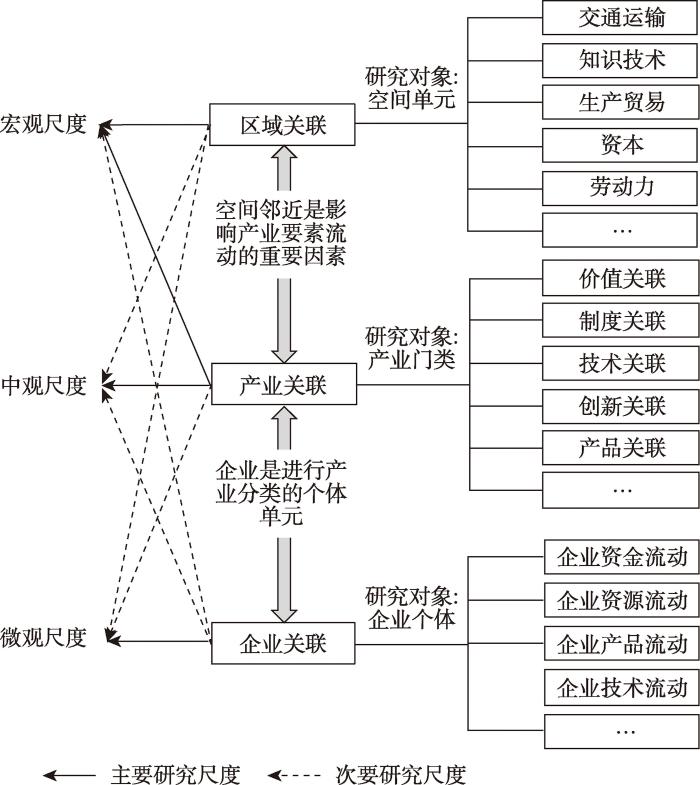
图1
关联视角下区域产业发展研究分析思路
Fig. 1
Dynamic analysis framework of regional industry from the perspective of relatedness
事实上,关联形成机制对塑造区域产业动态的发展格局有着重要作用 [11]。基于微观、中观和宏观等不同视角下分析产业要素的关联特征分异情况,有助于更好地解析区域产业动态发展的变迁,指导区域产业的协同发展优化配置。但受制于不同研究空间尺度下的数据精度差异导致的数据支撑性不足,以及研究对象的多样性导致难以找到统一的衡量特征两大问题,当下缺乏在同一尺度,特别是大区域尺度下基于企业关联、产业关联和区域关联特征进行比较的实证性研究。因此,在关联形成机制的理论基础上,本文进一步在同一空间尺度下,以企业个体及其所属产业门类为研究对象,从企业行为、产业门类、空间分布作为主要研究切入点,分析企业关联、产业关联和区域关联的特征及其相互之间的关系,解析产业要素关联对区域产业发展的影响。
根据现有研究,企业关联和产业关联的特征具有一致性,实际上是演化经济地理学中产业内源性“路径依赖”的体现。企业个体间通过资金、劳动力、知识、技术之间的相互流动产生企业关联,其实质均是企业行为的表现,区域的龙头企业相较于其它中小型企业往往能更高效的整合各类产业要素资源,并与区域其它产业交换各类物质和技术资源形成优势产业;而企业通过各类要素的交流和联系产生新产品并实现产品和产业升级,这也是区域经济发展的重要动力。生产技术同质性较高的一类企业形成的产业门类,也与其他不同类型的产业之间产生价值、产品、制度、技术等要素的联系[11]。相关产业之间的联系强度的强弱取决于生产要素、技术和制度等要素之间的相似程度,基于其在产品生产的上下游位置,进一步形成产业价值链,与周边衍生产业关联度较大的产业即为区域的优势产业[22,23]。当微观的企业行为和宏观的产业关联特征相对一致时,说明企业对外活动较强的产业也是更容易和相关产业发生关联的优势产业,区域产业动态总体遵循着“路径依赖”的特点,优势产业通过企业间更密切的联系进一步强化现有的产业优势,推动本产业的升级,同时也强化其与其它产业间的技术壁垒;但当企业关联和产业关联的特征不一致时,则说明企业对外联系较强的产业并不一定是和周边产业发生价值流动较多的产业。考虑到宏观视角下的优势产业的变迁与微观的企业行为相比存在滞后性,企业行为实际上避免了区域产业的“锁定”,有助于使区域产业发展实现“路径突破”产生新兴的优势产业,但其本质仍是一种产业内源化的“路径突破”,即通过产业要素本身的特征,如知识技术溢出等演化发展,引导新兴优势产业的产生和产品升级[11]。
企业关联和区域关联、产业关联和区域关联的特征具有一致性,实际上是 “空间邻近性”的体现。区域内产业要素空间分布及其之间复杂的动态和相互作用影响区域产业要素宏微观频繁流动和区域产业动态发展。区域关联强调空间距离的概念,一般认为,空间距离越近,要素的关联程度越强[52],这种特征在经济发达的地区尤为如此[53⇓⇓⇓⇓-58],此类问题已有较多研究分析其形成机制[11⇓⇓-14,19,42]。当企业关联和区域关联、产业关联和区域关联的特征具有一致性时,产业要素间的宏微观关联情况与现行产业要素的空间分布和空间相互作用相适应;当企业关联和区域关联、或产业关联和区域关联的特征不具有一致性时,企业的行为、产业要素的流动与其空间分布特征存在差异,为保证企业行为和要素流动效率最大化,区域内产业空间通过重新配置,以实现优势产业的重新布局和劣势产业的迁出,改变现有产业的发展态势。其本质是引起研究范围内部若干个区域产生地方破坏性创新和产业空间重组,同样是一种“路径突破”的过程,加速了区域内若干子区域产业的转型升级。
2.2 研究方法
企业关联的度量基于各行业企业间相互投资强度。产业i和产业j的企业关联度kij计算如下:
式中:
考虑到当以区域空间单元为研究主体,构建区域关联矩阵无法直接同产业关联、企业关联矩阵进行比较,本文对不同产业门类企业的空间分布特征进行梳理,以不同产业的企业平均重心之间的空间距离,作为构建区域关联矩阵的基础数据。
区域关联以企业位置作为研究的载体,产业i和产业j的区域关联cij计算如下。首先计算各产业的空间重心,对于产业i,其平均重心
式中:
产业间区域关联用产业空间重心间的欧式距离dij来表示。dij计算如下:
由地理学第一定律,空间距离越近,要素关联程度越强,则cij计算如下:、
得到区域关联矩阵C,C是对称矩阵。
其中,由于各产业所属企业的空间重心、产业间企业相互投资对数数据量巨大且其处理过程非常复杂,本研究在匹配过程中采用Hadoop分布式系统基础架构和Spark大规模数据计算引擎,通过编写python脚本进行处理。大数据运算集群通过并行9台服务器构建,其中1台master,8台worker,将原本需要以月计的计算量缩短到以天计,大大提升了产业大数据分析的运算效率。企业、产业、区域关联间的相互关系主要通过社会网络分析(Social Network Analysis,SNA)计算。
2.3 数据来源
基于数据的可获取性(投入产出表每五年编制一次,逢二逢七编制)和时间节点的内涵特征,重点选取2002年、2007年、2012年和2017年作为研究的四个时间节点,并重点对比2002年和2017年的变化差异。
本文的数据来源主要分为产业数据和企业信息数据两大类。产业分类来源于国家标准(GB/T 4754—2017)[64],共20个门类,97个大类。产业经济和投入产出数据来源于广东省历年的统计年鉴和广东省统计局(
3 广东省企业、产业、区域关联结构特征
3.1 企业关联结构特征
截止到2017年,广东省有效企业相互投资对数(清洗掉同行业企业间相互投资对数,后同)为218597对,其中2002年及之前有效企业相互投资对数为35329对(图2)。
图2
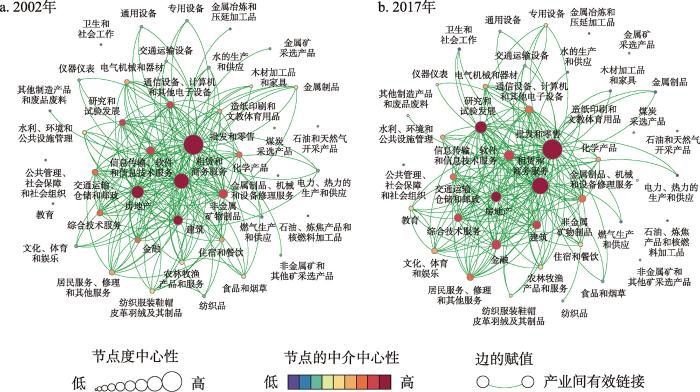
图2
广东省企业关联网络结构
Fig. 2
Firm relatedness network structure of Guangdong province
图3
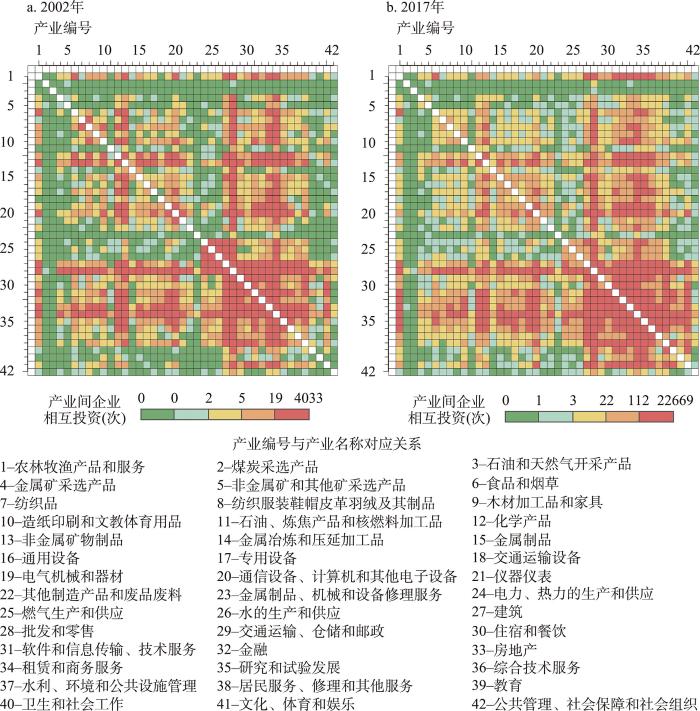
图3
广东省产业间企业相互投资次数矩阵
Fig. 3
Mutual investment matrix between industries in Guangdong province
自2002年到2017年,教育、文化体育娱乐、金融、卫生和社会工作、综合技术服务、木材加工等生产服务业和第三产业的企业对外投资和关联强度明显上升,而电气机械和器材、纺织服装、食品和烟草、金属制品、金属矿采选产品、电力、热力的生产和供应等轻工业和传统制造产业的企业对外投资和关联则呈现下降趋势。受20世纪90年代广东省完善市场化的经济制度建设和新千年中国加入WTO市场经济的迅速拓展的影响,第三产业和信息技术制造业在珠三角地区蓬勃发展,企业间联系和企业活力明显增强,以深圳市为代表的信息技术、金融、互联网产业等创新型产业成为促进区域发展的重要因素。
3.2 产业关联结构特征
根据投入产出测算结果,2002年与同其他产业投入产出价值流动关联较强的产业按顺序分别为化工、金属制品、机械和设备修理、建筑、金属制品、住宿和餐饮、农业、金属冶炼和压延加工、电器机械和器材和交通仓储和邮政等产业,主要集中在第一或第二产业等传统加工制造业;而到了2017年,同其他产业关联建立了有效关联,且排名靠前的产业按顺序分别为化工、金属冶炼和压延加工、金融、批发和零售、租赁和商务服务、交通仓储和邮政、电力热力的生产和供应等产业(图4见第2869页)。
图4
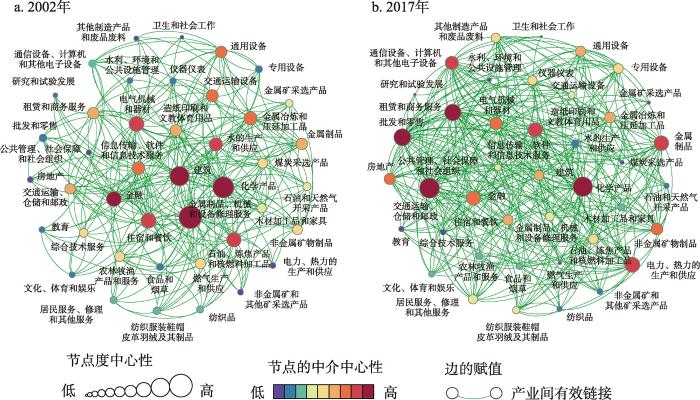
图4
广东省产业关联网络结构
Fig. 4
Industrial relatedness network structure of Guangdong province
从宏观产业的关联特征来看,自2002年到2017年,以产业间投入产出价值流动为代表的产业关联和以产业间企业相互投资为代表的企业关联存在相似性,但不同点在于,一是以化学、金属冶炼为代表的传统第二产业依旧在宏观层面的关联占据主导地位;二是相对于企业关联,产业关联中优势产业的变化具有延迟性和滞后性,2007年的产业关联结构和2002年基本保持不变,而2012年,金融、租赁商务服务等产业的产业关联强度略有增多但提升不明显,这一情况直到2017年才有所体现(图5)。
图5
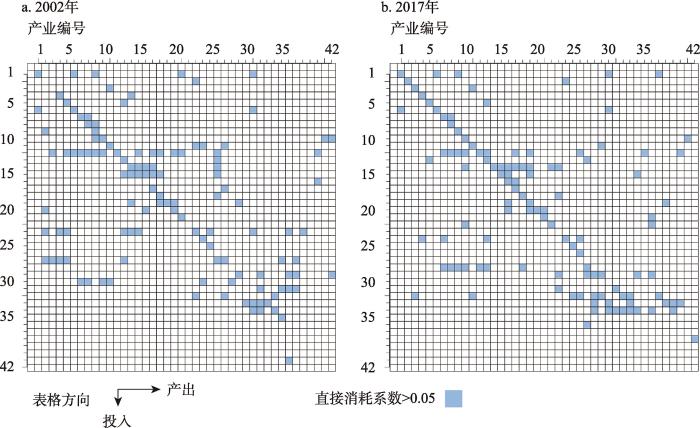
图5
广东省产业关联矩阵
注:产业编号与产业名称对应关系见
Fig. 5
Histogram of inter-industry correlation degree of Guangdong province
3.3 区域关联结构特征
截止到2020年,广东省有效的企业空间数据共有约4886018家,其中2002年及以前注册的企业数为352302家,2017年及以前注册的企业为3695970家。
以各产业的企业分布的空间重心之间的距离来代表区域关联(图6见第2870页)。2002年同其它产业空间分布均相对较近,在空间分布中占据优势地位,有较强的区域关联的产业主要包括交通运输、化学、批发零售、电力热力和造纸文体等第二产业和轻加工制造业;而到了2017年,广东省有着较强区域关联的产业类型则发生了较大变化,在空间分布中占据有利位置同周边区域有较强区域关联的产业几乎全部集中在第三产业,包括交通运输、电力热力、水的供应服务、建筑、文体娱乐、综合技术服务、地产和信息技术服务等产业。
图6
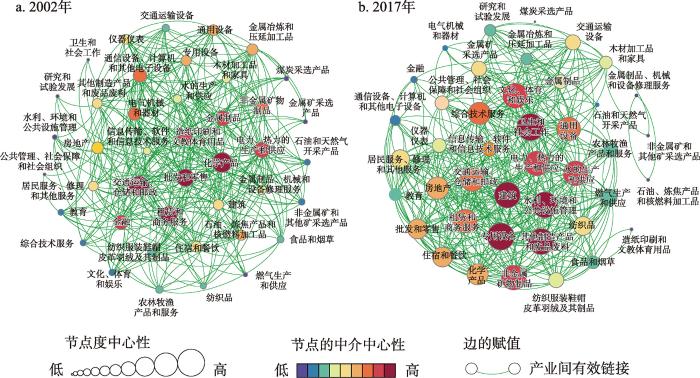
图6
广东省区域关联网络结构
Fig. 6
Regional relatedness network structure of Guangdong province
广东省产业区域关联存在以下两个特征(图7见第2871页):一是产业空间中心集中在珠三角地区,呈现明显的“中心-外围”格局;金属制品、机械、石油炼焦和核燃料加工、金属冶炼和压延加工、造纸印刷、煤炭开采等加工制造业和农、林、牧、渔普遍集中在外围;而以综合技术服务、房地产业、租赁和商务服务等第三产业则主要集中在珠三角的中心地区。二是自2002年到2017年,各行业的空间重心更加集中分布,产业要素的空间集聚态势显著增强;2005年以来,受广东省不断推进的产业转移政策和产业示范园的建立,粤东西北的第二产业逐步发展,以第三产业为“中心”,第一、第二产业为“外围”的产业空间格局进一步稳固,第二产业和轻加工制造业的空间优势减弱,和其他产业的区域关联程度减弱;第三产业逐步占据空间优势,和其他产业的区域关联程度增强。
图7
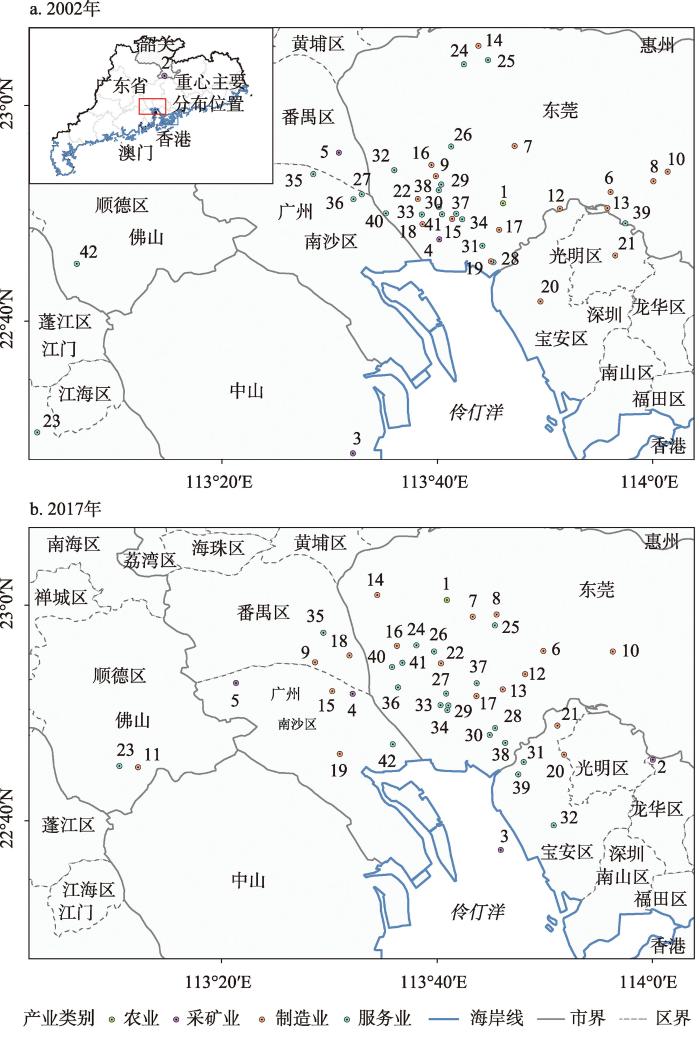
图7
广东省产业空间重心分布
注:产业编号与产业名称对应关系见
Fig. 7
Spatial focus distribution of industries in Guangdong province
4 广东省产业发展动态变化及产业协同发展优化配置探讨
4.1 广东省产业发展动态变化及企业、产业、区域关联之间关系解析
在传统视角下,2000年以来,广东省产业动态发展主要经历了三个阶段(图8见第 2872页)。一是2008年以前的高速粗放发展期:受加入“WTO”等国际事件以及“西电东送”等国家战略影响,以外向型制造业主导的广东省产业经济快速发展,这一期间广东省产业经济始终保持快速发展且当年增长速度从未低于10%;直到2008年,受全球金融危机波及,广东省外向型企业受重大打击,以资源和劳动力优势主导的相对粗放的出口导向型传统产业发展模式已无法适应未来的发展需求;当年,广东省委省政府提出“腾笼换鸟”进行劳动力和产业双重梯度转移,进行劳动力和产业双重梯度转移,其实是对2005年全省提出的产业转移政策的进一步深化,同时加强企业自身的发展方式,通过产业升级,避免继续走高投入、高消耗、高排放的增长方式。二是2008年到2014年前的产业转移增长期:受“腾笼换鸟”政策影响,广东省内产业转移战略得到大力推广,引导了产业空间的重新配置。此外,这一阶段受“四万亿”救市政策的影响,省内部分城市的房地产业成为这一阶段产业发展的焦点,部分地产企业对外联系明显增强,产业活动开始经由地产行业流入流出,全省以房地产业为代表的第三产业占比进一步增长。三是2014年以来的“新常态”协调发展期:这一阶段,省内先后颁布“制造业立省”和“实体经济十条”,奠定了创新型产业和制造业引领区域发展的态势,产业发展虽进入低速增长期,但总体增长趋势趋向健康、精细化发展,房地产等非实体产业逐渐被政府所抑制,避免了该类产业的过分膨胀,近年来“制造业十九条”的颁布和“1+20”产业政策体系的颁布则标志着以高端制造业主导的战略型产业集群的完全转型。
图8
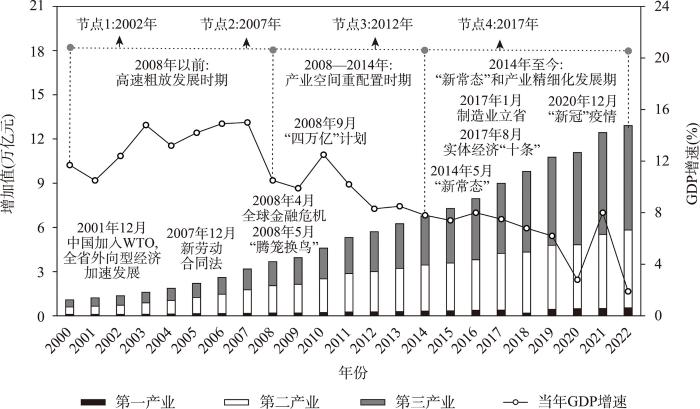
图8
2000年以来广东省产业发展变化及主要影响产业经济发展的事件和政策
Fig. 8
The changes in industrial development and major events and policies affecting the industrial economy in Guangdong province since 2000
进一步地,基于关联视角,通过企业、产业、区域关联之间关系,解析广东省产业动态变化。
根据QAP相关分析(表1),2002年,企业关联和区域关联具有一致性,相关系数为0.18,在1%的水平下显著;但产业关联和企业关联、产业关联和区域关联均不具有一致性。这反映了两点问题:一是新千年初期,区域产业升级的内源性“路径突破”,以数码、信息技术制造等行业逐步成为了区域发展的新兴产业,通过加强企业间联系完成知识技术溢出,促进了广东省的产业升级和产生新产业;但在此阶段,省内新兴的技术产业还主要集中在以深圳市为代表的珠三角城市群内部,新兴产业少,高端产业的空间分布相对集中;这一阶段,产业尚且不需要在区域内进行空间组团的重新配置来实现产业的升级和重组。
表1 产业关联矩阵、企业关联与区域关联矩阵的QAP相关分析结果
Tab. 1
| Obs | P | ||||||
|---|---|---|---|---|---|---|---|
| C | K | D | C | K | D | ||
| 2002年 | |||||||
| 产业关联(C) | 1.000*** | 0.080 | 0.021 | 0 | 0.053 | 0.303 | |
| 企业关联(K) | 0.080 | 1.000*** | 0.180** | 0.053 | 0 | 0.005 | |
| 区域关联(D) | 0.021 | 0.180** | 1.000*** | 0.303 | 0.005 | 0 | |
| 2007年 | |||||||
| 产业关联(C) | 1.000*** | 0.060 | 0.014 | 0 | 0.121 | 0.341 | |
| 企业关联(K) | 0.060 | 1.000*** | 0.008 | 0.121 | 0 | 0.415 | |
| 区域关联(D) | 0.014 | 0.008 | 1.000*** | 0.341 | 0.415 | 0 | |
| 2012年 | |||||||
| 产业关联(C) | 1.000*** | 0.143* | 0.009 | 0 | 0.025 | 0.517 | |
| 企业关联(K) | 0.143* | 1.000*** | 0.110 | 0.025 | 0 | 0.075 | |
| 区域关联(D) | 0.009 | 0.110 | 1.000*** | 0.517 | 0.075 | 0 | |
| 2017年 | |||||||
| 产业关联(C) | 1.000*** | 0.162*** | 0.061* | 0 | 0.001 | 0.050 | |
| 企业关联(K) | 0.162*** | 1.000*** | 0.128* | 0.001 | 0 | 0.014 | |
| 区域关联(D) | 0.061* | 0.128* | 1.000*** | 0.050 | 0.014 | 0 | |
注:*、**和***分别表示5%、1%和0.1%显著性水平。
2007年,企业、产业、区域关联两两之间均不具有一致性。这实际上是企业行为和区域产业空间重组两大诱因下的双重“路径突破”。一方面,新兴产业的企业通过进一步加强企业间的资金、信息、知识、技术的联系,促进企业联系密集的产业自身的转型和升级为区域的优势产业;另一方面,受产业转移政策的影响,事实上全省产业已经开始了空间重配置,对口帮扶和粤东西北产业转移园的建设实际上是加强了省内各区域之间的资源要素的转移,重配置了产业组团。
2012年,企业关联与产业关联具有一致性,相关系数为0.143,在5%的水平下显著;但区域关联与企业关联、区域关联与产业关联不具有一致性。一方面,此时信息技术、现代服务业等早期的新兴产业不但仍是全省战略性新兴产业,而且也已在国民经济价值流动中作用举足轻重;企业行为与产业价值流动保持一致,有利于优势产业通过企业间交流不断促进本产业发展,但不利于从突破现有产业基础,在全省范围内衍生出新兴优势产业。而另一方面,广东省产业转移政策在2011—2015年前后得到了力度空前的推广(粤府函〔2011〕198号、粤府〔2011〕100号、粤府办〔2013〕118号、粤发函〔2013〕9号、粤府办〔2015〕43号),广东省通过推进产业转移园合作共建和省内对口帮扶政策进一步促进了珠三角外围区域地方的突破性创新,避免了产业锁定和区域产业差异进一步增大,提升了粤东西北区域产业的活力。
2017年,企业、产业、区域关联两两之间均具有一致性。企业关联和产业关联的相关系数为0.162,在0.1%的水平下显著;产业关联和区域关联的相关系数为0.061,企业关联和区域关联的相关系数为0.128,均在5%的水平下显著。这种关系实际上是2014年以来“新常态”和产业精细化期广东省产业发展“路径依赖”和“空间邻近性”的集中体现。近十年来省内战略性新兴产业逐步壮大并成为支撑国民经济命脉的主导型产业并在依赖现有路径下,通过关联机制不断极化本产业的优势;另一方面,2002年以来全省经历数轮产业转移和产业空间重配置的浪潮,现行阶段下产业要素的空间分布已较为适应现阶段区域的产业发展。
4.2 基于关联视角的产业协同发展优化配置探讨
传统的产业分析主要是基于产业现状,明晰产业发展的规模和结构;基于规划和空间现状,明晰产业发展的空间条件和约束条件,并以此作为研究区域产业协同发展优化配置的重要依据。这种分析方式视角相对宏观,且产业门类本就大而庞杂,实际上会忽视了组成产业的个体行为和产业发展演化的内在机制,提出区域产业协同发展的优化配置策略有“大而空”之嫌。
本文在以实际案例分析了企业、产业区域关联的结构特征及其之间的关系的前提下,进一步尝试探讨并提出关联视角下产业协同发展优化配置框架,以便能够对区域产业动态发展提出更实际的优化策略。
企业关联往往在国家、省级等中宏观尺度研究中受到忽视。这主要是因为企业关联研究往往受制于数据精度及其代表性。在企业关联分析视角,应注重加强在国家和省级行政区等中宏观尺度的企业关联分析,根据企业大数据,分析区域内企业间资金、技术专利、资源、产品的联动关系,发展机遇和应对风险。
产业关联往往在园区等微观尺度研究中受到忽视。在产业关联分析视角,应注重加强在微观尺度的研究中的产业关联分析,分析市、区县、园区等研究单元选取的主导产业与宏观区域发展下所需要的产业的一致性和相关性,促进微观尺度区域在切实满足宏观尺度的区域发展需求的前提下,更好、更健康的发展。
区域关联现有研究最大的问题在于研究过程中主要以行政区域出发,忽视了产业要素自身的空间分布特征,导致区域关联的分析结果实际上与产业、企业关联的分析结果是“两层皮”。在区域关联分析视角,应注重加强区域与产业要素分析过程中的有机统一。通过区域关联分析视角,分析片区之间产业要素(资金、技术、知识、劳动力等)的流动特征和区域合作方式。
图9
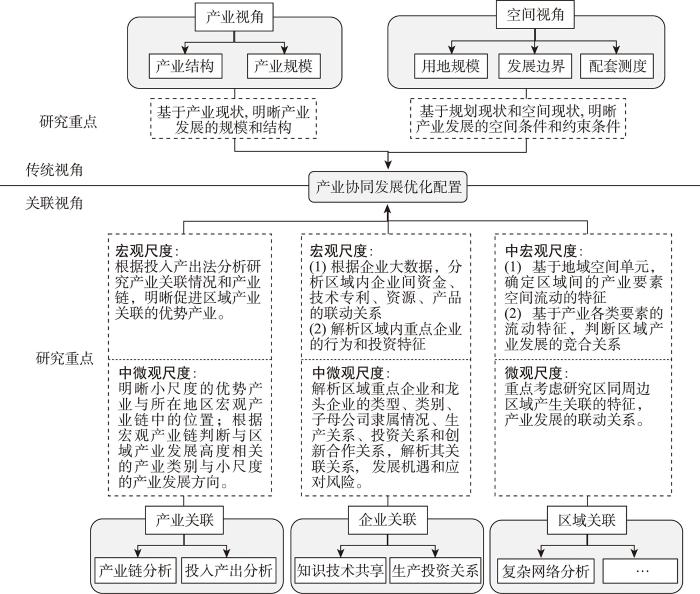
图9
关联视角下产业空间协同优化配置框架
Fig. 9
Optimal allocation framework of industrial synergy from the perspective of relatedness
总体来看,自2000年以来,广东省产业先后经历产业内源性自发升级和区域产业空间重组双重“路径突破”,近十年来省内产业发展以产业内生性的“路径依赖”为主,且现行阶段下产业要素的空间分布已较为匹配现阶段区域的产业发展。
基于企业关联视角,应进一步加强发展和优化信息技术服务业、研究和试验发展等战略性新兴产业和主导产业,通过引导资本、资源、技术、知识向片区的优势产业和主导产业流动,以溢出效应推进产业的进一步升级;加大对重点企业的融资服务,以资金流动促进大中小企业融通发展,提升广东省的产业发展活力。
基于产业关联视角,仍应巩固以化学产品、金属冶炼等传统制造业,加强发展中高端有色金属加工等金属制品金属冶炼加工产业中的先进材料和新材料产业,化学产品等产业中的高端电子化学产品,生物医药产业中的“创新药”研发和制造,保障国民经济产业价值的顺畅流动;此外,引导和优化通信设备、计算机和其他电子设备等技术密集型制造业在产业发展中的地位。同时逐步做强、做优新一代信息技术产业规模,大力发展数字经济,深化新一代信息技术和制造业融合发展。
基于区域关联视角,从产业要素的空间关联特征,探讨合理配置产业集群。一方面,应将优化配置交通运输相关产业的与其他产业空间联系作为配置区域产业发展的前提;另一方面,在片区各类产业集群不断向珠三角“收缩内收”和“极化”的现状下,应严格落实和保障珠三角片区工业用地红线,通过加强东西两翼沿海经济带和北部生态发展区的工业园区基础配套设施建设,促进部分第一产业和第二产业特色集群不断外延,以此科学统筹珠三角地区与粤东西北地区产业生产力布局。
5 结论与讨论
5.1 结论
关联视角下的产业发展研究逐渐成为学术研究和应用热点。本文基于现有研究,归纳了关联视角下区域产业发展研究分析思路和“关联”形成机制下企业、产业、区域关联之间的关系及其意义,选取2002年、2007年、2012年和2017年的四个时间节点,通过广东省42个全产业门类,构建并计算了企业、产业和区域关联,分析了广东省企业、产业、区域关联的结构特征,基于传统视角和关联视角分析了广东省产业发展的动态变化,并对企业、产业、区域关联两两之间的关系做了深度解析,提出了基于关联视角和国家、省、市、区县和产业园区等五级尺度的协同发展优化配置框架,并以广东省为例,给出了产业协同发展优化配置的路径和对策。
目前关联视角下的产业动态学术研究的实践应用相对有限,且研究偏向理论,尚无关于“关联”形成机制背景下区域产业动态发展的实证研究。本文的创新点一是在关联视角下,从研究对象和研究尺度的差异进一步归纳了产业发展研究分析的思路,以及企业、产业、区域关联间关系的意义;二是以实证分析了关联视角下产业发展的结构特征,以企业相互投资,产业价值流动和产业空间分布三个视角构建并计算了产业关联,企业关联和区域关联,在中宏观尺度分析了关联视角下广东省产业发展的动态变化,本文使用了微观企业大数据、Hadoop分布式系统基础架构和Spark大规模计算引擎进行产业相关分析,为将来关联视角下的产业学术研究和规划领域中的产业空间优化配置应用提供了借鉴;三是提出了基于关联视角的产业协同发展优化配置框架,为今后提出更深层次的产业协同发展策略提供了初步思路。
5.2 讨论
未来基于以上研究,关联视角下如何更高效、更准确度量企业、产业、区域关联是深化研究的重点之一。本文的关联关系的构建方法还处于探索阶段,而关联关系度量仅通过企业投资行为、产业价值流动、企业地理空间重心等空间特征等几个角度进行切入,涉及的角度相对较窄。未来研究可以继续深化产业关联、企业关联和区域关联的衡量方法,并探究基于其它不同的切入视角来分析区域产业的发展动态,进一步完善区域产业发展的优化配置。
当前中国正值“促进内循环”经济转型的新时期,中宏观尺度中,以关联视角分析区域产业动态的研究还处于起步阶段,但信息技术的发展和数据的爆炸式增长也增强了此方向研究的可行性。因此,要素关联视角下,区域产业动态研究在未来仍存在较大的研究潜力,如何获取海量大数据并结合信息技术新方法,将之纳入到传统的产业经济研究中值得引起关注,也是未来的深化方向。
致谢
真诚感谢匿名评审专家在论文评审中所付出的时间和精力,评审专家对关联视角下产业发展的具体表征、研究思路和论证逻辑等方面进行了数次详尽、细致的指导,使本文的研究深度和行文流畅度有了极大提升。
参考文献
经济制度变革还是产业结构升级: 论中国经济增长的核心源泉及其未来改革的重心
Economic institutional reform or industrial structural promotion? On core factor of Chinese economic growth and focus of the future reform
Research progress of industrial geography in China
产业集群研究进展探讨
Progress in studies of industrial cluster
The determinants of industrial location in Spain, 1856-1929
An industry disaggregated analysis of the determinants of regional entry and exit
The determinants of regional variation in new firm formation
重视资本市场发展优化产业结构
Attach importance to the development of capital market and optimize industrial structure
区域产业发展演化: 路径依赖还是路径创造
DOI:10.11821/dlyj201807001
[本文引用: 1]

区域发展是区域产业不断演化、转型与升级的过程。近年来发展起来的演化经济地理学旨在通过分析企业进入、成长、衰退和退出等动态过程阐释企业、产业、集群、网络、城市和区域的空间演化,认为区域产业发展演化遵循路径依赖,并决定于产业技术关联。然而路径依赖式演化理论过于强调内生发展过程,忽视了外生因素和制度变革带来的路径创造机会。中国处于经济转型时期,区域产业结构变动剧烈。技术关联推动了区域产业演化,显示中国区域产业演化具有路径依赖性,同时市场化、全球化和分权化的经济转型过程为区域产业发展创造了新路径。外部联系、制度安排、行为主体的战略性行为等促进了路径创造。
Regional industrial development and evolution: Path dependence or path creation
Regional development is a process in which industries develop, transform and upgrade constantly. Evolutionary economic geography understands the spatial evolution of firm, industry, cluster, network, city and region through the lens of firm entry, growth and exit, and argues that regional industrial evolution is path dependent and determined by inter-industrial technological relatedness. However, path dependence theory overemphasizes the endogenous factors in regional industrial development and ignores the critical role of external linkages and institutional factors, which would bring path creation for regional development. In China, there has been dramatic transformation in regional industrial structure since the economic reform. Empirical studies indicate that technological relatedness has indeed significantly determined regional industrial evolution, suggesting a path dependent process. Meanwhile, marketization, globalization and regional decentralization provide great opportunities to create new industries for regional development. In particular, external linkage, institutional factors and purposeful and strategic actions of local actors would stimulate path creation.
产业关联、空间地理与二三产业共同集聚: 来自中国212个城市的经验考察
Industrial association, spatial geography and agglomeration of secondary and tertiary industries: An empirical study of 212 cities in China
关联视角下的区域产业动态研究进展与反思
DOI:10.11821/dlyj020190995
[本文引用: 13]
区域产业动态是经济地理学的经典研究主题。不同尺度的传统经济地理研究常以企业、产业和区域为研究对象,忽略了不同个体之间的关联。近年来,经济地理学增加了关于企业关联的研究,但对于产业关联和区域关联的关注仍显不足。基于关联视角,本文首先围绕产业关联和区域关联等概念探讨了关联的形成机制,进一步梳理关于产业关联、区域关联与区域产业动态的研究进展,并为未来区域产业动态研究提出相关建议。与企业关联相同,产业和区域关联也与个体间的要素流动有关。现有研究表明产业关联有助于揭示区域产业演化规律,而区域关联会通过区域间要素流动影响区域产业动态。关联视角是区域产业动态研究的新视角,具有较大的研究潜力,值得引起经济地理学者们的关注。
The regional industrial dynamics from the perspective of relatedness
Chinese economic development has experienced a rapid transformation since 1978 due to the implementation of the reform and opening-up policy. Arguably the research of regional industry dynamics is at the core of economic geography. Traditional researches in economic geography tend to focus on individuals such as firms, industries and regions, ignoring the relationship between them. Over the past few years, much progress has been made in researches on the relatedness of firms, while the relatedness of industries and regions is still not paid sufficient attentions. From the perspective of relatedness, this paper attempts to shed some light on the linkages of industries and regions, and explore their formation mechanisms. It puts forward that the translocal linkages and resource mobilization on different scales are sources of the relatedness of firms, industries and regions. In addition, this paper also sketches out how industrial relatedness and regional relatedness influences regional industrial dynamics. As for industrial relatedness, evolutionary economic geography (EEG) theories based on a network model named the "product space" have adopted a view that regional spillovers from related, yet not too proximate industries will endogenously induce new industries in a region through processes of recombinatorial innovation. The vast majority of empirical case studies have confirmed these theories. Regional industrial dynamics has thus far largely been conceptualized as an endogenous process, underplaying exogenously-driven forms of regional relatedness. Then, this paper provides a systematic conceptual analysis of the role regional relatedness may play for industrial dynamics in regions. Good connections between the regions improve matching on labour markets, speeding up knowledge flows and plausibly fostering learning which will contribute to the reciprocal industrial dynamics of geographically distant regions. Accordingly, this paper argues that future studies can further investigate the regional development from a relatedness perspective: (1) pay more attention to the industrial relatedness, such as its indirect links, link strengths and industrial relatedness dynamics; (2) enhance the understanding of the properties of regional relatedness and draw on network analysis approaches; (3) forge a link between industrial relatedness and regional relatedness. Emanated from different disciplines, the new perspective of relatedness in the study of regional industry dynamics provides a sound basis for understanding China's special development path and deserves the attention of economic geography scholars. Besides, there is rapidly expanding various data of relatedness which will make the perspective of relatedness more potential in the future.
中国国家标准产业集群的识别与特征分析
Identification strategy and characteristics analysis of China's national standard industrial cluster
粤港澳大湾区建设国际科技创新中心的全球视野与理论模式
DOI:10.11821/dlyj020200367
[本文引用: 2]
建设国际科技创新中心是粤港澳大湾区新时代最有共识、最有优势、最富挑战的战略方向,亟需国际科技创新中心建设的理论探索。国内外经典创新系统理论更加专注于创新系统内部,注重单一空间的创新要素与创新活动组织问题,忽视了全球和区域之间要素的关联模式,缺乏在全球视野下宏观与微观结合的综合观察。由此,本文在总结国内外经典创新系统理论的基础上,构建了全球视野下的以“科技”和“人才”为核心,以“科技-产业-全球生产网络”和“人才-环境-世界城市网络”为链条的国际科技创新中心理论模式,认为国际科技创新中心是全球创新网络、全球生产网络和世界城市网络三重网络结构的核心节点,建设国际科技创新中心需要实现三重网络的协同效应。在这样的理论框架下,分析了粤港澳大湾区双核心与双链条的发展情况,并以此提出了粤港澳大湾区建设国际科技创新中心的路径和相关建议。
The Guangdong-Hong Kong-Macao Greater Bay Area developing into an international innovation and technology hub: A global perspective and theoretical model
Developing the region into an international innovation and technology hub is the most common, the most advantageous, and the most challenging strategic direction for the Guangdong-Hong Kong-Macao Greater Bay Area in the new era. There is an urgent need for the theoretical research and developing studies of the international innovation and technology hubs. Classical theories of the innovation systems focus more on the interior of innovation systems, paying attention to innovation elements and organization of innovation activities in a single space, but neglect the inextricable link between global and local elements and organizations, lacking comprehensive observations combining macro and micro perspectives. Therefore, on the basis of summarizing the classic innovation system theories, this paper constructs a theoretical model with global vision for the Guangdong-Hong Kong-Macao Greater Bay Area constituting international innovation and technology hubs: "Science and technology" and "talent" are the cores, and "science and technology-industry-global production network" and "talent-environment-world city network" are two chains. Focusing on science and technology and the pooling of talents, it is needed to gather elements of innovative resources, enhance regional innovation capabilities, drive industrial transformation and upgrading, and improve urban functions and environments, so as to reshape the role in the global production network and the world city network. It is considered that the international innovation and technology hubs are the core nodes of the triple networks: global innovation network, global production network and world city network. To develop into an international science and technology innovation center, it is necessary to upgrade its strength and position in the three networks at the same time. Compared with the existing innovation system theories, the new model attaches importance to the internal and external relations with both global and local visions, in which the chain structure avoids the simple listing of elements, but emphasizes the mechanisms of the innovation system. Under this theoretical framework, the double-cores (talent & science and technology) and double-chains (science and technology-industry-global production network & talent-environment-world city network) of the Guangdong-Hong Kong-Macao Greater Bay Area are analyzed, and the paths for the Guangdong-Hong Kong-Macao Greater Bay Area developing into an international technological innovation center are proposed. This paper provides an explanatory tool for the organizing similarities and differences between international innovation and technology hubs under the background of globalization, which is a supplement to the theories of innovation systems.
粤港澳大湾区区域一体化及其互动关系
DOI:10.11821/dlxb201912003
[本文引用: 2]
粤港澳大湾区一体化过程中存在跨社会制度、跨法律体系、跨行政等级的复杂性,必然会遭遇一系列的摩擦。发掘粤港澳之间合作与冲突的焦点与关键时间节点,是对粤港澳大湾区一体化研究的重要补充。本文通过GDELT全球新闻事件数据库梳理了粤港澳大湾区一体化发展的历史和现状,对粤港澳三地互动关系进行研究。结果发现:① 内地与香港关系呈现出“M”型波动,两者之间的冲突被新闻媒体有所强化。② 内地与澳门之间的政策与民意表现为较高的一致性,两者之间的言语合作是互动关系的主导因素。③ 内地与港澳之间的互动关系总体上变得更加紧密,合作与冲突的频率都在上涨,内地—香港关系在粤港澳互动关系中的重要性不断被凸显。④ 粤港澳大湾区一体化建设的推进过程中,实际合作项目相对短缺,缺少多元化的抓手。粤港的经济和科技的竞合关系和香港局势的发展是粤港澳互动关系的主要影响因素。未来,粤港澳大湾区区域协调发展不仅要关注区域政策在空间上的投影,更要关注其在社会舆论与新闻媒体上的投影,促进一体化建设从实体空间建设向虚拟、话语空间的综合引导转变,强化“硬联通”与“软联通”的互动。
Regional integration and interaction of the Guangdong-Hong Kong-Macao Greater Bay Area
The integration of the Guangdong-Hong Kong-Macao Greater Bay Area will inevitably encounter a series of frictions because of the cross-social system, cross-legal system and cross-administrative hierarchy. Research on the cooperation and conflict between Guangdong, Hong Kong and Macao is an important supplement to the integration study of the area. This paper reviews the process of integration development of the Guangdong-Hong Kong-Macao Greater Bay Area from 1997 to 2019 through the global news event database GDELT. The results show that: (1) the relationship between China's mainland and Hong Kong presents a "M" type fluctuation, and the conflict between them has been amplified by the news media compared with the mainland-Macao relationship. (2) The policy and public opinion between China's mainland and Macao are highly consistent, as the verbal cooperation between them is the leading factor of the interaction. (3) The interaction between China's mainland, Hong Kong and Macao has generally become closer, along with the increasing frequency of cooperations and conflicts. The importance of the mainland-Hong Kong relationship in the interactive relationship between Guangdong, Hong Kong, and Macao has been increasingly highlighted. (4) Material cooperation projects are still insufficient in the process of the regional integration of the Guangdong-Hong Kong-Macao Greater Bay Area, and there is an urgent need for diversified cooperation. The economic and technological competitions and cooperations between Guangdong and Hong Kong are the main factors affecting the interactive relationship between Guangdong, Hong Kong and Macao, as well as the tensions in Hong Kong. In the future, the coordinated development of the Guangdong-Hong Kong-Macao Greater Bay Area should focus on not only the projection of regional policies on space, but also its projection on social public opinion and the news media. It is necessary to combine the integration of physical space and virtue/discourse space, and strengthen the interactions between "hard connection" and "soft connection".
Behavior and location: Foundations for a geographic and dynamic location theory (Part 1)
Economic action and social structure: The problem of embeddedness
演化经济地理学与区域发展
Evolutionary economic geography and regional development
信息时代的企业区位研究
DOI:10.11821/xb201204005
[本文引用: 3]
信息化对传统经济地理学的许多理论和概念提出了新的挑战.其中,尤其值得关注的是信息化对传统区位理论提出的挑战以及赋予其的新活力.本文首先分析信息技术广泛应用对企业区位因子的影响,然后深入探讨信息技术对企业区位产生影响的机制,最后通过美特斯邦威案例进行验证.研究表明,信息化逐渐成为企业区位选择的核心因素之一;同时,信息化也对其他区位因子产生重要影响,主要表现为促进传统物质区位因子的弱化以及带来新区位因子作用的不断突显.在信息技术驱动的企业区位再选择的过程中,“时间成本”是决定新区位的核心机制.
The challenge of wide application of new information and communication technologies to traditional location theory
The wide application of new information and communication technologies (ICTs) has been argued to be critical to spatial transformation of firms. Recent advances in the studies along this line have challenged traditional location theory. Existing literature, however, focuses mainly on the impacts of new ICTs on locational conditions and industrial spatial distribution. Dynamics behind such changes have not yet been given sufficient attention by geographers. It is against such a background that this paper takes Metersbonwe as a case to look into the impacts of new ICTs on traditional location theory and the dynamics of industrial re-location enabled by new ICTs. The paper argues that the application of new ICTs has been a key location factor in the information age, and time-cost is becoming critical to the spatial organization of firms as a result of shorter product life and mass customization in particular among other dynamics.
Toward a relational economic geography
Proximity and innovation: A critical assessment
市场相似性与中国制造业出口市场的空间演化路径
DOI:10.11821/dlyj201807010
[本文引用: 2]
基于扩展引力模型和演化经济地理理论,利用2002-2011年中国海关数据库,采用核密度分布和计量经济模型等方法,考察中国城市出口市场的空间演化路径及其微观机制。基于共存分析方法测算的国家间市场相似度在方法上有所创新,将演化经济地理研究中的“路径”成功量化。全国样本的研究结果表明:城市和企业两个层面的演化路径证明了扩展引力模型的基本结论,说明与过去出口市场相似度越高的国家,被城市和企业扩展为新市场的概率越大,证实了中国出口市场的空间演化是遵循路径依赖的。此外,还发现城市与企业之间的协同演化过程:东部城市表现出路径突破,而企业层面的能力可能是城市路径突破的重要来源;同时,城市层面的知识溢出对企业市场演化有显著的正向影响。总之,城市与企业之间相互影响、协同演化是中国出口市场空间演化的重要机制。
Market similarity and the evolutionary path of China's export market expansion
Based on the extended gravity model and evolutionary economic geography, this paper uses Kernel density distribution and econometric models to investigate the path of export market expansion in urban China and its micro-mechanism at the firm level by using 2002-2011 China Customs Database. To quantify the evolutionary path of export market expansion, this paper measures the inter-national market similarity based on the co-occurrence analysis and then calculates the market similarity between export destinations and firms' (or cities') export market network, which is used as an important explanatory variable in the econometric models. The results show that the market that is more similar to cities or firms' previous destinations is more likely to be expanded as a new destination, implying that cities' and firms' export market expansion in China presents the pattern of path dependence. This study also examines the co-evolution of cities' and firms' market expansion. The city-level evolution in the east is path created, which may derive from firms' path dependence. Knowledge spillover effect within the same city plays a significantly positive role in the firms' market evolution. Therefore, the co-evolution of cities' and firms' market expansion is the key mechanism of export market expansion path in China.
A theoretical framework for evolutionary economic geography: Industrial dynamics and urbangrowth as a branching process
Both Marshall and Jacobs were right!
Technological relatedness and knowledge space: Entry and exit of US cities from patent classes
Patent statistics as economic indicators: A survey
Innovation and inter-firm linkages: New implications for policy
Industry-specific human capital: Evidence from displaced workers
DOI:10.1086/298388 URL [本文引用: 1]
What determines the scope of the firm over time? A focus on institutional relatedness
Measuring institutional relatedness
Technological relatedness and asymmetrical firm productivity gains under market reforms in China
中国对外贸易产品空间路径演化
Evolution of export product space in China: Path-dependent or path-breaking
Related variety, trade linkages, and regional growth in Italy
This article presents estimates of the impact of regional variety and trade linkages on regional economic growth by means of export and import data by Italian province (NUTS 3) and sector (three‐digit) for the period 1995–2003. Our results show strong evidence that related variety contributes to regional economic growth. Thus, Italian regions that are well endowed with sectors that are complementary in terms of competences (i.e., that show related variety) perform better. The article also assesses the effects of the breadth and relatedness of international trade linkages on regional growth, since they may bring new and related variety to a region. Our analysis demonstrates that regional growth is not affected by simply being well connected to the outside world or having a high variety of knowledge flowing into the region. Rather, we found evidence of related extraregional knowledge sparking intersectoral learning across regions. When the cognitive proximity between the extraregional knowledge and the knowledge base of a region is neither too small nor too large, real learning opportunities are present, and the external knowledge contributes to growth in regional employment.
How to jump further and catch up? Path- breaking in an uneven industry space
Learning from yourself or learning from neighbours: Knowledge spillovers, institutional context and firm upgrading
Using a firm-product-level data set on China's exports during the period 2000-11, we compare the impacts of intra- and inter-firm knowledge spillovers on the emergence of new, more sophisticated products at the firm level. Empirical results indicate that firm diversification is dependent on both intra- and inter-firm knowledge spillovers, though the effect of the former is much greater. More importantly, intra-firm knowledge spillovers are one key source of firm upgrading. In contrast, inter-firm knowledge spillovers even have some negative impacts on firm upgrading in the Chinese context, though it contributes to firm diversification. We further analyze how the roles of intra- and inter-firm knowledge spillovers in firm upgrading are contingent on regional institutional context.
Mapping knowledge space and technological relatedness in US cities
The resurgence of regional economics, ten years later
DOI:10.1177/096977649500200301
URL
[本文引用: 1]
Since the early 1980s, social scientists have increas ingly focused upon the significance of the region to the organization of economic life. This article considers three main lines of analysis which have emerged. These concentrate respectively on insti tutions, industrial organization and transactions, and technological change and learning. Each has made strong claims about the role of the region. I argue here, however, that none has yet developed a wholly convincing explanation for the resurgence of regional economies. To do this it is necessary to understand the region as a locus of untraded interdependencies. This has implications for how we think about regional and industrial policies. I illustrate these points with some remarks on regional policies in contemporary Europe.
Global production networks and the analysis of economic development
从全球生产网络到全球金融网络: 理解全球-地方经济联系的新框架
DOI:10.18306/dlkxjz.2019.10.003
[本文引用: 1]
全球化带来的新国际劳动分工使全球生产网络(Global Production Network, GPN)成为研究全球经济与区域发展的重要框架。与此同时,金融在现代社会经济运行中的地位日益提升,经济金融化在全球不同尺度下深刻影响着经济活动的空间分布和网络。因此,金融已经成为GPN研究不能忽略的重要环节。更重要的是,金融化带来的逻辑也日益深刻地影响到GPN的演化和运行。尽管GPN研究日益重视金融的作用,并开始研究金融业的全球生产网络,但是随着越来越多的企业通过获得国际股权投资或者在境外资本市场上市等方式融入全球资本市场,主要从生产角度理解地方经济融入全球过程的GPN难以对该现象深入分析。全球金融网络(Global Financial Network, GFN)为刻画和分析这个过程提供了新的框架。在这个分析框架中,地方经济体通过高级商业服务业(Advanced Business Service, ABS)企业与世界城市(国际金融中心)和离岸管辖区产生联系,从而融入GFN。论文介绍了GFN的基本结构,探讨了地方经济融入GFN的主要方式及其产生的影响。最后,提出GFN未来在理论和实证方面可继续深入研究的方向。
From global production network to global financial network: A new framework for understanding global-local economic linkages
The new international division of labor brought about by globalization has made the global production network (GPN) an important framework for the study of global economic and regional development. At the same time, the status of finance in the operation of modern social economic systems is increasing. Economic financialization has a significant impact on the spatial distribution and network of economic activities at different scales in the world. Therefore, finance has become the necessary basis of production activities in GPN. More importantly, the logic brought by financialization has profoundly affected the operation and change of GPN. Although GPN research has been paying attention to the role of finance and has begun to study the GPN of financial industry, inadequacies still exist. As increasingly more firms are integrated into the global capital market by obtaining international equity investment or listing in overseas capital market, it is difficult for the GPN framework to thoroughly analyze this phenomenon. Global financial Network (GFN) provides a new framework for describing and analyzing this process. In this analytical framework, local economies connect with world cities (international financial centers) and offshore financial jurisdictions through advanced business service (ABS) firms, thus forming GFN. This article first introduced the basic concept of GFN, including its main entities and network structure. Then we discussed the ways and further influences for cities or regions to integrate into GFN, focusing on the global-local economic linkages built by this process. Finally, we put forward the direction of further theoretical and empirical research of GFN in the future.
经济地理学中的企业网络研究
Firm networks in economic geography study
Spatial Divisions of Labour. Social Structures and the Geography of Production
产业关联对经济发展水平的影响: 基于欧盟投入产出数据的分析
Impact of industrial correlation on regional economic development: An empirical analysis based on input-output table of European Union
Economic structure and local growth: France, 1984-1993
长三角地区文化产业与旅游产业融合态势测度与评价
Assessment and evaluation of integration of the culture industry and tourism industry in Yangtze River Delta
基于投入产出模型的中国旅游业产业关联度研究
A research on industrial correlation of China's tourism industry: Based on the input-output model
四川省制造产业关联网络的结构特征分析
The structural features of regional manufacturing industrial association network: A case study of Sichuan province
基于投入产出的产业关联研究
Industry association studies based on the input-output
The measurement of relatedness: An application to corporate diversification
中国区域投入产出效率的研究框架与实证分析
DOI:10.13249/j.cnki.sgs.2020.11.012
[本文引用: 1]
基于投入?产出研究框架,分别采用传统SBM模型、非期望产出SBM模型及两阶段网络DEA模型分析2000—2015年中国各省区市的资源生产率、生态效率及两阶段系统下的资源生产率和环境效率,以期全面刻画中国各省的投入产出效率,并提出相关政策建议。研究发现:① 中国资源生产率总体呈东?中?东北?西逐渐下降的格局。② 考虑环境约束后,不同省市生态效率排名变动情况不同,反映出环境污染对区域投入产出效率会产生不同程度的影响。③ 大部分省区市的资源生产率、环境效率非均衡特征明显,且区域间存在较大差异。东部除京津外普遍呈资源生产率较高而环境效率较低,东北地区资源生产率中等偏高、环境效率中等偏低,中部资源生产率中等偏低、环境效率显著偏低,西部资源生产率显著低于全国平均水平,而环境效率水平相对较好。
Research framework and empirical study of input-output efficiency of resources and environment in China
How to improve the economic development benefits is a significant issue to global sustainable development. Under the background of resource and ecological constraints and economic transformation in China, it is important to scientificly and comprehensively evaluate the input and output efficiency of economic development. Based on the input-output research framework and according to the progressive research approach, this paper adopts traditional SBM model, undesirable-SBM model, and the two-stage network DEA model to analyze the resources productivity efficiency, eco-efficiency, and resource productivity efficiency and environmental efficiency of two-stage system, with a view to comprehensively depict the input-output efficiency of China, and then provides some advice and suggestions for further economic sustainable development. The major findings were summarized as follows. Firstly, China’s economic efficiency decreased from the east, to central to northwest and to north. Secondly, taking environmental pollution into consideration, the ranking changes of ecological efficiency in different provinces and cities are different, which reflects that environmental pollution has different effects on regional input-output efficiency. Thirdly, the economic efficiency and environmental efficiency of most provinces are obviously imbalance, and there are notable spatial differences. Provinces in eastern China show high economic efficiency and low environmental efficiency, except Beijing and Tianjin, whose economic efficiency and environmental efficiency made some balance. Provinces in northeast China have moderately high economic efficiency and moderately low environmental efficiency, with some environmental constraints. Provinces in central China have moderate to low economic efficiency and low environmental efficiency, with obvious environmental constraints. Economic efficiencies of provinces in western China are lower than the national average, while their environmental efficiencies performed much better.
服务业与中国经济: 相关性和加快增长的潜力
Service industry and China's economy: Correlation and potential of faster growth
Equilibrium locations of vertically linked industries
信息化对社会经济空间组织的影响研究
Spatial implications of new information and communication teachnologies
新经济地理学视角下的生产性服务业集聚及其影响因素研究: 来自中国222个城市的经验证据
Producer services agglomeration and its influencing factors from the perspective of new economic geography: Empirical Evidence from 222 cities in China
市场间邻近性与广东省出口企业的地理集聚
DOI:10.11821/dlyj020200373
[本文引用: 1]
对外贸易是塑造广东省产业空间分布格局的重要力量,深入地探讨出口贸易与广东省企业集聚的内在联系机制,具有重要意义。本文从出口市场与本地市场之间的多维邻近性角度,为广东省的企业集聚发生机制提供了新的解释,具有一定的理论与政策参考价值。本文认为,企业的出口市场与本地邻近性越低,企业自身越难以远距离地直接获取关于目的市场的出口知识。在这种情况下,企业为了实现出口的成功扩张,其在空间上倾向于集聚分布,以在本地获取相关知识的溢出。基于2000—2016年中国海关进出口贸易数据,本文对广东省出口企业的外部出口市场格局以及内部空间集聚格局进行了描述,并实证测度了企业的出口市场与广东省在地理、经济、文化、政治和制度五个维度上的邻近性与企业地理集聚水平之间的关系。特别地,本文运用DO方法对企业集聚水平进行定量测度,还原了企业集聚的原始微观形态,一定程度上弥补了现有对于集聚水平测度方法的不足。描述性分析表明,一方面,广东省企业的出口市场具有多样化的特点,其扩张一定程度上遵循“邻近性”原则;另一方面,广东省的企业空间分布呈现明显的“核心-边缘”格局。实证结果表明,当出口至与本地在经济、政治和制度三个维度上邻近性较低的市场时,企业在本地更加集聚。市场间地理和文化邻近性对企业集聚水平的影响不显著。同时,该影响效应在出口市场为发达地区和发展中地区的企业样本中具有差异。
Proximity between markets and the geographical agglomeration of exporters in Guangdong province
Trade has been an important force which shapes the industrial spatial pattern of Guangdong province. It is of great importance to conduct research on the relationship between export trade and firm agglomeration in Guangdong. From the perspective of multidimensional proximity between export destinations and local markets, this paper puts forward a new insight for the firm agglomeration in Guangdong, which has certain theoretical and practical significance. This paper argues that, the lower the proximity of a firm’s export destination to the local market is, the more difficult it is for the firm to directly gain comprehensive knowledge about the export destination at a distance. In this case, firms tend to agglomerate, in order to absorb the spillovers of relevant knowledge locally and achieve market expansion. Based on the data of China Customs Trade Statistics from 2002 to 2016, this paper describes the pattern of export markets and agglomeration of firms in Guangdong, and empirically measures the relationship between firms’ agglomeration level and the geographical, economic, political, institutional and cultural proximity between export destination and local market. In particular, the DO method is used to quantitatively measure the agglomeration level, which restores the original and micro form of firm agglomeration, making up for the shortcomings of the existing methods used to measure agglomeration level to a certain extent. Descriptive analysis shows that, on the one hand, the export markets of Guangdong’s firms are diversified, while the expansion of markets follows the principle of “proximity” to a certain extent. On the other hand, the distribution of firms presents an obvious “core-periphery” pattern. The empirical results show that when exporting to markets with low economic, political and institutional proximity to the local market, firms are more agglomerated. The geographical and cultural proximity has no significance effect on the agglomeration level of firms. At the same time, this effect is heterogenous in the sample of firms whose export markets are developed and developing regions.
从巨型城市区域视角审视粤港澳大湾区空间结构
DOI:10.18306/dlkxjz.2018.12.003
[本文引用: 1]
粤港澳大湾区是全球高度城市化地区之一。本文引介巨型城市区域理论来审视粤港澳大湾区的空间结构发展,从边界、功能、核心区、区域基础设施4个维度进行分析。未来粤港澳大湾区将呈现四大发展趋势:一是去边界化趋势显著,大湾区内部边界地区将快速发展;二是产业区将成为网络化的功能区块,并取代城市成为地区参与全球竞争的基本单元;三是广佛、港深两大核心区将形成;四是轨道公交化趋势,大湾区共享交通枢纽与公服设施。按发展趋势预测,未来粤港澳大湾区空间结构将形成“两核+若干功能区”的新格局。
Understanding the Guangdong-Hong Kong-Macao Greater Bay Area from the perspective of mega-city region
The Guangdong-Hong Kong-Macao Greater Bay Area is one of the most urbanized city regions in the world. This study aimed to understand the development of the Guangdong-Hong Kong-Macao Greater Bay Area by applying the theoretical framework of mega-city region. We regarded the Guangdong-Hong Kong-Macao Greater Bay Area as a mega-city region and analyzed its spatial structure from four dimensions: intraregional boundaries, functional network, core area, and regional infrastructure integration. Four development trends were identified: (1) Boundary effect is reducing remarkably and border areas will grow rapidly inside the Greater Bay Area. (2) Industrial clusters become functional areas in a functional network, replacing cities to be the basic unit in global competition. (3) Two core areas can be identified, including the Guangzhou-Foshan core area and the Hong Kong-Shenzhen core area. (4) Rail transit station density tends to increase and a global transportation hub is emerging, which make it convenient for people in the Greater Bay Area to share transportation hub and public service facilities. In the end, the article presents a vision of spatial structure for the Guangdong-Hong Kong-Macao Greater Bay Area, concluding that this mega-city region will form a new structure of 'two cores and functional areas.'
信息技术对服务业创新影响的空间计量分析
信息技术成为服务业创新的关键因素,并受到国内外学术界的普遍关注,但鲜有从省域及市域层面探索信息技术对服务业创新影响的研究成果。以广东省地级市(域) 为例,运用因子分析、探索性空间数据分析、空间计量模型等实证研究方法,深入分析信息技术和服务业创新的空间分布特征和两者之间的关系。结果表明,服务业创新和信息技术均存在空间正相关性,形成全域空间的核心—边缘模式和局域空间的"俱乐部"模式。高值簇集聚区(珠三角) 的扩散效应只局限在局域"俱乐部"里面,而低值簇亦形成集聚区(粤北、粤东和粤西),体现出珠三角同东西两翼与粤北山区之间巨大的差距。在空间差异和扩散效应的影响下,信息技术和服务业创新在空间上均出现"俱乐部"内趋同、"俱乐部"间趋异的现象。空间计量回归表明,服务业创新在市域空间上具有相互促进作用,信息技术对服务业创新具有明显的促进作用,当信息技术水平每提高1%,服务业创新水平就将提高0.7158%,证明了信息技术是影响服务业创新的重要因素。
A spatial econometric analysis of impact of ICT on service innovation: Based on analysis of 21 cities in Guangdong province
ICT is changing the relationship between service producers and consumers and is altering the established geography of service provision. Conventional approaches to services place considerable emphasis on the co-location of service producers with consumers. ICT has the potential to sever the geographic relationship between production and consumption and to produce a ‘new’ service geography. This article focuses on the interaction between ICT adoption, service innovation and location. In this research, Guangdong Province was selected as the case region given it is one of the most important Chinese opening up and reform frontier regions. The empirical data comes from the Guangdong Statistical Yearbook, etc., which covers the period 2001-2011. This article employs factor analysis and spatial econometrics techniques to explore the impact new forms of information communication technologies (ICT) have on the emerging geography of services in 21 cities in Guangdong Province, China. This research was summed up from the following five findings. First, the results identify a positive correlation between the level of service innovation and the level of ICT between the 21 cities. The analysis shows that across the province services are either dispersed or agglomerated. These differences are explained by variations in the levels of investment in ICT. Second, under the impact of spatial disparities and spatial diffusion, the spatial distribution of ICT and service innovation was convergent and divergent across the region. Third, spatial regression analysis was used to check the determinants of service innovation and this identified that service innovation was positive in mutually promoting inter-city interactions in the province. Fourth, amongst the determinants of domestic market demand, information technology, industrialization level, traffic accessibility, economic openness, the level of urbanization of service innovation is important. Fifth, the analysis reveals that the level of service innovation grows by 0.716% with every 1% growth in ICT. This has important implications for regional policy as improvements in ICT have a direct and measureable impact on service innovation and growth.
中国产业发展与布局的关联法则
DOI:10.11821/dlxb202012010
[本文引用: 1]
产业地理学研究产业空间分布及其动态演化规律。基于地理邻近性的集聚理论揭示了产业地理不平衡分布的内在机制。演化经济地理学借鉴演化经济学的历史视角,从历史角度考察经济活动空间分布的渐进演化机制,认为地理邻近性不是产业地理格局演化的充分必要条件,以认知邻近性为核心的多维邻近性能够提供更好的解释。本文从认知邻近视角系统地分析了中国区域产业发展与布局动态演化规律,总结出中国产业发展与布局的“关联法则”,即一个企业或区域进入(或退出)某项经济活动的概率是该企业或地区拥有的基于相关知识基础的经济活动的函数。本文全面地回顾了关联法则涉及的关键概念,梳理企业和区域尺度的实证研究成果,讨论关联法则在中国的适用性及其补充和拓展。本文指出:① 在认知邻近视角下,基于资源转换和组织学习等理论基础,关联法则研究了企业或区域发展新产业与现有产业之间的关系。② 关联法则不仅适用于中国企业和区域尺度,还会影响区域经济发展、创新和韧性等。③ 外部联系、冲击以及内部制度环境等可能会降低区域产业动态对本地产业基础的依赖性。关联法则指出中国区域需培育内生发展模式,围绕现有区域能力、技术和知识积累发展区域产业和实现区际产业优化布局与分工,逐步建立相关多样化的产业体系,增强区域韧性,支撑国内经济循环。
The principle of relatedness in China's regional industrial development
Geographical distribution and agglomeration of industries have been a long lasting concern of economic geographers. Some studies have stressed geographical proximity and industrial agglomeration as the key driving force of uneven distribution of industries. Recently, evolutionary economic geography, based on evolutionary economics, has adopted a dynamic and historic perspective to study the evolution of regional industrial dynamics. It argues that geographical proximity is neither sufficient nor necessary for efficient knowledge spillovers; instead, it calls for more attention to the idea of cognitive proximity as well as its importance in regional industrial dynamics. The idea is that for knowledge spillovers to take place effectively, some kind of cognitive proximity in terms of shared competencies must be in place. Inspired by this, we examine China's regional industrial development through the lens of cognitive proximity, and propose the "principle of relatedness", that is, the probability of a region to enter/exit one specific economic activity is heavily dependent on regional pre-existing economic profile and local knowledge base. This paper first introduces some key, relevant concepts, and then reviews empirical studies that are underpinned by the "principle of relatedness". Furthermore, it discusses the applicability of "principle of relatedness" in the Chinese context. Our main findings are as follows: (1) theories on resource base view and knowledge spillovers both support the existence of the "principle of relatedness"; (2) the "principle of relatedness" enables us to better understand China's regional economic development, innovation and resilience; however, (3) the effectiveness of the "principle of relatedness" may be compromised by external shocks and internal institutions. One policy implication from the "principle of relatedness" as well as our empirical research is that Chinese regions should seek to diversify related industries and enhance related variety of their regional profiles. In doing so, they are able to become more economically resilient and achieve more sustainable economic development.
企业跨区域投资格局及其影响因素: 以福建上市企业为例
Enterprise cross-regional investment pattern and its influencing factors: Taking listed enterprises in Fujian as an example
中国上市公司的创新引领能力与辐射效应: 以非上市公司为对象的视角
The innovation leadership ability and radiation effect of Chinese listed companies: From the perspective of non-listed companies
中国宏观经济多部门网络及其性质的实证研究
An empirical research on Chinese macroeconomic multi-sector networks
北京市产业网络结构特征与调节效应
Beijing industrial network structural features and moderating effect
The analysis of influencing factors on economic growth is an attractive scientific issue.Capital,labor power,technology or knowledge,principle and space have gradually become the analytic factors.These factors are causally related with economic output.The sectors in national economy construct the regional economic system.Each sector takes the other outputs as production factors,and supplies its own output for other sectors.The complicated demand-supply relationship integrated all sectors in national economy into an interdependent organization through the technical economy relation.Under the restriction of industrial network,various economic activities are accelerating the regional economic growth.If the sectors are regarded as nodes,and transaction activities as links,these factors could turn the demand-supply system into a complicated network.That is a new angle to research regional economic growth from industrial network.This paper maintains that both of the scale of input factors and industry are related to the structural characteristics of industrial networks,and emphasizes that it is necessary to bring these structural characteristics into the explanation framework of industrial output change.In order to do research on the essential features of industrial networks,we use the input-output tables of 42 industrial sectors in Beijing(2005) to set up a network based on industrial exchange link.And then,we discuss the efficiency of industrial networks in industrial development based on regression via moderator.It is found that: first,the specific connections in economy and technology between different industries make less industrial transaction links,and lead to the low cluster coefficient.Second,different industries have different numbers of supply-demand market.There are relatively few industrial sectors that have many supply and demand markets in Beijing's industrial network in 2005.Third,the structure parameters of the industrial network can be divided into two categories according to the influences on the industrial scale.One is the explanatory variable such as betweenness centrality.The other is the half moderator,which put emphasis on the causality between labor input,fixed assets investments and industrial scale.Meanwhile,the half moderators also have explanation function on industrial scale.


