



1 引言
西北干旱区长期以来受内陆干旱气候影响,生态环境问题突出、经济发展水平相对落后,是中国八大生态脆弱地区之一[1]。尤其自1978年以来,由于水资源过度攫取和耕地无序扩张等人类活动影响,致使西北干旱区土地荒漠化、盐碱化和植被景观破碎化程度加剧,生态系统退化明显,区域人地矛盾突出[2]。因此,如何缓解气候变化、资源禀赋不足、政策变迁和自然灾害等外部压力对西北干旱区农业和乡村发展的制约,并实现人地系统稳定运行成为学界关注的重点问题[3⇓-5]。而农户生计作为人类最重要的行为方式之一,既是人地关系变化的重要响应,又是驱动人地系统演化的主导因素,影响着区域人地关系的发展和走向,从而为微观尺度管窥西北干旱地区复杂人地关系提供了新视角和新工具[5,6]。
目前对农户生计的研究多集中于生计(生计资本、生计策略等)的空间分异[7,8]、气候和环境变化对生计的影响[9⇓-11]、生计与土地利用的关系[12⇓-14]、生计脆弱性与适应性评估[15,16]、乡村旅游与农户生计[17,18]以及生计转型[19⇓-21]等领域。其中,生计转型作为农户生计策略(类型)的动态变化[22],相关成果如Bhandari等研究认为人力资本、自然资本、经济资本和乡村社区资源对贫困地区农户生计转型过程具有重要影响[23];喻忠磊等研究表明乡村旅游开发促使农业种植、采药与伐木等传统农业生计活动衰减,旅游经营、常年务工等非农生计活动急剧增加,农户生计转向旅游专营型、旅游主导型、均衡兼营型和务工主导型[18]。总体而言,当前对其研究多综合运用实地调查、描述统计和计量分析等手段,聚焦于生计转型过程和前因(影响因素)分析命题,而对生计转型结果评估方面给予的关注尚少,割裂了农户生计与人地系统之间的联系[6]。然而,生计转型作为农户响应人地关系变化的关键选择,必然会对生态环境和社会经济发展产生一系列影响,使生计-社会-经济-生态之间形成复杂的反馈关系[6,22]。因此,有必要明确生计系统与人地系统之间的复杂和隐含关系,揭示生计转型过程及其对社会生活、经济发展与生态环境的影响。从而实现生计转型研究从转型过程、驱动机制到转型结果的拓展,有助于全面解析区域农户生计转型的发生机理。
社会-生态系统可以理解为人类与地理环境相互作用形成的具有复杂性、非线性、不确定性和多层嵌套等特性的耦合系统[24],这与人地系统特征不谋而合,可解构为社会、经济和生态3个亚系统[25]。根据Ostrom社会-生态系统分析框架,将农户视为行动者要素,流域资源主要是流域内部水资源和土地资源。其既强调社会-生态系统运行过程(行动者对资源的使用),也强调行动者利用资源后的结果(Outcomes),这为农户生计转型结果(社会-生态效应)评估提供了思路[26]。然而,以往生计转型的效应研究主要关注于单一生态系统范畴,如王成超等认为农户生计非农化会有效减少农户林地开荒等土地利用行为,从而减轻对地表覆被的破坏程度,有利于山区生态环境的恢复与改善[27];Perge等发现生计策略非农化和多样化水平越高,对森林资源的利用程度就越低,从而有利于森林植被的恢复[28]。而涉及社会、经济亚系统的研究尚少,散见于其他相关成果中,并重点关注于对社会结构(主体性要素与社会关系网络)[29,30]和经济收入[31]等方面的影响,而考察生计转型社会-生态综合效应的研究仍有待深入。
石羊河流域地处西北典型干旱区,生态环境脆弱,是中国水资源最为紧缺的内陆河流域之一。21世纪以来,针对气候变化和人类活动引发的生态问题,石羊河流域实施了一系列以生态治理为核心的政策举措,成为推动流域人地系统发生重大变化的关键扰动。并使农户面临耕地缩减、农业投入增加以及耕地有效灌溉程度降低等问题,促使单一农业收入来源不足以维系生计持续发展,从而农户通过外出务工和发展新型农业拓展生计,即迫使其采取生计转型策略以适应生态治理扰动,进而影响流域社会-生态系统运行过程。鉴此,本文以石羊河流域为标靶,借鉴社会-生态系统理论和可持续生计分析框架,基于实地调查数据,刻画生态治理下农户生计转型路径,评估转型结果(社会-生态效应),探究转型机理,以此为后续农户生计转型效应评估与机理探索相关研究提供借鉴,并对促进西北干旱地区乡村振兴具有重要现实意义。
2 研究区概况与数据来源
2.1 研究区概况
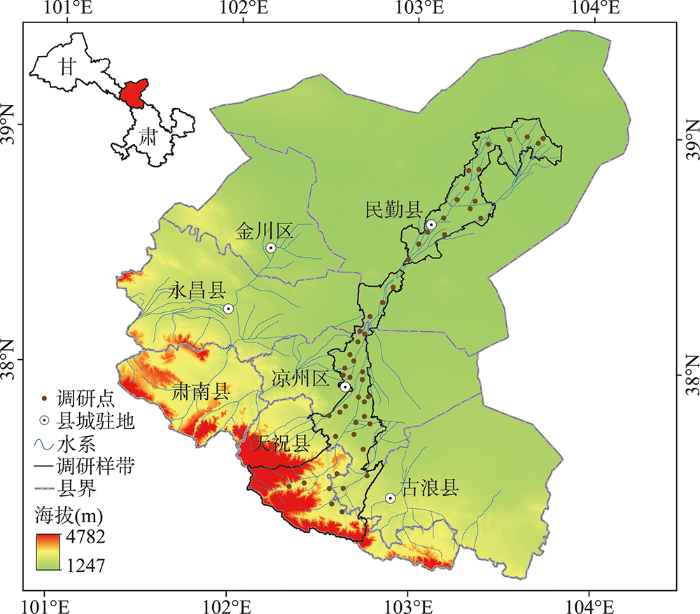
石羊河流域位于甘肃省中部、祁连山北麓(101°22'E~104°04'E, 37°07'N~39°27'N)。东南与白银、兰州两市相连,西北与张掖市毗邻,西南紧靠青海省,东北与内蒙古自治区接壤,流域面积为4.16万km2,多年平均降水量为207 mm,多年平均自产水资源量约为13.1亿m3,其行政区划包括武威市的古浪县、凉州区、民勤县全部及天祝县部分乡镇,金昌市的永昌县和金川区全部以及张掖市肃南县部分乡镇。地势自西南向东北倾斜,自西向东可分为三大区域:上游祁连山区、中游走廊平原区和下游绿洲农业区(图1)。
图1
本文以《石羊河流域重点治理规划》颁布的2007年为参考,并选取2000年(生态治理前)、2010年(生态治理初期)和2020年(生态治理后)3个关键时间节点开展研究工作。如表1所示,生态治理对该流域人地系统产生了重要影响。从宏观尺度上看,社会层面致使人口和劳动力要素不断流失,成为流域乡村“老年化”和“空心化”的重要原因[32];经济层面虽然促进流域整体经济(包括GDP和人均纯收入)持续增长,但也增加了农业经济效益波动等不确定性风险;在生态层面,耕地总量下降,用水结构调整,地表植被逐渐恢复,自然灾害频率降低,生态环境逐步改善。农户对生态治理影响内容的感知数据显示(表1),在微观尺度上,生态治理对农户生计的影响主要表现为农业投入增加、设施农牧业发展、有效灌溉程度变化、外出务工人数增加、经济收入变化和耕地缩减等。在生态治理多尺度扰动影响下,流域人地系统和农户生计都处于剧烈变化时期,因而基于微观农户视角,探讨流域生计转型及其社会-生态效应更加具有现实意义,为流域可持续发展和生计福祉增进提供决策依据。
表1 生态治理对石羊河流域人地系统和农户生计的影响
Tab. 1
| 人地系统指标 | 生态治理前 | 生态治理初期 | 生态治理后 | 农户生计感知 | 农户频数 | 占比(%) |
|---|---|---|---|---|---|---|
| 总人口(万人) | 191.10 | 191.83 | 182.78 | 农业投入增加 | 185 | 63.36 |
| 农村劳动力数量(万人) | 79.32 | 85.28 | 83.96 | 设施农牧业发展 | 160 | 54.80 |
| GDP(亿元) | 64.28 | 228.77 | 488.26 | 有效灌溉程度变化 | 124 | 42.47 |
| 人均纯收入(元) | 1884 | 3972 | 11518 | 外出务工人数增加 | 99 | 33.90 |
| 耕地面积(万hm2) | 25.97 | 25.24 | 25.34 | 经济收入变化 | 99 | 33.90 |
| 有效灌溉面积(万hm2) | 19.65 | 18.37 | 18.83 | 耕地缩减 | 77 | 26.37 |
| NDVI | 0.36 | 0.37 | 0.41 | 种植结构调整 | 58 | 19.86 |
| 机电井数量(眼) | 14589 | 11918 | 12584 | 减少放牧 | 39 | 13.56 |
| 用水结构(农业:生态: 工业:生活) | 92.5:0.1:4.9:2.5 | 87.7:2.5:6.5:3.3 | 83.8:9.3:2.7:4.2 | 移民搬迁 | 1 | 0.34 |
注:人地系统指标中用水结构数据来源于《石羊河流域水资源公报》(2010—2020年)和《甘肃省水资源公报》(2000年)(
2.2 数据来源
数据主要来自农户问卷调查和深度访谈。数据收集经历了3个阶段:① 2019年8月,选取典型乡镇进行实地调查,主要通过乡村社区关键人物和政府工作人员访谈,了解流域社会经济发展和生态治理概况,此次获得访谈录音11份;② 2020年10月,选取下游东湖镇、苏武镇,中游高坝镇、黄花滩镇,上游哈溪镇开展农户调查,共发放问卷175份,其中有效问卷160份,问卷有效率为92.49%,并获得访谈录音16份;③ 2021年9月,进行补充调研。首先根据团队2015年以来长期实地调研数据,结合流域自然资源、环境变化和乡村发展等特征选取石羊河干流沿线33个乡镇为调研对象(样带);其次,根据乡镇面积大小,对面积较大的乡镇选择2个行政村,面积较小的乡镇选取1个行政村,并使所选取样本点尽量均匀地分布于调研区域上;最后,在选取的行政村内部按随机抽样选择6~8个农户作为调查对象,共计发放问卷295份,其中有效问卷292份,问卷有效率达98.98%(图1)。因2019年和2020年石羊河流域社会经济发展状况接近、问卷调查内容一致,所以在问卷数据使用过程中对两期数据进行了直接合并,因黄花滩镇不在此次研究区域内,排除后有效问卷数据共计407份。并对问卷进行效度和信度检验,结果如下:Cronbach's Alpha值为0.676,KMO取样适切性量数为0.672,巴特利特球形检验结果sig=0.000,证明问卷各个变量数据内部一致性较高,变量设计合理。
问卷内容主要包括:① 家庭基本情况,包括人口规模、劳动力数量、外出人口数量、经济收支情况;② 自然资本,包括耕地面积、水资源状况、设施农牧业情况等;③ 物质资本,包括住房类型、牲畜资本量、家庭固定资产量等;④ 金融资本,包括借贷机会、可借款人数等;⑤ 社会资本,包括邻里冲突、乡村社区支持类型、政府或村委会任职情况等;⑥ 农户感知,包括生活满意度、基础设施满意度等;⑦ 生态足迹,包括粮食、肉、蔬菜和汽油等一年的消耗量;⑧ 其他,包括农户对生态治理政策的认知、生态治理对农户生计的影响内容等。
3 研究内容与方法
3.1 农户生计类型划分标准
实地调查表明,石羊河流域农户存在4种生计活动:传统农业活动,如种植小麦、玉米等粮食作物和茴香、葵花等经济作物(以下简称“粮经作物”);畜牧活动,如牛、羊等的放牧(不包括设施牧业);新型农业活动主要是设施农牧业,如温室大棚种植蔬菜、暖棚养殖牛羊等;非农生计活动,包括常年外出务工、企事业单位工作、个体经营等。已有研究大多从兼业视角出发,从劳动力主要投入方向和各项收入占比界定农户生计类型[5,33⇓-35]。鉴此,本文根据识别出的石羊河流域4种生计活动,定量考虑农户家庭收入结构,定性分析农户劳动力投入方向,将石羊河流域农户生计划分为5类:传统农业主导型、畜牧主导型、传统非农型、新型农业型和非农主导型(表2)。
表2 石羊河流域农户生计类型及划分标准
Tab. 2
| 农户生计类型 | 收入占比(%) | 劳动力主要投入方向 | 农户数量 (户) | 占比 (%) | |||
|---|---|---|---|---|---|---|---|
| 粮经作物收入 | 畜牧养殖 收入 | 设施农牧收入 | 非农收入 | ||||
| 传统农业主导型 | 70~100 | 0~70 | 0~50 | 0~20 | 粮经作物种植 | 25 | 6.14 |
| 畜牧主导型 | 0~20 | 70~100 | 0~50 | 0~20 | 畜牧活动 | 13 | 3.19 |
| 传统非农型 | 20~70 | 0~70 | 0~50 | 20~70 | 粮经作物种植、非农生计活动 | 122 | 29.98 |
| 新型农业型 | 0~20 | 0~70 | 50~100 | 0~20 | 设施农牧业、粮经作物种植或非农生计活动 | 29 | 7.13 |
| 非农主导型 | 0~20 | 0~70 | 0~50 | 70~100 | 非农生计活动 | 218 | 53.56 |
3.2 社会-生态效应评估
3.2.1 评估框架构建
根据Ostrom等社会-生态系统分析框架相关成果[26,36,37],将农户生计转型的社会-生态效应解构为社会、经济和生态3个维度,进而构建生计转型效应评估框架(表3)。社会效应可以理解为农户生计转型对地方社会结构产生的影响。在社会效应评估指标体系构建上,按照社会结构的定义:“社会结构就是社会诸要素及其相互关系按照一定的秩序所构成的相对稳定的网络”,以及社会结构构成的3个层面:要素构成形式层面、规范体系层面和关系网络层面[29],进行具体考量。其中,要素构成层面主要考虑个体(农户)因素,选取生活满意度和集体记忆(在外部环境扰动下乡村社区成员维持社会结构、功能稳定的能力[38])两个指标描述;关系网络层面借鉴社会学研究范例[29,39],用社会关系网络和社区支持度表征;而根据实地调研结果,石羊河流域规范体系层面要素多通过其他层面显现,且难以量化评估,所以在此不做专门考虑。经济效应可以理解为农户生计转型过程中所产生的经济效果,即经济收入的变化,选取家庭总收入、传统农业收入、新型农业收入和非农业收入衡量。生态足迹是指利用人类为了维持自身生存而利用自然的量来评估人类对生态系统的影响,在农户生计转型的生态效应评估中得到广泛应用[40]。
表3 农户生计转型的社会-生态效应评估框架
Tab. 3
| 维度 | 指标 | 指标描述 |
|---|---|---|
| 社会 | 生活满意度 | 农户对当前生活的满意程度:非常不满意=1;不满意=2;一般=3;比较满意=4;非常满意=5 |
| 社会关系网络 | 遇到困难时能够帮助的人数 | |
| 社区支持度 | 农户从乡村社区获得的支持类型数量 | |
| 集体记忆 | 家庭常年外出人口数量 | |
| 经济 | 农户家庭总收入 | 过去一年家庭所有收入总和(万元) |
| 传统农业收入 | 种植粮经作物获得的收入总和(万元) | |
| 新型农业收入 | 设施农牧业获得的收入总和(万元) | |
| 非农业收入 | 从事外出务工、企事业单位工作、个体经营等非农业生计活动获得的收入总和(万元) | |
| 生态 | 生态足迹 | 农户为了维持自身生存而利用自然的量(hm2) |
3.2.2 经济效应评估
式中:
3.2.3 生态效应评估
生态足迹可以有效地测度人类活动对生态环境的影响程度[43]。基于农户调查数据,获取不同生计类型农户生产、生活资源消耗量,进而计算出各类型农户生态足迹,并进行比较分析,从而达到评估农户生计转型生态效应的目的。计算公式如下:
式中:EF为户均生态足迹量;
3.3 生计转型影响因素分析
3.3.1 影响因子选取
已有成果表明[18],[19]26,[45,46],农户生计转型过程受多重因素影响。根据社会学“理性选择”理论,农户行为由动机和意图激发,但受两方面因素制约:一是资源的稀缺程度,即农户所拥有的资源,拥有更多资源的农户更易于达成目的,实现生计转型,而资源稀缺的农户则较难或不可能实现生计转型的目标[46]。这与DFID可持续生计分析框架核心内容不谋而合,其用生计资本衡量农户所拥有的资源[47]。二是政策制度,其通过支持或限制农户行为,从而对农户行动前的考量和行动后的结果产生影响,促使农户生计行为发生转变,并影响着农户所选择生计行为的可持续性[46]。另外,在政策制度和资源之下,还需要关注农户对于资源和政策制度等信息获取和利用的能力,其构成农户生计活动选择的知识基础。乡村社区作为行动者主体形成的集合,是农户获得信息的重要来源,其通过与社区内部其他主体之间的经验交流、参与乡村社区组织等,构成作为理性选择的重要信息基础。基于上述分析,并结合研究区域地理环境特征,从人力资本、自然资本、物质资本、金融资本、社会资本、地理区位和认知能力7个维度选取了影响农户生计转型的25个可能因子(表4)。
表4 农户生计转型的影响因子
Tab. 4
| 维度 | 影响因子 | 因子释义及单位 | 平均值 | 标准差 |
|---|---|---|---|---|
| 人力资本 | 劳动力数量 | 家庭拥有劳动力总量 | 3.03 | 1.07 |
| 劳动力受教育年限 | 家庭劳动力平均受教育年限(年) | 9.23 | 3.21 | |
| 家庭抚养比 | 无劳动力成员占家庭总人数比例 | 0.35 | 0.22 | |
| 培训机会 | 家庭成员参加农业技术培训的次数 | 0.54 | 1.02 | |
| 自然资本 | 耕地面积 | 拥有确权耕地面积(hm2) | 0.75 | 0.64 |
| 耕地质量 | 耕地质量:很差=1;较差=2;一般=3;较好=4;很好=5 | 1.64 | 2.40 | |
| 有效灌溉程度 | 农作物有效灌溉程度:基本没有=1;较少=2;一般=3;较多=4;全部灌溉=5 | 4.30 | 1.41 | |
| 物质资本 | 住房类型 | 纯木房=1;土木房=2;土砖房=3;砖瓦结构=4;混凝土结构=5 | 2.83 | 0.91 |
| 固定资产量 | 拥有固定资产数量 | 5.95 | 1.29 | |
| 牲畜资本量 | 拥有大型牲畜(牛、羊、马)数量 | 12.25 | 25.47 | |
| 金融资本 | 借贷机会 | 是否能从银行获得贷款:否=0;是=1 | 0.81 | 0.39 |
| 收入多样性指数 | 收入来源的多样化程度,利用收入多样性指数公式:EI= | 0.76 | 0.34 | |
| 家庭总收入 | 过去一年家庭总收入(万元) | 10.28 | 6.46 | |
| 经济能力 | 过去一年家庭财务储蓄(万元) | 2.94 | 4.18 | |
| 社会资本 | 邻里冲突 | 乡村社区邻里冲突状况:基本没有=1;冲突较少=2;一般=3;冲突较多=4;冲突很多=5 | 1.37 | 0.66 |
| 社区支持度 | 从乡村社区获得的支持类型数 | 2.40 | 0.75 | |
| 帮助人数 | 面临经济困难时可帮助人数:基本没有=1;较少=2;一般=3;较多=4;很多=5 | 2.23 | 1.15 | |
| 权利邻近度 | 家中是否有人在政府单位或村委会任职:否=0;是=1 | 0.15 | 0.36 | |
| 地理区位 | 可达性 | 距县道的距离(km),利用百度地图APP获得 | 3.41 | 3.46 |
| 距县城距离 | 距县城的时间距离(小时) | 1.08 | 0.90 | |
| 海拔高度 | 海拔高度(m),利用手机GPS定位获得 | 1586.83 | 367.84 | |
| 认知能力 | 社区参与 | 家庭成员参加乡村集体会议的次数:基本没有=1;偶尔参加=2;一般=3;参加较多=4;参加很多=5 | 3.75 | 1.26 |
| 社区学习 | 乡村社区内部务工与务农经验交流的频率:基本没有=1;较少=2;一般=3;较多=4;很多=5 | 3.45 | 1.08 | |
| 政府应灾能力 | 政府应对自然灾害的能力:很低=1;较低=2;一般=3;较高=4;很高=5 | 3.28 | 0.98 | |
| 政策认知 | 生态治理政策对农户的影响程度:基本没有=1;影响较小=2;一般=3;影响较大=4;影响很大=5 | 2.44 | 1.14 |
3.3.2 数据标准化
为消除生计转型影响因子不同量纲对分析结果的影响,选择极差标准化方法对原始数据进行归一化处理。因不对其进行综合计算,故在标准化时不考虑因子向性,统一使用正向标准化公式。计算公式如下:
式中:
3.3.3 影响因子辨识
y的条件概率为:
Logistic回归模型为:
式中:P为农户生计从传统农业主导型转向传统非农型、新型农业型和非农主导型的概率,或从传统非农型转向非农主导型的概率;
4 结果分析
4.1 农户生计转型路径
在生态治理前,农户生计活动主要以种植小麦、玉米、茴香和黑瓜籽等传统粮经作物为主,但也存在部分农户以打零工维持生计,传统农业主导型和传统非农型农户占比分别为49.63%和31.94%;在生态治理初期,农户通过外出务工或就地打零工方式拓展生计,逐渐转向传统非农型和非农主导型生计,占比分别为36.85%和34.89%;在生态治理后,农户生计以外出务工、企事业单位工作和个体经营等非农业活动为主,非农主导型农户占比为53.56%。如图2所示,在生态治理过程中,传统农业主导型农户数量持续下降(202→97→25);非农主导型(63→142→218)和新型农业型(0→7→29)农户数量持续上升;而传统非农型农户数量先增后降(130→150→122);畜牧主导型农户数量则基本保持不变(12→13→13)。
图2
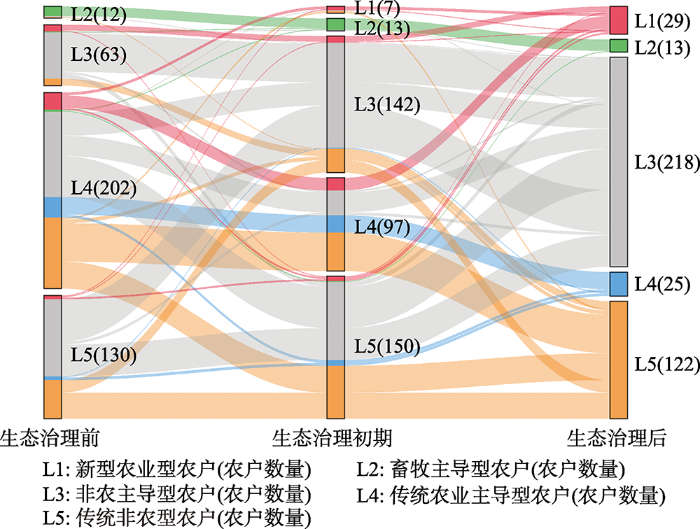
图2
石羊河流域农户生计转型路径
Fig. 2
The transformation paths of farmers' livelihood in the Shiyang River Basin
为进一步识别生计转型路径,将农户生计转型过程划分为P1和P2两个阶段(图3)。在P1阶段,生计转型的主要方式有“传统农业主导型→传统非农型”“传统农业主导型→非农主导型”和“传统非农型→非农主导型”3种;在P2阶段,生计转型的主要方式有“传统农业主导型→传统非农型”“传统农业主导型→新型农业型”“传统农业主导型→非农主导型”和“传统非农型→非农主导型”4种。可见,生态治理下石羊河流域农户生计转型过程呈现发散和聚合两种模式:一是从传统农业主导型生计发散向新型农业型、传统非农型和非农主导型生计;二是从传统农业主导型和传统非农型生计聚合向非农主导型生计。
图3
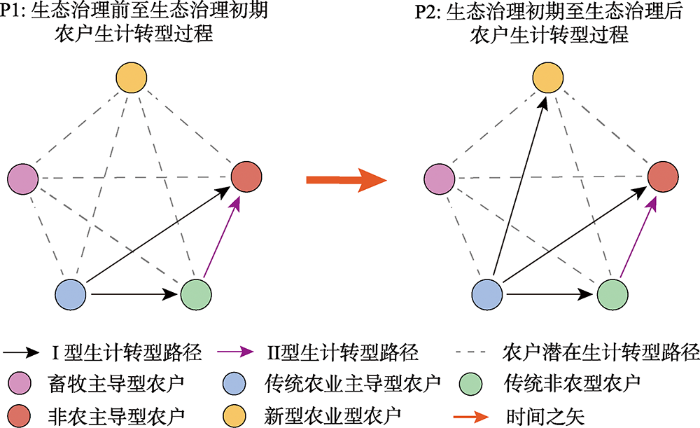
图3
石羊河流域农户生计转型路径模拟
Fig. 3
Simulation of the transformation path of farmers' livelihoods in the Shiyang River Basin
综上所述,基于生态治理前后生计类型比较、转型农户数量(规模)及其发散与聚合特征,可将石羊河流域农户生计转型路径总结为两种:Ⅰ型生计转型路径和Ⅱ型生计转型路径,前者主要是由传统农业主导型生计发散向传统非农型、新型农业型和非农主导型生计;后者主要是从传统非农型生计转向非农主导型生计。
4.2 生计转型的社会-生态效应
4.2.1 社会效应
Ⅰ型农户生计转型所产生的社会效应整体为负向。首先,据访谈了解,农户生计从传统农业主导型转向传统非农型、新型农业型和非农主导型的过程中,所面临务工机会减少、务工工资拖欠和新型农作物市场波动等不确定性增加,造成生活满意度降低,分别下降0.29、0.34和0.21。其次,虽然生计转型致使社会关系网络不断拓展,分别增加0.43、0.30和0.39,但农户从所在乡村社区获得的支持度却不断减少,分别下降0.15,0.23和0.12,对维持本地社会结构的稳定并没有积极贡献。最后,农户生计转型促使家庭流动人口数量不断增加,分别增加1.23人、0.49人和1.64人,改变了社会结构的主体性要素及其构成形式,对流域社会结构的稳定产生较强烈的冲击(表5)。
表5 石羊河流域农户生计转型的社会效应
Tab. 5
| 变量 | A | B | C | D | B-A | C-A | D-A | D-B | 变量向性 |
|---|---|---|---|---|---|---|---|---|---|
| 生活满意度 | 3.95 | 3.66 | 3.61 | 3.74 | -0.29 | -0.34 | -0.21 | 0.08 | + |
| 社会关系网络 | 0.86 | 1.29 | 1.17 | 1.26 | 0.43 | 0.30 | 0.39 | -0.03 | + |
| 社区支持度 | 2.53 | 2.38 | 2.3 | 2.41 | -0.15 | -0.23 | -0.12 | 0.03 | + |
| 集体记忆 | 0.73 | 1.95 | 1.22 | 2.37 | 1.23 | 0.49 | 1.64 | 0.42 | - |
注:A、B、C和D分别代表传统农业主导型、传统非农型、新型农业型和非农主导型农户;表头中“-”指减号运算符。
Ⅱ型农户生计转型的社会效应也呈现负向,但负向效应仅表现在集体记忆方面。在传统非农型生计转向非农主导型生计的过程中,生活满意度、社会关系网络和社区支持度变化幅度很小,变化量分别为0.08、-0.03和0.03。而家庭流动人口数量变化较大,平均增加了0.42人,即Ⅱ型农户生计转型亦促使流域人口流动性越来越强,从而使社会结构趋于不稳定(表5)。
4.2.2 经济效应
(1)Ⅰ型生计转型路径。以传统农业主导型农户作为对照组,以传统非农型、新型农业型和非农主导型农户分别作为控制组,将其经济收入引入构建的双重差分模型中,计算结果如表6所示。
表6 石羊河流域I型农户生计转型的经济效应
Tab. 6
| SD | ZDID | |||||||
|---|---|---|---|---|---|---|---|---|
| A-E | B-F | C-G | D-H | (B-F)-(A-E) | (C-G)-(A-E) | (D-H)-(A-E) | ||
| 家庭总收入 | 4.12 | 8.69 | 7.03 | 9.95 | 4.57(3.98)*** | 2.91(2.33)* | 5.83(4.35)*** | |
| 传统农业收入 | 3.01 | 2.35 | -0.35 | 0.20 | -0.65(0.97) | -3.35(-3.90)*** | -2.81(-7.79)*** | |
| 非农业收入 | 0.30 | 4.98 | 2.19 | 9.16 | 4.68(7.95)*** | 1.89(3.13)** | 8.86(7.52)*** | |
| 新型农业收入 | 0.78 | 1.40 | 5.20 | 0.60 | 0.62(1.86) | 4.42(8.14)*** | -0.18(-0.81) | |
注:A、B、C和D分别代表生态治理后的传统农业主导型、传统非农型、新型农业型和非农主导型农户;E、F、G和H分别代表生态治理前的传统农业主导型、传统非农型、新型农业型和非农主导型农户;“-”指减号运算符;括号内的值表示T检验结果;*、**、***分别代表在P<0.05、P<0.01、P<0.001水平上差异性显著;SD(Simple difference)指农户经济收入的初次差分结果。
农户生计从传统农业主导型转向传统非农型的过程中,家庭总收入、非农业收入呈现显著正向效应,分别增加4.57万元、4.68万元;对新型农业收入产生正向效应,增加0.62万元,而对传统农业收入产生负效应,减少0.65万元。在转向新型农业型的过程中,家庭总收入、非农业收入和新型农业收入均呈现显著正向效应,分别增加2.91万元、1.89万元和4.42万元,而传统农业收入则显著减少,减少幅度为3.35万元。在转向非农主导型的过程中,对家庭总收入和非农业收入呈现显著正向效应,分别增加5.83万元和8.86万元;而对传统农业收入呈现显著负向效应,减少2.81万元;对新型农业型收入也呈现负向效应,减少0.18万元,但负向效应程度不显著。可见,Ⅰ型生计转型显著增加了总体经济收入和非农业收入,却促使传统农业收入显著减少。新型农业收入仅在转向新型农业型生计时显著增加,而在转向传统非农型和非农主导型生计的过程中变化不显著。
(2)Ⅱ型生计转型路径。以传统非农型农户为对照组,以非农主导型农户为控制组,将其经济收入引入建立的双重差分模型,计算结果如表7所示。
表7 石羊河流域Ⅱ型农户生计转型路径的经济效应 (万元)
Tab. 7
| SD | ZDID | |||
|---|---|---|---|---|
| I-K | J-L | (J-L)-(I-K) | ||
| 家庭总收入 | 7.39 | 8.98 | 1.59(0.87) | |
| 传统农业收入 | 2.21 | 0.06 | -2.16(-5.41)*** | |
| 非农业收入 | 3.51 | 8.27 | 4.76(3.12)** | |
| 新型农业收入 | 1.67 | 0.60 | -1.06(-2.30)* | |
注:I、J分别代表生态治理后的传统非农型和非农主导型农户;K、L分别代表生态治理前的传统非农型和非农主导型农户;“-”指减号运算符;括号内的值表示T检验结果;*、**、***分别代表在P<0.05、P<0.01、P<0.001水平上差异性显著;SD(Simple difference)指农户经济收入的初次差分结果。
农户生计从传统非农型转向非农主导型的过程中,对家庭总收入的正向效应不显著,增加1.59万元;对非农业收入正向效应显著,增加4.76万元;而对传统农业收入和新型农业收入产生显著负向效应,分别减少2.16万元和1.06万元。可见,Ⅱ型生计转型对农户总体经济收入没有显著贡献,却促使收入结构的调整,表现为农业收入减少和非农收入增加。
4.2.3 生态效应
各类农户户均生态足迹的计算结果如表8所示,农户在生计转型过程中(包括Ⅰ型转型路径和Ⅱ型转型路径),对耕地、水域、草地和建筑用地的影响显著下降,而对林地和能源用地的依赖程度逐渐提高。总体上看,农户户均生态足迹的数量关系为:传统农业主导型(47.416 hm2)>传统非农型(27.775 hm2)>非农主导型(15.341 hm2)>新型农业型(14.113 hm2),表明生计转型促使农户对流域生态环境的影响程度显著减弱,即生计转型有利于流域生态环境的改善,产生正向生态效应。
表8 石羊河流域不同生计类型农户生态足迹
Tab. 8
| 传统农业主导型 | 传统非农型 | 新型农业型 | 非农主导型 | ||||||||
|---|---|---|---|---|---|---|---|---|---|---|---|
| 生态足迹(hm2) | 占比 (%) | 生态足迹(hm2) | 占比 (%) | 生态足迹(hm2) | 占比 (%) | 生态足迹(hm2) | 占比 (%) | ||||
| 耕地 | 42.937 | 50.08 | 22.717 | 26.49 | 10.204 | 11.9 | 9.887 | 11.53 | |||
| 林地 | 4.217 | 23.71 | 4.800 | 26.99 | 3.596 | 20.22 | 5.171 | 29.08 | |||
| 草地 | 0.019 | 27.14 | 0.017 | 24.29 | 0.023 | 32.86 | 0.011 | 15.71 | |||
| 水域 | 0.004 | 33.33 | 0.004 | 33.33 | 0.002 | 16.67 | 0.002 | 16.67 | |||
| 能源用地 | 0.239 | 23.11 | 0.237 | 22.92 | 0.288 | 27.85 | 0.270 | 26.11 | |||
| 建筑用地 | 0.133 | 27.03 | 0.121 | 24.59 | 0.121 | 24.59 | 0.117 | 23.78 | |||
| 总和 | 47.416 | 27.775 | 14.113 | 15.341 | |||||||
4.3 农户生计转型的影响因素
4.3.1 Ⅰ型转型路径影响因素
将4种农户生计类型与25个候选变量引入多项Logistic回归模型中,结果如表9所示。地理区位(海拔高度)、自然资本(耕地面积)、物质资本(牲畜资本量)、认知能力(政策认知)和金融资本(家庭总收入、收入多样性指数、经济能力)是影响农户Ⅰ型生计转型的主要因素。
表9 I型农户生计转型Logistic回归分析结果
Tab. 9
| 变量 | 传统非农型 | 新型农业型 | 非农主导型 | ||||||||
|---|---|---|---|---|---|---|---|---|---|---|---|
| 系数 | Wald | Sig. | 系数 | Wald | Sig. | 系数 | Wald | Sig. | |||
| 截距 | -0.85 | 0.02 | 0.902 | 1.59 | 0.05 | 0.826 | 8.91 | 1.67 | 0.196 | ||
| 海拔高度 | 18.50 | 3.96 | 0.047 | 13.07 | 1.89 | 0.169 | 15.60 | 2.81 | 0.094 | ||
| 耕地面积 | -5.77 | 4.59 | 0.032 | -12.89 | 7.22 | 0.007 | -9.61 | 7.65 | 0.006 | ||
| 牲畜资本量 | -9.28 | 3.93 | 0.047 | -5.05 | 0.85 | 0.356 | -11.60 | 5.39 | 0.020 | ||
| 政策认知 | -2.74 | 2.73 | 0.099 | -4.65 | 5.91 | 0.015 | -3.62 | 4.36 | 0.037 | ||
| 家庭总收入 | 19.58 | 4.35 | 0.037 | 6.92 | 0.39 | 0.530 | 23.54 | 6.04 | 0.014 | ||
| 收入多样性指数 | 6.80 | 6.09 | 0.014 | -3.35 | 1.10 | 0.295 | -10.16 | 10.71 | 0.001 | ||
| 经济能力 | -0.88 | 0.04 | 0.838 | 12.25 | 4.96 | 0.026 | 2.94 | 0.41 | 0.525 | ||
注:(1)表中加粗字体表示显著性水平P
其中,海拔高度、家庭总收入和经济能力对生计转型具有正向作用。首先,随着海拔不断升高,农户所拥有的耕地面积越来越少,且多以坡耕地为主,破碎化程度较高,而且受气候、土壤条件等制约,农作物产量低,因而农业效益远低于海拔较低的平原区和绿洲农业区,传统农业活动难以支撑农户生计的发展,所以农户更倾向于选择外出务工的方式拓展生计,易于转向传统非农型和非农主导型生计。其次,传统农业主导型、传统非农型和非农主导型农户的家庭总收入分别为5.45万元、9.86万元和10.80万元,因而后两者能够支配更丰富的经济资源,并具有更高的物质生活水平,从而促使农户基于经济理性,选择将劳动力投入非农生计活动,或同时投入传统农业活动和非农生计活动,发生生计转型。此外,由于温室大棚、养殖暖棚等建设需要较高的经济投入,所以当传统农业主导型农户能够动用的资金(经济能力)较多时,多选择从事设施农牧业,因为新型农业活动经济效益大于传统农业活动。
耕地面积、牲畜资本量和政策认知对生计转型具有负向作用。首先,耕地面积越大,农户从传统农业中获得的经济效益就越高,从而促使农户将劳动力投入传统农业活动中,降低了向其他生计转移的可能。其次,养殖收入是传统农业主导型农户的重要收入来源之一,也是其通过多样化手段规避外部风险扰动的重要选择,因而农户在以传统农业种植为主的生计前提下,更愿意将剩余劳动力投入牲畜养殖活动中,从而阻碍生计转型过程。此外,政策认知反映生态治理对农户的影响程度,而传统农业主导型农户的政策认知水平最高。生态治理促使该类农户面临耕地缩减、灌溉水资源成本增加等问题,从而降低其农业效益,推动生计转向传统非农型与非农主导型;而政府对节水设施农业的提倡,并适时引导该类农户发展西红柿、辣椒等设施大棚,以及养殖牛、肉羊等设施暖棚,拓展了农户生计,促使生计转向新型农业型。
收入多样性指数对生计转型既有正向也有负向作用。因传统农业主导型农户收入来源较少,在自然灾害、农作物市场波动等外部冲击下较难维系自身生计的稳定,因而农户多通过多样化手段来规避风险,易于转向传统非农型。而非农主导型农户收入来源较传统农业主导型更为单一(两者收入多样性指数分别为2.70和3.05),因而阻碍生计转向非农主导型。
4.3.2 Ⅱ型生计转型路径影响因素
将2种农户生计类型和25个候选变量引入Logistic回归模型中,结果如表10所示。家庭抚养比(人力资本)、耕地面积(自然资本)、社区学习(认知能力)和收入多样性指数(金融资本)是影响农户Ⅱ型生计转型路径的主要因子,并且均呈现负向作用。
表10 Ⅱ型农户生计转型Logistic回归结果
Tab. 10
| 变量 | 系数 | Wald | Sig. | |
|---|---|---|---|---|
| 非农主导型 | 截距 | 9.24 | 15.73 | 0.000 |
| 家庭抚养比 | -3.15 | 4.40 | 0.036 | |
| 耕地面积 | -5.53 | 2.79 | 0.095 | |
| 社区学习 | -1.95 | 4.10 | 0.043 | |
| 收入多样性指数 | -17.29 | 45.22 | 0.000 |
注:(1)表中加粗字体表示显著性水平P
首先,在抚养比较高的家庭,因需照顾无劳动人员,农户很难采取长期外出务工的生计策略,生计选择更多偏向于当地打零工,因而多成为传统非农型生计。其次,耕地面积越大,农户从土地上获得的效益就更大,传统农业活动对农户生计的支撑能力较强,因而生计较难完全转向非农主导型。再次,当乡村社区经验交流增多时,农户对于资源信息的掌握程度和对外部风险的认知程度更高,使其生计选择将持更加审慎的态度,从而阻碍生计转型过程。此外,非农主导型农户虽能获得更高的家庭收入,但其在外部冲击下维系自身生计稳定的能力也较弱,而传统非农型农户则可以通过多样化手段规避风险,因而收入多样性指数也阻碍生计转向非农主导型。
4.4 农户生计转型机理
4.4.1 地理环境
石羊河流域下游绿洲灌溉农业区由于人口密度较低,户均耕地面积大,光照充足,而且低海拔高度使得有更利于农作物生长的气候和土壤条件,农业效益相对较高,传统农业生计活动对农户生计的支撑能力强,所以农户生计多成为传统农业主导型和传统非农型生计。中游平原地区靠近武威市区,人口密度高,耕地面积较少,土壤条件较好,加之较发达的经济水平和相对较高的城镇化水平,使得更易形成非农主导型和新型农业型生计。而上游祁连山区海拔较高,沟壑纵横,为雨养农业区,其间耕地以坡耕地为主且面积小,农业生产效益低,所以易于形成非农主导型生计;而适宜牧草生长的土壤环境却为畜牧业的发展提供了良好条件,容易形成长期稳定的畜牧主导型生计。可见,地理环境差异导致的资源分布不均是农户生计活动空间差异和生计转型的重要前提。
4.4.2 政策制度
水土资源是影响石羊河流域社会经济发展和农户生计可持续性的关键因素,而生态治理对水土资源影响显著。其中,对土地资源的影响主要是大规模“退耕还林”和“关井压田”,致使农户拥有的耕地资源持续下降,因而从农业中获得的经济效益也不断减少。对水资源的影响主要有两方面:一是关闭机电井,实施灌溉水资源定量配给,降低了农户有效灌溉程度,对中下游农业区依赖水资源灌溉的农户产生压力;二是“水权改革”,在灌溉定额内,农户生产用水价格较低,超过灌溉定额后,则收取更高价格,并且自生态治理以来,水价呈快速上升趋势,致使农户农业投入越来越高。严格的生态治理政策与农户生存和发展需求产生矛盾,使其被迫寻求新的替代性生计方式,易于转向传统非农型和非农主导型生计。苏武镇×××村村支书:“我们村关井压田关掉了9眼井,目前还剩下7、8眼,村集体土地压掉了1200亩……现在政府要求的有效灌溉面积是人均2.5亩,每亩地一年灌4个水(4次水),水价弄的高,农民种地纯粹就掏了水费了,农业效益低,年轻人都出去打工了。”
同时,随着水土资源的减少,为了实现农户生计可持续性发展,政府大力支持农户发展设施农牧业,并给予相应补贴,如补贴修建温室大棚、养殖暖棚等的费用。从而促使农户选择发展设施农牧业,形成较为稳定的新型农业型生计。双茨科镇×××村村长:“……种西红柿的话,毛收入在两万左右,纯收入一万五左右。大棚种植蔬菜经济效益还可以。”大坝镇副镇长:“……像这几年,百姓种植人参果,一亩地的收入差不多一万块钱,比起一般的传统大田作物,一亩顶十亩。”
综上所述,生态治理政策成为促进石羊河流域农户生计转型的重要起因。
4.4.3 农户理性
(1)经济理性推动Ⅰ型农户生计转型过程。基于实证分析结果,在农业投入增加、耕地缩减以及地理条件制约等影响下,传统农业效益远低于外出务工效益,所以农户基于经济理性,选择外出务工拓展生计,生计方式逐渐转向传统非农型和非农主导型。而凉州区大柳镇、高坝镇,民勤县苏武镇、双茨科镇等乡镇,由于靠近市、县城区且土壤条件较好,又得到政府政策的大力支持,所以发展单位效益高于传统农业的温棚种植业,促进农户生计从传统农业主导型转向新型农业型。泉山镇×××村村支书:“……日光温室(种植)增加了我们的收入,但是现在整体农业(作物)的效益不好,销售的路子也不好,水价又很高,种植成本变得越来越高,现在出去打工的越来越多了。”
可见,经济理性促使农户生计从传统农业主导型转向传统非农型、新型农业型和非农主导型。
(2)社会理性阻碍Ⅱ型农户生计转型过程。虽然非农主导型农户收入高于传统非农型农户(分别为10.10万元、8.96万元)(仍然存在经济理性的吸引),但由于传统非农型农户拥有更高的家庭抚养比,可能在一定程度上阻碍了生计转向非农主导型。蔡旗乡×××村农户:“现在父母亲岁数都大了,留在家里不放心,(因此)不敢到远的地方打工,就闲了(农闲时)出去打些零工,地里忙了回来种地……”
乡村社区农户经验交流越多,资源信息的获取能力也就更强,同时对于外部风险的认知也就越深刻,所以农户会更加审慎地进行资源配置,这时农户生计转型并不是基于利益最大化,而是在众多因素权衡之中求出“满意解”,即基于社会理性做出决策。所以农户选择将劳动力同时投入传统农业生计活动和非农生计活动,既能增加家庭收入,也能规避外部风险。东坝镇×××村农户:“……现在外头打工(外出打工)活也不好找了,我家地也比较多,种地也能有些收入,再就闲了出去打些工,收庄稼了再回来。”
同时,在调查区域还存在一定数量农户,其生计特征为:父母在家务农,孩子在外务工(一般为企事业单位工作)。该类农户父母年龄在50~60岁,地方依恋性强,不愿随子女生活,而且认为在家务农能够减轻子女的经济负担。红沙梁镇×××村农户:“娃们大学毕业后就留在兰州上班了,不愿意回来,现在也结婚了,去年买了房……,现在城里生活消费高,我和他妈妈两个人在家种些地也能减轻他们的负担。”
可见,在Ⅱ型生计转型路径下农户并不是基于经济理性决策,而受社会理性支配的程度更高。
4.4.4 生计转型结果(效应)影响后续区域发展的管理决策和农户生计选择
农户生计转型持续影响着流域社会-生态系统演化方向和路径,主要体现为社会结构趋于不稳定,经济收入变化和生态环境改善。而生计转型产生的社会-生态效应也会给政策制定者和农户提供一个反馈,政府通过继续执行或改变政策措施(如针对生计转型过程中常年外出人口数量增加导致乡村“空心化”和“老年化”等社会问题显现,实施“乡村振兴”战略、开展“合村并居”项目等;而随着生态环境逐步得到改善,产生正向影响,从而进一步推进生态治理等),持续对农户生计产生外部影响;农户也会基于转型结果做出后续生计选择(如通过外出务工拓展生计,产生正向经济效应,因而在后续的生计选择中可能会继续增加非农生计活动劳动力投入,促进生计进一步转型等),从而影响农户生计转型的稳定性和生计选择的可持续性。
基于上述分析,生态治理下石羊河流域农户生计转型机理可总结如下:流域内部地理环境差异导致的资源分布不均是农户生计转型的前提条件,政策制度的变化为农户生计转型提供了推力,并影响农户生计转型过程,两者共同从宏观尺度对行动者要素(农户)生计活动选择产生影响。农户基于社会理性和经济理性选择生计活动,成为农户生计转型的微观动因。在农户生计转型发生后,转型结果(社会-生态效应)又会对政策制定者和农户产生反馈,影响后续区域发展的管理决策、农户生计转型过程及生计选择的可持续性(图4)。
图4
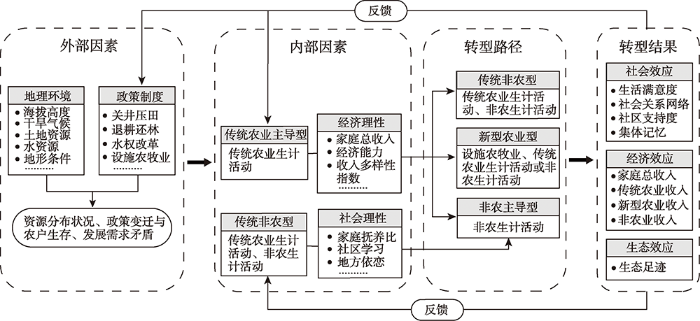
图4
石羊河流域农户生计转型机理
Fig. 4
Mechanism of farmers' livelihood transformation in the Shiyang River Basin
5 结论与讨论
5.1 结论
(1)石羊河流域农户存在2种生计转型路径:Ⅰ型生计转型路径和Ⅱ型生计转型路径,前者主要是由传统农业主导型生计发散向传统非农型、新型农业型和非农主导型生计;后者主要是从传统非农型生计转向非农主导型生计。而畜牧主导型生计并未发生转型,基本保持稳定。
(2)农户生计转型社会-生态效应评估结果表明:① 生计转型促使流域社会结构趋于不稳定,表现为生活满意度下降,农户跨越局域拓展社会关系网络而弱化了本地乡村社区支持度,以及集体记忆主体的流失。② 经济效应产生分化,其中,Ⅰ型生计转型显著增加了家庭总收入和非农业收入,却显著减少了传统农业收入,新型农业收入则仅在转向新型农业型生计时显著增加,而在转向传统非农型和非农主导型生计过程中该项收入变化不显著;Ⅱ型生计转型显著增加了非农业收入,却减少了传统农业收入和新型农业收入,促使农户收入结构调整,而总体经济收入效应并不显著。③ 生计转型促使农户户均生态足迹降低,从而减弱对生态环境的影响,形成正向效应。
(3)地理区位(海拔高度)、自然资本(耕地面积)、物质资本(牲畜资本量)、金融资本(经济能力、家庭总收入和收入多样性指数)和认知能力(政策认知)是影响农户生计从传统农业主导型转向传统非农型、新型农业型和非农主导型的主要因素;人力资本(家庭抚养比)、自然资本(耕地面积)、认知能力(社区学习)和金融资本(收入多样性指数)是影响农户生计从传统非农型转向非农主导型的主要因素。
(4)流域内部地理环境差异导致的水资源、耕地资源等分布不均是农户生计转型的前提条件,政策变迁为农户生计转型提供了推力,两者共同从宏观尺度对农户生计活动选择产生影响。农户基于社会理性和经济理性选择生计活动,成为生计转型的微观动因。在生计转型发生后,转型结果(社会-生态效应)又会对政策制定者和农户提供反馈,从而影响后续区域发展的管理决策、生计转型过程以及生计选择的可持续性。
5.2 讨论
(1)生计转型作为农户响应人地关系变化的重要选择,深刻影响着区域经济社会发展和生态环境变化过程。以往研究在生计转型路径、影响因素分析以及转型结果评估等领域均产出了许多卓有成效的成果,但仍缺乏对生计转型的整合性研究,因而对农户生计演变规律和演变机制的认识存在局限性。鉴此,本文在以往研究的基础上,构建了“外部扰动—农户生计转型—转型结果(社会-生态效应)评估—转型机理探究”的研究逻辑,并以石羊河流域为研究对象,对农户生计转型进行系统性研究。同时,引入社会学理性选择理论,基于“局内人”尺度与行动者(农户)视角,结合农户“经验描述”,全面探讨了农户生计转型机理。有助于深化西北典型干旱区域生计转型特征,把握生计转型规律,可为乡村转型发展、乡村振兴研究提供科学借鉴。
(2)以往对农户生计转型结果的评估主要以土地利用/覆被、能源消费等生态系统服务变化为中介,重点关注生计转型的生态效应,而对经济和社会效应的关注有限。因此,本文将石羊河流域视为局域社会-生态系统,并将农户生计转型作为流域社会-生态系统运行的内部扰动,借鉴社会-生态系统分析框架,从社会、经济和生态3个维度建立了农户生计转型结果评估框架,是对生计转型与社会-生态系统关联研究的一次尝试,深化了对农户生计转型综合效应的理解。但由于农户生计与社会-生态系统互动过程的复杂性,涉及要素众多,所以难免管中窥豹。未来研究应对生计转型社会-生态效应评估指标体系的补充与完善,农户生计与社会-生态系统关联的因果关系、作用机制等方面给予关注。
(3)在乡村振兴战略等促进乡村发展的政策持续推进背景下,乡村人口和劳动力逐渐回流,开始显现出从非农化、兼农化生计向农业专业化生计转变的趋势,其发生机理与本文识别出的转型路径存在异质性,后续研究中应当予以考虑。
致谢
真诚感谢二位匿名评审专家在论文评审中所付出的时间和精力,评审专家对本文研究问题凝练、文献述评、数据分析、指标选取依据及图件表达等方面的修改意见,使本文获益匪浅。
参考文献
干旱区绿洲湿地空间分布及生态系统服务价值变化: 以三大典型内陆河流域为例
DOI:10.18402/resci.2020.10.18
[本文引用: 1]

湿地在维系干旱区绿洲生态系统结构、功能以及水文循环方面发挥着重要作用。对绿洲湿地的综合监测与评估,是准确认识湿地保护政策成效、加强湿地生态环境恢复与保护的基础。本文利用1975—2015年多时段遥感影像解译数据和效益转移法,定量分析了2000年湿地保护政策实施前后近40年塔里木河干流上游、黑河中游和石羊河中下游等典型绿洲湿地空间格局及其生态系统服务价值变化特征。结果表明:①2000年之前,由于绿洲湿地被肆意开垦,导致绿洲湿地面积均大幅减少且湿地景观逐渐破碎化,损失了较多湿地生态效益。2000年之后,在湿地保护政策实施下,塔里木河干流上游和黑河中游绿洲湿地面积及其生态效益均取得较好的恢复成效,湿地破坏较为严重的石羊河中下游绿洲,其湿地保护与恢复工作有待进一步加强。②湿地生态系统服务总价值主要来源于调节服务功能(占比74%~81%)。③湿地所占绿洲面积非常小,但对绿洲总生态系统服务价值变化的贡献率较大。因此,湿地的保护与恢复对绿洲生态系统稳定性、提升生态系统服务价值至关重要。
Changes of spatial distribution and ecosystem service value of oasis wetlands in arid areas: Taking three typical inland river basins as examples
Wetlands play an important role in maintaining the structure, function, and hydrological cycle of oasis ecosystems in arid areas. The comprehensive monitoring and evaluation of oasis wetlands is the basis for accurately understanding the effectiveness of wetland protection policies and strengthening the restoration and protection of wetland ecological environment. Based on the multi-period remote sensing image interpretation from 1975 to 2015 and the benefit transfer method, this study quantitatively analyzed the spatial pattern and ecosystem service value change characteristics of the typical oasis wetlands in the upper reaches of the main stream of the Tarim River, the middle reaches of the Heihe River, and the middle and lower reaches of the Shiyang River in recent 40 years before and after the implementation of wetland protection policy in 2000, and put forward the corresponding management countermeasures of oasis wetlands. The study pointed out that due to people’s pursuit of short-term economic benefits in oases before 2000, the area of oasis wetlands was greatly reduced, and the wetlands landscape was gradually fragmented, resulting in more loss of wetland ecological benefits. Under the implementation of wetland protection policy after 2000, the area of oasis wetlands in the upper reaches of the main stream of the Tarim River and the middle reaches of the Heihe River and their ecological benefits have basically increased, but wetland loss in the Shiyang River oasis was serious and the protection and restoration of its wetlands needed to be further strengthened. The total value of ecosystem services of wetlands was mainly from its regulating service function (accounting for 74%-81% of the total). The wetland area of oases was very small, but the contribution rate of wetlands to the change of total ecosystem service value of oases was large. Therefore, the protection and restoration of wetlands are very important to the stability of oasis ecosystem and the improvement of ecosystem service value.
中国乡村地域系统与乡村振兴战略
DOI:10.11821/dlxb201912007
[本文引用: 2]
乡村地域系统是由人文、经济、资源与环境相互联系、相互作用下构成的、具有一定结构、功能和区际联系的乡村空间体系,是一个由城乡融合体、乡村综合体、村镇有机体、居业协同体等组成的地域多体系统。以乡村地域系统为对象,服务支撑国家乡村振兴战略,为新时期地理学创新研究提供了新机遇和新挑战。乡村振兴地理学研究,亟需以问题为导向、战略为指向,以人地关系地域系统理论和人地系统科学为指导,致力于地表人地系统交互作用下乡村地域系统结构、转型过程、演变机理、分异格局、地域功能,以及乡村振兴途径与模式综合研究,科学把握乡村地域系统类型及其分异规律。本文以全国39164个乡镇为基本单元,采用定量和定性相结合的研究方法,诊断识别了制约中国乡村地域系统可持续发展的主导因子,划分了中国乡村地域系统类型,揭示了乡村地域系统分异格局,探明了不同类型区乡村振兴科学途径。结果表明:① 地理环境、村镇化水平、资源禀赋、人口流动程度和老龄化水平等是乡村地域系统分异的主导因子,反映了乡村发展自然本底特征以及外援动力、内生动力的大小。② 通过主导要素聚类和空间叠加分析,将中国乡村地域系统划分为12个一级区、43个二级区。一级区采用“地理区位+主导要素驱动力/约束力”的方法命名,二级区采用“地域范围+主导要素驱动力/约束力+乡村经济发展水平”命名。③ 不同类型区乡村振兴地域模式和路径不同,乡村振兴战略与规划的落地要因地制宜、分类施策。
Rural regional system and rural revitalization strategy in China
Rural regional system is a spatial system with certain structure, function and inter-regional relationship, which is composed of humanity, economy, resources and environment that are connected and interacted with each other. It is a regional multi-body system, including urban-rural integrity, rural synthesis, village-town organism, and housing-industry synergy. Targeting the rural regional system and supporting the rural revitalization strategy provides new opportunities and challenges for innovation of Chinese geography in the new era. Guided by the theory of regional system of human-land system and the science of human-land system, the research on rural revitalization geography should serve national strategy by finding solutions to problems hindering rural sustainable development, and make contribution to the comprehensive study of rural regional system structure, transformation process, evolution mechanism, differentiation pattern, regional function, and rural revitalization path and model under the interaction of surface's human-land system. There is an urgent requirement to better understand and reveal differences in the types of rural regional system and their differentiation law. Taking 39164 townships in China as research object, this paper used quantitative and qualitative methods to detect and identify the dominant factors that restrict the sustainable development of rural regional systems in China. Then we divided the types of Chinese rural regional systems, revealed the pattern of rural regional differentiation and further proposed scientific approaches to rural revitalization in different areas. Results demonstrate that topographic conditions, climate conditions, ruralization level, land resources endowment, population mobility and aging level are the dominant factors restricting the sustainable development of rural regional system, of which reflects the level of resource endowment, endogenous power and external aid of rural development. Through cluster analysis and spatial overlay of dominant factors, China's rural regional system can be divided into 12 first-class zones and 43 second-class zones. The first-class zones are named by means of 'geographical location + driving force of dominant factors', and the second-class zones are named by means of 'regional scope + driving force of dominant factors + economic development level'. The driving force of rural sustainable development in different regional types are varied. The regional pattern and path of rural revitalization in different types of areas are varied, and promoting the rural revitalization strategy should be based on local conditions to realize the coordination and sustainable development of rural economy, society, culture and ecosystem.
石羊河下游农户的生计风险及应对策略: 以民勤绿洲区为例
DOI:10.11821/dlyj201505011
[本文引用: 1]
石羊河下游农户面临着严峻的风险冲击,使其生计脆弱性加剧。当前急需辨明农户面临的主要风险,探索阻碍农户抵御风险冲击的潜在因素,并依此找寻提高农户风险应对能力的对策措施。基于入户调查数据,分析了石羊河下游民勤绿洲区农户面临的主要生计风险及应对策略,并采用多元logistic模型分析了影响风险应对策略选择的因素。结果发现:① 市场、教育及自然风险已成为农户面临的最主要生计风险,其中纯农户(全部劳动力均从事农业生产)与一兼户(非农收入比重
The farmers' livelihood risk and their coping strategy in the downstream of Shiyang River: A case of Minqin Oasis
<p>There have always been kinds of livelihood risks in the environment, which will lower the level of the person or the family welfare, and restrict the region sustainable development. Shiyang River basin is located in the arid area of northwest China, and belongs to the typical arid inland basin. As the major economic activity unit in the downstream of the Shiyang River, the farmers are faced with the serious livelihood risk, which has aggravated the farmers’ livelihood vulnerability. It is extremely urgent now to distinguish the key livelihood risk which the farmers are facing, explore the potential factors which has hindered the farmers to resist the risk and seek the effective risk coping strategy. Through stratified random sampling survey, participatory rural appraisal and investigation of plot, 484 households are investigated and sampled. Farmers are divided into four types: pure agriculture households, agriculture-dependent households, off-farm dependent households and off-farm households. Based on the investigation data, we identify the main livelihood risk which the farmers are faced with and their risk coping strategies, and analyze the factors which influence the farmers′ risk strategy choice using the multi-logistic model. The results show: (1) The market risk, education risk and nature risk have been the main livelihood risks which the farmers are facing in the downstream of Shiyang River, but there are differences among different types of farmers. The top three livelihood risks facing the pure agriculture households and agriculture-dependent households are from market, education and nature; the risks facing the off-farm dependent households are from market, health and education; the risks facing the off-farm households are education, health and pension risk in sequence. (2) The main risk coping strategies include reducing consumption, going out to work, dissaving, asking relatives and friends for help and getting bank loans. However, there are some differences in the risk coping strategy choices among the different types of farmers. The first choice of off-farm households is going out to work, but the other three types of farmers would choose reducing consumption; (3) The most important factors which influence the choices of risk coping strategies are human capital, financial capital and social capital; material capital comes second; nature capital has the weakest influence. Finally, we present the risk control measures to reduce the livelihood risk possibility and give the suggestions to promote the farmers’ risk coping ability.</p>
黄土高原乡村体制转换与转型发展
DOI:10.11821/dlxb202002010
[本文引用: 3]
农户生计方式的改变对研究黄土高原乡村转型发展具有重要意义。以黄土高原苹果优生区的彬县、长武县和旬邑县为研究区,从体制转换的视角出发,基于模糊层次分析、地理探测器和多元线性回归等算法,模拟乡村体制演化的路径,甄别影响乡村转型发展的微观要素,进一步揭示农户家庭体制转换与乡村转型发展之间的互馈机理。研究发现:① 在研究区内抽样选择的130个乡村中,传统农业体制型乡村共有27个,主要分布于黄土梁地貌类型区,新型农业体制型乡村共有96个,主要分布于黄土塬地貌类型区,非农体制型乡村共有7个,主要分布于河谷地貌类型区;② 当乡村地域系统由传统农业型体制向新型农业型体制转变,再至非农型体制的演化路径中,乡村转型发展度在三维空间坐标系中为倒“U”型变化趋势,乡村人口发展度在二维坐标系中表现为下凸递增趋势,乡村经济发展度在二维坐标系中表现为上凸递增趋势,农业经济发展度在二维坐标系中表现为倒“U”型发展趋势;③ 生计方式成为衔接农户家庭体制转换与乡村转型发展的控制性因素,在农户尺度上,由人力资本与自然资本决定,并直接影响到金融资本和物质资本,在村域尺度上,通过与乡村地域系统的人口、经济和农业等3个维度的响应,引导乡村转型发展过程。
Rural regime shifts and transformation development on the Loess Plateau
It is important to study rural transformation and development from the perspective of farmers' livelihood regime changes on the Loess Plateau. We selected cunties of Binxian, Changwu and Xunyi located in the apple growing area of the Loess Plateau, as a case study to construct the evolutionary path of rural regime, identify the micro factors that affect rural transformation and development, and reveal the mutual feedback mechanism between farmers' household regime and rural transformation. In doing so we adopted a regime change perspective, and applied the fuzzy analytic hierarchy process method, geodetector, and multiple linear regression. We obtained the following three findings. First, 27 of 130 selected samples, distributed mainly in areas with loess girder topography, belonged to the traditional agricultural regime. Meanwhile, 96 samples, distributed mainly in areas with loess tableland topography, belonged to the new agricultural regime. Another 7 samples, mainly distributed in valley areas, belonged to the non-agricultural regime. Second, when rural transformation sees the traditional agricultural regime replaced by the new agricultural regime, and finally the non-agricultural regime, the overall performance of rural development follows an inverted U-type development trend in a 3D space coordinate system. Simultaneously, rural population development follows an upward convex development trend in a 2D space coordinate system. Meanwhile, rural economic development follows an upward concave development trend, and agricultural production development follows an inverted U-type development trend, both in 2D space coordinate systems. Third, means of livelihood is the control variable that connects family system transformation and rural transformation development, which are determined by human and natural capital and directly affect financial and material capital at the farmer level. These aspects of transformation development are guided by the response process at the village level of three dimensions, namely population, economy and agriculture, and lead the process of rural transformation and development.
地理学视角的可持续生计研究: 现状、问题与领域
DOI:10.11821/dlyj201710004
[本文引用: 3]
地球进入人类世新纪元以来,人地关系变得异常复杂难解,生计作为驱动人地关系演化的重要因素,为理解复杂的人地关系提供了新视角与新工具,目前以“人地关系”为核心议题的地理学已成为可持续生计研究最活跃的学科之一。在概述可持续生计研究的缘起与框架的基础上,从生计的空间分异、生计与生态环境的关系、脆弱性背景/结果与过程转变(气候变化、土地利用/覆被变化、生态补偿及乡村旅游)对生计的影响以及生计脆弱性评估等方面出发,系统梳理了地理学中可持续生计的研究现状,并指出当前研究的主要不足;同时提出未来急需在地理学框架内对生计的格局—过程—机制、生计的跨尺度问题、生计转型的生态—经济—社会效应、生计脆弱性的形成与调控、生计可持续性等领域开展更深入的研究。
Sustainable livelihoods research from the perspective of geography: The present status, questions and priority areas
Since the earth entered into a new era of the Anthropocene Era, the human-environment relationship has become extremely complicated. As the important driving factor of the human-environment relationship, livelihoods provides the new perspective and the new tool for understanding the human-environment relationship. For now, geography has become one of the most active discipline researching sustainable livelihoods. Based on the overviewing the origin and framework of sustainable livelihoods research, we tease out the research status of the major topics in geography, which include the spatial heterogeneity of livelihoods, the relationship between livelihoods and eco-environment, the impact of vulnerability context/consequence and process transformation (such as climate change, land use / cover change, payment for ecological service and rural tourism) on the farmers' livelihoods, and livelihoods vulnerability assessment. Then, we point out that the relevant research in geography has paid less attention to the dynamics of livelihoods, the impact of globalization on livelihoods and the impact of multi-stressor on livelihoods, and in the meantime, short of comprehensive integration of the new techniques and methods. Finally, we present the prospects of future studies for sustainable livelihoods in geography which include the livelihoods' patterns-processes-mechanism, the trans-scale question of livelihoods, the ecological-economic-social effect of livelihoods transformation, the formation and regulation of livelihoods vulnerability and livelihoods sustainability. These prospects and reviews would help to offer revelation and reference for domestic relevant researches.
SLA框架下生计资本影响山区农户分化的机理与实证研究: 以广西山区农户为例
The mechanism and empirical study of livelihood capital′s impact on the differentiation of farmers in mountainous aera under SLA framework: A case study of farmers in Guanxi Mountainous area
生计资本对农牧民生活满意度的影响: 以甘南高原为例
The impact of livelihood capital on the life satisfaction of peasants and herdsmen: A case of Gannan Plateau
DOI:10.11821/yj2011040011
[本文引用: 1]
The Gannan Plateau, located in the eastern edge of the Qinghai-Tibet Plateau, is a typical ecologically-sensitive region. The peasants and herdsmen are the main economic activities body and the essential decisive unit in this region. Their livelihood pattern affects the environmental security. Therefore, increasing and optimizing the peasants' and herdsmen's livelihood capital is the fundamental and key point of reducing poverty, protecting environment and using resources sustainably. At first, we set up the livelihood capital evaluation index, calculate the farmers' livelihood capital and analyze the farmers' livelihood pressure and the urgent assistance that they need by the field survey data. Then, we analyze the impact of the livelihood capital on the life satisfaction by logistic regression model. Finally, based on the analyses, we put forward the measures of increasing the farmers' livelihood capital. By evaluating the livelihood capital, the results show that the livelihood capital has spatial heterogeneity, namely, the first is the farmers in the pasture area, and the livelihood capital value reaches 1.4769; the second is the farmers in the farming area, being 1.2920; the last is the farmers in the farming-pastoral area, 1.2841. There are some differences of the capital scarcity in this region. The farmers in the farming area are lack of material and nature capital. Meanwhile shortage of material capital exists in the farming-pastoral area and financial capital is needed in the pasture area. Moreover, the farmers' life satisfaction is lower. Some 44.40% of the interviewees are not satisfied with their living conditions, and they are facing a series of life stresses, such as income, education, medical care and employment. But the farmers respond to the life risks in a passive way, willing to depend on the local government. By analyzing the impact of the farmer' livelihood capital on life satisfaction, the results show that the most important capital is the material capital at present, and its Wald statistics is 14.635, followed by the financial and social capital, with their Wald statistical values being 12.204 and 10.837, respectively. However, the livelihood capital that makes great contribution to the improvement of life satisfaction is the human and social capital, and their odds ratios are 10.283 and 7.632, respectively.
Local-level climate change adaptation decision-making and livelihoods in semi-arid areas in Zimbabwe
Rural household demographics, livelihoods and the environment
Livelihoods transformation and climate change adaptation: The case of smallholder water buffalo farmers in the Philippines
山区农村土地利用转型与小农经济变迁耦合机理
DOI:10.11821/dlyj020180060
[本文引用: 1]
通过山区土地利用转型与小农经济变迁的耦合关系分析,可以揭示山区人地关系的变化过程和机理。随着工业化、城镇化的快速推进,山区农村人地关系发生深刻变化,小农经济变迁驱动土地利用转型,土地利用转型进一步促进小农经济变迁。在阐述土地利用转型及小农经济变迁内涵和特征基础上,结合实证探讨二者间的耦合机理,以期为乡村振兴战略的实施提供理论支撑和现实参考。研究表明:① 山区农村土地利用转型与小农经济变迁相互影响,耦合演进。② 山区农村土地利用转型重点体现在农村宅基地、耕地及林地三类用地上。③ 中国小农经济已发生四次变迁,而山区小农经济变迁在第四次中表现较为明显,其阶段特征主要为农村人口向城镇迁移,土地流转频繁,土地规模经营趋势增强。④ 山区小农经济变迁引发耕地空间形态及功能转型,山区耕地转型进一步促进小农经济变迁。⑤ 山区小农经济变迁及农户生计策略非农化转变促使农户对宅基地结构及功能的需求发生变化;闲置废弃宅基地综合整治可显化农村土地资产价值,增加农民土地财产性收入,促进小农经济变迁。⑥ 通过云南省砚山县耕地利用转型案例剖析,验证了本文提出的山区农村土地利用转型与小农经济变迁的耦合机理。
The coupling mechanism between rural land use transition and smallscale peasant economy change in mountainous areas
It can be reveal the changing process and mechanism of the human-land relationship, through the analysis of the coupling relationship between the transition of land use and the small-scale peasant economy change in mountainous areas. With the rapid advancement of industrialization and urbanization, the relationship between human and land in rural areas has undergone profound changes. Small-scale peasant economy change has driven the transition of land use, and land use transition has further promoted small-scale peasant economy change. This paper discusses the coupling mechanism between rural land use transition and small-scale peasant economy change in mountainous areas in our country, which based on the analysis of the connotation and characteristics of the two; it can provide theoretical support and practical reference for the implementation of rural revitalization strategy. The results indicate that: (1) The rural land use transition and small-scale peasant economy change affect each other, coupled evolution in mountainous areas. (2) The rural land use transition in mountainous areas is mainly reflected in the three types of land in rural housing land, cultivated land and forest land. (3) China's small-scale peasant economy has undergone four changes, while it has been more obvious in the fourth in mountain areas, its stage features mainly mountainous rural to urban migration, land transfer frequently, and land scale management trends increased. (4) The small-scale peasant economy in mountainous areas leads to the spatial form and function transition of cultivated land, cultivated land transition in mountain areas further promoting the economic transition of small peasants. (5) The small-scale peasant economy change in mountainous areas and the non-agricultural transition of peasant household's livelihood strategy prompted peasants to change their demand for the functions and structures of homesteads. At the same time, which can apparent value of rural land assets, increase land property income and promote the small-scale peasant economy change. (6) The case of conversion of cultivated land use in Yanshan county of Yunnan province can support the coupling mechanism of rural land use transition and small-scale peasant economy change proposed in this paper.
多民族共生区农户生计与土地利用分异特征: 以云南洱源县郑家庄为例
Characteristics of farmers' livelihood and land use differentiation in multi-ethnic symbiotic areas: Taking Zhengjiazhuang, Wuyuan County, Yunnan Province as an example
Reconsidering rural land use and livelihood transition under the pressure of urbanization in Vietnam: A case study of Hanoi
Assessment of livelihood vulnerability of land-lost farmers in urban fringes: A case study of Xi'an, China
The Livelihood vulnerability index: A pragmatic approach to assessing risks from climate variability and change: A case study in Mozambique
Connecting the sustainable livelihoods approach and tourism: A review of the literature
乡村农户适应旅游发展的模式及影响机制: 以秦岭金丝峡景区为例
社会—生态系统理论为旅游影响与旅游可持续发展研究提供了新的分析思路,已成为国际上旅游研究的重要理论工具。从社会—生态系统适应性出发,借鉴脆弱性研究中的适应性理论,构建农户旅游发展适应性分析框架,以陕西秦岭金丝峡景区为案例,通过实地调查和访谈获取数据,较系统地研究了农户适应旅游发展的行为模式、影响因素及机制。主要结论包括:① 旅游业推动小河流域农业商品化,但并未促进农业增长,相反农业生产功能大幅衰退;农户以旅游经营和常年务工作为主要对策,形成了旅游专营型、主导型、均衡兼营型及务工主导型四种适应效果差异显著的适应模式。② 农户适应旅游发展的影响因素包括认知因素(机会和政策认知)、劳动力(劳动力总量、聘用人数)、地理区位(可达性与区位优势度)、自然资本(耕地面积)、物质资产(房屋类型) 和社会资本(邻里关系) 。③ 旅游开发导致的自然生计资源缺失与农户生存理性之间的矛盾是适应发生的根源,社区补偿制度是重要推动力量;农户社会理性与经济理性偏好决定着其适应模式选择;适应效果受适应力驱动因素影响。最后对旅游影响的社会—生态整合研究有效性进行讨论,并提出后续深化研究的方向和本研究的实践启示。
determinants and mechanisms of rural households' adaptability to tourism development: A case study of Jinsixia in Qinling Mountains
Identifying livelihood strategies and transitions in rural China: Is land holding an obstacle?
Using nationally representative rural survey data from 2010 and 2014 in China, this paper quantitatively investigates the factors determining Chinese rural households' livelihood strategies and dynamics in transitions. Using a multinomial probit regression and ordered logit regression (OLR), we find that human assets and transport facilities are the most important factors in improving the livelihood strategies of rural Chinese households. These factors also encourage upward livelihood mobility. However, factors such as land endowment, land renting-in, and land expropriation have a negative effect on rural Chinese households' upward mobility in livelihood strategies.
Assessing the effects of rural livelihood transition on non-point source pollution: A coupled ABM-IECM model
农户生计策略转型及对环境的影响研究综述
Review of eco-environmental effect of farmers' livelihood strategy transformation
Rural livelihood change? Household capital, community resources and livelihood transition
黄土高原社会-生态系统变化及其可持续性
DOI:10.18402/resci.2020.01.10
[本文引用: 1]
在全球变化和人类活动驱动下,社会系统与生态系统均处在不断加剧的动态变化中,揭示二者之间的互馈机制是保持和增强系统弹性以及可持续性的科学基础。黄土高原地区是中国人口、资源、环境矛盾最集中的区域之一,也是黄河重要的产水区和绝大部分泥沙的来源区。合理布局黄土高原土地利用格局,协调黄土高原水土保持和黄河下游水资源利用与泥沙控制,是黄土高原地区和黄河流域可持续发展的重大需求。本文立足于国际社会-生态系统耦合研究前沿和可持续发展与生态建设的国家需求,综述了区域社会系统与生态系统的互馈机制和社会-生态系统的耦合模拟的研究进展,总结了黄土高原社会-生态系统的变化过程和驱动机制,认为发展社会-生态系统动态机制分析方法和稳态转换识别方法,建立耦合社会系统与生态系统的土地利用权衡与优化模型,是推动社会-生态系统耦合研究理论与方法创新、为黄土高原的可持续发展提供科学依据的重要途径。
Dynamics and sustainability of social-ecological systems in the Loess Plateau
Driven by global environmental changes and human activities, the dynamic changes of social systems and ecological systems are increasing. Revealing the interaction mechanisms of this coupled system is the scientific basis for maintaining and enhancing resilience and sustainability. The Loess Plateau (LP) is one of the regions under great pressure from population, resources, and environment in China. It is also an important water and sediment source area of the Yellow River. Rational land use and the coordination of soil and water conservation with water resources use and sediment control are the main requirements of watershed management and regional sustainable development in the lower reaches of the Yellow River Basin. Based on the frontier research of coupled social-ecological system (SES) and the national needs for sustainable development and ecological construction, feedback mechanisms for regional social and ecological systems and coupled SES simulation are the key issues of research. Social-ecological system research in the Loess Plateau needs to illustrate the dynamics and mechanisms of SES evolution, develop methods for analyzing system dynamics and identifying regime shifts, and develop land-use optimization models for sustainable development in the LP, which are useful for the development of theories of SES and practices of sustainable development of the Loess Plateau.
Understanding the complexity of economic, ecological, and social systems
A general framework for analyzing sustainability of social-ecological systems
A major problem worldwide is the potential loss of fisheries, forests, and water resources. Understanding of the processes that lead to improvements in or deterioration of natural resources is limited, because scientific disciplines use different concepts and languages to describe and explain complex social-ecological systems (SESs). Without a common framework to organize findings, isolated knowledge does not cumulate. Until recently, accepted theory has assumed that resource users will never self-organize to maintain their resources and that governments must impose solutions. Research in multiple disciplines, however, has found that some government policies accelerate resource destruction, whereas some resource users have invested their time and energy to achieve sustainability. A general framework is used to identify 10 subsystem variables that affect the likelihood of self-organization in efforts to achieve a sustainable SES.
基于农户生计策略的土地利用/覆被变化效应综述
An overview of farmers' livelihood strategy change and its effect on land use/cover change in developing countries
Forest clearing, livelihood strategies and welfare: Evidence from the Tsimane' in Bolivia
关于社会结构的问题: 兼论中国传统社会的特征
Questions about social structure: On the characteristics of traditional Chinese society
生计风险及其对重点生态功能区农户生活满意度的影响: 以甘南黄河水源补给区为例
DOI:10.13249/j.cnki.sgs.2020.07.009
[本文引用: 1]
基于甘南黄河水源补给区入户调查数据,在分析农户生计风险及生活满意度特征的基础上,探明生计风险对农户生活满意度的影响。结果发现:① 甘南黄河水源补给区农户面临的主要生计风险为自然灾害、家人患病和子女学费开支,其对农户的冲击最为严重且持续时间较长;② 农户大多遭受多重风险的冲击,其生计风险多样化指数为4.12,面临家人患病与自然灾害、家人患病与子女学费开支、家人患病与建房开支等风险组合冲击的家庭较多;③ 农户的生活满意度处于中等水平,且经济示范区高于重点保护区和恢复治理区;④ 农户生活满意度除受子女学费开支、草场/耕地质量下降、人畜饮水困难、家人去世开支、生态政策等风险的严重程度和持续时间、家人患病风险的持续时间以及金融资本、自然资本、社会资本、心理资本、生计方式多样化程度的影响外,受家人患病与子女学费开支、自然灾害与子女就业困难及生计风险的综合严重性程度与综合持续性程度交互作用的影响更加显著。最后,提出防范生计风险、提高生活满意度的政策建议。
Livelihood risk and its impact on life satisfaction of farmers in key ecological functional areas: A case study of the Yellow River water supply area of Gannan
Based on the household survey data in the Yellow River water supply area, this article analyzes the characteristics of livelihood risk and life satisfaction of farmers, and explores the influence of livelihood risk on the life satisfaction of farmers. The results show that: 1) The main livelihood risk faced by farmers in the Yellow River water supply area of Gannan are natural disasters, illness of family members and tuition expenses of children, which have the most serious impact on farmers and last longer; 2) Most farmers in this area suffer from multiple risks, and their livelihood risk diversification index is 4.12, more families are affected by the risk combination of family illness and natural disaster, family illness and children's tuition expenses, family illness and housing expenses; 3) The life satisfaction of farmers in this area is at a middle level, and the economic demonstration areas is higher than that in the key protection area and rehabilitation management area; 4) The life satisfaction of farmers is not only due to the severity and duration of risks such as the tuition expenses of their children, the quality of pasture/cultivated land decline, the difficulty of drinking water for people and animals, family death expenses, ecological policies, the duration of family illness risk, as well as financial capital, nature capital, social capital, psychological capital and the diversity of livelihood methods, but also the interaction between the risk of family illness and tuition expenses of child, natural disasters and children's employment difficulties, as well as the impact of the comprehensive severity of livelihood risk and the degree of comprehensive sustainability is more significant. Finally, we propose policy recommendations to prevent livelihood risk and improve life satisfaction.
基于Logistic回归模型的生计资本与生计策略研究: 以云南新平县干热河谷傣族地区为例
DOI:10.18402/resci.2016.01.15
[本文引用: 1]
生计资本是农户生计策略选择的基础,探讨农户生计资本对生计策略选择的影响对于提高农户生计水平具有重要意义。本文以云南新平县干热河谷傣族地区为例,在依据问卷调查数据评估当地农户生计资本现状的基础上,采用Logistic回归模型剖析生计资本与生计策略之间的关系。研究结果表明:①农户的金融资本指数最高,自然资本、人力资本和社会资本居中,物质资本最低。当前研究区农户主要采取纯农型、农兼型和兼农型生计策略;②自然资本和物质资本对纯农型农户生计策略选择的影响最为显著,社会资本和物质资本对农兼型的影响最为显著,而金融资本对兼农型的影响最为显著;③金融资本和社会资本是影响纯农型向农兼型转化的关键因子。就具体生计资本指标而言,家庭收入、领导能力、家庭整体劳动力、人均机械数量和人均水田面积等对由纯农型向农兼型生计策略转化起到促进作用;④金融资本和人力资本是影响纯农型向兼农型转化的关键因子。就具体生计资本指标而言,人均纯收入、彩礼支出、成年劳动力受教育程度、参与社区公共祭祀活动和人均旱地种植面积等对由纯农型向兼农型生计策略转化起到促进作用。
The relationship between livelihood capital and livelihood strategy based on logistic regression model in Xinping County of Yunnan dry- hot valley
Livelihood capital is the basis for farmers’ livelihood strategy. Probing into the impact of farmers’ livelihood capitals on livelihood strategies is of great significance for improving local farmers’ livelihood. Based on sustainable livelihood approach framework,status quo of livelihood capital for farmers of Xinping dry-hot valley was assessed with field survey data. Logistic regression model was adopted to explore the relationship between livelihood capitals and livelihood strategies. The results showed as follows:firstly,for the five types of livelihood capital,financial capital exhibited the highest index of 0.994,physical capital exhibited the lowest of 0.313,while natural capital,human capital and social capital ranked in between with respective indexes of 0.662,0.569 and 0.479. In the meantime,pure agricultural strategies,agricultural dominant strategies and non-agricultural dominant strategies were the popular ones adopted in the study area. Secondly,natural and physical capitals exerted the most significant impact on farmers’ choice of pure agricultural livelihood strategies,social and physical capitals exerted the most significant impact on farmers’ choice of agricultural dominant ones,while financial capital exerted the most significant impact on farmers’ choice of non-agricultural dominant ones. Thirdly,financial and social capitals were the key factors affecting farmers’ conversion from pure agricultural to agricultural dominant strategies. In particular,total family income,leadership,household labor capacity,per capita number of machines and per capita area of paddy field as well exhibited positive impacts. With increase of proportion of the above-mentioned indexes,odds ratio from pure agricultural strategies to agricultural dominant ones would increase as other conditions remain unchanged. Fourthly,financial and human capitals were the key factors affecting farmers’ conversion from pure agricultural to non-agricultural dominant strategies. In particular,per capita net income,bride expenditure,adult labor education level,participation in community rites and per capita acreage of dry land as well exhibited positive impacts. With increase of proportion of the above-mentioned indexes,odds ratio from pure agricultural strategies to non-agricultural dominant ones would increase as other conditions remain unchanged.
不同兼业类型农户的土地利用行为和效率分析: 基于经济发达地区的实证研究
构建了农户兼业对土地利用行为及其效率作用机理的分析框架,并在此框架下以经济发达地区的农户调研数据为基础,利用分组比较分析、单因素方差分析、数据包络分析(DEA)等方法分析不同兼业类型农户的土地利用行为和土地利用效率的差异。研究结果表明:兼业类型对农户土地利用方式和行为的选择有显著的影响,不同类型农户的投入行为、施肥行为、土地利用程度、土地经营规模存在很大的差异,从总体上说,兼业农户的资本投入、劳动投入、化肥施数量、土地利用程度等方面低于纯农户,在兼业农户中二兼农户又低于一兼农户;同时,不同的土地利用行为又导致了不同类型农户的土地利用效率的差异,从DEA效率来看,一兼农户略大于纯农户,并且二者都远远大于二兼农户,这说明农户适当进行兼业经营有利于土地利用效率的提高,当兼业程度达到一定程度时就会影响土地利用效率。
Analysis of land use behavior and efficiency of different farm household types
This paper analyzes land use behavior and efficiency of different farm household types based on sample urvey data from a developed area in Jiangning District, Nanjing City. We used comparative analysis, single factor analysis and other methods of variance to analyze the land use behavior of farm households, and also analyzed land use efficiency using data envelopment analysis (DEA), which can include multiple input and output indexes, so as to avoid the inadequacy of using only one input and output index. Then we classified land use efficiency into two categories, pure technological efficiency and scale efficiency, to identify the factors causing differences in land use efficiency of farm households. Finally, we propose measures to improve the efficiency of farm households. The results suggest that the factor of whether farm households also participate in other businesses has an obvious effect on the choices of farm households related to land use behavior, as inputs, fertilization, and the degree and scale of land use of the three types of farm households were significantly different. Generally speaking, the inputs of capital, labor, fertilization, and the degree and scale of land use for mixed farm-business households (type I) were lower than exclusive farming households, and households with more than 50% of their income from non-farm business (type II) were lowest. The differences in land use behavior created diversity in land use efficiency. Based on the DEA efficiency, levels of efficiency improved for households with some non-farm income(type I), but was lowest for households with more than 50% non-farm income (type II), which indicates that some business activities can improve land use efficiency of farm households, but beyond a certain level participating in business can actually cause a decline in household efficiency. As for the structure of land use efficiency, the pure technological efficiency of the three types of farm households were all low, scale efficiency of pure farmer and households of farm-business I type were almost the same, and scale efficiency of the exclusive farming and farm-business type I households were all higher than that of the farm business type II households. Based on scale efficiency we can see that almost all farm households were in a phase of increasing returns to scale, which shows that the production scale is still quite small, which was one important reason why the efficiency level was also low. Improving the scale of land management is one way to improve the efficiency of farm households.
苏州农户兼业行为的因素分析
Analysis on the factors of suzhou farmer's behavior
Evaluation of sustainable intensification of cultivated land use according to farming households′ livelihood types
千岛湖社会-生态系统恢复力测度与影响机理
DOI:10.11821/dlxb201505009
[本文引用: 1]
立足反映恢复力属性特征的盆地模型理论,构建基于稳定性景观的恢复力评价体系。从脆弱性、应对能力两大层面以及社会、经济、生态三大子系统入手,建立旅游地社会—生态系统恢复力测度指标体系,运用集对分析法,测度千岛湖旅游地社会—生态系统恢复力,甄别影响恢复力的主要因子,揭示旅游地社会—生态系统恢复力因子影响机理及曲线规律。结果表明:① 1987-2012年间千岛湖旅游地社会—生态系统脆弱性指数由0.4576缓慢上升至0.5622,应对能力指数由0.0282快速上升至0.9725,恢复力指数由0.1276稳步上升至0.8669,恢复力应是脆弱性与应对能力相互作用的结果。② 总脆弱性受生态子系统脆弱性影响最大,总应对能力受经济子系统应对能力影响最大,总恢复力受社会和经济子系统恢复力影响较大。总应对能力对恢复力起着决定性作用,其中社会和经济系统的应对能力作用更加突出。③ 恢复力因子影响曲线可分为线性递增和递减、非线性U型/倒U型递增和递减6种类型,不同阶段、不同因子对系统恢复力作用方式、性质、速率具有差异性,主要以非线性影响为主,且存在不确定性。
Study on measurement and impact mechanism of socio- ecological system resilience in Qiandao Lake
贫困山区旅游地社会-生态系统脆弱性及影响机理
Vulnerability and influence mechanisms of social-ecological system in poor mountains tourism destinations
道路建设对秦岭山区社会-生态系统的影响: 一个社区恢复力的视角
DOI:10.11821/dlxb201508010
[本文引用: 1]
社会—生态系统具有不可预期、自组织和多稳态体制等特征。道路建设是区域发展重要的干扰驱动因素,对局域社会—生态系统产生多要素和跨尺度的影响。基于社会—生态系统恢复力的相关概念和分析框架,以道路建设为切入点,借鉴社会经济连通度概念,以商洛市为例,从区域(local)和社区(community)两个尺度,分析道路建设对欠发达山区社会—生态系统的综合影响。将社会—生态系统分解为经济增长、生态景观格局和乡村发展3个维度,选取商洛市统计年鉴、商州区遥感影像和典型农户调查3类数据,结合数理模型、遥感与GIS技术和问卷统计分析,对道路建设与经济发展,道路网络与景观破碎度变化以及高速公路(国道)建设对乡村社区恢复力的影响进行了研究。主要结论包括:① 道路扩张成为减贫的原因,却并非经济增长的动因,而经济增长却是道路网络扩展的原因;② 道路建设增加了当地生态景观的破碎度,却提高了社会连通度,并且景观破碎度与社会连通度之间呈正相关;③ 在乡村社区尺度上,道路建设与社区恢复力之间呈现复杂关系,乡村社区恢复力可以从集体记忆、生计多样性和适应能力3个准则层选取相应的替代指标,通过对农户调查来分析和解释,运用逐步回归分析,识别了乡村社区恢复力的影响因素。最后,对基础设施建设影响下的欠发达山区乡村恢复力的研究方向进行了探讨。
Exploring the impacts of road construction on a local social-ecological system in Qinling mountainous area: A resilience perspective
Social-ecological systems (SESs) are characterized by unpredictability, self-organization and regime shift. Road construction usually exhibits strong influences on the local SESs across multiple scales. By placing the research under the framework of the SESs and resilience theory, we conducted a comprehensive study on the influences of road paving in Shangluo, Shaanxi Province, from two scales—both the local and community scales. Specifically, the local social-ecological system in Shangluo was divided into three dimensions including economic growth, ecological landscape pattern and rural development. In order to understand the impacts of road construction on the economic development, landscape fragmentation, and resilience of rural area, we integrated and analyzed the statistical data, satellite images and questionnaires. The results indicate that, (1) Although road paving is an important factor in the process of poverty-relief, it is not a driving force in economic development. Economic development, in fact, has advanced the development of road paving. (2) Road paving has not only fragmented the local landscape, but also increased the social connectivity. Landscape fragmentation and social connectivity are positively correlated. (3) At the rural community level, the relationship between road paving and social resilience are complex, where the measurement of rural community resilience can be built from collective memory, livelihood diversity, and adaptive capacity. The impact factors of the resilience of rural community have been identified. Finally, based on the results, we highlighted the future work, in particular, the community resilience in the less-developed rural areas.
家庭社会网络与农户储蓄行为: 基于中国农村的实证研究
The family social network and the rural household saving behavior: A case study based on china's villages
不同生计方式农户的环境影响: 以甘南高原为例
DOI:10.13249/j.cnki.sgs.2013.05.545
[本文引用: 1]
生计方式是影响生态环境的重要人文因素。利用参与式农村评估方法,从生活用能与生态足迹出发,研究了甘南高原不同生计方式农户的环境影响。结果发现:① 随着非农化水平的提高,农户生活用能总量下降,其中生物质能比重降低,而商品性能源比重增加;② 随着非农化水平的提高,农户的人均生态足迹下降,农户对草地资源的依赖程度降低,但对林地、建筑用地、水域、化石能源用地的依赖程度增强;③提高非农化水平及农户受教育程度将减缓对生态环境的影响,而扩大家庭规模、提高富裕水平具有加剧环境影响的作用,但是现有样本数据支持环境Kuznets曲线假说。
Environmental impact of farmers of different livelihood strategies: A case of Gannan Plateau
As the most important human factor to impact the environment, the farmer’s livelihood strategy decides the intervention measure and the intervention intensity to environment. Thus, understanding the impact of farmer’s livelihood on the environment and identifying the relationship between human livelihood and environment is the key to solve the environmental problem. In recent years, the relationship between farmer’s livelihood and environment has been the research focus of the sustainable development domain. Through stratified random sampling survey, participatory rural appraisal and investigation of plots, 217 households are investigated and sampled. Farmers are divided into 3 types: the households earning from farming, the off-farming, and both. From the farmer’s household energy consumption and ecological footprint, the article employs the investigation data to analyze the environmental impact of the farmers with different livelihood strategies in the Gannan Plateau. The results show: 1) The diversification level of farmers’ livelihood in the Gannan Plateau is low, and the farmer’s livelihood diversity index is only 1.84. The livelihood diversity index of the farmers in the farming-pastoral area reaches 2.10, but that of the farmers in the pure pasturing area is 1.54. Moreover, the non-agricultural level in the farming-pastoral area is higher than that of the other areas; 2) With the non-agricultural level improving, the farmer’s household energy consumption in the Gannan Plateau will decline. Among the farmers of different livelihood strategies, the energy consumption of the farmer household is 738.08 kgce, but those of the household with combined occupation and the off-farming household are 368.34 kgce and 260.49 kgce respectively. Furthermore, following the non-agricultural level increasing, the proportion of biomass energy consumption will reduce, but that of commercial energy consumption proportion will increase; 3) The farmer’s per capita ecological footprint in the Gannan Plateau will decline with the non-agricultural level improving. Among the farmers of different livelihood strategies, the per capita ecological footprint of the farmer household is 1.644 gha, but those of the household with combined occupation and the off farming household are 1.488 gha and 1.225 gha respectively. Except that the proportion of per capita grassland footprint will decrease, those of per capita forest footprint, building land footprint, water area and fossil energy land proportion will increase; 4) The farmers’ livelihood mode has remarkable influences on their ecological footprint, and increasing non-agricultural level will decrease the impact on the environment. Meanwhile, increasing the labour/householder education level will also cut down the impact on the environment, but improving family size and earning level will aggravate the impact on the environment. However, within the range of calculated data, the analysis result supports the environmental Kuznets curve hypothesis.
双重差分模型介绍及其应用
Introduction to the difference-in-difference model and its applications
Benefits, costs, and livelihood implications of a regional payment for ecosystem service program
Despite broad interest in using payment for ecosystem services to promote changes in the use of natural capital, there are few expost assessments of impacts of payment for ecosystem services programs on ecosystem service provision, program cost, and changes in livelihoods resulting from program participation. In this paper, we evaluate the Paddy Land-to-Dry Land (PLDL) program in Beijing, China, and associated changes in service providers' livelihood activities. The PLDL is a land use conversion program that aims to protect water quality and quantity for the only surface water reservoir that serves Beijing, China's capital city with nearly 20 million residents. Our analysis integrates hydrologic data with household survey data and shows that the PLDL generates benefits of improved water quantity and quality that exceed the costs of reduced agricultural output. The PLDL has an overall benefit-cost ratio of 1.5, and both downstream beneficiaries and upstream providers gain from the program. Household data show that changes in livelihood activities may offset some of the desired effects of the program through increased expenditures on agricultural fertilizers. Overall, however, reductions in fertilizer leaching from land use change dominate so that the program still has a positive net impact on water quality. This program is a successful example of water users paying upstream landholders to improve water quantity and quality through land use change. Program evaluation also highlights the importance of considering behavioral changes by program participants.
甘肃省1998年生态足迹计算与分析
The calculation and analysis of ecological footprints of Gansu Province
乡村旅游开发对农户生计和社区旅游效应的影响: 旅游开发模式视角的案例实证
DOI:10.11821/dlyj201709009
[本文引用: 1]
乡村旅游开发不可避免会重构人地关系,对农户、乡村社区都会产生重要影响,不同旅游开发模式直接影响乡村旅游发展绩效。以三类乡村旅游地为例,在总结资源、管理和发展主体差异的基础上,发现其呈现三类模式,各自特征分别表现为社区集体发展的民俗体验、社区主导的农家乐休闲和政府主导的遗址景区休闲。进而利用可持续生计框架和旅游效应理论,系统分析旅游开发模式对农户生计变化和社区的影响。研究表明:三种模式下农户生计策略都由传统农业生计方式向新型旅游经营主导生计转型,农户金融、物质、社会资本提升明显;其资源开发模式决定农户生计多样性与务工选择,旅游经营管理模式影响生计资本变化方向和社区旅游效应差异。其次,通过逻辑回归模型深入解释了三种类型旅游开发模式的影响作用,并给出其影响机理的理论解释。研究指出三种模式旅游影响途径都以农户金融、物质资本提升、乡村社会经济发展主导,相比而言,社区集体运营、农户主导的袁家村模式以“人”为核心,促进了乡村旅游全面发展。总体来说,资源差异与社区基础是农户生计变化、社区影响的原动力,政府角色、社区(企业)作用与农户利益是旅游开发管理的核心,旅游开发模式中政府有效管理、农户主体地位与外界力量正确介入才能保障乡村旅游有序进行,促进乡村社区发展与转型。
The impact of tourism development on changes of households' livelihood and community tourism effect: A case study based on the perspective of tourism development mode
Rural tourism development inevitably reconstructs the human-environment relationship, which exerts a significant impact on household and rural communities, and different tourism development modes directly affect the development performance of rural tourism. Firstly, this paper takes three types of rural sightseeing place as an example, on the basis of summarizing the differences of resources, management and development subject. It is found that three types of patterns have formed, which are characterized by folk experience of community collective development, "Nong Jia Le" leisure of community leading and ruins scenic spots leisure of government leading. And then, this article uses the sustainable livelihoods framework and tourism effect theory to systematically analyze the impact of tourism development modes on changes of households' livelihood and communities. It turns out that the three modes of livelihood strategies are from the traditional agricultural livelihood to a new tourism business livelihood. Household finance, material and social capital increase notably; the resource development mode determines the households' livelihood diversity and selection of migrant workers, and the mode of tourism management affect the change direction of livelihood capital and the difference of community tourism effects. Secondly, the role of the three types of tourism development model is explained by the logistic regression model, and the theoretical explanation of the mechanism of effects is presented. This research points out that the approach of influence of the three tourism modes are dominated by the households' finance and physical capital promotion as well as rural social and economic development. In comparison, Yuanjia village mode, which is operated by communities in a collective way and is household-oriented, takes "people" as the core, promoting the comprehensive development of rural tourism. In general, differences in resources and the foundation of communities are the driving force of households' livelihood changes and community impacts. At the same time, the role of government, the function of communities (enterprises) and the interest of households are the core of tourism development and management. Only the three conditions, namely, effective management of government, dominant position of households and external forces all carried out properly, can ensure ordered operation of rural tourism and thus promote the development and transformation of rural communities.
从生存理性到社会理性选择: 中国农民外出就业动因的社会学分析
From surviving rationality to social rationality: Exploring mechanism of Chinese peasant in the contemporary era migration for job in social perspective
Sustainable Livelihoods Guidance Sheets


