



1 引言
“治国之道,富民为始”,共同富裕是社会主义的本质要求,也是新发展格局背景下推进国内大循环建设的重要内容。自改革开放以来,中国民生福祉建设已取得长足进步,居民收入不断提升,农村绝对贫困问题得到解决,全面小康基本实现,但由于区域资源禀赋及发展基础的约束,区域差距、收入差距及城乡差距仍较为明显,特别是城乡差距较为突出。根据《中国住户调查年鉴2022》,城乡居民人均可支配收入差额从1978年的209.8元扩大到2021年的28481元,虽然城乡居民收入倍差有所下降,但是绝对差距仍十分明显。在全面推进共同富裕实践进程中,农村经济社会系统中要素的约束程度远高于城市系统[1],制约共同富裕实现的最大短板还是乡村[2]。鉴于此,以乡村转型推动城乡经济社会高质量发展,对于不断缩小全国城乡差距,实现共同富裕具有重要意义。
十九届五中全会之后,学术界针对共同富裕的研究逐渐增多,并产生了一批重要学术成果。国内外学者关于共同富裕发展的研究主要集中在以下几个方面:① 共同富裕的科学内涵。共同富裕是突出在某一个富裕水平下的同一性程度[3],理解共同富裕需要抓住“富裕”和“共享”两个关键词,共同富裕是发展与共享的统一,要在发展中实现共享,在共享中促进发展[4],并实现发展与共享的可持续性[5]。② 共同富裕发展的测度研究。国外学者主要从城乡关系入手,从城乡产业发展[6]、城乡公共服务[7]、城乡福利[8]等视角展开分析;国内学者则主要基于共同富裕的内涵展开讨论,从发展性、共享性和可持续性等维度构建共同富裕水平的评价体系,对全国当前共同富裕的发展水平[9]以及总体发展差距[10]等进行测度。③ 共同富裕的实现路径。部分学者从城乡融合视角切入,指出实现共同富裕应当坚持以点带面的发展模式[11],需要从人口、经济、社会等方面促进城乡融合,以此消除城乡二元结构[12],并有部分学者认为实现脱贫攻坚与乡村振兴也是促进共同富裕的重要途径[13,14];此外,还有学者指出实现共同富裕需要坚持基本的分配制度、不断强化基本民生等政策,并在消除绝对贫困后重点开展相对贫困治理[15,16],同时加快建设农业现代化的产业体系、建立健全金融服务政策体系,推动脱贫攻坚与乡村振兴的有效衔接[14],进而实现农民农村共同富裕[17]。④ 共同富裕的推进机制分析。张来明指出实现共同富裕要形成农村资源与城市资源的双向流动机制,通过城乡融合发展,进一步缩小城乡差距[18];王涛等则沿着全国“脱贫攻坚-乡村振兴-共同富裕”的战略目标出发,主要从阻断机制、衔接机制、要素驱动机制和城乡融合发展机制等方面来解析共同富裕的推进机制[19];也有学者指出,在新发展阶段还应当推动数字经济与“有效市场+有为政府+有德社会”深度融合,构建推进共同富裕的共建机制与共享机制[20]。
综上所述,当前研究大多从理论层面探讨共同富裕评价指标体系的构建逻辑,少数成果在构建指标体系的基础上利用统计数据对全国范围、民族地区、省域的共同富裕程度进行了测度,基于县域层面测度共同富裕发展水平的文献还相对较少。浙江省作为共同富裕示范区,在推进“共富”的道路上具有一定先行性及特殊性,但现有文献中针对浙江县域的研究仍较为匮乏。随着相关研究的深入和实践发展的需要,共同富裕研究逐渐向定量和实证层面拓展,且当前研究主要从城乡融合视角、乡村振兴视角以及脱贫攻坚视角出发,着眼于分析其对共同富裕的潜在影响,少有研究直接聚焦于乡村发展要素转型对共同富裕的影响。因此,基于现有研究内容的不足,本研究可能的边际贡献为:第一,基于现有文献,从发展性、共享性和可持续性3个维度分析乡村发展要素转型对共同富裕的影响机制,并基于县域尺度对乡村发展要素转型程度和共同富裕发展水平之间的关系展开分析;第二,应用空间计量模型探究乡村发展要素转型对共同富裕的影响效应,从空间差异特征和空间溢出效应切入,进一步完善了乡村发展要素转型对共同富裕的影响效应研究;第三,采用分时检验,将“乡村振兴战略实施”作为时间节点,检验了乡村振兴战略实施前后乡村发展要素转型对共同富裕的影响差异。综上,本研究旨在通过定量分析,从经济地理学的视角,为促进共同富裕提供科学依据及理论参考。
2 理论框架
全国共同富裕面临着城乡差距、区域差距和收入差距“三大差距”的现实挑战,其中,城乡差距是阻碍中国式现代化推进的最大短板之一,农村基础设施水平、农业供给质量与农民收入水平仍有待提升。乡村振兴能促进乡村韧性发展,有利于改善农村生产生活条件,加快农业现代化建设,县域经济的振兴发展更加有利于实施好公共政策和社会政策[21],进一步优化乡村地域系统内部结构[22]。人口、土地和产业是影响乡村发展的核心要素,三者之间的互馈耦合调控是塑造乡村发展动力的过程[23],任何一个要素的变化都将使其他要素发生转变,进而引导乡村全域的持续转型[24],只有稳固推动“人、地、业”三维要素协同发展,才能加快促进共同富裕[25]。尽管当前研究表明,乡村发展要素转型能够对共同富裕产生影响,但直接探究乡村发展要素转型与共同富裕两者关系的文献还相对较少,尚未系统地解释其中涉及的机制,乡村发展要素转型对共同富裕影响的理论机制分析是开展后续研究的关键,梳理大量文献后,本研究主要从以下三方面展开分析,理论框架如图1所示。
图1
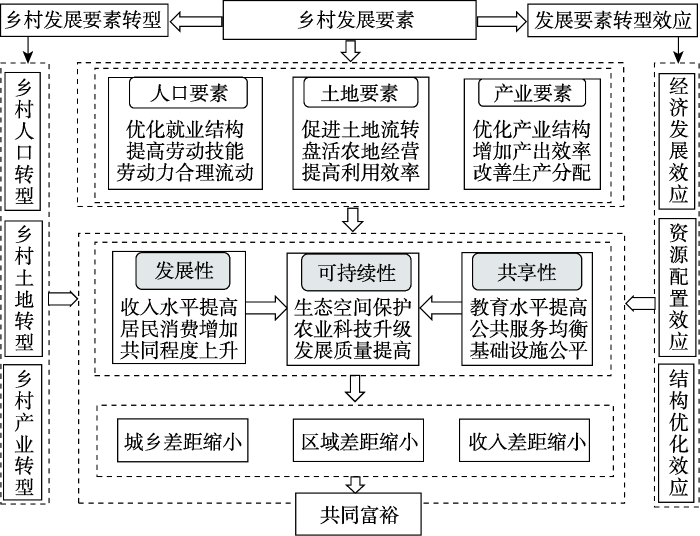
图1
乡村发展要素转型对共同富裕的影响理论框架
Fig. 1
Theoretical framework of the impact of factors of rural transformation development on common prosperity
2.1 乡村发展要素转型对共富“发展性”的影响
经济发展是实现共同富裕的重要前提,实现共同富裕需要推动群体、区域之间发展成果的收敛[9]。乡村发展要素转型对共富“发展性”的影响主要体现于乡村人口流动、土地转型以及产业升级等方面。从乡村人口流动促进共富发展视角出发,乡村人口要素转型能够促进城乡人口的良性流动,村庄通过人才返乡创业所带来的技术、资金等推动乡村产业发展[26],促进农民就业,提高农民收入;其次,农业剩余劳动力的流动通过释放农业资源实现了农业规模经营,进而增加农业劳动收入,缩小城乡之间的收入差距[27];农村劳动力的流动还能够有效提高农村居民的消费水平,并在提高本地消费水平的同时促进邻近地区农村居民的消费水平的提升[28],有效缩小城乡实际消费水平的差距。从乡村土地转型促进共富发展视角出发,乡村土地要素转型能够引导土地资源在不同区域、产业间的配置[29],通过加速土地流转、调整农地结构等,使土地利用由传统农业向现代农业模式转移,增加农户纯收入、工资性收入与经营性收入等,提升乡村的经济效益,并有助于提升乡村自身经济核心竞争力,实现专业村的建设,专业村的空间扩散作用还能够带动周边地区的协同发展,进而缩小区域间的发展差距。从乡村产业升级促进共富发展视角出发,产业升级是解决农村问题的重要路径之一,乡村产业要素转型能够通过调整农业结构、提升生产分工规模和生产效率促进产业升级,有效提高生产和改善分配,进而增加农民收入、缩小城乡差距[30];收入的增加还能够提升农村医疗保险等公共服务的覆盖率[31],进一步调节收入差距,使社会公平性得到大幅提升,加速了农民农村共同富裕进程。
2.2 乡村发展要素转型对共富“共享性”的影响
共同富裕是发展与共享的有机统一,要在富裕的基础上实现共享[4],这意味着实现共同富裕不仅需要缩小城乡居民收入差距,还应以提高乡村居民生活质量为目的,全力推进基本公共服务均等化[32]。在共富“发展性”的基础上,当乡村发展要素转型时,会产生以下效应:一是经济发展促进效应,经济发展有助于提高政府财政对于教育的投入程度,为乡村产业结构的优化升级提供人才保障,还有助于政府税收收入的增加,进而加强政府对于基础设施的投入,缩小区域间的差距。二是资源配置优化效应,乡村土地要素转型可以使土地资源得到重新配置,建设用地结构和功能得到改善,这既能强化村镇的社区功能,完成城市与乡村之间物质和信息的交换流通,还能逐渐提升乡村医疗、教育、社会保障等公共服务水平,促进城乡公共服务均等化[33];土地要素转型还能够吸引资本流入,进而促进非农产业、服务业的发展与人才的流入,倒逼基础设施和公共服务优化,提高公共服务的配置要求,从而带动公共服务共享发展[34]。三是产业结构优化效应,乡村转型发展能够带动产业不断优化与升级,吸引企业增加对乡村二、三产业的投资,促使政府和企业增加对于农村基础设施的资金投入,缩小城乡之间公共资源的分配差距,从而促进农村教育、医疗卫生、养老等公共服务和社会事业的发展,消除社会保障及可行性方面的歧视[35],公共服务水平的提高还能够夯实乡村信息化发展,有助于促进社会平等、全民公平。
2.3 乡村发展要素转型对共富“可持续性”的影响
共同富裕的关键在于实现发展与共享的可持续性[36],乡村发展要素转型为共同富裕的可持续性提供了有力支撑。首先,乡村发展要素转型有助于乡村生态治理,极大程度上保护了乡村生态空间[37],良好的生态空间能够为乡村居民提供生态服务、吸引城市人才的流入,从而维持乡村相对稳定的发展能力[38];乡村生态空间治理还能够通过将生态资源转化为生态产品,满足大众生态需求,形成生态产业化、产业生态化以促进乡村生态振兴,为推动县域经济持续健康发展提供有力保障。其次,农业科技创新对于实现高质量发展具有重要意义,乡村发展要素转型能够推动农业科技的创新升级,农业技术进步通过技术扩散带动区域农民增收与农业节本增效,发挥农业技术进步的合理配置和溢出效应,实现城乡间要素的流动[39],其均衡发展的长效机制将助力共同富裕的实现及其可持续发展。最后,乡村发展要素转型能够通过产业发展、社区功能集约等实现乡村的可持续发展[34],在激活内部资源的基础上联结外部要素,不断扩大合作网络、培育地区特色产业、持续生产服务,推动乡村产业绿色高效生产与稳定持续增收,实现乡村经济可持续发展的目标[40];乡村发展要素转型还能够加强政府财政支出的可持续性,保证乡村基础设施建设和公共服务的持续推进,为高质量发展建设共同富裕提供保障。
3 研究设计
3.1 共同富裕指标体系构建
共同富裕强调全体人民达到生活富裕富足、精神自信自强、环境宜居宜业、社会和谐和睦以及公共服务普及普惠,实现人民全面发展和社会全面进步,共享改革发展成果和幸福美好生活。无论从何视角出发,共同富裕的实现归根结底在于强调发展的充分性与均衡性,即通过对由于多种因素导致的不平等进行矫正和补偿,达到让全体人民均等地参与到高质量经济社会发展中,并共享经济社会发展成果的目的[5]。基于对共同富裕内涵的理解,本研究认为共同富裕应具有发展性、共享性和可持续性三大特征,发展性是指经济高质量发展取得实质性成效,即国内生产总值的提升能够有效转化为居民收入,基于发展水平提升实现城乡收入差距等多种差距缩小;共享性是指经济发展成果的全民性和全面性,即实现发展产生的公共服务及基础设施共享;可持续性是指全国所追求的共同富裕是建立在环境友好型、生态保护型基础上的高质量发展的富裕[9]。共同富裕要在“发展”与“共享”的基础上,形成持久扎实的推进机制,实现发展性、共享性和可持续性的统一[5,9]。针对发展性而言,收入是衡量物质富裕的基础,更是共同富裕的核心组成,因此从收入和消费两个层面,对居民富裕度与共同度进行测度,分别采用人均可支配收入衡量居民物质水平的获得情况,人均消费支出和恩格尔系数衡量居民的物质财富实现水平;通过县域间的发展差距,来测度县域间共同度水平,分别用城乡居民收入泰尔指数、城乡医疗保险覆盖率和城乡居民收入倍差进行衡量。针对共享性而言,从文化教育、医疗健康、基础设施、信息化水平以及社会保障5个方面进行测度,用以反映基础设施建设及公共服务水平是否惠及全体人民。最后,针对可持续性而言,从科技创新水平、生态环境保护与经济发展质量3个方面进行测度,反映生态环境、经济发展质量和科技进步的长远发展潜力,具体的共同富裕指标体系如表1所示。关于共同富裕水平的测度,借鉴相关研究经验[41],运用熵权法进行计算。
表1 共同富裕指标体系
Tab. 1
| 目标层 | 准则层 | 结构层 | 指标层 | 权重 |
|---|---|---|---|---|
| 共同富裕 | 发展性 | 富裕度 | 人均可支配收入(万元/人) | 0.037 |
| 人均消费支出(万元/人) | 0.052 | |||
| 恩格尔系数 | 0.012 | |||
| 共同度 | 城乡居民收入泰尔指数 | 0.010 | ||
| 城乡居民收入倍差 | 0.011 | |||
| 农村居民医疗保险参与率(%) | 0.039 | |||
| 共享性 | 文化教育 | 人均公共图书藏书量(册/人) | 0.129 | |
| 人均教育投入(万元/人) | 0.057 | |||
| 医疗健康 | 每万人拥有医疗机构床位数(张) | 0.024 | ||
| 每万人拥有执业医师数(个) | 0.024 | |||
| 基础设施 | 人均民用汽车拥有量(辆) | 0.038 | ||
| 每万人公共绿地面积(hm²) | 0.068 | |||
| 信息化水平 | 每百人中移动电话用户数 | 0.095 | ||
| 互联网接入率(%) | 0.041 | |||
| 社会保障 | 每万人社会福利床位数(张) | 0.024 | ||
| 可持续性 | 科技创新 | 每万人专利授权数(件) | 0.070 | |
| 生态环境 | 人均碳排放强度(元/人) | 0.129 | ||
| 森林覆盖率(%) | 0.004 | |||
| 发展质量 | 人均GDP(万元/人) | 0.012 | ||
| 全社会劳动生产率(万元/人) | 0.038 |
3.2 乡村发展要素转型指标体系构建
表2 乡村发展要素转型指标体系
Tab. 2
| 目标层 | 准则层 | 结构层 | 指标说明 | 权重 |
|---|---|---|---|---|
| 乡村发展要素发展水平 | 乡村人口发展 | 城镇化率 | 城镇人口与总人口的比值(%) | 0.035 |
| 从业结构 | 乡村从事非农林牧渔业/乡村从业(%) | 0.023 | ||
| 人口结构 | 乡村从业人员/乡村常住人口(%) | 0.032 | ||
| 乡村土地发展 | 农村耕地 | 耕地面积/乡村常住人口(hm²) | 0.051 | |
| 农地施肥 | 化肥施用量/耕地面积(t/hm²) | 0.060 | ||
| 农地灌溉 | 有效灌溉面积/耕地面积(%) | 0.035 | ||
| 农地产出 | 农林牧副渔业产值/耕地面积(万元/hm²) | 0.157 | ||
| 乡村产业发展 | 农业机械化 | 农业机械总动力/耕地面积(kw/hm²) | 0.044 | |
| 产业结构 | 农林牧副渔产值/国民生产总值(%) | 0.046 | ||
| 农业产出 | 农林牧渔业产值/农林牧渔业从业(万/人) | 0.064 | ||
| 产业融合水平 | 一二三产业融合水平 | 0.017 | ||
| 乡村发展要素转型水平 | 乡村人口转型 | 城镇化率变化 | 城镇人口占总人口比例的变化(%) | 0.035 |
| 从业结构变化 | 从事非农林牧渔业占总从业人口比例的变化(%) | 0.023 | ||
| 人口结构变化 | 乡村从业人口占总人口比例的变化(%) | 0.032 | ||
| 乡村土地转型 | 农村耕地变化 | 人均耕地面积的变化(hm²) | 0.051 | |
| 农地施肥变化 | 平均化肥施用量的变化(t/hm²) | 0.060 | ||
| 农地灌溉变化 | 有效灌溉面积与耕地面积比值的变化(%) | 0.035 | ||
| 农地产出变化 | 农林牧渔业平均产值的变化(万元/hm²) | 0.157 | ||
| 乡村产业转型 | 农业机械化水平变化 | 机械化水平的变化(kw/hm²) | 0.044 | |
| 产业结构变化 | 农林牧副渔产值占总产值比例的变化(%) | 0.046 | ||
| 农业产出变化 | 农业人均产出值的变化(万/人) | 0.064 | ||
| 产业融合变化 | 一二三产业融合水平的变化 | 0.017 |
注:乡村发展要素转型水平中的变化值使用当期指标数值与基期指标数值的差值表示。
4 数据来源与研究方法
4.1 数据说明及数据来源
2021年6月中共中央、国务院印发《关于支持浙江高质量发展建设共同富裕示范区的意见》,浙江省作为先行示范区,承担起了重要的示范改革任务,为全国推动共同富裕提供省域示范。县域经济的振兴发展更加有利于实施好公共政策和社会政策[21],实现共同富裕,县域是关键。因此,本研究选取2011—2020年浙江省52个县域作为研究对象。其中,本研究所运用的共同富裕发展水平、乡村发展要素转型水平的测度数据以及模型中其他的控制变量数据主要来源于2012—2021年的《浙江省统计年鉴》《中国农村统计年鉴》及浙江省各市统计年鉴。
4.2 Kernel密度估计
Kernel密度估计是一种非常重要的非参数动态估计法,由于对模型的依赖性较低,且具有较强的稳健性,因此被广泛应用于空间非均衡分析中。借鉴已有研究[43],本研究通过Kernel密度估计揭示共同富裕发展分布的演进特征。
式中:
4.3 空间自相关检验
本研究采用全局Moran' I指数对浙江省各县共同富裕水平进行空间自相关分析,相关公式如下:
式中:S2为样本方差;
4.4 空间计量模型
4.4.1 模型设定
共同富裕水平具有空间正相关性,如果忽视了这种空间相关性,在对共同富裕水平影响因素展开分析时,将会使系数估算产生偏误,基于此,本研究采用了空间计量模型。空间杜宾模型兼顾了共同富裕发展水平和乡村发展要素转型水平的空间滞后项,可以计算出乡村发展要素转型的直接效应与间接效应,其动态形式兼顾了共同富裕发展水平的时间滞后项和空间滞后项,能够在一定程度上缓解模型的内生性问题,因此,本文选用动态空间杜宾模型展开分析,具体表示形式如下:
式中:
4.4.2 空间权重说明
本研究采用空间邻接权重矩阵、地理距离空间权重矩阵与经济距离空间权重矩阵对模型进行处理,其中经济距离空间权重矩阵以两县域之间人均GDP差距的倒数为测度依据。
4.4.3 变量选取
梳理大量前人文献[44⇓⇓⇓⇓⇓⇓-51],发现各领域学者对共同富裕水平影响因素的探讨主要集中在经济因素和社会制度因素两方面。从经济因素角度看,人均GDP、产业结构、经济开放、财政收支等因素能够有效缩小收入差距,夯实共同富裕的发展基础[44⇓-46];从地区制度因素看,外商直接投资能够为居民提供更高的劳动报酬,促进了居民收入的增加,从而缩小收入的差距[47,48],对于低收入群体和欠发达地区,政府预算内收入能够进一步完善转移支付制度,使转移支付“输血”和“造血”两大功能协同发力助推共同富裕[49],此外教育水平、公共服务水平等也能够促进共同富裕[50,51]。如表3所示,在参照已有文献的基础上,本文引入了可能影响共同富裕发展水平的控制变量:① 金融发展水平(Fina)金融机构贷款余额占地区生产总值的比例;② 政府财政供给(Gover)政府一般预算内收入;③ 产业升级支撑(Indust)二三产业增加值占GDP的比例;④ 外商直接投资(Fdi)实际利用外资额占地区生产总值的比例;⑤ 贸易开放程度(Open)各进出口总额占地区生产总值的比例。
表3 变量说明
Tab. 3
| 变量类型 | 变量符号 | 变量名称 | 变量测度方式 |
|---|---|---|---|
| 被解释变量 | Common | 共同富裕发展水平 | 基于前文指标体系测度 |
| Common1 | 共富“发展性” | 基于前文指标体系测度 | |
| Common2 | 共富“共享性” | 基于前文指标体系测度 | |
| Common3 | 共富“可持续性” | 基于前文指标体系测度 | |
| 核心解释变量 | Rural | 乡村发展要素转型 | 基于前文指标体系测度 |
| 控制变量 | Fina | 金融发展水平 | 年末金融机构贷款余额/地区生产总值(%) |
| Gover | 政府财政供给 | 政府一般预算内收入/总支出(%) | |
| Indust | 产业升级支撑 | 二三产业增加值/地区生产总值(%) | |
| Fdi | 外商直接投资 | 实际利用外资额/地区生产总值(%) | |
| Open | 贸易开放程度 | 各进出口总额/地区生产总值(%) |
5 浙江县域共同富裕发展的时空演化格局
5.1 浙江县域共同富裕发展水平的时间演进特征
为明晰浙江省不同县域、不同时段下共同富裕发展水平的总体分布和变化趋势,本研究运用MATLAB软件,绘制了2011—2020年浙江县域共同富裕发展水平核密度估计图(图2)。
图2
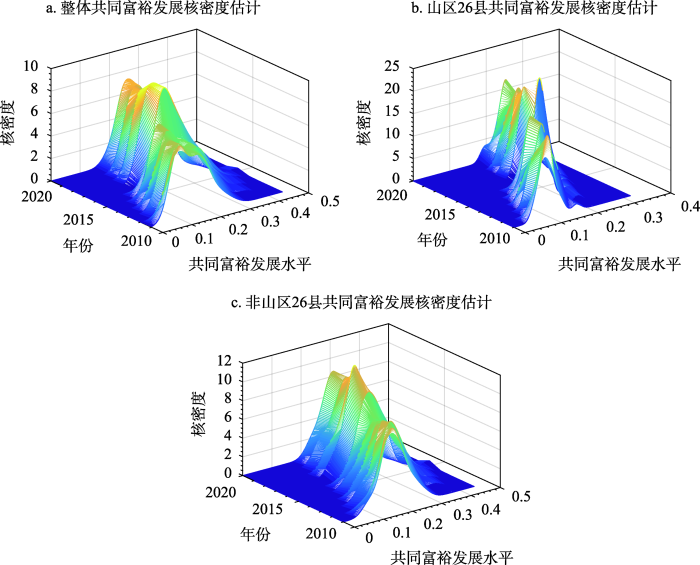
图2
共同富裕发展水平核密度估计图
Fig. 2
The estimation of kernel density of common prosperity
图2a为浙江省52个县域的共同富裕发展水平核密度估计图,在样本观察期内,核密度估计曲线呈现出了由“多峰向单峰”转变的发展趋势,表示共同富裕发展极化水平下降,共同富裕呈现出协调发展态势;在分布位置上,共同富裕曲线波形整体由左向右偏移,表明2011—2020年浙江省共同富裕发展水平在逐渐上升,共同富裕发展在浙江省整体发展中的地位越来越重要,是驱动经济发展和社会进步的重要引擎。图2b为浙江省山区26县共同富裕发展水平核密度估计图,在样本观察期内,波峰高度呈梯度上升趋势,最高值在观测范围内由左向右偏移,峰宽逐年增大,说明山区26县共同富裕水平逐渐增加,离散程度有所上升,绝对差异总体存在扩大趋势;在极化水平上,核密度估计曲线存在多峰,且随着时间推移波峰并未消失,说明在山区26县中共同富裕发展的多级分化现象仍比较明显,并未得到较好的改善。图2c为浙江省非山区26县的共同富裕发展水平核密度估计图,在样本观察期内,波峰先减小再增大,最高值在观测范围内由左向右偏移,带宽逐渐增加,说明非山区26县的共同富裕水平呈上升趋势;在2017年后出现“双峰”,其中,双峰由一个“高峰”和一个“矮峰”组成,存在多极化现象,“矮峰”意味着非山区26县地区的共同富裕水平向中高水平迈进,表明高共同富裕水平地区的不断崛起,从而带动其他非山区26县的整体共同富裕水平提升,但各县之间共同富裕水平的差异仍未消除。
5.2 浙江县域共同富裕发展水平的空间分布格局
本研究运用ArcGIS 10.2软件,对县域尺度下共同富裕发展水平空间分布的演化特征进行可视化分析,并采用自然断点法对共同富裕水平类型划分,将共同富裕发展水平分为共富滞后区、共富追赶区、共富推进区和共富先行区(图3)。从总体来看,2011—2020年浙江省县域共同富裕发展水平呈现逐渐增强态势;从局部来看,浙江省共同富裕发展水平呈现出从浙东北向浙西南梯次降低的空间分布格局。在2011—2015年期间,共同富裕发展滞后区开始加强自身发展,但由于资源禀赋及发展基础等因素限制,追赶态势并不明显,多数县域的共同富裕发展层级差距并未得到大幅改善,其中桐庐县、浦江县、新昌县以及东阳市挺入共富推进区;在2015—2020年期间,长兴县、新昌县、云和县、温岭市、瑞安市以及乐清市陆续挺近共富先行区的行列,并带动了周边县域的发展,最终形成以嘉兴市、宁波市等为核心的共同富裕发展格局。具体来说,在2015年,青田县的共同富裕发展水平最低(0.132),义乌市的共同富裕发展水平最高(0.440),由于地理位置和产业发展的差距,共同富裕发展水平差距突出,大部分地区共同富裕发展水平都普遍较低;至2020年,整体共同富裕发展水平有了较为明显的提升,发展格局呈现出由核心地区向周边扩散的态势,一方面,缘于资源从核心县域向外扩散能够改善县域发展的结构与格局,另一方面,核心县域能够借助共同富裕的溢出效应影响周边县域发展,带动整体的发展水平。
图3
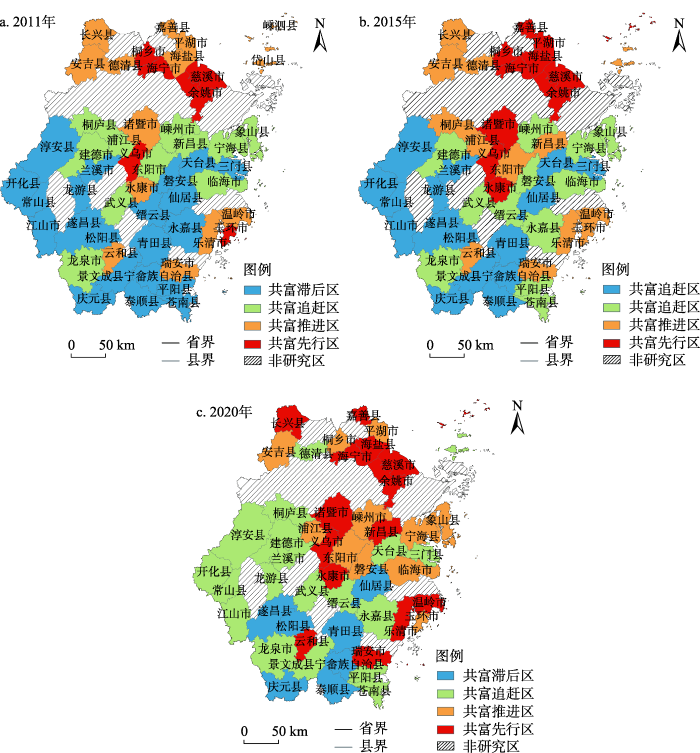
图3
浙江省共同富裕发展水平的空间分布格局
Fig. 3
The spatial patterns of common prosperity development levels
5.3 共同富裕发展水平的空间差异特征
根据2012—2021年浙江统计年鉴数据,将浙江省52个县域分为山区26县和非山区26县两个区域,根据泰尔指数测算公式,测算出共同富裕发展水平泰尔指数以及组间和组内共同富裕发展差距的泰尔指数贡献率(图4)。全省各县共同富裕差距一直存在,但整体上呈现减小趋势,2011—2020年泰尔指数从0.077下降到0.015,其中2015年下降幅度最大,下降0.0278。说明2011年以来,浙江省共同富裕发展更加协调,且发展差距逐渐缩小。从组内、组间差距对共同富裕差距的贡献可发现,尽管组内差距小于组间差距,但2011—2020年组间差距对总体差距的贡献呈逐年下降趋势,由2011年的61.34%下降至2020年的49.46%;同期组内差距对总体差距的贡献却呈上升趋势,贡献度上升了11.88%。2011—2020年组间差距对总体差距的平均贡献度高达54.99%,而组内差距贡献度不足50%,组间差异的贡献率明显超过组内差异。因此,在短期内解决共同富裕发展水平区域空间不平衡的关键还应当是缩小山区26县与非山区26县之间的差距。
图4
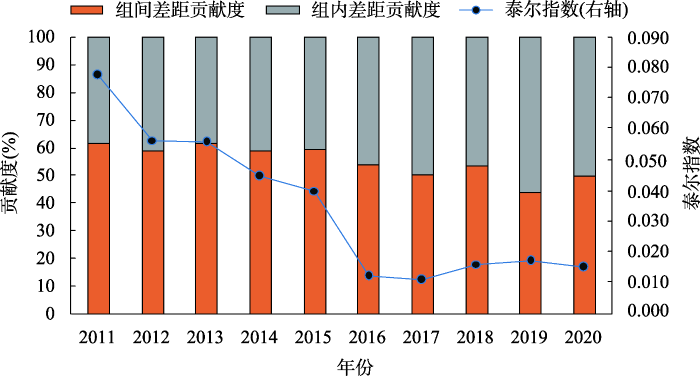
图4
共同富裕发展水平空间差异
Fig. 4
The spatial differences of common prosperity development levels
6 乡村发展要素转型对共同富裕影响的计量分析
6.1 乡村发展要素转型与共同富裕发展水平的空间自相关检验
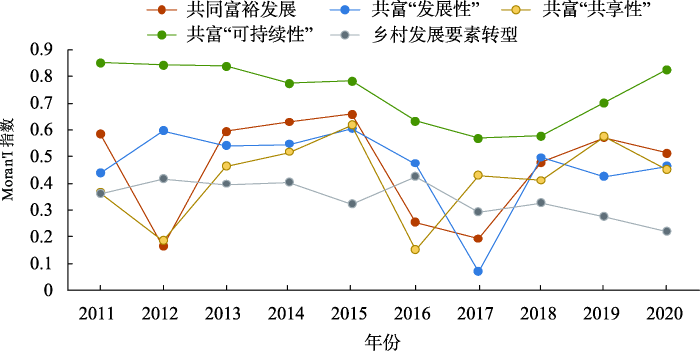
本文基于全局Moran' I指数探索浙江省县域共同富裕发展水平的集聚特征,共同富裕发展分布格局呈现出一定集聚性,为深入分析其空间关联性,计算共同富裕发展不同维度的全局莫兰指数(图5)。2011—2020年浙江省各县域共同富裕发展水平的莫兰指数在整体上呈现“两降两升”的W型波动的变化形态,莫兰指数皆为正,且通过显著性检验,这表明浙江省共同富裕发展水平具有空间聚集性,虽然总体上共同富裕的莫兰指数数值略有下降,但仍然表现出了非常强的空间正自相关。在共富“发展性”维度,“发展性”整体上呈现出了下降趋势,2017年左右出现急剧下降和上升的“V”型趋势,可能的原因是乡村振兴战略的实施促进了区域间的要素流动,优化了要素配置水平,从而促进部分地区加速发展;共富“共享性”变化趋势整体上与“发展性”保持一致,“可持续性”整体呈现了先下降后上升的趋势,且聚集度高于整体共同富裕发展和其他维度。乡村发展要素转型的莫兰指数整体上相对平稳,呈现了下降趋势,说明其在空间上的聚集程度有所降低。
图5
6.2 乡村发展要素转型对共同富裕影响的回归结果
本文Wald检验、LR检验的P值均在1%的水平上显著,表明空间杜宾模型不会发生退化。此外,基准回归模型的Hausman检验也通过了1%的显著性检验,选择固定效应模型更佳,经过双重检验可知固定效应空间杜宾模型为最优选择。
结果如表4所示,在三种权重下,乡村发展要素转型对共同富裕发展水平的影响系数(Rural)均显著为正,说明乡村发展要素转型能够显著提升本地区的共同富裕发展水平,可能是因为乡村发展要素转型过程中技术的进步能够带动产业升级,进而推动乡村经济发展,且乡村发展要素转型过程中会加速其他要素在区域间的流动,使生产效率和乡村资源使用效率得到优化调整,对共同富裕产生了显著的促进作用。在控制变量中,对外直接投资(Fdi)在不同空间权重矩阵下具有差异性,在邻接权重和经济权重下,对外直接投资对共同富裕的发展具有显著的负向效应,缘于对外直接投资具有熟练劳动力偏好,将会导致财富向少数人集中,使贫富差距持续扩大,不利于本土地区减贫[52]。基于动态杜宾模型发现,在经济权重矩阵下,对外直接投资对共同富裕并无显著影响,究其原因是地理邻近而非经济相近地区的对外直接投资水平提高更倾向于对本地区共同富裕发展造成压力;产业升级支撑(Indust)在非动态杜宾模型中的三种矩阵下表现了出一致性结果,均在1%水平上对共同富裕发展产生显著的正向影响,其原因可能在于产业升级能够促进资源在产业间的合理配置,使一二三产业的劳动生产率逐渐接近,产业间的收入差距逐渐减少,从而缩小城乡收入差距。贸易开放水平(Open)在动态杜宾模型中的三种矩阵下也表现出了一致性结果,均在10%水平上对共同富裕产生显著的正向影响,其原因可能是贸易开放会加速国内外的竞争,吸引更多国外投资的涌入,以此提升收入和生活水平,进而缩小城乡差距。
表4 空间计量模型回归结果
Tab. 4
| 变量 | 动态杜宾模型 | 非动态杜宾模型 | ||||
|---|---|---|---|---|---|---|
| 邻近权重 | 地理权重 | 经济权重 | 邻近权重 | 地理权重 | 经济权重 | |
| L. Common | 0.563*** | 0.616*** | 0.578*** | |||
| (18.778) | (20.066) | (17.618) | ||||
| Rural | 0.090*** | 0.085*** | 0.112*** | 0.109*** | 0.140*** | 0.121*** |
| (2.936) | (2.641) | (3.521) | (3.078) | (3.585) | (3.448) | |
| Fina | -0.012 | -0.002 | -0.037 | 0.048 | 0.059 | -0.026 |
| (-0.390) | (-0.072) | (-1.128) | (1.225) | (1.398) | (-0.681) | |
| Gover | 0.068 | 0.072 | 0.073 | -0.021 | -0.012 | -0.020 |
| (1.459) | (1.491) | (1.528) | (-0.358) | (-0.183) | (-0.342) | |
| Indust | 0.382 | 0.555 | 0.454 | 1.537*** | 1.527*** | 1.152*** |
| (1.058) | (1.532) | (1.282) | (3.368) | (3.152) | (2.709) | |
| Fdi | -0.009** | -0.008** | -0.006 | -0.016*** | -0.012** | -0.008* |
| (-2.375) | (-2.198) | (-1.552) | (-3.522) | (-2.528) | (-1.811) | |
| Open | 0.018* | 0.018* | 0.018* | 0.017 | 0.014 | 0.016 |
| (1.831) | (1.758) | (1.701) | (1.430) | (1.062) | (1.387) | |
| W×Rural | 0.089* | 0.459 | -0.178** | 0.105* | 2.180*** | 0.099 |
| (1.705) | (1.573) | (-2.036) | (1.755) | (6.658) | (1.053) | |
| W×Fina | -0.007 | 0.507 | 0.105 | -0.045 | 0.327 | 0.260*** |
| (-0.135) | (1.574) | (1.461) | (-0.746) | (0.769) | (3.065) | |
| W×Gover | 0.171** | 0.466 | -0.031 | -0.032 | -0.075 | -0.169 |
| (2.334) | (1.161) | (-0.226) | (-0.354) | (-0.139) | (-1.046) | |
| W×Indust | -0.450 | -7.405** | -0.615 | 0.028 | 1.961 | 2.169* |
| (-1.086) | (-2.055) | (-0.613) | (0.052) | (0.425) | (1.836) | |
| W×Fdi | 0.006 | 0.063* | -0.016 | 0.015** | 0.083** | -0.024* |
| (1.081) | (1.931) | (-1.391) | (2.077) | (1.986) | (-1.871) | |
| Open | 0.011 | -0.036 | -0.013 | -0.016 | 0.011 | 0.003 |
| (0.731) | (-0.379) | (-0.613) | (-0.871) | (0.083) | (0.137) | |
| rho | 0.316*** | 0.905*** | 0.340*** | 0.542*** | 0.732*** | 0.648*** |
| (7.833) | (6.558) | (6.114) | (15.302) | (9.310) | (13.963) | |
| sigma2_e | 0.005*** | 0.005*** | 0.006*** | 0.008*** | 0.010*** | 0.008*** |
| (16.843) | (16.642) | (16.954) | (15.504) | (15.931) | (15.658) | |
| Observations | 468 | 468 | 468 | 520 | 520 | 520 |
| R2 | 0.774 | 0.436 | 0.872 | 0.053 | 0.454 | 0.012 |
| Number of n | 52 | 52 | 52 | 52 | 52 | 52 |
| City FE | YES | YES | YES | YES | YES | YES |
| Year FE | YES | YES | YES | YES | YES | YES |
注:***表示P<0.01;**表示P<0.05;*表示P<0.1。
6.3 空间效应分解
为了进一步确定不同因素对共同富裕发展水平影响的方式,本研究将空间溢出效应进行分解计算(表5)。乡村发展要素转型(Rural)对应的直接效应系数显著为正,说明乡村发展要素转型对自身共同富裕发展水平的提高具有促进作用。具体而言,在短期内乡村发展要素转型的直接效应系数为0.103,在长期内则为0.377,可知乡村发展要素转型对共同富裕发展水平提高的贡献非常显著,且长期效果更好。同时,在短期内乡村发展要素转型对应的间接效应系数也显著为正,代表一个县域的乡村发展要素转型能够对其他县域共同富裕发展水平产生正向溢出效应,原因在于乡村发展要素转型具有经济溢出效应,不仅能够促进农村本地金融产业结构优化,还能够激励周边地区产业长效发展,有效带动区域内产业经济的全面增长[53];此外,乡村发展要素转型还具有技术溢出效应,能够带动乡村地区技术进步,增加农业生产所能达到的最高产量,并通过农业技术扩散带动邻近地区跟进,完成技术普及,缩小城乡收入差距[54]。而在其他变量中,无论是长期效应还是短期效应,政府财政供给(Gover)的直接效应都显著为正,说明区域内政府财政供给对共同富裕发展水平具有显著的促进作用。在短期内,政府财政供给对其他县域的共同富裕发展水平具有显著的溢出效应,且对本县域产生正向的反馈效应,但是长期来看,则不具有明显的溢出效应。
表5 空间效应分解结果
Tab. 5
| 短期效应 | 长期效应 | |||||
|---|---|---|---|---|---|---|
| 直接效应 | 间接效应 | 总效应 | 直接效应 | 间接效应 | 总效应 | |
| Rural | 0.103*** | 0.155** | 0.258*** | 0.377*** | 1.183 | 1.560 |
| (3.266) | (2.288) | (3.043) | (2.842) | (0.633) | (0.816) | |
| Fina | -0.010 | -0.008 | -0.018 | -0.033 | -0.089 | -0.122 |
| (-0.321) | (-0.131) | (-0.241) | (-0.316) | (-0.115) | (-0.151) | |
| Gover | 0.091* | 0.262*** | 0.353*** | 0.414** | 1.758 | 2.171 |
| (1.955) | (2.591) | (2.916) | (2.108) | (0.556) | (0.674) | |
| Indust | 0.337 | -0.484 | -0.146 | 0.629 | -1.443 | -0.813 |
| (0.952) | (-0.901) | (-0.206) | (0.560) | (-0.190) | (-0.101) | |
| Fdi | -0.008** | 0.005 | -0.003 | -0.020 | 0.003 | -0.016 |
| (-2.212) | (0.644) | (-0.348) | (-1.526) | (0.039) | (-0.170) | |
| Open | 0.020* | 0.021 | 0.040 | 0.066* | 0.173 | 0.239 |
| (1.860) | (1.054) | (1.619) | (1.848) | (0.501) | (0.670) | |
注:***表示P<0.01;**表示P<0.05;*表示P<0.1。
6.4 分维度效应检验
为进一步探究乡村发展要素转型对共同富裕发展水平的具体作用,分别以共同富裕发展指标体系中共享性(Common1)、发展性(Common2)和可持续性(Common3)作为被解释变量进行实证分析(表6)。在“共享性”维度中,乡村发展要素转型对共富“共享性”具有显著的正向影响,说明乡村发展要素转型可以促进农村基础设施的增加、社会保障制度的完善以及其他公共服务水平的提升;政府财政供给(Gover)与贸易开放水平(Open)均对共富“共享性”具有显著的正向影响,且贸易开放水平(Open)具有空间溢出效应。从“发展性”维度的结果来看,乡村发展要素转型对共富“发展性”具有显著的正向影响,说明乡村发展要素转型可以有效推动乡村产业的发展,加快农业现代化进程,使中等收入群体比例增加,进而缩小城乡收入差距;然而贸易开放水平(Open)的提高却会抑制共富“发展性”的提高,可能是因为富裕地区在吸引外资方面具有天然的区位和产业优势,外资流入上述地区可能进一步加大其与欠发达地区和农村地区的收入差距。从“可持续性”维度的结果来看,乡村发展要素转型并不会对本地区共富“可持续性”产生显著的影响,其原因可能是乡村发展要素转型在短期内可以产生较高的经济收益,但依靠大量要素投入推动的经济增长是不可持续的经济增长,只有依靠科学的进步与技术的提升,发展绿色经济,才能实现经济的可持续增长。
表6 分维度效应检验结果
Tab. 6
| 变量 | 共享性 | 发展性 | 可持续性 | |||
|---|---|---|---|---|---|---|
| X | W×X | X | W×X | X | W×X | |
| L.Y | 0.483*** | 0.738*** | 0.702*** | |||
| (20.248) | (23.643) | (19.004) | ||||
| Rural | 0.104*** | -0.052 | 0.149*** | 0.194** | -0.007 | -0.071** |
| (2.738) | (-0.796) | (3.284) | (2.499) | (-0.331) | (-2.037) | |
| Fina | 0.019 | 0.007 | 0.022 | -0.114 | -0.036 | 0.066* |
| (0.479) | (0.114) | (0.451) | (-1.553) | (-1.571) | (1.868) | |
| Gover | 0.159*** | -0.026 | 0.027 | 0.256** | 0.005 | -0.028 |
| (2.760) | (-0.279) | (0.388) | (2.341) | (0.163) | (-0.525) | |
| Indust | 0.251 | -1.100** | 0.526 | -0.259 | 0.709*** | -0.855*** |
| (0.555) | (-2.153) | (0.980) | (-0.422) | (2.757) | (-2.886) | |
| Fdi | -0.014*** | 0.013* | -0.008 | 0.001 | 0.000 | 0.007 |
| (-3.063) | (1.805) | (-1.532) | (0.098) | (0.107) | (1.625) | |
| Open | 0.024* | 0.039** | -0.028* | -0.002 | -0.000 | 0.004 |
| (1.923) | (2.060) | (-1.877) | (-0.108) | (-0.008) | (0.339) | |
| rho | 0.317*** | 0.433*** | ||||
| (7.863) | (11.938) | |||||
| sigma2_e | 0.008*** | 0.011*** | ||||
| (16.851) | (16.502) | |||||
| Observations | 468 | 468 | 468 | 468 | 468 | 468 |
| R2 | 0.835 | 0.835 | 0.696 | 0.696 | 0.720 | 0.835 |
| Number of n | 52 | 52 | 52 | 52 | 52 | 52 |
| City FE | YES | YES | YES | YES | YES | YES |
| Year FE | YES | YES | YES | YES | YES | YES |
注:***表示P<0.01;**表示P<0.05;*表示P<0.1。
6.5 乡村振兴战略实施的分时检验
新时代乡村振兴战略的重点是破解乡村发展面临的主要问题,并以激活乡村内生动力和要素活力为抓手,通过推动乡村发展要素转型重塑城乡关系,最终全面实现共同富裕[55]。为了考量乡村振兴战略实施前后乡村发展要素转型对共同富裕的影响,以2017年为节点,将整体时间分为2011—2016年以及2017—2020年两个时间段进行分时段检验。从表7中可以看出,在实施乡村振兴战略之后,乡村发展要素转型对共同富裕水平产生了显著的正向影响,这说明乡村振兴战略的实施使农村基础设施的投入力度逐渐加大,并极大地提高了农村农民的社会保障水平,带动了主导产业和特色优势产业的积极发展以及人居环境质量的显著提升[56],使农村经济的发展和农民生活水平得到改善,以此达到共同富裕的目的。在实施乡村振兴战略前后,金融发展水平对共同富裕产生的负面影响有所减弱,贸易开放水平(Open)对共同富裕的影响也变得不显著,而政府财政供给(Gover)和产业升级支撑(Indust)则对共同富裕产生了更加显著的影响。因此,实施乡村振兴战略、推动城乡协调发展既是实现共同富裕的基本路径,也是促进共同富裕的必然选择。
表7 分时检验结果
Tab. 7
| 变量 | 2011—2016年 | 2017—2020年 | ||
|---|---|---|---|---|
| X | W×X | X | W×X | |
| Rural | -0.066 | -0.126 | 0.331* | 0.537* |
| (-0.527) | (-0.515) | (1.833) | (1.807) | |
| Fina | -0.212*** | 0.001 | 0.046 | -0.103 |
| (-4.412) | (0.008) | (0.823) | (-1.206) | |
| Gover | 0.041 | -0.005 | 0.241** | -0.188 |
| (1.104) | (-0.086) | (2.110) | (-0.993) | |
| Indust | 0.211 | 0.019 | 3.950*** | -1.522 |
| (0.639) | (0.047) | (2.954) | (-0.935) | |
| Fdi | 0.004 | 0.000 | -0.023*** | 0.014* |
| (1.269) | (0.005) | (-3.997) | (1.654) | |
| Open | 0.029*** | -0.007 | -0.002 | -0.006 |
| (2.972) | (-0.523) | (-0.090) | (-0.220) | |
| rho | 0.231*** | 0.564*** | ||
| (2.993) | (12.728) | |||
| sigma2_e | 0.001*** | 0.007*** | ||
| (10.112) | (11.971) | |||
| Observations | 312 | 312 | 208 | 208 |
| R2 | 0.195 | 0.195 | 0.336 | 0.336 |
| Number of n | 52 | 52 | 52 | 52 |
| City FE | YES | YES | YES | YES |
| Year FE | YES | YES | YES | YES |
注:***表示P<0.01;**表示P<0.05;*表示P<0.1。
7 结论与建议
7.1 结论
本研究基于多维度构建了乡村发展要素转型与共同富裕发展水平评价体系,探究浙江省52个县域2011—2020年共同富裕发展的时空演化特征和空间差异特征,并运用空间杜宾模型进一步探究乡村发展要素转型对共同富裕的影响效应,结果显示:
(1)2011—2020年浙江省共同富裕发展水平持续上升,共富滞后区的县域有所减少,共富追赶区、推进区和先行区的县域明显增加,虽然县域之间发展差距正在逐渐缩小,但山区26县与非山区26县之间的差距仍然存在,短期内缩小山区26县与非山区26县之间的差距是解决共同富裕发展水平空间不平衡的关键。
(2)乡村发展要素转型对共同富裕发展水平具有显著的促进作用,对邻近县域也能够产生正向的溢出效应,在一定程度上缓解了共同富裕发展水平空间不平衡的问题,且长期效果更好。此外,乡村振兴战略的实施能够强化乡村发展要素转型的作用,说明当前浙江省共同富裕发展具有较大的发展空间和潜力,发展势头良好。
(3)在分维度检验中,乡村发展要素转型能够对共富“共享性”和共富“发展性”产生显著的正向影响,但对共富“可持续性”并无显著影响,这说明当前浙江省乡村发展要素转型对于促进乡村经济发展、缩小城乡差距、加强乡村基础设施与乡村公共服务水平的影响效应较为明显,但是对于乡村生态环境治理、经济高质量发展与生产技术提升等方面的影响仍有待提升。
7.2 建议
本研究以乡村发展要素转型对共富“发展性”、共富“共享性”以及共富“可持续性”的影响效应作为机制切入点,分析乡村发展要素转型对共同富裕的影响,并以“乡村振兴”这一基本符合共同富裕发展内涵的政策检验乡村发展要素转型对共同富裕发展的影响效应,针对以上结论,本文提出以下几点建议:
(1)基于共同富裕“发展性”视角。消除两极分化,缩小城乡差距,政府应加强对本地发展规划的部署以及人才引进政策的规划,因地制宜借鉴周边地区发展路径,加快农业现代化进程;增强县城对乡村农产品消费、劳动力接纳的能力,加强对本土品牌的培育,增加就业岗位;引导土地资源的合理配置,改善耕地资源禀赋,加强对建设用地的管控,推动城乡协同发展。
(2)基于共同富裕“共享性”视角。完善基础设施,弥合城乡鸿沟,在发展性的基础上,通过乡村发展要素转型提高就业稳定性,政府应加强对教育的投入,为劳动力子女提供更好的教育资源,同时完善基础设施的建设和社会服务的投入,发展慈善公益事业,实现幼有所育、老有所养、病有所医、残有所助以及劳有所得等基本公共服务,保障全体社会成员的基本权利。
(3)基于共同富裕“可持续性”视角。强化科技支撑,实现绿色转型,全力推进农业技术的发展,提升自主创新能力,为产业转型升级和结构现代化、塑造产业竞争新优势提供强有力的技术支撑,加强共同富裕的文化氛围,丰富人民的精神文化生活;同时要践行“绿水青山”就是“金山银山”的理念,全面推进生产生活方式绿色转型。
本研究基于县域尺度对乡村发展要素转型和共同富裕发展水平之间的关系展开分析,使用空间计量模型分析乡村发展要素转型对共同富裕的影响效应研究,并使用分时检验,检验了乡村振兴战略前后乡村发展要素转型的作用,为促进共同富裕提供科学依据及理论参考,但本研究存在的不足还需进一步完善。一方面,由于数据的可获得性限制,对共同富裕发展水平以及乡村发展要素转型的指标选取不够完善,后续研究可在数据丰富性和更长的时间维度基础上对此拓展,完善共同富裕发展水平和乡村发展要素转型的测度。其次,本研究虽然将乡村振兴战略引入研究,但是由于篇幅限制,实证探讨不足,在后续研究中,还需对乡村振兴战略的影响机制及其效应进行更为深入的研究。
致谢
真诚感谢匿名评审专家在论文评审中所付出的时间和精力,专家对本文中理论框架分析、共同富裕与乡村生产要素转型指标体系的构建、结果分析、结论梳理等方面的修改意见,使本文获益匪浅。
参考文献
Study on spatial-temporal evolution characteristics and restrictive factors of urban-rural integration in northeast China from 2000 to 2019
With the rapid development of urbanization and the widening gap between urban and rural areas, how to effectively enhance the balanced development of urban and rural areas as well as promote the integrated development of urban and rural areas have become heated topics. Based on the basic theory of urban–rural integration and spatial balance, this paper establishes a comprehensive evaluation system. Using a coupling coordination model and an obstacle degree model, this paper selects 32 indicators from aspects of economy, society and ecology to measure the development level of urban–rural integration in 34 prefecture-level cities in Northeast China from 2000 to 2019. We also analyze the spatial pattern, evolution type characteristics and obstacle factors of urban–rural relations. The results show that: (1) The growth rate of urban development in Northeast China is higher than that of rural development. Except for rural ecology, all dimensions of urban and rural areas have increased year by year, but there are large spatial differences within the region. (2) The urban–rural integration development level of Northeast China is growing constantly and the types of urban and rural coordination are all rising to a higher level. Areas with high urban–rural coordination levels are concentrated in the Harbin–Changchun urban agglomeration and the central and southern Liaoning urban agglomeration, with obvious agglomeration effects. (3) In the coordinated development of urban and rural areas, the restrictive degree of the rural social subsystem was higher than that of the urban subsystem. The restrictive factors in the coordinated development of urban and rural areas are relatively stable, and include per capita consumption expenditure, per capita public budget expenditure, books in public libraries per thousand people, etc. (4) The functions of rural social elements should be enhanced, and the social urban–rural integrated development mechanism should be established to promote the integrated development of urban and rural society.
城乡融合发展驱动共同富裕的内在机理与实现路径
The internal mechanism and realization path of erban-rural integrated development driving common prosperity
基于购买力平价下共同富裕测算模型及实证分析
Measurement model and empirical analysis for common richness based on purchase capacity
共同富裕的目标和实现路径选择
China's goal and paths of common prosperity
共同富裕的理论内涵与政策议程
Common prosperity: Theoretical connotation and policy agenda
Rural - urban balance as a measure of socio-economic development with special reference to Iran
The urban-rural divide in radical right populist support: the role of resident's characteristics, urbanization trends and public service supply
In a number of recent elections in Western Europe, support for far-right populist parties has been significantly higher in non-urban areas than in urban areas. This paper answers the following questions; (1) Can the urban–rural divide in voting behavior be explained by the fact that urban and non-urban populations differ in terms of education, income and other individual characteristics of voters, or by variations in immigration? (2) Can variations in public service supply explain parts of the urban–rural divide in far-right populist support? and (3) How does population growth and public services relate to voting behavior when examining urban and rural municipalities separately? The analyses combine survey data on individual characteristics and register data aggregated on municipalities. The results in this paper suggest that voter characteristics and immigration explain a substantial part of the urban–rural divide. However, the propensity to vote for a far-right populist party is still higher in regions with lower population growth even when controlling for individual characteristics and immigration. When considering public service supply, the urban–rural divide is further weakened. The propensity to vote for a far-right party decreases with higher public service supply and higher share of immigrants. The findings in this paper thereby support the hypothesis that individuals in shrinking areas with lower access to public services are likely to respond to the deterioration of their location by casting a vote on the far-right (i.e., protest voting).
Coping Strategies of urban and rural welfare organisations and the regulation of the poor
共同富裕指数模型的构建
实现共同富裕是社会主义的本质要求。构建体现中国特色的共同富裕指数模型,对于推进浙江高质量发展建设共同富裕示范区,探索推进共同富裕的体制机制和制度体系具有重要意义。本文系统回顾已有共同富裕理论内涵与评估指标体系的相关研究,在总结认知分歧和借鉴现有指标体系的基础上,以共同富裕的内涵和特征为逻辑起点,精准识别影响共同富裕进程的重要因素,确定以发展性、共享性、可持续性作为共同富裕指数模型的三大评价维度(一级指标),并基于当前中国各地推进共同富裕实践,开发了二级和三级指标。同时,基于问卷调查基础上的层次分析法,测算了各因素的重要性程度及其关联度,形成各指标权重,构建了包含3项一级指标、14项二级指标、81项三级指标的共同富裕指数模型。这一指数模型有助于多维度、多主体、多视角评价各地共同富裕建设进展,为中国特色社会主义共同富裕事业探路。
Construction of common prosperity index model
中国农民共同富裕水平测度及时空分异演变
Measurement and spatio-temporal differentiation of common prosperity level of Chinese farmers
城乡区域视角下促进共同富裕的战略路径研究
Strategic approach for promoting common prosperity from urban-rural and regional perspective
Spatial heterogeneity of urban-rural integration and its influencing factors in Shandong Province of China
Based on nighttime light data and statistical data, this study calculated the level of urban-rural integration (URI) of Shandong province, researched spatial heterogeneity of URI levels by local spatial autocorrelation analysis, Geodetector, and geographically weighted regression, and analyzed its influencing factors and spatial heterogeneity. The results concluded that: (1) The spatial pattern of urban-rural integrated level is consistent with the level of regional economic development in Shandong province. The level of URI is higher along the Qingdao-Jinan railway and along the coast, whereas the level is lower in southwest Shandong and northwest Shandong. (2) The cities of Yantai and Weifang are High-High cluster areas of urban integration, and Jining is a Low-Low cluster area. The spatial agglomeration characteristics are not significant in other cities. (3) Among the main factors affecting URI, the explanatory power of the rural population with high school or technical secondary school education or above, the area of urban construction land, and the secondary and tertiary industry GDP to the spatial pattern of URI in Shandong province are 73.58%, 62.08%, and 58.66%, respectively. As the key factors, spatial heterogeneity, such as north-south differences, southwest-to-northeast differences, and east-west differences, is evident.© 2022. The Author(s).
Sustaining escapes from poverty
以乡村振兴促进共同富裕的实践路径探究: 基于重庆市B区的多案例考察
On understanding and grasping the goal and path of realizing common prosperity and exploring the practical path of promoting common prosperity through rural revitalization: Based on the case study of B district in Chongqing
中国相对贫困治理及其对策研究
A study on the governance of relative poverty in China and its countermeasures
中国共产党百年减贫的思想演进与历史成就
Evolution of thoughts and historical achievements of the CPC on poverty reduction in the past century
促进农民农村共同富裕的政策体系及其实现路径
The policy system and realization path to promote the common prosperity of farmers and rural areas
促进共同富裕的内涵、战略目标与政策措施
The connotation, strategic goals and policy measures to promote common prosperity
全面推进乡村振兴实现共同富裕的影响机制与路径分析
Analysis of the influence mechanism and path to achieve common prosperity by comprehensively promoting rural revitalization
数字经济赋能共同富裕: 现实基底、逻辑机制与实现进路
Digital economy endow the common prosperity: Realistic basis, logical mechanism and realization approach
金融助推乡村振兴助力共同富裕的区域异质性研究
Research on regional heterogeneity of financial support for rural revitalization and common prosperity
Analysis of rural transformation development in China since the turn of the new millennium
乡村地域系统人-地-业要素互馈机制研究
DOI:10.11821/dlyj020210628
[本文引用: 1]

乡村振兴需要系统化的理论支持,人-地-业要素是乡村地域系统的核心,探索乡村地域系统结构及其人-地-业要素互馈如何塑造乡村发展动力不仅有现实迫切性,更有重要学术意义。论文运用逻辑分析法对乡村地域系统人-地-业要素互馈机制进行考察。结果表明:乡村地域系统可分为本底要素、直接要素与间接要素三大子系统,本底要素是乡村发展的“基础台”,直接要素是乡村发展主体,而间接要素是乡村发展的“调节器”;人-地-业互馈的科学内涵是通过相互作用来优化要素数量组合与空间匹配而塑造乡村发展动力,驱动乡村地域系统向优化状态迁移;人-地-业要素互馈机制框架中三者存在相互作用路径,是一个联动互馈环,有动态性、传播性与关联性特征;人-地-业要素互馈理论框架可为农业农村现代化、村庄规划、全域土地综合整治等乡村振兴工作提供理论支持;人-地-业要素互馈耦合调控实际上是塑造乡村发展动力的过程,应根据互馈路径在综合权衡基础上确定互馈调控强度与方向。
The mutual feedback mechanism of human-land-industry factors of the rural regional system
Nowadays the rural revitalization work in China needs a systematical theory to support its implementation, however few studies have addressed the rural development mechanism. As human-land-industry factors are the core of rural regional system (RRS), the exploration of the structure of RRS and how the mutual feedbacks among human-land-industry factors shapes the development impetus of RRS is not only urgently needed in reality, but also of great significance to academic research. Thus, this paper studies the mutual feedbacks among human-land-industry factors of RRS by logic analysis approach, to investigate how these feedbacks promote rural development. The results indicate that the RRS can be divided into three subsystems, namely, the background element, direct element and indirect element subsystem, of which background element subsystem is ‘the basic platform’, which is decisive for RRS development, including the location, hydrology, soil, climate and other resources and environmental conditions of providing physical basis. The direct element subsystem is the main body of rural development, including the human, capital, land and other production factors. The indirect element subsystem is the ‘regulator’ for RRS development, including the institution and policy, culture and customs and other social capital. The scientific connotation of the mutual feedbacks among human-land-industry elements is to optimize the quantitative combination and spatial matching of factors through interactions among human-land-industry elements, to create the internal driving force of rural development, and to drive RRS to the optimal status. According to the theoretical framework of Factor-Structure-Function, the development force of RRS comes from the structure optimization on the one hand, and from the improvement of factor level like population quality and land use efficiency on the other hand. The interactive paths among human-land-industry factors of RRS is a linkage mutual feedback loop, characterized mainly by dynamics, propagation and relevance. The theoretical framework of human-land-industry factors in this research can provide theoretical supports for actual works of agricultural and rural modernization, village planning and comprehensive land consolidation. The coupling regulation of human-land-industry elements of RRS is essentially a process of creating the endogenous development dynamics for RRS, therefore, the strength, direction and contents of coupling regulation measures should be determined based on the comprehensive trade-offs, according to the proposed framework.
基于“人口-土地-产业”视角的乡村转型发展研究: 以山东省为例
Analysis of rural transformation development from the viewpoint of"population- land- industry"-the case of Shandong Province
原连片特困地区共同富裕能力评价及其演变跃迁
Original contiguous destitute areas' common prosperity capability evaluation and evolution transition
乡村振兴背景下人口迁移对乡村转型发展影响的研究进展与展望
DOI:10.13249/j.cnki.sgs.2022.04.011
[本文引用: 1]
随着新时代乡村振兴战略的实施,中国已经进入乡村转型发展的快速转型阶段,人口迁移出现了新的分化与趋势。科学认知国内外人口迁移对乡村转型发展影响的研究进展对实施乡村振兴战略、调整城乡人口发展格局具有重要意义。系统梳理国内外城乡人口迁移研究的主要内容与研究视角基础上,从农村劳动力迁出与回流、逆城市化视角阐述了人口迁移对乡村转型发展影响的研究进展,最后基于新时代乡村振兴战略需求,提出了人口迁移与乡村转型发展关系的研究展望。
Progress and prospect of the impact of population migration on rural transformation development under the background of rural revitalization
With the implementation of the rural revitalization strategy in the new era, China has entered the stage of rapid transformation of rural development, and the population migration tend to have a new differentiation and development trend. To have a scientific cognition about the relationship between the population migration and rural transformation development is of great significance for implementing the rural revitalization strategy and adjusting the urban and rural population development pattern. Based on the content and perspective of the population migration research, this paper systematically expounds the relationship between the population migration and rural transformation development from the perspective of rural labor migration and return, and the counter-urbanization. Finally, based on the needs of rural revitalization strategy in the new era, the research areas and directions of the future focus between the population migration and rural transformation development are discussed.
农村劳动力流动对城乡二元经济结构转化的影响: 基于经济增长中介效应的分析
立足于中国城乡融合发展的现实要求, 本文就农村劳动力流动对城乡二元经济结构转化的影响机制和传导路径进行系统考察。 基于 1989 ~ 2018 年 31 个省 (自治区、 直辖市) 面板数据, 运用空间面板杜宾模型 (SDM) 对农村劳动力流动影响城乡二元经济结构转化的效应进行回归分析; 运用中介效应模型检验农村劳动力流动影响城乡二元经济结构转化的具体渠道。 研究发现: 城乡二元经济结构转化具有显著的空间相关性, 农村劳动力流动对城乡二元经济结构转化具有显著的空间溢出效应; 全国及西部地区农村劳动力流动对城乡二元经济结构转化的影响为显著的抑制作用, 而东部、 中部和东北地区则体现为显著的促进作用;农村劳动力流动通过经济增长渠道对城乡二元经济结构转化的间接影响具有 “先抑制后促进” 的变化特征,全国及中部、 西部和东北地区的中介效应仍处于抑制阶段, 而东部地区的中介效应已经发挥促进作用。
The influence of mobility of rural labor on the transformation of urban-rural dual economic structure:Based on the intermediary effect of economic growth
劳动力流动对农村居民消费的影响: 基于空间效应视角的分析
在考虑空间溢出效应的基础上, 本文以农村劳动力流动规模和流动方式为切入点, 利用空间杜宾模型实证考察了 2009 - 2019 年期间我国农村劳动力流动对农村居民消费的影响。 结果表明, 农村劳动力流动能够有效提高农村居民的消费水平, 劳动力流动总规模扩大不仅可以提高本地区农村居民的消费水平, 还可以促进邻近地区农村居民消费的增长; 农村劳动力本地流动、 外出 - 省内流动和跨省流动对本地区和邻近地区农村居民消费均具有显著的促进作用; 不同流动方式对农村居民消费的促进效应差异化明显, 外出 - 省内流动的直接效应大于跨省流动, 本地流动的直接效应最小。 农村劳动力流动对多数消费支出项目均具有显著的促进作用, 有助于推动农村消费升级。
The impact of labor mobility on rural residents consumption: Analysis based on the perspective of spatial effects
乡村转型背景下贵州坝子土地利用生产功能的空间演变
DOI:10.11821/dlyj020180650
[本文引用: 1]
基于6期高分影像数据和实地调查,定量分析贵州惠水涟江大坝1966—2016年乡村转型发展进程中土地利用生产功能时空演变规律。结果表明:① 坝子生产功能定量诊断体系可有效识别坝子生产功能空间格局;动态演变监测模型敏感反映坝子生产功能由“单一路径”主导向“多元路径”时空动态演化过程。② 研究区生产功能空间整体由传统向非传统农业生产主导功能转向,2010年为坝区生产功能转型拐点。③ 坝区传统农业生产功能呈“小幅增加-平稳减少-快速缩减”,非传统农业生产功能呈“波动维稳-小幅增加-快速增加”演变特征,且功能多样性不断增加。研究结果提供了贵州典型坝子土地功能转型微观案例,对当地土地资源优化配置具有现实意义。
Spatial evolution of land use production function in the basin of Guizhou Province under the background of rural transformation
Based on the hypothesis analysis of the land use function evolution of the basin in Guizhou province, this paper quantitatively explores the characteristics and rules of the spatial-temporal evolution of the land use production function under the background of rural transformation and development. The Lianjiang basin, located in Huishui County, Guizhou province, is chosen as the study area. The data comes from high resolution image interpretation and field surveys during 6 periods from 1966 and 2016. The results show that: (1) The spatial pattern of production function of the basin in karst mountainous areas can be effectively identified by the quantitative diagnostic model of the basin's production function; the model of dynamic evolution monitoring can reflect the dynamic spatiotemporal evolution of the basin's production function. This process is dominated by the "Single-Path" at the beginning and then turns to "Multi-Path". (2) During the study period, the reconstruction of the functional space of the basin in Guizhou has indeed occurred, and the overall functional structure of the basin has been transformed from the traditional agricultural production function to the layout of modern agricultural production functions. The microscopic spatial layout in the former is centered on the location of the town in the basin, and then it is reduced like a strip around the same center. The latter expanded in strips along the north-south road of the basin. (3) The traditional agricultural production function presents a changing trend featured by "Slight increase-Smooth reduction-Quick reduction", while the non-traditional agricultural function reflucts the change characteristics of "Stable fluctuations-Small increase-Rapid increase". The diversity of non-traditional agricultural production functions continues to increase, and the turning point of the production function transformation in the basin is 2010. (4) At the same time, this paper qualitatively discusses the driving force system and action process of the spatio-temporal evolution stage in the land use function of the basin. The results have enriched the microscopic cases of land function transformation in typical geomorphic regions (basin), the research methods make up for the deficiencies of the "macro-analysis" and "low space-time identity" of the method of transect research. It is of practical significance to optimize the allocation of local land resources and implement micro-land management and rectification according to local conditions.
产业振兴促进农民农村共同富裕:时代挑战、内在机理与实现路径
Industrial revitalization promotes common prosperity of farmers and rural areas: Challenges of the times, internal mechanism and realization path
城乡医保统筹政策、健康风险冲击与精准扶贫绩效研究
The integrated urban-rural medical insurance, health shocks and targeted poverty alleviation
Collaborative optimization of rural residential land consolidation and urban construction land expansion: A case study of Huangpi in Wuhan, China
城乡融合背景下乡村转型与可持续发展路径探析
DOI:10.11821/dlxb201912010
[本文引用: 1]
探究乡村转型发展规律对于系统认识乡村发展阶段、研判乡村发展趋势、明确乡村可持续路径、促进乡村转型与振兴具有重要意义。首先基于马斯洛需求层次理论、产业结构演变理论、区域空间结构理论等演绎乡村转型发展阶段,然后结合典型乡村发展历程分析进行实证检验,进而探讨对于新时期乡村可持续发展的启示。研究结果:① 乡村转型发展在理论上可分为4个阶段,一是生产力均匀分布下以实现温饱需求为目标的土地整治促增产阶段,二是城乡联系增强下以改善生活水平为目标的农业结构调整促增收阶段,三是区域联系增强下以提升生活质量为目标的产业结构调整促致富阶段,四是城乡互动融合下以城乡等值为目标的公服设施建设促均等阶段。② 典型发达乡村的发展历程在一定程度上印证了乡村转型发展阶段特征。③ 因资源基础、区位条件、市场规模、发展主动性等因素的差异,乡村实际发展过程可能存在阶段的跃迁或并行的现象。根据发展过程中不同主体发挥作用的变化,每个阶段又可细分为初始阶段、过渡阶段和成熟阶段。④ 基于乡村转型发展规律分析,城乡融合背景下不同类型地区乡村可持续发展路径可分为土地整治集聚路径、特色产业发展路径、产业平台集散路径和社区功能集约路径等4类。
Approaches to rural transformation and sustainable development in the context of urban-rural integration
Exploring the evolution rules of rural transformation is significant for systematically understanding stages of rural development, judging trends of rural development, determining paths of rural sustainable development and promoting rural vitalization. Based on Maslow's hierarchy of needs theory, industrial structure evolution theory, and regional spatial structure theory, this paper deduced the evolutionary stages of rural transformation. The evolutionary stages were verified by analysis of the development process of typical villages. Further, this paper explored the implication for rural sustainable development in the new era. The results showed that: (1) Evolutionary process of rural transformation included four stages. The first was the cropland-engineering stage, aiming at realizing the need for food and clothing under the uniform distribution of productivity. The second was the agricultural structure adjustment stage, aiming at increasing income under the intensifying urban-rural relationship status. The third was the industrial restructuring, aiming at improving the quality of life under the strengthening of regional linkages. The fourth was the stage of promoting the equalization of public service facilities with the goal of urban-rural equivalence under the urban-rural integration. (2) The development course of typical developed villages confirmed the evolution rules of rural transformation to some extent. (3) In practice, the evolutionary process of rural development presented skip or parallel phenomena because of regional differentiation of resources, location, market size, and willingness. According to the changes of the roles of different groups in development course, each stage could be subdivided into initial stage, transition stage, and maturation stage. (4) Based on the analysis of evolutionary rules of rural transformation, the paths of rural sustainable development in different types of region included land consolidation and agglomeration path, specialty industrial development path, industrial platform for collection and distribution path, and community function intensification path in the context of urban-rural integration.
Inequality of public facilities between urban and rural areas and its driving factors in ten cities of China
Urban development continues to face the dilemma of spatial inequality of public facilities, particularly educational and medical facilities. Identifying inequalities in various types of public facilities and their driving mechanisms is crucial in reducing social inequality. However, information on this topic is limited. This study took 10 typical cities in China as cases. We used the methods of the Gini coefficient and hedonic price model as bases in evaluating the equality of nine types of education and medical facilities, focusing on the differences between urban and rural areas. Moreover, we further analyzed the driving factors of facility equality. Results showed that equality of public facilities in urban areas was significantly higher than that in rural areas. Primary schools, middle schools, and health service centers were relatively equal, and kindergartens and pharmacies were unequal only in rural areas. However, the equality of facilities with large-size or commercial attributes was not optimistic. Furthermore, there remained a significant gap among counties (or districts), which was mainly driven by population, economy, and building density in the form of logarithm and logarithmic linear models. Our research contributes to an in-depth understanding of the inequality of public facilities and further supports decision-making to improve social equality.© 2022. The Author(s).
以新兴的乡村生态发展模式解决中国城乡协调发展, 探讨可持续性的发展模式: 安吉案例
Innovative rural eco-developments to deliver integrated urban-rural development for a sustainable model: The case of Anji
共同富裕统计监测评价探讨
Discussion on statistical monitoring and evaluation of common prosperity
The influence of village attractiveness on flows of movers in a declining rural region
A coupling mechanism and the measurement of science and technology innovation and rural revitalization systems
Under the concept of scientific and technological progress and new rural development, the relationship between scientific and technological innovation and rural revitalization is becoming closer and closer. The purpose of this study is to reveal the coupling coordination mechanism between the two and promote agricultural and rural construction and regional high-quality development through quantitative analysis and scientific decision making. This paper analyzes the systematic coupling mechanism of scientific and technological innovation and rural revitalization. An evaluation index system coupled with a coordination measure model and grey prediction GM (1,1) model are constructed. We demonstrate the implementation process of these models using data from Hebei province from 2010 to 2019. According to the application results, some suggestions for policy and measures are put forward. The results verify the coupling and coordination relationship between the two and the feasibility of the method. The results show that the state of coupling coordination of scientific and technological innovation and rural revitalization systems in Hebei province has transitioned from a mild imbalance to the primary coordination stage, and it is predicted that it will reach good coordination in 2024. This study provides theoretical and methodological support for the coupling coordination between regional scientific and technological innovation and rural revitalization and can serve as a useful reference for similar regional rural construction.
新中国成立70年来我国城乡居民收入差距历史变迁与未来展望
Historical changes and future prospects of income gap between urban and rural residents in China in the past 70 years since the founding of new China
乡村经济内生式可持续发展的实现逻辑: 基于江苏省Z镇的经验考察
The logicof realizing endogenous sustainable development of rural economy: An experience inspection based on Z town in Jiangsu province
中国县域城镇化水平的综合评价及类型区划分
The Study on comprehensive evaluation and urbanization division at county level in China
DOI:10.11821/yj2012070013
[本文引用: 1]
The China's urbanization,which is in rapid development stage,presents significant regional inequality.Using the counties as basic units can reflect the spatial pattern of China's urbanization,raise the level of understanding of spatial inequality of China's urbanization,and be beneficial to the sound development of China's urbanization. This paper constructs a comprehensive evaluation system for China's county urbanization level in three aspects of urbanization connotation: population,economy and society.Entropy method is adopted to evaluate the comprehensive urbanization levels of 2289 county units in China and levels of their subsystems.Then we transform calculated values into urbanization rate based on min-max normalization and dimensionless method.Urbanization type regions are constructed according to the relationships between population urbanization and economic-social urbanization.The driving force of each urbanization type region is evaluated by partial correlation analysis.Finally,the method of spatial autocorrelation is used to regionalize the level of China's comprehensive urbanization,population urbanization,economic urbanization and social urbanization. The results show that population and economy are two major subtypes reflecting the comprehensive urbanization level of China;the spatial distribution of China's comprehensive urbanization represents a clear administrative hierarchy;China can be divided into four urbanization types,namely,population urbanization lag region;economic-social urbanization lag region,population and economic-social urbanization lag region and comprehensive urbanization non-lag region;spatial autocorrelation is an alternative approach for regionalization researches in the field of human geography.Regionalization of four kinds of urbanization types is different in pattern,mechanism and mode.In regionalization mode of population urbanization type regions,the northern region is higher than the southern region while in regionalization mode of economic and social urbanization type regions,the eastern region is higher than the western region.
乡村转型发展影响因素及其作用效应的空间分异: 以陕西省为例
DOI:10.31497/zrzyxb.20220808
[本文引用: 1]
以陕西省为例,围绕人口、土地、产业等乡村社会经济发展要素构建乡村转型发展评价指标体系,借助ArcGIS平台分析陕西省乡村转型发展时空格局演化特征;利用逐步回归、地理加权回归模型(GWR模型)对陕西省乡村转型发展影响因素及作用效应的空间分异进行探究,以期为陕西省乡村高质量发展路径设计与政策制订提供参考依据。研究结论如下:(1)2005—2017年间,陕西省乡村转型发展程度呈现持续上升趋势,在空间上整体呈现西安及其周边以及榆林北部能源区发展程度高,其余地区发展程度低的特点,且乡村转型发展经历了低度转型主导到较低、中度转型主导的发展过程。(2)地均固定资产投入、加权路网密度、人均生产总值、规模以上工业企业个数和人均耕地资源量是陕西省乡村转型发展的主要影响因素。(3)影响因素中除人均耕地资源量对乡村转型发展整体呈现负向影响外,其余因素均呈现正向影响,且对不同县域影响程度不同,影响效应的空间分异明显。研究对因地制宜地制定陕西省乡村转型发展的差异化政策措施具有重要的参考意义。
The study on influencing factors of rural transformation development and their spatial differentiation of effects: Take Shanxi province as an example
Taking Shaanxi province as the case study area, this paper constructed an evaluation index system of rural transformation development with rural core elements such as population, land and industry to analyze the evolution of spatiotemporal pattern of rural transformation development. Then, the influencing factors and the spatial differentiation of their effects were discerned by Stepwise Regression model and Geographically Weighted Regression model, in order to provide a reference for policy formulation of high-quality development of rural areas in Shaanxi province. Our findings were as follows: (1) From 2005 to 2017, the degree of rural transformation development in Shaanxi showed a continuous upward trend. In the province, Xi'an and its surrounding areas as well as the energy area of northern Yulin city developed fast, and the rural transformation has experienced a process from being led by lower-level transformation to low-level and moderate-level transformation. (2) Fixed asset investment per unit land, weighted road network density, per capita GDP, number of industrial enterprises above designated size and per capita cultivated land resources were the main influencing factors of rural transformation. (3) Except for the per capita cultivated land resources which restricted rural development, other factors had positive effect in promoting rural transformation. Each influencing factor has different degrees of influence on different counties, and the spatial differentiation of influence effect is obvious. This research has important reference significance for Shaanxi province to formulate differentiated policies and measures for rural transformation and development in accordance with local conditions.
中国农业农村高质量发展的空间差异及驱动机制
Spatial differences and driving mechanism of high quality development in China's agriculture and rural area
先富地区带动了其他地区共同富裕吗: 基于空间外溢效应的分析
Have the earlier prosperous regions driven the other regions to be rich: A perspective of spatial spillover effects
中国多维城市空间结构与地区收入差距
DOI:10.13249/j.cnki.sgs.2020.05.006
[本文引用: 2]
基于DSMP/OLS全球夜间灯光数据,衡量了1992-2013年市域、省域、省际3个维度的城市空间结构,分析其对地区收入差距的影响程度及作用机制。研究发现,市域维度上城市空间结构越集聚,地区收入差距越小,而省域及省际维度上二者关系相反,城市空间结构越集聚、地区收入差距越大。同时考察了对应维度上的产业结构特征、人力资本水平、外商投资比重、政府财政支出、固定资产投资对上述关系的影响。结果发现,非中心城市的二产比重、人力资本水平、外商投资比重越高,对应维度上的地区收入差距越小,而政府财政支出和固定资产投资在不同维度上的作用不尽一致。
Multidimensional urban spatial structure and regional income disparity
Based on the context of Chinese analysis, this paper divides the spatial dimension into three levels: intra-provincial, provincial, and municipal, and puts forward two theoretical hypotheses: firstly, on the spatial scale of the municipal area, the spatial agglomeration is conducive to reducing regional income gap; secondly, at the provincial spatial scale, moderate spatial dispersion of factors is conducive to narrowing the regional income gap. This paper uses DMSP/OLS global nighttime light data to measure the urban spatial structure. We find that at municipal level, urban spatial structure expressed by the proportion of night light in the municipal jurisdiction, has a negative effect on the income gap. After controlling the exogenous influence of government behavior, industrial characteristics, and urban characteristics, and considering the self-inertia regional income gap, the conclusion is still robust. At provincial level, we find that the more concentrated the spatial structure of province, the greater the regional income gap. This conclusion is still robust after controlling the characteristics of provincial government, industry and nature. At intra-provincial level, Shanghai’s primacy ratio is positively correlated with the income gap of the Yangtze River Delta urban agglomeration, indicating that the more dispersed the intra-provincial urban spatial structure, the smaller the regional income gap. The above conclusions have important policy implications. From the perspective of narrowing the regional income gap, it is necessary to formulate appropriate urban development policies for different spatial scales.
中国收入差距的走势和影响因素分析
Income inequality in China and its influential factor
实现共同富裕与缩小地区收入差异因素分解研究
Researchon decomposition of income differences in common wealth and reduce area
我国共同富裕的影响因素研究: 基于现代产业体系与消费的视角
Analysis on the influencing factors of China's common prosperity: Based on the perspective of modern industrial system and consumption
共同富裕目标下政府转移支付“造血”功能的实现
Realization of the "hematopoietic" function of government transfer payment under the goal of common prosperity
Can equalization of public services narrow the regional disparities in China? A spatial econometrics approach
中国居民收入分配差距测算及其影响因素研究. 统计与信息论坛
Research of income distribution gap and its influencing factors in China
Foreign direct investment and relative wages: Evidence from Mexico's maquiladoras
乡村产业振兴的金融溢出效应: 形成机理与现实表征
Financial spillover effect of rural industry revitalization: Formation mechanism and realistic representation
空间溢出视角下农业技术进步对城乡收入差距的影响研究: 以河南省县域为例
The impact of agricultural technology progress on urban-rural income gap from the perspective of spatial spillover: A case study of counties in Henan province
贫困地区的精准扶贫与乡村振兴: 内在逻辑与实现机制
DOI:10.11821/dlyj020190644
[本文引用: 1]
面向“两个一百年”奋斗目标的需要,当前中国贫困地区乡村发展正逐渐由低层次的脱贫向更高层次的振兴转变,两者的紧密关联使得减贫对于推动乡村振兴战略目标的实现具有重要意义。通过分析精准扶贫与乡村振兴的基本内涵,探讨两者的内在逻辑关系,进而从多个维度剖析贫困地区的精准扶贫实践如何助推其乡村振兴。结果表明:① 贫困地区的精准扶贫旨在科学诊断致贫因子的基础上采取针对性措施实施帮扶,从根本上消除导致贫困的各种障碍性因素;乡村振兴则重点在于通过构建城乡融合发展的体制机制,最终实现农业农村的现代化。② 精准扶贫与乡村振兴的内在一致性使得两者存在紧密的逻辑顺承性,精准扶贫是乡村振兴的关键和基本前提,而乡村振兴是精准扶贫的深化和保障,可以说农村减贫的过程也是乡村逐步振兴的过程。③ 通过要素资源合理流动和配置补齐乡村人、地、业等发展短板,贫困地区重塑了要素耦合、结构合理、功能复合的乡村地域系统,从而推动乡村产业、人才、文化、生态、组织等振兴,最终实现农业强、农民富和农村美的发展目标。
Targeted poverty alleviation and rural revitalization in poverty-stricken areas: Internal logic and mechanism
Targeting at the needs of Two Centenary Goals, rural development in poverty-stricken areas of China is gradually transforming from poverty alleviation to rural revitalization. Since there is a close relationship between these two stages, targeted poverty alleviation practices in rural areas are of great significance to promote the realization of rural revitalization. This study analyzed the connotations of targeted poverty alleviation and rural revitalization, and investigated the internal logic between them. Then it discussed how antipoverty practices promote the rural revitalization in poverty-stricken areas. Results show that targeted poverty alleviation aims at taking countermeasures to help those who truly need them based on scientific diagnosis of the factors leading to poverty, thus all kinds of factors causing poverty can be eliminated fundamentally. The key of rural revitalization lies in establishing the system and mechanism for urban-rural integrated development, eventually realizing the modernization of agriculture and countryside. In term of the relationship between targeted poverty alleviation and rural revitalization, the former is the key and basic premise of the latter since poverty reduction guided by targeted poverty alleviation makes up the shortboard of rural development, and the latter is the higher stage and guarantee of the former since it steadily improves the abilities of rural sustainable development. Therefore, it can be said that the process of poverty alleviation in rural areas is also a process of gradual rejuvenation of the countryside. Through the rational flow and allocation of factors, such as human, land and capital, poverty-stricken areas have constructed a benign rural regional system with enough elements, proper structure and multiple functions to promote the revitalization of industries, talent, culture, ecology and organizations. Eventually, it helps to achieve the goals of strong agriculture, beautiful countryside and well-off farmers. Rural development has obvious path dependence; thus, its cyclic accumulation effect determines that the current antipoverty in poor areas should focus on the effective connection with rural revitalization, laying a solid foundation for rural sustainable development.
国内村域尺度乡村转型发展与重构的现状述评及展望
DOI:10.18306/dlkxjz.2022.05.012
[本文引用: 1]
乡村转型发展与重构是解决乡村衰落的重要抓手,乡村振兴是国家破解新时代“三农”问题的重大战略部署。论文通过对现有乡村发展相关文献的梳理与分析,从研究范式、演进过程、机理探析和路径探索等4个方面总结了国内乡村转型发展与重构的研究现状及展望。发现乡村转型发展与重构研究具有多学科交叉的研究视角、多元融合的研究内容、综合多样的研究方法与手段。未来需重视不同类型村域转型发展与重构中乡土文化的研究,加强欠发达区不同类型村域转型发展与重构的实证研究,深化多学科理论与方法的综合研究,优化不同发展模式下乡村转型发展与重构的路径。
Progress of research on the transformation and restructuring of rural development in China
Transformation and restructuring of rural development is an important starting point to solve the problem of rural decline, and rural revitalization is an important strategic deployment for China to address the "sannong issues" in the new era. This article summarized the progress of research on the transformation and restructuring of rural development from four aspects: research paradigm, evolution process analysis, mechanism analysis, and path exploration. It is found that the research on the transformation and restructuring of rural development took interdisciplinary research perspectives and covered diversified and integrated research contents and used comprehensive and diverse research methods and approaches. In the future, it is necessary to pay attention to the research of local culture in rural development of different villages, strengthen the empirical research on rural development of different villages in the west, innovate the theory and research methods of transformation and restructuring of rural development, and optimize the path of rural transformation and restructuring under different development modes.


