复杂网络视角下的城市人流空间概念模型与研究框架
|
罗桑扎西(1986-),男,云南香格里拉人,博士,主要研究方向为大数据与城市规划研究。 E-mail: tashi_lobsang@163.com |
收稿日期: 2019-11-18
录用日期: 2020-01-28
网络出版日期: 2021-06-10
基金资助
国家自然科学基金项目(41571146)
国家自然科学基金项目(52008201)
国家社会科学基金重大项目(20AZD040)
版权
A conceptual model and methodological framework for examining urban people flow space based on complex network perspective
Received date: 2019-11-18
Accepted date: 2020-01-28
Online published: 2021-06-10
Copyright
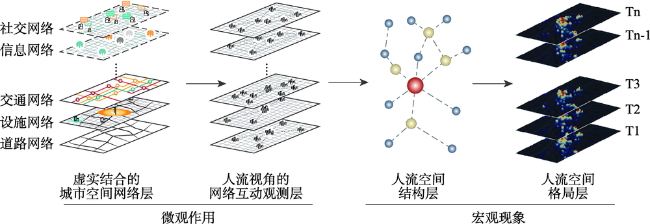
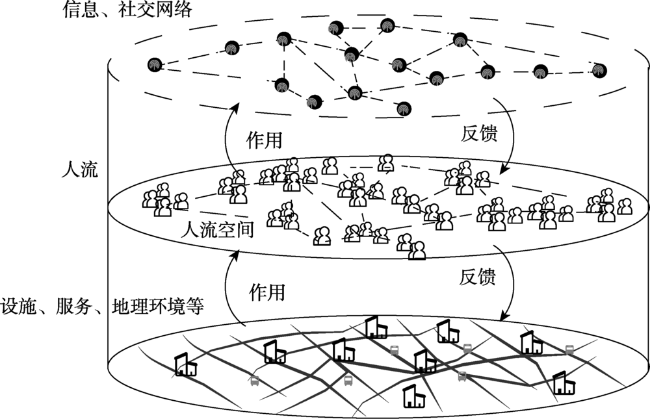
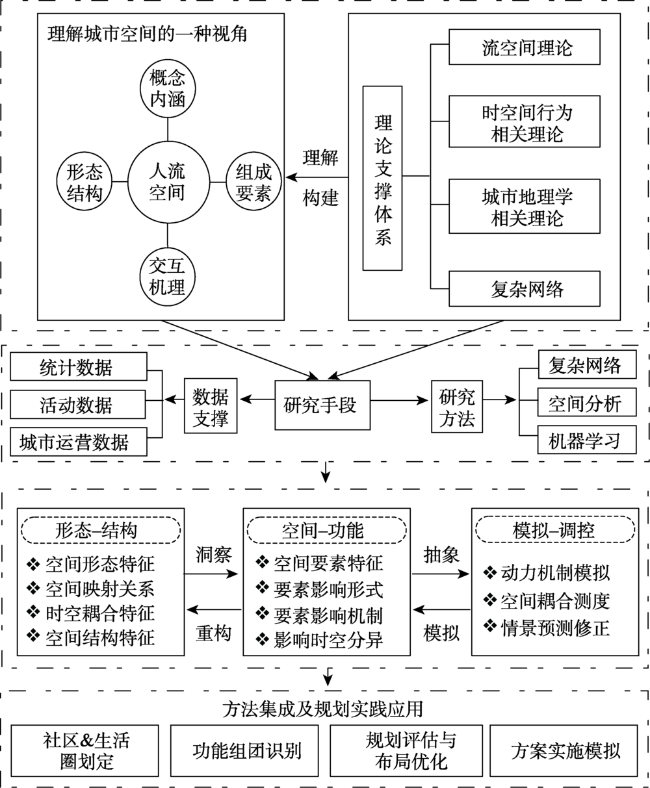
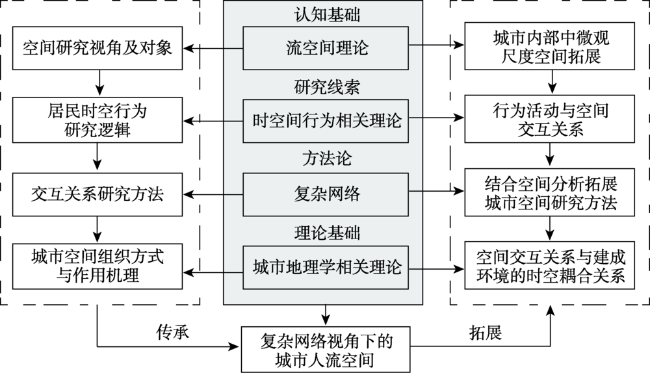
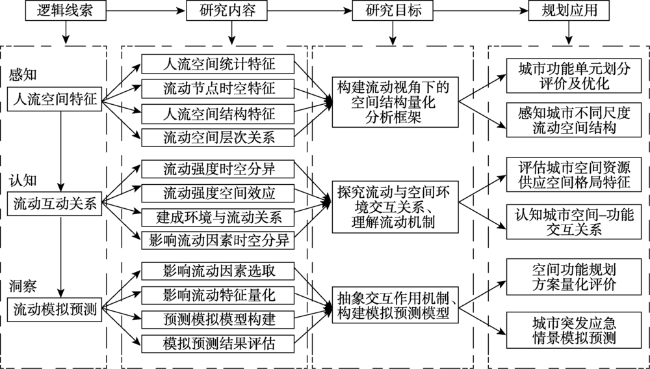
城市内人流特征研究一直是城市地理学和城市空间研究的重要领域之一。针对已有相关研究存在仅侧重于从人口规模、密度视角分析空间分布及格局特征,而对隐藏于空间分布背后,因人流动而建立的空间交互关系关注不足的问题。本文以流空间理论、复杂网络理论、空间行为交互理论为理论基础,立足基于流、网络剖析城市内部空间中各要素间的相互作用及关系,选取人流为观测研究对象,将城市空间、人、设施、服务和地理环境等要素之间的互动关系抽象为网络,提出了基于复杂网络视角的城市人流空间概念模型。在此基础上,进一步构建了城市人流空间研究框架,即基于理论融合、数据支撑与研究方法的整合创新,以探究人流视角下的城市空间特征、功能结构、人流与建成环境时空耦合关系及流动的时空模拟预测为重点的研究内容体系,并探讨其在规划实践业务中的方法技术支撑与应用拓展。以期为未来开展实证研究提供指导,提升城市感知数据在城市空间规划及管理中的应用价值,丰富“以流定形”的理性城市规划方法体系。
罗桑扎西 , 甄峰 , 张姗琪 . 复杂网络视角下的城市人流空间概念模型与研究框架[J]. 地理研究, 2021 , 40(4) : 1195 -1208 . DOI: 10.11821/dlyj020191007
Analyzing the dynamic characteristics of urban people flow is one of great practical significance in urban geography and urban space research. Traditional studies on people flow mainly use census data, focusing on the annual changes of people flow between regional, interprovincial, or municipal spatial scales, while studies on people flow characteristics at smaller spatial scales (such as areas within a city) are extremely limited. Recently, many researchers have carried out studies on spatial structure, the relationship between people flow and urban built environment, urban people flow simulation and prediction. The studies have made great achievements, which have promoted the understandings of the urban spatial organization from the perspective of spatial interaction. The existing studies, however, have obvious limitations because they only focus on the spatial distribution and spatial patterns of people from the perspective of population size and density, but pay less attention to the spatial interactions hidden behind the spatial distribution. To overcome these limitations, we proposed a conceptual model of urban people flow space based on the perspective of a complex network, which is based on the theories of flow space, of complex system, and the interaction of spatial behavior. In this conceptual model, we selected urban people flow as the study object and considered the interactions among urban space, elements, and people as a network. The model focuses on analyzing the interaction and relationships between intra-urban spatial elements based on network and flow. Based on the conceptual model, we further put forward an urban people flow space research framework, based on the theory of data fusion, support and research methods of the integration of innovation. The framework aims to facilitate the explorations of the urban space characteristic, function structure, traffic and built environment relations and flow simulation prediction research, with an emphasis on the research content, and the technical support and application development for the planning practice. The framework is expected to provide a reference for future empirical research and to deepen the application value of rich urban data in urban spatial planning and management.
表1 城市人流感知数据源Tab. 1 Data sources and types for studying urban people flow space |
| 数据来源 | 数据描述 | 数据特征 | 常见类型 |
|---|---|---|---|
| 城市智能基础设施采集 | 数据源于居民使用特定智能基础设施而产生使用行为记录 | 数据的样本大、数据维度丰富,但数据的时空精度低,对轨迹的刻画不完整,仅能代表某类活动 | 公交卡数据、地铁卡数据、市民卡数据、社保卡数据、交通视频数据、出租车轨迹数据、便携式视频采集器等 |
| LBS产品使用行为轨迹 | 数据源于居民在日常生活中使用某一类或某几类移动互联网位置服务产品,从而产生富含时空活动信息的个体轨迹 | 数据来源丰富、获取便利性高,但数据样本的社会经济属性、时空代表性具有一定的偏差 | 网络地图热力图数据、微博、Twitter、Flickr、快手、抖音、大众点评、美团外卖、共享单车、共享汽车、百度城市出行强度数据等。 |
| 移动轨迹追踪采集 | 此类数据源于设备主动记录或上报的所处时空信息 | 数据时空信息较为完整,能够准确的映射设备携带者的活动轨迹,具备较高的时空精度 | GPS活动调查数据、手机信令、交通出行调查等 |
| 社会调查、统计类 | 此类数据源于特定的社会调查、或政府职能部门常规的统计汇总。 | 数据属性维度较高、包含信息丰富,时空信息较少,数据时空分辨率低 | 交通出行调查、统计年鉴、流动人口调查、长时相夜间影像数据等等 |
真诚感谢匿名评审专家在论文评审中所付出的时间和精力,专家对本文整体框架组织、概念模型建构等方面的修改意见,使本文受益匪浅,深表谢意。
| [1] |
许学强, 周一星, 宁越敏, 等. 城市地理学: 第二版. 北京: 高等教育出版社, 2009: 63-64.
[
|
| [2] |
周春山, 叶昌东. 中国城市空间结构研究评述. 地理科学进展. 2013,32(7):1030-1038.
[
|
| [3] |
|
| [4] |
|
| [5] |
王桂新, 潘泽瀚, 陆燕秋. 中国省际人口迁移区域模式变化及其影响因素: 基于2000和2010年人口普查资料的分析. 中国人口科学. 2012, (5):2-13.
[
|
| [6] |
秦贤宏, 魏也华, 陈雯, 等. 南京都市区人口空间扩张与多中心化. 地理研究. 2013,32(4):711-719.
[
|
| [7] |
甄峰, 顾朝林. 信息时代空间结构研究新进展. 地理研究, 2002,21(2):257-266.
[
|
| [8] |
孙中伟, 路紫. 流空间基本性质的地理学透视. 地理与地理信息科学, 2005,21(1):109-112.
[
|
| [9] |
蔡晓梅, 卜美玲, 李军. 以流动看世界: 基于彼得·阿迪《流动性》的研究述评. 热带地理. 2020,40(3):455-465.
[
|
| [10] |
秦萧, 甄峰, 熊丽芳, 等. 大数据时代城市时空间行为研究方法. 地理科学进展. 2013,32(9):1352-1361.
[
|
| [11] |
秦萧, 甄峰. 大数据与小数据结合: 信息时代城市研究方法探讨. 地理科学. 2017,37(3):321-330.
[
|
| [12] |
甄峰, 王波, 秦萧, 等. 基于大数据的城市研究与规划方法创新. 北京: 中国建筑工业出版社, 2015: 5.
[
|
| [13] |
李德仁, 姚远, 邵振峰. 智慧城市中的大数据. 武汉大学学报: 信息科学版. 2014,39(6):631-640.
[
|
| [14] |
|
| [15] |
郑宇. 城市计算概述. 武汉大学学报: 信息科学版. 2015,40(1):1-13.
[
|
| [16] |
甄峰, 秦萧. 大数据在智慧城市研究与规划中的应用. 国际城市规划. 2014,29(6):44-50.
[
|
| [17] |
吴志强. 以流定形的理性城市规划方法. 第十届城市发展与规划大会. 广州. 2015.
[
|
| [18] |
|
| [19] |
|
| [20] |
|
| [21] |
钮心毅, 丁亮, 宋小冬. 基于手机数据识别上海中心城的城市空间结构. 城市规划学刊. 2014, (6):61-67.
[
|
| [22] |
钟炜菁, 王德, 谢栋灿, 等. 上海市人口分布与空间活动的动态特征研究: 基于手机信令数据的探索. 地理研究, 2017,36(5):972-984.
[
|
| [23] |
|
| [24] |
|
| [25] |
|
| [26] |
刘耀林, 方飞国, 王一恒. 基于手机数据的城市内部就业人口流动特征及形成机制分析: 以武汉市为例. 武汉大学学报: 信息科学版, 2018,43(12):2212-2224.
[
|
| [27] |
方家, 王德, 谢栋灿, 等. 上海顾村公园樱花节大客流特征及预警研究: 基于手机信令数据的探索. 城市规划, 2016,40(6):43-51.
[
|
| [28] |
罗桑扎西, 甄峰. 基于手机数据的城市公共空间活力评价方法研究: 以南京市公园为例. 地理研究, 2019,38(7):1594-1608.
[
|
| [29] |
|
| [30] |
|
| [31] |
|
| [32] |
|
| [33] |
陈丽娜, 吴升, 陈洁, 等. 基于手机定位数据的城市人口分布近实时预测. 地球信息科学学报, 2018,20(4):523-531.
[
|
| [34] |
|
| [35] |
|
| [36] |
梁鹤年. 城市人. 城市规划. 2012,36(07):87-96.
[
|
| [37] |
|
| [38] |
|
| [39] |
|
| [40] |
|
| [41] |
甄茂成, 张景秋, 杨广林. 基于复杂网络的商业银行网点布局特征: 以北京市中国银行为例. 地理科学进展. 2013,32(12):1732-1741.
[
|
| [42] |
|
| [43] |
甄峰, 秦萧, 席广亮. 信息时代的地理学与人文地理学创新. 地理科学, 2015,35(1):11-18.
[
|
| [44] |
|
| [45] |
王宇凡, 林文盛, 冯长春. 信息技术对城市生活服务业空间分布的影响: 以北京网络外卖餐饮业为例. 城市发展研究, 2019,26(6):100-107.
[
|
| [46] |
方怡青. 上海市网红餐饮店的空间特征研究. 上海: 华东师范大学硕士学位论文, 2019: 88-89.
[
|
| [47] |
|
| [48] |
王杨, 孙中伟, 刘宁涛. 网络空间信息对地理空间人流的导引作用: 以石家庄行者户外为例. 世界地理研究, 2015,24(3):85-93.
[
|
| [49] |
魏冶. 流空间视角的沈阳市空间结构研究. 长春: 东北师范大学博士学位论文, 2013: 9.
[ Spatial structure of Shenyang in the perspective of space flows. Changchun: Doctoral Dissertation of Northeast Normal University, 2013: 9.]
|
| [50] |
刘红. 曼纽尔·卡斯特流动空间思想及现实意义研究. 武汉: 华中科技大学硕士学位论文, 2018: 15.
[
|
| [51] |
柴彦威, 谭一洺, 申悦, 等. 空间: 行为互动理论构建的基本思路. 地理研究. 2017,36(10):1959-1970.
[
|
| [52] |
郑波尽. 复杂网络的结构与演化. 北京: 科学出版社, 2018: 11.
[
|
| [53] |
方锦清, 汪小帆, 郑志刚, 等. 一门崭新的交叉科学: 网络科学(上). 物理学进展. 2007,27(3):239-343.
[
|
| [54] |
|
| [55] |
|
/
| 〈 |
|
〉 |