大国战略交汇区小国地缘环境及其对冲战略响应——以菲律宾与中美为例
|
富宁宁(1994-),男,甘肃天水人,博士研究生,主要研究方向为全球化与区域国别地缘环境。E-mail: funn1008@163.com |
收稿日期: 2023-09-11
录用日期: 2024-03-27
网络出版日期: 2024-07-05
基金资助
国家社会科学基金重大项目(20&ZD138)
国家自然科学基金项目(42271253)
Geo-setting and hedging strategy responses of small states in an area of strategic intersection: A case study of the Philippines, China, and the United States
Received date: 2023-09-11
Accepted date: 2024-03-27
Online published: 2024-07-05
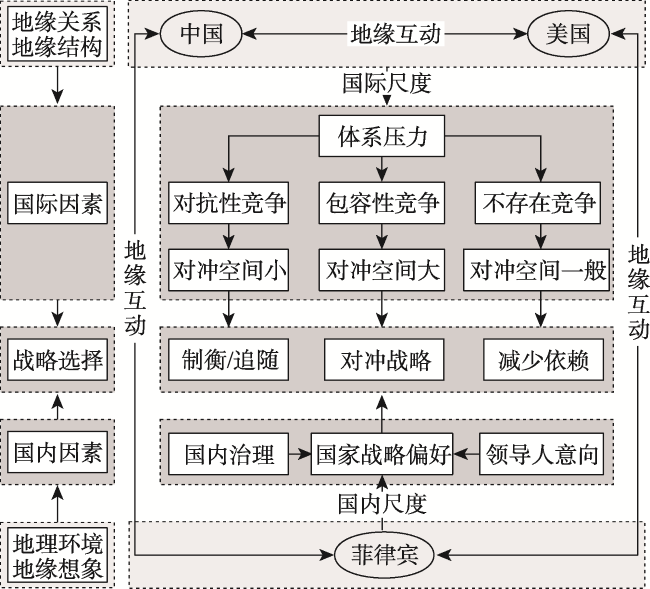
后冷战时代,位处大国战略交汇区的小国地缘环境敏感而多变,其对外战略行为往往表现为对冲战略特征。本文基于跨学科交融互鉴的理念,构建大国战略交汇区小国地缘环境及其对冲战略响应分析框架,解析中美战略交汇区菲律宾地缘环境要素特征,分析冷战后菲律宾对中美对冲战略实践的演变及地缘驱动因素。研究发现:① 国别地缘环境可作为解析一国战略行为的情景视角,体系压力和国家战略偏好是跨尺度影响对冲战略的地缘变量,两者共同作用于大国战略交汇区小国实施差异化战略。② 菲律宾独特的地缘区位和自然地理环境及漫长的被殖民史是菲律宾实施对冲战略的地理基础。不同时期中美菲三角地缘关系的不对称性、及区域地缘结构的二重性和不稳定性,导致亚太区域权力关系和结构的不确定性是菲律宾实施对冲战略的地缘驱动因素。③ 后冷战时期,中美战略竞争加剧导致菲律宾的区域地缘环境体系压力增大,并压缩其对冲空间,菲律宾在中美之间采取对冲战略并趋于追随美国。同时,菲律宾的国内治理问题和领导人认知决定其不同时期战略实施的具体手段。本文旨在探究大国战略交汇区地缘环境对小国实施对冲战略的地缘驱动因素,以期为中国制定对周边小国的外交政策提供有益启示。
富宁宁 , 牛福长 , 葛岳静 , 刘菊梅 , 彭飞 , 叶帅 . 大国战略交汇区小国地缘环境及其对冲战略响应——以菲律宾与中美为例[J]. 地理研究, 2024 , 43(7) : 1627 -1643 . DOI: 10.11821/dlyj020230797
In the post-Cold War era, small states located at the strategic intersection of great powers are faced with heightened sensitivity and variability in their geo-setting, consequently, their foreign strategic behaviors are characterized as hedging. This article constructs an analytical framework underpinned by the interdisciplinary integration of geo-setting and hedging theories to reveal the rationale of strategy responses of small states in the strategic intersection. Taking the triple-relation between the Philippines, China and the US as an example, the research unpacks the characteristics of geo-setting elements of the Philippines as a strategic intersection, the evolution of its hedging strategies towards China and the US after the Cold War, as well as the geopolitical driving factors. The study concludes that: (1) The diverse strategies of small states in strategic intersections are influenced by national geo-setting, systemic pressure, and national strategic preference. The national geo-setting functions can be considered as a contextual perspective in analyzing strategic behaviors, while the other two can be regarded as geo-variables that play their cross-scale roles regionally and nationally. (2) The strategic response of the Philippines is deeply based on and driven by geographical, and relational and structural factors. The hedging strategy of the Philippine is geographically grounded by its unique geo-location and physical geographical environment, as well as its long history of colonization. Propelled by the uncertainty of power relations and structures in the Asia-Pacific region, the hedging strategy of the Philippine evolves with the dynamics of the asymmetric triangular geo-relations between the Philippines-US-China, and the duality and instability within this region. (3) In the post-Cold War period, the ever-intensifying strategic competition between China and the US has exerted regional geopolitical pressures on the Philippines, thereby shrinking its hedging space. The Philippines has forged hedging strategies between China and the US, and concomitantly align with the United States. Meanwhile, the implementation of strategies in different periods are influenced by domestic governance issues and the perceptions of leaders. This study aims to interrogate the driving factors behind small states' implementation of hedging strategies in strategic intersections of great powers, with the hope of providing illuminative insights for China's diplomatic policy towards neighboring small countries.
表1 冷战后中美地缘关系演变整体态势Tab. 1 The overall situation of the evolution of Sino-US geopolitical relations after the Cold War |
| 美国总统及任期 | 中美地缘关系整体特征 | 美国对华战略认知 |
|---|---|---|
| 克林顿(1993—2000年) | 消极趋向积极 | 中国是美国的“改造”对象 |
| 小布什(2001—2008年) | 整体平稳发展 | 从“战略竞争者”到“负责任的利益攸关者” |
| 奥巴马(2009—2016年) | 平稳转向波动 | 从“应对共同挑战的伙伴”到“相互尊重、互利共赢的合作伙伴” |
| 特朗普(2017—2020年) | 急剧和系统性恶化 | 中国是美国的“战略竞争对手” |
表2 后冷战时期菲律宾对冲战略演变Tab. 2 The evolution of hedging strategies in the Philippines after the Cold War |
| 阶段 | 1992—2001年 | 2001—2010年 | 2010—2016年 | 2016—2022年 |
|---|---|---|---|---|
| 菲律宾 总统任期 | 拉莫斯、 艾斯特拉达 | 阿罗约 | 阿基诺三世 | 杜特尔特 |
| 体系压力 (国际尺度) | 中美地缘关系波动;区域权力结构“一超多强”形成 | 中美地缘关系平稳;区域权力结构延续“一超多强” | 中美地缘平稳趋向波动;区域权力结构“中美战略竞争”形成 | 中美地缘关系急剧恶化;区域权力结构“中美战略竞争”加剧 |
| 对冲空间 | 初步形成 | 空前巨大 | 逐渐缩小 | 进一步缩小 |
| 国家战略偏好 (国内尺度) | 美国削减对菲律宾经济援助、撤出军事基地;菲律宾民众长期积压的反美情绪释放 | 阿罗约政府将经济发展作为重点,重视与中国的经济合作;菲律宾南部诸岛反恐有求于美国 | 阿基诺三世代表军方利益,强化南海问题上对中国挑衅;菲律宾在经济和防务方面均有求于美国 | 杜特尔特推动的菲律宾国内反毒问题遭美国的人权话语攻击;菲律宾有求于中国的基础设施投资 |
| 具体战略选择 | 减少对美国安全依赖;接触中国,开启中美对冲战略 | 延续中美对冲战略;实施大国平衡,多边外交 | 倾向于对美国选边;追随美国,并制衡中国 | 调回中美对冲战略;后期趋于追随美国 |
| 对冲原则使用 | 不偏袒任何一方 | 经济上靠中国,安全上靠美国;多元化追求 | 对冲原则使用不明显 | 不偏袒任何一方;多元化追求 |
真诚感谢两位匿名评审专家在论文评审中所付出的时间和精力,评审专家对本文的分析框架、战略启示、语言表达等方面的修改意见,使本文获益匪浅。
| [1] |
陆大道, 杜德斌. 关于加强地缘政治地缘经济研究的思考. 地理学报, 2013, 68(6): 723-727.
[
|
| [2] |
叶帅, 胡志丁, 葛岳静, 等. 地缘战略交汇区类属的国别地缘环境解析: 以乌克兰为例. 地理研究, 2021, 40(9): 2591-2605.
[
|
| [3] |
葛汉文. 岛链、空间控制与霸权: 美国对西太平洋地区的地缘政治想象. 国际展望, 2020, 12(3): 63-79.
[
|
| [4] |
索尔·科恩. 地缘政治学:国际关系的地理学. 严春松, 译. 上海: 上海社会科学院出版社, 2011: 7-8.
[
|
| [5] |
|
| [6] |
崔守军, 杨宇. 俄罗斯与乌克兰冲突的地缘政治渊源与地缘战略逻辑. 地理研究, 2022, 41(8): 2065-2075.
[
|
| [7] |
周方银. 中国崛起、东亚格局变迁与东亚秩序的发展方向. 当代亚太, 2012, (5): 4-32.
[
|
| [8] |
胡伟, 胡志丁, 葛岳静. 中国地缘环境研究进展与思考. 地理科学进展, 2019, 38(4): 477-488.
[
|
| [9] |
胡志丁, 张喆, 赵路平. 地缘环境研究的理念及议程与路径. 地理学报, 2023, 78(1): 198-213.
[
|
| [10] |
胡伟, 刘晓凤, 葛岳静, 等. 美国地缘环境解析及其对中国的启示. 科技导报, 2019, 37(16): 95-107.
[
|
| [11] |
葛岳静, 计晶韵, 黄宇. 多尺度视角下的印度地缘环境解析及对中国的启示. 世界地理研究, 2021, 30(2): 223-233.
[
|
| [12] |
胡志丁, 杜德斌. 日本德川幕府时期的地缘环境分析: 兼论国别地缘环境分析框架. 地理学报, 2020, 75(10): 2047-2060.
[
|
| [13] |
王萍, 杜德斌, 胡志丁. 约旦河跨境水冲突的地缘环境研究. 地理学报, 2023, 78(1): 214-229.
[
|
| [14] |
张喆, 胡志丁. 基于国别地缘环境视角解析缅甸民主化改革进程. 地理研究, 2022, 41(11): 3051-3068.
[
|
| [15] |
哈尔福德·麦金德. 历史的地理枢纽. 林尔蔚, 陈江. 译. 北京: 商务印书馆, 2011: 1-71.
[
|
| [16] |
尼古拉斯·斯皮克曼. 和平地理学. 愈海杰. 译. 上海: 上海人民出版社, 2016: 1-151.
[
|
| [17] |
科林·弗林特, 刘鹏. 亚洲的地缘政治竞争与不可避免的战争: 世界体系视角下的历史教训. 印度洋经济体研究, 2017, (1): 1-24.
[
|
| [18] |
|
| [19] |
熊琛然, 武友德, 李正, 等. 国家地缘体类属及其对地缘战略抉择的影响. 地理与地理信息科学, 2016, 32(6): 117-124.
[
|
| [20] |
韦民. 小国与国际关系. 北京: 北京大学出版社, 2014: 65.
[
|
| [21] |
|
| [22] |
|
| [23] |
韦民. 规模、体系与小国脆弱性. 国际政治研究, 2013, (1): 65-87.
[
|
| [24] |
曹原, 王佳, 葛岳静. 越南政治地理的脆弱性. 世界地理研究, 2011, 20(4): 26-32.
[
|
| [25] |
|
| [26] |
李飞, 成升魁, 于会录, 等. 国家地缘脆弱性探索: 缅甸案例及对中国地缘战略启示. 地理科学进展, 2016, 35(6): 737-746.
[
|
| [27] |
|
| [28] |
|
| [29] |
|
| [30] |
|
| [31] |
|
| [32] |
|
| [33] |
|
| [34] |
|
| [35] |
|
| [36] |
|
| [37] |
|
| [38] |
|
| [39] |
|
| [40] |
|
| [41] |
|
| [42] |
|
| [43] |
宋长青, 葛岳静, 刘云刚, 等. 从地缘关系视角解析“一带一路”的行动路径. 地理研究, 2018, 37(1): 3-19.
[
|
| [44] |
韦民. 小国与国际安全. 北京: 北京大学出版社. 2016: 1-392.
[
|
| [45] |
|
| [46] |
|
| [47] |
Roy, Denny. Southeast Asia and the rising China: Balancing or bandwagoning? Contemporary Southeast Asia, 2005, 27(2): 305-322. DOI: 10.1353/csa.2011.0115.
|
| [48] |
杨美姣. 后冷战时期对冲战略探究: 以菲律宾、马来西亚和老挝为例. 国际政治研究, 2020, 41(6): 105-126.
[
|
| [49] |
|
| [50] |
马燕冰, 黄莺. 列国志:菲律宾. 北京: 社会科学文献出版社, 2007: 84-103.
[
|
| [51] |
陈晓晨. 小国研究视域下太平洋岛国的外交策略. 国际关系研究, 2020, 44(2): 108-131.
[
|
| [52] |
|
| [53] |
|
| [54] |
郭达, 迟雪. 中美关系50年: 历史演变与发展趋势. 全球化, 2023, (1): 36-44.
[
|
| [55] |
陈积敏. 特朗普政府对华战略定位与中美关系. 国际关系研究, 2018, (1): 29-34.
[
|
| [56] |
吴心伯. 新常态下中美关系发展的特征与趋势. 国际问题研究, 2016, (2): 14-28.
[
|
| [57] |
刘建飞. 从战略模糊到战略清晰: 奥巴马全球战略调整与中美关系. 国际展望, 2013, (3): 63-76.
[
|
| [58] |
宋清润. 从“亚太再平衡”战略看美菲军事同盟关系. 国际研究参考, 2015, (1): 1-9.
[
|
| [59] |
蒋琛娴, 鞠海龙. 南海问题上菲律宾对华政策波动性的影响因素、原因及前瞻. 广西社会科学, 2021, 312(6): 113-126.
[
|
| [60] |
曹宛鹏, 杜德斌. 21世纪以来美国对东盟国家援助的空间结构演变及其地缘战略解析. 地理研究, 2023, 42(1): 17-33.
[
|
| [61] |
彭飞, 富宁宁, 韩增林, 等. 中西方海洋地缘政治思想演化解构: 基于人海关系分析框架. 地理研究, 2021, 40(2): 556-570.
[
|
/
| 〈 |
|
〉 |