迁移视角下移动办公人群职住空间的郊区化特征探究——一个ICT对郊区化影响的大数据实证
|
牛强(1978-),男,湖北宜昌人,博士,教授,博士生导师,主要研究方向为行为大数据分析、信息时代的城乡规划、定量城市研究和规划分析。E-mail: niuqiang@whu.edu.cn |
收稿日期: 2023-10-09
录用日期: 2024-04-29
网络出版日期: 2024-10-14
基金资助
国家自然科学基金项目(52278075)
Revealing the suburbanization characteristics of mobile-office worker's job-house space from the perspective of migration: A big data empirical study on the impact of ICT on suburbanization
Received date: 2023-10-09
Accepted date: 2024-04-29
Online published: 2024-10-14
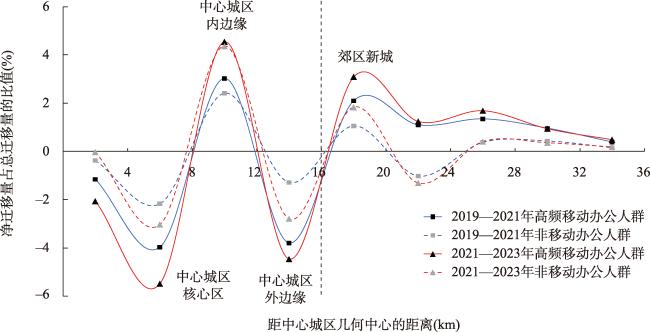
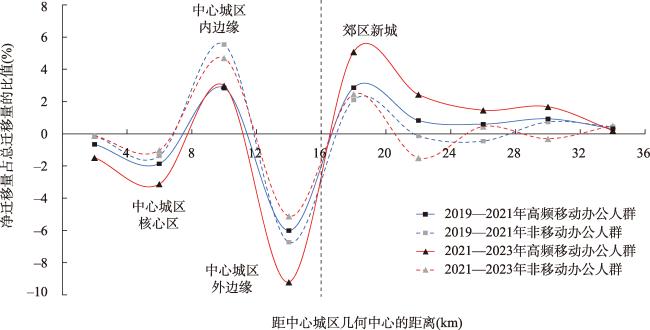
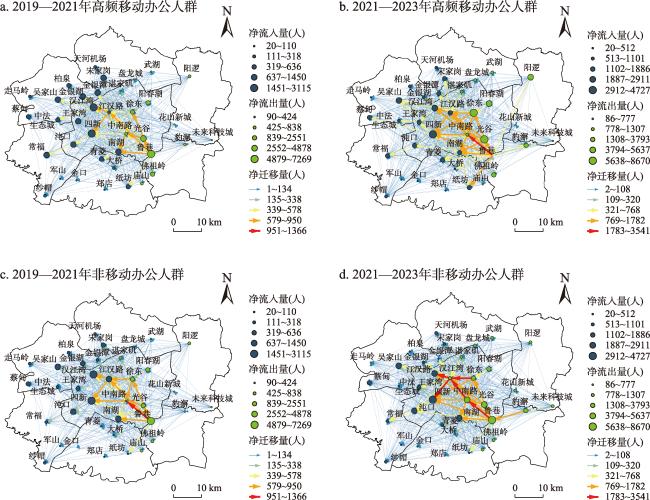
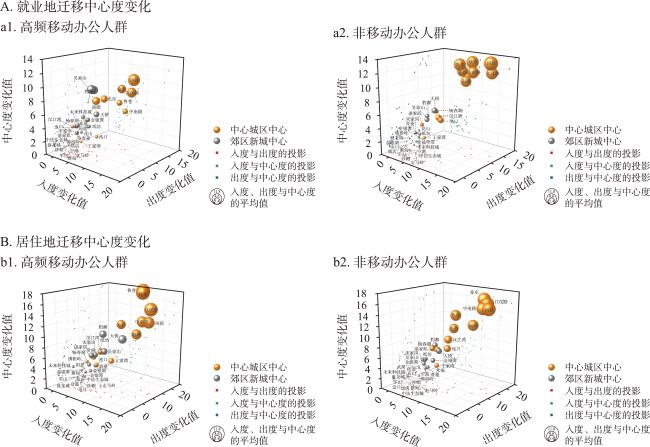
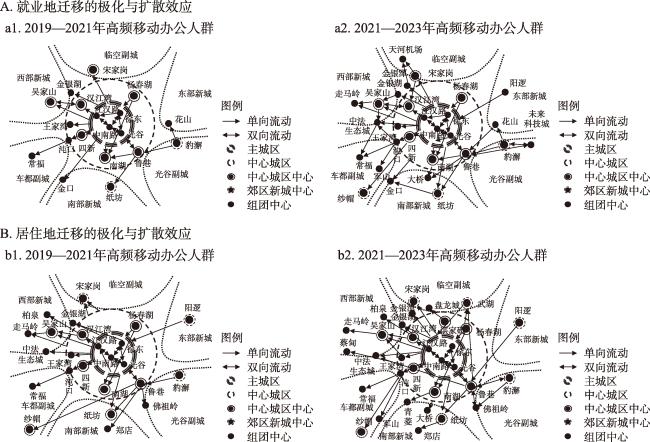
信通技术影响下的郊区化现象和格局演变一直是城市空间结构研究的热点话题。移动办公作为信通技术衍生出的新型办公生产活动,极大地提升了个体职住空间选择的灵活性和流动性,从而为解析城市郊区化现象与城市空间结构演变规律提供了新视角。基于时序手机信令大数据,构建2019—2021年、2021—2023年武汉市高频移动办公人群和非移动人群职住空间迁移数据库,综合对比分析、空间分析、社会网络分析等方法探究其职住空间郊区化的数量、空间、结构特征和演进趋势。研究发现:① 数量特征上,移动办公人群职住空间由中心城区向郊区新城迁移的人数和占比一定程度上高于非移动办公人群,其迁出数量更多且回迁相对更少,向郊区新城分散化的趋势在持续加强。② 空间特征上,移动办公人群职住空间由中心城区向郊区新城迁移的趋势较为明显,而非移动办公人群则主要在中心城区内部迁移的趋势更为明显。同时,移动办公人群在中心城区圈层内负向净迁移量更多,而在郊区新城内正向净迁移量更大。这表明移动办公人群迁向郊区的分散化趋势进一步强化。③ 结构特征上,移动办公人群在部分郊区新城中心的中心度隐有反超中心城区的趋势,且其中心度增幅已经高于三分之一的中心城区中心。此外,相较于就业空间,移动办公人群居住空间的分散程度更强、辐射范围更远,逐渐由中心城区向城郊结合地区-近郊区新城中心-接近远郊的组团中心扩散,这表明移动办公人群居住空间的选择进一步削弱了地理集聚效应。研究通过大数据实证发掘了信通技术影响下的城市空间及结构的郊区化演变趋势,丰富了信通技术对城市郊区化作用格局、过程的相关研究,也为解析城市的郊区化分散规律提供了移动办公这一新的理论视角,对信通技术发展新阶段下的城市郊区化现象、城-郊进一步融合协调和郊区新城可持续发展具有借鉴作用。
牛强 , 张浩 , 付文琪 , 伍磊 . 迁移视角下移动办公人群职住空间的郊区化特征探究——一个ICT对郊区化影响的大数据实证[J]. 地理研究, 2024 , 43(10) : 2666 -2683 . DOI: 10.11821/dlyj020230884
The phenomenon of suburbanization under the influence of ICT has always been a hotspot in the study of urban space. As a new type of job activity derived from information and communications technology, mobile-office greatly improves the flexibility and mobility of individual's job-house space choices, which provides a new perspective for analyzing the suburbanization phenomenon of urban space, as well as the laws of how urban spatial structure to evolve. Based on the mobile phone big data, we firstly build the job-house spatial migration database of high-frequency mobile-office workers and non-mobile workers in Wuhan between 2019-2021 and 2021-2023, then explore the quantity, space, structural characteristics and evolution trend of their migration by using comparative analysis, spatial analysis, social network analysis. Our research has shown that mobile office has a promoting effect on the suburbanization of job-house space. Detailed conclusions are listed below. (1) The number and proportion of mobile-office workers migrating their job-house space from the central urban area to the suburban new city are higher than those of non-mobile office workers, with a larger number of moving out and relatively few moving back, and the trend of decentralization towards the suburban new city continues to strengthen. (2) Mobile-office workers mainly migrate from the central urban area to suburban new city, while non-mobile office workers mainly migrate within the central urban area. Besides, the mobile-office population has a greater negative net migration within the central urban area, while a greater positive net migration occurs in suburban new city. Our discovery indicates that the decentralization trend of mobile-office workers moving to the suburban new city has been further strengthened. (3) In terms of structural characteristics, the centrality of mobile-office workers in some suburban new city centers shows a potential trend of exceeding central urban area, and their centrality increase is higher than one-third of the central urban center. In addition, compared to suburbanization of job space, the dispersion of home space among mobile-office workers are stronger, with a wider migration district range, gradually spreading from the central urban area to the suburban new city and the far suburban city area. These conclusions indicate that the selection choice of job-house space for mobile-office workers obviously weakens the geographical agglomeration effect. Our study confirms the suburbanization trend of urban space under the influence of ICT, enriching the relevant research on the pattern and process of how ICT influences the suburbanization, as well as providing a theoretical perspective for analyzing the suburbanization of urban space in cities, which is of great importance to further integration of urban and suburban areas, and sustainable development of suburban new cities.
Key words: migration; mobile-office; job-house space; suburbanization; big data; Wuhan
表1 高频移动办公群体与非移动办公群体样本构成对比Tab. 1 Sample composition of high-frequency mobile-office group and non-mobile office group |
| 时 序 | 高频移动办公人群样本构成 | 非移动办公人群样本构成 | |||||||||||||
|---|---|---|---|---|---|---|---|---|---|---|---|---|---|---|---|
| 分年龄 | 分性别 | 分年龄 | 分性别 | ||||||||||||
| 类型 | 人数 | 占比 (%) | 类型 | 人数 | 占比 (%) | 类型 | 人数 | 占比 (%) | 类型 | 人数 | 占比 (%) | ||||
| 2019—2021年 | 青年 (18~44岁) | 68089 | 92.21 | 男性 | 42498 | 57.5 | 青年 (18~44岁) | 67646 | 91.61 | 男性 | 43291 | 58.63 | |||
| 中年 (45~59岁) | 5627 | 7.62 | 女性 | 31341 | 42.5 | 中年 (45~59岁) | 6040 | 8.18 | 女性 | 30693 | 41.57 | ||||
| 老年 (≥60岁) | 123 | 0.17 | 老年 (≥60岁) | 153 | 0.21 | ||||||||||
| 2021—2023年 | 青年 (18~44岁) | 134918 | 92.51 | 男性 | 91059 | 62.44 | 青年 (18~44岁) | 133022 | 91.22 | 男性 | 91559 | 62.78 | |||
| 中年 (45~59岁) | 10753 | 7.38 | 女性 | 54772 | 37.56 | 中年 (45~59岁) | 12646 | 8.67 | 女性 | 54272 | 37.22 | ||||
| 老年 (≥60岁) | 160 | 0.11 | 老年 (≥60岁) | 163 | 0.11 | ||||||||||
表2 2019—2021年、2021—2023年高频移动办公人群与非移动办公人群城-郊就业地迁移整体异质性Tab. 2 Comparison of overall characteristics of job migration of mobile-office workers and non-mobile office workers in urban and suburban areas between 2019-2021 and 2021-2023 in Wuhan |
| 迁移方向 | 2019—2021年就业地迁移 | 2021—2023年就业地迁移 | |||||||||
|---|---|---|---|---|---|---|---|---|---|---|---|
| 高频移动办公人群 | 非移动办公人群 | 高频移动办公人群 | 非移动办公人群 | ||||||||
| 人数 | 占比(%) | 人数 | 占比(%) | 人数 | 占比(%) | 人数 | 占比(%) | ||||
| 中心城区→中心城区 | 21739 | 57.60 | 22710 | 57.52 | 35771 | 52.38 | 38362 | 56.17 | |||
| 中心城区→郊区新城 | 6951 | 15.07 | 5465 | 13.84 | 12546 | 18.37 | 9781 | 14.32 | |||
| 郊区新城→中心城区 | 5558 | 14.80 | 6224 | 15.76 | 9975 | 14.61 | 11097 | 16.25 | |||
| 郊区新城→郊区新城 | 5232 | 13.25 | 5081 | 12.87 | 10001 | 14.64 | 9053 | 13.26 | |||
表3 2019—2021年、2021—2023年高频移动办公群体与非移动办公群体城-郊居住地迁移整体异质性Tab. 3 Comparison of overall characteristics of house migration of mobile-office workers and non-mobile office workers in urban and suburban areas between 2019-2021 and 2021-2023 in Wuhan |
| 迁移方向 | 2019—2021年居住地迁移 | 2021—2023年居住地迁移 | |||||||||
|---|---|---|---|---|---|---|---|---|---|---|---|
| 高频移动办公人群 | 非移动办公人群 | 高频移动办公人群 | 非移动办公人群 | ||||||||
| 人数 | 占比(%) | 人数 | 占比(%) | 人数 | 占比(%) | 人数 | 占比(%) | ||||
| 中心城区→中心城区 | 25052 | 48.35 | 27098 | 51.47 | 40343 | 45.28 | 42222 | 47.39 | |||
| 中心城区→郊区新城 | 10977 | 20.09 | 9736 | 18.49 | 19504 | 21.89 | 16632 | 18.67 | |||
| 郊区新城→中心城区 | 9464 | 17.98 | 9579 | 18.20 | 14514 | 16.29 | 16420 | 18.43 | |||
| 郊区新城→郊区新城 | 7151 | 13.58 | 6231 | 11.84 | 14740 | 16.54 | 13827 | 15.52 | |||
真诚感谢匿名评审专家在论文评审中所付出的时间和精力,评审专家对本文理论研究、题目的准确性、研究结果的分析等方面提出的宝贵修改意见,使本文获益匪浅。
| [1] |
牛强, 张浩, 伍磊, 等. 近年来移动办公发展的城-郊异质性特征研究: 基于2019年与2021年武汉市联通用户手机App使用大数据. 地理科学进展, 2022, 41(8): 1428-1439.
[
|
| [2] |
中国互联网络信息中心. 第51次中国互联网络发展状况统计报告. https://finance.sina.com.cn/tech/2023-03-24/doc-imymycyi8700104.shtml, 2023-03-24.
[ CNNIC. The 51st Statistical Report on Internet Development in China. https://finance.sina.com.cn/tech/2023-03-24/doc-imymycyi8700104.shtml, 2023-03-24.]
|
| [3] |
牛强, 朱玉蓉, 姜祎笑, 等. 城市活动的线上线下化趋势、特征和对城市的影响. 城市发展研究, 2021, 28(12): 45-54.
[
|
| [4] |
徐毅松, 郑时龄, 伍江, 等. “上海五大新城建设及相关思考”学术笔谈. 城市规划学刊, 2022, (1): 1-9.
[
|
| [5] |
段进, 张庭伟, 尹稚, 等. “中国式城乡现代化:内涵、特征与发展路径”学术笔谈. 城市规划学刊, 2023, (1): 1-10.
[
|
| [6] |
|
| [7] |
|
| [8] |
|
| [9] |
|
| [10] |
|
| [11] |
张景秋, 陈叶龙, 张宝秀. 北京市办公业的空间格局演变及其模式研究. 城市发展研究, 2010, 17(10): 87-91.
[
|
| [12] |
温锋华, 许学强. 广州商务办公空间发展及其与城市空间的耦合研究. 人文地理, 2011, 26(2): 37-43.
[
|
| [13] |
张景秋, 陈叶龙, 孙颖. 基于租金的北京城市办公活动经济空间结构解析. 地理科学, 2010, 30(6): 833-838.
[
|
| [14] |
叶强, 赵垚, 谭畅. 长沙市商务办公空间集聚特征及其影响因素. 热带地理, 2022, 42(6): 916-927.
[
|
| [15] |
吴一洲, 吴次芳, 贝涵璐. 转型期杭州城市写字楼空间分布特征及其机制. 地理学报, 2010, 65(8): 973-982.
[
|
| [16] |
|
| [17] |
魏宗财, 甄峰, 席广亮, 等. 全球化、柔性化、复合化、差异化: 信息时代城市功能演变研究. 经济地理, 2013, 33(6): 48-52.
[
|
| [18] |
|
| [19] |
|
| [20] |
|
| [21] |
|
| [22] |
|
| [23] |
|
| [24] |
|
| [25] |
|
| [26] |
|
| [27] |
|
| [28] |
裴韬, 舒华, 郭思慧, 等. 地理流的空间模式:概念与分类. 地球信息科学学报, 2020, 22(1): 30-40.
[
|
| [29] |
李智轩, 甄峰, 张姗琪. 城市居民智慧流动性研究进展及展望. 国际城市规划, 2023, 38(1): 110-116.
[
|
| [30] |
孔宇, 甄峰, 张姗琪. 智能技术影响下的城市空间研究进展与思考. 地理科学进展, 2022, 41(6): 1068-1081.
[
|
| [31] |
罗桑扎西, 甄峰, 张姗琪. 复杂网络视角下的城市人流空间概念模型与研究框架. 地理研究, 2021, 40(4): 1195-1208.
[
|
| [32] |
周春山, 叶昌东. 中国城市空间结构研究评述. 地理科学进展, 2013, 32(7): 1030-1038.
[
|
| [33] |
崔璨, 穆学英, 常鹤影, 等. 上海市居民居住迁移的区位选择及其影响因素研究. 地理科学进展, 2021, 40(3): 422-432.
[
|
| [34] |
姚永玲. 郊区化过程中职住迁移关系研究: 以北京市为例. 城市发展研究, 2011, 18(4): 24-29.
[
|
| [35] |
冯健, 周一星. 郊区化进程中北京城市内部迁居及相关空间行为: 基于千份问卷调查的分析. 地理研究, 2004, 23(2): 227-242.
[
|
| [36] |
王蓓, 王良, 刘艳华, 等. 基于手机信令数据的北京市职住空间分布格局及匹配特征. 地理科学进展, 2020, 39(12): 2028-2042.
[
|
| [37] |
易行, 仝德, 吴雅莹, 等. 基于手机信令数据的深圳市二元居住空间迁居模式研究. 地理研究, 2023, 42(1): 137-155.
[
|
| [38] |
宋小冬, 王园园, 张开翼, 等. 考虑通勤距离的职住分离测度方法. 城市规划学刊, 2017, (6): 25-32.
[
|
| [39] |
史新宇. 基于多源轨迹数据挖掘的城市居民职住平衡和分离研究. 城市发展研究, 2016, 23(6): 10-13, 17.
[
|
| [40] |
罗琼, 舒红, 徐亚瑾, 等. 移动轨迹数据支持下的城市居民通勤活动分析. 武汉大学学报: 信息科学版, 2021, 46(5): 718-725.
[
|
| [41] |
王德, 朱查松, 谢栋灿. 上海市居民就业地迁移研究: 基于手机信令数据的分析. 中国人口科学, 2016, (1): 80-89.
[
|
| [42] |
牛强, 盛富斌, 刘晓阳, 等. 基于手机信令数据的城内迁居活跃度识别方法研究: 以武汉市为例. 地理研究, 2022, 41(8): 2142-2154.
[
|
| [43] |
牛强, 伍磊, 盛富斌, 等. 基于个体职住迁移的武汉郊区新城职住动态平衡测度方法. 地理学报, 2023, 78(12): 3095-3108.
[
|
| [44] |
李智轩, 甄峰, 曹钟茗, 等. 人流视角下城市空间结构特征及规划与治理响应: 以南京市为例. 城市发展研究, 2021, 28(6): 58-65.
[
|
| [45] |
杨延杰, 尹丹, 刘紫玟, 等. 基于大数据的流空间研究进展. 地理科学进展, 2020, 39(8): 1397-1411.
[
|
| [46] |
甄峰, 席广亮, 张姗琪, 等. 智慧城市人地系统理论框架与科学问题. 自然资源学报, 2023, 38(9): 2187-2200.
[
|
| [47] |
|
| [48] |
|
| [49] |
|
| [50] |
|
| [51] |
|
| [52] |
喻冰洁, 崔叙, 张秋仪, 等. 大城市空间交互网络的多中心结构特征及形成机制研究: 基于流动空间与空间效应的成都实证. 规划师, 2021, 37(21): 66-74.
[
|
| [53] |
|
| [54] |
|
| [55] |
|
| [56] |
|
| [57] |
|
| [58] |
|
| [59] |
李亚格, 兰诚栋. 基于iOS的移动办公系统设计与性能优化. 计算机工程, 2016, 42(7): 22-26.
[
|
| [60] |
艾瑞研究院. 重新定义移动办公: 2018年中国企业移动办公平台发展洞察. https://www.iresearch.com.cn/Detail/report?id=3130&isfree=0, 2018-01-15.
[ IResearch. Redefining mobile office: Insights into the development of mobile office platform for Chinese enterprises in 2018. https://www.iresearch.com.cn/Detail/report?id=3130&isfree=0, 2018-01-15.]
|
| [61] |
移动信息化研究中心. 2016中国移动办公全景分析报告. https://www.sohu.com/a/71465400_267877, 2016-04-25.
[ MIRC. China mobile office panoramic analysis report. https://www.sohu.com/a/71465400_267877, 2016-04-25.]
|
| [62] |
威廉·J·米切尔. 伊托邦:数字时代的城市生活. 吴启迪, 乔非, 俞晓, 译. 上海: 上海科技教育出版社, 2005: 102.
[
|
| [63] |
|
| [64] |
赵构恒, 贾鹏, 周安民. 有向加权网络中的改进度中心性. 计算机应用, 2020, 40(S1): 141-145.
[
|
/
| 〈 |
|
〉 |