地方性景观重构的结构主义与人文主义叠加分析——以传统村落党家村为例
|
杨阳(1993-),女,陕西西安人,博士生,研究方向为乡村聚落发展与景观演变研究。E-mail: yangy516@nenu.edu.cn |
收稿日期: 2024-04-22
录用日期: 2024-10-21
网络出版日期: 2025-01-02
基金资助
国家自然科学基金项目(42071223)
国家自然科学基金项目(42471223)
Structuralism and humanism superposed analysis of local landscape reconstruction: The case study of traditional Dangjia village in Shaanxi province
Received date: 2024-04-22
Accepted date: 2024-10-21
Online published: 2025-01-02
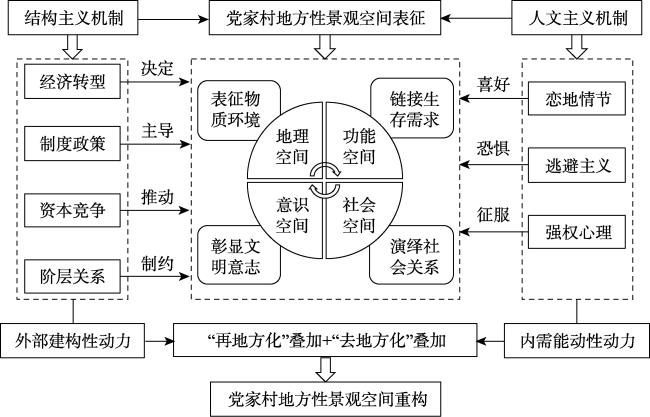
传统村落地方性景观的分化与重构既需要考虑人文主义式的“自我个体”诉求,更需要将其置于“家族宗祠”以及“历史文化名村”这个特定“社会结构”的时空场域中来管窥地方性景观重构的机制与结果。本文透过结构主义与人文主义的叠加分析,探寻传统村落地方性景观“能指”的表象重构过程,并剖析背后“所指”的深层异化根源。研究发现,党家村聚落空间表征及其重构过程具有结构主义与人文主义的双重地方性,主要体现在地理空间、功能空间、社会空间以及意识空间四个方面。其中,结构主义机制强调内部潜在、积极的互动实践,源自多元参与者携带的外源力量的塑造,是以经济转型、制度政策、资本竞争、阶层关系为主导的外部建构性动力;人文主义机制强调景观重构与人-地情感的内在联系,源自村民自发的经验倾向参与建构,是以恋地情节、逃避主义、强权心理为主导的内需能动性动力。两种机制相互依存、相互转换,形成了“再地方化”和“去地方化”的循环叠加,共同作用地方性景观的重构过程。本文旨在通过对党家村地方性景观为何?何为?以及如何重构的跨越式回应为乡村聚落景观的理论研究提供新的探讨方式和着力点,并在实践层面为保护传统村落的“文脉情长”提供有益的借鉴。
杨阳 , 房艳刚 , 李少琦 . 地方性景观重构的结构主义与人文主义叠加分析——以传统村落党家村为例[J]. 地理研究, 2025 , 44(1) : 149 -165 . DOI: 10.11821/dlyj020240350
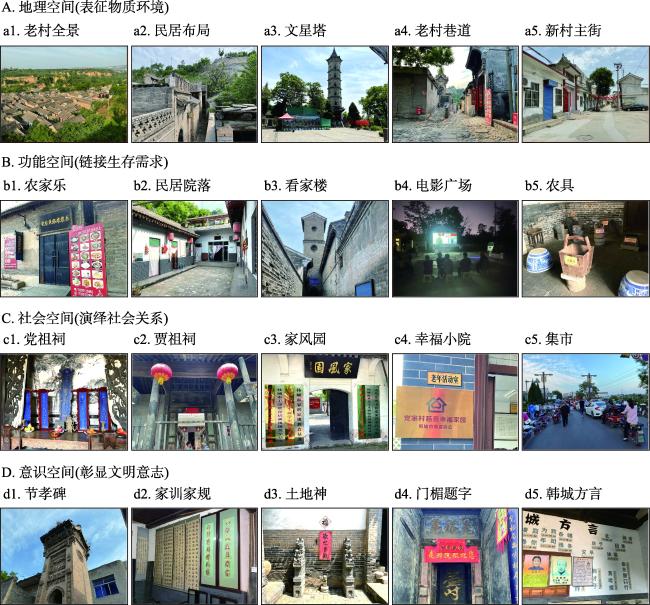
The differentiation and reconstruction of the local landscape should not only combine the individual demands of the humanist paradigm, but also place them in the specific places of "ancestral hall", "Chinese traditional village", and "social structure" to study the process and results of synergistic mechanism. Through the superposed analysis of structuralism and humanism, this study analyzes the visible reconstructing process and the invisible driving mechanism of the local landscape in a traditional village. The conclusion shows that the local landscape of Dangjia village is mainly reflected in geographical space, functional space, social space and consciousness space. The geographical space organically combines the villagers with the natural environment, which is a local landscape with physical environmental characteristics; The functional space shows the selection and adaptation of the environment in the development process of Dangjia village, which is a local landscape that connects the needs of survival; The social space reveals the gathering motives of different villager groups, which is a local landscape that interprets social relations; The consciousness space connects the relationship between the place identity of the villagers and the cultural landscape of the village, which is the local landscape that reflects the spiritual civilization. In these four spaces, the representation and reconstruction of local landscapes include both structuralism and humanism, and the combined vectors of the two mechanisms are interdependent and interconverted forming a cyclic superposition of "re-localization" and "de-localization, which jointly interprets the logical relationship of local landscape reconstruction. Among them, the structuralism mechanism of the local landscape in Dangjia village is derived from the exogenous forces carried by multiple participants including economic transformation, institutional policies, capital competition and class relations, which are all external-constructive mechanism. The humanist mechanism originates from the villagers' spontaneous participation in the construction of the landscape, including topology, topophobia, and power psychology, which are all internal-demand mechanism. This study aims to coherently response to three questions: for whom? why? and how the local landscape of Dangjia village was reconstructed? which has theoretical and practical significance, one is to provide new theoretical guidance for the study of rural settlement landscape, and the other is to provide a useful reference for the protection of the "cultural continuity and emotional sustenance" in traditional villages.
表1 深度访谈样本构成情况Tab. 1 Samples of in-depth interviews |
| 编号 | 年龄 | 身份信息 | 学历 | 编号 | 年龄 | 身份信息 | 学历 |
|---|---|---|---|---|---|---|---|
| F01 | 60 | 村委会妇联主任 | 高中 | F19 | 50 | 农家乐老板 | 高中 |
| F02 | 57 | 村委会会计 | 初中 | F20 | 55 | 村委会前任会计 | 大专 |
| M03 | 59 | 停车场收费员 | 初中 | F21 | 56 | 一组村民 | 小学 |
| M04 | 77 | 翰林院家主 | 小学 | F22 | 56 | 农家乐服务员 | 初中 |
| M05 | 34 | 农家乐私营司机 | 大专 | F23 | 58 | 晋源小院保洁 | 小学 |
| M06 | 37 | 民俗农家乐老板 | 高中 | F24 | 65 | 老村导游 | 高中 |
| F07 | 65 | 文星阁商店老板 | 小学 | F25 | 67 | 老村保洁员 | 初中 |
| M08 | 42 | 芮国博物馆馆长 | 本科 | M26 | 71 | 天津游客 | 大专 |
| M09 | 58 | 农家乐老板 | 初中 | M27 | 33 | 山东游客 | 本科 |
| M10 | 59 | 晋源小院老板 | 小学 | F28 | 67 | 西安游客 | 高中 |
| M11 | 59 | 党家村瓦工 | 初中 | M29 | 24 | 西安游客 | 本科 |
| M12 | 59 | 族谱编纂者 | 初中 | F30 | 27 | 铜川游客 | 研究生 |
| M13 | 60 | 二组村民 | 初中 | M31 | 31 | 富平游客 | 本科 |
| M14 | 63 | 三组村民 | 初中 | F32 | 66 | 麻将馆老板 | 初中 |
| M15 | 64 | 农家乐老板 | 高中 | F33 | 49 | 幸福小院厨师 | 小学 |
| M16 | 71 | 上寨村民 | 初中 | F34 | 53 | 医疗室医生 | 大专 |
| M17 | 75 | 四组村民 | 小学 | F35 | 45 | 早餐店老板 | 初中 |
| M18 | 64 | 龙门有限责任公司保安 | 初中 | M36 | 81 | 幸福小院抗美援朝老兵 | 小学 |
注:Female(F)代表女性,Male(M)代表男性。访谈地点:党家村管委会、景区停车场保安亭、樱桃采摘园入口、晋源小院农家乐、麻将馆、景区入口观景台、党祖祠、贾祖祠、节孝碑前、福字墙前、惜字炉前、中日友好广场、新村休闲广场、幸福小院、双旗杆院、文星阁前、翰林院、老村家风广场、泌水河岸、泌阳堡、党家村村民家里等。 |
衷心感谢匿名审稿专家的中肯点评和极富建设性的修改意见,对本文的行文逻辑、结构内容与文字表达有很大帮助,同时也让此文可以更好地呈现给大家,再次感谢!
| [1] |
爱德华·雷尔夫. 地方与无地方. 刘苏, 相欣奕, 译. 北京: 商务印书馆, 2021.
[
|
| [2] |
王向荣. 景观的地方性. 中国园林, 2023, 39(4): 2-3.
[
|
| [3] |
汪芳, 章佳茵, 卞辰龙, 等. 生态适应中乡村地方性景观的分化重构与机制分析. 中国园林, 2023, 39(4): 14-19.
[
|
| [4] |
|
| [5] |
|
| [6] |
段义孚.
[
|
| [7] |
杨阳, 房艳刚, 梁璐. 人文地理方法论视角下的乡村聚落景观流派进展及展望. 地理科学进展, 2024, 43(1): 163-178.
[
|
| [8] |
赵思文, 胡希军, 汤佳, 等. 流域古城镇地名文化景观基因组图谱及群系特征: 以湖南沅水流域为例. 地理研究, 2023, 42(11): 3020-3042.
[
|
| [9] |
宿爱云. 明清河西走廊汉族民间信仰及其文化景观研究. 西宁: 青海师范大学博士学位论文. 2022: 79-96.
[
|
| [10] |
王云才. 论景观空间图式语言的逻辑思路及体系框架. 风景园林, 2017, (4): 89-98.
[
|
| [11] |
刘宏芳, 明庆忠, 韩剑磊. 结构主义视角下民族旅游村寨地方性建构动力机制解析: 以石林大糯黑村为例. 人文地理, 2018, 33(4): 146-52.
[
|
| [12] |
孔翔, 卓方勇. 文化景观对建构地方集体记忆的影响: 以徽州呈坎古村为例. 地理科学, 2017, 37(1): 110-117.
[
|
| [13] |
操小晋, 刘春卉, 余思奇. 老旧社区的具身实践与地方认同: 基于超越表征的整合视角. 人文地理, 2023, 38(2): 69-78.
[
|
| [14] |
|
| [15] |
杨馥端, 窦银娣, 李伯华, 等. 符号消费与场域转换: 传统村落文化空间演变与重构. 地理研究, 2023, 42(8): 2172-2190.
[
|
| [16] |
张中华, 章墨. 基于“点-链-集”结构的传统村落景观地方性知识体系研究. 西北大学学报(自然科学版), 2022, 52(4): 617-627.
[
|
| [17] |
蔡运龙, 叶超, 陈彦光, 等. 地理学思想经典解读. 北京: 商务印书馆, 2023: 247.
[
|
| [18] |
|
| [19] |
R.J.约翰斯顿. 地理学与地理学家: 1945年以来的英美人文地理学. 唐晓峰, 李平, 叶冰,等译. 北京: 商务印书馆, 2010: 348-350.
[
|
| [20] |
|
| [21] |
陈伊乔, 刘逸. 段义孚的人地情感研究对城乡规划的启示. 城市发展研究, 2019, 26(8): 104-110.
[
|
| [22] |
周尚意, 杨鸿雁, 孔翔. 地方性形成机制的结构主义与人文主义分析: 以798和M50两个艺术区在城市地方性塑造中的作用为例. 地理研究, 2011, 30(9): 1566-1576.
[
|
| [23] |
段义孚, 志丞, 左一鸥. 人文主义地理学之我见. 地理科学进展, 2006, 25(2): 1-7.
[
|
| [24] |
郭文. 空间的生产与重塑:流动中的文化古镇. 北京: 商务印书馆, 2022: 254-255.
[
|
| [25] |
古荭欢, 孙斌栋. 城市社会空间结构及其演变: 从芝加哥、洛杉矶到上海. 地理科学, 2023, 43(2): 185-196.
[
|
| [26] |
皮亚杰. 结构主义. 倪连生, 王琳, 译. 北京: 商务印书馆, 2021: 82-83.
[
|
| [27] |
人民政协网. 感悟历史传承, 海外华文媒体走进韩城. https://www.rmzxb.com.cn/c/2021-04-07/2823743.shtml, 2024-10-16.
[The Chinese People's Political Consultative Conference Website. Feeling the historical inheritance, overseas Chinese media visited Hancheng. https://www.rmzxb.com.cn/c/2021-04-07/2823743.shtml, 2024-10-16.]
|
| [28] |
叶超, 吴佩瑾. 朝向人文主义的世界: 段义孚的思想遗产. 人文地理, 2023, 38(2): 44-50, 96.
[
|
| [29] |
周尚意. 触景生情:文化地理学人笔记. 北京: 商务印书馆, 2019: 162-164.
[
|
| [30] |
丹尼斯·E. 科斯格罗夫. 社会形态与符号景观. 李捷, 译. 北京: 商务印书馆, 2022: 296.
[
|
| [31] |
刘滨谊, 冯晶磊, 马淑菡, 等. 八景的景观多维感知机制研究. 风景园林, 2024, 31(7): 12-9.
[
|
| [32] |
|
/
| 〈 |
|
〉 |