汪侠 , 甄峰
, 甄峰
WANG Xia, ZHEN Feng
收稿日期: 2017-06-5
修回日期: 2017-09-2
网络出版日期: 2017-12-15
版权声明: 2017 《地理研究》编辑部 《地理研究》编辑部
基金资助:
作者简介:
作者简介:汪侠(1974- ),女,安徽怀远人,博士,副教授,研究方向为旅游地理、城市与区域规划。E-mail:wangxia128@nju.edu.cn
展开
摘要
借鉴多维贫困理论,采取因子分析方法,构建了基于贫困居民视角的旅游扶贫满意度评价指标体系,并运用模糊综合评价模型,以贵州郎德镇为例,对贫困居民旅游扶贫满意度进行定量评价。研究发现:① 贫困居民旅游扶贫满意度的评价指标包括经济条件、生活水平、社会和谐、医疗健康、公共设施、教育条件、生态文化,以及扶贫参与及收益等8个方面;② 贫困居民旅游扶贫满意度模糊综合评价结果表明,郎德镇旅游扶贫的满意度水平处于“一般”到“满意”之间;③ 贫困居民旅游扶贫满意度的重要性—绩效评价揭示了郎德镇贫困居民比较重视,但同时也是旅游扶贫工作中比较薄弱的地方,为郎德镇提升贫困居民旅游扶贫满意度提供依据。
关键词:
Abstract
To improve the accuracy and long-term effect of poverty alleviation, it is of great significance to investigate poor residents' satisfaction with tourism poverty alleviation. Despite its importance, few studies have been conducted on the evaluation of poor residents' satisfaction with tourism poverty alleviation. Based on the multidimensional poverty theory, this paper constructs the evaluation factors of poor residents' satisfaction with tourism poverty alleviation based on literature review, multidimensional poverty indicators of the United Nations, as well as depth interviews with the poor residents. Employing fuzzy comprehensive evaluation model, and taking Langde Town in Guizhou Province as an example, we carried out the quantitative evaluation of poor residents' satisfaction with tourism poverty alleviation. The results indicate that: (1) The evaluation items of poor residents' satisfaction with tourism poverty alleviation can be grouped into eight categories based on principal component analysis, namely, economic conditions, living standard, participation in tourism development and the stability of the benefits, health level, social harmony, public facilities, educational conditions, and ecology and culture. Among the eight evaluation factors, economic conditions, participation in tourism development and the stability of the benefits, and living standard are the three factors that poor residents most concerned. (2) The fuzzy comprehensive evaluation of poor residents' satisfaction with tourism poverty alleviation in Langde Town is 3.68, indicating that the level of poor residents' satisfaction with tourism poverty alleviation in this town is between the level of "moderate" and "satisfied". (3) The importance-performance evaluation of poor residents' satisfaction with tourism poverty alleviation revealed the weaknesses of the current tourism poverty alleviation in the study area, namely, "poverty alleviation accuracy", "benefit distribution of poverty alleviation", "tourism development participation", "tourism decision-making participation", and "the long-term effect of tourism poverty alleviation", which provides scientific reference for improving poor residents' satisfaction with tourism poverty alleviation. Collectively, this study makes theoretical contribution to tourism research by applying multidimensional poverty theory into the evaluation of poor residents' satisfaction with tourism poverty alleviation.
Keywords:
全球贫困地区与旅游资源的空间分布具有很高的地理重叠性[1]。凭借丰富的旅游资源发展旅游产业,已成为贫困地区发展经济的手段之一,伴随旅游扶贫的推进,旅游扶贫也成为学者研究的重要内容。截至2016年底,旅游扶贫研究文献已达2100多篇,其中,国外相关研究主要集中在扶贫理论[2-5]、扶贫方式[6-10]、扶贫效果[11-13]、扶贫受益主体[14,15]、扶贫参与角色[16-19]等方面。国内旅游扶贫则主要关注旅游扶贫效应[20-23]、旅游扶贫模式和路径[24-29]、旅游扶贫问题与对策[30-32]、旅游扶贫与社区居民感知态度[21,33]等内容。
随着国家精准扶贫工作的开展,基于贫困居民的精准旅游扶贫受到越来越多的重视,贫困居民对于旅游扶贫的满意度是旅游扶贫质量的指示器,其评价指标体系及定量评价方法值得深入探讨。所谓贫困居民旅游扶贫满意度,是指贫困居民对于本地旅游扶贫的期望与实际感知相比较而产生愉悦或者失望的心理状态。一方面,贫困居民经济基础差,文化程度低,技术能力弱,而旅游业进入门槛低、以及弹性就业的特点,可以为他们提供摆脱贫困的有效途径,相对而言,贫困居民对于旅游扶贫的期望值更高。另一方面,如果忽视贫困居民在旅游扶贫中的满意度,则容易使得他们产生心理、社会文化与经济利益的失衡感,对旅游业发展产生消极情绪以致阻碍旅游的发展[34,35],从而使旅游扶贫落空。因此,从贫困居民微观视角出发,关注其对旅游扶贫的满意度及其评价指标,对于提高中国旅游扶贫工作的精准性和长效性具有重要意义。
21世纪以来,学界关于旅游地居民满意度的研究不断增加,如旅游开发的居民满意度驱动因素[36,37]、旅游地居民满意度影响机理[34,38]、旅游地居民生活满意度评价[39]、居民社区旅游参与满意度[40-42]等。总体来看,相关研究多聚焦居民对于旅游开发和社区参与满意度等方面,虽然旅游扶贫满意度评价的研究在居民感知和态度的探讨中有所涉及[21,22],但基于贫困居民视角的旅游扶贫满意度评价指标的研究还比较零散,其系统性和科学性还有待加强。
基于以上分析,拟构建贫困居民旅游扶贫满意度的评价指标体系,运用模糊综合评价模型,对贵州郎德镇的贫困居民旅游扶贫满意度进行定量评价,并使用重要性—绩效分析(Importance-performance Analysis,IPA)对郎德镇旅游扶贫的优势和问题进行剖析,以期丰富中国的旅游扶贫绩效评价研究,为实施精准扶贫提供科学依据。
从收入方面划定贫困线是最常使用的方法。所谓贫困线,是在一定的时间、空间和社会发展阶段的条件下,维持人们的基本生存所必需消费的食物、衣服等物品的最低费用[43]。贫困问题的持久性使一些学者质疑将收入作为评估贫困的唯一指标是否过于片面,认为教育、健康、资源的可获得性都会影响到个体的贫困程度,这些变量也应作为个体收入以及贫困的影响因素[44]。Sen较早提出“能力贫困”的概念[45],并基于此促进了多维贫困理论的产生[46,47],使得包括教育[48]、健康[49]、能源[50]、水资源[51]、环境[52]等指标的多维贫困标准越来越多被使用。在2010年联合国的人类发展报告(Human Development Report)中,多维贫困指数(Multidimensional Poverty Index, MPI)开始取代1997年以来使用的人类贫困指数(Human Poverty Index,HPI),即以日均花费1美元作为划分贫困人口界限的旧标准,多维贫困指数涵盖了单位家庭的关键评价因素,使用包括教育、健康等10个主要变量来测算贫困水平[53]。
本研究在构建贫困居民旅游扶贫满意度的评价指标时,借鉴多维贫困理论和联合国MPI评价指标,即考虑多维旅游扶贫的满意度。主要原因:首先,从调查对象看,MPI是基于微观层面的个体或家庭在不同维度上的贫困程度的评价[53,54],不同于以往基于国家宏观层面的贫困数据的汇总,这与本文基于居民视角的旅游扶贫研究对象相契合。其次,从贫困评价指标来看,多维贫困理论强调客观评价指标和主观评价指标相结合[55],客观评价指标除了收入的考量,还包括饮用水、道路、卫生等其他客观指标的贫困;主观评价指标则是指个体对于福利的主观感受的贫困,即个体对于其生活状况的主观评价,其中,满意度是个体主观评价贫困程度的重要方面[56,57]。张晓颖等在基于多维贫困理论的贫困人口分析中,就使用了包括满意度在内的主客观评价指标[57]。
选择贵州省黔东南苗族侗族自治州的郎德镇作为研究区。该镇面积73.7 km2,辖郎德村、南猛村、乌流村、报德村、肖瓦吉村5个行政村,共有2639户,总人口10400人,少数民族人口占总人口的98.8%,主要以苗族居多。
选择郎德镇作为贫困居民旅游扶贫满意度研究的案例地,原因有三:首先,郎德镇位于国家级贫困县雷山县,脱贫工作艰巨。2015年全镇共有贫困人口2327人,占全镇总人口的29.8%。其次,郎德镇旅游资源丰富,近年来该镇不断加大旅游开发力度,开展旅游扶贫工作,2015年南猛村还被列为国家旅游局旅游扶贫试点村。第三,郎德村民的生活与旅游发展密切相关,村民主要通过农家乐、旅游餐馆、加工刺绣商品、销售特产等方式参与旅游业,旅游产业已经成为郎德镇的支柱产业。
数据采集采取问卷调查的方式进行,调查时间为2015年6月25-30日,调查地点为郎德镇的郎德村、报德村、乌流村、南猛村。通过雷山县扶贫建档立卡的数据了解贫困人口情况,然后在贫困人口中采取随机抽样的方法进行问卷调查,对于能够读懂问卷的村民,请其在问卷上直接作答,对于文化程度较低者通过访谈辅助方式帮助其完成问卷。本次调查共向贫困居民发放问卷450份,回收有效问卷397份,样本的分布情况见表1。采用SPSS 22.0统计软件对数据进行分析,对于缺失的数值采用均值替代法进行了处理。
表1 问卷调查样本分布
Tab. 1 Sample distribution of survey
| 人口社会属性特征 | 人数 | 占比(%) | 人口社会属性特征 | 人数 | 占比(%) | ||
|---|---|---|---|---|---|---|---|
| 性别 | 男 | 201 | 50.63 | 家中是否有旅游从业人员 | 是 | 293 | 73.80 |
| 女 | 196 | 49.37 | 否 | 104 | 26.20 | ||
| 年龄(岁) | ≤18 | 26 | 6.55 | 文化程度 | 小学及以下 | 41 | 10.33 |
| 19~30 | 95 | 23.93 | 初中 | 102 | 25.69 | ||
| 31~50 | 202 | 50.88 | 高中 | 191 | 48.11 | ||
| 51~60 | 56 | 14.11 | 大专 | 61 | 15.37 | ||
| ≥61 | 18 | 4.53 | 本科及以上 | 2 | 0.50 | ||
| 家庭人均纯收入(元) | ≤500 | 5 | 1.26 | 居住地 | 郎德村 | 106 | 26.70 |
| 501~1000 | 21 | 5.29 | 报德村 | 91 | 22.92 | ||
| 1001~2000 | 141 | 35.52 | 乌流村 | 90 | 22.67 | ||
| 2001~2800 | 230 | 57.93 | 南猛村 | 110 | 27.71 | ||
贫困居民旅游扶贫满意度评价指标体系的构建,主要按照以下三个步骤进行:
首先,对旅游扶贫和居民满意度的相关文献进行梳理,从学界视角探讨贫困居民对旅游扶贫满意度的评价指标,选取的指标有带动工农业发展[58]、带动第三产业发展[58,59]、增加就业[22,59]、提高本地知名度[22]、促进家庭和谐[59]、促进邻里和谐[59]、改善社会治安[58]、扶贫收益分配[34]、提升女性地位[22,60]、改善道路交通[59]、改善信息通讯[60]、增加医疗保险机会[61]、增加技能培训[59,61]、促进文化传承[59]、加强语言学习[61]、提升环保意识[59]、改善生态环境[59]等17个评价指标。
其次,借鉴多维贫困理论和联合国的多维贫困指标,旅游扶贫不仅是经济方面的扶贫,还包括教育、健康、医疗、卫生等方面的扶贫,即多维扶贫,据此,选取了提高家庭收入、改善教育设施、提高儿童入学率、改善健康状况、改善营养状况、美化村庄环境、改善住房条件、改善水电条件、优化家庭资产(生活耐用品、交通工具、家用电器等)、优化燃料类型、改善医疗条件、改善卫生设施等12个评价指标。
第三,对郎德镇的贫困居民进行访谈,从居民角度了解旅游扶贫满意度的影响因素,选取旅游开发参与、旅游决策参与、扶贫精准性、扶贫长效性、降低贷款难度、增加医疗报销机会、增强地方认同感这7个指标。通过以上步骤,共遴选出贫困居民旅游扶贫满意度评价指标36个。
为了降低36个评价指标之间可能存在的共线性,并删除相关性低的评价指标,采用因子分析法对以上36个评价指标进行量化处理。因子分析的数据来源于2015年6月25-30日在郎德镇进行的问卷调查。将36个评价指标转化为调查问卷的问题,请贫困居民按照李克特五级量表对评价指标的重要性,分别从5~1进行打分。统计结果表明Cronbach's α系数为0.761,大于0.5,说明评价指标具有较好的可靠性。效度分析中,KMO统计量值为0.797,巴特勒球形检验的P值为0.000,说明调查数据可以进行因子分析。进一步采用主成分分析法,通过最大方差法进行因子正交旋转,根据Hair等的建议[62],以特征值大于1和因子载荷大于0.5为标准,提取出旅游扶贫满意度33个评价指标的8个公因子(提高儿童入学率、改善营养状况、改善社会治安这3个指标被剔除)(表2),分别涵盖了旅游扶贫的经济、社会、生活、健康、教育、公共设施、以及生态文化7个维度的满意度,此外,鉴于旅游扶贫的特殊性,还包括扶贫参与及收益这一公因子。
表2 因子分析结果
Tab. 2 Results of factor analysis
| 评价指标 | 因子载荷 | 特征值 | 方差解释百分比 | Cronbach's α | 均值 | 标准差 |
|---|---|---|---|---|---|---|
| 经济条件(U1) | 7.765 | 23.530 | 0.94 | |||
| 1、提高家庭收入(U11) | 0.853 | 3.31 | 1.441 | |||
| 2、增加就业(U12) | 0.869 | 3.08 | 1.408 | |||
| 3、降低贷款难度(U13) | 0.816 | 3.04 | 1.422 | |||
| 4、带动第三产业发展(U14) | 0.849 | 3.29 | 1.443 | |||
| 5、带动工农业发展(U15) | 0.774 | 3.11 | 1.634 | |||
| 生活水平(U2) | 3.983 | 12.071 | 0.913 | |||
| 6、改善住房条件(U21) | 0.850 | 3.41 | 1.337 | |||
| 7、改善水电条件(U22) | 0.848 | 3.15 | 1.274 | |||
| 8、优化家庭资产(U23) | 0.856 | 3.39 | 1.332 | |||
| 9、优化燃料类型(U24) | 0.842 | 3.13 | 1.266 | |||
| 10、改善卫生设施(U25) | 0.768 | 3.34 | 1.336 | |||
| 扶贫参与及收益(U3) | 3.33 | 10.092 | 0.896 | |||
| 11、旅游开发参与(U31) | 0.938 | 3.85 | 0.903 | |||
| 12、旅游决策参与(U32) | 0.857 | 3.80 | 1.02 | |||
| 13、扶贫收益分配(U33) | 0.755 | 3.80 | 0.934 | |||
| 14、扶贫精准性(U34) | 0.832 | 3.99 | 0.816 | |||
| 15、扶贫长效性(U35) | 0.783 | 3.74 | 0.943 | |||
| 医疗健康(U4) | 2.886 | 8.746 | 0.924 | |||
| 16、改善医疗条件(U41) | 0.782 | 4.00 | 1.392 | |||
| 17、改善健康状况(U42) | 0.861 | 3.64 | 1.527 | |||
| 18、增加医疗报销机会(U43) | 0.831 | 3.63 | 1.518 | |||
| 19、增加医疗保险机会(U44) | 0.861 | 3.57 | 1.543 | |||
| 社会和谐(U5) | 2.431 | 7.366 | 0.862 | |||
| 20、提升女性地位(U51) | 0.868 | 3.52 | 1.381 | |||
| 21、提高本地知名度(U52) | 0.854 | 3.41 | 1.335 | |||
| 22、增强地方认同感(U53) | 0.862 | 3.51 | 1.379 | |||
| 评价指标 | 因子载荷 | 特征值 | 方差解释百分比 | Cronbach's α | 均值 | 标准差 |
| 23、促进家庭和谐(U54) | 0.775 | 3.35 | 1.285 | |||
| 24、促进邻里和谐(U55) | 0.595 | 3.44 | 1.41 | |||
| 公共设施(U6) | 1.888 | 5.722 | 0.841 | |||
| 25、美化村庄环境(U61) | 0.854 | 3.52 | 0.944 | |||
| 26、改善道路交通(U62) | 0.829 | 3.53 | 0.889 | |||
| 27、改善信息通讯(U63) | 0.815 | 3.67 | 0.934 | |||
| 教育条件(U7) | 1.530 | 4.638 | 0.679 | |||
| 28、改善教育设施(U71) | 0.732 | 2.39 | 1.312 | |||
| 29、增加技能培训(U72) | 0.817 | 2.74 | 1.481 | |||
| 30、加强语言学习(U73) | 0.688 | 2.71 | 1.597 | |||
| 生态文化(U8) | 1.279 | 3.875 | 0.776 | |||
| 31、提升环保意识(U81) | 0.610 | 3.29 | 1.384 | |||
| 32、改善生态环境(U82) | 0.851 | 3.28 | 1.480 | |||
| 33、促进文化传承(U83) | 0.790 | 3.40 | 1.525 |
8个公因子中,第1个公因子为“经济条件”,反映了贫困居民对于旅游扶贫提升家庭和社区经济水平的满意度,评价因子包括提高家庭收入、增加就业、降低贷款难度、带动第三产业发展、带动工农业发展等5个。第2个公因子为“生活水平”,体现了居民对于旅游扶贫提升家庭生活条件的满意度,评价因子包括改善住房条件、水电条件、优化家庭资产和燃料类型,以及改善卫生设施。
第3个公因子为“扶贫参与及收益”,探查了居民参与旅游开发并获取稳定收益的满意度,评价因子包括旅游开发参与、旅游决策参与、扶贫收益分配、扶贫精准性、和扶贫长效性。第4个公因子为“医疗健康”,反应了居民对于旅游扶贫提升健康保障的满意度,评价因子包括改善医疗条件、改善健康状况、增加医疗报销机会,以及增加医疗保险机会。
第5个公因子为“社会和谐”,探查了居民对于旅游扶贫融洽家庭关系、增强社区和谐的满意度,评价指标包括提升女性地位、提高本地知名度、增强地方认同感,以及促进家庭和邻里和谐。第6个公因子为“公共设施”,反映了居民对于旅游扶贫优化社区公共设施的满意度,评价指标包括美化村庄环境、改善道路交通和信息通讯。
第7个公因子为“教育条件”,反映了居民对于旅游扶贫改进教育培训条件的满意度,评价指标包括改善教育设施、增加技能培训、加强语言学习等3个指标。第8个公因子为“生态文化”,体现了居民对于旅游扶贫美化环境和加强交流的满意度,评价指标包括提升环保意识、改善生态环境、促进文化传承。
采取模糊综合评价方法(Fuzzy comprehensive evaluation method)[63]对贫困居民旅游扶贫满意度进行量化评价,选择该方法的原因有两个:① 居民对于旅游扶贫满意度的评价包括经济、生活、社会、教育等多个维度,很难将影响旅游扶贫满意度的全部因素纳入到评价体系;② 旅游扶贫满意度的评价受到贫困居民的文化水平和认知能力的影响,评价信息存在模糊性。模糊综合评价方法有利于解决评价信息的不完备及模糊性等问题,使评价较为客观全面。
评价因素集为各个评价指标构成的集合U=(U1,U2,…,Un),基于文献分析和主成分分析方法,可以将贫困居民旅游扶贫满意度评价集划分为两个层次(表2)。
评价论域是指由评价等级构成的集合V。本研究将贫困居民旅游扶贫满意度的评价论域分为5级,V=(V1,V2,V3,V4,V5)=(很满意,满意,一般,不满意,很不满意),并分别赋值为5、4、3、2、1。
根据主成分分析所得的因子载荷,计算各评价指标的权重。因为主成分分析数据来自于贫困居民对于旅游扶贫满意度评价指标重要性的打分,因子载荷越大,说明该评价指标对于公因子的贡献越大,因此应赋予更大的权重。通过对因子载荷值进行归一化处理,得到各评价指标的权重如下:
A1=(0.205,0.209,0.196,0.204,0.186)
A2=(0.204,0.204,0.206,0.202,0.184)
A3=(0.225,0.206,0.181,0.200,0.188)
A4=(0.235,0.258,0.249,0.258)
A5=(0.220,0.216,0.218,0.196,0.150)
A6=(0.342,0.332,0.326)
A7=(0.327,0.365,0.308)
A8=(0.271,0.378,0.351)
同理,根据各公因子的方差贡献率进行归一化处理,得到各公因子的权重如下:
A=(0.309,0.159,0.133,0.115,0.097,0.075,0.061,0.051)
为了构建评价隶属矩阵,请郎德镇的贫困居民按照李克特量表的5个评分等级(很满意、满意、一般、不满意、很不满意),对郎德镇旅游扶贫的满意度进行评价,得到旅游扶贫满意各评价指标的评价隶属矩阵为:
采用M(·,+)的计算方式进行运算,得到郎德镇的贫困居民旅游扶贫满意度二级评价指标U1的模糊评价结果:B1=A1∧R1=(0.261,0.304,0.33,0.077,0.028)。同理,可计算出评价指标U2、U3、U4、U5、U6、U7、U8的模糊评价结果B2、B3、B4、B5、B6、B7、B8,并据此构建一级评价指标的评价隶属矩阵R:
其次,采用M(·,+)方法,计算得到一级评价指标U的模糊评价结果:B=A∧R=(0.237,0.371,0.248,0.122,0.023),将模糊向量B进行单值化处理,得到最终评价结果W=0.237×5+0.371×4+0.248×3+0.122×2+0.023×1=3.68。参考评价论域V=(V1,V2,V3,V4,V5)=(很满意,满意,一般,不满意,很不满意),以及各评价等级的赋值5、4、3、2、1,可知郎德镇的贫困居民旅游扶贫满意度评价结果W值介于“一般”到“满意”之间。
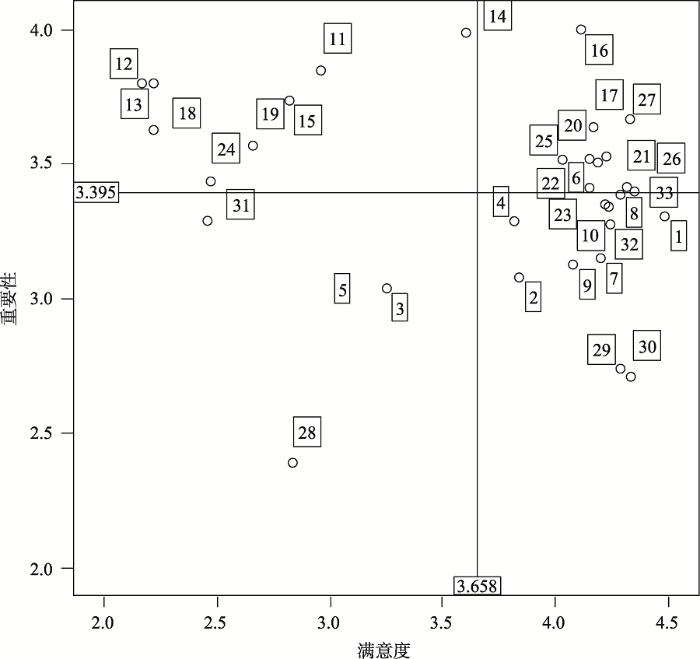
在贫困居民旅游扶贫满意度评价的基础上,运用IPA方法对郎德镇旅游扶贫存在的优势和问题进行剖析。IPA方法由Martilla等提出[63],被运用于航空[64]、旅游[65,66]、酒店[67]等研究领域。本研究以横轴表示绩效(满意度评价得分),纵轴表示重要性(重要性评价得分),绘制IPA图。
如图1所示,依据满意度和重要性的平均值(3.658和3.395),33个旅游扶贫满意度评价指标被划分在四个象限中。其中右上方象限为优势保持区(keep up the good work),即当前旅游扶贫工作中贫困居民满意度较高的因素,主要包括“改善医疗条件”“改善信息通讯”“改善健康状况”“增强地方认同感”“改善住房条件”“优化家庭资产”“提高本地知名度”“改善道路交通”“美化村庄环境”“提升女性地位”“促进文化传承”等。这些因素是郎德镇贫困居民比较重视且较满意的因素,应予以强化保持。
左上方象限为“重点改善区”(concentrate here),即贫困居民比较重视但却是当前郎德镇旅游扶贫中比较薄弱的地方,主要包括“扶贫精准性”“扶贫收益分配”“旅游开发参与”“旅游决策参与”“扶贫长效性”“增加医疗报销机会”“增加医疗保险机会”“促进邻里和谐”等。以上因素是改进旅游扶贫满意度的关键所在,应予以充分重视,将劣势转化为优势。
右下方象限为“供给过度区”(possible overkill),即贫困居民对于这些评价指标重视程度相对低而其实际满意度却很高,主要包括“加强语言学习”“增加技能培训”“增加就业”“优化燃料类型”“改善水电条件”“带动第三产业发展”“改善卫生设施”“改善生态环境”等。
左下方象限为“次重要区”(low priority),即贫困居民对于这些评价指标重视程度低而且满意度也很低的因素,主要包括“改善教育设施”“降低贷款难度”“提升环保意识”“带动工农业发展”等。从长远角度看,这些因素虽然不及左上方象限的指标重要,但是未来也需着力改善。
(1)运用多维贫困理论,结合旅游扶贫的特点,构建了基于贫困居民视角的旅游扶贫满意度测评指标体系。研究表明,除了经济条件以外,扶贫参与及收益、生活水平、医疗健康、社会和谐、公共设施、教育条件、生态文化也是评价旅游扶贫满意度的重要指标,因此,仅仅以经济收入来衡量旅游扶贫满意度有一定的片面性。这与王艳慧等的发现一致[68,69]。这些研究运用多维贫困理论,对于贫困人口进行了多维测量,发现基于收入和基于MPI的评价结果存在明显的差别,而运用多维贫困指标来评价贫困更加全面。未来,转变福利经济学的收入视角,从微观发展经济视角来多维评价贫困,并科学测度旅游扶贫满意度非常必要。
(2)生活水平是生活质量的重要表征,本研究表明生活水平是评价旅游扶贫满意度的重要维度。中国政府在2015年扶贫目标中提出“两不愁、三保障”,明确要让贫困人口的住房安全有保障。张伟等在基于贫困人口发展的旅游扶贫效应研究中,使用了供水、供电、卫生等评价指标[22]。此外生活耐用品、交通工具、家用电器等资产贫困也是家庭持久性贫困的体现[56],这些指标在贫困测量中的使用越来越多。因此,在旅游扶贫满意度测评中,生活水平应作为经济水平指标的补充。
(3)旅游开发参与、旅游决策参与、扶贫收益分配等指标的重要性高,验证了周歆红提出的贫困人口在旅游开发中的获益和发展机会,是旅游扶贫的核心[70]。同时,也与汪侠等的研究相一致[34],即提升旅游扶贫效应,不仅要依靠收入增长的“涓滴效应”,还取决于收入分配效应,重视贫困居民的社区旅游扶贫参与,并使之获得收益分配是提升满意度的关键所在。
(4)在旅游扶贫满意度的多维评价指标中,扶贫精准性的权重非常高。随着精准旅游扶贫在学界受到的关注增多,学者们发现在中国旅游扶贫中,扶贫方式普遍较为粗放,扶贫项目选择并非基于贫困人口利益诉求,认为精准旅游扶贫迫在眉睫[71]。因此,要提升旅游扶贫满意度,需要对以往旅游扶贫中出现的“谁投资、谁受益”的扶贫模式进行反思,坚持PPT(pro-poor tourism)理念,让贫困人口获得更多的发展机会,打造“利贫性”(pro-poor)和“包容性”(inclusive)增长的旅游扶贫模式。
(5)贫困居民旅游扶贫满意度的评价指标中,除了经济条件、扶贫参与及收益指标外,还包括了医疗健康、教育条件、公共设施、生态文化等指标。在旅游业作为主导产业的地区,贫困居民对于旅游扶贫效应的期望已经超出了狭义的经济领域,拓展到个人以及家庭之外的医疗、教育、设施、环境等广义范畴,并会对旅游扶贫满意度产生影响。这主要因为旅游产业乘数效应强,旅游业发展会带来地区收入总量增加,贫困居民希望通过旅游收入的分配,带动公共服务设施的改善[72],促进贫困地区基础公共服务设施均等化。
(6)2016年起,国家旅游局联合多部委启动乡村旅游扶贫工程行动,要利用乡村旅游带动全国747万贫困人口实现脱贫。目前,乡村旅游扶贫工程正在积极推进,从贫困居民满意度的角度评价旅游扶贫,可以作为衡量旅游扶贫质量的重要指数。旅游扶贫是一项系统工程,如何有效的分阶段、分步骤逐步脱贫是管理者、贫困居民都共同关心的问题。本研究中旅游扶贫满意度评价指标体系的构建能够为旅游扶贫工作提供具体的抓手。此外,各评价指标的权重也可以为扶贫工作的关注点提供启示。从权重来看,贫困居民在评价旅游扶贫满意度时,经济条件、生活水平、扶贫参与及收益是贫困居民最关注的三个方面,其次是医疗健康、社会和谐和公共设施。相比而言,教育条件、生态文化处于次重要的地位,这表明对于贫困居民而言,通过参与旅游扶贫,改善其经济落后局面、提升生活水平、在旅游扶贫中获取长期受益是其最关心的问题。郎德镇案例通过重要性—绩效分析,清晰地指明了当前和未来旅游扶贫工作的关键所在,可以为其他贫困地区旅游扶贫满意度评价提供参考。
本研究还存在一些不足之处。首先,在构建评价指标体系时,虽然使用了文献综述和深度访谈方法,却未从专家角度筛选评价指标,未来的研究可以将德尔菲法运用于该研究,进一步提升评价指标的科学性。其次,在对贵州郎德镇的旅游扶贫满意度进行IPA分析时,限于篇幅,仅以重要性和满意度的均值作为象限划分的标准,近来有学者尝试运用引申重要性对IPA评价结果进行修正分析[73],未来,可以考虑基于传统IPA与修正IPA方法对于旅游扶贫满意度评价结果的对比分析。此外,本文仅以民族旅游镇——贵州郎德镇为例进行了个案研究,未来应加强其他类型旅游地的旅游扶贫满意度评价对比,增强研究结果的普适性。
The authors have declared that no competing interests exist.
| [1] |
Sustainable Tourism-Eliminating Poverty(ST-EP): An Overview .
Sustainable Tourism - Eliminating Poverty: An Overview
|
| [2] |
Tourism and poverty reduction: Theory and practice in less economically developed countries. https://doi.org/10.1080/09669582.2012.668909 URL [本文引用: 1] 摘要
This paper analyses the evolution of the theory and practice of tourism development aimed at poverty reduction in less economically developed countries (LEDCs). It critically reviews two central early themes in this area: community-based tourism projects, and the focus on structural conditions and power relations between global players and local communities. The paper considers the potential strengths of tourism development for LEDCs and summarises the many new subject area developments. A review of papers within the Journal of Sustainable Tourism's special issue on tourism and poverty reduction follows and four main themes are explored: development agency strategies and approaches, governance and biodiversity conservation, the assessment of tourism impacts and value chain analysis and inter-sectoral linkages. Key potential topics for future research and action are outlined, including: (1) the use of new techniques measuring tourism impacts, (2) the roles of development agency governance and operational practices, (3) how inequitable power relations and weak governance can undermine efforts, (4) the importance of private-sector business practices that contribute to poverty reduction, (5) the value of multidisciplinary quantitative and qualitative research tools and (6) the need for linkages between academic research and practitioner interventions.
|
| [3] |
Assisting the poor in China through tourism development: A review of research. https://doi.org/10.1016/j.tourman.2011.08.014 URL 摘要
The role of Pro-Poor Tourism has been increasingly studied in China since the 1990s. The research has addressed a broad range of key issues such as the implication of “ fu pin lv you ” (or TAP to use an English acronym arising from the translation ‘Tourism-Assisting the Poor’), governmental roles, local participation and the contribution of rural, natural and cultural resources to TAP. However, there has been a lack of research in some areas such as in the micro-economics of TAP targeting local poor people, quantitative research, case studies and anthropological analysis. This paper reviews Chinese academic literature on pro-poor tourism to provide a clearer picture of current practice and progress in TAP policies and research in China.
|
| [4] |
国外旅游扶贫研究进展 .
Review of overseas research on pro-poor tourism.
|
| [5] |
Tourism and poverty alleviation: An integrative research frame work. https://doi.org/10.2167/cit296.0 URL [本文引用: 1] 摘要
The past decade has seen an upsurge of interest from the governments and development organisations in a tourism-based approach to poverty alleviation. More specifically, poverty alleviation has been established as a major priority within the United Nations World Tourism Organisation (UNWTO) itself, as is evidenced by the launching of the concept of ST-EP (Sustainable Tourism as an effective tool for Eliminating Poverty). In contrast, the implications of tourism for poverty alleviation have been largely neglected by the tourism academic community. Relevant research to date is fragmented, limited in scope, and lacks a consistent methodological development. To address these deficiencies, this paper presents an integrative research framework, which synthesises multiple perspectives and can be used as an overarching guideline to stimulate and guide other future enquiries on tourism and poverty alleviation. Towards this end, a number of research needs and opportunities have also been identified and suggested along with the presentation of the framework.
|
| [6] |
Linkages among biodiversity, livelihood and tourism. https://doi.org/10.1016/j.annals.2011.03.006 URL [本文引用: 1] 摘要
The purpose of this study was to explore the relationships among biodiversity conservation, livelihood improvements, and tourism development using the appreciative inquiry approach as a research tool. The research was conducted in three different buffer-zone communities representing different levels of tourism development around Chitwan National Park, Nepal. The results indicate that tourism helps change local people’s attitudes toward the conservation of biodiversity and reduce people’s dependence on natural resources. Tourism, particularly small-scale and locally owned ecotourism ventures, is also identified as a tool to enhance the livelihoods of people around protected areas. The linkages, however, vary with the level of tourism development. This study also developed a framework to help understand these linkages.
|
| [7] |
Heritage, local communities and economic development. https://doi.org/10.1016/j.annals.2004.10.010 URL 摘要
Patrimoine, communautés locales et développement économique. Pour de nombreuses communautés locales dans des pays en voie de développement, la proximité de complexes touristiques importants génère des bénéfices mais aussi des co04ts. Cet article examine certains dynamiques des relations complexes et embo06tées entre ces communautés d’accueil, leur patrimoine local et les structures de gestion de tourisme. L’exemple de Borobudur, surl’06le de Java en Indonésie, est utilisé pour illustrer la discussion concernant le pouvoir, le déplacement et le contr00le, la participation locale et le r00le du > dans les pays en voie de développement. De plus, cet exemple offre quelques points de réflexion sur la fa04on dont la gestion et la planification du tourisme pourraient encourager des entreprises locales touristiques à petite échelle dans l’intérêt de la population d’accueil ainsi pour la population de passage.
|
| [8] |
Challenges and potential for linking tourism and agriculture to achieve pro-poor tourism objects. https://doi.org/10.2466/pr0.2001.89.3.663 URL 摘要
With tourism rapidly increasing in developing nations there is an emerging focus on integrating pro-poor tourism into both the international tourism and aid agendas. Following a brief review of the pro-poor tourism literature, this article argues for the explicit creation of tourism and agriculture linkages to achieve pro-poor tourism objectives. To understand both the potential and the problem...
|
| [9] |
An integrated approach to assess the impacts of tourism on community development and sustainable livelihoods. URL 摘要
A key challenge in sustainable tourism is to develop economically viable enterprises that provide livelihood benefits to local communities while protecting indigenous cultures and environments. Such ventures are difficult to assess due to a general lack of effective assessment and monitoring methods, a lack of consensus about methodology and the inability of some monitoring systems to incorpora...
|
| [10] |
Can community based tourism contribute to development and poverty alleviation lessons from Nicaragua. https://doi.org/10.1080/13683500.2011.559200 URL [本文引用: 1] 摘要
Since the development of community-based tourism (CBT) governments, development agencies and NGOs have placed considerable emphasis on this development model. However, CBT has been strongly criticized with respect to low economic impact in terms of jobs and income, the result of small-scale interventions, its low life expectancy after external funding ends, the monopolisation of benefits by local elites, or the lack of business skills to make it operational. This article explores the viability of the CBT model to support socio-economic development and poverty alleviation via a Nicaraguan case study. The characteristics and effects of different modes of organising community tourism were examined, based on an impact assessment and lifecycle analysis of the CBT Nicaraguan Network. The results showed how traditional top-down CBT, created and fully funded by external organisations, reflected the general criticisms of the approach, while bottom-up CBT, borne as a result of a local initiative, demonstrated longer life expectancy, faster growth, and more positive impacts on the local economy. The findings suggest a shift is required in the attention of donors and policy-makers towards redistribution policies that strengthen the skills, resources, and conditions of micro, community-based and family entrepreneurship, together with a stronger orientation towards the domestic markets.
|
| [11] |
Exploring the tourism-poverty nexus. https://doi.org/10.2167/cit318.0 URL [本文引用: 1] |
| [12] |
|
| [13] |
Tourism and local economic development: The case of the Highlands Meander. https://doi.org/10.1080/03768350220123918 URL [本文引用: 1] 摘要
Local economic development (LED) planning is of major policy importance in post-apartheid South Africa. Although issues surrounding LED have attracted considerable policy attention, one neglected theme has been the role of tourism as a lead sector for LED. The aim of this article is to examine the planning and workings of one tourism-led LED initiative in South Africa. The case study is that of the Highlands Meander in Mpumalanga province, where five towns are collaborating in their LED initiatives in order to promote the area's tourism products. A key finding is that this growing tourism initiative is currently not benefiting local black communities. Recommendations are offered for developing a pro-poor tourism initiative.
|
| [14] |
Pro-Poor Tourism: Who Benefits? Perspectives on Tourism and Poverty Reduction. https://doi.org/10.1016/j.annals.2008.02.001 URL [本文引用: 1] 摘要
Through a series of cases and reviews from experts in the field, this book provides an assessment of the effectiveness of pro-poor tourism as a development strategy and tackles the issue of whether developing countries benefit from tourism's potential role in poverty reduction. The book has 7 chapters.
|
| [15] |
Pro-Poor Tourism: Do 'tourism exchanges benefit primarily the countries of the south'?. https://doi.org/10.1080/13683500708668426 URL [本文引用: 1] 摘要
This special issue consists of 6 papers (in addition to an editorial) that present different perspectives and experiences on the role of tourism in poverty alleviation in developing countries.
|
| [16] |
International development assistance in tourism. https://doi.org/10.1016/S0160-7383(00)00034-7 URL [本文引用: 1] 摘要
A brief summary of issues and trends, examples of selected agencies and multilateral banks (Inter-American Development Bank, Organization of American States, International Bank for Reconstruction and Development and International Development Association, both are components of the World Bank Group, and International Finance Corporation), and relevant references regarding the international devel...
|
| [17] |
An overview: tourism non-governmental organizations and poverty reduction development countries. https://doi.org/10.1080/10941660902847237 URL 摘要
This article illustrates how select non-governmental organizations (NGOs) are using tourism as a development tool for poverty reduction. These tourism-oriented NGOs are becoming increasingly relevant as an alternative and legitimate source of development aid to many developing countries, since the turn of the 21st century. Many NGOs based in the developed world, in their quest to meet the United Nation's Millennium Development Goals, are partnering with developing world NGOs and communities to help create locally initiated solutions to poverty. These partnerships ensure community involvement and more direct benefits to communities, while creating sustainable solutions that preserve their culture and environment. Although there are several distinct types of tourism NGO providing both financial and non-financial benefits to poor and indigenous communities, this article focuses on three61educational and advocacy organizations, “voluntourism” organizations and tour company foundations61that have made substantial contributions to poverty reduction through sustainable tourism. Is this an effective means of providing communities with socially and environmentally responsible tourism in developing countries in Africa, Asia and Central and South America? This article suggests that it is; however, the lack of uniform standards for measuring the success of these organizations complicates efforts to ascertain the exact levels of poverty reduction.
|
| [18] |
Lao tourism and poverty alleviation: Community tourism and the private sector. https://doi.org/10.2167/cit310.0 URL 摘要
Tourism as a tool for development was first mooted in the 1970s. Recently, focus has been on the role of ecotourism, pro-poor tourism and community-based tourism (CBT). This has been so in Lao People's Democratic Republic, where international tourism is a vital source of foreign exchange and employment and an important feature of the government's poverty-alleviation strategy. The Asian Development Bank (ADB) finances many infrastructural projects facilitating tourist movement in the Lower Mekong Basin, and with the Lao Government and the Netherlands Development Agency (SNV) is a key player in donor-assisted, community-based tourism (DACBT). The development of DACBT in Lao PDR is discussed in some detail, especially the Nam Ha Ecotourism Project, and is compared briefly with the role of the private sector in tourism development in Southern Lao PDR. It is concluded that while DACBT projects can indeed alleviate poverty and develop financial and cultural capital, private sector tourism enterprises also have an important role in poverty alleviation, and it should not be assumed that DACBT is the only – or necessarily the most efficient – form of pro-poor tourism.
|
| [19] |
The nature and roles of small tourism businesses in poverty alleviation: Evidence from Guangxi, China. https://doi.org/10.1080/10941660902847229 URL [本文引用: 1] 摘要
This research examines the characteristics and economic effects of small tourism businesses in the context of pro-poor tourism development. The sample came from a survey in rural Guangxi, China. A large majority of the businesses were micro in scale, newly established, and run by couples. Business-owners had a low level of educational attainment, but had rich relevant work experience. The economic contribution of the business to the owner and the owner's family was substantial and well recognized. Implications were drawn for future research.
|
| [20] |
基于产业链视角的旅游扶贫效应研究方法 .https://doi.org/10.3969/j.issn.1002-5006.2015.11.008 URL Magsci [本文引用: 1] 摘要
现有旅游扶贫效应研究多以贫困地区旅游总收入,而不是贫困家庭收入占总收入的比重来衡量旅游扶贫效果。这种研究指标选取存在的先天缺陷十分明显。无论是贫困地区的旅游接待人次还是旅游总收入,都属于宏观指标,能够反映旅游为贫困地区带来的总的经济回报,但却不能反映总的经济回报中有多少进入了目的地的贫困家庭。事实上,许多在贫困地区从事旅游经营的企业是外来投资,旅游总收入的相当一部分流向了企业的所有者而不是贫困家庭。旅游扶贫收入指数作为微观指标,能反映贫困家庭收入占当地总收入的比重,但是如何通过田野调查测算这一指标需要新的研究方法。针对这一问题,论文对现有旅游扶贫效应的研究方法进行了梳理,设计了可以用于微观指标分析的“产业链跟踪法”。自2012年开始,课题组应用该方法对东北6个典型贫困地区进行了多年数据跟踪,检验了这一方法的适用性和解释力。
Industrial chain tracing method of assessing pro-poor tourism impact. https://doi.org/10.3969/j.issn.1002-5006.2015.11.008 URL Magsci [本文引用: 1] 摘要
现有旅游扶贫效应研究多以贫困地区旅游总收入,而不是贫困家庭收入占总收入的比重来衡量旅游扶贫效果。这种研究指标选取存在的先天缺陷十分明显。无论是贫困地区的旅游接待人次还是旅游总收入,都属于宏观指标,能够反映旅游为贫困地区带来的总的经济回报,但却不能反映总的经济回报中有多少进入了目的地的贫困家庭。事实上,许多在贫困地区从事旅游经营的企业是外来投资,旅游总收入的相当一部分流向了企业的所有者而不是贫困家庭。旅游扶贫收入指数作为微观指标,能反映贫困家庭收入占当地总收入的比重,但是如何通过田野调查测算这一指标需要新的研究方法。针对这一问题,论文对现有旅游扶贫效应的研究方法进行了梳理,设计了可以用于微观指标分析的“产业链跟踪法”。自2012年开始,课题组应用该方法对东北6个典型贫困地区进行了多年数据跟踪,检验了这一方法的适用性和解释力。
|
| [21] |
民族贫困地区居民对旅游扶贫效应的感知和参与行为研究: 以青海省三江源地区为例 .
近年来,旅游扶贫效应研究呈现出从区域经济效应为主向区域经济、社会文化和环境效应并重发展的态势,研究视角也开始从贫困地区向贫困人口转换。本文在分析以藏族为主体的典型民族贫困地区——青海省三江源地区贫困与旅游发展现状的基础上,运用问卷调查和数理统计方法,探析
Study on residents' perception and participational behavior on the effect of poverty-elimination by tourism in ethnic poverty-stricken areas.
近年来,旅游扶贫效应研究呈现出从区域经济效应为主向区域经济、社会文化和环境效应并重发展的态势,研究视角也开始从贫困地区向贫困人口转换。本文在分析以藏族为主体的典型民族贫困地区——青海省三江源地区贫困与旅游发展现状的基础上,运用问卷调查和数理统计方法,探析
|
| [22] |
基于贫困人口发展的旅游扶贫效应评估: 以安徽省铜锣寨风景区为例 .https://doi.org/10.3969/j.issn.1002-5006.2005.05.018 URL Magsci [本文引用: 5] 摘要
本文以安徽省铜锣寨风景区旅游扶贫开发为例,基于旅游扶贫开发对贫困人口的经济影响和非经济影响,从实际效应——贫困人口在旅游扶贫开发中实际受益和发展情况,感知效应——贫困人口对景区旅游业发展及由此产生的生活变化的感知和态度,效应的可持续性3个方面对旅游扶贫效应
Effect evaluation of tourism-based poverty elimination based on the poor's benefit: An example of Tongluozhai Resorts in Anhui province. https://doi.org/10.3969/j.issn.1002-5006.2005.05.018 URL Magsci [本文引用: 5] 摘要
本文以安徽省铜锣寨风景区旅游扶贫开发为例,基于旅游扶贫开发对贫困人口的经济影响和非经济影响,从实际效应——贫困人口在旅游扶贫开发中实际受益和发展情况,感知效应——贫困人口对景区旅游业发展及由此产生的生活变化的感知和态度,效应的可持续性3个方面对旅游扶贫效应
|
| [23] |
武陵山区旅游扶贫效率的时间演进与空间分异 .https://doi.org/10.15957/j.cnki.jjdl.2015.10.029 [本文引用: 1] 摘要
运用数据包络分析(DEA)测算出武陵山区2009—2013年的旅游扶贫效率,结合MI指数评价其效率形态,分为潜力型,朝阳型,黄金型和夕阳型。在分类基础上研究各类型旅游扶贫适宜采用的模式,四类型分别适用于产业联动模式,战略联合模式,政企合作模式,项目支撑模式。还原武陵山区旅游扶贫效率随时间演进的路径,具体可分为往复式演进,渐进式演进和复杂演进。结合GIS空间分析功能从产出效益角度与投入产出效率角度研究其空间分异。两个角度共同揭示了旅游扶贫在空间上具备的聚集效益和区域间差距,但是某些县(市)旅游经济效益与旅游扶贫效率数据结果存在一定不协调,意味着必须在保证较高的旅游效益同时提高的旅游扶贫效率,从而实现旅游的精准扶贫。
The evolution of time and space differentiation of Wuling mountain area tourism poverty alleviation efficiency. https://doi.org/10.15957/j.cnki.jjdl.2015.10.029 [本文引用: 1] 摘要
运用数据包络分析(DEA)测算出武陵山区2009—2013年的旅游扶贫效率,结合MI指数评价其效率形态,分为潜力型,朝阳型,黄金型和夕阳型。在分类基础上研究各类型旅游扶贫适宜采用的模式,四类型分别适用于产业联动模式,战略联合模式,政企合作模式,项目支撑模式。还原武陵山区旅游扶贫效率随时间演进的路径,具体可分为往复式演进,渐进式演进和复杂演进。结合GIS空间分析功能从产出效益角度与投入产出效率角度研究其空间分异。两个角度共同揭示了旅游扶贫在空间上具备的聚集效益和区域间差距,但是某些县(市)旅游经济效益与旅游扶贫效率数据结果存在一定不协调,意味着必须在保证较高的旅游效益同时提高的旅游扶贫效率,从而实现旅游的精准扶贫。
|
| [24] |
河北省环京津贫困县旅游扶贫适宜模式选择 .Choice of pro-poor tourism suitability mode for national poverty counties in Heibei around Beijing and Tianjin. Geography and |
| [25] |
民族地区负责任旅游扶贫开发模式与实现路径 .URL 摘要
国外关注贫困问题的负责任旅游研究和实践为我国民族地区旅游扶贫开发提供了新的视角。我国民族地区与贫困地区、旅游资源丰富地区具有高度的重叠性,进而衍生出了多样化的旅游扶贫开发模式。这些旅游扶贫开发模式对民族地区旅游业发展和贫困人口致富起到了促进作用的同时,也因缺乏对文化景观脆弱性和自然生态敏感性的系统考虑而产生了诸多负面影响。基于此,本文重点讨论了负责任旅游视角下民族地区扶贫开发的模式重构问题,明晰了民族地区负责任旅游扶贫开发的战略取向和运行机制,构建了民族地区负责任旅游扶贫开发的旅游者驱动和社会型旅游企业带动两种模式,进而提出了与之相适应的实施对策与建议。
Development models and realization paths of responsible pro-poor tourism in ethnic minority areas. URL 摘要
国外关注贫困问题的负责任旅游研究和实践为我国民族地区旅游扶贫开发提供了新的视角。我国民族地区与贫困地区、旅游资源丰富地区具有高度的重叠性,进而衍生出了多样化的旅游扶贫开发模式。这些旅游扶贫开发模式对民族地区旅游业发展和贫困人口致富起到了促进作用的同时,也因缺乏对文化景观脆弱性和自然生态敏感性的系统考虑而产生了诸多负面影响。基于此,本文重点讨论了负责任旅游视角下民族地区扶贫开发的模式重构问题,明晰了民族地区负责任旅游扶贫开发的战略取向和运行机制,构建了民族地区负责任旅游扶贫开发的旅游者驱动和社会型旅游企业带动两种模式,进而提出了与之相适应的实施对策与建议。
|
| [26] |
基于微观经济效应的面向贫困人口旅游扶贫(PPT)模式研究: 以宁夏六盘山旅游扶贫实验区为例 .
A study on poverty alleviation model for poverty-stricken population based on microeconomic: A case of Liupan mountain tourism poverty alleviation experimental zone in Ningxia.
|
| [27] |
山岳旅游景区旅游扶贫模式探析: 基于对伏牛山重渡沟景区田野调查的思考 .Magsci 摘要
伏牛山重渡沟景区发展具有典型示范性,探讨重渡沟景区旅游扶贫机制和发展路径,分析其存在的问题和未来发展策略,既有助于旅游扶贫理论研究的深入,也可以促进旅游扶贫实践的科学发展;通过实地调研掌握一手资料,采用企业经济分析的理论方法,揭示了重渡沟景区经济利益主体间的合作博弈图景。研究表明:伏牛山重渡沟景区旅游扶贫模式的独特之处在于景区公司+农户的互补型旅游企业共同体的组织形式、旅游公司对农家宾馆的垄断管理和一体化的经营机制、旅游公司与社区合作博弈中政府的制度保障和约束作用的发挥等;结论是农户深度参与景区旅游企业经营体系,保证社区居民旅游受益最大化,是旅游扶贫成功的关键。
Pattern of anti-poverty and development of scenic spot of mountains tourism: Based on the field survey report about Chongdugou scenic spot. Magsci 摘要
伏牛山重渡沟景区发展具有典型示范性,探讨重渡沟景区旅游扶贫机制和发展路径,分析其存在的问题和未来发展策略,既有助于旅游扶贫理论研究的深入,也可以促进旅游扶贫实践的科学发展;通过实地调研掌握一手资料,采用企业经济分析的理论方法,揭示了重渡沟景区经济利益主体间的合作博弈图景。研究表明:伏牛山重渡沟景区旅游扶贫模式的独特之处在于景区公司+农户的互补型旅游企业共同体的组织形式、旅游公司对农家宾馆的垄断管理和一体化的经营机制、旅游公司与社区合作博弈中政府的制度保障和约束作用的发挥等;结论是农户深度参与景区旅游企业经营体系,保证社区居民旅游受益最大化,是旅游扶贫成功的关键。
|
| [28] |
旅游扶贫及其开发模式研究 .Magsci 摘要
在回顾旅游扶贫理论研究与实践发展的基础上,对旅游扶贫概念进行了界定,总结出旅游扶贫开发与一般旅游开发的不同特点,探讨了旅游扶贫开发的两种模式,提出了旅游扶贫开发的操作流程,并以广东省河源市东江画廊旅游区为例,对旅游扶贫操作模式进行了实证研究.
A study on tourism-elimination poverty program and its development model. Magsci 摘要
在回顾旅游扶贫理论研究与实践发展的基础上,对旅游扶贫概念进行了界定,总结出旅游扶贫开发与一般旅游开发的不同特点,探讨了旅游扶贫开发的两种模式,提出了旅游扶贫开发的操作流程,并以广东省河源市东江画廊旅游区为例,对旅游扶贫操作模式进行了实证研究.
|
| [29] |
我国旅游扶贫生态效率的提升路径 .https://doi.org/10.3969/j.issn.1002-5006.2016.09.006 URL Magsci [本文引用: 1] 摘要
2015年国家旅游局携手国务院扶贫办共同宣布,到2020年在全国形成15万个乡村旅游特色村,300万家乡村旅游经营户,乡村旅游年接待游客超过20亿人次,收入将超过1万亿元,受益农民5000万人,预计带动约1200万贫困人口脱贫。这标志着旅游扶贫正成为我国扶贫攻坚的崭新生力军,也标志着旅游扶贫在“推进生态文明、建设美丽中国”和“坚持五大发展理念、全面建成小康社会”国家战略引领下迈入新阶段,并逐步走向以生态和环境为底线、以投入和能耗为标尺、以质量和效益为中心的内涵式发展新方向。基于此,旅游扶贫生态效率提升便成为我国当前贫困地区走规模增长与质量效益并重发展道路的必然选择。旅游扶贫生态效率由旅游生态效率概念衍生而来,两者具有原理和属性上的继承性,是指在快速实现贫困人口及地区脱贫致富目标的同时,不断降低资源能耗成本和减少环境影响。旅游扶贫生态效率的核心内涵及特征可以概括为:在较短的时间范围内旅游扶贫开发行为能够实现贫困地区经济增长、脱贫人口及家庭数量增加、旅游产品和服务质量提升,而在此过程中却对资源和能源消耗少、生态和环境负面影响小、废物和污染排放量低。在此理论框架下针对我国旅游扶贫发展的现实基础,总结出我国旅游扶贫生态效率提升的六大路径。
Promotion path of eco-efficiency of poverty elimination in tourism in China. https://doi.org/10.3969/j.issn.1002-5006.2016.09.006 URL Magsci [本文引用: 1] 摘要
2015年国家旅游局携手国务院扶贫办共同宣布,到2020年在全国形成15万个乡村旅游特色村,300万家乡村旅游经营户,乡村旅游年接待游客超过20亿人次,收入将超过1万亿元,受益农民5000万人,预计带动约1200万贫困人口脱贫。这标志着旅游扶贫正成为我国扶贫攻坚的崭新生力军,也标志着旅游扶贫在“推进生态文明、建设美丽中国”和“坚持五大发展理念、全面建成小康社会”国家战略引领下迈入新阶段,并逐步走向以生态和环境为底线、以投入和能耗为标尺、以质量和效益为中心的内涵式发展新方向。基于此,旅游扶贫生态效率提升便成为我国当前贫困地区走规模增长与质量效益并重发展道路的必然选择。旅游扶贫生态效率由旅游生态效率概念衍生而来,两者具有原理和属性上的继承性,是指在快速实现贫困人口及地区脱贫致富目标的同时,不断降低资源能耗成本和减少环境影响。旅游扶贫生态效率的核心内涵及特征可以概括为:在较短的时间范围内旅游扶贫开发行为能够实现贫困地区经济增长、脱贫人口及家庭数量增加、旅游产品和服务质量提升,而在此过程中却对资源和能源消耗少、生态和环境负面影响小、废物和污染排放量低。在此理论框架下针对我国旅游扶贫发展的现实基础,总结出我国旅游扶贫生态效率提升的六大路径。
|
| [30] |
我国旅游扶贫对象、主体、规划、指向和效益的审视 .The review of objects, subject, planning, prospect and efficiency in tourism poverty alleviation of China. |
| [31] |
旅游扶贫开发中存在的问题及对策 .
Problems and countermeasures on the pro-poor tourism development.
|
| [32] |
对我国“旅游扶贫”的几点思考 .Some reflections on Chinese "the aid-the-poor program by tourism". |
| [33] |
旅游扶贫中社区居民态度的分异与主要矛盾: 以中俄边境村落室韦为例 .https://doi.org/10.3724/SP.J.1011.2011.00211 URL [本文引用: 1] 摘要
错综的矛盾常令以旅游业扶贫的乡村很快面临发展的瓶颈。以内蒙古边境村落室韦为例,以身处贫困漩涡中心的社区居民为研究对象,根据居民介入当地"家庭游"时间不同分为3组,通过深度访谈和问卷调查,剖析不同居民在旅游的经济、社会和文化影响感知方面的差异,从社区居民态度角度揭示出困扰当地旅游发展的三对主要矛盾,即负向的经济影响感知与正向的社会文化影响感知、居民强旅游支持与弱幸福感、高参与意愿与低政策评价。围绕这些矛盾,借鉴国内外经验,提出贫困地区破解旅游发展瓶颈的两大政策调整方向:一要建立以收入提高、分配公平和文化保护为核心支撑的多元化扶贫目标;二要注重政策的差异化和动态性,充分尊重社区居民的非同质化特征。
Differentiation and principal contradictions of residents' attitudes during Pro-Poor Tourism development in poor rural communities: The case of Shiwei village on the Sino-Russian border. https://doi.org/10.3724/SP.J.1011.2011.00211 URL [本文引用: 1] 摘要
错综的矛盾常令以旅游业扶贫的乡村很快面临发展的瓶颈。以内蒙古边境村落室韦为例,以身处贫困漩涡中心的社区居民为研究对象,根据居民介入当地"家庭游"时间不同分为3组,通过深度访谈和问卷调查,剖析不同居民在旅游的经济、社会和文化影响感知方面的差异,从社区居民态度角度揭示出困扰当地旅游发展的三对主要矛盾,即负向的经济影响感知与正向的社会文化影响感知、居民强旅游支持与弱幸福感、高参与意愿与低政策评价。围绕这些矛盾,借鉴国内外经验,提出贫困地区破解旅游发展瓶颈的两大政策调整方向:一要建立以收入提高、分配公平和文化保护为核心支撑的多元化扶贫目标;二要注重政策的差异化和动态性,充分尊重社区居民的非同质化特征。
|
| [34] |
Exploring factors influencing residents' satisfaction with tourism development in poverty-stricken areas: A case study of five poor villages in China. https://doi.org/10.1080/10941665.2013.768283 URL [本文引用: 4] 摘要
As one of the key stakeholders in tourism development, residents' satisfaction with tourism development (RSTD) has an important effect on the alleviation of poverty. Despite its great significance, only limited research had been conducted by researchers to explore factors influencing RSTD in poor regions. To fill the void, this study built the proposed model of RSTD in poverty-stricken areas by structural equation modeling technique. The results indicated that (1) six key influencing factors, namely, perceived benefits of tourism development, perceived costs of tourism development, residents' participation in tourism development, distribution of personal benefits from tourism, residents' expectations for tourism development, and community attachment, were proved to be the antecedents of RSTD in poverty-stricken areas. (2) According to path coefficients between constructs, “distribution of personal benefits from tourism” was the most significant antecedent of RSTD in poverty-stricken regions. Furthermore, “residents’ participation in tourism development” also need to be paid more attention.
|
| [35] |
贫困地区旅游开发居民满意度差异及其成因: 以桂林市的5个贫困村落为例 .https://doi.org/10.3969/j.issn.1006-575X.2011.03.005 URL [本文引用: 1] 摘要
当前,研究贫困地区居民对旅游开发的满意度具有一定的重要性和必要性。本文通过对相关文献的研究,择取10个引起旅游开发居民满意度差异的因素——旅游地生命周期、居民的旅游经济依赖程度、社区归属感、主客接触程度、使用旅游设施频率、在旅游地居住时间、居住地距核心景区的远近、年龄、性别以及文化程度;通过对桂林市5个贫困村落的实地调查,运用方差分析方法,分别考察这些因素对旅游开发居民满意度的影响,并对其成因进行分析。
Difference and causal mechanism of resident satisfaction with tourism development in poverty-stricken areas: A case study of 5 poor villages in Guilin. https://doi.org/10.3969/j.issn.1006-575X.2011.03.005 URL [本文引用: 1] 摘要
当前,研究贫困地区居民对旅游开发的满意度具有一定的重要性和必要性。本文通过对相关文献的研究,择取10个引起旅游开发居民满意度差异的因素——旅游地生命周期、居民的旅游经济依赖程度、社区归属感、主客接触程度、使用旅游设施频率、在旅游地居住时间、居住地距核心景区的远近、年龄、性别以及文化程度;通过对桂林市5个贫困村落的实地调查,运用方差分析方法,分别考察这些因素对旅游开发居民满意度的影响,并对其成因进行分析。
|
| [36] |
农户满意度视角的民族地区农村扶贫开发绩效评价研究: 基于2014年民族地区大调查数据的分析 .Research on the performance evaluation of rural poverty alleviation in minority areas from the perspective of peasant household satisfaction: Based on the analysis of the survey data of ethnic minority areas in 2014 . |
| [37] |
旅游开发的居民满意度驱动因素: 以广西阳朔县为例 .https://doi.org/10.1017/S0004972710001772 URL [本文引用: 1] 摘要
运用结构方程模型方法,构建旅游开发居民满意度假设模型,对旅游开发居民满意度的关键驱动因素(居民期望、居民社区归属感、旅游获益和利益分配、正面旅游影响感知、负面旅游影响感知)进行了探讨.结果表明:(1)居民期望、居民社区归属感、旅游获益和利益分配、正面旅游影响感知、负面旅游影响感知是影响居民满意度的5个重要驱动因素.(2)居民社区归属感、旅游获益和利益分配、正面旅游影响感知等变量与居民满意度之间呈正相关关系;而居民期望、负面旅游影响感知则与居民满意度呈负相关.(3)在5个驱动因素中,正面旅游影响感知对居民满意度的直接影响最大,而旅游获益和利益分配对居民满意度的总效应最大.
Driving factors of resident satisfaction with tourism development: A case study of Yangshuo county in Guangxi Zhuang Autonomous Region. https://doi.org/10.1017/S0004972710001772 URL [本文引用: 1] 摘要
运用结构方程模型方法,构建旅游开发居民满意度假设模型,对旅游开发居民满意度的关键驱动因素(居民期望、居民社区归属感、旅游获益和利益分配、正面旅游影响感知、负面旅游影响感知)进行了探讨.结果表明:(1)居民期望、居民社区归属感、旅游获益和利益分配、正面旅游影响感知、负面旅游影响感知是影响居民满意度的5个重要驱动因素.(2)居民社区归属感、旅游获益和利益分配、正面旅游影响感知等变量与居民满意度之间呈正相关关系;而居民期望、负面旅游影响感知则与居民满意度呈负相关.(3)在5个驱动因素中,正面旅游影响感知对居民满意度的直接影响最大,而旅游获益和利益分配对居民满意度的总效应最大.
|
| [38] |
民族村寨旅游地居民满意度影响机理模型与实证: 以社区, 政府和企业力量导向模式的比较研究 .Mechanism model and demonstration of residents' satisfaction in Guizhou ethnic tourism villages: A comparative study of community-driven, government-driven and enterprise-driven ethnic tourism villages. |
| [39] |
古村落旅游社区居民生活满意度及社区建设研究: 以世界文化遗产皖南古村落为例 .Research on Life Satisfaction and community construction of ancient village tourism community: A case study of ancient world villages in southern Anhui province. |
| [40] |
乡村旅游地居民社区参与满意度结构关系研究: 基于贵州镇远铁溪乡村旅游地居民旅游影响感知分析 .https://doi.org/10.3969/j.issn.1004-5570.2016.03.005 URL [本文引用: 1] 摘要
选取"社区参与"、"旅游影响感知"、"居民满意度"3个结构变量,依托社区参与理论、顾客满意度指数模型(ASCI)、旅游开发居民满意度TD模型提出研究假设,构建居民满意度结构关系模型。借助构建模型与因子分析结果,对贵州省镇远县铁溪乡村旅游地居民满意度结构关系进行研究。结果表明:铁溪乡村旅游地居民"社区参与"程度能够影响其"满意度"与"忠诚度",影响关系为正向,影响效果为"明显",当地居民参与乡村旅游程度越高,满意度愈大;旅游地"社区参与"通过影响居民"旅游影响感知"进而影响其满意度的效能不高,影响关系为正向,但影响效果为"不明显";铁溪旅游地居民"旅游影响感知"程度整体上对于其满意度影响较大,影响关系为正向,其中居民"正面旅游影响感知"对满意度影响显著,"负面旅游影响感知"对满意度影响效能较小。基于研究结论为铁溪乡村旅游的可持续发展提出建议。
Research on the relationship of satisfaction degree of community participation in rural tourism destination: Based on the perception analysis of tourism impacts of residents in rural tourism districts of Tiexi county, Guizhou province. https://doi.org/10.3969/j.issn.1004-5570.2016.03.005 URL [本文引用: 1] 摘要
选取"社区参与"、"旅游影响感知"、"居民满意度"3个结构变量,依托社区参与理论、顾客满意度指数模型(ASCI)、旅游开发居民满意度TD模型提出研究假设,构建居民满意度结构关系模型。借助构建模型与因子分析结果,对贵州省镇远县铁溪乡村旅游地居民满意度结构关系进行研究。结果表明:铁溪乡村旅游地居民"社区参与"程度能够影响其"满意度"与"忠诚度",影响关系为正向,影响效果为"明显",当地居民参与乡村旅游程度越高,满意度愈大;旅游地"社区参与"通过影响居民"旅游影响感知"进而影响其满意度的效能不高,影响关系为正向,但影响效果为"不明显";铁溪旅游地居民"旅游影响感知"程度整体上对于其满意度影响较大,影响关系为正向,其中居民"正面旅游影响感知"对满意度影响显著,"负面旅游影响感知"对满意度影响效能较小。基于研究结论为铁溪乡村旅游的可持续发展提出建议。
|
| [41] |
农村社区生态旅游开发的居民满意度及其影响: 以广西桂林龙脊平安寨为例 .https://doi.org/10.3969/j.issn.1000-8462.2006.05.035 URL 摘要
社区生态旅游是生态旅游的重要形式,是农村社区解决"三农"问题的重要途径.文章主要从社区居民视角,通过社区居民对旅游开发满意度的研究来探索影响发展的原因,采用模糊综合评价法对龙脊平安寨社区居民的满意度进行评价,并分析了社区居民满意度对旅游发展的影响;结合利益相关者理论得出结论:社区(含居民)是社区旅游发展中最关键的群体,是社区旅游发展能否实现持续发展的决定因素,社区居民对旅游开发的满意程度将直接影响其发展前景.
Residents' satisfaction of rural community ecotourism development and its impact: A case study of Ping'an Village in Longji of Guilin, Guangxi, China. https://doi.org/10.3969/j.issn.1000-8462.2006.05.035 URL 摘要
社区生态旅游是生态旅游的重要形式,是农村社区解决"三农"问题的重要途径.文章主要从社区居民视角,通过社区居民对旅游开发满意度的研究来探索影响发展的原因,采用模糊综合评价法对龙脊平安寨社区居民的满意度进行评价,并分析了社区居民满意度对旅游发展的影响;结合利益相关者理论得出结论:社区(含居民)是社区旅游发展中最关键的群体,是社区旅游发展能否实现持续发展的决定因素,社区居民对旅游开发的满意程度将直接影响其发展前景.
|
| [42] |
基于IPA方法的民族村寨旅游开发社区居民满意度分析: 以三江程阳桥景区为例 .
<p>社区居民是民族村寨旅游开发中的关键性群体,他们的感知和态度对于民族村寨旅游的可持续发展关系重大。以广西三江程阳桥景区为例,在参考相关文献并结合旅游地实际情况的基础上,运用德尔菲法和因子分析法,构建了民族村寨旅游开发社区居民满意度评价指标体系,包括社区经济、社区文化、社区环境、旅游支持条件等4方面的32个因子。通过实地调查,运用IPA方法,对程阳桥景区社区居民满意度进行分析评价,并据此提出进一步提升其满意度的对策建议。</p>
Analysis of satisfaction degree of residents in ethnic village tourism development communities based on IPA method: A case study of Chengyangqiao Scenic Spot in Sanjiang.
<p>社区居民是民族村寨旅游开发中的关键性群体,他们的感知和态度对于民族村寨旅游的可持续发展关系重大。以广西三江程阳桥景区为例,在参考相关文献并结合旅游地实际情况的基础上,运用德尔菲法和因子分析法,构建了民族村寨旅游开发社区居民满意度评价指标体系,包括社区经济、社区文化、社区环境、旅游支持条件等4方面的32个因子。通过实地调查,运用IPA方法,对程阳桥景区社区居民满意度进行分析评价,并据此提出进一步提升其满意度的对策建议。</p>
|
| [43] |
Poverty threshold . , |
| [44] |
怎样测度贫困: 从单维到多维 .
本文沿着贫困的识别和贫困指数的构造两条线索,探讨了从单维贫困测度向多维贫困测度的演变。本文从公理化的角度进行一般论证,比较和研究了对传统单维测度进行修正的FGT测度方法,如基于信息理论的方法、双界线方法以及完全模糊方法;同时,脱离传统方法而构建新的测度方法,如测度平均能力剥夺的模糊集方法、基于投入产出理论的效率方法和计量方法,探讨了多维贫困测度现存的问题和未来的发展趋势。
How to measure poverty: From single dimensional to multidimensional.
本文沿着贫困的识别和贫困指数的构造两条线索,探讨了从单维贫困测度向多维贫困测度的演变。本文从公理化的角度进行一般论证,比较和研究了对传统单维测度进行修正的FGT测度方法,如基于信息理论的方法、双界线方法以及完全模糊方法;同时,脱离传统方法而构建新的测度方法,如测度平均能力剥夺的模糊集方法、基于投入产出理论的效率方法和计量方法,探讨了多维贫困测度现存的问题和未来的发展趋势。
|
| [45] |
|
| [46] |
Concepts of Human Development and Poverty: A Multidimensional Perspective. https://doi.org/10.1017/S0021853700030930 URL [本文引用: 1] 摘要
An academic directory and search engine.
|
| [47] |
|
| [48] |
The poverty reduction strategy papers: An analysis of a hegemonic link between education and poverty. https://doi.org/10.1016/j.ijedudev.2012.02.014 URL [本文引用: 1] 摘要
This paper has two main objectives. First, it aims to analyse the connections between education and poverty established by the Poverty Reduction Strategy Papers (PRSPs), a central policy tool for the articulation of the Post Washington Consensus. Second, it intends to study how the PRSPs have been consolidated and expanded through different international organisations. With these objectives, the paper includes four sections: the first and second sections present the ‘model of poverty’ and the ‘model of education’ defined in the PRSPs. The third analyses how different international actors have adopted the PRSPs as a guide to orient their strategies and policies in the field of education, development and poverty reduction. The fourth and final section critically explores the current global development agenda and identifies some of its main challenges in terms of conceptualisation and implementation.
|
| [49] |
Health and vulnerability to poverty in Ghana: Evidence from the Ghana Living Standards Survey Round 5. https://doi.org/10.1186/2191-1991-2-1 URL PMID: 22827912 [本文引用: 1] 摘要
Abstract This experiment investigates decisions made by prospective economists and physicians in an allocation problem which can be framed either medically or neutrally. The potential recipients differ with respect to their minimum needs as well as to how much they benefit from a treatment. We classify the allocators as either 'selfish', 'Rawlsian', or 'maximizing the number of recipients'. Economists tend to maximize their own payoff, whereas the physicians' choices are more in line with maximizing the number of recipients and with Rawlsianism. Regarding the framing, we observe that professional norms surface more clearly in familiar settings. Finally, we scrutinize how the probability of being served and the allocated quantity depend on a recipient's characteristics as well as on the allocator type.JEL Classification: A13, I19, C91, C72.
|
| [50] |
Energy poverty, in rural Bangladesh. https://doi.org/10.1016/j.enpol.2010.11.014 URL [本文引用: 1] 摘要
Energy poverty is a well-established concept among energy and development specialists. International development organizations frequently cite energy-poverty alleviation as a necessary condition to reduce income poverty. Several approaches used to measure energy poverty over the past 20 years have defined the energy poverty line as the minimum quantity of physical energy needed to perform such basic tasks as cooking and lighting. This paper uses a demand-based approach to define the energy poverty line as the threshold point at which energy consumption begins to rise with increases in household income. At or below this threshold point, households consume a bare minimum level of energy and should be considered energy poor. This approach was applied using cross-sectional data from a comprehensive 2004 household survey representative of rural Bangladesh. The findings suggest that some 58 percent of rural households in Bangladesh are energy poor, versus 45 percent that are income poor. The findings also suggest that policies to support rural electrification and greater use of improved biomass stoves might play a significant role in reducing energy poverty.
|
| [51] |
中国农村水贫困测度及空间格局机理 .https://doi.org/10.11821/yj2012080009 URL [本文引用: 1] 摘要
通过构建我国农村水贫困测度评价指标体系,并运用水贫困指数模型(WPI)及主客观综合赋权法,对我国2004~2009年31个省级行政单位农村地区水贫困状况进行测算,结果基本显示了近年来我国农村地区水贫困程度的分布格局。其中高水贫困地区为宁夏、海南、天津、甘肃、山西、吉林、重庆、新疆、贵州、内蒙古;中水贫困地区为陕西、青海、上海、辽宁、福建、黑龙江、安徽、北京、江西、湖北、河北;低水贫困地区为广西、云南、河南、浙江、湖南、山东、江苏、广东、四川、西藏。同时对我国农村水贫困空间格局机理进行研究,并就此提出治理农村水贫困问题的相关对策建议,力图为我国最终实现"三农"问题的协调发展提供决策依据及政策性启示。
Measure of water poverty conditions and its spatial pattern mechanism in China's rural areas. https://doi.org/10.11821/yj2012080009 URL [本文引用: 1] 摘要
通过构建我国农村水贫困测度评价指标体系,并运用水贫困指数模型(WPI)及主客观综合赋权法,对我国2004~2009年31个省级行政单位农村地区水贫困状况进行测算,结果基本显示了近年来我国农村地区水贫困程度的分布格局。其中高水贫困地区为宁夏、海南、天津、甘肃、山西、吉林、重庆、新疆、贵州、内蒙古;中水贫困地区为陕西、青海、上海、辽宁、福建、黑龙江、安徽、北京、江西、湖北、河北;低水贫困地区为广西、云南、河南、浙江、湖南、山东、江苏、广东、四川、西藏。同时对我国农村水贫困空间格局机理进行研究,并就此提出治理农村水贫困问题的相关对策建议,力图为我国最终实现"三农"问题的协调发展提供决策依据及政策性启示。
|
| [52] |
Environmental poverty, a decomposed environmental Kuznets curve, and alternatives: Sustainability lessons from China. https://doi.org/10.1016/j.ecolecon.2011.10.025 URL [本文引用: 1] 摘要
78 Environmental poverty is defined as a degraded environment unfit for human survival. 78 An environmental Kuznets curve (EKC) has varied hidden curves within the same place. 78 Some areas may achieve “flat EKCs” and cause environmental poverty to other areas. 78 The “grow first, clean up later” approach causes environmental poverty for the poor. 78 Countries, especially poor countries, should aspire to “flat EKCs” for all citizens.
|
| [53] |
Human Development Index . , |
| [54] |
中国城乡多维贫困的测度及比较 .https://doi.org/10.3969/j.issn.1002-4565.2012.11.010 URL [本文引用: 1] 摘要
传统的仅用收入或消费来衡量贫困的方法只能提供单一的信息,从多 维角度则能够较全面地认识贫困.本文利用CHNS数据库中2000年和2009年数据,借鉴了多维贫困指数的构造及分解方法,对近十年来中国城乡多维贫困 进行了测度、分解及分析,认为总体上城乡贫困程度均有所减轻,农村贫困严重于城市,应重视医疗健康保险、卫生设施、城市住房、做饭燃料等维度上的贫困,同 时降低中西部省份的贫困.
Measure and comparison of multidimensional poverty in urban and rural areas in China. https://doi.org/10.3969/j.issn.1002-4565.2012.11.010 URL [本文引用: 1] 摘要
传统的仅用收入或消费来衡量贫困的方法只能提供单一的信息,从多 维角度则能够较全面地认识贫困.本文利用CHNS数据库中2000年和2009年数据,借鉴了多维贫困指数的构造及分解方法,对近十年来中国城乡多维贫困 进行了测度、分解及分析,认为总体上城乡贫困程度均有所减轻,农村贫困严重于城市,应重视医疗健康保险、卫生设施、城市住房、做饭燃料等维度上的贫困,同 时降低中西部省份的贫困.
|
| [55] |
|
| [56] |
|
| [57] |
流动妇女多维贫困分析: 基于北京市 451 名家政服务从业人员的调查 .Analysis of multidimensional poverty of migrant women: A survey of 451 domestic service employees in Beijing. |
| [58] |
武陵源世界自然遗产地旅游扶贫绩效模糊评价 .
首先采用Delphi法和 AHP法建立旅游扶贫绩效评价指标体系,然后以武陵源世界自然遗产为例,运用问卷调查和模糊分析法评价武陵源世界自然遗产旅游扶贫绩效。评价结果表明:旅 游产业的扶贫经济绩效非常显著,扶贫社会绩效比较显著,扶贫生态绩效处于一般水平,但总体的扶贫绩效非常显著,最后提出了相关对策。
Fuzz evaluation of tourism poverty alleviation performance in Wulingyuan World Natural Heritage Site.
首先采用Delphi法和 AHP法建立旅游扶贫绩效评价指标体系,然后以武陵源世界自然遗产为例,运用问卷调查和模糊分析法评价武陵源世界自然遗产旅游扶贫绩效。评价结果表明:旅 游产业的扶贫经济绩效非常显著,扶贫社会绩效比较显著,扶贫生态绩效处于一般水平,但总体的扶贫绩效非常显著,最后提出了相关对策。
|
| [59] |
集中连片特困区域旅游扶贫绩效评价体系的构建 .https://doi.org/10.3969/j.issn.1009-2854.2014.08.016 URL [本文引用: 9] 摘要
旅游扶贫方式已经得到贫困地区 的广泛认可和重视.如何评价、衡量旅游扶贫对集中连片特困区域的经济、社会、环境的绩效状况已成为研究焦点.国内外有关旅游扶贫绩效的研究成果较多,但 是,对突出解决集中连片特困区域旅游扶贫存在的问题的相关研究并不多.文章从旅游扶贫必须重点关注的问题入手,构建了基于农民受益、资源可持续利用及产业 关联的区域旅游扶贫绩效评价指标体系,以期为贫困地区旅游扶贫的规划制定、项目验收、战略选择及调整等提供理论借鉴.
Construction of the performance evaluation system of tourism poverty alleviation in centralized concentrated regions. https://doi.org/10.3969/j.issn.1009-2854.2014.08.016 URL [本文引用: 9] 摘要
旅游扶贫方式已经得到贫困地区 的广泛认可和重视.如何评价、衡量旅游扶贫对集中连片特困区域的经济、社会、环境的绩效状况已成为研究焦点.国内外有关旅游扶贫绩效的研究成果较多,但 是,对突出解决集中连片特困区域旅游扶贫存在的问题的相关研究并不多.文章从旅游扶贫必须重点关注的问题入手,构建了基于农民受益、资源可持续利用及产业 关联的区域旅游扶贫绩效评价指标体系,以期为贫困地区旅游扶贫的规划制定、项目验收、战略选择及调整等提供理论借鉴.
|
| [60] |
集中连片特殊困难地区村域空间贫困测度指标体系研究 .
<p>在阐述多维贫困和空间贫困概念内涵及其指标基础上,提出了集中连片特殊困难地区村域空间贫困测度指标体系构建的基本原则,即强调科学性和主导性原则、重视数据的可获得性和测度的可操作性、体现减贫与反贫困的新要求、突出区域性和空间刻画能力。据此,构建了包括经济、社会、环境和政策4 个维度,收入和消费、市场连通性、人口状况、学有所教、病有所医、老有所养、住有所居、劳有所得、地貌要素、自然灾害、生态安全、农业生态、粮食安全和政策的实效性共13 个指标组,27 个原始指标或生成指标构成的集中连片特殊困难地区村域空间贫困测度指标体系。进一步讨论了空间贫困测度指标的检验、获取方法和空间化等关键问题。</p>
A study on spatial poverty measurement index system of village districts with particularly difficulty in centralized concentrated regions.
<p>在阐述多维贫困和空间贫困概念内涵及其指标基础上,提出了集中连片特殊困难地区村域空间贫困测度指标体系构建的基本原则,即强调科学性和主导性原则、重视数据的可获得性和测度的可操作性、体现减贫与反贫困的新要求、突出区域性和空间刻画能力。据此,构建了包括经济、社会、环境和政策4 个维度,收入和消费、市场连通性、人口状况、学有所教、病有所医、老有所养、住有所居、劳有所得、地貌要素、自然灾害、生态安全、农业生态、粮食安全和政策的实效性共13 个指标组,27 个原始指标或生成指标构成的集中连片特殊困难地区村域空间贫困测度指标体系。进一步讨论了空间贫困测度指标的检验、获取方法和空间化等关键问题。</p>
|
| [61] |
边境连片特困区多维贫困测算与空间分布: 以新疆南疆三地州为例 .Multidimensional poverty estimation and spatial distribution in the contiguous area of the border region: A case study of the three prefectures in South Xinjiang. |
| [62] |
Multivariate Data Analysis: 6th ed. |
| [63] |
Importance-performance analysis. https://doi.org/10.2307/1250495 URL [本文引用: 2] |
| [64] |
Prioritizing improvement of service attributes using impact range-performance analysis and impact-asymmetry analysis. https://doi.org/10.1108/09604520810920068 URL [本文引用: 1] 摘要
Purpose – The aim of this paper is to describe and apply a new three-step approach to prioritizing service attributes in formulating quality-improvement strategies. In particular, the paper seels to demonstrate the value of impact range-performance analysis (IRPA) and impact-asymmetry analysis (IAA) in prioritizing quality attributes for improvement. Design/methodology/approach – The proposed new analytical framework is developed and presented. Data from a survey on satisfaction with airport passenger services are then used to demonstrate the proposed approach. Improvement priorities are derived using a three-step analytical framework. Findings – This paper raises several conceptual issues concerning importance-performance analysis (IPA). In particular, the study contends that direct and indirect measures of the “ importance” of an attribute are not measuring the same construct. Practical implications – Managers who use IPA to prioritize the improvement of service attributes might obtain misleading recommendations. In particular, managers should be aware that the impact of an attribute on overall customer satisfaction can vary significantly with different levels of performance of that attribute. Originality/value – The study proposes a revised approach to IPA in which the traditional measure of “ attribute-importance” is replaced by a measure of the range of attribute-impact on overall customer satisfaction (RIOCS). Moreover, a new analysis provides detailed information on asymmetric relationships between attribute-level performance and overall customer satisfaction (OCS).
|
| [65] |
Facilitating reef tourism management through an innovative importance-performance analysis method. https://doi.org/10.1016/j.tourman.2011.08.010 URL [本文引用: 1] 摘要
This study presents a quantitative analysis of visitor satisfaction and its relation to tourism attributes on the Great Barrier Reef, Australia. It applies a modified version of the importance-performance analysis to determine various attributes range of impact on, and asymmetrical contribution to, visitor satisfaction. The analysis of 369 visitor surveys identified a complex relationship between satisfaction and environmental, operational and customer service attributes. It also identified those attributes which have a strong satisfaction-generating potential when they perform well, such as the diversity of the marine life, interactions with other passengers, comfort of the boat, quality of the entertainment, knowledgeable crew, quality of the information provided and the destination of the trip, and attributes with a high dissatisfaction-generating potential when they perform poorly, e.g. customer service, comfort of the trip, weather, quality of the coral, and cost of the trip. The study also considers the use of attribute-based studies of satisfaction within protected-area tourism and the management of visitor experiences.
|
| [66] |
Examining the "relative image" of tourism destinations: A case study. https://doi.org/10.1080/13683500.2011.629721 URL [本文引用: 1] 摘要
Many traditional destination image studies employ a non-comparative assessment approach. This study, however, suggests defining and measuring destination image in a comparative manner (termed ‘relative image’) for the purpose of destination positioning. Using a case study on American leisure travellers’ image of Mainland China, the author proposes and demonstrates the utility of a multi-step procedure of relative image assessment. The author concludes that by utilising competing destinations as a reference frame and replicating tourists’ actual decision-making process, relative image assessment may generate more relevant information and insights for destination marketers.
|
| [67] |
An importance-performance analysis of hotel selection factors in the Hong Kong hotel industry: A comparison of business and leisure travellers. https://doi.org/10.1016/S0261-5177(99)00070-9 URL [本文引用: 1] 摘要
Using an Importance–Performance Analysis (IPA), this paper examined business and leisure travellers’ perceived importance and performance of six hotel selection factors in the Hong Kong hotel industry. The six hotel selection factors identified were: Service Quality, Business Facilities, Value, Room and Front Desk, Food and Recreation, and Security. Both business and leisure travellers held the same perceptions towards all the six hotel selection factors. The IPA grids illustrated that the Value factor fell into the Concentrate Here quadrant; Service Quality, Room and Front Desk and Security in the Keep Up the Good Work quadrant; and Business Facilities and Food and Recreation in the Low Priority quadrant. Room and Front Desk and Security were found to be the determining factors for business and leisure travellers, respectively, in their hotel choice selection. Implications for Hong Kong hoteliers and researchers were discussed.
|
| [68] |
县级多维贫困度量及其空间分布格局研究: 以连片特困区扶贫重点县为例 .Study on the multidimensional poverty measurement and its spatial distribution pattern at county level: A case study of the key county of poverty alleviation in extremely difficult areas. |
| [69] |
生态敏感区农户多维贫困测度及影响因素分析: 以河南省淅川县3个村为例 .https://doi.org/10.15957/j.cnki.jjdl.2016.10.019 URL [本文引用: 1] 摘要
通过借鉴MPI方法,使用河南省淅川县146户被调查农户的教育、健康、生活水平3个维度的7个指标数据对农户多维贫困进行测量.样本中,农户多维贫困特征明显,有较大比例的农户处于收入维度之外的多维贫困状态,房屋结构、家庭收入主要来源、医疗支出为家庭主要的致贫因素.此外,从个体、家庭、村庄等方面对农户处于多维贫困状态的影响因子进行分析,结果显示,户主年龄、户主受教育程度、家庭学生数量、外出务工劳动力数量、村庄水利设施状况、村庄到县城的距离6个影响因子均对农户处于多维贫困状况具有显著影响.最后,针对被调查农户多维贫困程度,扶贫措施应将家户健康、教育维度的因素考虑在内,实施精准扶贫,精准脱贫,逐步提高农户生活水平.
Analysis on the multidimensional poverty of farmers in ecologically sensitive areas and its influencing factors: A case study of three villages in Xichuan county, Henan province. https://doi.org/10.15957/j.cnki.jjdl.2016.10.019 URL [本文引用: 1] 摘要
通过借鉴MPI方法,使用河南省淅川县146户被调查农户的教育、健康、生活水平3个维度的7个指标数据对农户多维贫困进行测量.样本中,农户多维贫困特征明显,有较大比例的农户处于收入维度之外的多维贫困状态,房屋结构、家庭收入主要来源、医疗支出为家庭主要的致贫因素.此外,从个体、家庭、村庄等方面对农户处于多维贫困状态的影响因子进行分析,结果显示,户主年龄、户主受教育程度、家庭学生数量、外出务工劳动力数量、村庄水利设施状况、村庄到县城的距离6个影响因子均对农户处于多维贫困状况具有显著影响.最后,针对被调查农户多维贫困程度,扶贫措施应将家户健康、教育维度的因素考虑在内,实施精准扶贫,精准脱贫,逐步提高农户生活水平.
|
| [70] |
关注旅游扶贫的核心问题 .https://doi.org/10.3969/j.issn.1002-5006.2002.01.007 URL Magsci [本文引用: 1] 摘要
反贫困是发展研究中最重要的议题之一.扶贫的目标定位于贫困人口的脱贫和发展,所以贫困人口如何在旅游发展中获益和增加发展机会,应该是旅游扶贫的核心问题.由于对旅游扶贫的理解会影响其研究重点的确立和扶贫行动的方向,本文尝试从其核心问题出发,考察"旅游扶贫"作为特殊旅游发展形式的要素和特征,以此梳理"旅游扶贫"区别于一般的"经济欠发达地区旅游开发"的关键点.
Focus on the core issues of poverty alleviation tourism. https://doi.org/10.3969/j.issn.1002-5006.2002.01.007 URL Magsci [本文引用: 1] 摘要
反贫困是发展研究中最重要的议题之一.扶贫的目标定位于贫困人口的脱贫和发展,所以贫困人口如何在旅游发展中获益和增加发展机会,应该是旅游扶贫的核心问题.由于对旅游扶贫的理解会影响其研究重点的确立和扶贫行动的方向,本文尝试从其核心问题出发,考察"旅游扶贫"作为特殊旅游发展形式的要素和特征,以此梳理"旅游扶贫"区别于一般的"经济欠发达地区旅游开发"的关键点.
|
| [71] |
|
| [72] |
|
| [73] |
IPA分析法的修正及其在游客满意度研究的应用 .https://doi.org/10.3969/j.issn.1002-5006.2013.011.007 Magsci [本文引用: 1] 摘要
传统的重要性绩效(IPA)分析法以受访者自述满意度和重要性评价来衡量各评价要素对提升客户满意度的意义。多数学者指出,这种分析方法存在两个弊端:一是重要性评价受满意程度的影响,二是单个评价要素的满意与否不一定能带来整体满意度相对称的变化,因此,单个评价要素的重要性也应当有所不同。所以,采用自述重要性的分析方式并不能反映客户的真实感受,分析方法需要改进。该研究以一山地景区的游客满意度为例,使用对数转化和偏相关系数法从满意度评价计算出引申重要性评价,去除满意度的影响,从而能较为客观地反映出游客对评价指标重要性感知。该研究对两种IPA分析方法进行了实证比较研究,并指出了结果存在差异性的原因,为完善使用IPA方法提供了有价值的理论阐述和实践检验。
IPA correction analysis method and its application in research of tourist satisfaction. https://doi.org/10.3969/j.issn.1002-5006.2013.011.007 Magsci [本文引用: 1] 摘要
传统的重要性绩效(IPA)分析法以受访者自述满意度和重要性评价来衡量各评价要素对提升客户满意度的意义。多数学者指出,这种分析方法存在两个弊端:一是重要性评价受满意程度的影响,二是单个评价要素的满意与否不一定能带来整体满意度相对称的变化,因此,单个评价要素的重要性也应当有所不同。所以,采用自述重要性的分析方式并不能反映客户的真实感受,分析方法需要改进。该研究以一山地景区的游客满意度为例,使用对数转化和偏相关系数法从满意度评价计算出引申重要性评价,去除满意度的影响,从而能较为客观地反映出游客对评价指标重要性感知。该研究对两种IPA分析方法进行了实证比较研究,并指出了结果存在差异性的原因,为完善使用IPA方法提供了有价值的理论阐述和实践检验。
|

/
| 〈 |
|
〉 |