王武林 , 余翠婵, 吴聘奇
WANG Wulin, YU Cuichan, WU Pinqi
通讯作者:
收稿日期: 2018-04-5
修回日期: 2018-09-8
网络出版日期: 2019-05-13
版权声明: 2019 《地理研究》编辑部 《地理研究》编辑部
基金资助:
作者简介:
作者简介:王武林(1982-),男,湖南邵阳人,博士,讲师,主要从事区域发展、交通地理等方面的研究。E-mail: wangwulin421@163.com
展开
摘要
基于1978—2017年中国种植业发展的专业化测算,本研究对中国种植业发展的时空特征进行了回顾和评价,创新性地运用聚类分析的方法对中国种植业的发展阶段进行划分,总结了各阶段中国种植业的发展特征。研究发现:① 各省区市种植业的专业化系数FRi逐步增强;相较于全国平均水平,东北地区和东部地区的专业化系数FRi具有较好的基础和较快的增速,中部地区和西南地区则刚好相反,西北地区的基础及增速与全国平均水平持平。② 6种农产品的地方化系数FIj均获得不同程度的增长,粮食、棉花和油料增长较快,糖料、水果和蔬菜增长较慢;糖料为高度地方化农产品,棉花和水果长期表现为高度地方化,粮食、蔬菜和油料属于低度地方化农产品。③ 相较于农业总产值10.66%的年均增速,中国种植业发展的国家专业化系数Fmn保持平稳而缓慢的增长趋势,年均增长仅2.83%。④ 可将1978—2017年中国种植业发展划分为四个阶段,即1978—1983年的第一阶段为奠定制度基础阶段、1984—1995年的第二阶段为稳步复苏和扩张阶段、1996—2014年的第三阶段为市场化改革和产业化发展深入阶段、2015—2017年的第四阶段为追求全面发展的改革创新阶段。本研究对于梳理改革开放以来中国种植业发展具有重要的指导意义,可为种植业专业化相关政策的制定提供参考依据。
关键词:
Abstract
Based on the specialized calculation of planting industry development from 1978 to 2017 in China, the paper reviews and evaluates the temporal and spatial features of Chinese planting industry, divides the development of Chinese planting industry into several stages by using cluster analysis creatively, and summarizes the development characteristics of each stage. The main contents and results are summed up as follows: (1) The specialization coefficient of the planting industry (FRi) increases gradually in each Province (Municipality, Municipality); compared to the national average of specialization coefficient, Northeast China and Eastern China with higher value of specialization coefficient also grow faster, Central China and Southeast China are just the opposite, and Northwest China closes to the foundation and growth rate of national average. (2) The planting areas for sugar crop, grain, cotton, vegetable, oil crop and fruit accounts for more than 91% of the total planting area of crops in China, so it is representative and feasible to choose these 6 agricultural crops as the research object. Location coefficient of the six agricultural products(FIj) increases in different degrees, while grain, cotton and oil crop grow faster and sugar crop, fruit, vegetable more slowly. Sugar crop is highly localized agricultural product, while cotton and fruit are characterized by highly localized agricultural products long term; grain, vegetable and oil crop belongs to agricultural product with low localization. (3) National specialization coefficient of planting industry (Fmn) keeps steady and slow growth with the average annual growth of 2. 83%, comparing with the total annual agricultural output value about 10. 66%. (4) The characteristics of policy system and emphases of Chinese planting industry are different in each development stage. It could be divided into four stages of planting industry development in China from 1978 to 2017, namely, the first stage from 1978 to 1983 characterized by laying the institutional foundation, the second stage from 1984 to 1995 characterized by steady recovery and expansion, the third stage from 1996 to 2014 with the in-depth phase of market-oriented reform and industrialization, the fourth stage from 2015 to 2017 accompanied by reforming and innovation of pursuing all-round development. This paper, meaning important guiding significance for sorting out Chinese planting industry development since the reform and opening-up, can provide reference for the development of relevant policies for specialization of planting industry.
Keywords:
专业化思想自亚当.斯密、李嘉图等人开创以来,地区专业化现象即成为区域经济领域重要的研究议题,地区专业化所要描述和解释的经济现象即某一地区集聚了某些产业,而其他地区集聚了另外的产业[1],工业领域的专业化引起了学者们的广泛关注[2],相对而言,对于农业及种植业专业化的研究是稀缺的。专业化是现代农业的本质特征,西方发达国家大体在20世纪60、70年代完成了由传统农业向现代农业的转变,基本实现了农业的现代化和专业化。美国之所以能够在资本主义农业生产中占据领先地位,在很大程度上是因为它的农业实现了专业化[3],专业化是西方发达国家农业高水平发展的重要推动力[4]。美国经济学家、诺贝尔经济学奖获得者Schultz较早关注农业专业化现象,指出现代农业技术的进步和扩散削弱了传统农业地区的比较优势,因而不利于农业区域专业化的发展[5]。Krugman、Porter等学者从提高区域竞争力和应对全球化挑战的高度论证了农业专业化的关键作用[6,7]。此外,国外学者多从专业化生产机制[8,9]、空间集聚[10,11,12]、价值链嵌入[13]等视角探究农业专业化的过程、格局、作用与意义。
20世纪70、80年代,国内学者开始介绍发达国家或地区的农业专业化现象及经验启示[14,15,16],农业专业化发展作为农业现代化的重要标志[17],培育和建设专业化、规模化、特色化的农业地理集聚区,成为世界农业发展的重要趋势[18]。吴传钧先生曾呼吁要因地制宜,发挥地区优势,促使我国农业逐步形成地域生产专业化[19]。中国农业科学院基于我国农产品商品化生产和农业区域开发的演变,分析了国内农产品专业化生产的基本特征以及粮、棉、油、糖、畜牧和水产等6种大宗农产品集中生产地带的形成与发展,并提出了农产品专业化发展的方向[20]。随后,国家或地区农业生产及其专业化逐渐受到更多国内学者的关注,研究内容主要集中在专业化测度[21,22]、时空格局[23,24,25,26,27,28]、影响因素[29,30,31,32,33]、经济效应[34,35,36]以及综合区划[37,38,39]等方面,这些研究利用各种相关指数和空间计量手段客观地评价了所研究区域农业生产的专业化水平。
广义农业包括种植业、林业、畜牧业、渔业和副业五种产业形式;狭义农业专指种植业,包括生产粮食作物、经济作物、饲料作物和绿肥等农作物的生产活动,上述大部分文献中所论述的农业即狭义农业。种植业作为农业的主要组成部分,其发展关系到人类衣食住行,影响到一个国家或地区的经济安全和政治稳定,在当前的宏观形势下,种植业的规模化和专业化是根本方向,专业化在现代农业中普遍存在,已成为一种潮流和趋势。综合来看,国内外对种植业专业化的研究具有以下特点:研究尺度以国家、区域等中观尺度为主,侧重于实证研究,多基于比较优势理论、要素禀赋理论等从产业集群、空间集聚、专业化区域等视角展开研究,研究结论具有一定的实践意义和指导性,但系统性的时空定量研究相对缺乏,尤其对农业及其专业化发展过程的划定缺少科学依据。尽管少量的研究将农业划分为不同阶段[17,40],但划分的方法依赖于先验性的定性分析,划分的结果往往较为主观和粗略。
有鉴于此,本研究基于专业化视角,采用定量方法对1978—2017年期间中国种植业专业化发展的时空特征进行研究,并结合种植业发展进程和国家有关政策制度等内容对各阶段特征进行总结,以期在研究方法上有所创新和充实中国种植业专业化的相关研究内容,为中国种植业及其专业化发展提供参考依据。
以中国大陆地区及其31个省区市(省、自治区、直辖市,简称“省区市”,不包括港澳台地区)为基本统计单元,基于种植业专业化视角研究1978—2017年中国种植业发展演化的时空特征及阶段划分。
本研究的数据来源主要包括《中国农村统计年鉴》(1979—2018)、《中国统计年鉴》(1979—2018)以及上述31个省区市的统计年鉴(1979—2018),例如河南统计年鉴(1979—2018)、新疆统计年鉴(1979—2018)、上海统计年鉴(1979—2018)等,其中糖料等6种农作物在各省区市历年的种植面积来自于各省区市的统计年鉴(1979—2018),中国历年的GDP、总人口数及农村人口比重来自于《中国统计年鉴》(1979—2018),中国历年的农作物总播种面积、糖料等6种农作物的种植面积、农林牧渔业产值、农业总产值、农产品生产价格指数、农村固定资产投资、农业机械总动力及农民人均纯收入等来自于《中国农村统计年鉴》(1979—2018)。由于1988年从广东省析出而成立了海南省以及1997年从四川省析出而成立了重庆市,1978—2017年期间广东省和四川省以及海南省和重庆市的相关数据均按其当前所辖的行政区划范围进行统计。
由于地区专业化具有多重均衡和不稳定等特点,测度地区专业化是极其复杂的工作,学术界衡量专业化的指标包括:SCRn指数、SHHI指数等产业集中度指标、区位商指标、Hoover专业化系数、Theil指数、克鲁格曼专业化指数等。樊福卓构建的应用于测度地区专业化系数的指标更具有一般性[1,22],可借鉴用于测度中国种植业发展过程中国家、省市区以及主要农产品的专业化程度。本研究用m表示所讨论地区的个数,涉及中国大陆地区31个省区市,m取值为31;i代表其中一个省区市,则有i=1,2,3,…,m;n表示种植业体系中的农产品种类,包括糖料、粮食、棉花、蔬菜、油料、水果等6种农产品,故n取值为6;j表示其中一种农产品,j=1,2,3,…,n;Eij表示省区市i的农产品j的播种面积;Ei表示省区市i的农作物总播种面积;C j表示农产品j在全国的播种面积;C表示全国农作物总播种面积。就种植业的专业化测度而言,省区市i的专业化系数、农产品j的地方化系数和国家专业化系数分别计算如下:
省区市i的专业化系数FRi,反映省区市i与其他省区市发生种植业贸易的相对规模:
FRi的取值范围为[0, 1-
农产品j的地方化系数FIj,反映该农产品在各省区市之间贸易的相对规模:
FIj的取值范围为[0, 1-
国家专业化系数Fmn,反映一个国家种植业专业化发展的整体水平:
国家专业化系数Fmn既是m个省区市的专业化系数FRi的加权平均值,又是n种农产品的地方化系数FIj的加权平均值,从省区市i的专业化系数FRi或农产品j的地方化系数FIj两个方面来计算国家专业化系数Fmn的值,计算得到的结论是一致的,其取值范围为[0,(
上述三个专业化指标的测度对象及含义各不相同:省区市i的专业化系数FRi反映的是省区市i的种植业专业化分工水平,该指标中的i即本研究所涉及的31个不同的省区市;农产品j的地方化系数FIj反映农产品j的地方化程度,该指标中的j分别指糖料、粮食、棉花、蔬菜、油料、水果等6种不同的农产品;国家专业化系数Fmn反映国家种植业整体的专业化分工水平,m为涉及的省区市个数、n为涉及的农产品种类数。
采用聚类方法进行阶段划分。首先构建由专业化水平、规模、效率等综合反映种植业专业化发展的指标体系(表1),利用主成分分析方法进行因子分析并提取公因子。然后基于公因子得分进行以年份为个案标记的聚类分析,以此对中国种植业的发展阶段进行客观、科学的划分。
表1 种植业专业化发展特征指标体系
Tab. 1 Developmental characteristic indexes of planting industry specialization
| 一级 指标 | 二级指标 (变量) | 一级 指标 | 二级指标 (变量) | 一级 指标 | 二级指标 (变量) |
|---|---|---|---|---|---|
| 专业化 | Fmn(X1) | 规模 | 农作物总播种面积(X8) | 效率 | 农业总产值占比(X15) |
| 糖料FIj(X2) | 糖料产量(X9) | 农业总产值增长率(X16) | |||
| 粮食FIj(X3) | 粮食产量(X10) | 农产品生产价格指数(X17) | |||
| 棉花FIj(X4) | 棉花产量(X11) | 农村固定资产投资占GDP的比重(X18) | |||
| 蔬菜FIj(X5) | 蔬菜产量(X12) | 农民人均农作物总播种面积(X19) | |||
| 油料FIj(X6) | 油料产量(X13) | 农民人均农业机械总动力(X20) | |||
| 水果FIj(X7) | 水果产量(X14) | 农民人均纯收入(X21) |
种植业发展水平的评价指标涉及面较广,指标体系的科学系统性对评价结果的准确度和可信度影响极大。仅有少量研究从区域或国家的尺度构建了评价农业发展水平的综合评价指标体系[41,42]。本研究在构建中国种植业发展水平的评价指标体系时,充分考虑种植业发展内涵和种植业类型多样、省域之间差异巨大等现实问题,指标数量适中并兼顾指标的综合性和可获取性,构建能反映专业化水平的中国种植业发展评价指标体系,该指标体系包括两个层次:第一层次形成一级指标体系,包括专业化水平、规模、效率三大指标;第二层次形成二级指标体系,是一级指标体系的定量化主要因素,其数值直接确定各层级的指标构成,二级指标能综合反映种植业可持续发展、农村经济发展水平、投入和产出水平等方面的含义,其中国家专业化系数Fmn和糖料、粮食、棉花、蔬菜、油料、水果等农产品的地方化系数FIj反映种植业的专业化水平,农作物总播种面积、糖料产量、粮食产量、棉花产量、蔬菜产量、油料产量、水果产量等指标反映种植业的规模,农业总产值占比及其增长率、农产品价格生产指数、农村固定资产投资占GDP比重、农民人均农作物总播种面积、农民人均农业机械总动力、农民人均纯收入等指标反映种植业的效率(表1)。
基于表1的21个评价指标,采用K-均值聚类方法对1978—2017年的40个年份进行聚类,以划分中国种植业发展的不同阶段。聚类分析的原理是依照事物的数值特征来观察各样品之间的亲疏关系,而样品之间的亲疏关系则由样品之间的距离来衡量,一旦样品之间的距离定义之后,就把距离近的样品归为一类。K-均值聚类是常见的一种聚类分析方法,其优势是能够对预先给定的分类数量进行检验,以选择最合理的分类数量,其基本步骤包括:① 选择聚类分析的变量和类数;② 确定k个初始类中心;③ 根据距离最近原则进行分类;④ 根据聚类终止条件进行迭代,逐步调整到最终分类。
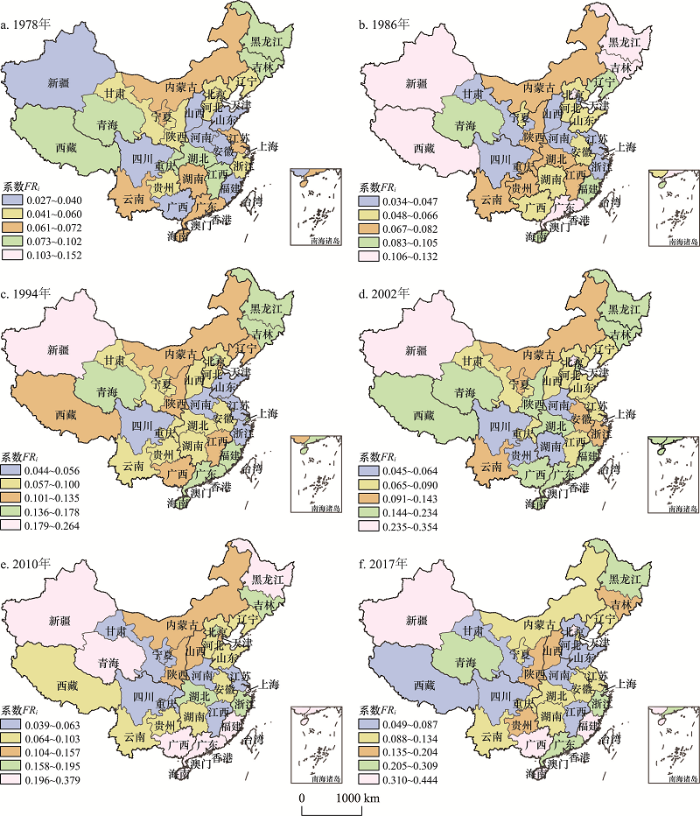
根据公式(1)测算出1978—2017年中国31个省区市的专业化系数FRi值,期间中国种植业的专业化系数FRi均值平缓增长(表2),从1978年的0.063增长到2017年的0.182,增长了188.89%,年均增长2.76%,说明改革开放以来中国种植业生产的专业化程度获得了较缓慢的提升,专业化逐步增强。为了更好地解释说明区域之间专业化系数FRi的特征和差异,将中国分为东北地区(黑龙江、吉林、辽宁)、中部地区(山西、河南、湖北、湖南、江西、安徽)、东部地区(北京、天津、河北、山东、江苏、上海、浙江、福建、广东、海南)、西北地区(陕西、甘肃、内蒙古、宁夏、新疆、青海)和西南地区(西藏、云南、贵州、四川、重庆、广西)5个地区(图1、表2),对比5个地区的专业化系数FRi均值及其增长变化,不同地区之间种植业专业化生产的基础和发展速度有所不同:
(1)东北地区种植业专业化生产具有较好的基础,是全国种植业生产的专业化程度最高的区域,1978—2017年东北地区的专业化系数FRi均值高于全国平均水平,从1978年的0.075增长到2017年的0.193,年均增长2.45%,低于全国2.76%的平均增速,其中黑龙江的专业化系数FRi在全国处于领先的位置。
(2)中部地区的种植业专业化生产水平是全国较低的区域,1978—2017年中部地区的专业化系数FRi均值和年均增速均明显低于全国平均水平,年均增速仅1.75%,且历年的专业化系数FRi均值明显小于全国均值,其中传统的种植业大省如河南、江西等省的专业化系数FRi在全国处于较落后的水平。
(3)东部地区的专业化系数FRi均值明显高于全国平均,年均增速达3.35%,居全国首位。尤其是2000年以后经历了较快地增长,到2017年东部地区已成为全国FRi均值最高的区域,其中上海、海南、广东等省区市的专业化系数FRi在全国处于较高的水平,福建的专业化系数FRi年均增长5.94%,是东部地区专业化系数FRi增长最快的省区市。
(4)西北地区大部分年份的专业化系数FRi均值基本与全国平均水平持平,从1978年的0.060增长到2017年的0.194,年均增速为3.05%,2000年以后,该区域的内部差异逐渐扩大,例如新疆的专业化系数FRi长期处于较高水平,而甘肃的专业化系数FRi长期处于较低水平。
(5)西南地区种植业的专业化系数FRi均值及其增速在全国均处于最低水平,均值从1978年的0.064增长到2017年的0.153,年均增长2.26%,其中四川的专业化系数FRi及其增速长期处于较低的水平。
图1 1978—2017年中国各省区市的专业化系数FRi
注:此图根据国家测绘地理信息局标准地图(审图号:GS(2016)1580)绘制而成,底图无修改。
Fig. 1 Specialization coefficient (FRi) of provinces in China, 1978-2017
表2 1978—2017年中国分地区的专业化系数FRi均值变化
Tab. 2 Variation of average specialization coefficient (FRi) of different regions in China, 1978-2017
| 地区 | 1978年 | 1986年 | 1994年 | 2002年 | 2010年 | 2017年 | 总变化率(%) | 年均增长率(%) |
|---|---|---|---|---|---|---|---|---|
| 东北地区 | 0.075 | 0.107 | 0.152 | 0.149 | 0.180 | 0.193 | 157.33 | 2.45 |
| 中部地区 | 0.057 | 0.060 | 0.081 | 0.093 | 0.102 | 0.112 | 96.49 | 1.75 |
| 东部地区 | 0.064 | 0.077 | 0.111 | 0.185 | 0.182 | 0.231 | 260.94 | 3.35 |
| 西北地区 | 0.060 | 0.082 | 0.142 | 0.171 | 0.178 | 0.194 | 223.33 | 3.05 |
| 西南地区 | 0.064 | 0.076 | 0.094 | 0.114 | 0.108 | 0.153 | 139.06 | 2.26 |
| 中国平均 | 0.063 | 0.077 | 0.112 | 0.147 | 0.151 | 0.182 | 188.89 | 2.76 |
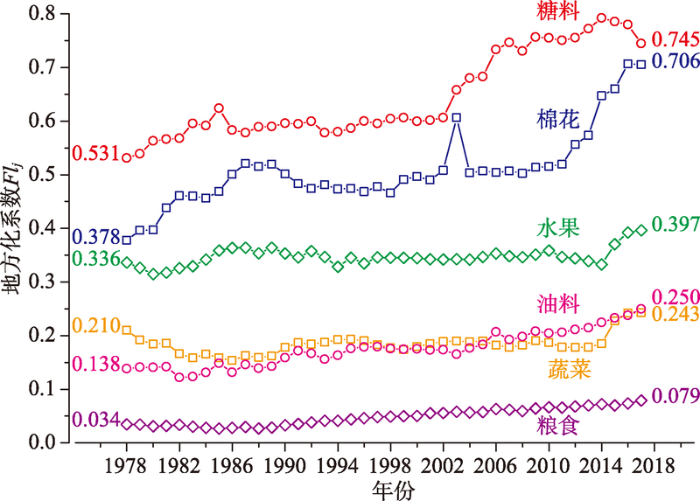
根据公式(2),测算并总结出1978—2017年期间糖料、粮食、棉花、蔬菜、油料、水果等6种农产品地方化系数FIj的发展演化过程和特征(图2),其中粮食、棉花和油料的地方化系数FIj增长相对较快,糖料、水果和蔬菜的地方化系数FIj增长相对较慢。以各农产品地方化系数FIj的均值和标准差作为分段标准,将各农产品的地方化水平分为高度地方化、中度地方化和低度地方化三类,当某种农产品的地方化系数FIj大于均值和标准差之和时,该种农产品即为高度地方化,低于均值和标准差之差,即为低度地方化,居中的为中度地方化[25]。
图2 1978—2017年中国主要农产品的地方化系数FIj
Fig. 2 Localization coefficient (FIj) of the main agricultural products in China, 1978-2017
由此可见,在上述6种农产品中,糖料的地方化系数FIj从总体水平最高,从1978年的0.531上升到2017年的0.745,上升了40.19%,年均增长仅为0.87%;1978—2017年期间,糖料的地方化系数FIj大于上述6种农产品地方化系数的均值与标准差之和,表现为高度地方化。粮食的地方化系数FIj总体水平最低但增长速度最快,从1978年的0.034增长到2017年的0.079,增长128.68%,年均增长2.14%;1978—2017年期间粮食的地方化系数FIj始终低于均值与标准差之差,表现为低度地方化。棉花的地方化系数FIj总体水平较高且在波动中增长,从1978年的0.378增长到2017年的0.706,增长了86.57%,年均增长仅1.61%;棉花的地方化系数FIj经历了由短暂的中度地方化向长期的高度地方化转变的过程,仅1978年表现为中度地方化,1979—2017年表现为高度地方化。蔬菜的地方化系数FIj增长速度最慢,从1978年的0.210增长到2017年的0.243,仅增长了15.60%,年均增长0.37%;1978—2017年期间,蔬菜表现为低度地方化。油料的地方化系数FIj整体水平较低且增长缓慢,从1978年的0.138增长到2017年的0.250,增长了80.64%,年均增长1.53%;1978—2017年期间,油料表现为低度地方化。水果的地方化系数FIj有一定的波动,从1978年的0.336增长到2017年的0.397,增长了17.86%,年均增长仅0.42%;1978年、1984—1993年、1995—2013年以及2015—2017年期间水果表现为高度地方化,其余年份表现为中度地方化。简言之,1978—2017年期间,上述6种农产品的地方化系数FIj均有不同程度的上升,其中粮食、棉花、油料的地方化系数FIj上升速度相对较快,糖料、蔬菜和水果的地方化系数FIj上升速度相对较慢;糖料属于高度地方化农产品,棉花和水果仅少数年份表现为中度地方化,大部分年份表现为高度地方化,粮食、蔬菜和油料均属于低度地方化农产品(表3)。
表3 1978—2017年期间中国主要农产品的地方化划分
Tab. 3 Localization division of main agricultural products in China, 1978-2017
| 地方化 | 糖料 | 粮食 | 棉花 | 蔬菜 | 油料 | 水果 |
|---|---|---|---|---|---|---|
| 高度地方化 | 1978—2017年 | ― | 1979—2017年 | ― | ― | 1978年,1984—1993年,1995—2013年,2015—2017年 |
| 中度地方化 | ― | ― | 1978年 | ― | ― | 1979—1983年,1994年,2014年 |
| 低度地方化 | ― | 1978—2017年 | ― | 1978—2017年 | 1978—2017年 | ― |
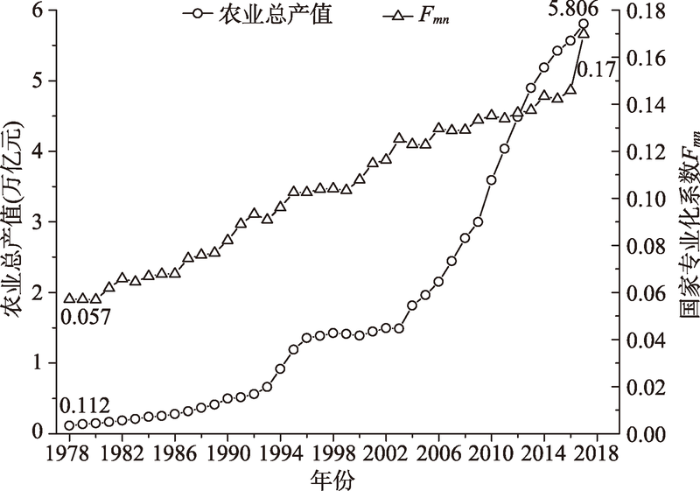
中国的农业总产值从1978年的0.112万亿元增长到2017年的5.806万亿元,增长了48倍多,年均增长10.66%;从空间上来看,期间各省区市农业总产值的排序具有一定的稳定性,农业总产值相对较高的省份包括山东、河南、江苏、河北和四川等,农业生产总值相对较低的省区市包括西藏、青海、宁夏、海南、北京和天津等,其余省区市的农业总产值处于中间水平。同期中国的糖料、粮食、棉花、蔬菜、油料、水果等农作物历年的种植面积之和约占全部农作物种植面积的91%以上,以上述6种主要农产品为对象研究中国种植业专业化具有一定的代表性和可行性。根据公式(3)测算得出,1978—2017年期间中国种植业的国家专业化系数Fmn保持较平缓的增长趋势(图3),从1978年的0.057增长到2017年的0.170,增长了196.94%,年均增长2.83%,相较于中国农业总产值年均10.66%的增速,中国种植业的国家专业化系数Fmn缓慢增长过程与农业总产值的快速扩大并不匹配。
图3 1978—2017年中国农业总产值及国家专业化系数Fmn
Fig. 3 National specialization coefficient (Fmn) and gross output value of agriculture in China, 1978-2017
基于1978—2017年期间的21个二级指标,采用主成分分析法分进行因子分析,当提取出4个公因子时,KMO= 0.850>0.70,说明因子分析的效果较好。因子分析综合了原来21个变量指标的信息,对照表4发现,前4个主成分的特征值大于1,它们的累积贡献率为90.00%,即90%的总方差可以由4个潜在因子解释,从中提取4个公因子指标。
表4 旋转后的公因子方差解释
Tab. 4 Rotated variance of common factors
| 公因子 | 特征值 | 解释比例(%) | 总解释比例(%) |
|---|---|---|---|
| Fac_1 | 13.943 | 66.397 | 66.397 |
| Fac_2 | 2.324 | 11.067 | 77.465 |
| Fac_3 | 1.544 | 7.351 | 84.816 |
| Fac_4 | 1.088 | 5.182 | 89.998 |
如表5所示,每个变量的共性方差均在0.7以上,且大多数均接近或超过0.9,说明4个公因子能够很好地反映原变量的大部分信息。根据0.5原则,第一个公因子(Fac_1)主要对应于X1、X2、X3、X4、X6、X8、X9、X10、X11、X12、X13、X14、X20和X21共14个指标;第二个公因子(Fac_2)主要对应于X5、X8、X19和X21共4个指标;第三个公因子(Fac_3)主要对应于X4、X5和X7共3个指标,第四个公因子(Fac_4)主要对应的指标为X16和X17。
表5 旋转后的因子载荷矩阵
Tab. 5 Rotated component matrix
| 指标 | 变量 | 共性方差 | Fac_1 因子载荷 | Fac_2 因子载荷 | Fac_3 因子载荷 | Fac_4 因子载荷 |
|---|---|---|---|---|---|---|
| Fmn | X1 | 0.967 | 0.916 | 0.214 | 0.276 | -0.082 |
| 糖料FIj | X2 | 0.905 | 0.876 | 0.343 | 0.141 | -0.010 |
| 粮食FIj | X3 | 0.945 | 0.870 | 0.382 | 0.162 | -0.130 |
| 棉花FIj | X4 | 0.827 | 0.606 | 0.296 | 0.604 | -0.089 |
| 蔬菜FIj | X5 | 0.700 | 0.209 | 0.608 | 0.534 | -0.054 |
| 油料FIj | X6 | 0.940 | 0.822 | 0.387 | 0.325 | -0.098 |
| 水果FIj | X7 | 0.885 | 0.283 | -0.021 | 0.891 | -0.103 |
| 农作物总播种面积 | X8 | 0.946 | 0.765 | 0.515 | 0.213 | -0.221 |
| 糖料产量 | X9 | 0.811 | 0.873 | 0.018 | 0.219 | 0.028 |
| 粮食产量 | X10 | 0.909 | 0.851 | 0.259 | 0.335 | -0.082 |
| 棉花产量 | X11 | 0.805 | 0.889 | -0.094 | -0.039 | 0.061 |
| 蔬菜产量 | X12 | 0.978 | 0.894 | 0.339 | 0.204 | -0.147 |
| 油料产量 | X13 | 0.935 | 0.922 | 0.165 | 0.204 | -0.126 |
| 水果产量 | X14 | 0.967 | 0.873 | 0.430 | 0.140 | -0.028 |
| 农业总产值占比 | X15 | 0.916 | -0.929 | 0.104 | -0.202 | 0.004 |
| 农业总产值增长率 | X16 | 0.870 | 0.007 | -0.188 | -0.091 | 0.909 |
| 农产品生产价格指数 | X17 | 0.888 | -0.120 | -0.017 | -0.047 | 0.934 |
| 农村固定资产投资占GDP的比重 | X18 | 0.885 | -0.064 | -0.931 | 0.037 | 0.109 |
| 农民人均农作物总播种面积 | X19 | 0.858 | 0.312 | 0.865 | 0.067 | -0.090 |
| 农民人均农业机械总动力 | X20 | 0.986 | 0.900 | 0.384 | 0.158 | -0.061 |
| 农民人均纯收入 | X21 | 0.976 | 0.702 | 0.584 | 0.368 | -0.081 |
计算上述4个公因子的得分值,经检验4个公因子得分值完全线性无关,即所代表的信息不重叠,因此完全可以基于这4个公因子历年的得分值,进行以年份作为个案标记的K-均值聚类分析,根据最优结果分类指标通过显著性检验的基本原则,可以科学、客观地对1978—2017年期间中国种植业的专业化发展阶段划分进行研究。经过对两阶段、三阶段、四阶段等不同阶段划分的综合对比检验,发现基于四阶段的划分能保证4个公因子指标全部通过F检验,F统计量分别为36.165、16.387、46.803和3.143,显著性水平分别为0.000、0.000、0.000和0.037,通过显著性水平检验。
因此将1978—2017年期间的40个年份划分为4类丛集(表6),从整体上来看年份的4类丛集分类具有较为显著且连续的丛集归属。考虑到年份及种植业专业化发展的时间连续性和邻近性,对于个别具有离散特征的丛集分类年份归并于其前或后邻近年份的丛集类型。这些离散的年份在部分指标上具有异常的特征,例如1991年的粮食产量下降及农业总产值增速明显放缓,聚类分析结果属于丛集3,但其前后邻近年份均属于丛集4,因此将1991年归并为丛集4所属的阶段。根据丛集的分类结果并考虑年份的完整性与连贯性,最终1978—2017年40个年份的丛集分类划分为以下四个阶段:① 第一阶段:1978—1983年;② 第二阶段:1984—1995年;③ 第三阶段:1996—2014年;④ 第四阶段:2015—2017年。
表6 4类丛集年份分布
Tab. 6 Four clusters of year distribution
| 年份 | 丛集 | 年份 | 丛集 | 年份 | 丛集 | 年份 | 丛集 | 年份 | 丛集 |
|---|---|---|---|---|---|---|---|---|---|
| 1978 | 2 | 1986 | 4 | 1994 | 4 | 2002 | 3 | 2010 | 3 |
| 1979 | 2 | 1987 | 4 | 1995 | 4 | 2003 | 3 | 2011 | 3 |
| 1980 | 2 | 1988 | 4 | 1996 | 3 | 2004 | 3 | 2012 | 3 |
| 1981 | 2 | 1989 | 4 | 1997 | 3 | 2005 | 3 | 2013 | 3 |
| 1982 | 2 | 1990 | 4 | 1998 | 3 | 2006 | 3 | 2014 | 3 |
| 1983 | 2 | 1991 | 3 | 1999 | 3 | 2007 | 3 | 2015 | 1 |
| 1984 | 4 | 1992 | 4 | 2000 | 3 | 2008 | 3 | 2016 | 1 |
| 1985 | 4 | 1993 | 4 | 2001 | 3 | 2009 | 3 | 2017 | 1 |
为了更好地分析中国种植业专业化发展的阶段性特征,结合1978—2017年四个阶段的种植业发展历史和政策制度,可以看出中国种植业发展具有不同的阶段性特征:
(1)1978—1983年的第一阶段:奠定制度基础阶段。1978年以来中国开始对经济政策实行由中央计划经济渐进过渡到社会主义市场经济的根本性改革,种植业发展相较于改革开放以前获得了巨大的发展,以家庭联产承包责任制为内核的经营制度迅速普及到各个乡村,成为全国农村生产基本的经营制度,彻底改变了种植业生产的激励机制,刺激了农民的生产热情,加之政府开始对农产品大幅度提价,这种非集体化和刺激创造性的制度和政策机制,为后续的种植农业高速增长和全面繁荣创造了政策保障[43]。由于在建国至改革开放之前的政策和经营体制下,产加销分离、农工商脱节,农产品加工和流通附加值低,严重影响了农业生产的发展,中国农业几乎走到了崩溃的边缘,该阶段中国种植业的专业化水平、规模和效率等指标水平较低且增长速度缓慢,但该阶段的主要成就即奠定了以家庭联产承包责任制为内核的制度基础。
(2)1984—1995年的第二阶段:稳步复苏和扩张阶段。随着家庭联产承包责任制的稳定实施,进入20世纪80年代以后,农业生产的活力开始激发出来。但由于1985年中国经济体制改革的重心开始由农村转向城市,此后几年中国宏观经济政策环境有所恶化,定价、收购等相关农业政策未能抵消宏观经济环境和比较利益格局恶化给种植业发展带来的冲击,以及对农业形势判断失误和困难估计不足,反而实施了一些对农业发展起抑制和误导作用的农业政策[43]。直至1989年,非农经济活动如乡镇企业的生产环境日益严峻,在一定程度上强化了农业吸引资源的能力,此后政府对农业的扶持力度也开始逐渐增强。相较于第一阶段,该阶段种植业的专业化水平、规模和效率的大部分指标都获得了稳步增长。总体来看,该阶段是中国种植业专业化发展的稳步复苏和扩张阶段。
(3)1996—2014年的第三阶段:市场化改革和产业化发展的深入阶段。进入20世纪90年代以来,中国政府加快了市场经济转变的步伐,采取了若干行政和财政措施支持农业规模经营,加入WTO的谈判增加了政策实施和制度改革的外部压力,为应对开放国内市场后不断加剧的竞争,政府高度重视提高农业生产效率[44]。自《人民日报》于1995年12月11日出版《论农业产业化》长篇社论以及1996年农业部成立“农业产业化办公室”以来,农业产业化的思想开始在全国范围广泛传播,推动了农业产业链的纵向一体化,解决了农业产销衔接问题,并形成了“公司+农户”、“公司+中介组织+农户”等经营模式。进入21世纪以来,中国农业受到加入WTO后的巨大冲击,首当其冲的是政府对农业生产的管理体制和政策选择,其次是农民和涉农企业[45],中国调整了工农业发展战略,工业反哺农业得到加强,农产品价格体系的市场化改革不断加快[46],农业产业化不断深入,中国种植农业和农村经济发生了积极的变化,农产品供给能力不断增强,农民收入快速增长[47]。伴随着种植农业市场化改革和产业化发展不断深入,该阶段种植业的专业化水平、规模和效率的大部分指标获得了较大的增长。
(4)2015—2017年的第四阶段:追求全面发展的改革创新阶段。2015年2月1日中共中央、国务院印发并实施一号文件《关于加大改革创新力度加快农业现代化建设的若干意见》,为加大改革创新力度和加快农业现代化建设提出意见,加快推进中国特色农业现代化。该文件提出农业要强、农民要富、农村要美三个任务,改革是动力,法治是保障,从以往追求产量为主转向数量、质量、效益并重。该阶段农业基础地位继续得到强化,农民持续增收,种植业的专业化、规模和效率等指标稳定在较高水平,是追求全面发展、高质量发展的改革创新阶段,中国农业现代化发展的改革创新仍在持续进行。
本研究通过相关文献梳理和中国及各省区市相关数据整理分析,基于专业化视角探讨了中国种植业发展的时空格局演化特征,采用定量方法对中国种植业发展进行了阶段划分,并总结了各个阶段的特征。具体而言:
(1)1978—2017年期间:① 中国各省区市种植业生产的专业化水平不同程度地增强,各省区市的专业化系数FRi逐年提升,东北地区的专业化系数FRi均值具有较好的基础,是全国专业化程度最高的地区;中部地区的专业化系数FRi均值和年均增速均明显低于全国平均水平;东部地区的专业化系数FRi均值及其增速明显高于全国的平均水平;西北地区的专业化系数FRi均值与全国平均水平持平,内部差异较大;西南地区的专业化系数FRi均值及其增速均明显低于全国平均水平,是全国种植业生产专业化水平最低的地区。② 6种农产品的地方化系数FIj获得不同程度的增长,粮食、棉花和油料增长较快,糖料、水果和蔬菜增长较慢;糖料为高度地方化农产品,棉花和水果大部分年份表现为高度地方化,粮食、蔬菜和油料为低度地方化农产品。③ 中国种植业发展的国家专业化系数Fmn提升速度明显低于农业总产值的增速。
(2)基于K-均值聚类的方法,并结合1978—2017年期间中国种植业发展历程和相关政策制度,将1978—2017年中国种植业发展的过程划分为四个阶段并总结其阶段特征:① 第一阶段为1978—1983年,该阶段种植业的专业化水平、规模和效率等发展水平较低,但该阶段奠定了以家庭联产承包责任制为内核的制度基础。② 第二阶段为1984—1995年,该阶段的农业生产的活力开始激发出来,政府对农业的扶持力度逐渐增强,种植业的专业化水平、规模和效率的大部分指标获得了稳定的增长,我国种植业及其专业化发展开始稳步复苏和扩张。③ 第三阶段为1996—2014年,我国种植业进入市场化改革和产业化发展的深入阶段,政府加快了市场经济转变的步伐,农产品价格体系的市场化改革加快,农业产业化不断深入,种植业的专业化水平、规模和效率的大部分指标获得了较大的增长。④ 第四阶段为2015—2017年,是追求全面发展的改革创新阶段,该阶段以改革为动力,农业基础地位继续得到强化,农民持续增收,种植业的专业化、规模和效率等指标稳定在较高水平,从以往追求产量为主转向数量、质量、效益并重,追求全面发展和高质量发展。
本研究涉及的6种农产品中,糖料属于高度地方化农产品,棉花和水果大部分年份均属于高度地方化农产品,粮食、蔬菜和油料属于低度地方化农产品,与上述农产品对生长环境的要求及各省区市的种植历史等有较大关系。例如,种植糖料的省区市主要集中在低纬度的广东、广西和云南等地,棉花则主要向西北的新疆集中,一定程度上使糖料、棉花具备了高度地方化的特征;同理,其他几种农产品在种植范围趋于分散化,其地方化程度则有不同程度的降低。
诚然,中国种植业的专业化和现代化过程并非一蹴而就,且影响种植业专业化发展的因素极其复杂多元,气候、土壤、水源和地形等自然资源禀赋往往是种植业生产及专业化的必要条件和物质基础,市场需求、规模效应、专业人才、技术及金融资本等因素构成种植业生产及专业化的内在动力,外贸及开放水平、运输成本、方针政策乃至路径依赖等因素构成种植业生产及专业化的外在推力,这些因素无不对种植业专业化产生深刻影响。应当针对不同区域种植业专业化发展的差异性,分不同的亚区对区域的种植业专业化演化格局及其因素进行对比研究和总结,真正实现区域种植业的专业化发展,以形成分工合理、特色明显、优势互补、协调发展的专业化区域布局,促进种植业专业化分工体系的逐步形成和完善,提高资源的配置效率和种植业的经济效益。
本研究采用定量为主、定性为辅的研究方法,在宏观尺度上较为准确地理顺了中国种植业的专业化时空格局及其发展阶段,结合中国种植业政策制度的梳理,佐证了不同阶段的发展特征。本研究的尝试对采用定量方法进行发展过程的阶段划分具有一定的借鉴意义,研究结论对中国种植业发展及其专业化具有一定的理论意义和参考价值。但本研究也存在政策制度的影响效果难以量化、农村和农民等微观尺度考虑欠缺等不足,有待于在今后的相关研究中进一步考虑和检验。
The authors have declared that no competing interests exist.
| [1] |
地区专业化的度量 .
在封闭经济假设和地区间需求结构一致假设下,本文构造了地区专业化的度量指标——地区专业化系数;这一度量指标更具一般性,产业结构差异系数、空间分布差异系数、绝对利差及行业分工指数等指标只是作为它的特例而存在。在讨论地区专业化问题时,如果忽略地区的(或行业的)相对规模因素,除了犯有逻辑推理错误外,在实践中还存在着可能得出错误判断的倾向。本文发现:中国工业的地区专业化水平自20世纪80年代中后期以来有了较大程度的提高;如果忽略地区的(或行业的)相对规模因素来讨论中国工业的地区专业化问题,则会高估中国工业的地区专业化水平。
The measurement of regional specialization .
在封闭经济假设和地区间需求结构一致假设下,本文构造了地区专业化的度量指标——地区专业化系数;这一度量指标更具一般性,产业结构差异系数、空间分布差异系数、绝对利差及行业分工指数等指标只是作为它的特例而存在。在讨论地区专业化问题时,如果忽略地区的(或行业的)相对规模因素,除了犯有逻辑推理错误外,在实践中还存在着可能得出错误判断的倾向。本文发现:中国工业的地区专业化水平自20世纪80年代中后期以来有了较大程度的提高;如果忽略地区的(或行业的)相对规模因素来讨论中国工业的地区专业化问题,则会高估中国工业的地区专业化水平。
|
| [2] |
|
| [3] |
|
| [4] |
Does the recoupling of dairy and crop production via cooperation between farms generate environmental benefits? A case-study approach in Europe .https://doi.org/10.1016/j.eja.2016.08.005 URL [本文引用: 1] 摘要
The intensification of agriculture in Europe has contributed significantly to the decline of mixed crop-livestock farms in favour of specialised farms. Specialisation, when accompanied by intensive farming practices, leaves farms poorly equipped to sustainably manage by-products of production, capture beneficial ecological interactions, and adapt in a volatile economic climate. An often proposed solution to overcome these environmental and economic constraints is to recouple crop and livestock production via cooperation between specialised farms. If well-managed, synergies between crop and livestock production beyond farm level have the potential to improve feed and fertiliser autonomy, and pest regulation. However, strategies currently used by farmers to recouple dairy livestock and crop production are poorly documented; there is a need to better assess these strategies using empirical farm data. In this paper, we employed farm surveys to describe, analyse and assess the following strategies: (1) Local exchange of materials among dairy and arable farms; (2) Land renting between dairy and arable farms; (3) Animal exchanges between lowland and mountainous areas; and (4) Industrially mediated transfers of dehydrated fodder. For each strategy, cooperating farm groups were compared to non-cooperating farm groups using indicators of metabolic performance (input autonomy, nutrient cycling and use efficiency), and ecosystem services provision. The results indicate that recoupling of crop and dairy production through farm cooperation gives farmers access to otherwise inaccessible or underutilised local resources such as land, labour, livestock feed or organic nutrients. This in turn leads to additional outlets for by-products (e.g. animal manure). Farmers- decisions about how to allocate the additional resources accessed via cooperation essentially determine if the farm diversifies, intensifies or expands operations. The key finding is that in three of the four crop-livestock integration strategies assessed, these newly accessed resources facilitated more intensive farming practices (e.g. higher stocking rate or number of milking cows per hectare) on cooperating dairy farms relative to non-cooperating, specialised dairy farms. As a consequence, cooperation was accompanied by limited environmental benefits but helped to improve resource use efficiency per unit of agricultural product produced. This article provides a critical step toward understanding real-world results of crop-livestock cooperation beyond the farm level relative to within-farm crop-livestock integration. As such, it brings practical knowledge of vital importance for policy making to promote sustainable farming.
|
| [5] |
The declining economic importance of agricultural land . |
| [6] |
Increasing returns and economic geography . |
| [7] |
Clusters and the new economics of competition .https://doi.org/10.1016/S0361-3682(98)00009-9 URL PMID: 10187248 [本文引用: 1] 摘要
Economic geography in an era of global competition poses a paradox. In theory, location should no longer be a source of competitive advantage. Open global markets, rapid transportation, and high-speed communications should allow any company to source any thing from any place at any time. But in practice, Michael Porter demonstrates, location remains central to competition. Today's economic map of the world is characterized by what Porter calls clusters: critical masses in one place of linked industries and institutions--from suppliers to universities to government agencies--that enjoy unusual competitive success in a particular field. The most famous example are found in Silicon Valley and Hollywood, but clusters dot the world's landscape. Porter explains how clusters affect competition in three broad ways: first, by increasing the productivity of companies based in the area; second, by driving the direction and pace of innovation; and third, by stimulating the formation of new businesses within the cluster. Geographic, cultural, and institutional proximity provides companies with special access, closer relationships, better information, powerful incentives, and other advantages that are difficult to tap from a distance. The more complex, knowledge-based, and dynamic the world economy becomes, the more this is true. Competitive advantage lies increasingly in local things--knowledge, relationships, and motivation--that distant rivals cannot replicate. Porter challenges the conventional wisdom about how companies should be configured, how institutions such as universities can contribute to competitive success, and how governments can promote economic development and prosperity.
|
| [8] |
Wine cluster formation in New Zealand: Operation, evolution and impact .https://doi.org/10.1111/j.1365-2621.2008.01848.x URL [本文引用: 1] 摘要
This paper analyses the Waipara wine cluster, located in the South Island of New Zealand, in relation to formation, operation, evolution and impact. The unique methodological approach of this research is that it analyses the current and desired future state of the cluster and secondly examines the cluster in relation to both the domestic and international markets. Key findings from the research include a greater understanding of the relationships between cluster members, the operation of cluster, problems within the cluster and how the cluster operates for both domestic and international markets. The research lends itself to a new definition of internationalisation –'direct and indirect methods of increasing the likelihood of international sales'– and also provides new insights for cluster theory, wine clusters and the wine industry in general. Some of the practices detailed have use in the wider wine community of the world, making the paper of interest to a wide audience.
|
| [9] |
Food quality changes and implications: Evidence from the rice value chain of Bangladesh .https://doi.org/10.1016/j.worlddev.2012.06.015 URL [本文引用: 1] 摘要
In Dhaka, the share of the less expensive coarse rice is shown to be rapidly decreasing in rice markets and it thus seems that the role of rice as only a cheap staple food is being redefined. The increasing demand for the more expensive varieties is seemingly associated with a more important off-farm food sector—in particular, milling, retailing, and branding—as well as a transformed milling industry. We further find that the labor rewards for growing different rice varieties are not significantly different and that farmers do not benefit directly from consumers’ increased willingness to pay for rice.
|
| [10] |
Rural industry clusters raise local earnings . |
| [11] |
Microenterprise clusters in rural Indonesia: Industrial seedbed and policy target .https://doi.org/10.1016/S0305-750X(99)00076-5 URL [本文引用: 1] 摘要
This paper shows the importance of clustering at early stages of development, when clustering is still largely a rural phenomenon and may serve as a survival strategy. It argues, first, that dismally poor but clustered rural microenterprises may have a seedbed function for industrial development, and, second, that clustering policy has brought about some success in Indonesia. Data on more than 4,000 rural clusters provide insights in the various forces behind cluster gestation, prosperity and dissolution. It is argued that social capital is crucial for the achievement of transaction cost reductions, which attract traders to the clustered enterprises. Ubiquitous search and reach advantages in marketing trigger clustering processes, but these advantages diminish with overcrowding. Further external economies arise from specialization and technical indivisibilities, but vary significantly by subsector. Consequently, only specific clusters might benefit from public intervention in technology and organization.
|
| [12] |
Creating a cluster while building a firm: Entrepreneurs and the formation of industrial clusters . |
| [13] |
The globalization of organic agro-food networks .https://doi.org/10.1016/j.worlddev.2003.11.008 URL Magsci [本文引用: 1] 摘要
This article analyzes the booming world trade in organic agro-foods such as tropical products, counterseasonal fresh produce, and processed foods. Research focuses on expanding South-揘orth networks linking major US and European markets with major production regions, particularly in Latin America. Employing a commodity network approach, I analyze organic production, distribution, and consumption patterns and the roles of social, political, and economic actors in consolidating international trade. Organic certification proves central to network governance, shaping product specifications, production parameters, and enterprise participation. My analysis identifies key contradictions between mainstream agro-industrial and alternative movement conventions in global organic networks.
|
| [14] |
关于美国农业专业化的几个问题 .
正 众所周知,美国农业具有相当高的劳动生产率。根据美国的材料,目前农场每个劳动者所生产的农产品平均可以供养59人。因此,尽管1977年直接从事农业生产的农场劳动力只有415万人(占总人口1.9%),但他们在有关部门配合下所生产的农畜产品不仅能满足本国2亿多人口的消费需要,而且还有相当大一部分可供出口。近几年来美国每年出口的农产品价值已超过200亿美元。
Several issues about American agricultural specialization .
正 众所周知,美国农业具有相当高的劳动生产率。根据美国的材料,目前农场每个劳动者所生产的农产品平均可以供养59人。因此,尽管1977年直接从事农业生产的农场劳动力只有415万人(占总人口1.9%),但他们在有关部门配合下所生产的农畜产品不仅能满足本国2亿多人口的消费需要,而且还有相当大一部分可供出口。近几年来美国每年出口的农产品价值已超过200亿美元。
|
| [15] |
|
| [16] |
国外农业区划研究现状、特点及发展趋势 .https://doi.org/10.7621/cjarrp.1005-9121.19890316 URL [本文引用: 1] 摘要
正 这4组特征是:1、社会与所有制特征:①、②、③土地占有制度,④、⑤农场规模(土地、劳力)平均大小,⑥、⑦每块土地面积和总产量大小。2、组织管理特征:⑧劳动力投入量,⑨畜力投入量,⑩机械投入量,⑾化肥施用量,⑿灌溉面积比重,⒀耕地利用集约度,⒁每公顷耕地牲畜头数。3、生产特征:⒂土地生产力,⒃劳动生产率,⒄商品性劳动生产率,⒅农产品商
Research status, characteristics and development trend of foreign agricultural regionalization .https://doi.org/10.7621/cjarrp.1005-9121.19890316 URL [本文引用: 1] 摘要
正 这4组特征是:1、社会与所有制特征:①、②、③土地占有制度,④、⑤农场规模(土地、劳力)平均大小,⑥、⑦每块土地面积和总产量大小。2、组织管理特征:⑧劳动力投入量,⑨畜力投入量,⑩机械投入量,⑾化肥施用量,⑿灌溉面积比重,⒀耕地利用集约度,⒁每公顷耕地牲畜头数。3、生产特征:⒂土地生产力,⒃劳动生产率,⒄商品性劳动生产率,⒅农产品商
|
| [17] |
国外农业区域专业化发展进程及其政策措施 .https://doi.org/10.3969/j.issn.1005-9121.2003.06.001 URL [本文引用: 2] 摘要
分析了国外农业区域专业化发展 的进程及一般形式 ,提出农业区域专业化发展的相关政策措施 ,以及对我国农业区域专业化发展的几点认识 :一是我国仍处于初级阶段 ;二是有实现跨越式发展的基础与机遇 ;三是应发展有中国特色的农业区域专业化 ;四是提出推进我国农业区域专业化发展的 3个关键点。
Professional development progress of agricultural regional planning abroad and its policy and measures .https://doi.org/10.3969/j.issn.1005-9121.2003.06.001 URL [本文引用: 2] 摘要
分析了国外农业区域专业化发展 的进程及一般形式 ,提出农业区域专业化发展的相关政策措施 ,以及对我国农业区域专业化发展的几点认识 :一是我国仍处于初级阶段 ;二是有实现跨越式发展的基础与机遇 ;三是应发展有中国特色的农业区域专业化 ;四是提出推进我国农业区域专业化发展的 3个关键点。
|
| [18] |
从农业产业化到农业产业区——竞争型农业产业化发展的可行性分析 .
专业化、规模化和特色化是世界农业发展的一种趋势。近年来,国内外的实践也证实农业产业区是一种提升农业综合生产能力和农产品国际竞争力的有效方式。从微观角度看,农业产业区内各经济主体进行了专业化的分工协作,交织在区域社会关系网络之中,创造了难以模仿的竞争优势;农业产业区将小规模的分散经营者聚合在一起,形成了小规模经营者与大市场的有效连接机制,实现以小搏大。从宏观角度看,农业产业区有利于区域合理分工和布局,提高生产效率,减少市场的波动性。本文在对我国农业产业化发展战略反思的基础上,对产业区为什么会产生竞争优势进行了理论分析与案例解剖,在此基础上提出我国从农业产业化到农业产业区战略调整应该注意的问题与政策选择。
From agricultural industrialization to agricultural industrial district: The feasibility analysis of the development of competitive agriculture industrialization .
专业化、规模化和特色化是世界农业发展的一种趋势。近年来,国内外的实践也证实农业产业区是一种提升农业综合生产能力和农产品国际竞争力的有效方式。从微观角度看,农业产业区内各经济主体进行了专业化的分工协作,交织在区域社会关系网络之中,创造了难以模仿的竞争优势;农业产业区将小规模的分散经营者聚合在一起,形成了小规模经营者与大市场的有效连接机制,实现以小搏大。从宏观角度看,农业产业区有利于区域合理分工和布局,提高生产效率,减少市场的波动性。本文在对我国农业产业化发展战略反思的基础上,对产业区为什么会产生竞争优势进行了理论分析与案例解剖,在此基础上提出我国从农业产业化到农业产业区战略调整应该注意的问题与政策选择。
|
| [19] |
因地制宜发挥优势逐步发展我国农业生产的地域专业化 .https://doi.org/10.11821/xb198104001 URL [本文引用: 1] 摘要
In the field of agriculture, physical reproduction and economic reproduction crosseach other intricately. Thus, agriculture must fundamentally adapt to tiie local condi-tions, which should be properly recognized as including not only the physical, but thesocial and economic conditions as well. In a country of vast territory like China, arealdifferentiation of local conditions is so evident that it would never be exaggeration toemphasize the importance of adaptation.On the march towards modernization, Chinese agriculture will have to undergo aperiod of strategic transferring. The adjustment applies both to the allocation and thestructure of agriculture.The guiding principles like: "reclaim those land suitable for agriculture, afforestthose suitable for forestry, and grazing those suitable for animal husbandry", and eeo-nomic crops should be"properly concentrated in distribution", etc.. are just in generalterms and cause much trouble in implementation. Here, the terms "suitable" and "pro-perly concentrated" should be defined precisely by means of a series of quantitative andqualitative criteria.Ever since ancient times, food crop has been the mainstay of Chinese agriculture.About 80% of rural labour, cultivated land and sown area are devoted to food crop cultiva-tion. However ,the dogmatic demand of self-sufficiency in food supply for everywhereis impracticable in many parts of the country, such as the loess plateau and the dryfarming areas of Inner Mongolia. A proper ratio between the acreage of food cropsand economic crops and the critical limit of treple cropping (double cropping of riceplus winter wheat or rapeseeds) index in southern China are needed to be thoughtfully decided.The new guiding principle of "developing the areal predominance through promot-ing the favorable and dodging the unfavorable conditions" attracted much attentionfrom the agricultural and academic circles. The author suggests that in order to realizethe principle true meaning, the following view points are helpful. (l-檌 Areal predo-minance is a comprehensive idea, and it can only be developed under the conditions thatare physically suitable, technically practicable and economically profitable,i(-2)i In theregional system of the country, any region is not isolated, but is linked together with oneanother, just like a single piece on the chessboard. The right order of developing arealpredominance should put national first, provincial nest, and local still next. (3) Asconditions of any region are subject to change, the development of areal predominanceshould be considered with long-term sense. (4) Comparative plans for developing arealpredominance are preferred, so as to select the mostninst rational and profitable one throughteehno-economic appraisal.Through the process of developing areal predominance, areal specialization of agri-culture will gradually take shape. Chinese agriculture, on the basis of petty-peasanteconomy, asked local self-sufficiency for every thing in the past, deterred areal speciali-zation of production. There only flourished .sericulture in the deltas of the Yangtze andthe Pearl River, due to the need for de luxe clothing in the feudal times. Cotton andtobacco plantings were encouraged in the vicinities of Shanghai. Tsingtao and Hankowthrough the investment of foreign manufacturers in the semi-feudal and semi-colonialdays. It was only after liberation, new bases of commercial grains, cotton, sugar beetand tropical crops were established by the state farms in the interior and border regionsThe areal specialization of agiculture that China is going to promote is not those ofmono-cropping systems of the colonial or semi-colonial nations, but is the rational divi-sion of labour among regions under the guichnce of planning economy. It is expectedthat the potential of agricultural production will be brought into full play through theproceeding of areal specialization.
Promoting areal specialization of agriculture through developing areal predominance .https://doi.org/10.11821/xb198104001 URL [本文引用: 1] 摘要
In the field of agriculture, physical reproduction and economic reproduction crosseach other intricately. Thus, agriculture must fundamentally adapt to tiie local condi-tions, which should be properly recognized as including not only the physical, but thesocial and economic conditions as well. In a country of vast territory like China, arealdifferentiation of local conditions is so evident that it would never be exaggeration toemphasize the importance of adaptation.On the march towards modernization, Chinese agriculture will have to undergo aperiod of strategic transferring. The adjustment applies both to the allocation and thestructure of agriculture.The guiding principles like: "reclaim those land suitable for agriculture, afforestthose suitable for forestry, and grazing those suitable for animal husbandry", and eeo-nomic crops should be"properly concentrated in distribution", etc.. are just in generalterms and cause much trouble in implementation. Here, the terms "suitable" and "pro-perly concentrated" should be defined precisely by means of a series of quantitative andqualitative criteria.Ever since ancient times, food crop has been the mainstay of Chinese agriculture.About 80% of rural labour, cultivated land and sown area are devoted to food crop cultiva-tion. However ,the dogmatic demand of self-sufficiency in food supply for everywhereis impracticable in many parts of the country, such as the loess plateau and the dryfarming areas of Inner Mongolia. A proper ratio between the acreage of food cropsand economic crops and the critical limit of treple cropping (double cropping of riceplus winter wheat or rapeseeds) index in southern China are needed to be thoughtfully decided.The new guiding principle of "developing the areal predominance through promot-ing the favorable and dodging the unfavorable conditions" attracted much attentionfrom the agricultural and academic circles. The author suggests that in order to realizethe principle true meaning, the following view points are helpful. (l-檌 Areal predo-minance is a comprehensive idea, and it can only be developed under the conditions thatare physically suitable, technically practicable and economically profitable,i(-2)i In theregional system of the country, any region is not isolated, but is linked together with oneanother, just like a single piece on the chessboard. The right order of developing arealpredominance should put national first, provincial nest, and local still next. (3) Asconditions of any region are subject to change, the development of areal predominanceshould be considered with long-term sense. (4) Comparative plans for developing arealpredominance are preferred, so as to select the mostninst rational and profitable one throughteehno-economic appraisal.Through the process of developing areal predominance, areal specialization of agri-culture will gradually take shape. Chinese agriculture, on the basis of petty-peasanteconomy, asked local self-sufficiency for every thing in the past, deterred areal speciali-zation of production. There only flourished .sericulture in the deltas of the Yangtze andthe Pearl River, due to the need for de luxe clothing in the feudal times. Cotton andtobacco plantings were encouraged in the vicinities of Shanghai. Tsingtao and Hankowthrough the investment of foreign manufacturers in the semi-feudal and semi-colonialdays. It was only after liberation, new bases of commercial grains, cotton, sugar beetand tropical crops were established by the state farms in the interior and border regionsThe areal specialization of agiculture that China is going to promote is not those ofmono-cropping systems of the colonial or semi-colonial nations, but is the rational divi-sion of labour among regions under the guichnce of planning economy. It is expectedthat the potential of agricultural production will be brought into full play through theproceeding of areal specialization.
|
| [20] |
|
| [21] |
2008年中国种植业地理集聚与专业化格局 .https://doi.org/10.11820/dlkxjz.2012.08.010 URL Magsci [本文引用: 1] 摘要
There has been less current literature on the pattern of Chinese agricultural geographic concentration and specialization. This paper discusses the geographic concentration pattern of China's planting in 2008. Through calculating the average Gini coefficient (0.46,0.66 and 0.68, respectively), the average Moran I index (0.11,0.18 and 0.20, respectively ) and the Location quotient (LQ ) in the three scale classifications at the provincial level, it is found that the planting in China presents certain geographic concentration and exposes different agglomeration degree at different levels of industrial classification. And the finer division of planting industry, the more obvious the trend of spatial concentration and specialization of production. At the macro-planting level, the distribution of crop production is relatively dispersed, while at the micro-planting level, the distribution of crop production shows the trend of more agglomeration and specialization. The regional specialized production pattern in Chinese planting has emerged. The regional specialized degree of the staple crops is low, and that of the commercial crops is relatively high. Although the specific pattern of spatial concentration is determined by the matching between the natural conditions and production conditions of various crops, the government decision-making, institutional changes and other social factors plays an important role in regional specialized production functioning as the optimization and adjustment to the natural gathering. So, by calculating the spatial autocorrelation and the Gini coefficient, specialized index in various types of crops grown in contiguous spatial patterns, the potential location of the agricultural regional specialization and large-scale production can be identified, which can help the government make specific agricultural policies in different regions.
Geographical agglomeration and specialized pattern of planting in china based on the different classifications .https://doi.org/10.11820/dlkxjz.2012.08.010 URL Magsci [本文引用: 1] 摘要
There has been less current literature on the pattern of Chinese agricultural geographic concentration and specialization. This paper discusses the geographic concentration pattern of China's planting in 2008. Through calculating the average Gini coefficient (0.46,0.66 and 0.68, respectively), the average Moran I index (0.11,0.18 and 0.20, respectively ) and the Location quotient (LQ ) in the three scale classifications at the provincial level, it is found that the planting in China presents certain geographic concentration and exposes different agglomeration degree at different levels of industrial classification. And the finer division of planting industry, the more obvious the trend of spatial concentration and specialization of production. At the macro-planting level, the distribution of crop production is relatively dispersed, while at the micro-planting level, the distribution of crop production shows the trend of more agglomeration and specialization. The regional specialized production pattern in Chinese planting has emerged. The regional specialized degree of the staple crops is low, and that of the commercial crops is relatively high. Although the specific pattern of spatial concentration is determined by the matching between the natural conditions and production conditions of various crops, the government decision-making, institutional changes and other social factors plays an important role in regional specialized production functioning as the optimization and adjustment to the natural gathering. So, by calculating the spatial autocorrelation and the Gini coefficient, specialized index in various types of crops grown in contiguous spatial patterns, the potential location of the agricultural regional specialization and large-scale production can be identified, which can help the government make specific agricultural policies in different regions.
|
| [22] |
中国农业生产地区专业化的特征及变化趋势 .
运用1980—2010年的农产品播种面积面板数据,分别计算出29个省区各年的地区专业化系数和6种主要农产品的地区专业化系数,并从产业和地区角度对中国农业生产的地区专业化程度进行了特征和变动趋势分析。结果表明,从产业与地区两个路径测度的农业地区专业化系数呈现一致的快速上升变化趋势,这说明,中国农业生产的地区专业化水平,在总体上呈现显著的稳步提高态势。从产业层面上看,主要农产品生产的地区专业化程度呈现明显的增强态势,但不同农产品的增强态势存在明显差异。从地区层面上看,各省区农业生产的地区专业化程度呈现整体上的增强趋势,地区专业化分工进一步加强。
China's regional division of agriculture: Characteristics and changing trends of agricultural regional specialization .
运用1980—2010年的农产品播种面积面板数据,分别计算出29个省区各年的地区专业化系数和6种主要农产品的地区专业化系数,并从产业和地区角度对中国农业生产的地区专业化程度进行了特征和变动趋势分析。结果表明,从产业与地区两个路径测度的农业地区专业化系数呈现一致的快速上升变化趋势,这说明,中国农业生产的地区专业化水平,在总体上呈现显著的稳步提高态势。从产业层面上看,主要农产品生产的地区专业化程度呈现明显的增强态势,但不同农产品的增强态势存在明显差异。从地区层面上看,各省区农业生产的地区专业化程度呈现整体上的增强趋势,地区专业化分工进一步加强。
|
| [23] |
中国粮食生产发展的时序变化研究 .https://doi.org/10.3321/j.issn:1000-0585.1998.03.004 URL [本文引用: 1] 摘要
The temporal variation of China's grain production development is studied comprehensively and systematically in this paper. First, the research method about temporal variation of China's grain production development is discussed. After analyzing the common method such as "stage method" and "step method", the author proposed a new opinion and a method named as "gradual variation method", and worked out a new formula to calculate "comprehensive variation ratio". Second, taking the statistic data of historical national annual total grain production (from 1949 to 1995) as source data, the author analyzed the temporal variation characteristics of China's total grain production development by using the author's research method. Three temporal variation characteristics of China's total grain production are as follows: (1) The increase tendency of China's total grain production is very obvious; (2) The average increase ratio of China's total grain production is nearly 3%; (3) The trend of China's total grain production increase ratio is reducing. Third, the temporal variation mechanism of China's total grain production is researched by using relative analyses method and gray interrelation analyses method. The analyses result is that the first direct driving force of China's total grain production development is grain crop yield, and the second is grain crop sown area. Finally, the tendency of China's grain production development is studied and predicted by comprehensive dynamic prediction method and equal dimensional GM(1,1) dynamic prediction method. Three prediction schemes are obtained by each prediction method, and the final prediction result is that China's total grain production will be more than 500 million ton by the year 2000.
A study on the temporal variation of China's grain production development .https://doi.org/10.3321/j.issn:1000-0585.1998.03.004 URL [本文引用: 1] 摘要
The temporal variation of China's grain production development is studied comprehensively and systematically in this paper. First, the research method about temporal variation of China's grain production development is discussed. After analyzing the common method such as "stage method" and "step method", the author proposed a new opinion and a method named as "gradual variation method", and worked out a new formula to calculate "comprehensive variation ratio". Second, taking the statistic data of historical national annual total grain production (from 1949 to 1995) as source data, the author analyzed the temporal variation characteristics of China's total grain production development by using the author's research method. Three temporal variation characteristics of China's total grain production are as follows: (1) The increase tendency of China's total grain production is very obvious; (2) The average increase ratio of China's total grain production is nearly 3%; (3) The trend of China's total grain production increase ratio is reducing. Third, the temporal variation mechanism of China's total grain production is researched by using relative analyses method and gray interrelation analyses method. The analyses result is that the first direct driving force of China's total grain production development is grain crop yield, and the second is grain crop sown area. Finally, the tendency of China's grain production development is studied and predicted by comprehensive dynamic prediction method and equal dimensional GM(1,1) dynamic prediction method. Three prediction schemes are obtained by each prediction method, and the final prediction result is that China's total grain production will be more than 500 million ton by the year 2000.
|
| [24] |
中国水稻生产布局变动分析 .
近20多年来,中国水稻生产发生了很大变化,一方面表现为水稻总播种面积的减少,另一方面表现为地区布局的变化:传统水稻主产区的南方区、长江中下游区水稻播种面积减少较多,而东北区水稻播种面积则出现较大幅度的增长。本文分析了全国各区域水稻播种面积发生变化的原因。模型回归结果表明:各区域水稻生产相对于替代作物净收益的差异是导致不同区域水稻生产布局变化的直接原因,而在部分地区资源约束条件、制度改革等因素也起到显著作用。
Research on the changes of Chinese rice production layout .
近20多年来,中国水稻生产发生了很大变化,一方面表现为水稻总播种面积的减少,另一方面表现为地区布局的变化:传统水稻主产区的南方区、长江中下游区水稻播种面积减少较多,而东北区水稻播种面积则出现较大幅度的增长。本文分析了全国各区域水稻播种面积发生变化的原因。模型回归结果表明:各区域水稻生产相对于替代作物净收益的差异是导致不同区域水稻生产布局变化的直接原因,而在部分地区资源约束条件、制度改革等因素也起到显著作用。
|
| [25] |
中国种植业地理集聚: 时空特征, 变化趋势及影响因素 .
本文基于中国29个省份种植业总播种面积及6种主要农作物播种面积数据,从产业和地区两个方面系统地刻画了1980~2010年中国种植业地理集聚的时空特征及变化趋势,并揭示了其影响因素。从整体上看,中国种植业具有显著的地理集聚特征,不同农作物生产的地理集聚存在显著的差异。中国种植业的地理集聚呈现不断增强的趋势,并且具有显著的拐点特征和明显的“先小幅增强、随后显著增强、后趋于减弱”阶段性特征。中国种植业的地理集聚区域是中部地区,主要省份种植业呈现出明显的中度地理集聚特征。一些农作物生产还呈现出高度集聚在少数省(区、市)的特征,地区垄断性趋势不断增强。影响种植业地理集聚的因素日益复杂化和多元化,主要包括自然资源禀赋、技术外部性、金融外部性、农产品运输成本和农业对外开放等。
Geographical agglomeration of Chinese planting industry: Spatial-temporal feature, changing trend and influencing factors .
本文基于中国29个省份种植业总播种面积及6种主要农作物播种面积数据,从产业和地区两个方面系统地刻画了1980~2010年中国种植业地理集聚的时空特征及变化趋势,并揭示了其影响因素。从整体上看,中国种植业具有显著的地理集聚特征,不同农作物生产的地理集聚存在显著的差异。中国种植业的地理集聚呈现不断增强的趋势,并且具有显著的拐点特征和明显的“先小幅增强、随后显著增强、后趋于减弱”阶段性特征。中国种植业的地理集聚区域是中部地区,主要省份种植业呈现出明显的中度地理集聚特征。一些农作物生产还呈现出高度集聚在少数省(区、市)的特征,地区垄断性趋势不断增强。影响种植业地理集聚的因素日益复杂化和多元化,主要包括自然资源禀赋、技术外部性、金融外部性、农产品运输成本和农业对外开放等。
|
| [26] |
中国农业地理集聚格局演化及其机制 .https://doi.org/10.11821/yj2012050012 URL [本文引用: 1] 摘要
通过对1981~2008年12类农作物种植重心、基尼系数、空间自相关和专业化指数的计算,探讨了中国(不包括港、澳、台地区)种植业的空间集聚格局及演化路径,并从演化经济地理视角构建分析框架探讨其演化机制。结果显示:(1)中国种植业整体上空间集聚程度逐渐增大,区域专业化和多样化程度逐步加强。(2)与制造业地理集聚总体呈现"南下东进"不同,种植业地理集聚逐步"南下西进",从东部省份向中西部省份转移,东北地区的三江平原和松嫩平原也是重要的集聚地,而昔日鱼米之乡的优势已逐渐下降。(3)农业地理集聚格局的演变经历了由自然集聚向社会集聚进而形成完善的农业生产体系的过程,其中,自然集聚的作用日益减少,而社会集聚作用逐步增加。技术创新、制度创新等社会变异步伐的加快,也将进一步推进农业的地理集聚和空间重构。
Analysis of the evolution path and mechanism of China’s agricultural agglomeration and geographic pattern .https://doi.org/10.11821/yj2012050012 URL [本文引用: 1] 摘要
通过对1981~2008年12类农作物种植重心、基尼系数、空间自相关和专业化指数的计算,探讨了中国(不包括港、澳、台地区)种植业的空间集聚格局及演化路径,并从演化经济地理视角构建分析框架探讨其演化机制。结果显示:(1)中国种植业整体上空间集聚程度逐渐增大,区域专业化和多样化程度逐步加强。(2)与制造业地理集聚总体呈现"南下东进"不同,种植业地理集聚逐步"南下西进",从东部省份向中西部省份转移,东北地区的三江平原和松嫩平原也是重要的集聚地,而昔日鱼米之乡的优势已逐渐下降。(3)农业地理集聚格局的演变经历了由自然集聚向社会集聚进而形成完善的农业生产体系的过程,其中,自然集聚的作用日益减少,而社会集聚作用逐步增加。技术创新、制度创新等社会变异步伐的加快,也将进一步推进农业的地理集聚和空间重构。
|
| [27] |
近30年中国农作物种植结构时空变化分析 .https://doi.org/10.11821/dlxb201605012 URL [本文引用: 1] 摘要
综合运用时序变化趋势、空间集聚分析等方法,从种植结构类型和种植比例变化趋势分析了1980年以来中国县域种植结构的时空特征。结果表明:1近30年来中国前10位的种植结构类型有16种,2002年后多元种植结构逐步替代单一型种植结构。粮食作物占优的单一种植结构类型呈逐年递减趋势,其中1980年全国82.7%的县级农业种植结构是水稻、小麦、玉米及其组合种植类型,2002年后的果蔬类型增加改变了种植结构格局。2全国种植县中有47%的水稻、61%的小麦和29.6%的玉米的种植比例显著减少,其他作物呈现增加趋势。粮食作物由以水稻为主的格局调整为水稻、小麦和玉米共存格局,其中玉米种植面积比例在空间上变化最为显著,在中国形成北东—西南向的"玉米减少带"。种植结构调整热点的城市地区,城市化对种植结构变化影响显著,水果和蔬菜类种植比例在城市化地区快速增加。3种植结构变化趋势在1300个县形成空间集聚效应,水稻的高高聚集占全国县数的2.86%、小麦占5.64%、玉米占6.11%、大豆为4.53%、麻类为1.62%、棉花占7.77%、蔬菜占8.24%、薯类占12%、水果占10%、糖料占1.41%、油料占9.35%,主要分布于中国东北、新疆和沿海的城市化地区。
Spatio-temporal changes in Chinese crop patterns over the past three decades .https://doi.org/10.11821/dlxb201605012 URL [本文引用: 1] 摘要
综合运用时序变化趋势、空间集聚分析等方法,从种植结构类型和种植比例变化趋势分析了1980年以来中国县域种植结构的时空特征。结果表明:1近30年来中国前10位的种植结构类型有16种,2002年后多元种植结构逐步替代单一型种植结构。粮食作物占优的单一种植结构类型呈逐年递减趋势,其中1980年全国82.7%的县级农业种植结构是水稻、小麦、玉米及其组合种植类型,2002年后的果蔬类型增加改变了种植结构格局。2全国种植县中有47%的水稻、61%的小麦和29.6%的玉米的种植比例显著减少,其他作物呈现增加趋势。粮食作物由以水稻为主的格局调整为水稻、小麦和玉米共存格局,其中玉米种植面积比例在空间上变化最为显著,在中国形成北东—西南向的"玉米减少带"。种植结构调整热点的城市地区,城市化对种植结构变化影响显著,水果和蔬菜类种植比例在城市化地区快速增加。3种植结构变化趋势在1300个县形成空间集聚效应,水稻的高高聚集占全国县数的2.86%、小麦占5.64%、玉米占6.11%、大豆为4.53%、麻类为1.62%、棉花占7.77%、蔬菜占8.24%、薯类占12%、水果占10%、糖料占1.41%、油料占9.35%,主要分布于中国东北、新疆和沿海的城市化地区。
|
| [28] |
中国县域粮食产量与农业劳动力变化的格局及其耦合关系 .https://doi.org/10.11821/dlxb201706009 URL [本文引用: 1] 摘要
本文构建了中国粮食产量与农业劳动力数量变化的耦合关系模式,初步探讨了县域粮食产量与农业劳动力比重变化的耦合过程。利用全国1991年、2000年和2010年3期分县截面数据,分别建立了粮劳弹性系数和农业劳动力转移效应系数用以分析中国县域粮食产量与农业劳动力变化的耦合关系。研究表明:① 中国农业转型发展过程中,县域粮食产量与农业劳动力数量变化的耦合关系呈现多样化并存的格局,1991-2010年中国县域农业劳动力数量减少而粮食产量增加、农业劳动力数量增加而粮食产量也增加和农业劳动力数量减少的同时粮食产量也减少的县域数量占县域总数的比重分别为48.85%、29.11%和19.74%;3种耦合类型分别集中于传统农区、西部欠发达牧区和农牧交错区、东南沿海农业快速转型区。② 中国县域粮食产量与农业劳动力比重的耦合曲线呈现阶梯式波动变化,且二者耦合关系的离散趋势不断加强。③ 粮劳弹性系数和农业劳动力转移效应系数的变化表明农业劳动力变化在促进粮食增产中的作用在不断下降。④ “胡焕庸线”是中国粮食产量与农业劳动力变化耦合特征的重要分界线,塑造了二者耦合格局的主体结构。
Pattern and coupling relationship between grain yield and agricultural labor changes at county level in China .https://doi.org/10.11821/dlxb201706009 URL [本文引用: 1] 摘要
本文构建了中国粮食产量与农业劳动力数量变化的耦合关系模式,初步探讨了县域粮食产量与农业劳动力比重变化的耦合过程。利用全国1991年、2000年和2010年3期分县截面数据,分别建立了粮劳弹性系数和农业劳动力转移效应系数用以分析中国县域粮食产量与农业劳动力变化的耦合关系。研究表明:① 中国农业转型发展过程中,县域粮食产量与农业劳动力数量变化的耦合关系呈现多样化并存的格局,1991-2010年中国县域农业劳动力数量减少而粮食产量增加、农业劳动力数量增加而粮食产量也增加和农业劳动力数量减少的同时粮食产量也减少的县域数量占县域总数的比重分别为48.85%、29.11%和19.74%;3种耦合类型分别集中于传统农区、西部欠发达牧区和农牧交错区、东南沿海农业快速转型区。② 中国县域粮食产量与农业劳动力比重的耦合曲线呈现阶梯式波动变化,且二者耦合关系的离散趋势不断加强。③ 粮劳弹性系数和农业劳动力转移效应系数的变化表明农业劳动力变化在促进粮食增产中的作用在不断下降。④ “胡焕庸线”是中国粮食产量与农业劳动力变化耦合特征的重要分界线,塑造了二者耦合格局的主体结构。
|
| [29] |
我国蔬菜主产地形成的影响因素——以山东寿光为例 .https://doi.org/10.11821/yj2012040011 URL [本文引用: 1] 摘要
通过对我国蔬菜主产区山东寿光 4个乡镇的284位蔬菜种植户的调查,构建了蔬菜主产地形成的概念模型,并运用结构方程模型分析我国蔬菜主产地形成的影响因素。研究发现:技术进步、交通 条件、市场需求和规模、知识溢出、政府政策对我国蔬菜主产地形成有显著的正向影响,要素禀赋因素影响较小。从影响效应看,政府政策的影响程度最大,之后依 次为市场需求和规模、交通条件、技术、知识溢出和要素禀赋,同时政府政策对知识溢出也有显著正向影响。本研究为更加准确把握我国蔬菜主产地的形成机制,有 效提供决策参考的理论支撑做出努力,并且有助于推进我国农业区域经济理论的深化发展。
Analysis of the influencing factors of the formation of main vegetable production areas in China: A case study of Shouguang in Shandong Province .https://doi.org/10.11821/yj2012040011 URL [本文引用: 1] 摘要
通过对我国蔬菜主产区山东寿光 4个乡镇的284位蔬菜种植户的调查,构建了蔬菜主产地形成的概念模型,并运用结构方程模型分析我国蔬菜主产地形成的影响因素。研究发现:技术进步、交通 条件、市场需求和规模、知识溢出、政府政策对我国蔬菜主产地形成有显著的正向影响,要素禀赋因素影响较小。从影响效应看,政府政策的影响程度最大,之后依 次为市场需求和规模、交通条件、技术、知识溢出和要素禀赋,同时政府政策对知识溢出也有显著正向影响。本研究为更加准确把握我国蔬菜主产地的形成机制,有 效提供决策参考的理论支撑做出努力,并且有助于推进我国农业区域经济理论的深化发展。
|
| [30] |
特色种植专业村空间扩散及影响因素分析——以河南省柘城县辣椒种植为例 .
专业村是中国区域农业专业化发展的空间载体,其扩散因能扩大专业种植规模、形成地理优势而备受关注。运用2011年河南省柘城县辣椒种植业调查数据,采用空间分析、社会网络分析、回归分析等方法,从辣椒种植空间扩散及影响因素入手,探讨了辣椒种植专业村的空间扩散过程及其影响因素。研究发现:①特色种植空间扩散主要有4种途径,但以政府廊道、近邻廊道为主;②专业村的空间扩散特征为:点域扩散→交通轴线扩散→局部面状扩散→广域扩散→边缘区扩散。此发现说明,示范效应、政府深刻影响着柘城县农户对辣椒种植的选择,距离、交通及村庄区位等地理要素深刻影响着扩散的空间格局。③整个特色种植的扩散速度主要受距离县城远近的影响,专业村的扩散速度主要受距离辣椒种植基地远近的影响。④特色种植的扩散强度受资源、政府影响最大;随着时间的推移,媒体、市场、耕地规模影响逐步增强。专业村的扩散强度受区位影响较弱,受资源、种植习惯的影响较大,且随时间的推移,市场因素影响凸显。总之,影响特色种植空间扩散的因素较分散,影响专业村空间扩散的因素较集中,但均随着时间的变化不断变化,且整体呈现:区位、资源条件的影响始终最大,市场因素作用趋于增强。最后,文章从村域微观环境、村际中观环境及社会宏观背景三个方面对其进行了分析和解释。
Spatial distribution of specialized vegetable cultivation villages and its influencing factors: A case study of capsicum plantation in Zhecheng County, Henan Province .
专业村是中国区域农业专业化发展的空间载体,其扩散因能扩大专业种植规模、形成地理优势而备受关注。运用2011年河南省柘城县辣椒种植业调查数据,采用空间分析、社会网络分析、回归分析等方法,从辣椒种植空间扩散及影响因素入手,探讨了辣椒种植专业村的空间扩散过程及其影响因素。研究发现:①特色种植空间扩散主要有4种途径,但以政府廊道、近邻廊道为主;②专业村的空间扩散特征为:点域扩散→交通轴线扩散→局部面状扩散→广域扩散→边缘区扩散。此发现说明,示范效应、政府深刻影响着柘城县农户对辣椒种植的选择,距离、交通及村庄区位等地理要素深刻影响着扩散的空间格局。③整个特色种植的扩散速度主要受距离县城远近的影响,专业村的扩散速度主要受距离辣椒种植基地远近的影响。④特色种植的扩散强度受资源、政府影响最大;随着时间的推移,媒体、市场、耕地规模影响逐步增强。专业村的扩散强度受区位影响较弱,受资源、种植习惯的影响较大,且随时间的推移,市场因素影响凸显。总之,影响特色种植空间扩散的因素较分散,影响专业村空间扩散的因素较集中,但均随着时间的变化不断变化,且整体呈现:区位、资源条件的影响始终最大,市场因素作用趋于增强。最后,文章从村域微观环境、村际中观环境及社会宏观背景三个方面对其进行了分析和解释。
|
| [31] |
中国粮食生产区域集中化的演化趋势 .
农业生产的区域专业化与地域分工是农业现代化的一个重要标志,也是未来中国农业发展的必由之路。受农业生产市场化程度以及耕地保护、农业补贴、价格保护等政策因素的影响,中国目前区域专业化的方向和地域分工取向尚不清晰,不过农产品生产的集中化趋势却为回答这一问题提供了重要线索。论文以稻谷、小麦和玉米3种主要粮食作物为研究对象,利用省域单元1981—2013年的产量数据,运用集中化指数方法揭示1980年以来中国粮食生产区域集中化程度的演变特征和演化趋势。结果表明:中国粮食生产的集中化程度明显上升,3种粮食作物中小麦生产的集中化程度最高,并呈相对稳定的集中化趋势,而稻谷和玉米生产的集中化程度则经历了一个"U"型变化过程,意味着稻谷和玉米生产在这一阶段发生了空间重组;依据集中化趋势,稻谷生产向黑龙江、湖南、江西等地集中,小麦生产向河南、山东、安徽等传统小麦产区集中,玉米生产则向黑龙江、内蒙古等地集中,预示未来极有可能在这些地区及其周边形成专业化粮食产区。加强这些地区的农田基本建设将有助于推进中国粮食生产的地区专业化与地域分工。
Evolution trend of regional centralization of grain production in China .
农业生产的区域专业化与地域分工是农业现代化的一个重要标志,也是未来中国农业发展的必由之路。受农业生产市场化程度以及耕地保护、农业补贴、价格保护等政策因素的影响,中国目前区域专业化的方向和地域分工取向尚不清晰,不过农产品生产的集中化趋势却为回答这一问题提供了重要线索。论文以稻谷、小麦和玉米3种主要粮食作物为研究对象,利用省域单元1981—2013年的产量数据,运用集中化指数方法揭示1980年以来中国粮食生产区域集中化程度的演变特征和演化趋势。结果表明:中国粮食生产的集中化程度明显上升,3种粮食作物中小麦生产的集中化程度最高,并呈相对稳定的集中化趋势,而稻谷和玉米生产的集中化程度则经历了一个"U"型变化过程,意味着稻谷和玉米生产在这一阶段发生了空间重组;依据集中化趋势,稻谷生产向黑龙江、湖南、江西等地集中,小麦生产向河南、山东、安徽等传统小麦产区集中,玉米生产则向黑龙江、内蒙古等地集中,预示未来极有可能在这些地区及其周边形成专业化粮食产区。加强这些地区的农田基本建设将有助于推进中国粮食生产的地区专业化与地域分工。
|
| [32] |
中国农业生产经营主体变迁及其影响效应 [J].https://doi.org/10.11821/dlyj201706007 URL [本文引用: 1] 摘要
系统回顾了1952年土地改革完成以来,中国农业生产经营制度及主体变迁的过程。采用工具变量法等定量方法,对农业经营制度变化进行量化,并识别主体变迁的影响效应。研究表明:中国农业生产经营制度及主体变迁具有明显的阶段性特征,农业经营制度安排对粮食产量、农业全要素生产率具有显著正向影响,具有较高的同步性。新时期农业生产经营制度安排,首先要尊重农业生产经营主体自愿加入或成立合作组织的意愿,保障主体的生产经营自主性,内化生产监督成本,提高组织化程度;其次要加快配套制度设计与探索,推动适度规模经营;最后应分区施策,培育新型农业生产经营主体,发展职业农民,提高劳动者生产技能。
The change of agricultural business entities and its influence effect .https://doi.org/10.11821/dlyj201706007 URL [本文引用: 1] 摘要
系统回顾了1952年土地改革完成以来,中国农业生产经营制度及主体变迁的过程。采用工具变量法等定量方法,对农业经营制度变化进行量化,并识别主体变迁的影响效应。研究表明:中国农业生产经营制度及主体变迁具有明显的阶段性特征,农业经营制度安排对粮食产量、农业全要素生产率具有显著正向影响,具有较高的同步性。新时期农业生产经营制度安排,首先要尊重农业生产经营主体自愿加入或成立合作组织的意愿,保障主体的生产经营自主性,内化生产监督成本,提高组织化程度;其次要加快配套制度设计与探索,推动适度规模经营;最后应分区施策,培育新型农业生产经营主体,发展职业农民,提高劳动者生产技能。
|
| [33] |
政府推动下农业专业项目的空间扩散——以西峡县香菇产业为例 [J].https://doi.org/10.11821/dlyj201708013 URL [本文引用: 1] 摘要
以政府推动下逐渐发展起来的西峡县香菇产业为例,利用官方统计及调查数据,借助Arc GIS软件,分析了该县袋料香菇种植业的空间扩散现象,发现以下特征:(1)早期参与的村空间分布分散,晚期参与的村空间分布集聚;(2)初始参与强度相似的村空间分布分散;(3)当前生产规模较大和较小的村、专业化水平相近的村空间分布均显著集聚。构建指标体系,运用AMOS 21.0研究了政府对农业专业项目空间扩散的影响发现,政府对项目空间扩散的强度、速度和各村当前生产规模、专业化水平均具有显著正向影响(影响系数分别为0.438、0.213、0.459、0.815),但非政府因素(如地理、资源、经济背景等)改变了政府作用下专业项目空间扩散整齐划一的面状格局,使低水平均衡的空间分布逐渐被高水平集聚的空间格局所替代,出现了"面→点"的逆向空间扩散特征。
The spatial diffusion of agricultural specialized production under government promotion: A case study of mushroom production in Xixia County .https://doi.org/10.11821/dlyj201708013 URL [本文引用: 1] 摘要
以政府推动下逐渐发展起来的西峡县香菇产业为例,利用官方统计及调查数据,借助Arc GIS软件,分析了该县袋料香菇种植业的空间扩散现象,发现以下特征:(1)早期参与的村空间分布分散,晚期参与的村空间分布集聚;(2)初始参与强度相似的村空间分布分散;(3)当前生产规模较大和较小的村、专业化水平相近的村空间分布均显著集聚。构建指标体系,运用AMOS 21.0研究了政府对农业专业项目空间扩散的影响发现,政府对项目空间扩散的强度、速度和各村当前生产规模、专业化水平均具有显著正向影响(影响系数分别为0.438、0.213、0.459、0.815),但非政府因素(如地理、资源、经济背景等)改变了政府作用下专业项目空间扩散整齐划一的面状格局,使低水平均衡的空间分布逐渐被高水平集聚的空间格局所替代,出现了"面→点"的逆向空间扩散特征。
|
| [34] |
市场结构与农民收入 .Specialization, market structure and farmer income . |
| [35] |
比较优势理论与农业区域专业化发展——以福建省为例 .https://doi.org/10.3969/j.issn.1000-8462.2007.04.022 URL [本文引用: 1] 摘要
应用比较优势理论探讨农业区域专业化发展问题.理论推导得出,按照区域农产品生产优势来选建农业专业化部门能够实现农业增效,提高农业生产整体水平.以福建省为例,采用区位商和平均值法分析了主要农产品生产比较优势.结果表明,福建省多数县份的一种或几种农产品具有显著比较优势,农业生产的区域专业化已现端倪.但目前大多数县份主导产品不显著,专业化生产与农业资源禀赋不相协调.按照县域农产品的比较优势创建农业专业化部门,将是福建省解决"三农"问题和协调县域之间经济发展的有效途径.
Comparative advantage theory and the development of agriculture district specialization: With Fujian Province as example .https://doi.org/10.3969/j.issn.1000-8462.2007.04.022 URL [本文引用: 1] 摘要
应用比较优势理论探讨农业区域专业化发展问题.理论推导得出,按照区域农产品生产优势来选建农业专业化部门能够实现农业增效,提高农业生产整体水平.以福建省为例,采用区位商和平均值法分析了主要农产品生产比较优势.结果表明,福建省多数县份的一种或几种农产品具有显著比较优势,农业生产的区域专业化已现端倪.但目前大多数县份主导产品不显著,专业化生产与农业资源禀赋不相协调.按照县域农产品的比较优势创建农业专业化部门,将是福建省解决"三农"问题和协调县域之间经济发展的有效途径.
|
| [36] |
农业分工和专业化能否引致农户的合作行为——基于西部5省20县农户数据的实证分析 .
本文以分工合作理论为基础,对农业分工和专业化能否引致农户的合作行为进行了理论分析,并利用西部地区5省20县355个农户的实地调查数据建立Logit模型,验证了农户参与农业分工和从事农业专业化生产对农户加入农民合作经济组织行为的影响。结果表明,农业分工和专业化能够引致农户的合作行为,即农户参与农业分工和从事专业化生产能够显著促进农户加入农民合作经济组织,而户主、家庭特征、主要农产品类型、参与订单农业情况、市场和政策环境等因素也不同程度影响农户加入农民合作经济组织的行为。
Whether the agricultural labor division and specialization can lead to cooperative behavior among farmers: Based on the empirical analysis of peasant household data in 20 counties of 5 western provinces .
本文以分工合作理论为基础,对农业分工和专业化能否引致农户的合作行为进行了理论分析,并利用西部地区5省20县355个农户的实地调查数据建立Logit模型,验证了农户参与农业分工和从事农业专业化生产对农户加入农民合作经济组织行为的影响。结果表明,农业分工和专业化能够引致农户的合作行为,即农户参与农业分工和从事专业化生产能够显著促进农户加入农民合作经济组织,而户主、家庭特征、主要农产品类型、参与订单农业情况、市场和政策环境等因素也不同程度影响农户加入农民合作经济组织的行为。
|
| [37] |
宁夏农业综合开发战略转型区划研究 [J].https://doi.org/10.11821/dlxb201512003 URL [本文引用: 1] 摘要
Strategic transformation of regionalization for agricultural comprehensive development(ACD) was presented by the Ministry of Finance of the People's Republic of China(MOF) in 2014. The regionalization is the premise and basis of the sustainable development and improved competitiveness for agriculture. Based on the environmental resources related to agriculture, such as cropland, climate, water resources, terrain, geomorphology, patterns of the ACD projects, distribution of ecological planning, etc., we devised 13 indices using the geographic comprehensive regionalization method. The indices took into account a combination of dynamic and static, qualitative and quantitative, as well as agricultural and ecological factors. The strategic transformation of regionalization for the ACD in Ningxia Hui Autonomous Region of China was performed; seven types were included: prioritized regions, prioritized and restricted regions, protected regions, protected and restricted regions, restricted and prioritized regions, restricted and protected regions, and restricted regions. A further 24 subtypes were used based on locations and ecological zones. The regionalization results showed that prioritized regions were mainly in northern Ningxia, the most suitable area for agriculture. The protected and restricted regions were in central and southern Ningxia. In the central part, drought was the limiting factor for agriculture, and water conservation projects there should be supported. The ecological environment is fragile in southern Ningxia, so there is a need for ecologically sound agriculture to be developed in this region. Such regionaliza-tion could achieve two goals, namely agricultural conservation and eco-environmental protection. It was performed following the requirement for scientific regionalization to include three types of regions(prioritized regions, protected regions, and restricted regions), and was applied at the township scale in a provincial or autonomous region for the first time. The results provide both guidance for the strategic transformation of the ACD in Ningxia, and a reference for similar work in other provinces.
Strategy transformation regionalization for the agricultural comprehensive development in Ningxia Hui Autonomous Region of China .https://doi.org/10.11821/dlxb201512003 URL [本文引用: 1] 摘要
Strategic transformation of regionalization for agricultural comprehensive development(ACD) was presented by the Ministry of Finance of the People's Republic of China(MOF) in 2014. The regionalization is the premise and basis of the sustainable development and improved competitiveness for agriculture. Based on the environmental resources related to agriculture, such as cropland, climate, water resources, terrain, geomorphology, patterns of the ACD projects, distribution of ecological planning, etc., we devised 13 indices using the geographic comprehensive regionalization method. The indices took into account a combination of dynamic and static, qualitative and quantitative, as well as agricultural and ecological factors. The strategic transformation of regionalization for the ACD in Ningxia Hui Autonomous Region of China was performed; seven types were included: prioritized regions, prioritized and restricted regions, protected regions, protected and restricted regions, restricted and prioritized regions, restricted and protected regions, and restricted regions. A further 24 subtypes were used based on locations and ecological zones. The regionalization results showed that prioritized regions were mainly in northern Ningxia, the most suitable area for agriculture. The protected and restricted regions were in central and southern Ningxia. In the central part, drought was the limiting factor for agriculture, and water conservation projects there should be supported. The ecological environment is fragile in southern Ningxia, so there is a need for ecologically sound agriculture to be developed in this region. Such regionaliza-tion could achieve two goals, namely agricultural conservation and eco-environmental protection. It was performed following the requirement for scientific regionalization to include three types of regions(prioritized regions, protected regions, and restricted regions), and was applied at the township scale in a provincial or autonomous region for the first time. The results provide both guidance for the strategic transformation of the ACD in Ningxia, and a reference for similar work in other provinces.
|
| [38] |
中国粮食生产的区域类型和生产模式演变分析 .https://doi.org/10.11821/dlyj201805007 URL [本文引用: 1] 摘要
运用粮食生产空间转移系数将中国大陆地区31个省(直辖市、自治区)划分为3种粮食生产区域类型,并揭示其时空演变和集聚特征.在此基础上,概括出6种粮食生产演变模式,并采用面板二值选择模型研究不同演变模式的主要驱动因素.研究表明:①粮食生产转入区主要分布在粮食主产区以及西部和北部边疆地区,而粮食生产转出区则主要分布在粮食主销区和产销平衡区:②粮食主产区是粮食生产稳步增长型的主要构成,粮食主销区和部分产销平衡区的粮食生产表现为明显衰退演变型;③扩大粮食播种面积可以有效促进粮食生产稳步增长并防止粮食生产衰退演变,提高有效灌溉面积对于促进粮食生产稳步增长和防止粮食生产的衰退演变收效甚微,而提高化肥施用量、城镇化和农村居民家庭可支配收入则可以有效防止粮食生产的衰退演变.
Analysis on regional types of grain production and evolution of grain production models in China .https://doi.org/10.11821/dlyj201805007 URL [本文引用: 1] 摘要
运用粮食生产空间转移系数将中国大陆地区31个省(直辖市、自治区)划分为3种粮食生产区域类型,并揭示其时空演变和集聚特征.在此基础上,概括出6种粮食生产演变模式,并采用面板二值选择模型研究不同演变模式的主要驱动因素.研究表明:①粮食生产转入区主要分布在粮食主产区以及西部和北部边疆地区,而粮食生产转出区则主要分布在粮食主销区和产销平衡区:②粮食主产区是粮食生产稳步增长型的主要构成,粮食主销区和部分产销平衡区的粮食生产表现为明显衰退演变型;③扩大粮食播种面积可以有效促进粮食生产稳步增长并防止粮食生产衰退演变,提高有效灌溉面积对于促进粮食生产稳步增长和防止粮食生产的衰退演变收效甚微,而提高化肥施用量、城镇化和农村居民家庭可支配收入则可以有效防止粮食生产的衰退演变.
|
| [39] |
中国农业地域分异与现代农业区划方案 [J].
农业是自然再生产与经济再生产过程的统一,农业地域格局取决于自然、经济、社会和技术等要素的综合影响,而且伴随着这些要素的长期变化而产生时空演化和区域分异,由此奠定了综合农业区划的科学基础。本文探讨了中国工业化、城镇化、信息化和农业现代化协调发展新战略,剖析了现代农业发展环境的时空转变及其动态特征,建立了农业自然要素与农业地域功能耦合测度指标体系,应用聚类分析和定性评判综合手段提出了新时期中国现代农业区划原则和方法,制定了全国现代农业区划方案。该方案包括15个农业一级区、53个农业二级区,并与1981年农业综合区划方案进行比较分析,深入揭示了快速工业化、城镇化、信息化进程中中国农业生产结构、地域功能、格局动态和发展趋向,为新时期加快各地区现代农业战略性结构调整,促进农业现代化发展奠定了重要基础,为创新发展现代农业与乡村地理学,促进地理学综合研究服务国家战略需求提供了重要参考。
Regional differentiation and comprehensive regionalization scheme of modern agriculture in China .
农业是自然再生产与经济再生产过程的统一,农业地域格局取决于自然、经济、社会和技术等要素的综合影响,而且伴随着这些要素的长期变化而产生时空演化和区域分异,由此奠定了综合农业区划的科学基础。本文探讨了中国工业化、城镇化、信息化和农业现代化协调发展新战略,剖析了现代农业发展环境的时空转变及其动态特征,建立了农业自然要素与农业地域功能耦合测度指标体系,应用聚类分析和定性评判综合手段提出了新时期中国现代农业区划原则和方法,制定了全国现代农业区划方案。该方案包括15个农业一级区、53个农业二级区,并与1981年农业综合区划方案进行比较分析,深入揭示了快速工业化、城镇化、信息化进程中中国农业生产结构、地域功能、格局动态和发展趋向,为新时期加快各地区现代农业战略性结构调整,促进农业现代化发展奠定了重要基础,为创新发展现代农业与乡村地理学,促进地理学综合研究服务国家战略需求提供了重要参考。
|
| [40] |
中国现代农业发展的阶段定位及区域聚类分析 .
在国内外农业发展阶段相关研究的基础上,将中国现代农业发展细分为三个阶段:(1)现代农业初步实现阶段,以调整农作物经营品种、发挥区域比较优势、提高农产品竞争力为特征;(2)现代农业基本实现阶段,以发展绿色高效农业、优化农作物品质结构、促进农业产业升级为特征;(3)现代农业全面实现阶段,以建立资源节约型农业、扶持农村非农产业、引导农村和谐发展为特征。此外,通过构建4个一级指标和12个二级指标的综合评价体系,进一步对我国各区域的现代农业发展进行评估,利用聚类分析将其划分为4个大类,并提出区域分异视角下的现代农业发展策略。
Research on stage orientation and regional cluster of modern agricultural development in China .
在国内外农业发展阶段相关研究的基础上,将中国现代农业发展细分为三个阶段:(1)现代农业初步实现阶段,以调整农作物经营品种、发挥区域比较优势、提高农产品竞争力为特征;(2)现代农业基本实现阶段,以发展绿色高效农业、优化农作物品质结构、促进农业产业升级为特征;(3)现代农业全面实现阶段,以建立资源节约型农业、扶持农村非农产业、引导农村和谐发展为特征。此外,通过构建4个一级指标和12个二级指标的综合评价体系,进一步对我国各区域的现代农业发展进行评估,利用聚类分析将其划分为4个大类,并提出区域分异视角下的现代农业发展策略。
|
| [41] |
|
| [42] |
湖南现代农业发展水平评价 .
随着世界农业现代化进程加快,采用科学的标准尺度来描述和衡量农业发展的状况是必须的,在参考现阶段国内外众多农业现代化评价指标体系的基础上建立湖南现代农业评价指标体系,结果表明:湖南省农业总体上已处在现代农业的初步发展阶段,其中农业投入水平较高,处于现代农业的基本实现阶段;农业产业化尚处于起点阶段;农业生产已具有一定的科技含量;农业支持保障水平尚处于起点阶段,农业经济结构处于农业现代化的起点阶段;全面推进农业现代化已具备了较好的社会经济条件和物质技术基础。湖南提前实现农业现代化具有多方面的有利条件,但也存在制约因素,有许多难点需要解决。
The development of modern agriculture level evaluation in Hunan Province .
随着世界农业现代化进程加快,采用科学的标准尺度来描述和衡量农业发展的状况是必须的,在参考现阶段国内外众多农业现代化评价指标体系的基础上建立湖南现代农业评价指标体系,结果表明:湖南省农业总体上已处在现代农业的初步发展阶段,其中农业投入水平较高,处于现代农业的基本实现阶段;农业产业化尚处于起点阶段;农业生产已具有一定的科技含量;农业支持保障水平尚处于起点阶段,农业经济结构处于农业现代化的起点阶段;全面推进农业现代化已具备了较好的社会经济条件和物质技术基础。湖南提前实现农业现代化具有多方面的有利条件,但也存在制约因素,有许多难点需要解决。
|
| [43] |
|
| [44] |
|
| [45] |
加入WTO与我国农业政策调整和制度创新 .https://doi.org/10.3969/j.issn.1000-6389.2002.01.004 URL [本文引用: 1] 摘要
本文认为,加入WTO对政府的影响最大,提出在农业发展环境发生变化的情况下,必须对农业政策目标进行调整,并对制度创新提出了一些观点.
Join WTO and agricultural policy adjustment and institutional innovation in China .https://doi.org/10.3969/j.issn.1000-6389.2002.01.004 URL [本文引用: 1] 摘要
本文认为,加入WTO对政府的影响最大,提出在农业发展环境发生变化的情况下,必须对农业政策目标进行调整,并对制度创新提出了一些观点.
|
| [46] |
中国农业政策环境影响初步分析 .
国家农业政策是国家总体经济政策的重要组成部分,是政府为了实现一定的农业、经济和社会发展目的。对影响农业发展的重要环节所采取的一系列具有宏观调控作用的政策措施的总称。国家农业政策的实施,可能会对中国的环境及其保护事业造成巨大的压力和影响。通过对中国农业政策背景、政策目标、政策利益相关者、政策手段等进行分析总结,指出中国农业政策通过改变农户生产结构、生产方式和生产技术等对农业环境产生影响。目前对农业环境影响较大的农业政策有粮食安全政策、土地政策、提高农民非农收入的政策、结构调整政策和农业环境政策。通过对这些政策对农业环境的影响分析,提出了要提高对农业环境问题的重视程度、实施农业政策与环境政策一体化,深化农地使用制度改革、明确界定土地所有权主体、稳定土地承包关系,制定激励政策减轻农业面源污染,建立健全农业环境污染监管机制,重视生态建设,发展生态农业等政策调整建议。
Preliminary analysis of the environmental impact of chinese agricultural policy .
国家农业政策是国家总体经济政策的重要组成部分,是政府为了实现一定的农业、经济和社会发展目的。对影响农业发展的重要环节所采取的一系列具有宏观调控作用的政策措施的总称。国家农业政策的实施,可能会对中国的环境及其保护事业造成巨大的压力和影响。通过对中国农业政策背景、政策目标、政策利益相关者、政策手段等进行分析总结,指出中国农业政策通过改变农户生产结构、生产方式和生产技术等对农业环境产生影响。目前对农业环境影响较大的农业政策有粮食安全政策、土地政策、提高农民非农收入的政策、结构调整政策和农业环境政策。通过对这些政策对农业环境的影响分析,提出了要提高对农业环境问题的重视程度、实施农业政策与环境政策一体化,深化农地使用制度改革、明确界定土地所有权主体、稳定土地承包关系,制定激励政策减轻农业面源污染,建立健全农业环境污染监管机制,重视生态建设,发展生态农业等政策调整建议。
|
| [47] |
当前农业和农村经济形势分析与农业政策的创新 .
当前我国农业农村经济总体上保持了稳定发展的态势,形势好于预期,实现全年"稳粮、增收、强基础、重民生"的目标具备了较好的基础,金融危机没有改变我国农业农村发展的基本走势。但由于我国农业农村经济与外部关联度不断提高,在应对金融危机的过程中,我国农业农村经济发展的阶段性、区域性、结构性和不确定性特征日益凸显。在新形势下,面对金融危机可能存在的长期的、潜在的影响,以及日益趋紧的资源和市场约束,我国需要在保持相关政策基本稳定的同时增强政策调控的灵活性,以促进农业农村经济平稳健康发展。
Analysis of current agricultural and rural economic situation and agricultural policy innovation .
当前我国农业农村经济总体上保持了稳定发展的态势,形势好于预期,实现全年"稳粮、增收、强基础、重民生"的目标具备了较好的基础,金融危机没有改变我国农业农村发展的基本走势。但由于我国农业农村经济与外部关联度不断提高,在应对金融危机的过程中,我国农业农村经济发展的阶段性、区域性、结构性和不确定性特征日益凸显。在新形势下,面对金融危机可能存在的长期的、潜在的影响,以及日益趋紧的资源和市场约束,我国需要在保持相关政策基本稳定的同时增强政策调控的灵活性,以促进农业农村经济平稳健康发展。
|

/
| 〈 |
|
〉 |