



1 引言
自1998年中国住房市场化改革以来,中国房地产市场逐步建立并得到快速发展,同时城镇居民居住条件不断提高,人均住房建筑面积从1998年的18.7 m2提升到2020年的41.76 m2,净增加了1.23倍。但住房市场化改革在推动住房总体质量改善的同时,也带来了住房不平等、区域住房质量分化等负面影响[1⇓-3]。例如,七普数据显示中国城镇地区仍有1840.06万常住人口人均住房建筑面积在8 m2以下。2015年联合国可持续发展峰会提出的可持续发展目标指出要建设包容、安全、有抵御灾害能力和可持续的城市和人类住区。2022年中央经济工作会议进一步将“支持住房改善”列为扩大国内需求的首位。因此,厘清中国城市当前住房质量空间分布特征以及影响因素的空间异质性,对于解决住房发展中存在的不平等问题、建设可持续住区以及为政府部门精准制定住房质量改善计划,具有十分重要的理论和现实意义。
国内外学术界已对住房质量开展了大量的实证研究,主要议题包括住房质量的定义、测度、空间分异和影响因素。有学者根据住房结构和住房提供的设施进行定义,包括住房面积和房间数量,厨房、浴室和卫生间的可用性[4]。也有研究认为住房质量不应仅考虑住房本身质量,还应包括基础设施、生活配套设施以及物理环境等,以综合反映住房的居住质量[5]。还有研究使用社区类型来间接表征住房质量[6]。在住房质量测度方面,单一指数法和综合指数法是最为常见的方法。其中,单一指数法是将住房质量的单个指标进行纵向的单维度比较分析,主要涉及住房面积、设施配备、建成年代、建筑层数、建筑结构和地理位置等[7⇓-9],并以住房面积和设施配备最为常见[8,9];综合指数法基于住房质量评价指标体系构建综合指数以全面反映住房质量情况,以住房面积、设施配备和功能环境构建综合指数最为常见[10⇓⇓⇓-14],也有研究将外部建成环境纳入评价体系[5]。
过去学者曾对中国城市住房质量空间分异开展过大量的实证研究[9,10,12⇓⇓-15],发现中国城市住房质量有“内陆地区高,东南沿海地区低”的特点[15]。省级层面的住房面积呈现出东西差异,住房设施呈现出南北差异[9]。住房质量改善表现为“中部和东北地区快,东南和华北地区慢”的特点[14]。值得注意的是,虽然现有基于五普和六普数据对中国城市住房质量空间分异的研究较多,但主要关注省级尺度或大中城市[9,12,14],对指导新时期中国全域地级及以上城市住房高质量发展,缓解地域住房不平等仍缺乏政策参考依据和时效性。因此,利用最新七普数据全面审视中国城市住房质量空间格局对认识中国城市居住空间分异和地域发展不平等具有重要的意义。
已有研究表明,住房质量差异的影响因素主要包括宏观和微观层面因素。其中,宏观层面因素包括经济特征[16]、住房市场[17⇓-19]、城镇化发展水平[20]和住房制度[21]等因素;微观层面因素涉及家庭结构[22⇓-24]、人口特征[15,25,26]和收入水平[27]等因素。在宏观因素方面,一个地区经济发展水平提升、住房市场化程度提高和住房保障政策出台都有利于中国城市住房质量改善[16,19],但城镇化水平的提升并不一定会带来流动人口住房质量的改善[9,20]。在微观因素方面,家庭户规模、学历和家庭收入水平的提高都有助于提升居民的住房质量[15,23,27]。可见,住房质量差异背后更多的是地域发展不平等以及社会分层[13,28]。上述研究为探究中国城市住房质量空间差异的影响因素提供了很好的理论借鉴,但由于方法的局限,鲜有研究观察到不同影响因素对中国城市住房质量空间异质性影响作用尺度的差异。采用多尺度地理加权回归模型(Multiscale Geographically Weighted Regression,MGWR)可精准识别中国城市住房质量影响因素的作用尺度范围和提取关键影响因素。
为此,本文基于2020年中国人口普查分县资料数据,采用空间自相关和MGWR模型探讨中国337个地级及以上城市住房质量空间分布格局与影响因素空间异质性。本研究的主要贡献在于:① 基于七普数据构建最新的中国城市住房质量研究框架,可以有效和精准识别中国城市住房质量的空间分布格局;② 利用MGWR模型探究中国城市住房质量影响因素的空间分异格局、尺度效应和关键因素;③ 研究结论更为全面精准且具有针对性,为全面认识中国城市住房质量空间分异格局与影响因素,深刻认知其背后的地域发展差距和住房不平等提供重要的理论价值,同时对精准指导中国城市住房高质量建设具有重要的实践价值。
2 数据来源与研究方法
2.1 数据来源
2.1.1 变量选择
表1 中国城市住房质量评价指标体系
Tab. 1
| 一级指标 | 二级指标 | 指标定义 |
|---|---|---|
| 住房质量 | 住房面积 | 人均住房建筑面积(m2) |
| 住房设施 | 管道自来水、厨房、厕所、洗澡设施和电梯平均拥有率(%) |
参考已有文献[15,16,19,20,22⇓⇓⇓-26],中国城市住房质量影响因素主要由社会经济因素、住房因素和人口特征因素等构成。其中,社会经济因素包括人均GDP、非农产业产值比例、人均地方财政一般预算支出、城镇化率、外来人口比例和人均房地产开发投资额。人均GDP常用于衡量地区经济发展状况以及居民生活水平[2,15],人均GDP高的城市经济水平和生活水平一般相对较好,住房市场越发达,居民越有可能获得高质量住房。非农产业产值比例可用于衡量地区第二、第三产业发展状况[29],非农产业产值比例越高的城市,工业和服务业相对越发达,提供高质量住房的产业基础越好。人均地方财政一般预算支出是衡量政府财政能力的重要指标[28],较高的人均财政支出提升了城市的公共服务水平,居住环境和质量往往也会有所提高。城镇化率和外来人口比例是衡量城镇化发展水平的重要指标[2,30]。一般来说,城镇化发展水平越高的城市,住房配套设施可能越好,但同时城镇地区住房资源更加紧张,有可能降低居民人均居住面积,并恶化居住环境,导致住房质量综合评价可能相对较差[31,32]。城市房地产发展水平用人均房地产开发投资额衡量[5,15]。通常来说,房地产业越发达的城市,人均房地产开发投资额越高,有更好的产业基础提供高质量住房。
人口特征因素包括平均受教育年限、文盲人口比例、家庭户规模和人口老龄化。已有研究表明,受教育程度越高的人,收入水平也相对较高,在住房市场往往拥有更多的决策信息、更强的决策能力以及更高的住房品质要求,越有可能获得质量更高的住房[15,25],因此认为地区人口整体受教育程度越高,住房质量相对越好,并采用平均受教育年限和文盲人口占15岁及以上人口比例来衡量城市居民受教育程度。家庭户规模越大对住房面积和设施需求也会大量增加[24],故认为家庭户规模越大,其住房质量评价可能越高。另有研究发现,人口老龄化与人均住房面积的关系呈先增加后减少的“倒U型”趋势,且年龄越大,居民居住在老旧小区的可能越高,住房设施配套条件可能越差[26],故认为人口老龄化可能会降低住房质量评价,并采用60岁及以上人口比例衡量人口老龄化。
2.1.2 数据来源与描述性统计
研究区域为中国337个地级及以上城市(不包括香港特别行政区、澳门特别行政区、台湾地区的城市),其中住房面积和住房设施数据均来自2020年中国人口普查分县资料,城市社会经济特征数据来自中国经济社会大数据研究平台(
表2 变量描述性统计
Tab. 2
| 类型 | 变量名称 | 变量描述 | 单位 | 平均值 | 标准差 | 最小值 | 最大值 |
|---|---|---|---|---|---|---|---|
| 住房质量 | hindex | 住房质量 | - | 0.00 | 0.82 | -4.32 | 2.05 |
| 住房面积 | harea | 人均住房建筑面积 | m2 | 41.53 | 7.98 | 21.50 | 69.89 |
| 住房设施 | hfaci | 管道自来水、厨房、厕所、洗澡设施和电梯平均拥有率 | % | 73.69 | 7.58 | 18.99 | 82.16 |
| 社会经济因素 | pgdp | 人均GDP | 万元 | 6.40 | 3.31 | 1.07 | 18.09 |
| nonagri | 非农产业产值比例 | % | 86.81 | 9.05 | 38.00 | 99.90 | |
| fiscal | 人均地方财政一般预算支出 | 万元 | 1.48 | 0.85 | 0.67 | 7.47 | |
| urbanrate | 城镇化率 | % | 60.42 | 14.54 | 17.48 | 99.72 | |
| outprovin | 外来人口比例 | % | 6.50 | 8.60 | 0.41 | 59.17 | |
| pinvest | 人均房地产开发投资额 | 万元 | 0.80 | 0.65 | 0.01 | 4.41 | |
| 住房因素 | hprice | 住宅商品房平均销售价格 | 万元/m2 | 0.84 | 0.57 | 0.23 | 5.68 |
| howner | 住房自有率 | % | 84.15 | 11.66 | 19.36 | 97.40 | |
| 人口特征因素 | edu | 平均受教育年限 | 年 | 9.23 | 0.89 | 6.01 | 12.21 |
| illiter | 文盲人口比例 | % | 3.99 | 3.65 | 0.49 | 30.71 | |
| hsize | 家庭户规模 | 人/户 | 2.66 | 0.33 | 1.88 | 4.17 | |
| older | 人口老龄化 | % | 18.66 | 4.87 | 5.33 | 30.26 |
2.2 研究方法
2.2.1 核密度估计
核密度估计是一种非参数的概率密度函数估计方法,可以推导出未知分布特征的数据分布函数,其优点是对数据分布不附加任何假定,因此可以避免函数错误设定造成的误差,同时也可采用连续密度曲线刻画随机变量的分布密度。本研究采用常见的高斯核函数进行核密度估计,具体计算可参见文献[36]。
2.2.2 空间自相关
全局空间自相关反映空间对象属性值在整个研究区域内的空间分布特征,用以检验空间对象属性值与邻近对象属性值的空间相关性。Moran's I统计量是测量全局空间自相关的常用指标,具体计算可参见文献[37]。Moran's I的取值范围为[−1,1]。Moran's I>0,表示研究区域与相邻区域住房质量变化趋势相同;Moran's I<0则相反;Moran's I=0,表示研究区域住房质量变化不存在空间相关性。
局域空间自相关反映空间对象属性值与其临近区域属性值的空间关联程度,用于探寻空间对象属性值在局部空间的集聚程度或异质性。局域空间自相关测度可以用LISA表示,具体计算可参见文献[38]。LISA的统计检验结果一般包括“高高、高低、低高和低低”四种类型。其中,高高分布表示观察城市和邻近城市的住房质量指数值都较高,低低分布的意义相反;高低分布表示观察城市的住房质量指数值较高,但邻近城市却较低,低高分布的意义正好相反。高高和低低分布类型表明城市住房质量指数值具有空间正相关,反映局部空间住房质量指数的空间集聚性和相似性;高低和低高类型表明城市住房质量指数值存在空间负相关,反映局部空间城市住房质量指数存在空间异质性。
2.2.3 多尺度地理加权回归模型
式中:yi为被解释变量,即城市i的住房质量;xij为解释变量,包括城市i的社会经济因素(人均GDP、非农产业产值比例、人均地方财政一般预算支出、城镇化率、外来人口比例、人均房地产开发投资额)、住房因素(住宅商品房平均销售价格、住房自有率)和人口特征因素(平均受教育年限、文盲人口比例、家庭户规模、人口老龄化);β0(ui,vi)为城市i的地点截距;βbwj为城市i的第j个解释变量局部回归系数;bwj表示估计第j个解释变量时使用的带宽;εi为误差项。
3 中国城市住房质量空间格局
3.1 住房质量核密度分布
图1为中国城市住房质量核密度分布图。经过Z值标准化后的中国城市住房质量平均值为0,最小值为-4.32,最大值为2.05,说明中国不同城市住房质量存在较大差距。住房质量核密度在0值附近达到峰值,核密度值为0.6,表明中国超过半数城市住房质量维持在平均水平。中国城市住房面积平均值为41.53 m2,最小值为21.50 m2,最大值为69.89 m2,意味着中国城市住房面积存在较大的空间差异。住房面积核密度出现两次峰值,第一次在35 m2附近,第二次在45 m2附近。中国城市住房设施平均值为73.69%,最小值和最大值分别为18.99%和82.16%,反映出中国城市住房设施整体发展水平仍不高。核密度峰值出现在75%左右,核密度值达到0.1,表明只有少数城市住房设施维持在平均水平。
图1
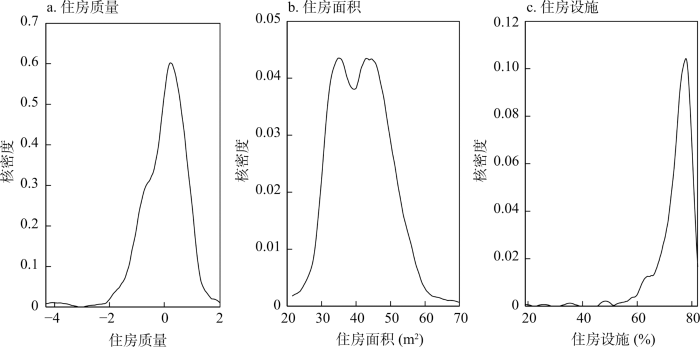
图1
中国城市住房质量核密度分布图
Fig. 1
Kernel density profile of housing quality in urban China
3.2 住房质量空间分布特征
根据中国城市住房质量平均值加减1个标准差从高到低依次划分为高、中高、中、中低和低5个等级。图2a结果显示,中国城市住房质量空间分布以胡焕庸线为界呈现出“东南高西北低”并在新疆和内蒙古自治区略有回升的空间格局。其中,高住房质量的城市有45个,零星散布在华东、华中和华南地区,如扬州、黄冈和镇江等;中高住房质量的城市有151个,大部分集中在华东、华中和华南地区境内,包括南京、武汉和湛江等,另有少数散布在西北和西南地区;中住房质量的城市有95个,主要散布在西北和东北地区,以阿克苏地区和哈尔滨等为代表,另有部分中住房质量的城市集中在珠三角城市群,如广州、珠海和中山等;中低住房质量的城市有36个,分布在华北和西南地区,且华北地区主要以呼包鄂榆城市群为中心分布,包括榆林、呼伦贝尔和齐齐哈尔等;低住房质量的城市有10个,集中在西南地区,包括阿里地区和那曲地区等。中国城市住房质量的全局Moran's I值为0.393,且在1%水平上显著,表明中国城市住房质量空间分布存在显著的空间正相关。图2d的局部空间自相关结果显示,中国城市住房质量高值集聚区集中在长三角、珠三角和长江中游城市群地区,低值集聚区分布集中在哈长、呼包鄂榆和兰西城市群地区。
图2
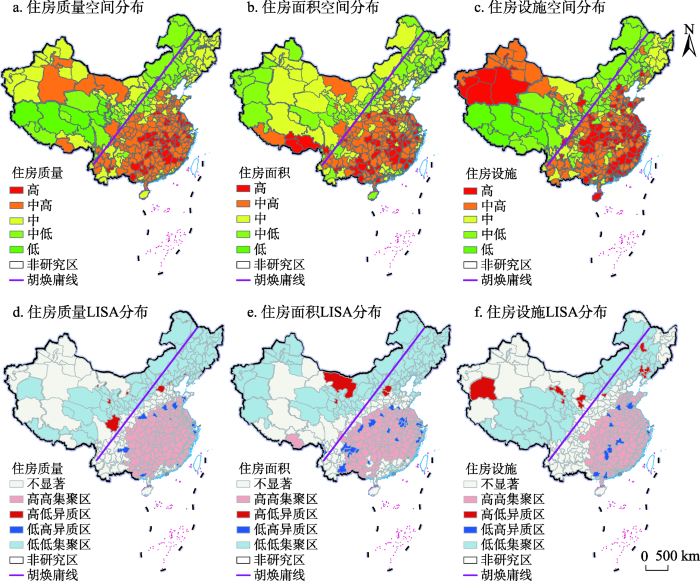
图2
中国城市住房质量空间分布及其LISA分布情况
注:基于自然资源部地图技术审查中心标准地图服务网站的标准地图(审图号:GS(2020)4619号)绘制,底图边界无修改。
Fig. 2
Spatial distribution and LISA distribution of housing quality in urban China
根据住房面积平均值加减1个标准差从高到低依次划分为高、中高、中、中低和低5个等级。图2b结果显示,中国城市住房面积空间分布呈现出明显的“南高北低”空间分布特征。其中,高住房面积的城市有51个,集中在长江中游和藏中南城市群,包括九江和拉萨等;中高住房面积的城市有112个,集中在华东、华中和华南地区,有杭州、长沙和湛江等;中住房面积的城市有111个,主要分布在华北、西北和西南地区,包括北京、兰州和那曲地区等;中低住房面积的城市有58个,分布在东北、部分华北和西北地区,并以哈长城市群为中心聚集,如吉林和松原等;低住房面积的城市有5个,仅出现在西北和西南地区交界处,包括阿里地区和玉树藏族自治州等,另外,深圳在住房面积上也存在劣势。中国城市住房面积全局Moran's I值为0.408,并在1%水平上显著,表明中国城市住房面积的空间分布存在显著的空间正相关。图2e的局部空间自相关结果显示,中国城市住房面积高值集聚区在长三角、粤闽浙沿海、长江中游和黔中城市群地区,低值集聚区在哈长、京津冀、兰西和天山北坡城市群地区。
根据住房设施平均值加减0.5个标准差从高到低依次划分为高、中高、中、中低和低5个等级。图2c结果发现,中国城市住房设施空间分布呈现出明显的“东南和西北地区高,东北和西南地区低”的空间格局。其中,高住房设施和中高住房设施的城市分别有107个和119个,两者分布形态较为接近,大多分布在华东、华中、华南以及西北地区,代表城市有上海、长沙、珠海和和田地区等;中住房设施的城市有51个,以哈长城市群为中心分布,包括吉林和牡丹江等,其余零星散布在宁夏沿黄、兰西和滇中城市群;中低住房设施的城市有24个,主要位于华北和部分西北地区,包括晋中和海西蒙古族藏族自治州等;低住房设施的城市有36个,主要集中在西南地区,包括拉萨和昌都地区等。中国城市住房设施的全局Moran's I值为0.223,并在1%水平上显著,表明中国城市住房设施空间分布也存在显著的空间正相关,但空间集聚强度要弱于住房面积分布。图2f的局部空间自相关结果显示,中国城市住房设施高值集聚区集中在长三角、长江中游、粤闽浙沿海和珠三角城市群地区,低值集聚区主要在呼包鄂榆和兰西城市群地区分布。
4 中国城市住房质量影响因素空间异质性
4.1 模型对比分析
多重共线性检验结果发现,所有解释变量VIF值均小于7,说明原始解释变量之间不存在多重共线性问题。表3的模型拟合优度结果显示,MGWR模型的R2和调整后的R2均高于普通最小二乘回归模型(Ordinary Least Squares,OLS)和GWR模型,且残差平方和与AICc准则值明显下降,说明MGWR模型的拟合效果最好,能够更好地解释住房质量影响因素的局部变化,降低模型残差的空间自相关性。因此,本研究选取MGWR模型深入探究中国城市住房质量影响因素的空间异质性。
表3 OLS模型、GWR模型与MGWR模型回归指标对比
Tab. 3
| 模型 | OLS | GWR | MGWR |
|---|---|---|---|
| R2 | 0.392 | 0.833 | 0.838 |
| 调整后的R2 | 0.366 | 0.775 | 0.801 |
| 残差平方和 | 79.823 | 48.369 | 47.020 |
| AICc | 478.391 | 510.194 | 431.620 |
4.2 住房质量影响因素的空间尺度效应
MWGR模型的带宽代表各影响因素对住房质量影响的作用尺度范围。表4结果显示,GWR模型影响因素的平均作用尺度范围为111个城市,占样本总量的32.94%,而MGWR模型影响因素的作用尺度变化范围为49~289个城市。具体而言:人均GDP、住宅商品房平均销售价格和人口老龄化等解释变量的作用尺度最大,带宽达到289个城市,接近全局;非农产业产值比例和家庭户规模等解释变量的作用尺度最小,带宽分别仅为49个和88个城市。
表4 GWR模型和MGWR模型解释变量的带宽
Tab. 4
| 变量 | GWR带宽 | MGWR带宽 | 最小值 | 中位数 | 最大值 |
|---|---|---|---|---|---|
| Intercept | 111 | 43 | -1.133 | 0.313 | 0.984 |
| pgdp | 111 | 289 | 0.275 | 0.297 | 0.311 |
| outprovin | 111 | 289 | -0.090 | -0.086 | -0.047 |
| hprice | 111 | 289 | -0.104 | -0.101 | -0.053 |
| older | 111 | 289 | 0.115 | 0.124 | 0.135 |
| fiscal | 111 | 237 | -0.010 | 0.035 | 0.169 |
| hown | 111 | 272 | 0.049 | 0.151 | 0.166 |
| illiter | 111 | 251 | -0.151 | -0.104 | -0.042 |
| edu | 111 | 178 | -0.033 | 0.126 | 0.223 |
| pinvest | 111 | 149 | -0.015 | 0.134 | 0.367 |
| urbanrate | 111 | 111 | -0.624 | -0.206 | 0.265 |
| hsize | 111 | 88 | -0.364 | 0.231 | 0.636 |
| nonagri | 111 | 49 | -0.585 | -0.065 | 0.787 |
4.3 住房质量影响因素的空间异质性
4.3.1 社会经济因素
根据对中国城市住房质量产生显著影响的社会经济因素的作用尺度从高到低进行分析。
图3
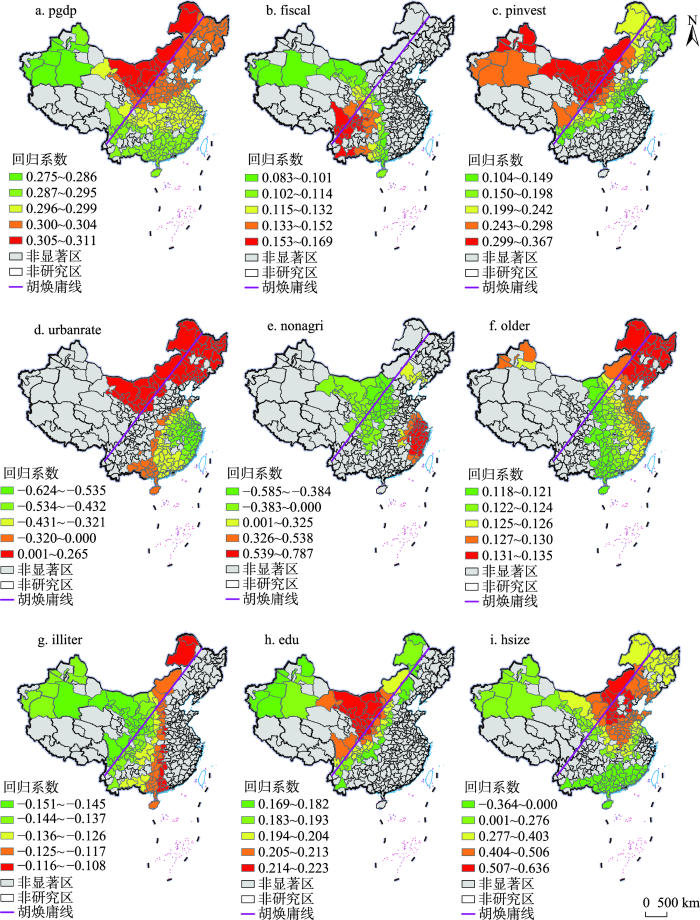
图3
中国城市住房质量影响因素空间分异格局
注:基于自然资源部地图技术审查中心标准地图服务网站的标准地图(审图号:GS(2020)4619号)绘制,底图边界无修改。
Fig. 3
Spatial heterogeneity patterns of factors affecting the distribution of housing quality in urban China
4.3.2 人口特征因素
根据对中国城市住房质量产生显著影响的人口特征因素的作用尺度从高到低进行分析。
人口老龄化对中国城市住房质量的正向影响从中到东阶梯式加强,并在东北地区达到最强(图3f),说明东北地区人口老龄化的提高对住房质量的提升效果要好于中部和东南地区。这一发现与已有研究结论不完全一致[26],但也有研究证实人口老龄化对住房需求的影响在不同经济发展水平地区存在差异[45]。这是因为,虽然中国人口老龄化形势凸显,但中国正在积极应对人口老龄化[46],现阶段住房质量并不会因为老年人口的增多而下降,反而由于老年人具有更好的财富积累提高了对住房质量的需求,尤其是在经济发达的地区。东北地区人口老龄化对住房质量的提升作用最为明显是因为东北地区工业化起步较早且城镇化水平总体较高,造成东北地区人口老龄化对住房质量的提升效果反而最为明显。
家庭户规模对中国城市住房质量的正向影响以辽中南城市群为核心向外逐渐减弱,并在珠三角、北部湾、粤闽浙沿海城市群产生负向影响(图3i),说明辽中南城市群家庭户规模的提高对住房质量的提升效果要强于周边城市。合理的解释是,家庭户规模的增加将会产生对住房空间以及住房设施的需求[24],而辽中南城市群相比西北地区和东北地区的其他城市具有更好的经济基础和社会条件满足居民的住房需求,因此家庭户规模对住房质量的正向影响在北方呈现以辽中南城市群为核心向外逐渐减弱的空间分布特征。然而,珠三角、北部湾、粤闽浙沿海城市群房价收入比明显高于其他城市,居民住房支付能力也相对偏弱[33],因此在家庭户规模增长的情况下,住房需求得不到合理解决,住房质量反而下降。
4.3.3 住房因素
住宅商品房平均销售价格和住房自有率对中国城市住房质量影响不显著。可能原因在于,住宅商品房平均销售价格和住房自有率对住房质量均存在正负双向影响。例如,住宅商品房平均销售价格较高地区的住房设施条件可能较好,但却容易牺牲当地居民的住房面积;住房自有率较高的城市,通常是住房资源不太紧张和城镇化水平较低的中小城市,其住房设施水平相对较差,但可能具有住房面积的补偿优势,因此这两个因素可能对住房质量无显著影响。
总体而言,社会经济因素和人口特征因素都会对中国城市住房质量产生显著的空间异质性影响,住房因素影响不显著。在社会经济因素中,人均GDP、人均地方财政一般预算支出和人均房地产开发投资额都会对中国城市住房质量产生显著的正向影响,城镇化率和非农产业产值比例会同时产生显著的正负向影响。其中,人均GDP和人均房地产开发投资额的正向影响呈现出“南-北”向空间分异格局,非农产业产值比例的影响呈现出“东-西”向空间分异格局,人均地方财政一般预算支出的正向影响高值区在黔中城市群,城镇化率的影响高值区为东三省和内蒙古地区。在人口特征因素中,人口老龄化和平均受教育年限都会对中国城市住房质量产生显著的正向影响,文盲人口比例会产生显著的负向影响,家庭户规模会同时产生显著的正负向影响。其中,人口老龄化和文盲人口比例的影响呈现出“东-西”向空间分异格局;平均受教育年限的正向影响高值区为宁夏沿黄城市群;家庭户规模的影响高值区为辽中南城市群。
5 研究结论与政策建议
5.1 研究结论
本研究利用2020年中国337个地级及以上城市人口普查数据和各城市社会经济特征数据,对中国城市住房质量空间格局与影响因素空间异质性进行了详细分析,主要得出如下结论:
(1)中国城市住房质量空间分布呈现出以胡焕庸线为界“东南高西北低”并在新疆和内蒙古自治区略有回升的空间格局。空间集聚模式分析发现,中国城市住房质量高值集聚区主要集中在长三角、珠三角和长江中游城市群,低值集聚区主要分布在哈长、呼包鄂榆和兰西城市群。中国城市住房面积空间分布呈现出明显的“南高北低”空间分布特征,高值集聚区集中在长三角、粤闽浙沿海、长江中游和黔中城市群,低值集聚区主要分布在哈长、京津冀、兰西和天山北坡城市群。中国城市住房设施空间分布呈现出“东南和西北地区高,东北和西南地区低”的空间格局,高值集聚区集中在长三角、长江中游、粤闽浙沿海和珠三角城市群,低值集聚区分布在呼包鄂榆和兰西城市群。
(2)MGWR模型的拟合优度明显高于OLS模型和GWR模型,且不同影响因素的作用尺度存在差异。对中国城市住房质量产生显著影响的社会经济因素的作用尺度由高到低依次为人均GDP、人均地方财政一般预算支出、人均房地产开发投资额、城镇化率和非农产业产值比例;对中国城市住房质量产生显著影响的人口特征因素的作用尺度由高到低依次为人口老龄化、文盲人口比例、平均受教育年限和家庭户规模。
(3)社会经济因素和人口特征因素共同作用于中国城市住房质量的空间分布。在社会经济因素中,人均GDP和人均地方财政一般预算支出是影响中国城市住房质量的关键因素,两者同时对中国城市住房质量产生显著的正向影响;在人口特征因素中,人口老龄化和文盲人口比例是影响中国城市住房质量的关键因素,前者会对中国城市住房质量产生显著的正向影响,后者会对中国城市住房质量产生显著的负向影响。
(4)中国城市住房质量影响因素存在空间异质性。其中,人均GDP和人均房地产开发投资额的正向影响呈现出“南-北”向空间分异格局;非农产业产值比例、人口老龄化和文盲人口比例的影响呈现出“东-西”向空间分异格局;人均地方财政一般预算支出的影响高值区为黔中城市群地区;城镇化率的影响高值区为东北三省和内蒙古自治区;平均受教育年限的影响高值区为宁夏沿黄城市群地区;家庭户规模的影响高值区为辽中南城市群地区。
5.2 政策建议
在理清当前中国城市住房质量空间分布特征以及影响因素空间分异格局的基础上,本文研究发现对促进中国城市住房高质量发展具有如下政策启示作用:
(1)住房质量落后地区应着力提高住房质量水平,并促进各项住房指标的平衡发展。中国城市住房质量存在明显的地域差异,哈长、呼包鄂榆和兰西城市群的住房质量远落后于其他地区,地方政府应将全面提升住房质量作为首要任务,合理扩大住房面积以及改善住房设施,加快建设高质量住房,努力缩小与其他地区的住房质量差距。哈长、京津冀、兰西和天山北坡城市群在住房面积上存在明显劣势,地方政府应优先解决居住拥挤问题,加快住房供给端制度改革,科学制定土地供应计划,合理安排土地供应结构,使得区域内住房供给量、供给结构与人口住房需求基本匹配。呼包鄂榆和兰西城市群在住房设施上存在明显劣势,地方政府应着重考虑通过棚户区改造和城市有机更新等途径继续完善居民住房设施,让居民享有管道自来水、厨房、厕所和洗澡设施等基本住房设施,并在技术安全的前提下,鼓励老旧小区加装电梯,确保居民生活和居住便利。
(2)提高中国城市社会经济发展水平,促进当地城市住房质量提升。研究发现,城市社会经济发展水平对不同地区住房质量的影响强度有所差异。其中,人均GDP对中国城市住房质量的改善作用在东北和华北地区最为明显,地方政府应出台促进地区经济发展的政策,合理引导转变经济发展模式,优化产业结构升级,积极处理老工业基地的历史遗留问题,从而提高城市经济发展水平和运行效率,进而改善城市住房质量。人均地方财政一般预算支出对中国城市住房质量的提升效果在黔中城市群最为明显,地方政府应继续加大对公共服务设施的财政支出,完善城市交通、水、电、气等基础设施建设,改善城市外部居住环境,从而提升城市住房质量。
(3)积极应对人口老龄化和提高居民受教育程度,以人才发展推动中国城市住房质量提升。人口老龄化对中国城市住房质量的提升效果在东北地区最好,地方政府应积极应对人口老龄化,根据老年人对住房物理环境需求的不同匹配相应的养老服务设施,改善老年人口的居住水平。文盲人口比例对中国城市住房质量的恶化效果在西部地区最为严重,地方政府应大力推行义务教育,提高居民文化水平,使其具备获得高质量住房的能力,以人才发展带动城市住房质量提升。
本研究仅对2020年中国城市住房质量空间格局与影响因素空间异质性进行了详细研究,仍存在一些研究不足。首先,本研究使用的数据为截面数据,未来研究可考虑使用面板数据或多个年份截面数据进行对比研究;其次,由于数据获取的限制,未能将住房制度等因素纳入模型,未来研究应深入讨论制度因素对中国城市住房质量的空间异质性影响;最后,本研究所使用的城市只是行政区的概念,实际数据包括了城市、镇和乡村地区,评价结果容易受到不同地区城镇化水平的影响,未来研究可以单独关注城市、镇或乡村地区的住房质量差异与影响因素空间异质性。这些研究不足值得未来研究进一步探讨和解决。
致谢
真诚感谢匿名审稿专家对本文研究意义、结果分析、结论梳理和图表展示等方面的修改意见,使本文获益匪浅。
参考文献
中国城镇居民家庭住房不平等测度及其影响因素分析
Measurement and influencing factors of housing inequality of urban households in China
中国城市住房不平等的空间特征分析
Analysis on the spatial characteristics of urban housing inequality in China
中国居民住房状况的新变化
Changing housing conditions in China
Data from the 7th National Population Census suggest that housing conditions in China have continued to improve in the past decade. The per capita housing area of urban residents has reached the standard of living of a comprehensive well-off society. The household residential pattern,used to be dominated by two-generation households, has now featured by a dichotomy between onegeneration households and multi-generation households, and the proportion of buying commercial houses and renting other houses has increased significantly. The housing conditions in China's western and northeastern regions have both greatly improved, and the regional disparity has narrowed. However,the urban-rural gap in housing conditions has been changing that the gap in housing facilities narrowing, while the gap in per capita housing area widening. While differentials in housing sources exist,differences by occupation in urban areas tend to narrow.
Housing quality of the urban poor: Wandegeya in Kampala Uganda
国内城镇住房质量指标体系研究: 基于北京、上海和深圳统计数据的分析
Research on domestic urban housing quality indicator system: Based on the statistical data of Beijing, Shanghai and Shenzhen
社区对流动人口的健康效应研究: 基于住房质量与邻里构成的双维度分析
Research on the health effect of community on floating population: Based on the comparative analysis of housing quality and neighborhood composition
Estimating housing quality for poverty and development policy analysis: CWIQ in Ghana
基于2010年人口普查数据的中国城镇住房状况分析
Housing distribution in urban China basing on China's 2010 Census
基于六普数据的中国流动人口住房状况的空间格局
DOI:10.11821/dlyj201405008
[本文引用: 9]

住房是流动人口融入城市、实现市民化过程中必须解决的关键问题。基于2010 年第六次人口普查数据,采用住房拥有率、租住房率、住房面积指数、住房不受干扰指数、住房质量指数和住房费用指数6 个指标考察流动人口的住房状况,并综合运用数理统计、空间自相关和系统聚类法揭示流动人口住房状况的属性特征、空间分布与集聚类型。研究发现,与城镇常住人口相比,流动人口的住房状况较差。从空间分布看,流动人口住房状况的各项指标具有显著的空间正相关,在空间分布上不仅存在集聚现象,而且有明显的集聚中心。研究结果还表明,流动人口住房条件综合状况可划分为较好、中等、中等偏下、较差4 级类型区,在全国尺度上的空间分布除个别类型外具有团块聚合的结构特征。在考虑社会公平的前提下,应分类解决不同类型区域流动人口的住房问题。
The spatial pattern of the housing situation of China's floating population based on the Sixth Census data
China's rapid urbanization and economic development have given rise to the fast growth of the floating population, and housing is a key issue in the process of their integration into the destination cities. This paper intends to explore this topic by analyzing the spatial patterns of housing conditions of the floating population. Based on the sixth census data, the paper selects six indicators to measure housing conditions of the floating population: the home-ownership rate, the rental-housing rate, the floor area index, the housing facilities index (constructed by summing up the situation of five variables: availability of running water, washroom, bathroom, kitchen, and the type of fuel), the index of privacy (constructed by summing up the situation of two variables: the function of the dwelling and the number of the dwelling's floors), and the housing consumption index. It uses the methods of Spatial Autocorrelation Analysis and Hierarchical Cluster to examine the spatial distribution and agglomeration patterns of the floating population's housing conditions. The results of the calculation show that compared with urban permanent residents, members of the floating population are much more likely to live in rental homes;their housing conditions are generally worse;and their rental expenses are higher. The spatial variation of the homeownership rate, the rental-housing rate, and the housing facilities index is mainly manifested as north-south differences;the floor area index, and the index of privacy show marked difference between eastern and western China. The low-value centers of the housing consumption index are located in Inner Mongolia, Shaanxi, Hubei and Anhui provinces, while the high-value centers are located in Beijing. Furthermore the results of Spatial Autocorrelation Analysis demonstrate that there is a significant positive spatial correlation in the indicators of the floating population's housing conditions on a national scale, and identify the phenomenon of their spatial clustering and the centers of such spatial clustering. The analysis of Hierarchical Clustering identifies the housing conditions of the floating population into four distinctive groups, and suggests that the housing conditions of the floating population in the inner and east parts of China are better than those in the outer and west parts, and such a spatial variation extends from the north to the south. Finally, on the basis of the above findings, the paper puts forward some policy suggestions for improving the housing conditions of the floating population.
我国城镇家庭住房水平分析
Analysis on the housing standards of urban families in China
Housing quality and its determinants in rural China: A structural equation model analysis
流动人口的社会分层与居住质量: 基于上海市长宁区“六普”数据的分析
Floating population: social stratification and housing quality: Evidence from the Six Census data of Changning district in Shanghai
社会分层、住房产权与居住质量: 对中国“五普”数据的分析
Social stratification, home ownership and quality of living: Evidence from China's Fifth Census
中国城镇家庭住房质量时空差异分析
Analysis on the space-time differences of housing quality of urban families in China
中国城市流动人口住房质量的空间分异与影响因素
DOI:10.11821/dlxb202112006
[本文引用: 13]
基于2015年全国1%人口抽样调查和2014年流动人口动态监测调查(CMDS)数据,本文以房屋面积、设施条件、建筑年代和社区类型来衡量流动人口住房质量,运用空间统计工具探讨了中国310个地级及以上行政单元流动人口住房质量的空间分异特征,进而通过空间计量模型考察流动人口住房质量的影响因素。研究发现:① 流动人口住房整体水平虽不及本地居民,但差距并不悬殊;② 流动人口住房质量的空间差异明显,中部地区流动人口住房质量最高,东部、西部和东北地区在住房质量4个方面各有劣势;③ 按照行政等级和规模等级划分,中等城市流动人口住房质量最好,超大城市住房质量最差;④ 流动人口住房质量呈现出显著的空间正相关,但各指标高、低值集聚区的分布格局存在一定差异;⑤ 流动人口个体(内部特征)和流入地(外部特征)因素对流动人口住房质量具有显著影响,分别作用于不同的方面;⑥ 中小城市和大城市流动人口住房质量的决定因素及作用强度不尽相同。
Spatial variation of migrant population's housing quality and its determinants in China's prefecture-level cities
Based on data from the 1% National Population Sample Survey 2015 and the 2014 China Migrant Population Dynamic Survey (CMDS), the paper selects four indicators to measure housing quality of the migrant population including floor area, housing facilities, construction period and living communities (urban or rural) and discusses the phenomenon about spatial differentiation of migrant populations' housing quality in 310 prefecture- and provincial-level cities in China, using GIS spatial analysis methods such as Moran's I coefficient and Getis-Ord Gi*. Besides, we investigate the influencing factors of migrant populations' housing quality. Some conclusions can be drawn as follows: (1) Compared with the local residents, the housing quality of the migrants is not that worse. (2) The spatial distribution of housing quality of migrant population presents marked spatial differentiation on cities of different levels and scales, population sizes and geographical divisions. (3) The results of spatial autocorrelation analysis demonstrate that there is a significant positive spatial correlation in the indicators of the migrant population's housing quality on a national scale, and identify the phenomenon of their spatial clustering and the centers of such spatial clustering. (4) The housing quality is influenced by both internal factors of migrant population and external factors of in-flow cities. (5) Population, economic development and the housing market play different roles in the housing quality of migrant population.
经济发展、公租房政策与家庭居住质量: 基于2016年低收入家庭调查的实证分析
Economic development, public rental housing policy and residence quality of urban low-income families: Empirical analysis based on the low-income household survey in 2016
Rental externality, tenure security, and housing quality
流动劳动力的住房供给与需求分析
The analysis of housing supply and demand of the floating labor force
住房市场化与住房不平等: 基于CHIP和CFPS数据的研究
Housing marketization and housing inequality: A study based on CHIP and CFPS data
超大城市乡-城与城-城流动人口的居住空间差异: 基于北京和上海的研究
The difference of living space between rural-urban and urban-urban floating population in mega cities: Based on the study of Beijing and Shanghai
Interpreting the meaning of housing quality towards creating better residential environment
Malaysian National Housing Policy has reinforced the aspect of quality as one of the aspects that utterly needs consideration in new housing development. There are problems in defining the housing quality regarding the expected criteria and standards due to subjective and contextual determined in controlling the quality of housing development. It focuses on what constitutes a good housing quality in the perspectives of housing actors in Malaysia? This paper employs in-depth interview with the actors as well as focus group interviews with residents as the main instruments towards understanding the meaning of housing quality in developing countries such as Malaysia.eISSN: 2398-4287 © 2018. The Authors. Published for AMER ABRA cE-Bs by e-International Publishing House, Ltd., UK. This is an open access article under the CC BYNC-ND license (http://creativecommons.org/licenses/by-nc-nd/4.0/). Peer–review under responsibility of AMER (Association of Malaysian Environment-Behaviour Researchers), ABRA (Association of Behavioural Researchers on Asians) and cE-Bs (Centre for Environment-Behaviour Studies), Faculty of Architecture, Planning & Surveying, Universiti Teknologi MARA, Malaysia.DOI: https://doi.org/10.21834/e-bpj.v3i8.1414
子女数量、性别与中国城市家庭的住房选择
On the relationship between the number and gender of children and housing choices in urban China
家庭式迁移的流动人口住房状况
DOI:10.11821/dlyj201704003
[本文引用: 3]
近年来“家庭式迁移”日益成为流动人口迁移的主要趋势,并对城市居住的独立性、权属和质量提出了现实需求。运用2009年环渤海、长三角、珠三角、成渝四区域12市的2394份抽样调查问卷,采用Logistic回归分析等计量方法,探究家庭式迁移的流动人口住房特征及影响因素。研究发现,“独住型”“夫妻同住型”“两代同住型”和“三代同住型”的流动家庭住房特征存在显著差异,其购房比例和住房质量依次提高。流动家庭的住房权属和质量受到家庭社会经济特征、家庭类型、地理因素以及流动家庭与老家联系和在流入地融入程度的影响。研究发现,如果纳入城市归属感、留城意愿及与老家的联系等变量,将会显著弱化户口对住房的作用。由于不同类型家庭所处的社会经济状况和应对策略不同,住房特征产生了家庭分异。因此,政府应当制定梯度化的住房管理政策,以此推动流动家庭逐步实现“固化”到城市。
Housing outcomes of family migrants at the place of destination
Nowadays family migration has become the main migration pattern of floating population in China, which may raise new requirements for residential independence, tenure and quality in the cities. For some researchers, the migrant households were generally considered as passive recipients of housing inequality, and the institutional barrier of Hukou were no doubt still the decisive factors for migrants' housing outcomes. However, other researchers start to challenge this perspective, and argue that migrants should be considered as enabling agents with coping strategies in the housing market since the influence of Hukou system in migrants' housing outcomes is declining. Under this context, this paper tries to explore the role of family strategy in family migrants' housing outcomes, and whether this conclusion differentiates among various households. Based on a questionnaire survey which covered 2394 migrants and their households in 12 cities of the Bohai Rim Region, the Yangtze River Delta Region, the Pearl River Delta Region, and the Chengdu-Chongqing Region, this paper uses logistic regression model to explore family migrants' urban housing outcome in terms of housing tenure and quality and the mechanism for this. The result shows, different household arrangements lead to diversification of housing outcome, which means that the ownership and housing quality differs significantly among sole migrants, couple migrants, two-generation migrants, and three-generation migrants. The three-generation migrant households, as expected, have the highest ownership percentage and residential quality among all types of migrant households, while the sole and couple migrants suffer from the poor residential conditions. This housing outcome should be explained by factors such as socio-economic characteristics, household arrangements, geographic environment, migrants' connection with the original hometown and adaptation to current destination. Especially, when considering the effect of migrants' sense of belonging, plan to settle down in the destination and connection with hometown, the effect of Hukou is weakened. Different household arrangements have different barriers and strategies, which leads to the divergence of housing outcomes. The implication from this research is that the governments should make gradient regulation policy for the diverse family migrants, and lead them to settle stably step by step.
Living together but apart: Material geographies of everyday sustainability in extended family households
In the Industrialized West, ageing populations and cultural diversity—combined with rising property prices and extensive years spent in education—have been recognized as diverse factors driving increases in extended family living. At the same time, there is growing awareness that household size is inversely related to per capita resource consumption patterns, and that urgent problems of environmental sustainability are negotiated, on a day-to-day basis (and often unconsciously), at the household level. This paper explores the sustainability implications of everyday decisions to fashion, consume, and share resources around the home, through the lens of extended family households. Through interviews with extended family households in Australia, we explore the potential for these living arrangements to reduce resource use, and thus improve sustainability outcomes. In these households, a desire to care for and support family members in hard times (rather than an overt sustainability agenda) has promoted particular modes of extended family living, including unique forms of sharing and pooling material goods. But cultural values of privacy, space, and independence—and the sanctity of the nuclear family—have led to duplication (and even multiplication) of household spaces, appliances, and resources, under one roof. The potential environmental and economic benefits of resource sharing within larger households are thus mediated by deep cultural values and exigencies of everyday life.
新生代农民工居住特征及影响因素分析
Characteristics and impact factors of residential status of the new generation of migrant workers
个体老化过程中的中国城市老年人居住环境变化: 基于中国城乡老年人口追踪调查数据的分析
Changes of the residential environment for the elderly in urban China during personal aging process: Based on the data of China's urban and rural elderly survey
新城市贫困空间居住满意度及其影响因素: 基于西安市企业社区的实证
DOI:10.18306/dlkxjz.2021.05.007
[本文引用: 2]
研究新城市贫困空间居住满意度,对深入认识城市贫困群体生活状况,提升居住质量,完善居住区理论具有重要意义。论文以西安市主城区典型老旧企业社区为例,基于1010份问卷数据,构建居住满意度结构方程模型,探究居民居住满意度及其影响因素;引入重要性—绩效理论(importance-performance analysis, IPA),甄别企业社区改造重点与次序,指出老旧小区提升建议。结果表明:① 企业社区居住满意度整体“一般”,在李克特五分制量表下均值为3.21;② 居住满意度受居住环境、住房条件及配套设施3个方面影响,与居民搬离意愿呈显著负相关;③ 不同社会经济属性个体的居住满意度在年龄、文化程度、户籍、职业、个人收入、居住时长、住宅产权以及企业运营状况等变量作用下差异显著;④ 企业社区改造亟需优先关注社区休憩活动场所、卫生清洁、适老化医疗护理设施、物业服务、公共服务设施等要素,进而改善居住条件,增强居民的社区归属感与凝聚力。文章提出从创新管理模式、改善居住环境、改造住房条件以及建设配套设施等4个方面实施未来老旧小区改造建议。
Residential satisfaction of new urban poverty space and its influencing factors: An empirical study on enterprise communities in Xi'an city
Studying on residential satisfaction of the new urban poverty space is of great significance for understanding the living condition of the urban poverty group, improving the life quality, and enriching the research of residential area. Taking the typical old enterprise communities in the central city of Xi'an as an example, this study explored residential satisfaction of enterprise communities and its influence factors based on survey data and structural equation modeling (SEM) method. Importance-performance analysis (IPA) theory was introduced to identify the priorities and sequence of enterprise community renewal, and we propose methods for the renewal of the old urban communities. The results show that: 1) Residential satisfaction of enterprise communities is at an average level, and the mean value of the 5-point Likert scale is 3.21. 2) Residential satisfaction is successively affected by the living environment, housing conditions, and supporting facilities, and has a significant negative impact on residents' willingness to move out. 3) There were significant differences in residential satisfaction among individuals with different socioeconomic attributes, such as age, educational level, household registration, occupation, monthly income, length of residence, housing property rights, and enterprise operation. 4) In order to improve the living conditions, it is necessary to give priority attention to the factors of community recreation and activity, sanitation, medical and nursing facilities suitable for the aged population, property services, public service facilities, and so on, and strengthen the sense of community belonging and cohesion of residents. It is recommended that the renewal of the old urban community in the future should be carried out from four aspects: management mode, living environment, housing, and supporting facilities.
经济发展特征、住房不平等与生活机会
Economic development, housing inequality and life opportunities
住房成本、人口流动与产业集群
Housing costs, population shift and industrial clusters
中国人口城镇化过程中的住房问题研究
Research on the housing problem in the process of population urbanization in China
Government competition, land supply structure and semi-urbanization in China
Population urbanization is crucial to establishing a harmonious society. However, the phenomenon of population semi-urbanization is becoming an issue of ever-increasing concern in China. More and more immigrants from rural areas work and live in the city, but their roots remain in the rural area. This paper aims to analyze the influence mechanism of government competition on population semi-urbanization through land supply structure. The study’s theoretical analysis and empirical analysis results are based on the panel data of 105 key prefecture-level cities in China from 2007 to 2017. The results demonstrate that: (1) land finance and land-motivated investment engendered by government competition lead to an imbalance in the land price structure, further increasing the rate of population semi-urbanization; (2) land finance does not lead to population semi-urbanization through the land area structure; and (3) land-motivated investment aggravates the imbalance in the land area structure, further leading to population semi-urbanization. It is found that government competition in terms of achieving performance indicators affects population semi-urbanization by adjusting the land supply structure. Efforts should be made to achieve the coordinated development of urbanization, given that the increasing rate of population semi-urbanization will almost certainly aggravate social instability.
流动人口家庭化迁移与住房选择分异研究: 基于全国25个城市的实证分析
Family migration and housing tenure choice: Empirical evidences from 25 Chinese cities
中国城市住房支付能力空间差异与分类调控策略
DOI:10.13249/j.cnki.sgs.2022.02.004
[本文引用: 2]
住房支付能力事关广大百姓生活质量与福祉,已成为世界各国政府共同关心的民生话题。2020年度住建部城市体检工作对中国城市住房支付能力给予了高度重视,并将其纳入到城市体检评价指标体系。基于全国337个地级以上城市房价/房租和家庭可支配收入数据,从购房群体和租赁群体视角客观评估了中国城市住房支付能力及其变化,并划分了中国城市住房支付能力空间类型区,最后分析总结了中国城市住房支付能力的影响机制与分类调控对策。研究结果表明:① 中国城市房价收入比略微偏高且有所提升,2015年和2019年的平均房价收入比分别为7.01和7.76;中国城市房租收入比更加合理且有所下降,2015年和2019年的平均房租收入比分别为25.04%和22.01%。② 中国城市住房支付能力空间分异明显,房价收入比呈现出明显的东部高、中西部低的特征,房租收入比却呈现明显的南高北低的特点。③ 根据房价收入比和房租收入比联合空间分布特点,可将中国城市住房支付能力划分为租购支付能力双弱型、租购支付能力偏弱型、购房支付能力偏弱型、租购支付能力双强型和租房支付能力偏弱型等5种空间类型区,不同空间类型区的住房支付能力调控策略有所区别。④ 中国城市住房支付能力的影响机制包括城市住房供给和需求、城市生活质量、社会预期和住房偏好、金融与房地产政策以及家庭收入水平等方面。
Spatial disparity and classified control strategies of housing affordability in urban China
Based on 337 prefecture-level above cities’ housing prices/rent and household disposable income data, this article objectively evaluates housing affordability and its changes for Chinese cities from perspectives of both homeowners and tenants, then identifies spatial types of housing affordability, and finally summarizes the influence mechanism and control measures of housing affordability. The results show that price-to-income ratio for Chinese cities is slightly higher and has increased, with an average being 7.01 and 7.76 in 2015 and 2019 respectively, but rent-to-income ratio for Chinese cities is more reasonable and has declined, with an average of 25.04% in 2015 and 22.01% in 2019. Moreover, there is distinct spatial differentiation of housing affordability in urban China. Price-to-income ratio is witnessed with higher value in the eastern region, while lower value in the central and western regions and rent-to-income ratio with higher value in the southern region and lower value in the northern region. Following the joint distribution of price-to-income ratio and rent-to-income ratio, housing affordability in China can be divided into five spatial types: type of weak affordability for both renters and purchasers, type of slight weak affordability for both renters and purchasers, type of weak affordability for only purchasers, type of strong affordability for both renters and purchasers, and type of weak affordability for renters. Distinguished control strategies have been raised for different spatial types of housing affordability. Last, the influencing mechanism of housing affordability in urban China includes housing supply and demand, urban quality of life, social expectation and housing preference, financial and real estate policies, and household income level.
流动人口购房意愿影响因素的空间异质性: 基于MGWR模型的研究
DOI:10.13249/j.cnki.sgs.2022.08.006
[本文引用: 1]
基于2016年中国流动人口动态监测数据,运用多尺度地理加权回归模型对流动人口流入地购房意愿影响因素的空间异质性进行分析。研究发现:① 中国流动人口在流入地城市的购房意愿整体偏低,尤其在流动人口聚集的东南沿海地区,流动人口购房意愿最低。② 多尺度地理加权回归(multi-scale geographically weighted regression,MGWR)模型能识别出不同因素对购房意愿的影响具有空间尺度差异,其中户口类型、流动范围、流动次数等显著变量对不同区域流动人口购房意愿的影响存在明显的区域差异。③ 各影响因素呈现显著的空间分异格局,其中婚姻状况、户口类型、职业类型、房价、公共服务等因素对东南地区购房意愿的影响较大,收入、流动次数、已购住房、随迁子女等因素对东北地区购房意愿的影响更大,西北地区平均受教育年限和拥有住房公积金对流动人口购房意愿的正向促进作用显著,而跨省流动的负向影响由西北向中部地区梯度递减。
Spatial heterogeneity of floating population' home purchase intention in China: A multi-scale geographically weighted regression approach
Against the backdrop of new urbanization in China, the home purchase intention of floating population in the destination city is closely related to the process of citizenization. However, existing studies have paid insufficient attention to the spatial heterogeneity of floating population’s home purchase intention and its influencing factors. Based on China Migrants Dynamic Survey in 2016, this study investigates the determinants of floating population’s home purchase intention and their spatial heterogeneity using the multi-scale geographically weighted regression (MGWR). The results show that the overall willingness of China’s urban floating population to purchase a home in the city of their inflow is on the low side, especially in the southeastern coastal region where the floating population congregates, where the floating population has the lowest willingness to purchase a home. The results of the MGWR model indicate that different factors exerting significant impacts on floating population’ home purchase intention have spatial scale differences. Among them, significant variables such as hukou status, inter-provincial migration have obvious regional differences in the influence of the floating population’s home purchase intention in different regions. Specifically, marital status, hukou status and occupation at the individual level and housing price, public financial expenditure and medical resources at the city level have greater impacts on the willingness of floating population to purchase a dwelling in southeast China than other regions. The impacts of income, frequency of migration, owning a dwelling and migration with children are more significant in northeast China. The educational attainment and housing provident fund have more significant positive effects on floating population’s home purchase intention in northwest China, while the negative impact of inter-provincial migration decreases from northwest to middle central China. This study provides theoretical basis and policy recommendations for alleviating the housing problem of the floating population and advancing the process of urbanization.
新市民的住房问题及其解决路径
Housing issues and solutions for new citizens
时间地理支持下的核密度估计研究进展
DOI:10.18306/dlkxjz.2022.01.006
[本文引用: 1]
时间地理核密度估计是经典核密度估计(KDE)基于时间地理的一种扩展,主要是将标准核函数的定义域扩展至时间地理的时空可达域,以通过增强定义域在时空方面的物理意义来避免非零密度被分配到可达域之外的问题。时空可达域包括时空碟和由时空碟复合而成的潜在路径区域(PPA)。这2类可达域用作核函数的定义域能解决上述问题,但也带来了新的问题。基于时空碟构建的核函数能叠加成PPA上的概率密度,但敏感于时空碟的时间点。而基于PPA构建的核函数相较于理想布朗桥模型缺乏双峰特性,且也不能生成时空碟上的概率密度函数。因此,时间地理与KDE相结合的研究还处于应用前的理论探索阶段,论文的目标就是对这一进程进行梳理并引出未来的发展趋势。论文围绕时空轨迹不确定性量化这一目标,首先回顾了时间地理与核密度估计的不同功用,然后对两者相融合的意义、框架和模式进行了阐述。最后,认为时间地理的可达域代替核密度估计的定义域是改进时空轨迹不确定性测度的重要手段,但距离目标的落地还有一定的距离。
Advances in kernel density estimation supported by time geography
Time geographic kernel density estimation is an extension of classical kernel density estimation (KDE) based on time geography. It mainly extends the definition domain of the standard kernel function to the space-time reachable domain of time geography, so as to avoid the problem of non-zero density being assigned outside the reachable domain by enhancing the physical meaning of the definition domain in space-time. The space-time reachable area includes the space-time disc and the potential path area (PPA) compounded by the space-time disc. These two types of reachable domains can be used as the domain of the kernel function to solve the above problems, but they also bring new problems. The kernel function constructed based on the space-time disc can be superimposed into the probability density on the PPA, but it is sensitive to the time point of the disc. Compared with the ideal Brown Bridge model, the kernel function constructed based on PPA lacks bimodal characteristics, and cannot generate the probability density function on the space-time disc. Therefore, the research on the combination of time geography and KDE is still in the stage of theoretical exploration before application. The goal of this article is to sort out this process and elicit future development trends. Focusing on the goal of quantifying the uncertainty of space-time trajectory, this article first reviews the different functions of time geography and KDE, and then elaborates the meaning, framework and mode of the integration of the two. Finally, this article believes that the time-geographic reachable domain instead of the domain of KDE is an important means to improve the uncertainty measurement of space-time trajectory, but there is still a certain distance from the landing of the target.
Simple diagnostic tests for spatial dependence
Local indicators of spatial association: LISA
The capabilities for visualization, rapid data retrieval, and manipulation in geographic information systems (GIS) have created the need for new techniques of exploratory data analysis that focus on the “spatial” aspects of the data. The identification of local patterns of spatial association is an important concern in this respect. In this paper, I outline a new general class of local indicators of spatial association (LISA) and show how they allow for the decomposition of global indicators, such as Moran's I, into the contribution of each observation. The LISA statistics serve two purposes. On one hand, they may be interpreted as indicators of local pockets of nonstationarity, or hot spots, similar to the Gi and G*i statistics of Getis and Ord (1992). On the other hand, they may be used to assess the influence of individual locations on the magnitude of the global statistic and to identify “outliers,” as in Anselin's Moran scatterplot (1993a). An initial evaluation of the properties of a LISA statistic is carried out for the local Moran, which is applied in a study of the spatial pattern of conflict for African countries and in a number of Monte Carlo simulations.
Multiscale geographically weighted regression (MGWR)
Inference in multiscale geographically weighted regression
A recent paper expands the well‐known geographically weighted regression (GWR) framework significantly by allowing the bandwidth or smoothing factor in GWR to be derived separately for each covariate in the model—a framework referred to as multiscale GWR (MGWR). However, one limitation of the MGWR framework is that, until now, no inference about the local parameter estimates was possible. Formally, the so‐called “hat matrix,” which projects the observed response vector into the predicted response vector, was available in GWR but not in MGWR. This paper addresses this limitation by reframing GWR as a Generalized Additive Model, extending this framework to MGWR and then deriving standard errors for the local parameters in MGWR. In addition, we also demonstrate how the effective number of parameters can be obtained for the overall fit of an MGWR model and for each of the covariates within the model. This statistic is essential for comparing model fit between MGWR, GWR, and traditional global models, as well as for adjusting multiple hypothesis tests. We demonstrate these advances to the MGWR framework with both a simulated data set and a real‐world data set and provide a link to new software for MGWR (MGWR1.0) which includes the novel inferential framework for MGWR described here.
Measuring bandwidth uncertainty in multiscale geographically weighted regression using Akaike weights
基于居住环境的常州城市居民生活质量空间结构
DOI:10.11821/dlxb202006011
[本文引用: 1]
第六次全国人口普查数据面世以后,基于因子生态分析的中国城市社会空间结构研究虽取得较多成果,但方法创新还有待推进。本文以常州作为实证研究地区,将人口普查数据与大数据(城市POI数据)相结合,借助网格化处理和公共服务设施可达性计算方法,从居住内部环境(住房条件)和居住外部环境(设施可达性)两方面综合衡量城市居民生活质量,进而探讨城市居民生活质量空间结构及其与居民社会经济属性之间的关系。结果表明,常州城市居民生活质量空间结构呈现出较为明显的圈层结构与扇形结构叠加的模式,城市生活质量空间结构与居民社会经济属性在空间上存在一定的耦合关系,即不同类型居民属性区的生活质量存在较为明显的差异,各类居民属性区均有与之重叠度较高的相对应的生活质量区,这种空间关系的揭示对城市规划和管理具有一定的借鉴意义,同时也从居民社会空间与实体空间互动关系的角度对社会—空间辩证法进行了诠释。
Spatial structure of quality of life of urban residents in Changzhou based on the living environment
跨地区生计及其变迁视角下流动人口城镇住房分层的特征及其影响因素
DOI:10.11821/dlyj020210818
[本文引用: 1]
在跨地区生计及其变迁的视角下,将流动人口在流入地和流出地城镇的住房状况有机结合,借助2016年中国流动人口动态监测调查数据和相匹配的城市特征数据,运用描述统计和多层次回归模型,探究流动人口城镇住房分层的特征及其影响因素。结果发现,流动人口的城镇住房已形成了一个从低到高依次由无城镇产权房、有城镇产权房(流出地或流入地城镇产权房)和多区域城镇产权房构成的“三阶四级式”的“金字塔型”结构。模型结果显示,流动人口个体及家庭的社会经济条件和流出地的区位禀赋是其实现城镇住房自有的重要基础和财务支撑,流入城市的经济发展水平、房价和城市规模仅对流入地和多区域城镇产权房有显著影响。因此,本文挑战了流动人口住房条件差的刻板印象,并吸引人们关注流动人口跨地区生计及其变迁对其城镇住房的影响,拓展了当代中国城镇住房分层研究的视角。
Characteristics and determinants of the floating population's urban housing stratification in China: From the perspective of multi-locational household arrangements and their changes
Using data from the 2016 China Migrant Dynamic Survey and the corresponding data on the characteristic of relevant cities, this paper first provides an updated and comprehensive study on the urban housing stratification of the floating population, and then uses multilevel multinomial logit model to estimate its determinants, based on the perspective of multi-locational household arrangements and their changes. The results show that the floating population′s urban housing stratification is characterized by the “three ranks” and “four levels”: the “three ranks” are composed of those who do not own any housing unit at the lowest rank, those owning one housing unit in an urban place of either origin or destination, and those owning more than one housing units in multiple urban locations at the highest rank, and the “four levels” consist of those who do not own any housing unit at the first level, those owning one housing unit in an urban place of origin at the second level, those owning one housing unit in an urban place of destination at the third level, and those owning more than one housing units in multiple urban locations at the highest level. Our findings also demonstrate that with the advancement of China′s urban and mobility transitions, some of the floating population in China has already had their owner-occupied housing in the destination cities and/or cities or towns of their places of origin, suggesting a significant change in the floating population′s housing conditions and their spatial arrangements. The results of the MMLM show that while the socio-economic conditions of the floating population at both the individual and family levels and the location endowment of their places of origin are important basis and financial foundation for the realization of their urban housing ownership, the per capita GDP, housing price and city size of the destination cities only affect the floating population′s housing ownership in their destination cities and in multiple urban locations. Our conclusions challenge the traditional stereotype of poor housing conditions of the floating population, provide a new perspective for urban housing stratification research in contemporary China, and call for more attention to the effects of multi-locational household arrangements and their changes of the floating population on their urban housing stratification.
中国高新技术企业分布影响因素的空间异质性与尺度效应
DOI:10.11821/dlyj020210499
[本文引用: 2]
影响高新技术企业分布的因素往往具有空间非平稳性,然而既有研究对其关注尚少。基于2017—2019年间认定的215791家高新技术企业数据,运用多尺度地理加权回归模型(MGWR),刻画了中国高新技术企业的空间分布格局,识别了其影响因素的空间异质性与尺度效应,结果表明:① 2019年中国高新技术企业的空间分布呈现出在以“北上广深”为首位中心,以成渝与区域性中心城市为次位中心的高度集聚特征。② 企业内部因素、城市知识创造水平、技术创新水平、创新环境水平和外部连通水平共同影响了高新技术企业的空间分布。③ 影响高新技术企业分布的因素存在空间异质性,公司年龄、高校学生数量、互联网的影响呈现出“东-西”向空间分异格局,专利申请数、高新区、生活设施的正向影响呈现出“南-北”向空间分异格局,高铁的正向影响呈现出“东南-西北”向空间分异格局,研发费用投入对东北地区影响最大,市场化水平对京津冀和珠三角城市群地区影响最大。④ 影响因素存在尺度效应,靠近创新末端的变量具有更大的作用空间尺度。最后,本研究提出相关的政策建议,以期为高新技术产业的发展提供借鉴与参考。
Exploring the spatial and scale variation of factors affecting the geography of high-tech enterprises in China
The main driving forces of China’s economic growth have gradually shifted from production factors and investments to innovations since the 2010s. The high-tech industry is knowledge- and technology-intensive and is one of the key intermediaries in regional innovation systems. Therefore, the development of high-tech industry or high-tech enterprises contributes to regional development, especially in the context of the “new normal” of China’s economy. However, researchers have paid little attention to factors affecting the distribution of high-tech enterprises with spatially varying effects. With the help of the data of 215,791 high-tech enterprises and multiscale geographically weighted regression, this paper described the spatial distribution of China’s high-tech enterprises in 2019 and explored the spatial and scale variation of its determinants. The following conclusions were drawn. First, in 2019, the spatial distribution of China’s high-tech enterprises showed a high concentration, with Beijing, Shanghai, Guangzhou and Shenzhen as the primary cores, and Chengdu-Chongqing region and several regional centers as the secondary cores. Second, the attributes of high-tech enterprises, the capabilities of urban knowledge creation and technological innovation, innovation environment and extra-regional linkages are the main factors affecting the distribution of high-tech enterprises. Third, the determinants showed spatially varying effects. Specifically, the positive impacts of new companies, college students and the Internet presented an “East-West” spatial differentiation pattern; the positive impacts of the number of patent applications, high-tech zones and amenities showed a “South-North” spatial differentiation pattern. The positive effects of high-speed rail presented a “Southeast-Northwest” spatial differentiation pattern; R&D expenditure is a strong driver in Northeast China; marketization has the most significant impact on the Beijing-Tianjin-Hebei and Pearl River Delta urban agglomerations. Fourth, the determinants have different working scales, and the variables indirectly related to the profits of high-tech enterprises that need a transformation process (e.g., R&D investment, extra-regional linkages) have less significant spatial variation than other factors (e.g., high-tech zones, the number of college students, the number of patent applications). Finally, justified on territorial equity criteria, this research provided several suggestions for improving spatially unbalanced innovation (high-tech enterprises), helping developing regions jump faster (develop high-tech industry). Current findings broaden our understanding of the associations of geography and scale with high-tech industry in an emerging large-scale economy.
The impact of population ageing on house prices: A micro-simulation approach
This study attempts to estimate the impact of population ageing on house prices. There is considerable debate about whether population ageing puts downwards or upwards pressure on house prices. The empirical approach differs from earlier studies of this relationship, which are mainly regression analyses of macro time‐series data. A micro‐simulation methodology is adopted that combines a macro‐level house price model with a micro‐level household formation model. The case study is Scotland, a country that is expected to age rapidly in the future. The parameters of the household formation model are estimated with panel data from the British Household Panel Survey covering the period 1999–2008. The estimates are then used to carry out a set of simulations. The simulations are based on a set of population projections that represent a considerable range in the rate of population ageing. The main finding from the simulations is that population ageing – or more generally changes in age structure – is not likely a main determinant of house prices, at least in Scotland.


