



1 引言
高学历人才就业迁移是经济机会下的理性决策,传统形式是从低等级城市向高等级城市的梯次迁移,一线城市更容易吸引高学历人才集聚[8⇓-10]。但近年来,随着一线城市生活成本的快速提高与其他城市的稳步发展,出现部分高学历人才“逃离北上广”的现象。《2019Q3中高端人才招聘与就业全景大数据报告》①(① 发布机构:猎聘大数据研究院(国内中高端人才的职业发展平台:
现有研究中,多从宏观面板数据揭示高学历人才城-城流动的空间分布、流动规律和形成机制,缺乏基于微观个体数据对人口城-城流动持续有向的跟踪,更缺少聚焦高学历人才择业阶段城-城逆向梯次迁移的探索。鉴于此,本文尝试利用2020年武汉市中小学教师招聘考试数据——其真实反映了正规就业驱动下的个体迁移意愿,以此揭示高学历人才城际逆向梯次迁移的新现象;并尝试引入空间粘性理论,探讨逆向梯次迁移的动力机制。研究结论有助于进一步认识城镇化下半场中国人口迁移流动模式的变化,为国家合理引导人口流动及城镇化策略制定提供现实依据;也有助于完善本土化的粘性理论分析框架。
2 研究综述
国外对人口迁移研究关注较早。拉文斯坦(E.G.Ravenstein)移民法则提出“逐步迁移”(Step-wise Migration)的空间迁移模式[12],即人口流动趋向遵循从农村至附近小城镇,至更大城镇,再至大城市的逐步而非跨越式的向上迁移。Conway[13]进一步指出,人口逐步迁移的概念应该包含跨城市等级的流动。结合城市等级,Plane等[14]将逐步迁移拓展为城市间的“梯次迁移与逆向梯次迁移”(Migration Up and Down the Urban Hierarchy),即人口沿等级规模向上/向下迁移至更高/低级别的城市。人口的“逆向梯次迁移”与城镇化密切相关。20世纪90年代末,美国等发达国家进入“逆城市化”阶段,在主流人口梯次迁移(向上流动)的同时,开始出现人口的逆向梯次迁移(向下迁移)[14],非大都市区的人口流入率和就业率提升。社会、经济、政治力量变化及个体空间选择差异被认为推动了人口从大城市核心地区向城市边缘区或低等级城市流动[14,15]。
人口跨城市等级迁移机制是复杂的,共性影响因素涉及经济[21,22]、社会文化及个体层面,包括地方性、社会关系和安全感[23,24],年龄和生命周期[25,26]等。Mu等[18]在中国的实证发现,年龄结构和户籍对人口向低等级城市流动影响显著。为了更好地探讨逆向梯次迁移与地理空间的关联,本研究引入粘性理论。粘性是理解人口流动与所处地理空间关系的重要介质,能够从空间的视角对流动特征与驱动机制进行解释[27,28]。西方早期研究将粘性视为人口流动的阻力,即嵌入式人力资本、知识和金融关系的特定流动和社会关系被短暂地锁定在特定地方[29]。David[30]认为“粘性”是人口不愿意迁移的行为和对某个地点的依附——它就像一种“胶水”,是人才流失的反作用力。近期研究中,粘性理论拓展至解释跨国或跨区移民返回的迁移机制。如,宗教信仰[31]和家庭粘滞[32]减弱流动性;种族上,白人受粘性影响小,流动性强[33];非洲的研究发现,粘性来自于个人价值追求[31]。此外,Belfield等[34]在英国的研究为就学地粘性提供了证据,面临就业选择时,只有36%的毕业生离开大学,而64%的毕业生留在就学地。总之,西方对不同群体迁移行为的分析发现,学校、宗教、种族、家庭与个人价值是主要粘性因素[33⇓⇓-36]。
高学历人才作为人力资本的重要载体,在城市间的迁移流动得到关注[9⇓-11]。已有关于全国高学历人才迁移空间格局的系统研究,发现高学历人才呈现高度集中于东部地区的不均衡模式,其迁移具有明显的地理邻近性与城市等级偏好,总体呈现梯次迁移[5,37⇓-39]。其中,聚焦高校毕业生就业迁移的实证进一步表明,毕业生倾向于把自身户籍地以上等级规模的城市划为主要劳动力市场[40],东部地区[27]及区域中心城市[41]仍具有强大的吸引力,梯次迁移是主流;但这种模式有所转变,毕业生对于非一线城市,尤其是发达地区的新一线、二线城市的就业偏好强化[6],产生逆向梯次迁移行为。关于高学历人才迁移机制,研究发现,区域经济差异[8,9]、行政因素[42]、社会环境[43]、空间粘性[27,44]等均有影响。其中,空间粘性贯穿人口迁移的各阶段,主要包括就学地粘性与户籍地粘性。就学地粘性对高校毕业生初次就业迁移影响显著。区域层面,经济发达地区会对本区域毕业生产生较大的“滞留”效应[44];城市层面,不同等级城市的就学地粘性强弱存在差异,一线城市高于新一线和二线城市,促进人才城际迁移[5,39]。户籍地粘性的主要影响因素为乡土情结、家庭、土地和户籍制度,空间迁移形式表现为人口回流[45]。
总体而言,研究视角上,受统计面板数据的限制,更多地从宏观趋势出发,缺乏基于个体数据对实际逆向梯次迁移行为或意愿的跟踪研究;研究对象上,更关注一般技术劳动力的迁移,相对忽略高学历人才的流动;流动方向上,较多分析乡-城迁移,对于城-城迁移特别是城-城“逆向梯次迁移”的探索不足。本文的研究问题聚焦于:① 城-城逆向梯次迁移的高学历人才呈现怎样的个体特征?② 城-城逆向梯次迁移的影响因素又是什么?基于此,本文以武汉市中小学教师招聘考试引发的高学历人才择业迁移行为(意愿)为研究对象,运用二元Logistic模型,对正规就业驱动的高学历人才“城-城”逆向梯次迁移现象展开个体层面的实证研究。特别关注就学地和户籍地的“粘滞效应”对高学历人才逆向梯次迁移的影响。
3 数据来源与研究方法
3.1 研究区域与数据来源
本文以武汉市两个国家级开发区——东湖新技术开发区与武汉市经济技术开发区作为实证区域。作为国家中心城市之一,武汉市是中部地区主要的人口流入地;两个国家级开发区作为武汉市经济增长最迅速、城镇化进程最快的地区,有极大的人才需求,每年公立中小学教师招聘岗位数量占全市一半以上。其次,公立中小学教师岗招聘对象为本科及以上学历人群,符合高学历人才定义[49]。第三,中小学教师招聘数据包含应聘者个体的流动信息,能够精确到个人的人口学特征和迁移过程中“户籍地—就学地—上次就业地—意愿就业地(武汉)”连续有向的迁移选择,从而体现出个体迁移经历和特征差异。第四,中小学教师岗是典型的正规就业。正规就业作为完成人口城镇化的重要途径[50],其更高的稳定性与职业声望、更优越的工资水平与社会福利[51]影响高学历人才的迁移选择。因此,基于武汉市中小学教师招考数据考察高学历人才由一线城市(北京、上海、广州、深圳)至新一线城市(武汉)的逆向梯次迁移现象,具有可行性和代表性。
此次聘用考试为面向全国应聘者的统一考试,共计16039人参加,可以认为以上样本具有选择武汉市为就业地的意愿,一旦其被录用,即产生实际的迁移行为。为进一步明确研究对象,本文首先筛选出跨省城际迁移样本,再从其中筛选逆向梯次迁移样本,考察其特征。结合数据特点,本文将跨省城际迁移群体定义为“不在湖北就学但选择武汉就业(应聘)的应届生;以及上次就业不在湖北但本次就业选择武汉的非应届生”。进一步定义逆向梯次迁移群体为“在一线城市就学但选择武汉就业的应届生;以及上次就业在一线城市但本次就业选择武汉的非应届生”。由此筛选出跨省城际迁移样本2123个,占总样本的13.24%;逆向梯次迁移样本511个,占跨省城际迁移样本的24.07%(详见表1)。
表1 样本概况
Tab. 1
| 样本类型 | 样本量(个) /占比(%) | 是否逆向梯次 迁移筛选 | 样本量(个) /占比(%) | 有无工作经历筛选 | 样本量(个) /占比(%) | |
|---|---|---|---|---|---|---|
| 跨省城际迁移样本 | 2123 /13.24 | 逆向梯次迁移样本 | 511 /24.07 | 有工作经历 | 上次就业在一线城市(北京 上海 广州 深圳) | 402 /78.67 |
| 无工作经历 | 毕业学校在一线城市(北京 上海 广州 深圳) | 109 /21.33 | ||||
| 非逆向梯次迁移样本 | 1612 /75.93 | 有工作经历 | 上次就业在非一线城市 | 857 /53.16 | ||
| 无工作经历 | 毕业学校在非一线城市 | 755 /46.84 | ||||
注:数据通过合作方式获取。
样本数据包括一系列可能影响逆向梯次迁移的因素,涉及粘性因素、个体因素和城市因素。其中粘性因素包括户籍地在湖北和就学地在湖北2项,个体因素包括年龄、性别、毕业学校级别、学历级别、是否师范生5项,城市因素包括户籍地所在城市级别1项,共计8项,对各因素的说明见表2。
表2 变量定义与特征描述
Tab. 2
| 变量 | 变量含义 | 变量赋值 | 标准差 | 均值 | 哑变量 | ||
|---|---|---|---|---|---|---|---|
| 因变量 | Y | 是否逆向梯次迁移 | 是=1;否=0 | 0.24 | 0.428 | 否 | |
| 自变量 | 粘性因素 | X1 | 户籍地是否湖北 | 是=1;否=0 | 0.62 | 0.487 | 否 |
| X2 | 就学地是否湖北 | 是=1;否=0 | 0.29 | 0.454 | 否 | ||
| 个体因素 | X3 | 性别 | 女=1;男=0 | 1.10 | 0.295 | 否 | |
| X4 | 年龄 | 高学历人才实际年龄值/岁 | 26.93 | 2.996 | 否 | ||
| X5 | 毕业学校级别 | 非双一流=1;双一流=2;国外高校=3 | 1.15 | 0.416 | 是 | ||
| X6 | 学历级别 | 本科以下=1;本科=2,研究生及以上=3 | 2.33 | 0.509 | 是 | ||
| X7 | 是否师范生 | 是=1;否=0 | 0.23 | 0.422 | 否 | ||
| 城市因素 | X8 | 户籍地所在城市级别 | 低于武汉(二线及以下城市)=1;与武汉同级(新一线城市)=2;高于武汉(一线城市)=3; | 1.32 | 0.504 | 是 | |
注:①对高学历人才而言,距离其户籍/就学城市最近的大城市产生了户籍地/就学地粘性。对于户籍地/就学地为湖北的高学历人才,武汉市作为湖北省行政(省会城市)、经济、教育等级最高的城市,产生了逆向梯次迁移的粘性,回到武汉即意味着回到湖北。所以,本文将户籍地/就学地在湖北作为粘性因素变量。②国外高校:此处将港澳台地区与国外地区的学校统一赋值为3(国外高校)。③根据《2021城市商业魅力排行榜》,针对本研究所涉及城市,其城市等级划分如下:一线城市包括北京、上海、广州、深圳;新一线城市包括武汉、成都、杭州、重庆、西安、苏州、南京、天津、郑州、长沙、东莞、佛山、宁波、青岛和沈阳;其余为二线及以下城市。
3.2 研究方法
针对筛选后有效的2123个跨省城际迁移样本,运用二元Logistic回归模型估计高学历人才逆向梯次迁移影响因素。模型设置是否逆向梯次迁移为因变量,将筛选出的逆向梯次迁移样本赋值为1,非逆向梯次迁移样本赋值为0。自变量分别用X1~X8表示,定义和赋值见表2,经共线性诊断,自变量之间无多重共线性(容差>0.1且VIF<10)。其中X5毕业学校级别的赋值基于中华人民共和国教育部发布的“双一流”建设高校名单设置,X8户籍地所在城市级别的赋值基于第一财经新一线城市研究所发布的《2021城市商业魅力排行榜》设置②(②《2021城市商业魅力排行榜》:是第一财经采用商业资源集聚度、城市枢纽性、城市人活跃度、生活方式多样性和未来可塑性五大一级指标,构成综合评定城市等级的参考依据,能够全面地反映城市的商业魅力,其城市分级结果具有科学性与合理性,
模型的具体表现形式如公式(1)[52]:
式中:p代表调查对象逆向梯次迁移发生的概率;X1,X2,⋯,Xk是影响是否逆向梯次迁移的各因素变量;β0为常数项;β1,β2,⋯,βk是影响是否逆向梯次迁移各因素的回归参数;ε为随机误差。由公式(1)可以得到优势比的计算公式:
样本逆向梯次迁移的概率p的计算公式:
通过参数βi(β0除外)的估计值以及二元Logistic回归其他实证结果可以分析各影响因素的作用情况。
4 正规就业驱动下高学历人才“城-城”逆向梯次迁移机制分析
4.1 高学历人才逆向梯次迁移的基本特征
表3 变量的描述统计
Tab. 3
| X:变量 | Y:逆向梯次迁移 | Y:非逆向梯次迁移 | ||||
|---|---|---|---|---|---|---|
| 频数(次) | 占比(%) | 频数(次) | 占比(%) | |||
| X1户籍地是否湖北 | 是 | 381 | 74.56 | 925 | 57.38 | |
| 否 | 130 | 25.44 | 687 | 42.62 | ||
| X2就学地是否湖北 | 是 | 287 | 56.16 | 331 | 20.53 | |
| 否 | 224 | 43.84 | 1281 | 79.47 | ||
| X3性别 | 男 | 47 | 9.20 | 157 | 9.74 | |
| 女 | 464 | 90.80 | 1455 | 90.26 | ||
| X4年龄 | 25岁及以下 | 167 | 32.68 | 590 | 36.60 | |
| 26~35岁 | 342 | 66.93 | 995 | 61.72 | ||
| 36~46岁 | 2 | 0.39 | 27 | 1.68 | ||
| X5毕业学校级别 | 非双一流 | 439 | 85.91 | 1421 | 88.15 | |
| 双一流 | 65 | 12.72 | 148 | 9.18 | ||
| 国外高校 | 7 | 1.37 | 43 | 2.67 | ||
| X6学历级别 | 本科以下 | 14 | 2.74 | 25 | 1.55 | |
| 本科 | 305 | 59.69 | 1033 | 64.08 | ||
| 研究生及以上 | 192 | 37.57 | 554 | 34.37 | ||
| X7是否师范生 | 是 | 110 | 21.53 | 384 | 23.82 | |
| 否 | 401 | 78.47 | 1228 | 76.18 | ||
| X8户籍地所在城市级别 | 低于武汉 | 308 | 60.27 | 1171 | 72.64 | |
| 与武汉同级 | 170 | 33.27 | 436 | 27.05 | ||
| 高于武汉 | 33 | 6.46 | 5 | 0.31 | ||
注:本科以下学历满足以下条件之一也符合部分岗位招聘条件:①已取得中级及以上职称且已聘任到相应的专业技术岗位等级,具有同等学力;②符合任教年限及资历要求。
空间上(见图1),从北京逆向梯次迁移至武汉的高学历人才占比最高,达32.10%,往后依次为深圳(27.98%)、上海(20.35%)和广州(19.57%);北京逆向梯次迁移的应届生占比最高(9.20%),深圳逆向梯次迁移的非应届生占比最高(26.81%),猜测这与北京高等院校资源丰富、深圳就业环境优越有关。
图1
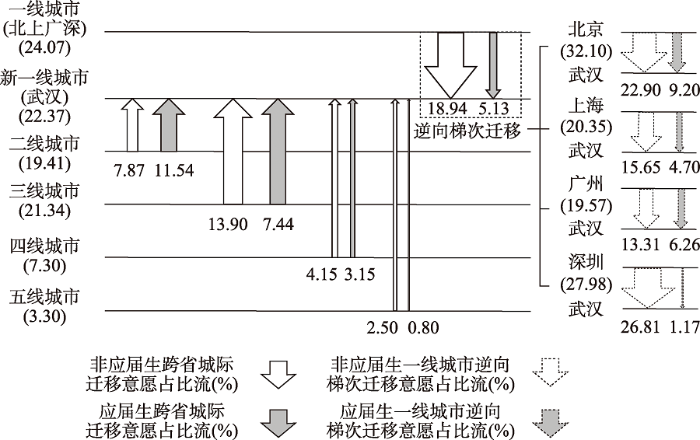
图1
高学历人才跨城市等级迁移(以武汉为目的地)
注:①跨省城际迁移意愿占比流(100%)=逆向梯次迁移(24.07%)+新一线城市内部水平迁移(22.37%)+二、三、四、五线城市梯次迁移(19.41%+21.34%+7.30%+3.30%)+海外归国人才迁移(2.21%);②一线城市逆向梯次迁移意愿占比流(100%)=北京(32.10%)+上海(20.35%)+广州(19.57%)+深圳(27.98%)逆向梯次迁移至武汉;③由于海外归国人才占跨省城际迁移群体比例较低(2.21%),图中未显示。
Fig. 1
Migration of highly educated population up and down the urban hierarchy (with Wuhan as the destination)
4.2 高学历人才“城-城”逆向梯次迁移的影响因素
构建二元Logistic回归模型评估多因素对是否逆向梯次迁移的影响,结果见表4,-2似然对数值为1973.966,卡方值为369.326(p=0.000<0.05),表明模型至少有一个自变量与因变量显著相关,模型整体显著。模型预测准确率为78.1%,拟合效果良好。
粘性因素中,户籍地在湖北(B=0.735, p=0.000<0.01)与就学地在湖北(B=1.698, p=0.000<0.01)均展现出对高学历人才逆向梯次迁移意愿的正向影响,且在0.1%的水平上显著。户籍地在湖北的高学历人才产生逆向梯次迁移意愿的概率是户籍地非湖北高学历人才的2.085倍((OR)=2.085>1);曾就学于湖北的高学历人才逆向梯次迁移意愿显著升高,是就学地非湖北的5.465倍((OR)=5.465>1),显示出户籍地粘性与就学地粘性对逆向梯次迁移的关键性影响。湖北籍或在湖北就学群体之所以有更强的意愿逆向迁移,关键在于“乡缘”及“学缘”带来的地方粘性。在传统社会网络中,个体通常依靠“乡缘”取得社会资本存量,获得更广的人际网络、更多的社会资源以及更强的地方归属,形成对地方的依赖。对于高学历人群,学缘扮演了类似乡缘的角色,使得毕业生能够通过学缘网络增加自身的社会资本,从而对就学地产生依赖,由此形成户籍地粘性和就学地粘性,对择业迁移选择产生重大影响。
表4 高学历人才城-城逆向梯次迁移的二元Logistic模型结果(N=511)
Tab. 4
| 变量(参照组) | B | S.E. | Wald | Sig. | Exp(B) |
|---|---|---|---|---|---|
| 户籍地在湖北 | 0.735 | 0.135 | 29.755 | 0.000*** | 2.085 |
| 就学地在湖北 | 1.698 | 0.123 | 189.918 | 0.000*** | 5.465 |
| 性别 | -0.136 | 0.191 | 0.511 | 0.475 | 0.872 |
| 年龄 | -0.046 | 0.023 | 4.098 | 0.043** | 0.955 |
| 毕业学校级别(非双一流) | |||||
| 双一流学校 | 0.555 | 0.183 | 9.215 | 0.002*** | 1.741 |
| 国外高校 | -0.626 | 0.440 | 2.022 | 0.155 | 0.535 |
| 学历级别(本科以下) | |||||
| 本科 | -0.706 | 0.413 | 2.926 | 0.087* | 0.494 |
| 研究生及以上 | -0.154 | 0.415 | 0.138 | 0.711 | 0.857 |
| 非师范生 | -0.178 | 0.137 | 1.693 | 0.193 | 0.837 |
| 户籍地所在城市级别(低于武汉) | |||||
| 与武汉同级 | 0.212 | 0.122 | 3.031 | 0.082* | 1.236 |
| 高于武汉 | 3.617 | 0.510 | 50.300 | 0.000*** | 37.239 |
| 常量 | -0.691 | 0.783 | 0.780 | 0.377 | 0.501 |
| -2倍对数似然值 | 1973.966 | ||||
| 卡方 | 369.326*** | ||||
| 准确率(%) | 78.100 | ||||
注:*、**、***分别代表p<0.1、p<0.05、p<0.01;B为回归系数;Exp(B)为发生比。
个体因素中,年龄、学校级别、学历等级对高学历人才逆向梯次迁移具有一定影响。年龄越大(B=-0.046, p=0.043<0.05,(OR)=0.955<1),逆向梯次迁移的概率越低。这与正规就业普遍对应聘者有年龄限制(30或35周岁以下)有关,且相较于年长者,年轻人逆向梯次迁移的成本(经济成本、心理成本、情感成本等)更低。学校级别方面,双一流学校毕业的高学历人才逆向梯次迁移概率是非双一流学校的1.741倍(B=0.555, p=0.002<0.1,(OR)=1.741>1)。这与已有研究结论,一流大学毕业生更倾向于选择继续流动而较少选择返回流动[5]存在差异。可能的原因是,双一流学校毕业生对正规就业更加青睐,同时也拥有更高的人力和社会资本,对于职业变动、社会环境变化等逆向梯次迁移风险的承受力更强。此外,学历等级越高,获得高级专业技能职位的机会越多,逆向梯次迁移概率越低。“性别”与“是否师范生”未通过二元Logistic回归的显著性检验,进一步讨论不具有代表性。
城市因素中,户籍所在城市等级对高学历人才的逆向迁移选择具有显著正向影响。原户籍所在城市级别较低的样本逆向迁移概率较低,符合全国高学历人才整体向上迁移的大趋势。持有一线城市户口样本(B=3.617, p=0.000<0.1,(OR)=37.239>1)及持有新一线城市户口样本(B=0.212,p=0.082<0.1,(OR)=1.236)的逆向迁移概率较高,一个合理的推测是,持有高等级城市户口的群体在择业时更不容易被户籍限制。需要指出,由于本例中户籍地为一线城市的样本较少,结论需要后续研究进一步验证。
已有研究发现部分高校青年知识移民从就学地(一线城市和新一线城市)向下流动至低等级城市的现象[53],但并未深入探讨其机制。本文揭示了高学历人才择业阶段的逆向梯次迁移是粘性因素、个体因素和城市因素相互作用的结果,验证了“户籍地粘性”和“就学地粘性”是人才选择向下流动的重要动力。
4.3 户籍地与就学地的粘滞效应
本例中户籍地与就学地的粘滞效应可概括为:首先,中小学教师岗作为正规就业,其提供的经济保障、社会保障及社会关系能够满足城镇化人口的生活需求。武汉较多的正规就业机会、较低竞争压力和生活成本强化了城市对本地人才的粘性,使高学历人才做出能够更快实现人力资本投资价值的就业选择。其次,“链式迁移”是中国最普遍的迁移现象,关系到个体迁移切身利益的选择仍更多地依靠亲属和朋友[54],户籍地产生的情感联系和地方依恋,就学地积累的人力和社会资本,均构成高学历人才获得信息的主要社会关系网络。第三,个体在户籍地和就学地长期的生活经历,增强了特定城市的情感粘性(过往生活经历所导致的情感依赖程度)和制度粘性(户籍、社会保障等制度的接纳、认可程度)[55],教师作为有高工作归属感和认可度的职业,具有较强的职业粘性。综合情感、制度和职业粘性等多因素作用导致就学地粘性和户籍地粘性打破了一线城市对高学历人才的“锁定”效应,产生逆向梯次迁移行为。需要指出,户籍地或就学地粘性主要来源于距离户籍地或就学地最近的大城市或区域中心城市,因此武汉成为户籍地或就学地在湖北的高学历人才逆向梯次迁移的首要选择。
Amin等[56]认为人口迁移在时间和空间上比大多数形式的流动更具“粘性”,原因在于个人发展社会网络的时间,学习新技能和获得金融资本的过程,以及这些因素构成的特定社会关系强化了该粘性[28]。已有研究证实,经济优势使得一线城市在个体择校迁移和初次择业迁移中均具有更强的空间粘性[39,27,44]。然而,地区粘性是相互作用的复杂系统,在对人才产生“锁定”效应的同时,粘性的强度差异也引起了人才在空间上的流动、集聚或分散。与已有的研究相比,本文发现“乡缘”及“学缘”粘附对高学历群体择业阶段从高等级城市向下迁移产生了关键作用,出生或就学在较低等级城市的经历会对个体产生反向粘滞,强化其逆向迁移意愿。该粘滞效应不仅发生在初次就业也发生在后续择业过程,既可以是人才“不流动”的粘滞力,也可以是人才“流动”的引力。
5 结论与讨论
本文以武汉市中小学教师岗驱动的高学历人才迁移为例,聚焦个体视角,揭示了城际人口逆向梯次迁移的新趋势,运用粘性理论探讨正规就业下高学历人才城-城逆向梯次迁移的机制,主要结论如下:
(1)正规就业驱动下,高学历人才城-城逆向梯次迁移已成为重要的择业迁移选择之一。数量特征上,近1/4的跨省城际迁移样本表现出逆向梯次迁移意愿。其中,非应届生占比高于应届生。空间特征上,一线城市逆向梯次迁移的高学历人才比例由大到小依次为北京、深圳、上海、广州;北京的应届生占比最高,深圳的非应届生占比最高。
(2)高学历人才的逆向梯次迁移行为受多方面因素影响,户籍地粘性和就学地粘性起到关键性作用。二元Logistic回归模型结果发现,粘性因素(户籍地或就学地在湖北)对是否逆向梯次迁移的影响明显,户籍地城市级别与个体因素中的年龄、毕业学校级别、学历级别也有一定影响,年轻、毕业于双一流学校的高学历人才选择逆向梯次迁移的概率更高。
(3)在西方,宗教、种族、家庭和个人价值是影响移民回国、回乡等回返迁移的主要粘性因素。在中国,新一线城市的发展优势逐步显现,强化了对本地高学历人才的粘滞效应;链式迁移模式下,户籍地粘性和就学地粘性不仅能够“锁定”高学历人才,城市间粘性强度的差异也导致了高学历人才跨城市等级的梯次或逆向梯次迁移;就个体而言,情感粘性、制度粘性和职业粘性等多因素相互影响,使户籍地粘性和就学地粘性深刻影响高学历人才择业迁移的选择,引起了城际逆向梯次迁移现象。
高学历人口的逆向梯次迁移是中国城镇化进入新阶段的新现象,对该现象的认知能够帮助理解转型期中国人口迁移的新特点、新动能。本文研究结论具有以下两点启示:第一,高学历人才的逆向梯次迁移是全国人口迁移模式的重要变化,亟需研究关注。当前,一线城市的“挤出效应”已经引发部分高学历群体的主动撤离,打破了传统“向上”的梯次流动格局。虽然高学历群体的逆向流动类似于传统的农民工返乡回流,但两者在动力机制上存在根本差别,或对中国城镇化进程产生深远影响。长期来看,逆向梯次迁移人口的规模是否会持续扩大,会对当前人才空间格局产生怎样影响,都是需要探讨的科学问题。第二,面对高学历人才迁移模式的变化,需要基于城市发展目标重新审视地方人才政策。对于一线城市,需要判断人才的逆向迁移是否意味着本地承载力达到饱和,进一步明确地方亟需的人才类型,检讨人才落户政策。对于新一线及其他城市,需要重视乡缘、学缘对人才迁移的粘附,发挥城市粘性的引智效应;比如支持校友会、同乡会发展,建立本地用人单位、人才、高校、政府间的常态化联络机制,强化学缘、乡缘对高层次人才的粘性。
虽然尚未对逆向梯次迁移现象做长期观察,但随着就业压力的持续增大,沿城市等级向下的人口迁移趋势很可能会继续。后续研究可以关注以下几个方面:① 探究转型期跨多个城市等级的向下迁移是否普遍存在,呈现出怎样的空间特征;② 基于更多地区、更一般化的个体迁移数据探讨高学历群体的逆向梯次迁移决策机制,也可考察不同学历群体的逆向梯次迁移选择,展开比较研究,增加对人口向下迁移的深层次认知;③ 进一步聚焦个体的连续有向迁移,将原户籍地作为分析起点,考察全生命周期的迁徙轨迹,探索更一般性的人口流动规律。
致谢
衷心感谢匿名评审专家在论文评审中所付出的时间和精力,评审专家对本文概念界定、理论框架完善、研究模型选取、结论梳理等方面的修改意见,使本文获益匪浅。
参考文献
城镇化中后期中国人口迁移流动形式的转变及政策应对
DOI:10.18306/dlkxjz.2020.12.008
[本文引用: 1]

人口迁移流动形式是构成人口迁移流动特征的一个关键要素。在中国进入人口城镇化中后期后,准确判断和把握人口迁移流动形式的转变是一项十分重要的工作。论文基于人口迁移流动形式转变的相关理论与国际经验,考察现阶段中国人口迁移流动形式转变的进程和特点及由此产生的问题与挑战。研究发现,中国人口迁移流动形式已发生转变,并突出表现为人口回流现象不断增多、省际和省内人口迁移流动此消彼长的趋势日益明显;城—城流动显著增加,人口的城-城间流动将渐成常态化;流动人口户籍城镇化进程开始加快,其城乡两栖生计的重心向城镇转移;住房驱动下的流动人口就地、异地城镇化渐成趋势等。同时,人口迁移流动形式转变过程中面临着人口回流推动的就近就地城镇化发展可持续性不足;城—城流动向东部少数省市聚集的态势明显;以户籍城镇化主导的农业流动人口市民化面临多重障碍等问题与挑战。最后,从流动人口城镇化的空间载体构建、城市治理方式转变、中西部小城镇自我可持续发展能力提升等方面提出相应的建议。
Changes in the form of population migration and mobility in China and corresponding policy responses at the late-intermediate stage of urbanization
The form of population migration and mobility constitutes a key element of the characteristics of migration. Since China has entered the late-intermediate stage of urbanization, it is very important to accurately identify and understand the transformation in the form of population migration and mobility. While a growing body of literature has been generated and significant progress has been made on China's population migration and mobility and its determinants, an important inadequacy of relevant research are often focused on rural to urban population migration and mobility, neglecting the multi-dimensional forms of population migration and mobility. Based on relevant theories and international experience relating to the transformation in the forms of population migration and mobility, and using data from the China Migrants Dynamic Survey (CMDS), Report on Monitoring and Investigation of Migrant Workers in China, and relevant statistics, this study examined the processes of the transformation in the forms of the population migration and mobility in China and their characteristics at the present stage and the issues and challenges arising therefrom. The results show that there have been significant changes in the forms of population migration and mobility in China, and such changes mainly manifest in the following aspects: First, there has been a steady increase in return migration and short-distance migration; Second, inter-urban migration has also significantly increased and become increasingly common; Third, the urbanization process of the floating population based on the rural-urban transfer of their hukou has started to accelerate, and their rural-urban multiple livelihoods has increasingly shifted towards the urban end; Fourth, there has been a developing trend of urbanization driven by housing purchases in both migrants' places of origin and destination. The study also identified issues and challenges in the process of transformation in the forms of population migration and mobility, including: First, there is a lack of sustainability in in situ urbanization promoted by return migration; Second, urban-urban migration are highly concentrated in a few provinces of the eastern region; Third, there are still many obstacles for the urbanization of rural migrants based on their hukou transfer. Finally, the article puts forward some policy recommendations from the perspectives of the construction of multi-level spatial system of urbanization of the floating population, the transformation of urban governance mode, and the promotion of the capacity for sustainable development of small towns in central and western regions.
中国人口流动与城镇化新动向的考察: 基于第七次人口普查公布数据的初步解读
New trends in migration and urbanization in China: A preliminary investigation based on the seventh census data
四类流动人口的比较研究
A comparative study on four types of floating population
长三角城市圈的就业迁移和人力资本差别效应
The employment migration and the differential effect of manpower capital in the Yangtze Metropolitan Delta
人力资本的空间迁移模式与影响因素分析: 以南京市高校毕业生为例
DOI:10.13249/j.cnki.sgs.2021.06.005
[本文引用: 4]
知识经济时代人才是决定区域经济竞争力的重要资源,各地政府发起的人才争夺战日益白热化,中央政府也一再强调应当引导合理、公正、畅通、有序的人才社会性流动。基于南京市高校《毕业生就业质量报告》和一手问卷调查数据,进行毕业生择校迁移与择业迁移模式并采用多项逻辑斯蒂回归模型探究其影响因素研究。研究表明:① 南京市高校毕业生中近84%来自东部和中部地区,而择业迁移进一步向东集聚。② 毕业生整体迁移路径呈“东西非对称U型”格局,长三角城市群构成毕业生流动的核心区域;就业地经济发展水平明显高于生源地且往往与生源地邻近。③ 个体的教育背景、家庭和社会网络和对就业机会的评估都会显著影响毕业生的流动类型选择。
Migration pattern of human capital and its influential factors: A case study of university graduates in Nanjing City
In the era of knowledge economy, talent are acknowledged as a key driver for innovation, and thereby determine the vitality and competitiveness of regional economy. The competition of attracting talent initiated by some second-tier cities is increasingly heating up. The central government has repeatedly stressed the importance of reasonable, fair, smooth and orderly mobility of talent to facilitate economic transformation. Against this background, based on the “Graduate Employment Quality Report” and first-hand questionnaire survey data of university graduates from Nanjing, this study adopted chord diagram and map visualization to depict the previous and subsequent migration patterns of university graduates. Furthermore, multinominal logistic regressions were employed to explore the factors underlying graduates’ migration choice. The results show that the the number of people flowing into Nanjing for higher education decreases with the increase in distance. Nearly 84% of the graduates originally come from the eastern and central regions. After graduation, their subsequent migration shows further concentration to the east. Using a measurement of regional circulation, the overall migration path of graduates presents an “east-west asymmetric U-shaped” pattern, with the Yangtze River Delta region constituting the core area for graduates to flow to. The economic development level of the destination of graduates’ subsequent migration is obviously higher than that of their domicile, and the destination is often in close proximity to their domicile. At the individual level, the rank of the university, discipline, social netweok, and graduates’ evaluation on job opportunities all have significant influence on graduates’ migration decisions.
北上广还是二线? 大学毕业生就业区域流向分析
Guangzhou or the second- tier cities? Analysis on the regional flow of university graduates' employment
大学生就业地域选择的影响因素分析: 基于扩展的托达罗人口流动模型
The analysis on influencing factors of colleges graduates′ choices among job locations
高校毕业生城际流动的特征分析
An empirical study on inter-city migration of university graduates in China
中国高学历人才的空间演化特征及驱动因素
DOI:10.11821/dlxb202102006
[本文引用: 4]
人才是推动地区创新发展的核心动力,也是未来城市竞争的关键。基于第六次全国人口普查和2015年全国1%人口抽样调查数据,运用集聚度、基尼系数等空间统计分析以及负二项回归模型方法,对2010—2015年中国城市高学历人才的空间演化特征及驱动因素展开研究。结果发现:① 人才呈现出高度集中且不平衡的空间分布格局,但不平衡的趋势有所缓解,分布方向为“东北—西南”走向。人才分布的空间溢出效应显著,城市群是人才集聚的高地。② 经济机会是影响中国高学历人才集聚的主导力量,其中工资是核心驱动因素,地区的发展水平、产业结构同样产生显著影响。③ 控制经济机会的影响后,以教育和医疗等基础公共服务、交通可达性和城市消费设施为核心的地方品质变量在高学历人才的空间集聚过程中发挥重要作用。④ 城市群与非城市群人才驱动因素存在显著差异:经济机会是城市群和非城市群人才集聚的主要驱动力;教育、消费、交通以及自然环境等地方品质变量对城市群人才集聚的影响更为显著。本研究为城市和区域人才政策和区域发展政策的制定提供借鉴与参考。
Spatial evolution characteristics and driving forces of Chinese highly educated talents
Talents are the core driving force for regional innovation and development, and they are also the key to urban competition in the future. Based on the data of the sixth population census and the national 1% population sampling survey in 2015, this paper uses the concentration index (CI), Gini index (GI) and several related spatial analysis methods to examine the spatial patterns of highly educated talents across China and the drivers behind these patterns from 2010 to 2015. The results are as follows: (1) Talents show highly concentrated and unbalanced spatial distribution patterns at the city level over the five years, but the trend of concentration and imbalance has gradually eased. Results from standard deviation ellipse (SDE) indicate that the distribution direction of highly educated people is "NE-SW". Furthermore, there is a significant spatial spillover effect in the distribution of talents, with three major urban agglomerations of China as the highlands. (2) Economic opportunities are the dominant drivers for the distribution of highly educated talents in China. Among them, wages are the core driver, and gross GDP and industrial structure of each city also exert a significant impact. (3) After controlling the impacts of economic opportunities, local quality variables represented by basic public services (e.g., education and medical care), transportation accessibility and urban consumption facilities play an important role in the distribution of highly educated talents. (4) There are significant differences between the driving factors for talents in urban agglomerations and non-urban agglomerations: economic opportunities are the main driving force for the distribution of talents in both urban agglomerations and non-urban agglomerations, while local qualities including education, consumption, transportation and natural environment have a more significant impact on the distribution of talents in urban agglomerations. This study provides references for the formulation of urban and regional talent policies and regional development policies.
人才流动的空间特征、驱动因素及其对长三角一体化高质量发展的启示: 基于高校毕业生的分析
Spatial patterns and underlying forces of talent migration and their implications on integrated high-quality development of the Yangtze River Delta: An analysis of university graduates
2000-2015年中国高学历人才分布格局及其影响机制
DOI:10.13249/j.cnki.sgs.2020.11.007
[本文引用: 2]
基于2000年、2010年中国人口普查分地级及以上行政区数据和2015年中国各省份1%人口抽样调查数据,采用变异系数、泰尔系数、基尼系数测度中国高学历人才比重分布的空间不均衡程度,并采用面板数据Tobit随机效应模型,识别影响高学历人才比重空间分布的主要因素。结果表明:① 中国的人才比重分布表现出极大的不均衡性,人才比重的高低与城市等级密切相关,主要表现在直辖市、省会城市、计划单列市等行政区吸引了大量人才,而普通地级城市人才比重相对较低;② 10 a间人才比重的变异系数、基尼指数和泰尔指数均有所下降,表明人才比重分布的空间不均衡程度有所下降;③ 平均工资水平、生活成本、城市等级、每万人高校在校学生数、每万人医院卫生院床位数、人均科学事业、教育事业经费与人才比重呈正相关,中学生师比、万人互联网用户数与人才比重呈负相关,失业率、单位面积二氧化硫排放量、绿地率对人才比重没有影响。
Spatial pattern and determinants of highly educated talents in China, 2000-2015
Based on the data from the 2000 and 2010 China censuses by prefecture level and above, and the 2015 1% population sample survey data of Chinese provinces, this article studies the spatial pattern evolution of the distribution of highly educated talents and its influence mechanism in China. The coefficient of variation, Theil coefficient and Gini coefficient are used to measure the spatial imbalance of the highly educated talents proportion. The panel data Tobit model is used to identify the main factors affecting the spatial distribution of the proportion of the highly educated talents. The results show that: 1) The distribution of the highly educated talents proportion in China shows a great imbalance, closely related to the city level, which is highlighted in administrative regions such as municipality, provincial capitals, and city specifically designated in the state plan, to which a large number of talents are attracted, while the talents proportion in ordinary prefecture-level cities is relatively low; 2) In the past 15 years, the coefficient of variation, Gini coefficient and Theil coefficient of the talents proportion have all declined, indicating that the spatial imbalance of the talents proportion has decreased; 3) Average wage level, cost of living, city hierarchy, students enrollment of regular institutions of higher education per 10 000 people, the number of hospital beds per 10 000 people, expenditure for education per capita, expenditure for science and technology per capita are positively correlated with talents proportion; The ratio of middle school students to teachers and the number of internet users per 10 000 people are negatively correlated with talents proportion; Unemployment rate, green rate, sulfur dioxide emissions per unit area have no significant impact on the talents proportion.
The laws of migration
DOI:10.2307/2979181 URL [本文引用: 1]
Step-eise migration: Toward a clarification of the mechanism
Migration up and down the urban hierarchy and across the life course
The california cauldron: Immigration and the fortunes of local communities
The hypothesis of mobility transition
DOI:10.2307/213996 URL [本文引用: 1]
国内人口迁移流动的演变趋势: 国际经验及其对中国的启示
文章从人口迁移流动的不同形式及其演变趋势、中国国内人口迁移整体强度的国际对比、人口迁移流动的微观生命过程、以及人口循环流动的发生发展机制和近期演变等4个方面回顾了国际上对人口迁移流动演变趋势及其机制的相关研究,并根据从中获得的借鉴和启示对中国人口迁移流动的未来走势做出判断,认为目前我国人口在区域和乡城间迁移流动的减缓更多预示的是人口迁移流动形式的改变,而不是其整体规模和强度的下降,后者还有着相当大的上升空间;今后仍不可忽视针对迁移流动人口的各种公共服务的转移、接续问题,并要根据人口迁移流动形式的变化,尤其是人口在城市间和城市内部迁移流动上升的新形势,与时俱进地改进流动人口的管理和服务工作。
Trends in internal migration and mobility: International experiences and their implications for China
This article reviews international literature on the changing trends of population migration and mobility and their mechanisms from the following perspectives: the changing trends of different forms of population mobility,the international comparison of the overall intensity of China’s internal mi- gration,the micro life course of population migration and mobility,and the mechanism and recent evolution of circular migration.The authors derive the following views on the future trends of China’s population migration and mobility from the above review and its implications: First,the recent decreasing trends of regional and rural-urban migration in China indicate changes in the forms of China’s population mobility rather than a real decline of its overall volume and intensity,which will still be on the rise; Second,great attention still needs to be paid to the portable issues of various public services provided to the floating population; and third,the management of and services to the floating population need to be improved in accordance with the changes in the forms of population mobility,especially the rise of urban to urban and intra-urban migration and mobility.
Moving down the urban hierarchy: Turning point of China's internal migration caused by age structure and hukou system
中国流动人口的跨等级流动及其对流入城市住房选择的影响
DOI:10.11821/dlxb202202009
[本文引用: 2]
妥善解决流动人口在流入城市的住房问题是实现流动人口市民化和提高新型城镇化发展质量的关键。本文基于2017年全国流动人口动态监测调查数据,揭示了流动人口的跨等级流动格局,并探讨了跨等级流动对流动人口在流入城市住房选择的影响。研究发现:① 流动人口以跨等级向上流动为主,其中向上跨三级、两级流动的比例较大;② 不同流出地的流动人口在流入城市的住房选择存在显著差异,流出城市的人均GDP和平均房价越高,流动人口在流入城市获得住房产权的概率越大;③ 流入城市的平均房价越高,流动人口获得商品房的概率越低,随着流入城市人均GDP的增加,流动人口购买商品房的概率先增后降,而购买不完全产权房的概率则恰恰相反;④ 随着流动人口跨越城市等级的增加,其获得住房产权的概率降低,而租赁正规住房的可能性增大。研究结果有助于深化理解流动人口在流入城市住房选择的地理根源,对进一步优化面向流动人口的住房政策具有参考意义。
Hierarchical migration patterns of China's floating population and their impact on the housing choices
Access to homeownership profoundly affects floating population's social integration in the destination city and, in the long term, wealth accumulation. While housing differentiation within China's floating population has received increasing attention in the past two decades, the varied housing outcomes of the floating population experiencing different geographic mobility have been rarely investigated. Using data from the 2017 China Migrants Dynamic Survey, this study employs logistic regression models to examine the association between migrants' hierarchical migration patterns and their housing outcomes in the destination city. The results show that the migration patterns of China's floating population are mostly featured by moving up along the urban hierarchy. There are significant disparities in housing outcomes among floating population with different origins and destinations. Migrants originating from cities with higher gross domestic product (GDP) per capita and average housing prices are more capable to afford a home in the destination city. Moving to cities with higher average housing prices implies fewer opportunities to purchase local commodity housing. As GDP per capita in destination cities increases, the probability of floating population purchasing commercial housing increases first but then decreases, while the probability of purchasing housing with incomplete property rights exhibits the opposite phenomenon. Furthermore, migrants making larger upward movements are less likely to own a home in the destination city, but more likely to rent formal housing. This study highlights the role of geographical mobility between different origins and destinations in affecting floating population's housing outcomes in the destination city and furthermore provides insight into understanding housing inequality.
中国城城流动人口的空间分布、流动规律及其形成机制
DOI:10.11821/dlyj020180280
[本文引用: 1]
在人口城城流动日益成为中国人口流动的重要形式背景下,基于人口普查数据和流动人口动态监测数据,分别探讨城城流动人口空间流动的结果、过程和成因,也就是探讨城城流动人口的空间分布、流动轨迹及形成机制。研究表明:城城流动人口倾向于向发达地区和大城市流动,同时在流动过程中会考虑空间的邻近;地区间经济发展水平、就业机会以及高水平教育医疗设施的差距是诱发城城人口流动的内在动力,而在实际的流动过程中会综合考虑由于空间摩擦而产生的金钱成本、心理压力等障碍;同时,已有城城流动人口存量会通过减少适应流入地的成本、提供相应的生活和就业信息等方式降低流动成本,刺激城城流动人口按照已有路径流动。借鉴西方发达国家人口流动的阶段划分,认为中国人口流动仍然处于从小城镇进入大城市的阶段。在这一时间节点上,依据人口流动的自然规律,鼓励人口向大城市流动,并通过发展副中心和卫星城等形式疏散中心区功能,推动城市郊区化发展才符合城市发展的自然逻辑。
Spatial distribution, flowing rules and forming mechanism of inter-cities floating population in China
The population flow between cities not only reflects the choice of the urban population who voted with their feet based on different development levels of urban economy, society, and public services, but also exerts a direct bearing on the success of rational and orderly movement of population, coordinated development of large, medium and small cities and the new-type urbanization strategies. Therefore, it is of practical significance to explore the spatial flowing laws and driving mechanism of urban-to-urban population flows in China for realizing rational and orderly distribution of population and the new-type urbanization strategy. In the context of the increasing amounts of urban-to-urban floating population in China, this paper discusses the results, processes, and causes of the spatial mobility of floating population in urban areas based on data of population census and dynamic monitoring of floating population. In addition, it studies the spatial distribution, flow trajectory and forming mechanism of urban-to-urban floating population. This paper uses Arcgis to visualize the spatial distribution and main flow trajectories of inter-cities floating population, then uses regression equations to analyze the main factors driving population movement between cities. The results of this paper indicate that the urban-to-urban floating population tends to flow to developed regions and metropolises, during the process of which the proximity of destination is considered; gaps among regions in terms of economic development, employment opportunities, and high levels of education and medical facilities are the internal impetus to the flow of urban-to-urban floating population, while comprehensive consideration will be given to obstacles such as money costs and psychological pressure generated by space friction; at the same time, the existing urban-to-urban floating population will reduce the flow costs, and stimulate the flow of urban-to-urban floating population according to existing routes by reducing the cost of inflows, and providing living and employment information. According to the stage division of population flow in the developed countries, it is discovered that the population movement in China is still transforming from the stage where people move from small cities and towns to metropolises. At this time point, the government should encourage the flow of population to large cities according to the natural law of population movement, decentralize the functions of the central area through the development of sub-centers and satellite cities, and promote the development of urban suburbanization, which are in line with the natural logic of urban development.
The urban hierarchy and domestic migration. the interaction of internal migration, disposable income and the cost of living, Sweden 1993-2002
中国人口流动与城镇化进程的回顾与展望
Review and prospect of China's population migration and urbanization
Prospect theory and the decision to move or stay
中国流动人口梯次流动的实证研究
An empirical study on the laddering migration of china's floating population
Ties that no longer bind? The patterns and repercussions of age-articulated migration
中国人才流动的地域模式及空间分布格局研究
DOI:10.13249/j.cnki.sgs.2018.12.005
[本文引用: 4]
依据教育部直属高校2015届本科毕业生生源与就业数据,采用指标评价与冷热点分析方法,分析升读大学与本科就业两个流动阶段的人才流动地域模式及省域空间分布格局。研究表明:① 人才流动具有明显的本地空间粘滞性特征,地域模式包括“本地-跃迁”型、“本地-半依附”型和“本地-依附”型。② 省际层面形成沿东南沿海与长江沿岸分布的“弓形”格局,显示了优势区域的整体粘滞性对人才高地形成的意义。研究指出,把握关键节点、依托城市群来发挥粘滞作用有助于城市推进引智工作。
Spatial pattern and the resulting characteristics of talent flows in China
By looking into the enrollment and employment data of graduates from universities directly administered by China Ministry of Education and with the method of index evaluation and hot-cold spot analysis, this article analyzed the graduates’ regional flowing patterns of two flowing stages of enrolled in the university and employed after graduation, and the resulting spatial distribution at the provincial level. The study found that the flow of talent from the university to study in different stages, can more clearly reveal the characteristics of the geographical space for talents. The local spatial viscosity in different regions dominates the flow of talent, and geopolitical and income factors in subsequent plays a role of regional adjustment. In the two stages, the flow of talent has significant spatial viscous characteristics. The geographical pattern of the flow includes “local-leapfrog” mode, “local-semi adherent” mode and “local-adherent” mode. Under the influence of different factors, the enrollment stage is dominated by “local-(semi) adherent” mode due to the adherence to the geo-social relations, while the employment stage is dominated by “local-leapfrog” type, which is adhered to the multiple possibilities of regional employment opportunities and benefits. From the perspective of the provincial pattern formed by talent flow, however, the spatial distribution of talents at the level of provincial level is more flat, while the phase of employment flow is more polarized in the longitudinal distribution. The “arch” pattern along the southeastern coast and the Yangtze River is characterized in both two stages, and the Yangtze River Delta region belongs to the hot spot of talent. However, because of the lack of provincial integration and linkage, the centralization of talent is not significant enough in the central and western regions, which highlight the important effect of the dominant area’s viscosity in the formation of the high ground of talent. It is suggested that different cities should bring into full play the role of local glutinosity to enhance the work of introducing university intelligence, from the two stages of talent generation and with the help of the strength of the urban agglomeration.
Moving People And Knowledge
Clio and the economics of QWERTY
Human stickiness as a counterforce to brain drain: Purpose-driven behaviour among Tanzanian medical doctors and implications for policy
The role of family and friends in return migration and its labor market outcomes
Some evidence that women are more mobile than men: Gender differences in U.K. graduate migration behavior
Regional migration to and from higher education institutions: Scale, determinants and outcomes
Here today, gone tomorrow? Regional labour mobility of German university graduates
Human capital, graduate migration and innovation in British regions
多维邻近性与城-城流动人口的流入地选择: 基于嵌套Logit模型的实证分析
DOI:10.13249/j.cnki.sgs.2021.07.011
[本文引用: 1]
基于2017年中国流动人口动态监测调查数据,采用嵌套Logit模型分析了地理、制度、信息和知识等多维邻近性对城-城流动人口流入地选择的影响。结果表明:城-城流动人口倾向于流入与户籍地地理相邻、制度相似、信息联系密切以及与自身知识水平相匹配的城市,这在一定程度上缓解人口向工资水平高、就业机会多和公共服务水平好的大城市集聚的趋势;不同维度的邻近性之间存在替代效应,省内流动能够降低距离对流入地选择的负面影响;多维邻近性的影响强度存在群体差异,女性对知识邻近性更加敏感;新生代流动人口对正式制度和信息邻近的城市有更强的偏好,但受知识邻近性的影响较弱;高学历群体更能远距离、跨省迁移并受到城市间互联网信息联系更强的影响;而有过流动经历的劳动力再流动时更能克服地理、文化和知识距离的限制。
How multi-proximity affects destination choice in urban-urban migration: An analysis based on nested logit model
As entering into middle-and-late-stage of urbanization, China’s rural-urban migrants has slowly declined after decades of growth while the amount of urban-urban migrants continues to increase. The migration flow among cities reflects the rational choice of the urban population and has a profound impact on the urban system and urban development. Therefore, it is of practical significance to explore the mechanism of urban-urban migration flows in China for realizing rational and orderly distribution of urban population. Focused on urban-urban migrants who differ from other types of migrants in several ways, this paper develops a framework of how multi-proximity, which includes geographical proximity, institutional proximity, informational proximity and knowledge proximity, makes an influence on destination choice by affecting the migration cost. Based on data from the 2017 China Migrant Population Dynamic Monitoring Survey, and by using the nested logit model, we empirically tested the proximity-migration relationship. The results show that multi-proximity has a significant and robust impact on migrants’ destination choice after controlling for the effects of cities’ characteristics. Urban-urban migrants prefer destinations that are geographically adjacent to their origins and those located in the same province and dialect area. Besides, they are more likely to choose cities which are closely connected with their origins and match them well in education background. Substitutional effect is also found between geographical and formal institutional proximity. But the effect of multi-proximity varies among sub-groups of intercity migrants. This is reflected in the following facts. First, women are more sensitive to knowledge proximity than men. Second, young migrants are less affected by knowledge proximity but relies more on informational and formal institutional proximity than the older. Third, highly educated labors are more able to migrate over a long distance and across provinces, and are affected more by internet information flow between cities than their counterparts. Finally, onward migrants can get over the barriers of geography, culture and knowledge better owing to their accumulation of experience in the previous migration experiences. Empirical results also verified the clear preference of labors for large cities with high wages, abundant job opportunities and adequate public services. But the preference can be relieved by the effect of multi-proximity. Empirical results of this study indicate that policy makers of small cities can strengthen local attraction to the surrounding areas through industrial development and public service improvement to avoid increasingly severe outflow of labors and maintain long-term competitiveness.
城市新生代流动人口的回流意愿与区位选择: 基于北京、深圳、成都和中山4个城市的实证
DOI:10.13284/j.cnki.rddl.003166
[本文引用: 1]
基于北京、深圳、成都和中山4个具有代表性的城市抽样调查监测数据,采用计量模型探讨了新生代流动人口的回流意愿与区位选择特征及影响因素。结果表明:1)新生代流动人口具有较强的回流意愿,且不同类型(智力型、投资型和劳力型)在回流意愿和区位选择上存在显著差异。2)其回流意愿受个体“客观属性”(人口学因素、经济因素)与“主观感知”(经济地位感知、社会心理感知)双重影响,特别是人口学因素和社会心理感知。3)就回流区位选择而言,人力资本是影响其回流至户籍地所在省会城市最显著的因素;主观感知中的城市社会适应、家庭“心理成本”和家乡生活方式认同与其选择回流至户籍地所在的地级市显著相关;客观属性中的人口学因素(性别和年龄)、在外务工时间主要影响其回流至户籍地所在的县(市、区)或乡镇;经济因素中的个人收入对各类回流地的选择均有显著的影响。不同回流区位的选择是综合“生存”与“发展”两方面需求的结果。建议未来精准施策,尤其要注意地级市的人口回流;在重视吸引人才的同时,要进一步关注流动人口的社会适应问题,完善公共服务设施尤其是医疗、养老、子女入学等,推进城镇化持续健康发展。
Profiles and mechanisms of return migration in post-reform urban China: A case study of four cities
“人才争夺战”背景下人才流动的空间特征及影响因素: 以中国“一流大学”毕业生为例
DOI:10.11821/dlyj020200437
[本文引用: 3]
自2017年以来,“人才争夺战”如火如荼,城市步入以人才为核心要素的高维竞争阶段。作为人才争夺战的主要目标和人力资本的重要承载者,本文聚焦中国“一流大学”毕业生,基于2018年《毕业生就业质量报告》,运用Cartogram地图呈现了毕业生的空间流动特征,并梳理政府人才政策文件构建了人才政策评价指标体系,运用有向迁移模型剖析毕业生流动的影响因素。结果表明:① 就学地存在粘滞性,但区域差异显著,毕业生向一线城市集聚。② 城市吸引力水平分异明显,部分城市通过发布人才政策以补充地方经济、舒适性吸引力的不足。③ 经济维度要素与城市舒适性均能有效吸引毕业生流入,较高房价收入比会引发“挤出效应”。人才政策中,落户政策对毕业生流入起激励作用。
Migration of human capital in the context of vying for talent competition: A case study of China's "first-class" university graduates
Human capital is the key driver of urban innovation and development. In 2017, the "vying for talent" competition was initiated by some second-tier cities, since then cities have been competing each other fiercely for recruiting and retaining talent. This paper focuses on China′s "first-class" university graduates, who are regarded as the main target of the "vying for talent" competition and an important carrier of human capital. Based on 2018 Graduate Employment Reports, this paper demonstrates the spatial mobility of graduates using Cartogram. In addition, an evaluation system for assessing talent policy is constructed through analyses of the talent policies issued by different cities. With a directional migration model, the determinants of graduate mobility are explored. The results reveal that there are significant regional disparities in retention rates, with the geographical patterns of the Y-shaped low-value areas in the northeastern, northwestern, and central regions, and the U-shaped high-value areas covering east coast to southwest. Graduates have been accumulating spatially, and the T-shaped cluster along east coast and the Yangtze River Economic Belt has formed. The spatial patterns of "neighborhood interaction" and "long-distance unidirectional flow" are presented between the city of university and the city of employment. Moreover, the differences in city attractiveness are remarkable. First-tier cities are preferred by graduates, even though limited talent policies have been implemented there. Some second-tier cities have issued talent policies to make up for the lack of attractiveness in economy and amenities. The findings suggest that economic factors, such as income level and technological innovation, as well as amenities including natural and cultural environment, educational resources, and public transportation are positively associated with the volume of graduates inflow. It has been found that a higher ratio of house price to income has squeezed out university graduates. With regard to talent policies, only relaxed hukou policy has a strong effect on attracting graduates, whereas the effects of housing and employment policies are relatively limited. However, it needs to be noted that talent policies may take a longer time to show effects, which requires follow-up investigation. In addition, heterogeneity at the individual level in terms of place of origin, major, etc. should be explored in the future studies.
我国大学生就业城市选择意愿及其影响因素分析
Employment location choice of Chinese college students and its determinants
高校毕业生就业流动现状的分析
An analysis of the current employment flow of college graduates
中国高技能劳动力与一般劳动力的空间分布格局及其影响因素
DOI:10.11821/dlyj020180391
[本文引用: 1]
基于2000和2010年全国人口普查分县数据和地级行政单元数据,采用不均衡指数和空间自相关分析等方法,刻画中国高技能劳动力和一般劳动力的空间分布格局及其变化,并采用空间滞后模型,识别高技能劳动力与一般劳动力空间分布的决定因素及其变化。结果表明:① 两类劳动力总体的空间特征均为东南密集,西北稀疏;② 2000—2010年,高技能劳动力在空间分布上呈集中化的趋势,而一般劳动力呈分散化的趋势;③ 十年间高技能劳动力集聚区虹吸作用加强,其分布越发集中于沿海特大城市群,而一般劳动力集聚区回波作用加强,其分布越发均衡;④ 空间回归分析结果表明,职工平均工资、是否直辖市或省会、每万人在校高校学生、是否沿海城市、常住人口数和空间溢出效应在十年中一直都是决定高技能劳动力和一般劳动力空间分布的主要因素,而失业率、中学生师比、二氧化硫排放量和绿地率在2010年也成为影响两类劳动力空间分布的主要因素。对比两类劳动力的模型结果可得,高技能劳动力的空间分布受行政因素、高校因素和地区生活舒适度的影响更大,而一般劳动力的空间分布受劳动力市场因素的影响更大。
The spatial pattern and determinants of skilled laborers and lessskilled laborers in China
城市(地区)环境对人才流动的影响分析
The analysis of the influence of the city (region) environment on the talent flow
区域差距、就业选择与人力资本流动: 基于高校毕业生的实证研究
Regional disparity, job choosing and human capital mobility: An empirical research of China graduates job survey
“人口回流”视角下的中部地区乡村振兴: 对湖北“毛嘴模式”的实证
DOI:10.13249/j.cnki.sgs.2020.01.014
[本文引用: 1]
采用质性研究方法,以中部地区湖北的“毛嘴模式”为例,围绕武汉汉正街与仙桃毛嘴镇的城乡联系问题,研究人口回流及返乡创业所带动的地方发展,解析其对乡村振兴的重要作用。研究发现:①劳动力回流受家庭需求、家乡发展环境等多重因素影响;资本回流的主要影响因素是雇佣“本地化”劳动力,也涉及城市更新及其“外部性”效应的间接影响;②技能型劳动力回流以及企业家在城-乡间的高频流动,有利于发挥流动人口的“桥梁”作用;③回流人口主要从事与之前就业相关的行业,倾向于在镇区或市区购买商品房,促进了乡村经济转型,同时利于社会资本的培育,重塑了乡村社会空间。
Return migration and rural revitalization in central China: A case of Maozui, Hubei Province
Urban to rural return migration is a new phenomenon which provides a new perspective to understand the transformation of rural-urban relations in China. In the last decades, the substantial increasing number of urban to rural return migrants has attracted wide concerns among policymakers, society and academia. However, little attention has been given to understand the process of return migration and their influences on local developments, especially from the perspective of origin place. Hanzhengjie, located in the central city of Wuhan, was a famous street with a long history of business and trading. After the Reform Era began in the late 1970s, it attracted a great deal of clothing industry workers and entrepreneurs from Maozui. Since 2011, with the government’s efforts to redevelop Hanzhengjie from ‘low-end’ to ‘high-end’, many small factories have been forced to move out. Maozui, a small town of Xiantao City, Hubei Province, seized the opportunity to receive the industry relocated from Hanzhengjie to achieve its local development. Followed by industrial relocation, many migrants returned to Maozui. In this context, based on a series of fieldwork conducted in Maozui and Hanzhengjie during 2018 and 2019, this article examines the different return process of rural labor force and capitals, and interrogates the important roles of return migration and returning entrepreneurial activities in relation to rural revitalization. The findings include: 1) The return migration is marked by a process of the ‘localization’ of rural labor force and capital. The return of labor force is motivated by multiple factors such as family reunion, local opportunities and both living environment. ‘Localized’ labor force becomes the main driving force of return capital. 2) The return skilled migrants and entrepreneurs who keep moving back and forth between city and rural areas aim to capture the new market opportunities. They act as a ‘bridge’ to transfer knowledge, capital and culture from urban to rural areas. 3) Most of the returnees work in industries related to their previous employment and prefer to buy commodity housing in the central town instead of their original village. It promotes the transformation of rural economy and reconstructs the rural social space. These results indicate that the dynamic role of return migrants in central China as agents of information transfer and entrepreneurship. Geographic research on urban-rural relations and rural revitalization should focus more on the complexity and dynamics of return migration and explore the interactive mechanism of return migration and the transformations or reconstruction of villages and towns.
长株潭城市群城乡人口流动特征及动力机制
Characteristics and mechanism of urban and rural population mobility in Chang-Zhu-Tan urban agglomeration
A microanalysis of contextual determinants of labour migration in Sri Lanka
中国城市流动人口户籍迁移意愿的空间格局及影响因素: 基于2012年全国流动人口动态监测调查数据
DOI:10.11821/dlxb201610003
[本文引用: 1]
基于2012年全国流动人口动态监测调查数据和相关统计年鉴数据,对中国地级以上城市流动人口的户籍迁移意愿、空间格局及影响因素进行了系统分析。研究发现,中国城市流动人口户籍迁移意愿的整体水平并不高;等级高、规模大的城市流动人口的户籍迁移意愿高,而等级低、规模小的城市流动人口的户籍迁移意愿低;沿海城市群流动人口的户籍迁移意愿高,其他城市流动人口的户籍迁移意愿低,但内陆部分省会城市和交通区位与资源禀赋较好的中小城市也已经形成了一批流动人口的户籍迁移意愿高值区。中国城市流动人口户籍迁移意愿的空间分布特征受到流入城市和流动人口自身双重力量的影响,流入城市因素的正向影响作用大于流动人口自身因素。其中,流入城市的社会、经济发展水平和流动人口在流入城市的社会融合程度是核心要素,对城市流动人口户籍迁移意愿的提升具有正向的促进作用,而流动人口过于集中在次级劳动力市场的就业特征和较高的家庭财富与收入对户籍迁移意愿的提升却具有显著的抑制作用。最后,提出了相关政策启示。
Spatial variation and its determinants of migrants' Hukou transfer intention of China's prefecture-and provincial-level cities: Evidence from the 2012 national migrant population dynamic monitoring survey
Based on data from the 2012 national migrant population dynamic monitoring survey and related statistics, this article examines the spatial pattern and its determinants of migrants' intention of hukou transfer of China's 276 prefecture- and provincial-level cities, using GIS spatial analysis and statistical modelling. The results show that the overall level of migrants' hukou transfer intention of the cities is not high, and varies significantly among different cities. The intention of migrants' hukou transfer increases as the administrative level and/or the size of their destination cities increase. Meanwhile, migrants' hukou transfer intention is generally higher in coastal mega-city regions than in other cities, but it is also relatively high in some provincial capital cities and small and medium-sized cities in some inland regions with good transport location and resource endowment. The spatial pattern of migrants' intention of hukou transfer is shaped jointly by both the characteristics of the destination cities and migrants themselves characteristics, with the former exerting more influence than the latter. High level of socioeconomic development and good location of the destination cities can effectively promote their migrants' intention of hukou transfer; however, their level of basic public services does not have the same effect. The degree of migrants' social integration in the destination cities also exerts positive effects on their hukou transfer intention. However, having medical insurance, the concentration in the secondary labor market and higher household income are negatively related to such intention; furthermore, the individual and family characteristics of migrants do not have a significant impact on it. Finally, on the basis of the above findings, we put forward some suggestions for relevant policy making.
2000-2015年中国高学历人才省际迁移的演化格局及影响机理
DOI:10.11821/dlyj020201191
[本文引用: 1]
经济快速增长和社会转型促使中国人才迁移的地理景观正涌现出一些新特征和新趋势。利用中国2005年、2010年和2015年千分之一人口抽样调查微观数据,揭示2000—2005年、2005—2010年和2010—2015年全国高学历人才省际迁移格局的演化趋势,选用零膨胀负二项回归模型解释高学历人才省际迁移格局的演化机理。结果发现:① 中国高学历人才跨省流动性呈先增后减的演化趋势,人才省际迁移规模的空间分布开始趋于均衡化。② 东部发达省市人才净流入活跃,中部、东北和河北等地区人才净迁出活跃,2010年后发达地区的人才高强度净流入及欠发达地区的人才高强度净流失问题均开始缓解。③ 高学历人才由中西部流动至东部地区的主要迁移模式比较稳定,但东部向中西部地区的高学历人才迁移规模持续上升。④ 从影响因素的演化趋势上看,全国人才省际迁移主要为经济驱动型,但收入在人才迁移决策中的重要性开始减弱,产业转型、购房成本、教育服务舒适性及气候舒适性对人才跨省流动性的影响开始增强。⑤ 全国人才跨省流动性的演化机制具有一定的阶段分异性,前期,城镇居民收入差距的扩大是人才跨省流动性升高的主要动因;之后人才跨省流动性的减弱主要受城镇居民收入差距的缩小、发达地区过高的购房成本及小学教育服务设施短缺等因素影响。
Evolution pattern and its driving forces of China's interprovincial migration of highly-educated talents from 2000 to 2015
The rapid economic growth and social transition in China brings about some new trends of skilled migration. Based on microdata of China's 2005, 2010 and 2015 one-thousandth population sample survey, this paper analyzes the evolution pattern of China's interprovincial migration of highly-educated labors in the periods of 2000-2005, 2005-2010 and 2010-2015, and employs zero inflation negative binomial regression models to explain the evolution mechanism of the interprovincial migration of highly-educated talents. Results show that: (1) the interprovincial mobility of China's highly-educated workers rose first and then declined from 2000 to 2015, and the spatial distribution of migration volume of highly-educated talents tended to be balanced. (2) The net inflow rate of highly-educated talents was high in the eastern developed provinces, while the net out-flow rates were high in the central region, northeastern region and Hebei Province; the high-intensity net inflow of highly-educated talents in developed areas as well as high-intensity net outflow in less-developed areas began to ease after 2010. (3) Highly-educated individuals mainly migrated from central and western regions to eastern coastal areas, while the sizes of highly-educated labors migrating from eastern regions to central and western regions continuously increased. (4) From the perspective of the evolution trend of influencing factors, China's interprovincial migration of highly-educated talents was mainly driven by economic factors, but the importance of income in the decision-making of skilled migration tended to weaken, and the impact of industrial transformation, housing price income ratio, education service facility, and climate on the interprovincial mobility of talents began to increase. (5) The evolution mechanism of the interprovincial mobility of highly-educated talents in China varied in development stages. In the early stage, the widening urban residents' income gap was the main driver for the increase of the interprovincial mobility of highly-educated talents. After that, the decrease of the interprovincial mobility of highly-educated talents was mainly affected by the narrowing urban residents' income gap, the high housing price income ratio and the shortage of primary education service facilities in developed areas.
正规就业下人口城镇化时间成本与迁徙路径研究: 以武汉为例
Study on the Population urbanization time and migration path under formal employment: Taking Wuhan as an example
正规与非正规: 就业模式对农民工工作贫困的影响: 来自八个城市的经验证据
Standard and non-standard: The influence of employment models on the in-work poverty of migrant workers: Empirical evidence from eight big cities
基于二元Logistic模型的贫困山区农村土地流转意愿影响因素研究: 源于河北省贫困山区县的调研样本
The influence factors of rural land circulation intention in poverty-stricken mountainous areas based on binary logistic model from the survey samples of 19 provincial-level poverty-stricken mountain counties in Hebei Province
青年知识移民就业城市选择及其影响因素: 以广州市高校大学生为例
DOI:10.13284/j.cnki.rddl.003458
[本文引用: 2]
随着城市知识经济转型,各个城市越来越重视对知识人才包括青年知识人才的吸引。以广州市高校大学生为例,采用定性和定量相结合的方法,从城市与个人的双重视角探讨高校青年知识移民就业城市选择的特点及其影响因素。研究发现:1)青年知识移民总体上倾向于选择其本科或研究生就读地所在的城市和比其户籍地与就读地更高等级的城市(如一线、新一线城市)就业,这反映了他们向上空间流动和社会流动的意愿与动机;2)他们的就业流动是城市因素和个人因素共同作用的结果,其影响因素主要包括城市经济、城市环境、城市政策与城市文化,以及青年知识移民来源地的户籍类型与户籍地的城市等级等;3)城市经济发展(工作机会)是吸引高校青年知识移民的最重要因素,但与此同时,生存舒适度(生活机会)在青年知识移民的就业流动过程中所起的作用愈发重要,城市环境建设需要关注公共文化设施、社会舒适程度、交通便利程度、卫生服务设施以及城市自然环境和居住环境等方面的问题。个人因素方面,高校青年知识移民来源地的户籍类型与户籍地的城市等级对其就业流动决策具有显著的影响作用。细致探究青年知识移民就业流动规律及其影响因素是新时期理解和建构基于中国语境的知识型人才流动理论的需要,也是人才政策制定与知识人才实现自身价值的关键。
Determinants of employment city selection of young intellectual migrants: A case study of Guangzhou university graduates
With the transformation of urban knowledge economy, cities pay more and more attention on efforts to attract knowledge talents, including young intellectuals. Taking college students in Guangzhou as an example, this research adopts a combination of qualitative and quantitative methods to explore the mobility of young intellectual migrants, and the characteristics and influencing factors of their employment city selection. The research has found the following. First, young intellectual migrants generally tend to choose cities where their undergraduate or postgraduate studies are located and cities with higher grades than their household registration and place of study (i.e., first-tier and new first-tier cities), which reflects their willingness and motivation for upward spatial and social mobility. Second, their employment mobility is a process of the interaction between urban and individual factors. Its influencing factors mainly include urban environment, economy, policy and culture, as well as the type of household registration and the city level of household registration, among others. Third, urban economy development (job opportunities) is the most important factor for attracting young intellectual migrants, along with employment opportunities, wage levels, and others. At the same time, amenities such as cultural facilities and educational institutions, as well as physical features such as climate and natural environment and other living comforts (living opportunities) play an increasingly important role in the employment mobility of young intellectual migrants. Therefore, urban environmental construction needs to pay attention to public cultural facilities, social comfort, transportation convenience, health service facilities, and urban natural and living environment. The urban policies of high-level cities are more attractive to young intellectual migrants, including talent introduction, housing subsidies and urban development policies. Fourth, in terms of personal factors, the type of household registration and the city level of the source of youth intellectual migration have significant impact on their employment mobility decisions. There are differences in the mobility costs between the different types and city level of household registration, which further affects their employment mobility behavior. A detailed exploration of the employment mobility law of young intellectual migrants and its influencing factors is necessary to understand and construct a knowledge-based talent mobility theory based on Chinese context in the new era. It is also the key to talent policy formulation and the realization of the value of knowledge talents.
我国人口迁移趋势及空间格局演变
文章从影响人口迁移的动力要素和迁移方式入手,从战略上把握我国不同地区未来人口迁移及空间格局的基本趋势,探索促进人口有序流动的各项政策。研究表明,2000~2020年我国每年从乡村迁入到城市的净常住人口数量将大体保持在1500万左右,并在链式迁移方式主导下,人口迁移的空间格局不会有太大的改变,仅出现一些微调,未来迁移人口还将主要集中在大都市区范围内。
Future trends and spatial patterns of migration in China
This paper discusses driving forces and types of migration in China,and forecasts migration trends and changes in spatial patterns of migration in the next 20 years.Finally the paper explores policy options that stimulate migration to occur orderly.Estimate of annual rural-urban migration during 2000-2020 is about 15 millions,and spatial patterns of future migration remain stable and changes will be small.The metropolitan areas will continue to be the major migration destinations.
大都市农民工的“城市黏性”及其影响因素分析
The "Urban Stickiness" of migrant workers in metropolis and its influencing factors


