刘爱利 , 涂琼华, 刘福承
LIU Aili, TU Qionghua, LIU Fucheng
通讯作者:
收稿日期: 2015-03-21
修回日期: 2015-06-9
网络出版日期: 2015-09-15
版权声明: 2015 《地理研究》编辑部 《地理研究》编辑部
基金资助:
作者简介:
作者简介:刘爱利(1981- ),博士,讲师,主要从事旅游地理与旅游声景研究。E-mail: beyondtour@163.com
展开
摘要
遗产地旅游开发中的商业化现象越来越普遍,成为遗产保护与旅游实践中亟待解决的关键问题。尤其是具有特殊文化意义的宗教型遗产地,其旅游开发的商业化既影响了遗产资源的保护与可持续发展,也对游客的旅游体验产生了消极影响。在对相关研究进行总结回顾的基础上,选取嵩山少林寺为典型案例,从商业化阶段、产业链形态、旅游景观变迁、旅游世俗化影响等方面,对商业化的演化过程进行刻画与解读;通过利益相关者的视角,对商业化的形成机制进行分析和总结。提出的旅游商业化演化过程和形成机制的研究视角,对客观认知中国宗教型遗产地的商业化开发状态,指导宗教型遗产地的可持续发展,具有重要的现实作用。
关键词:
Abstract
Commercialization has become a common phenomenon in the tourism development process of world heritage sites, which remains to be solved in heritage protection and tourism development in practice; especially for the religious cultural heritage sites with special cultural significance, the development of tourism commercialization not only affects the protection of heritage resources and sustainable development, but also brings negative impacts to tourists’ experience. In the theoretical research, the tourism commercialization of ancient towns and ancient villages have been paid special attention while other categories of destinations such as religious cultural heritage sites have aroused little concern. In the research content, the analysis of evolution process of tourism commercialization also lacks a comprehensive and systematic perspective. Based on the review of relevant researches of tourism commercialization, taking Shaolin Temple Scenic Area as a study case, this paper firstly analyzed the evolution of tourism commercialization of the religious heritage site from four perspectives: commercialization stages, cultivation and expansion of industrial chains, tourism landscape transformation and impacts brought by religion secularization, and then examined the mechanism of tourism commercialization of Shaolin Temple Scenic Area from the perspective of stakeholders. The main conclusions of the paper include: (1) The tourism commercialization of Shaolin Temple could be divided into six stages, that is, pre-commercialization stage, preparation commercialization stage, primary commercialization stage, grown-up commercialization stage, development commercialization stage and mature commercialization stage. Seen from the perspective of tourism creative destruction model of Mitchell, the commercialization of Shaolin Temple has been in the post-destruction stage. (2) Seen from the perspective of industry economics, the process of tourism commercialization is the cultivation of industrial chains, which help further the extent of commercialization with the expansion of different industries. (3) Seen from the perspective of semiotics, the process of tourism commercialization is the landscape transformation from original landscape signals to tourism landscape signals. (4) Seen from the perspective of religion secularization, the tourism commercialization is part of the process of religion secularization in religious heritage sites, in which the religious function fades out and the religion constantly adapts to the secular society. (5) The formation of tourism commercialization of Shaolin Temple is affected and restricted by many stakeholders, including the government of Dengfeng City and Songshan Management Committee.
Keywords:
随着中国旅游的快速发展,旅游地的商业化开发成为普遍现象,尤其在各类文化遗产旅游地,商业化过程成为遗产地开展旅游不可避免的过程[1]。遗产地旅游商业化的性质和程度,直接影响到遗产保护与旅游开发的关系,成为制约遗产地可持续发展的关键问题。综观已有研究,从本体论上,古镇、古村落旅游开发中的商业化现象成为研究和关注的焦点,其他类型旅游地的商业化研究涉及较少;尤其是对宗教型遗产地这一同时具备宗教旅游和遗产旅游两大属性的热门旅游地而言,商业化问题严重,但针对性的专题研究较少。从方法论上,相关研究大多采用现时截面数据,历时性研究缺乏[2],即对旅游商业化现状的研究较多,对商业化演化过程的研究较少,难以获取对遗产地旅游商业化过程的完整认知。基于此,选取宗教型遗产地作为研究对象,以旅游商业化的演化过程和形成机制为研究内容,试图系统刻画旅游地商业化发展的演化特征和形成原因,延伸和拓展旅游商业化的研究内容和视角,有益于解答“如何认识与刻画旅游地的商业化发展”这一科学问题,为宗教型遗产地的旅游发展提供理论指导。
西方学者非常关注文化遗产地的旅游发展问题,普遍承认遗产地保护与旅游开发之间存在不可避免的矛盾和利益冲突。无论是认为文化遗产代表文明进化基因、勾勒文明进化路径的法国思想“文化孑遗论”,还是认为文化遗产有保护本民族文化不受外来侵害使命的德国浪潮“民族精魂论”,核心主张都以维持遗产地文化原生态为重点[3]。遗产地旅游开发的商业化与商品化问题,直接成为学者们关注和研究的热点与重点,尤其在商业化和商品化对遗产地价值的本真性影响及可持续发展方面,进行了专门而细致的研究。
首先在概念界定方面,西方学者区分了旅游商品化与商业化的关系,认为商品化是指“某事物(或活动)在贸易的背景下,逐渐以其交换价值来评估,从而成为商品(或服务)的过程”[4],因此在遗产地的旅游发展背景下,旅游商品化是遗产作为“产品”通过展现、解说、销售等方式被选择和利用的过程,通常以牺牲真实性为代价[5]。而商业化则强调“以获利为目的”,即“某事物被(尤指不择手段地)用于创造金钱利益的过程”[6],从这个意义上来讲,如果遗产在被当作“产品”被“商品化”的过程中,能够为遗产旅游经营者带来经济利益,那整个遗产被选择和利用的过程,即是旅游商业化的过程[7]。
其次,在旅游商品化和商业化的影响研究方面,西方学者主要从对遗产资源的影响、对文化传承的影响、对民族意识的影响、对文化真实性的影响、对旅游体验真实性的影响、对可持续发展的影响等方面,进行了案例分析与实证。主要观点包括:① 遗产商业化有助于将传统文化活化,使其不至于消亡[8];② 将遗产的历史、遗产自身价值或相关事件商业化,可提升遗产的旅游或娱乐吸引力,达到赚取利润(如提高当地经济生存能力)的目的[5];③ 屏蔽过往历史的遗产再开发过程,能使不了解遗产地历史背景的游客产生真实性的旅游体验[9];但通过改变旧的意义或加入新的意义,会使遗产真实性受到影响[4];④ 将遗产商品化,不可避免地影响资源的性质,使资源受到破坏、失真或消耗的威胁[5];⑤ 遗产商品化及国际化是削弱民族意识或中心管理控制力的两股力量[10];⑥ 考虑到经济可行性,可通过修复历史建筑、将文化区博物馆化或精英化等方式来吸引游客,但由于居民原有活动和生活方式已消失,已无法保留遗产的真实性[11]。
此外,基于遗产地旅游开发带来的各种影响,西方学者米歇尔(Mitchell)将创造性破坏模型(creative destruction model)引入旅游研究,提出了旅游创造性破坏模型,来分析遗产地旅游开发的商品化过程。该模型根据商业投资构成、旅游者数量与消费、居民态度3个变量的不同特征,将遗产地商业化过程划分成初级商品化、高级商品化、初级破坏、高级破坏及破坏后5个阶段[12]。此后Mitchell对模型进行了修订,增加了“前商品化”阶段,丰富了变量参数[13],从而使其成为描述遗产地商品化过程的重要方法。
与国外遗产旅游研究以“商品化”为核心关注点不同,中国学者更强调基于产业视角,对遗产旅游的“商业化”现象进行研究。中国学者对旅游商业化问题的研究,起始于旅游影响研究,是将商业化作为旅游经济影响某一层面的内容来对待[14,15]。中国学者关于旅游商业化问题的研究,主要具有以下四方面的特征:
第一,从研究内容来看,商业化的概念探讨与界定[1,16-18]、商业化的特征分析[19-22]、商业化的成因分析[23-25]、商业化的影响研究[14,26]、商业化的对策与建议[27,28]等,是当前研究的重点;而基于长期历时数据、对旅游商业化演化过程的研究尚不多见,是未来研究的重点[2]。
第二,从研究对象的类型和案例特征来看,古镇、古村落的旅游商业化研究是当前的热点和重点[2],其他类型旅游地的商业化问题涉及较少。
第三,从理论基础和研究视角来看,外部性理论[29]、利益主体理论[30]、符号学视角[31]、路径依赖理论[1]等成为研究旅游商业化现象的理论基础,对阐释旅游商业化的特征、表现形态和成因发挥了重要作用,但整体来看,大多数是基于单一理论视角进行研究,亟需加强理论研究的深度和广度[2]。
第四,宗教型遗产地的旅游商业化现象引起广泛关注,但缺乏系统深入的理论研究。总体上,有关宗教型遗产地的旅游商业化研究,目前停留在该不该进行商业化发展的探讨,对商业化问题的系统研究(商业化特征、成因、形成机制、演化过程等)还未见报道。
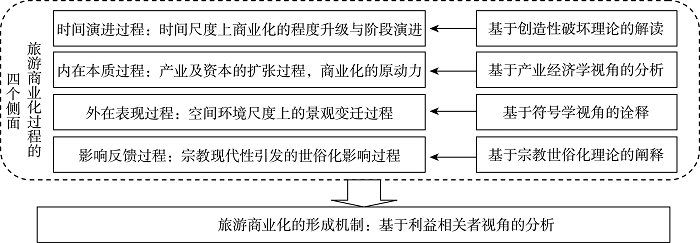
在对宗教型遗产地商业化现象综合调研、解构分析和系统归纳的基础上,从4个方面解读旅游商业化过程:① 商业化的步骤与阶段;② 商业化的产业及资本扩张过程;③ 伴随商业化的景观变迁过程;④ 宗教现代性引发的世俗化影响过程。其中,步骤和阶段划分是从时间尺度上对商业化进行的特征刻画,产业及资本扩展则是从商业化的内在本质进行的剖析,景观变迁是商业化过程的外在表现,而世俗化影响过程是商业化的后果和反馈。因此,这4个方面是旅游商业化演化过程的不同侧面,4个方面分析的整合是完整解读旅游商业化过程的必然要求。在此基础上,针对旅游商业化演化过程的不同侧面,选取最具相关性的理论视角进行阐释,从而形成对宗教型遗产地旅游商业化演化过程分析的多理论视角。而在旅游商业化的形成机制分析方面,虽然上述每个侧面的商业化过程都有其各自影响因素,但整体来看,其核心要素都是不同利益相关者之间的博弈,或者说是不同利益相关者特定关系在不同侧面的不同表现。基于这一认识,对商业化形成机制的分析主要以利益相关者视角为主。具体研究思路与框架如图1所示。
文中“宗教型遗产地”是指以宗教文化或宗教建筑为核心景观和文化价值的(已被列入世界遗产名录的)世界遗产地。这类遗产地多以山岳、洞窟、寺庙、道观等形式存在,在目前(截至2015年1月)中国获批的47项世界遗产中,有17项属于宗教型遗产地,占到36%。这些遗产地作为中国顶级旅游吸引物的代表,已成为热门旅游景区,旅游商业化现象也由此产生。
选择嵩山少林寺作为宗教型遗产地商业化问题的研究对象,主要基于以下考虑:第一,少林寺多重身份的典型性。少林寺拥有世界文化遗产地、全国重点佛教寺院、中国汉传佛教禅宗祖庭、少林武术发源地、国家级重点文物保护单位、国家首批5A级景区等多重身份。因此在遗产地文化资源保护与可持续发展、经营管理及旅游开发等方面,面临多种利益相关者的约束和制衡。第二,少林寺商业化现象的典型性。“少林寺现象”已经引起了社会的广泛关注,其商业化、市场化、产业化倾向尤为突出,对少林寺商业化现象的研究可为中国宗教型遗产地的可持续发展提供更多的参考和借鉴意义。第三,少林寺商业化现象研究的必要性。少林寺作为中国宗教型遗产地的典型代表,一直处于商业化开发的风口浪尖,成为社会各界关注的焦点,但对少林寺商业化现象进行的系统研究尚不多见,这与少林寺商业化现象引起的社会关注度极不相称。
对少林寺商业化演化过程的分析,需要借助现时和历史数据资料来完成。数据资料主要包括:① 少林寺旅游发展的总体过程及年际旅游接待量;② 少林寺旅游发展与所在地登封市社会经济发展的关系;③ 少林寺过去30多年发展过程中的重大事件、重要活动、管理体制的变化、产业链条的拓展等情况;④ 少林寺住持及少林寺管理委员会的发展理念及思路;⑤ 登封市政府在少林寺发展过程中的地位和作用;⑥ 少林寺周边社区居民对少林寺在不同发展阶段的看法和态度;⑦ 旅游者真实体验后对少林寺感知印象的变化;⑧ 以媒体和遗产保护委员会等NGO对少林寺商业化发展的看法和反应。
为获取上述数据资料,主要通过案例地实地考察和调研、文献资料收集与分析、网络资料收集与分析三种方式来实现。首先在实地调研方面,研究小组于2012年5月、2013年10月和2014年6月三次前往少林寺,进行数据资料的收集、游客访谈、景观变化记录,以及少林寺全产业链的切身体验,依据相关资料进行归纳分析与判断。其次在文献资料收集方面,通过Elsevier和CNKI等数据库,检索1978年以来与少林寺旅游、少林寺商业化、少林寺产业等相关的学术文献,通过文献梳理与归纳,进行相关观点的总结和提取。再次在网络资料收集方面,主要针对实地调研和文献分析的不足,充分发挥网络搜索的功能优势,收集上述所需数据资料中的历史资料部分,尤其是通过不同时期全国各大媒体的新闻报道、少林寺官网、全国各大旅游网站、主流博客的旅游板块、微博等新媒体平台,获取相关数据资料。在此基础上,通过个案研究、归纳分析、论述分析等质性分析方法,实现对旅游商业化演化过程和形成机制的研究。
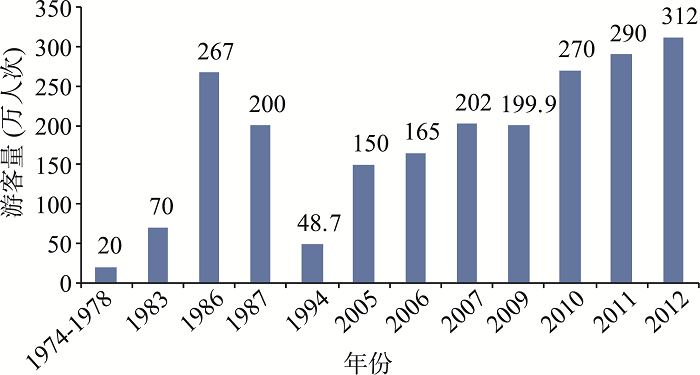
从1982年电影《少林寺》放映算起,少林寺景区的旅游发展已经走过了30多年的历程。这一过程既是少林寺景区实现游客接待量稳步增长的过程(除20世纪90年代中期的短暂回落外)(图2),也是少林寺发展逐渐走向现代化、企业化和商业化的过程。已有研究指出:商业化的真实含义,并不仅仅指遗产地商店铺面的增加,更是指具有垄断性和唯一性的文化资本逐渐被广域的经济资本所取代[1]。少林寺发展过程中的旅游商业化,在某种意义上正是经济资本比重逐渐增加的过程。
图2 少林寺景区年游客接待量的变化 注:根据现场调研及网络资料收集整理。
Fig. 2 The annual tourist reception of Shaolin Temple scenic area
通过对少林寺的实地调研和网络数据收集,在全面梳理少林寺历年发展情况的基础上,以少林寺发展的重大商业化事件为标志点,参照旅游地生命周期理论和Mitchell的旅游创造性破坏模型[12,13],将少林寺的商业化过程划分为6个阶段:① 前商业化阶段(1987年以前)、② 商业化预备阶段(1987-1999年)、③ 商业化初级阶段(1999-2005年)、④ 商业化成长阶段(2005-2007年)、⑤ 商业化发展阶段(2007-2009年)、⑥ 商业化成熟阶段(2009年至今)(表1)。
表1 少林寺商业化发展阶段与特征
Tab. 1 The stages and characteristics of Shaolin's commoditization
| 阶段 | 时间 | 特征 | 划分依据 | 商业化标志性事件 |
|---|---|---|---|---|
| ① 前商业化阶段 | 1987 以前 | 少林寺维持香火经济 政府主导旅游初步发展 | 文物部管理↓ 自主管理 | 电影《少林寺》热映。少林寺由文物部门移交僧人管理。成立嵩山景区管委会,管理嵩山国家公园和少林寺武术馆。 |
| ② 商业化预备阶段 | 1987 ↓ 1999 | 少林寺以武术产业开始商业发展,为公司化做足准备,发展迅速 | ↓ 释永信接管少林寺 | 释永信上任。武僧团成立,舞台包装少林功夫,对外公演。武僧院招收武术弟子。美国纽约建立第一家分寺。创办中国嵩山少林寺武僧团培训基地 |
| ③ 商业化初级阶段 | 1999 ↓ 2005 | 少林寺开始公司化; 品牌化经营; 国际化推广; 政府部门权责不清; 景区管理混乱 | ↓ 公司化 经营 | 成立实业发展有限公司,经营素饼和禅茶。成立无形资产管理有限公司,管理商标品牌。官方网站正式开通。创办德国分寺,并成立德国少林寺股份有限公司。成立少林书局。“少林功夫”申遗失败。藏经阁举办中国互联网新闻宣传高峰论坛。登封市政府成立少林风景区管理局,收走嵩山景区管理委员会的门票出售权 |
| ④ 商业化成长阶段 | 2005 ↓ 2007 | 少林寺全面推进企业化; 娱乐化推广; 商业行为泛滥; 政府整合旅游资源; 管理体制依旧混乱 | ↓ 政府主导 旅游 企业化 | 政府将三皇寨景区合并入少林景区,少林风景区管理局与少林景区管理处并入少林旅游发展有限公司,景区门票价格由40元上调至100元。独家授权网络游戏《少林传奇》。文化传播(登封)有限公司成立,与深圳广电集团合作为电影《新少林寺》海选主演。少林药局恢复建制,成立少林药局有限公司。省、市政府协调后,将少林景区管理处门票出售权归还给嵩山风景名胜区管委会。申请注册“少林药局”商标用于方便面、咖啡、盒饭、茶等商品,被驳回。释永信为10个联通号码开光,联通公司拍卖所得款项赠予少林寺慈幼院,但少林寺不愿公开账目。成立食品发展有限公司 |
| ⑤ 商业化发展阶段 | 2007 ↓ 2009 | 全面步入集团化; 政府下辖嵩山旅游集团成立,推行市场化运作; 少林寺下辖少林武术集团成立,进行兼并整合,开始特许连锁 | ↓ 政府主导 旅游 集团化 | 登封市组建嵩山少林旅游集团,统一经营运作、策划包装、开发推介,自主经营,市场化运作。山地实景演出剧目《禅宗少林·音乐大典》正式运营。《嵩山风景名胜区机构编制方案》明确嵩山风景名胜区管委会负责管理少林景区管理局。嵩山少林寺武僧团培训基地教育集团成立,下辖武僧团培训基地、少林禅拳文化表演团、香港和平电影公司演员培训基地等8个武校。少林欢喜地有限公司开设总店,负责少林寺特许商品全球连锁经营。官方网站公开大量武功秘笈及少林药方。接管清丰县普照寺为豫北地区下院。食品公司获特许经营资质,由贴牌生产扩展到特许连锁。成立禅医医药有限公司,隶属于少林药局 |
| ⑥ 商业化 成熟阶段 | 2009 至今 | 完全产业化; 少林寺以委托经营方式并购下院,连锁扩张,网络推广;政府接受外资成立合资企业,共营景区 | ↓ 外资注入 | 登封市政府与香港中旅合资成立港中旅(登封)嵩山少林文化旅游公司,合资公司拥有40 年经营权,统一管理和运营基础设施建设和文化旅游产业项目。成立少林香堂。接管昆明市官渡4寺为下院,为期20年。开通“少林寺官方网站”新浪微博。少林欢喜地淘宝网店开业 |
对照米歇尔的旅游创造性破坏模型可以发现,少林寺目前处于旅游创造性破坏模型的“后破坏”阶段。首先,从少林寺产业投资的指向性来看,在少林寺实景演出、影视拍摄、商业演出等众多行业中,私人投资已经占据主导地位,如《禅宗少林·音乐大典》是由郑州市天人文化旅游有限责任公司投资建设,项目总投资3.5亿元,演出项目投资1.15亿元。尽管这些行业的投资在一定程度上促进了少林寺品牌的宣传和传播,但都不属于真正意义上的遗产保护投资。其次,从少林寺旅游者的需求特性来看,电影《少林寺》放映之后带来的大量游客都以功夫猎奇、拍摄地游览等需求为主,真正的遗产探寻旅游者只存在于1983年以前;此外,以旅行社组团为主要方式的“走马观花”式的大众观光旅游,也与真正的遗产探寻活动相去甚远。再次,从与周边社区居民的关系来看,为全面恢复少林寺景区的禅宗意境,依据《嵩山少林寺景区详细规划》,登封市对核心景区内的所有居民区、商业区和武校都进行了搬迁,涉及少林、塔沟、郭店等4个行政村的441户[32],实现了景区与居民区的分离。第四,随着少林寺商业化的发展,少林寺原先“禅宗祖庭”的原始宗教景观,已经在很大程度上发展成为以宗教建筑为特色的休闲旅游景观,实现了主导景观符号的变迁。这些都表明,少林寺的商业化发展已经处于Mitchell旅游创造性破坏模型的“后破坏”阶段[12,13]。
但需要注意的是,不管是Mitchell关于圣·雅各布的案例研究,还是旅游创造性破坏模型在中国的运用,其研究视角大都是从乡村社区的视角关注创业精神(entrepreneurialism)、居民态度与商品化发展的关系,更强调旅游发展过程中的商品化过程,因此在旅游地属性、空间尺度与关注内容等方面,都与宗教型遗产地的商业化研究存在很大不同。其次,旅游创造性破坏模型的商品化阶段划分,是与旅游地生命周期大体匹配的,尤其在游客量增长、居民态度变化等方面,存在循序渐进的过程,而少林寺的旅游生命周期从阶段划分来看并不十分明显,尤其在游客量方面,从1983年实现井喷之后,并没有出现明显的增减变化,而且大众团队游客的旅游者属性也一直没有发生较大变化,因此,尽管旅游创造性破坏模型为解释旅游商业化提供了重要的分析视角,但在具体应用过程中,需要根据案例地的实际情况相应调整。
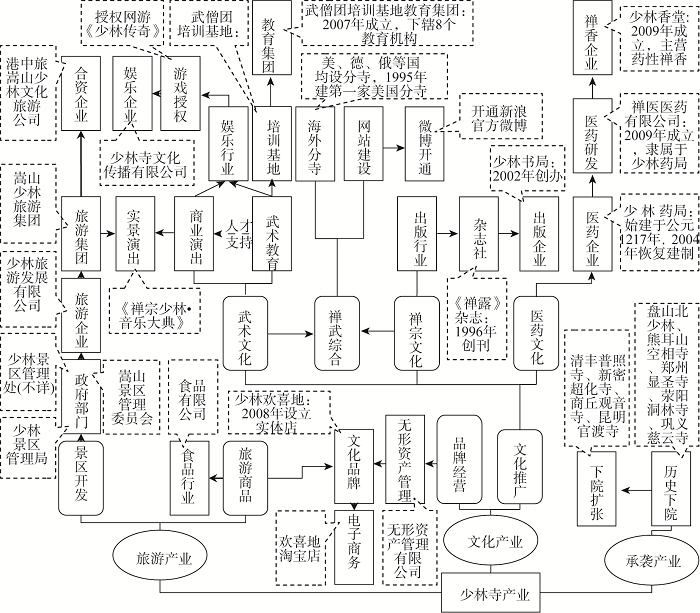
从产业经济学的视角来看,产业发展和产业培育的过程,是经济资本扩张和实现价值控制的过程,从这个意义上来讲,产业发展尤其是相关产业链条的形成和扩展过程,是商业化演化过程的本质特征和核心内容。Mitchell的案例研究已经证明,创业精神和创业投资(entrepreneurial investment)不仅是推动地区经济发展的重要战略,而且是遗产商品化和旅游地创新的核心动力[13]。纵观少林寺过去几十年的发展历程,其先后涉足了旅游行业、武术教育行业、商业演出、出版行业、食品行业、医药行业、娱乐行业、文化品牌行业等不同行业门类,并拥有相应公司发展关联业务,同时通过网络推广、设立海外分支、传媒合作、兼并扩张、电子商务等方式扩大商业化发展规模;其中,当地政府及外来投资商的资源支持贯穿少林寺商业化发展过程,大大加快了商业化的发展速度。根据少林寺产业各分支行业发展路径的相关资料,将目前少林寺商业化的产业链扩展过程绘图(图3)。
图3 少林寺产业链条构成及扩张过程示意图注:根据实地调查资料、网络资料、文献资料综合整理而成。
Fig. 3 The structure of Shaolin industry chain
从图3可以看出,围绕少林寺这一核心品牌,少林寺已经形成关联密集、规模庞大的产业体系,这种产业体系的外延式发展,又进一步刺激和促进了少林寺的商业化发展。这也充分说明,旅游地的商业化过程是产业业态不断扩展、产业链条不断培育的系统过程;在此过程中,经济资本介入旅游开发的广度和程度不断得以强化,从而使得旅游商业化呈现出快速发展的态势。
旅游景观变迁是旅游商业化发展的必然结果,也是表征与刻画旅游商业化演化过程的重要方面。从符号学的视角来看,旅游商业化的过程不仅是自在景观(旅游开发前处于自在状态的文化景观)符号转变为旅游景观(自在景观进入旅游者视野,成为旅游吸引物之后的景观)符号的必然结果,也是伴随各文化主体对于旅游景观符号的意义博弈(开发商、政府、居民等在商业化过程中的立场和角色),是旅游景观符号系统中自在景观符号成分逐渐减少,而现代城市景观和商业景观符号成分逐渐增多的过程[31]。基于这一视角,对少林寺旅游商业化过程中的景观变迁进行如下分析(表2)。
表2 符号学视角下少林寺景观符号的变迁过程
Tab. 2 The transformation of Shaolin Temple from original landscape to tourism landscape
| 景观类别 | 自在景观符号 | 旅游景观符号 |
|---|---|---|
| 景区整体景观 | 深山藏古寺,碧溪锁少林; 曲径通幽处,禅房花木深 | 宽阔的马路、大型停车场、城市化的广场、欧式的廊柱、雷同的商业街 |
| 僧人景观 | 礼佛修行、烧香拜佛、习武强身 | 智能手机、上网冲浪、学习英语、计算机培训、出国留学 |
| 建筑及设施景观 | 传统寺庙建筑体系 | 建筑崭新局促;新建食品公司、演出基地、旅游企业、少林书局、医药企业、学校、娱乐场所等设施 |
| 声音景观 | 寺庙的钟声、木鱼声、诵经声、习武声、自然风雨及虫鸣鸟叫声,环境清幽 | 导游的讲解声、游客的嘈杂声、商贩的叫卖声、汽车的喇叭声、实景演出声音等,环境喧嚣嘈杂 |
| 新兴景观 | 武术表演;《禅宗少林》音乐大典 | |
| 游客感知景观与 外界景观认知 | 禅宗祖庭、佛门净土;少林武术之源 | 武术基地;“企业化”的少林寺;中国十五大宰人景点 |
景观变迁作为旅游商业化在景观环境层面的外在表现,最容易为人所感知,尤其从旅游体验的视角来看,旅游者对少林寺“商业化”的感知,渗透在对吃住行游购娱每一要素景观的体验过程中,也通过旅游者视觉、听觉、味觉、嗅觉、触觉、情感、记忆等多种感官途径,形成相对完整的景观判断和认知。在这一过程中,旅游者对少林寺“自然景观符号”的期望与旅游过程中“旅游景观符号”的实际感受之间是否存在偏差,是积极正向的偏差还是消极反向的偏差,是影响旅游者体验水平和满意度的重要标准。
需要说明的是,符号学视角下自在景观符号向旅游景观符号的这一旅游商业化过程,本身是中性的,是旅游发展中商业资本投注在旅游地景观上的外在反应。从这一角度理解旅游商业化过程,涉及两个相互关联的核心问题:第一,这种景观符号的变迁能否为宗教型遗产地的利益相关者(寺庙管委会、普通信众、旅游者、遗产保护主义者、政府、投资商等)认同和接受?第二,将景观符号的变迁控制在什么样的范围内才是合理的?从少林寺的实例来看,寺庙管委会、政府和投资商普遍对商业化过程中景观符号的变化没有异议,但普通信众和旅游者作为少林寺旅游发展的主要客源群体,普遍对旅游商业化形成的“新旅游景观符号”持否定和反对意见,“商业化气息太浓”、“是否还是一片佛门净土”、“失去了佛门的清静之感”、“找不到深山古刹的庄严与肃穆感”等,是普通信众和旅游者的集中反馈。
宗教世俗化是指随着社会政治生活、文化生活、经济生活的发展变化,宗教观念由神圣化到非神圣化的此消彼长的变化过程,是一个世界性的历史过程,其目的是为了更好地适应现代社会,其结果对宗教社会功能演化产生影响[33]。世俗化理论起源于西方中世纪,后来马克思·韦伯(Max Weber)全方位概括了世俗化及其改变宗教社会功能的现实[34]。世俗化理论引入中国后,中国学者认为世俗化的过程主要包括宗教社会功能的淡出和理性化,以及宗教的内容、形式不断适应社会走向世俗的变化[35],并将其用于解释在现代化社会中宗教圣地、宗教信徒所呈现出的一些与一般大众对宗教传统印象相背的现象和行为,从这个意义上来讲,少林寺的商业化现象可以通过宗教世俗化理论得以解析。
与古镇、古村落等其他类型的遗产旅游地不同,宗教型遗产地的宗教性特质,决定了宗教景观欣赏、宗教氛围感知、宗教文化体验是游客旅游需求的重要方面,而随着旅游商业化的不断推进,宗教型遗产地原有的宗教氛围不复存在,宗教体验也呈现出完全不同的性质和特点,从而导致游客实际体验与期望体验的偏差,而这一点从宗教社会学的视角来看,旅游商业化是宗教世俗化的一个重要过程。本文基于宗教世俗化理论的视角,通过文献分析法,从宗教自我发展、功能性、社会发展、品牌与宣传效应、社会适应性、文化传承与保护等六个方面,对少林寺商业化过程中世俗化影响的正反两方面观点总结如表3。
表3 基于宗教世俗化视角的少林寺商业化对阵观点
Tab. 3 The positive and negative views of the commercialization of Shaolin Temple
| 支持观点 | 反对观点 | |
|---|---|---|
| 自我 发展 | 寺院要想在现实社会中获得长足发展,就不能不突破传统观念的束缚,不可能不讲经济、远离金钱[36] | 佛教中存在着许多经营的禁区,这是佛教生存和发展的必要保证。如果禁区被打开,佛教的神圣性、庄严性就不复存在,佛教存在的基石也就动摇了[37] |
| 功能性 | 商业化不等同于世俗化,普渡众生的“佛法”不会被商业化[38] | 寺院的经济独立很可能使僧团失去教化社会的功能,从而丧失其不可替代的功用,成为一个世俗的团体[39] |
| 社会 发展 | 少林寺的旅游发展带动了周围村庄以及登封市的经济发展,成为登封市三大支柱产业之一[40] | 变味的文化产业泛滥炒作会造成恶劣社会效应,影响旅游业发展[41] |
| 品牌 与宣传效应 | 虽有商业化的一面,但其扩大了中国传统武术在社会上的影响力,增强了少林全球化品牌营销力[42] | 少林寺内涵“禅、武、医”的核心竞争力几乎不能糅合或并存,缺少市场调研的少林寺外在形象过于模糊[43]。少林武术文化在对外传播中存在“功夫”宣传误区,仅用散打表现武术“功夫”[44] |
| 社会 适应性 | 佛教经济需要而且应该做出现代适应性的调整[45],这与佛教逐步实现中国化的传统相一致,也是对人间佛教理论的积极实践[46] | 释永信把现代化误解为商业化,其追求现代化的每项措施,都是在斫丧寺院、佛教的真精神[47]。少林寺的发展思路市场化、经济化,发展手段世俗化、娱乐化,僧人行为经济化,不利于少林寺的长期发展[48] |
| 文化传承与保护 | 少林文化有关注世俗社会的传统,甚至有以武力积极参与改变社会事物的传统。产业开发进一步反哺文化,经济实力实现少林文化品牌保值。由于旅游的发展,许多宗教和古建筑得以被拯救[49] | 少林寺对佛教“禅宗”精神的振兴和推广,没有起到应有的作用。少林寺商业行为淡化了宗教的神秘性和神圣性,最终影响其宗教性[50]。违背宗教基本要义的过度商业化,突破了商业伦理的底线,损害了民众对少林寺的文化认同和传统价值观的呵护,导致文化符号被商业所腐蚀[51] |
通过上述四个方面的分析,得出以下结论:少林寺的旅游商业化是一个跨越不同阶段的历史过程,其中,资本和产业链条的扩张是其本质特征,景观符号的变迁是其外在表现,而世俗化影响的不断推进则代表着社会大众的认知和反馈。这四个方面的有机整合,形成少林寺旅游商业化发展演化的全过程。
与前面通过四种不同视角对旅游商业化的演化过程分析不同,对旅游商业化形成机制的分析主要基于利益相关者的独立视角进行。原因包括两个方面:第一,商业化的演化特征从表现形态上分为很多不同的层面,包括时间特征层面、空间景观层面、产业及资本扩张层面以及世俗化影响层面,这些不同的层面因为关注内容和侧重点的差异,无法用统一的理论视角进行分析,因此多视角的演化特征分析成为必然。但从形成机制的研究来看,旅游商业化本身是一个独立的现象,对这一现象的分析可以有不同的分析视角,但独立的理论视角能够实现对该现象的解释。第二,从旅游商业化的特征分析可以看出,尽管每一特征的形成都有其不同的影响因素,但从本质来看,旅游商业化都是不同利益相关者在不同层面的制衡与博弈。具体来讲,基于旅游创造性破坏模型的商业化阶段是寺庙管委会(决策中心)、开发商(投资主体)、消费者(旅游者)和当地居民共同作用的结果,基于产业经济学的产业链扩张是寺庙委员会、政府、开发商、市场需求(潜在消费者)共同作用的结果,基于符号学视角的旅游景观分析是宗教内群体(开发决策者)与宗教外群体(消费者、居民、无政府组织)相互作用的结果,而基于宗教世俗化的影响过程分析是宗教走向现代化过程中宗教内部与世俗社会各自需求无法实现对接的结果,因此,尽管影响四个方面的因素各有不同,但都是不同利益相关者相互制约、相互博弈和彼此平衡的结果。
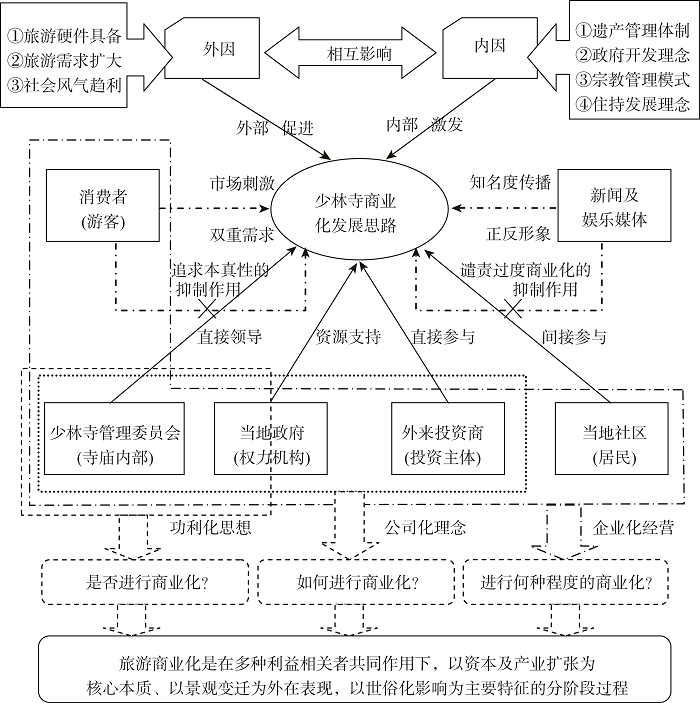
通过对少林寺旅游商业化现象的深入分析,识别出主要的利益相关者包括少林寺管委会(主持及僧众)、当地各级政府(登封市、河南省)、投资商、当地社区(居民)、消费者(旅游者及信众)、新闻媒体、NGO组织(宗教协会、遗产保护委员会)等。少林寺旅游商业化的形成,首先是内外因互相作用的结果。从外因来看,全国旅游的快速发展为少林寺的商业化开发提供了宏观背景,居民收入和闲暇时间的增加,以及旅游需求层次的大幅提升,也从外部准备了相对充足的客源市场,形成了市场需求的拉动刺激;从内因来看,一方面遗产管理体制不健全导致的资金不到位,使遗产维护所需的大量资金匮乏,另一方面,宗教自主管理体制下住持拥有寺庙管理的绝对权力,决定了寺庙的发展方向要以住持的理念为指导;在这种情势下,释永信“出世化”的佛教文化推广思路得以顺利实施,从而使少林寺企业化、市场化、产业化的商业化发展成为可能。
其次,从各利益相关者的关系来看,少林寺旅游商业化的形成,是不同利益相关者相互制衡、相互博弈的结果。第一,市场游客的需求刺激,是少林寺商业化的外部动力,但同时旅游需求不断升级而愈发追求本真性的游客也对商业化发展有抑制作用;第二,少林寺自身尤其是主持发展理念的商业化倾向,是少林寺商业化发展的直接动力;第三,当地政府对产业发展的倡导与引导,为少林寺商业化发展提供了政策支持,而其参与少林寺门票分成等商业化行为又进一步强化了政府与少林寺之间的复杂关系;第四,外来投资商直接参与少林寺的经营管理,形成与少林寺休戚相关的利益共同体,推动了旅游商业化的发展;第五,社区居民通过就业或商贩经营等方式参与商业化活动,其对旅游商业化的态度因其参与方式和经济获利程度而有显著差别;第六,新闻媒体一方面与少林寺通过合作各取所需,扩大少林寺的知名度和影响力,从而刺激旅游市场;另一方面谴责过度商业化行为对千年古寺的破坏性影响,从侧面抑制了旅游商业化发展的速度;第七,以宗教协会和遗产保护委员会为代表的NGO组织从可持续发展的理念出发,对少林寺的商业化行为提出批评和谴责,但在实践中其影响力有限。需要说明的是,尽管少林寺的旅游商业化是多种利益相关者共同作用的结果,但由于不同利益相关者掌握资源及话语权的不同,其对旅游商业化的影响和作用存在较大差异。其中少林寺管委会、当地政府、投资商作为旅游商业化的核心推动力量,直接决定了旅游商业化的性质、程度和影响(图4)。
图4 基于利益相关者视角的少林寺商业化形成机制 注:根据实地调查资料、网络资料、文献资料综合整理而成。
Fig. 4 The mechanism of tourism commoditization development of Shaolin Temple from the perspective of stakeholder theory
主要结论如下:
第一,旅游商业化是一个分阶段的历史过程。在这一过程中,产业及资本扩张是旅游商业化的核心特征,景观符号的变迁是外在表现,而世俗化的影响则是旅游商业化的后果反馈。其中,产业及资本扩张是旅游商业化实现阶段升级和程度强化的根本动力,也是实现文化资本被经济资本替代的关键内容。经济资本介入旅游开发的广度和强度,直接影响旅游地商业化发展的范围、性质和水平,从而对游客体验、遗产地的资源保护和可持续发展发挥作用和影响。
第二,旅游商业化现象的形成是多种利益相关者相互制衡和博弈的结果。但由于遗产地管理体制的限制、利益相关者表达意愿的渠道的限制,参与商业化决策机会的限制,不同利益相关者对旅游商业化形成的作用和影响存在较大差异。从少林寺的案例可以看出,寺庙管理委员会、当地政府、外来开发商在旅游商业化发展中起主导作用,而社区居民、消费者(旅游者和信众)、NGO组织则处于利益相关者的弱势地位。从未来遗产地旅游商业化的调控来看,处理好利益相关者之间的关系是核心和关键。其中,政府从当前参与旅游商业化的利益分成转变到宏观调控、消费者享受遗产价值体验的权利受到尊重、外来投资由经济利益最大化向遗产保护利益最大化的转变等,都是未来需要解决和调整的关键问题。
第三,与其他类型的文化遗产地不同,宗教型遗产地因其具有特殊的宗教属性,其旅游商业化的过程具有更复杂的利益相关群体。一方面市场消费者对宗教型遗产地的文化氛围、景观特质、体验内容以及总体感知印象,都有特殊的要求和期望,另一方面,宗教在现代社会的世俗化发展成为备受争议和关注的内容,在这种背景下,如何评价宗教型遗产地的旅游商业化开发,以及如何调控旅游商业化并使其与遗产保护协调发展,成为核心问题。少林寺作为中国宗教型遗产地旅游商业化的典型代表,对其商业化演化过程和形成机制的分析,能为其他宗教型遗产地的旅游商业化研究提供借鉴。
The authors have declared that no competing interests exist.
| [1] |
文化遗产旅游商业化的路径依赖理论模型 .https://doi.org/10.3969/j.issn.1006-575X.2005.03.014 [本文引用: 4] 摘要
Tourism development of cultural heritage sites always follows the same pattern. That is first being discovered, packaged and placed into the market, then starting to develop toward modernization, playing a role of pulling force in the local economy, and ultimately falling into the pitfall of over-commercialization. The paper summarized the dynamic process the commercialization of cultural heritage sites, made a theoretical demonstration of commercialization of heritage resources exploration through studying the transfer between cultural and economical capitals in the process of tourism development, raised a hypothesis of path dependence of tourist commercialization of cultural heritages, and frame-worked a theoretical model for tourist commercial development of heritage sites.
A theoretical model of path dependence for cultural heritage tourism commercialization. https://doi.org/10.3969/j.issn.1006-575X.2005.03.014 [本文引用: 4] 摘要
Tourism development of cultural heritage sites always follows the same pattern. That is first being discovered, packaged and placed into the market, then starting to develop toward modernization, playing a role of pulling force in the local economy, and ultimately falling into the pitfall of over-commercialization. The paper summarized the dynamic process the commercialization of cultural heritage sites, made a theoretical demonstration of commercialization of heritage resources exploration through studying the transfer between cultural and economical capitals in the process of tourism development, raised a hypothesis of path dependence of tourist commercialization of cultural heritages, and frame-worked a theoretical model for tourist commercial development of heritage sites.
|
| [2] |
近15年来中国古村镇旅游商业化研究进展 .https://doi.org/10.3969/j.issn.1001-7852.2012.03.018 [本文引用: 4] 摘要
The research on tourism commercialization in ancient village and town has become one of hot topics in present-day study.Based on the analysis of related literatures in recent 15 years in China,the paper pointed out the major results of tourism commercialization in ancient village and town:the concept, characteristics,influence and evaluation,cause,countermeasures and suggestions of tourism commercialization in ancient village and town.The research method is mainly qualitative method based on the descriptive method,with the increasing use of quantitative method.Finally,concludes the tendency of future tourism commercialization in ancient village and town research is:improving and perfecting the concept and related theory;broadening the research perspective;strengthening quantitative study,at the same time combining with qualitative research;expanding the scope of case studies;strengthening studies of the evolutionary process of tourism commercialization in ancient village and town etc.
Progress on tourism commercialization in ancient village and town in China in recent 15 years. https://doi.org/10.3969/j.issn.1001-7852.2012.03.018 [本文引用: 4] 摘要
The research on tourism commercialization in ancient village and town has become one of hot topics in present-day study.Based on the analysis of related literatures in recent 15 years in China,the paper pointed out the major results of tourism commercialization in ancient village and town:the concept, characteristics,influence and evaluation,cause,countermeasures and suggestions of tourism commercialization in ancient village and town.The research method is mainly qualitative method based on the descriptive method,with the increasing use of quantitative method.Finally,concludes the tendency of future tourism commercialization in ancient village and town research is:improving and perfecting the concept and related theory;broadening the research perspective;strengthening quantitative study,at the same time combining with qualitative research;expanding the scope of case studies;strengthening studies of the evolutionary process of tourism commercialization in ancient village and town etc.
|
| [3] |
文化遗产旅游研究的现状、症结与范式创新 .https://doi.org/10.3969/j.issn.1002-5006.2010.06.003 [本文引用: 1] 摘要
一、4种文化遗产元叙述及其对旅游研究的渗透 通过梳理文献,笔者共发现了4种关于文化遗产的元叙述: 其一是17世纪以来法国的文明进化思想.它认为,本质上人类拥有共同的文化路径与文化归宿,只是由于历史境遇不同,不同民族不但在文化拥有量上存在区别,在发展上也呈现不同的轨迹.
Study on the cultural heritage tourism: present situation, problems and paradigm innovation. https://doi.org/10.3969/j.issn.1002-5006.2010.06.003 [本文引用: 1] 摘要
一、4种文化遗产元叙述及其对旅游研究的渗透 通过梳理文献,笔者共发现了4种关于文化遗产的元叙述: 其一是17世纪以来法国的文明进化思想.它认为,本质上人类拥有共同的文化路径与文化归宿,只是由于历史境遇不同,不同民族不但在文化拥有量上存在区别,在发展上也呈现不同的轨迹.
|
| [4] |
Authenticity and commoditization in tourism. https://doi.org/10.1016/0160-7383(88)90028-X URL [本文引用: 2] 摘要
Three basic assumptions, common in the literature on tourism, regarding “commoditization”, “staged authenticity”, and the inability of tourists to have authentic experiences are re-examined. Authenticity is conceived as a negotiable rather than primitive concept, the rigor of its definition by subjects depending on the mode of their aspired touristic experience. New cultural developments may also acquire the patina of authenticity over time — a process designated at “emergent authenticity”. It is also argued that commoditization does not necessarily destroy the meaning of cultural products, although it may change it or add new meanings to old ones. Conclusions contrary to the deductions following from the above assumptions are spelled out, and a new approach to the study of authenticity and meaning in tourism, which could help the formulation of a more discerning tourism policy, is advocated.L'authenticité et la marchandisation du tourisme. On examine dans cet article trois suppositions de base qui se trouvent souvent dans les oeuvres de recherche sur le tourisme au sujet de la “marchandisation”, la “mise-en-scène de l'authenticité” et l'incapacité des touristes d'éprouver des expériences authentiques. L'authenticité se présente comme un concept négotiable plut00t qu'un concept primitif. La rigueur de la définition de l'authenticité dépend de la nature de l'expérience touristique à laquelle on aspire. Les nouveautés culturelles peuvent en plus acquérir un air d'authenticité avec le temps, ce qu'on peut appeler “l'authenticitéémergente”. On soutient aussi que la marchandisation ne détruit pas nécessairement le sens des produits culturels, bien qu'elle puisse changer ce sens ou ajouter de nouveaux sens aux anciens. On explique bien clairement des conclusions qui sont contraires à la déductions qui s'ensuit de ces suppositions, et on pr00ne une nouvelle fa04on d'aborder l'étude de l'authenticité et du sens dans le tourisme, ce qui pourrait mener à la formulation d'une politique touristique plus perspicace.
|
| [5] |
https://doi.org/10.1016/B978-008044910-4.00955-X URL [本文引用: 3] 摘要
This article examines the concepts, definitions, policies, and practices of heritage in a contemporary context. Within recent years, there have been significant shifts in our understandings and applications of heritage concepts and policies in the modern world. 'Heritage' emerged as a buzz word in international policy arenas in the 1980s and early 1990s, and has since weathered the vagaries of turbulent definitional and governance–nomenclature storms, as traditional debates about what it is and what it is not’ reverberate around academia and state agencies alike. Policy and funding structures for heritage are determined by the classifications used to define them in various countries. Typically, reference is made to 'built heritage', 'natural heritage', and 'intangible heritage', loosely reflecting buildings, landscapes, and culture. Aspects of heritage are used by the cultural and tourism industries to add economic value, through heritage tourism sites, museums, and other activities. The cultural tourism product is often anchored around notions of heritage, and in post modern, post-tourist societies, boundaries between culture, (travel) space, and identities are increasingly blurred. Issues of authenticity become important in the representation of heritage, and questions are asked about the validity of nostalgia versus realism. The role of heritage is examined in the context of identity formulation at individual and nation-state levels, and the political aspects of this are also discussed. Finally, heritage conservation is assessed through an examination of UNESCO’s World Heritage Site listing and protection strategy. In a changing world, new constructs of heritage, identity, authenticity, and representation will continue to emerge as meanings are constantly renegotiated over time and space.
|
| [6] |
|
| [7] |
|
| [8] |
A consumer-based model of authenticity: An oxymoron or the foundation of cultural heritage marketing ?.https://doi.org/10.1016/j.tourman.2009.07.010 URL [本文引用: 1] 摘要
This study examines the relevance and conceptualizations of the authenticity concept in cultural tourism from the managerial standpoint. We propose a consumer-based model in which authenticity is a key mediating construct between cultural motivation and loyalty. The model is empirically examined by means of a survey conducted on 25 Romanesque heritage sites in four European countries. A confir- matory factor analysis and structural equation modeling were performed using LISREL 8.72. The results indicate that cultural motivation is an important antecedent of both object-based and existential authenticity, which in turn influence tourist loyalty. Theoretical, managerial and marketing implications of authenticity are discussed, showing that the consumer-based perspective can transcend some 'irreconcilable tensions' related to this concept.O 2009 Elsevier Ltd. All rights reserved.
|
| [9] |
Consuming heritage: Perceived historical authenticity. https://doi.org/10.1016/S0160-7383(99)00115-2 URL [本文引用: 1] 摘要
This paper examines tourists' perceptions of the historical authenticity of The Rocks, Australia, a heritage precinct fashioned by the Sydney Cove Redevelopment Authority. Interviews randomly approached pedestrians in the district and 372 completed responses were obtained (111 Sydneysiders, 126 other Australians and 135 international visitors, May-June 1995). It is argued that overall tourists ...
|
| [10] |
Building a new heritage: Tourism, culture and identity in the New Europe. |
| [11] |
Tourism and heritage conservation in Singapore. https://doi.org/10.1016/0160-7383(95)00003-O URL [本文引用: 1] 摘要
Using a survey of tourists and locals, this study investigates the success of Singapore's Civic and Cultural District as a conservation project. The survey revealed that tourists were attracted by the facades of old colonial buildings that have been carefully restored. In contrast, Singaporeans attach a great deal more to activities and lifestyles within the district that have since been removed or have disappeared because of conservation. Planning authorities have concentrated mainly on the issue of economic viability and favor commercial activities such as retail and recreation/leisure. As such, Singaporeans feel that conservation in the district, because it ''museumizes'' or makes ''elitist'' to encourage tourism, has failed to preserve their heritage.
|
| [12] |
Entrepreneurialism, commodification and creative destruction: A model of post-modern community development. https://doi.org/10.1016/S0743-0167(98)00060-6 URL [本文引用: 3] 摘要
The desire to experience the countryside ideal is a growing trend among North American residents. Entrepreneurs have reacted to this by commodifying the countryside and its associated rural heritage. The result has been the creation of heritage shopping villages: centres of consumption providing post-modern consumers with tangible keepsakes of the past. While contributing to the accumulation of capital within the community, investment in commodification may lead to destruction of the rural idyll. The process by which this occurs is outlined in a stage model of community development. The model is then tested in the community of St. Jacobs, a picturesque village located in the heart of Ontario's Mennonite country. It is concluded that the model presented here may be a useful tool for geographers and planners interested in guiding the fate of communities whose development has occurred around the commodification of the rural tradition.
|
| [13] |
Revisiting the model of creative destruction: St. Jacobs, Ontario, a decade later. https://doi.org/10.1016/j.jrurstud.2008.09.003 URL [本文引用: 4] 摘要
Ten years ago, the model of creative destruction was developed to predict the fate of communities that base their development on the commodification of rural heritage (Mitchell, C.J.A., 1998. Entrepreneurialism, commodification and creative destruction: a model of post-modern community development. Journal of Rural Studies 14, 273-286). Its application to the village of St. Jacobs, Canada, demonstrated that entrepreneurial investment had fostered the creation of a setting for aestheticized consumption. In this paper we demonstrate that creative destruction has continued to unfold in the village over the course of the past decade. The evolutionary path taken is assessed in light of current literature on rural space. It is concluded that to fully understand the transformative process, one must integrate the demands of myriad sub-cultures, whose social relations, ideologies and actions will contribute to the development of a contested landscape of consumption. This finding necessitates
|
| [14] |
旅游社会影响研究: 以大理古城居民学英语态度为例 .Tourism social impacts: A case study in Dali, Yunnan province, China. |
| [15] |
世界文化和自然遗产地保护与旅游发展 .https://doi.org/10.3969/j.issn.1006-0022.2003.06.007 URL [本文引用: 1] 摘要
The purpose of having the place of world cultural and natural heritage entered in the Records of World Heritage is to make it betterprotected. However, while the development of tourism can increase the value of the world heritage and raise funds for the protection of theplace of heritage, it also creates heavy pressure on its protection work. There exist in the place of heritage the problems of social change ofover-artificialization, urbanization, commercialization and residents deviation from their original life style. Therefore, there is no time to delay inreducing the pressure induced from the tourism in the place of the world heritage. Measures should be taken to strengthen the directmanagement of the place of world heritage by the state and to speed up the drafting of concerned laws. The place of the world heritage mustbe well planned and the public must be educated on the awareness of the protection of the heritage place.[
Protection of the place of World Cultural and Natural Heritage and the development of tourism. https://doi.org/10.3969/j.issn.1006-0022.2003.06.007 URL [本文引用: 1] 摘要
The purpose of having the place of world cultural and natural heritage entered in the Records of World Heritage is to make it betterprotected. However, while the development of tourism can increase the value of the world heritage and raise funds for the protection of theplace of heritage, it also creates heavy pressure on its protection work. There exist in the place of heritage the problems of social change ofover-artificialization, urbanization, commercialization and residents deviation from their original life style. Therefore, there is no time to delay inreducing the pressure induced from the tourism in the place of the world heritage. Measures should be taken to strengthen the directmanagement of the place of world heritage by the state and to speed up the drafting of concerned laws. The place of the world heritage mustbe well planned and the public must be educated on the awareness of the protection of the heritage place.[
|
| [16] |
历史城镇的旅游商业化研究 .
This paper analyzes the current commercial status quo in the tourist historic towns of Zhouzhuang and Lijiang in China by using first-hand data. It examines the present use of historical buildings in the two towns in order to investigate the relationship between tourism and the use of buildings. In 2002, 682 building units in Lijiang, accounting for nearly 70% of all units in the main streets, were used for commercial purposes catering tourists; while 10.42% of the buildings catered local residents. These findings suggest that Lijiang has become a tourism-oriented town and its traditional culture is being threatened by tourism. This applies to Zhouzhuang, which attracted 1.5 million tourists in 2000, when 67.02% of building units in the main streets were used to cater tourists, while only 7.28% of them served local residents.A comparison with the use of historic buildings in 2000 and 2002 in Lijiang reveals that commercial units have been increasing rapidly. Tourism plays a key role in this process. As a result, tourism commercialization has taken place in Lijiang. The same case is also true for Zhouzhuang.
Studies on tourism commercialization in historic towns.
This paper analyzes the current commercial status quo in the tourist historic towns of Zhouzhuang and Lijiang in China by using first-hand data. It examines the present use of historical buildings in the two towns in order to investigate the relationship between tourism and the use of buildings. In 2002, 682 building units in Lijiang, accounting for nearly 70% of all units in the main streets, were used for commercial purposes catering tourists; while 10.42% of the buildings catered local residents. These findings suggest that Lijiang has become a tourism-oriented town and its traditional culture is being threatened by tourism. This applies to Zhouzhuang, which attracted 1.5 million tourists in 2000, when 67.02% of building units in the main streets were used to cater tourists, while only 7.28% of them served local residents.A comparison with the use of historic buildings in 2000 and 2002 in Lijiang reveals that commercial units have been increasing rapidly. Tourism plays a key role in this process. As a result, tourism commercialization has taken place in Lijiang. The same case is also true for Zhouzhuang.
|
| [17] |
古镇旅游开发及其商业化现象初探 .URL 摘要
In the past 20 years,travel in ancient towns have been warmly welcomed by tourists. However, with the rapid development of tourism in those ancient towns, many problems also came along, especially the problem of commercialization that has become a controversial topic. Most scholars think that commercialization or over commercialization is the by-product of tourism development of ancient towns. However, there is no clear definition between these two. This paper tries to distinguish “commercialization” from “over commercialization” and points out that commercialization is the process of transformation from social-culture capitals to economic capitals, which is inevitable in the process of tourism development. In discussing the relation between “commercialization” of tourism and the development of ancient towns, we have arrived at a conculsion that a moderate commercialized environment will further enhance and help to realize the sustainable development of these ancient towns. Finally, the paper also proposes several measures that are conductive to the moderate development of commercialization.
Preliminary study on tourism development and commercialization in ancient towns. URL 摘要
In the past 20 years,travel in ancient towns have been warmly welcomed by tourists. However, with the rapid development of tourism in those ancient towns, many problems also came along, especially the problem of commercialization that has become a controversial topic. Most scholars think that commercialization or over commercialization is the by-product of tourism development of ancient towns. However, there is no clear definition between these two. This paper tries to distinguish “commercialization” from “over commercialization” and points out that commercialization is the process of transformation from social-culture capitals to economic capitals, which is inevitable in the process of tourism development. In discussing the relation between “commercialization” of tourism and the development of ancient towns, we have arrived at a conculsion that a moderate commercialized environment will further enhance and help to realize the sustainable development of these ancient towns. Finally, the paper also proposes several measures that are conductive to the moderate development of commercialization.
|
| [18] |
丽江古城旅游商业人口和空间分布的关系研究 .https://doi.org/10.3969/j.issn.1000-6664.2009.05.006 URL [本文引用: 1] 摘要
With the trend of wide development of tourism commerce in heritage sites, the tourism commercialization has brought changes into the social structure, cultural atmosphere and other aspects of heritage sites. It is necessary to deeply study the theme, process and expression of the tourism commercialization of heritage sites, so as to provide the basis for effective protection of heritage sites and the proper guidance for tourism commerce development. With the case study of the old town of Lijiang, the World Culture Heritage city, the changes of population and spatial distribution brought by the tourism commerce development are studied from the perspectives of shop types, merchandise categories, operator composition and spatial distribution, and the potential impact on cultural heritage sites is analyzed.
Study on tourism commerce population and spatial distribution in Old Town of Lijiang. https://doi.org/10.3969/j.issn.1000-6664.2009.05.006 URL [本文引用: 1] 摘要
With the trend of wide development of tourism commerce in heritage sites, the tourism commercialization has brought changes into the social structure, cultural atmosphere and other aspects of heritage sites. It is necessary to deeply study the theme, process and expression of the tourism commercialization of heritage sites, so as to provide the basis for effective protection of heritage sites and the proper guidance for tourism commerce development. With the case study of the old town of Lijiang, the World Culture Heritage city, the changes of population and spatial distribution brought by the tourism commerce development are studied from the perspectives of shop types, merchandise categories, operator composition and spatial distribution, and the potential impact on cultural heritage sites is analyzed.
|
| [19] |
江南古镇商业化倾向及其可持续发展对策: 以浙北三镇为例 .The characteristics of commercialization trends and sustainable development of ancienct towns in South China: A case study of three towns in the north of Zhejiang province. |
| [20] |
江南水乡古镇的保护与合理发展 .https://doi.org/10.3969/j.issn.1000-3363.2008.05.007 URL 摘要
The historic water towns in south of Yangtze River represent a typical traditional town type of extraordinary integrality,locality,and diversity in Chinese culture.Furthermore,the water town conservation practices,led by Zhouzhuang, started from 1980s and has been flourishing till today,have been the landmark and model of the practices of the urban heritage conservation in China.Having experienced the constructive destructions in the Reform and Opening up,over-commercialization, social variation,residents relocating,space crowding and ecological deterioration during the historic town tourism boom,the historic water towns have to face new challenges,such as the impacts of the local characteristics in globalization,the new cultural product demands from profound tourism,etc.The practice of water town conservation and development has arrived at a crossroad.To choose which orientation has complicated urban development issues such as economy,culture and society.This article reviews,analyzes and concludes the historic water town practices, the lessons learned and the characteristics of the trend,so as to gain some inspiration for the historic town conservation in future.
Conservation and development of the historic water towns in the south of Yangtze River. https://doi.org/10.3969/j.issn.1000-3363.2008.05.007 URL 摘要
The historic water towns in south of Yangtze River represent a typical traditional town type of extraordinary integrality,locality,and diversity in Chinese culture.Furthermore,the water town conservation practices,led by Zhouzhuang, started from 1980s and has been flourishing till today,have been the landmark and model of the practices of the urban heritage conservation in China.Having experienced the constructive destructions in the Reform and Opening up,over-commercialization, social variation,residents relocating,space crowding and ecological deterioration during the historic town tourism boom,the historic water towns have to face new challenges,such as the impacts of the local characteristics in globalization,the new cultural product demands from profound tourism,etc.The practice of water town conservation and development has arrived at a crossroad.To choose which orientation has complicated urban development issues such as economy,culture and society.This article reviews,analyzes and concludes the historic water town practices, the lessons learned and the characteristics of the trend,so as to gain some inspiration for the historic town conservation in future.
|
| [21] |
历史城镇的文化商业旅游发展模式 .URL 摘要
通过探讨历史城镇保护与开发的关系,对中国历史城镇发展中几种典型的错误商业形态进行了总结,并指出适宜的旅游商业化开发对历史城镇发展的必要性。提出历史城镇的文化商业发展模式:在其地域文化的基础上,发掘传统文化的内涵,并与多种商业形式结合进行综合开发。
The commercialization tourism development of historic towns. URL 摘要
通过探讨历史城镇保护与开发的关系,对中国历史城镇发展中几种典型的错误商业形态进行了总结,并指出适宜的旅游商业化开发对历史城镇发展的必要性。提出历史城镇的文化商业发展模式:在其地域文化的基础上,发掘传统文化的内涵,并与多种商业形式结合进行综合开发。
|
| [22] |
江南水乡古镇旅游与可持续发展 .https://doi.org/10.3969/j.issn.1006-3862.2009.06.022 URL [本文引用: 1] 摘要
Nowadays, the tourism in ancient towns nearby the Yangtze River is booming rapidly.Some ancient towns overexploit the tourist sources; compete in an unordered manner and homogeneous competition that influence the sustainable development seriously. To solve the problem above, we should integrate the cultural resources, make overall plans, position the ancient town tourism rationally, exert each comparative advantages, stress each culture trait and culture feature, and accelerate the transform and upgrade of the ancient towns tourism, in order to realize sustainable development and the win-win project of environmental protection and cultural tourism exploitation.
The tourism and sustainable development of ancient towns nearby the south of the lower reaches of the Yangtze River. https://doi.org/10.3969/j.issn.1006-3862.2009.06.022 URL [本文引用: 1] 摘要
Nowadays, the tourism in ancient towns nearby the Yangtze River is booming rapidly.Some ancient towns overexploit the tourist sources; compete in an unordered manner and homogeneous competition that influence the sustainable development seriously. To solve the problem above, we should integrate the cultural resources, make overall plans, position the ancient town tourism rationally, exert each comparative advantages, stress each culture trait and culture feature, and accelerate the transform and upgrade of the ancient towns tourism, in order to realize sustainable development and the win-win project of environmental protection and cultural tourism exploitation.
|
| [23] |
当前我国古村落旅游开发面临的核心矛盾探究: 以江西婺源为例 .A preliminary study of the core contradictory of tourism development in ancient villages. |
| [24] |
古村镇旅游的问题与难题 .https://doi.org/10.3969/j.issn.1002-5006.2010.06.006 URL 摘要
作为不可复制、不可再生的文化资源,古村镇集中体现了传统社会的生产方式、生活方式、文化习俗和社会结构,具有极高的保护价值和旅游价值.自20世纪80 年代末开始,古村镇旅游在我国悄然兴起并蔚然成风,至今已经成为旅游业的一大热点,发展旅游也成为实现古村镇经济发展和遗产保护最常用的途径.
The problems and difficulties of tourism development in ancient towns and villages. https://doi.org/10.3969/j.issn.1002-5006.2010.06.006 URL 摘要
作为不可复制、不可再生的文化资源,古村镇集中体现了传统社会的生产方式、生活方式、文化习俗和社会结构,具有极高的保护价值和旅游价值.自20世纪80 年代末开始,古村镇旅游在我国悄然兴起并蔚然成风,至今已经成为旅游业的一大热点,发展旅游也成为实现古村镇经济发展和遗产保护最常用的途径.
|
| [25] |
符号化的原真与遗产地商业化: 基于乌镇、周庄的案例研究 .Semiotic authenticity and commercialization heritage tourism destinations based on a case study of Wuzhen and Zhouzhuang. |
| [26] |
旅游地空间商品化的形式与影响研究: 以云南省丽江古城为例 .A study on the form and impact of the destination's spatial commoditization: With Lijiang Ancient Town as a case study. |
| [27] |
区域旅游发展的“竞合模式”探索: 以苏南三镇为例 .The cooperation-competition model of regional tourism development: A case study on three ancient towns in southern Jiangsu province. |
| [28] |
乡村景观遗产地保护性旅游开发模式研究: 以浙江龙门古镇为例 .Protective-oriented tourism development mode of rural heritage site: A case study of Longmen ancient town, Zhejiang. |
| [29] |
基于外部性视角的旅游商业化研究 .
外部性是一个经济学的基本概念,旅游商业化现象是伴随旅游发展的一种必然现象,对旅游商业化 现象引入外部性理论进行分析具有重要的理论意义和现实意义。文章从外部性理论的发展及其内涵入手,介绍了旅游商业化过程中的外部性表现、特点及其影响,分 析了旅游商业过程中的相关利益主体及其利益诉求,并以此为依据提出了旅游商业化外部性内部化的对策。
Study on the tourism commercialization based on externality Perspective.
外部性是一个经济学的基本概念,旅游商业化现象是伴随旅游发展的一种必然现象,对旅游商业化 现象引入外部性理论进行分析具有重要的理论意义和现实意义。文章从外部性理论的发展及其内涵入手,介绍了旅游商业化过程中的外部性表现、特点及其影响,分 析了旅游商业过程中的相关利益主体及其利益诉求,并以此为依据提出了旅游商业化外部性内部化的对策。
|
| [30] |
基于利益主体理论的旅游商业化研究 .
相关利益主体分析是解决多方利 益和目标平衡的一种决策方法。旅游商业化现象是伴随旅游发展的一种必然现象,对旅游商业化现象引入相关利益主体分析具有重要的理论意义和现实意义。文章分 析了旅游商业化中的相关利益主体,确定了主要利益主体之间的关系,并以此为依据作为指导旅游商业化的行动决策。
Study on the tourism commercialization based on Stakeholder theory.
相关利益主体分析是解决多方利 益和目标平衡的一种决策方法。旅游商业化现象是伴随旅游发展的一种必然现象,对旅游商业化现象引入相关利益主体分析具有重要的理论意义和现实意义。文章分 析了旅游商业化中的相关利益主体,确定了主要利益主体之间的关系,并以此为依据作为指导旅游商业化的行动决策。
|
| [31] |
旅游景观形成与演变机制的符号学解释: 兼议符号学视角下的旅游城市化与旅游商业化现象 .
As a special cultural landscape,tourism landscapes are cultural landscapes in its natural form trans-formed by participators in tourism industry.With the help of semiotic theory,the paper firstly analyses the symbol of tourism landscape,and then explains the phenomenon of tourism landscape paradox.Resorting to the theory of symbol formation,the paper analyses the mechanism of tourism landscape formation and evolu-tion of analysis and points out that during the formation and evolution of tourism landscape,based on the game of cultural meanings,holders of tourism culture not only transform the cultural landscape symbol in its natural form to the "signifier" of tourism landscape,but also attach it to new meanings as "signified",thus completing the process of symbolization of tourism landscape.Tourism Urbanization and tourism commer-cialization is the natural result of tourism landscape formation and evolution.Based on the game of meaning,the percentage of original landscape in tourism landscape goes down,while the percentage of urban landscape and commercial landscape goes up.Tourism Urbanization and tourism commercial themselves are neutral.A suitable tourism urbanization and tourism business level should be adapted to support the sustainability of tourism industry.Thus tourism urbanization and tourism commercial are actually modern reconstructions of tourism landscape symbols based on the game of cultural meaning among cultural holders in tourism industry.Finally,the paper proposes that creating high-quality contemporary tourism landscape is a golden key to tourism landscape paradox.The creation of the contemporary high-quality tourism landscape is to infuse elite ideas of the time under the foundation of proper protection and utilization of cultural heritages.
An explanation of the mechanism of tourism landscape formation and evolution from the perspective of semiotics.
As a special cultural landscape,tourism landscapes are cultural landscapes in its natural form trans-formed by participators in tourism industry.With the help of semiotic theory,the paper firstly analyses the symbol of tourism landscape,and then explains the phenomenon of tourism landscape paradox.Resorting to the theory of symbol formation,the paper analyses the mechanism of tourism landscape formation and evolu-tion of analysis and points out that during the formation and evolution of tourism landscape,based on the game of cultural meanings,holders of tourism culture not only transform the cultural landscape symbol in its natural form to the "signifier" of tourism landscape,but also attach it to new meanings as "signified",thus completing the process of symbolization of tourism landscape.Tourism Urbanization and tourism commer-cialization is the natural result of tourism landscape formation and evolution.Based on the game of meaning,the percentage of original landscape in tourism landscape goes down,while the percentage of urban landscape and commercial landscape goes up.Tourism Urbanization and tourism commercial themselves are neutral.A suitable tourism urbanization and tourism business level should be adapted to support the sustainability of tourism industry.Thus tourism urbanization and tourism commercial are actually modern reconstructions of tourism landscape symbols based on the game of cultural meaning among cultural holders in tourism industry.Finally,the paper proposes that creating high-quality contemporary tourism landscape is a golden key to tourism landscape paradox.The creation of the contemporary high-quality tourism landscape is to infuse elite ideas of the time under the foundation of proper protection and utilization of cultural heritages.
|
| [32] |
少林雄风何时再飞扬: 少林景区整治活动观感 .When the glory of Shaolin could be back again: perceptions on the environment improvement of Shaolin scenic area . |
| [33] |
宗教世俗化和藏传佛教 .The secularization of religion and Tibetan Buddhism. |
| [34] |
|
| [35] |
|
| [36] |
谈寺院的商业化旅游运作: 以河南嵩山少林寺为例 .
With the development of marketing economy,It is the new trend to provide the tourists the commercial services during their visiting the temples in China.Taking Shaolin Temple for example,the article analyses the current situation of the temples' commercial operation.Several suggestions are offered regarding how to carry out the commercial operation for the temples as a sight spot.
On the commercial operation of temples as a tourist sight spot.
With the development of marketing economy,It is the new trend to provide the tourists the commercial services during their visiting the temples in China.Taking Shaolin Temple for example,the article analyses the current situation of the temples' commercial operation.Several suggestions are offered regarding how to carry out the commercial operation for the temples as a sight spot.
|
| [37] |
佛教文化旅游资源开发中应处理好的几个关系 .https://doi.org/10.3969/j.issn.1672-867X.2003.01.009 URL [本文引用: 1] 摘要
The exploitation of the tourist resources of Buddhist culture is a task requiring the prudent handling of three relationships: 1. The relationship between the exploitation of Buddhist cultural elements and the development of Buddhism proper; 2. The relationship between tourist activities and regular religious activities; 3. The relationship between the management of the scenic spots of Buddhist culture and the distribution of interests. Only in this way can we best protect the tourist resources of Buddhist culture, help adapt it to the needs of socialism and bring all favorable factors into full play to realize a balanced development of Buddhism and tourism.
On the handling of several relationships in the exploitation of the tourist resources of Buddhist culture. https://doi.org/10.3969/j.issn.1672-867X.2003.01.009 URL [本文引用: 1] 摘要
The exploitation of the tourist resources of Buddhist culture is a task requiring the prudent handling of three relationships: 1. The relationship between the exploitation of Buddhist cultural elements and the development of Buddhism proper; 2. The relationship between tourist activities and regular religious activities; 3. The relationship between the management of the scenic spots of Buddhist culture and the distribution of interests. Only in this way can we best protect the tourist resources of Buddhist culture, help adapt it to the needs of socialism and bring all favorable factors into full play to realize a balanced development of Buddhism and tourism.
|
| [38] |
神圣空间的世俗化: 少林寺模式以昆明官渡少林寺为例的探究 .The secularization of sacred space: The study of Shaolin model on Kunming Guandu Shaolin Temple as an example. |
| [39] |
少林寺:商业潮中的出世姿态 .
释永信.这位披着袈裟的“CEO”.已经以越来越多的惊人之举.使得他和他背后的千年古刹——禅宗祖庭少林寺.成为世人和媒体关注的焦点。《洛杉矶时报》将他描绘为一位融中国佛教文化与现代企业文化为一体的成功宗教人士
Shaolin Temple: The secular life in the commercial tide.
释永信.这位披着袈裟的“CEO”.已经以越来越多的惊人之举.使得他和他背后的千年古刹——禅宗祖庭少林寺.成为世人和媒体关注的焦点。《洛杉矶时报》将他描绘为一位融中国佛教文化与现代企业文化为一体的成功宗教人士
|
| [40] |
方丈释永信搞活少林寺 .
天下功夫出少林,但少林方丈释永信并非精武之人,可近来一套套掷地有声的"组合拳"却令 世人前所未有的眼花缭乱:武僧全球巡演、新婚祈福法会、电视功夫选秀……旗下的少林实业发展有限公司赚得盆盈钵满.因推动地方经济发展有功,2006年8 月,释永信获赠价值百万的专车,又让一介出家人站在舆论的风口浪尖.但释永信安之若素,从让功夫进军拉斯维加斯到创立发展少林学,他表示还有太多的事想 干.……
The abbot enlivens the Shaolin Temple.
天下功夫出少林,但少林方丈释永信并非精武之人,可近来一套套掷地有声的"组合拳"却令 世人前所未有的眼花缭乱:武僧全球巡演、新婚祈福法会、电视功夫选秀……旗下的少林实业发展有限公司赚得盆盈钵满.因推动地方经济发展有功,2006年8 月,释永信获赠价值百万的专车,又让一介出家人站在舆论的风口浪尖.但释永信安之若素,从让功夫进军拉斯维加斯到创立发展少林学,他表示还有太多的事想 干.……
|
| [41] |
少林寺该不该进行商业运作? .
佛教发源于古代印度,其发展和得到广泛的传播却是在古代中国和深受中华文化影响的一些东方国家,像日本、朝鲜、东南亚国家等。但是风靡东南亚的佛教也未见其进行过多的商业化运作,一样是传播佛教的机构,一样是吃斋念经的和尚这差别还真不小。
Whether it is feasible for Shaolin Temple to have commercial operation?
佛教发源于古代印度,其发展和得到广泛的传播却是在古代中国和深受中华文化影响的一些东方国家,像日本、朝鲜、东南亚国家等。但是风靡东南亚的佛教也未见其进行过多的商业化运作,一样是传播佛教的机构,一样是吃斋念经的和尚这差别还真不小。
|
| [42] |
国际“海选”的赢家 .Shaolin Temple: The international "sea election" winner. |
| [43] |
少林寺品牌的商业管理 .
嵩山少林寺亟待在品牌识别系统方面进行科学的规划,而且少林寺这个鲜活的案例,可以为极有可能步其后尘的武当山、峨眉山等宗教、文化胜地的商业化提供借鉴。
Business management of Shaolin Temple brand.
嵩山少林寺亟待在品牌识别系统方面进行科学的规划,而且少林寺这个鲜活的案例,可以为极有可能步其后尘的武当山、峨眉山等宗教、文化胜地的商业化提供借鉴。
|
| [44] |
少林武术文化对外传播中的“功夫”宣传误区 .https://doi.org/10.3969/j.issn.1671-9476.2011.05.047 URL [本文引用: 1] 摘要
运用问卷调查法及访谈法对少林武术文化对外传播中的“功夫”宣传误区进行调查研究分析,结果表明:少林武术文化在对外传播中“功夫”宣传误区有少林影视武打、被改编的套路武舞、少林基本功与绝技表演、散打等.并提出了凝练少林武术真“功夫”的建议.
The "Kung Fu" propaganda misunderstanding of Shaolin martial arts culture in external communication. https://doi.org/10.3969/j.issn.1671-9476.2011.05.047 URL [本文引用: 1] 摘要
运用问卷调查法及访谈法对少林武术文化对外传播中的“功夫”宣传误区进行调查研究分析,结果表明:少林武术文化在对外传播中“功夫”宣传误区有少林影视武打、被改编的套路武舞、少林基本功与绝技表演、散打等.并提出了凝练少林武术真“功夫”的建议.
|
| [45] |
从“佛门第一寡头”少林寺浅析佛教经济的现代性适应 .
自从释永信成为少林寺方丈后, 他对少林寺大刀阔斧的改革可谓备受争议。现在人们似乎更难定义他的角色,是少林方丈好呢,还是佛门CEO比较合适呢?而在他领导下,少林寺也走上了一条与 以往和与其他寺庙截然不同的发展道路。企业化的管理,集团式的经济发展策略,虽然很难从少林寺的角色来定性这样做是否正确,但至少它提供给我们一个新的思 路,也向我们提出一个新的问题,就是佛教经济如何在现代社会的背景下进行变革。实践证明,"深山老林"式的闭门发展思路是无法帮助佛教解决实际问题的,佛 教经济需要而且应该做出适应性的调整。本篇论文就是以"新少林经济"模式为切入点,结合佛教经济的有关内容,分析少林寺新经济模式存在和发展的因素。探讨 佛教经济在现代社会如何做适应性改变的问题。
The modernity adaptation of Buddhist economy based on the case study of Shaolin Temple.
自从释永信成为少林寺方丈后, 他对少林寺大刀阔斧的改革可谓备受争议。现在人们似乎更难定义他的角色,是少林方丈好呢,还是佛门CEO比较合适呢?而在他领导下,少林寺也走上了一条与 以往和与其他寺庙截然不同的发展道路。企业化的管理,集团式的经济发展策略,虽然很难从少林寺的角色来定性这样做是否正确,但至少它提供给我们一个新的思 路,也向我们提出一个新的问题,就是佛教经济如何在现代社会的背景下进行变革。实践证明,"深山老林"式的闭门发展思路是无法帮助佛教解决实际问题的,佛 教经济需要而且应该做出适应性的调整。本篇论文就是以"新少林经济"模式为切入点,结合佛教经济的有关内容,分析少林寺新经济模式存在和发展的因素。探讨 佛教经济在现代社会如何做适应性改变的问题。
|
| [46] |
从佛教中国化看少林寺的现代性 .
佛教传人中国后,为和中国文化环境相适应,不断调整和改变自己,一步步实现了中国化。今天少林寺的发展变化不仅是对这一传统的继承,也是对人间佛教理论的积极实践,更是对中国现代社会的适应性变化。
Study on the modernity of Shaolin Temple from the perspective of sinicization of Buddhism.
佛教传人中国后,为和中国文化环境相适应,不断调整和改变自己,一步步实现了中国化。今天少林寺的发展变化不仅是对这一传统的继承,也是对人间佛教理论的积极实践,更是对中国现代社会的适应性变化。
|
| [47] |
被怀疑的少林寺“商业化” .
像释永信这样的人,反而形成了一种错误的认知:把现代化误解为商业化,结果他所采取的追求现代化的每一项措施,其实都是在斫丧寺院、佛教的真精神。
The suspicious commercialization of Shaolin Temple.
像释永信这样的人,反而形成了一种错误的认知:把现代化误解为商业化,结果他所采取的追求现代化的每一项措施,其实都是在斫丧寺院、佛教的真精神。
|
| [48] |
新时期少林文化趋势特征与思考 .https://doi.org/10.3969/j.issn.1004-0560.2008.06.040 URL [本文引用: 1] 摘要
为更全面地推进少林文化的发展,在众多学者研究的基础上,从少林文化趋势特征发展新视角出发,认为新时期少林文化有禅文化观念淡薄化、武文化的泛滥化与精 神内涵的模糊化、民主化管理观念的淡薄化、寺务管理的世俗化、僧人思想的经济化、品牌经营的商业化、文化资源开发的不均衡化等趋势特征,分析特征形成的原 因,并提出由此特征引发的几点思考.
Characteristics of Shaolin trend at the new stage and consideration. https://doi.org/10.3969/j.issn.1004-0560.2008.06.040 URL [本文引用: 1] 摘要
为更全面地推进少林文化的发展,在众多学者研究的基础上,从少林文化趋势特征发展新视角出发,认为新时期少林文化有禅文化观念淡薄化、武文化的泛滥化与精 神内涵的模糊化、民主化管理观念的淡薄化、寺务管理的世俗化、僧人思想的经济化、品牌经营的商业化、文化资源开发的不均衡化等趋势特征,分析特征形成的原 因,并提出由此特征引发的几点思考.
|
| [49] |
走向世界的少林文化 .Shaolin culture is marching towards the world. |
| [50] |
浅谈寺院的商业发展对宗教的影响: 以少林寺为例 .Study on the impacts of commercialization development on religion. |
| [51] |
“重商主义”作践少林文化 .
正按照基本的逻辑思维,成立"嵩山少林"文化旅游公司,明摆着的是利用"少林寺"的知名度搞商业运作,但无论是"被上市"的少林寺,还是港中旅以及登封市政府,都拿出一副"糊弄"公众的态度,不由人不生疑。仅以少林寺而言,这个自释永信当家以后即大踏步迈向商业化的千年禅院,
Mercantilism spoils the Shaolin culture.
正按照基本的逻辑思维,成立"嵩山少林"文化旅游公司,明摆着的是利用"少林寺"的知名度搞商业运作,但无论是"被上市"的少林寺,还是港中旅以及登封市政府,都拿出一副"糊弄"公众的态度,不由人不生疑。仅以少林寺而言,这个自释永信当家以后即大踏步迈向商业化的千年禅院,
|

/
| 〈 |
|
〉 |